Sustaining the Business: Jaguar Land Rover - Challenges and Strategies
VerifiedAdded on 2022/10/11
|22
|5298
|8
Report
AI Summary
This report provides a comprehensive analysis of Jaguar Land Rover's (JLR) sustainability challenges. It begins with an overview of the company, its market position, and performance relative to competitors, highlighting recent financial difficulties and the impact of factors such as the decline in diesel sales and Brexit. The report then critically evaluates JLR's sustainability initiatives, referencing key performance indicators (KPIs) and tracing the evolution of its sustainability policies. Furthermore, it identifies and analyzes the failures within the organization that have contributed to its current difficulties, including the China crisis and the impact of global pollution scandals. The report also assesses JLR's organizational resilience and its use of both internal and external data for decision-making. Finally, the report applies the Viable Systems Model (VSM) to JLR, proposing necessary changes in key areas to enhance sustainability in light of the challenges it faces. The report underscores the importance of sustainability as a strategic imperative for JLR, detailing its efforts to integrate sustainability into its corporate decision-making processes and business functions.
Running head: SUSTAINING THE BUSINESS
Sustaining the Business
Name of the Student:
Name of the University:
Author note:
Sustaining the Business
Name of the Student:
Name of the University:
Author note:

Paraphrase This Document
Need a fresh take? Get an instant paraphrase of this document with our AI Paraphraser
1SUSTAINING THE BUSINESS
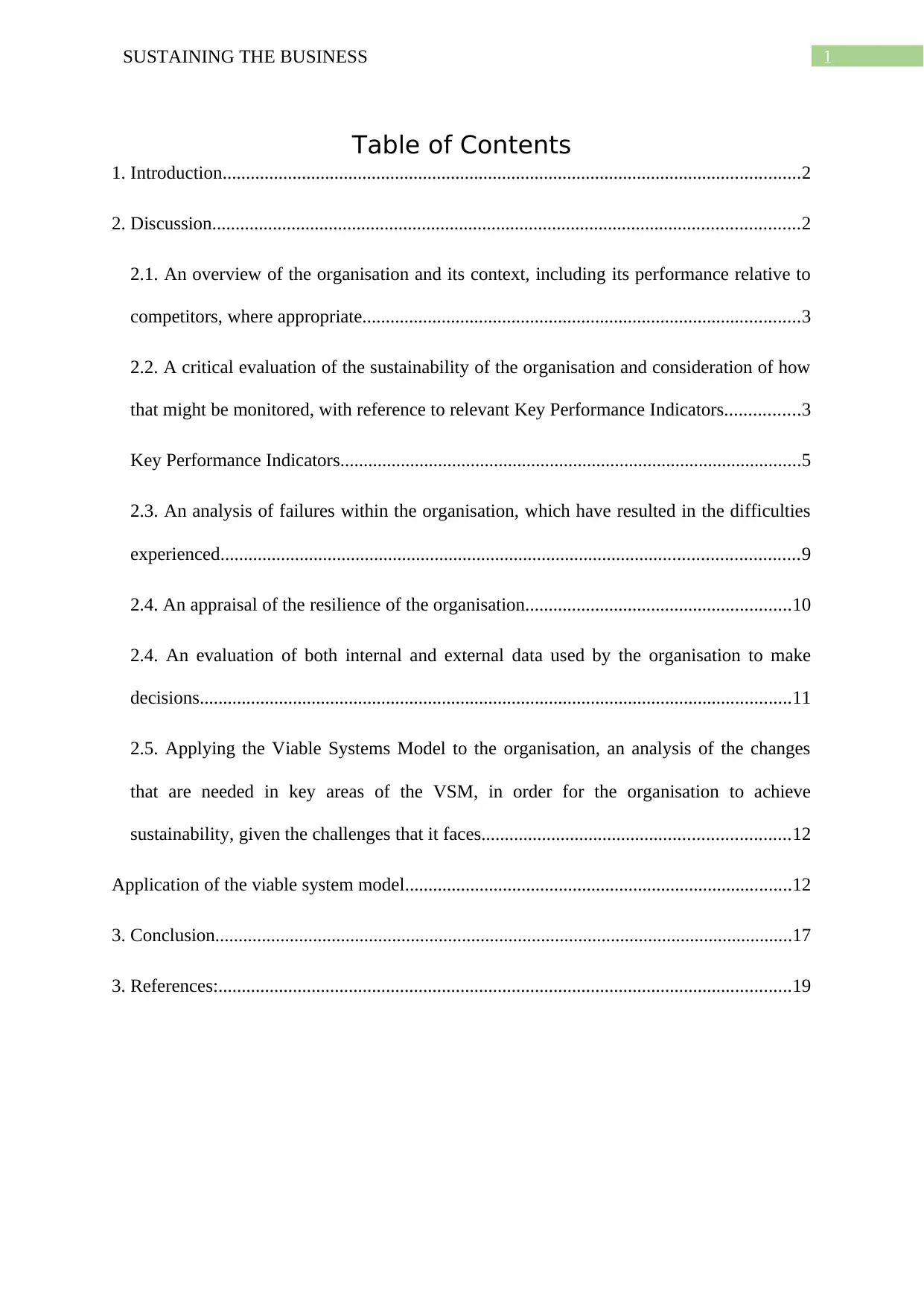
Table of Contents
1. Introduction............................................................................................................................2
2. Discussion..............................................................................................................................2
2.1. An overview of the organisation and its context, including its performance relative to
competitors, where appropriate..............................................................................................3
2.2. A critical evaluation of the sustainability of the organisation and consideration of how
that might be monitored, with reference to relevant Key Performance Indicators................3
Key Performance Indicators...................................................................................................5
2.3. An analysis of failures within the organisation, which have resulted in the difficulties
experienced............................................................................................................................9
2.4. An appraisal of the resilience of the organisation.........................................................10
2.4. An evaluation of both internal and external data used by the organisation to make
decisions...............................................................................................................................11
2.5. Applying the Viable Systems Model to the organisation, an analysis of the changes
that are needed in key areas of the VSM, in order for the organisation to achieve
sustainability, given the challenges that it faces..................................................................12
Application of the viable system model...................................................................................12
3. Conclusion............................................................................................................................17
3. References:...........................................................................................................................19
Table of Contents
1. Introduction............................................................................................................................2
2. Discussion..............................................................................................................................2
2.1. An overview of the organisation and its context, including its performance relative to
competitors, where appropriate..............................................................................................3
2.2. A critical evaluation of the sustainability of the organisation and consideration of how
that might be monitored, with reference to relevant Key Performance Indicators................3
Key Performance Indicators...................................................................................................5
2.3. An analysis of failures within the organisation, which have resulted in the difficulties
experienced............................................................................................................................9
2.4. An appraisal of the resilience of the organisation.........................................................10
2.4. An evaluation of both internal and external data used by the organisation to make
decisions...............................................................................................................................11
2.5. Applying the Viable Systems Model to the organisation, an analysis of the changes
that are needed in key areas of the VSM, in order for the organisation to achieve
sustainability, given the challenges that it faces..................................................................12
Application of the viable system model...................................................................................12
3. Conclusion............................................................................................................................17
3. References:...........................................................................................................................19
2SUSTAINING THE BUSINESS
1. Introduction
Every organisation seeks for growing its business, yet only few know the process of
sustaining for long term. Growing a business needs right intellectual capital, some significant
and effective strategic partnerships and services or products with a powerful marketplace
demand (Visnjic, Wiengarten and Neely 2015). Along with all these fundamentals, sustaining
growth and development needs a strong operational foundation for reducing the risks to the
business over the passage of time. Automobile industry is considered to be one of the most
significant and strategic industry in the sector of manufacturing. It is regarded as the largest
manufacturing organisation in the world and also, one of the most resource intensive sectors
of all the key industrial system (Poulikidou, Bjorklund and Tyskeng 2014). All its processes
and products are of notable source of environmental impact. This paper shall elaborate on
analysing an organisation that has recently faced some significant sustainability challenges.
The chosen organisation for this purpose is Jaguar Land Rover. At first, a brief overview of
the company shall be explained, including its performance related to competitors. Secondly, a
critical analysis of company’s sustainability and the consideration of how that might be
monitored using KPI shall be presented. Thirdly, this report shall elaborate on analysing the
challenges present within the company that have led to the issues that it have experienced.
With the same, appraisal of the organisational resilience and evaluation of both the external
and internal data that is used by the company for making decisions shall be provided in this
report. Lastly, by means of applying the Viable Systems Model (VSM) to the Jaguar Land
Rover, analysing changes, which are required in the important areas of the VSM, for the
organisation for achieving sustainability, provided the issues that it faces shall be presented.
2. Discussion
1. Introduction
Every organisation seeks for growing its business, yet only few know the process of
sustaining for long term. Growing a business needs right intellectual capital, some significant
and effective strategic partnerships and services or products with a powerful marketplace
demand (Visnjic, Wiengarten and Neely 2015). Along with all these fundamentals, sustaining
growth and development needs a strong operational foundation for reducing the risks to the
business over the passage of time. Automobile industry is considered to be one of the most
significant and strategic industry in the sector of manufacturing. It is regarded as the largest
manufacturing organisation in the world and also, one of the most resource intensive sectors
of all the key industrial system (Poulikidou, Bjorklund and Tyskeng 2014). All its processes
and products are of notable source of environmental impact. This paper shall elaborate on
analysing an organisation that has recently faced some significant sustainability challenges.
The chosen organisation for this purpose is Jaguar Land Rover. At first, a brief overview of
the company shall be explained, including its performance related to competitors. Secondly, a
critical analysis of company’s sustainability and the consideration of how that might be
monitored using KPI shall be presented. Thirdly, this report shall elaborate on analysing the
challenges present within the company that have led to the issues that it have experienced.
With the same, appraisal of the organisational resilience and evaluation of both the external
and internal data that is used by the company for making decisions shall be provided in this
report. Lastly, by means of applying the Viable Systems Model (VSM) to the Jaguar Land
Rover, analysing changes, which are required in the important areas of the VSM, for the
organisation for achieving sustainability, provided the issues that it faces shall be presented.
2. Discussion
⊘ This is a preview!⊘
Do you want full access?
Subscribe today to unlock all pages.

Trusted by 1+ million students worldwide
3SUSTAINING THE BUSINESS
2.1. An overview of the organisation and its context, including its performance relative
to competitors, where appropriate.
It is to note that Jaguar Land Rover Limited is a British multinational automobile firm
that has its headquarters in U.K, Whitley, Coventry and one of the subsidiary of Indian
Automotive Company known as Tata Motors (Mackie 2019). The company was founded in
the year 1982 by Dr Ralf Speth. It operates as an automobile company and produces,
develops, manufactures, designs and markets some high performing cars. It has a very strong
competition from the automobile companies like Aston Martin, Audi, Mercedes and Bently.
All these are the key players in the market and they all have same target audience. It is to note
that the company is experiencing a significant increase in their sales for 11 months now and
this depicts a strong brand image that they have gained in the market after acquisition that
Tata Motors have made. However, very recently in the year 2018, the company made a
biggest loss in its history (Meyer 2015). It sank with 3.6 billion Euros into red as it compete
with the weak Chinese market, falling the sales of diesel along with a one-off downward
revision to the value of its business. Like some of its competitors in the automobile market,
the company has also faced a strong impact of fall of diesel sales among the different
scandals of global pollution and this is uncertainty in terms of the Brexit. Jaguar Land Rover
Limited announced plans for cutting 4,500 staffs the same year and said its plans of
efficiency had already provided about 1.25 billion Euros of savings (Aliberti and Lisitsyna
2019). However, the company is going to take some concerted action for reducing
complexity and for transforming the business through cash flow and cost improvements.
Also, like many key automotive firms to have issued grave warnings regarding the significant
effect of Brexit on its United Kingdom business, especially in the no-deal scenarios.
2.2. A critical evaluation of the sustainability of the organisation and consideration of
how that might be monitored, with reference to relevant Key Performance Indicators.
2.1. An overview of the organisation and its context, including its performance relative
to competitors, where appropriate.
It is to note that Jaguar Land Rover Limited is a British multinational automobile firm
that has its headquarters in U.K, Whitley, Coventry and one of the subsidiary of Indian
Automotive Company known as Tata Motors (Mackie 2019). The company was founded in
the year 1982 by Dr Ralf Speth. It operates as an automobile company and produces,
develops, manufactures, designs and markets some high performing cars. It has a very strong
competition from the automobile companies like Aston Martin, Audi, Mercedes and Bently.
All these are the key players in the market and they all have same target audience. It is to note
that the company is experiencing a significant increase in their sales for 11 months now and
this depicts a strong brand image that they have gained in the market after acquisition that
Tata Motors have made. However, very recently in the year 2018, the company made a
biggest loss in its history (Meyer 2015). It sank with 3.6 billion Euros into red as it compete
with the weak Chinese market, falling the sales of diesel along with a one-off downward
revision to the value of its business. Like some of its competitors in the automobile market,
the company has also faced a strong impact of fall of diesel sales among the different
scandals of global pollution and this is uncertainty in terms of the Brexit. Jaguar Land Rover
Limited announced plans for cutting 4,500 staffs the same year and said its plans of
efficiency had already provided about 1.25 billion Euros of savings (Aliberti and Lisitsyna
2019). However, the company is going to take some concerted action for reducing
complexity and for transforming the business through cash flow and cost improvements.
Also, like many key automotive firms to have issued grave warnings regarding the significant
effect of Brexit on its United Kingdom business, especially in the no-deal scenarios.
2.2. A critical evaluation of the sustainability of the organisation and consideration of
how that might be monitored, with reference to relevant Key Performance Indicators.
Paraphrase This Document
Need a fresh take? Get an instant paraphrase of this document with our AI Paraphraser
4SUSTAINING THE BUSINESS
The issue of sustainability is increasingly becoming one of the major issues among
the companies all around the world. It is to mention that in the year 1998, Jaguar Land Rover
(JLR) is considered to be one of the first firms to be certified of the global environmental
management standards, ISO14001 (Husain 2014). After then, the company have continuously
taken initiative for increasing its attention in the issue sustainability and at present, it is highly
considered as a strategic imperative. Furthermore, in the year 2003, the company first
introduced its policy of sustainable development and measured its progress against the
important targets of environment since then. In the year 2006, the company launched its CO2
offset programme and again, in 2007, for further embedding sustainability that they
introduced a long lasting strategy of sustainability along with the assistance of Forum for the
future and the sustainability champions over the different business (Negacz 2014). Again in
the year 2008, the company formed a board-level sustainability for increasing the focus on
the different sustainability initiatives. In the year 2009, first vehicle life cycle assessment
certification was introduced and environmental innovation strategy along with several targets
were launched all over the business of Jaguar Land Rover. Again, in 2010, Freelander 2 had
launched with the Start and Stop technology, while improving the fuel economy while
reducing the tailpipe emissions of CO2. The company also received its first environmental
innovation awards for engaging the employees in the process of sustainability. The first ever
premium plug in Hybrid was launched in the year 2011. It also launched a “4-cylinder Diesel
Jaguar XF” with the start and stop technology. It also launched the lightest and smallest
model of Range Rover called “The Evoque”.
All these initiatives were driven by the passion of David Smith, the CEO of the
company, and his introduction of the structure of corporate governance. Due to this,
environmental innovation is considered to be the three core strategic pillars. The company
always made sure that their policy is all integrated into the process corporate decision making
The issue of sustainability is increasingly becoming one of the major issues among
the companies all around the world. It is to mention that in the year 1998, Jaguar Land Rover
(JLR) is considered to be one of the first firms to be certified of the global environmental
management standards, ISO14001 (Husain 2014). After then, the company have continuously
taken initiative for increasing its attention in the issue sustainability and at present, it is highly
considered as a strategic imperative. Furthermore, in the year 2003, the company first
introduced its policy of sustainable development and measured its progress against the
important targets of environment since then. In the year 2006, the company launched its CO2
offset programme and again, in 2007, for further embedding sustainability that they
introduced a long lasting strategy of sustainability along with the assistance of Forum for the
future and the sustainability champions over the different business (Negacz 2014). Again in
the year 2008, the company formed a board-level sustainability for increasing the focus on
the different sustainability initiatives. In the year 2009, first vehicle life cycle assessment
certification was introduced and environmental innovation strategy along with several targets
were launched all over the business of Jaguar Land Rover. Again, in 2010, Freelander 2 had
launched with the Start and Stop technology, while improving the fuel economy while
reducing the tailpipe emissions of CO2. The company also received its first environmental
innovation awards for engaging the employees in the process of sustainability. The first ever
premium plug in Hybrid was launched in the year 2011. It also launched a “4-cylinder Diesel
Jaguar XF” with the start and stop technology. It also launched the lightest and smallest
model of Range Rover called “The Evoque”.
All these initiatives were driven by the passion of David Smith, the CEO of the
company, and his introduction of the structure of corporate governance. Due to this,
environmental innovation is considered to be the three core strategic pillars. The company
always made sure that their policy is all integrated into the process corporate decision making
5SUSTAINING THE BUSINESS
of the company by means of comprising of some sustainable development into all their
corporate business plans and hence, in this way, they elevate their status to the same level as
the other imperatives. This is why, all the business functions of the company have some
collection of sustainability target that they are required to be working towards. The company
considers finance professionals are at the heart of the process of business planning, the
process of target setting and also in the performance measuring and reporting activities that
further helped the company to ensure that it is progressing towards meeting its sustainability
target. Furthermore, according to Jacobs (2017), the JLR has invested about 800 million
Euros over five years in the development and introduction of new technologies for improving
the environmental performance of its vehicles. One of the best example of the outcome of this
strategy is the new Jaguar XJ. This vehicle has benefitted from the investment in numerous
technologies and this has resulted in the reduction of energy use in the design, distribution
and manufacturing of the vehicle. With the same, it also makes the usage of lightweight
recyclable materials along with a new variety of more fuel efficient and high performing
engines.
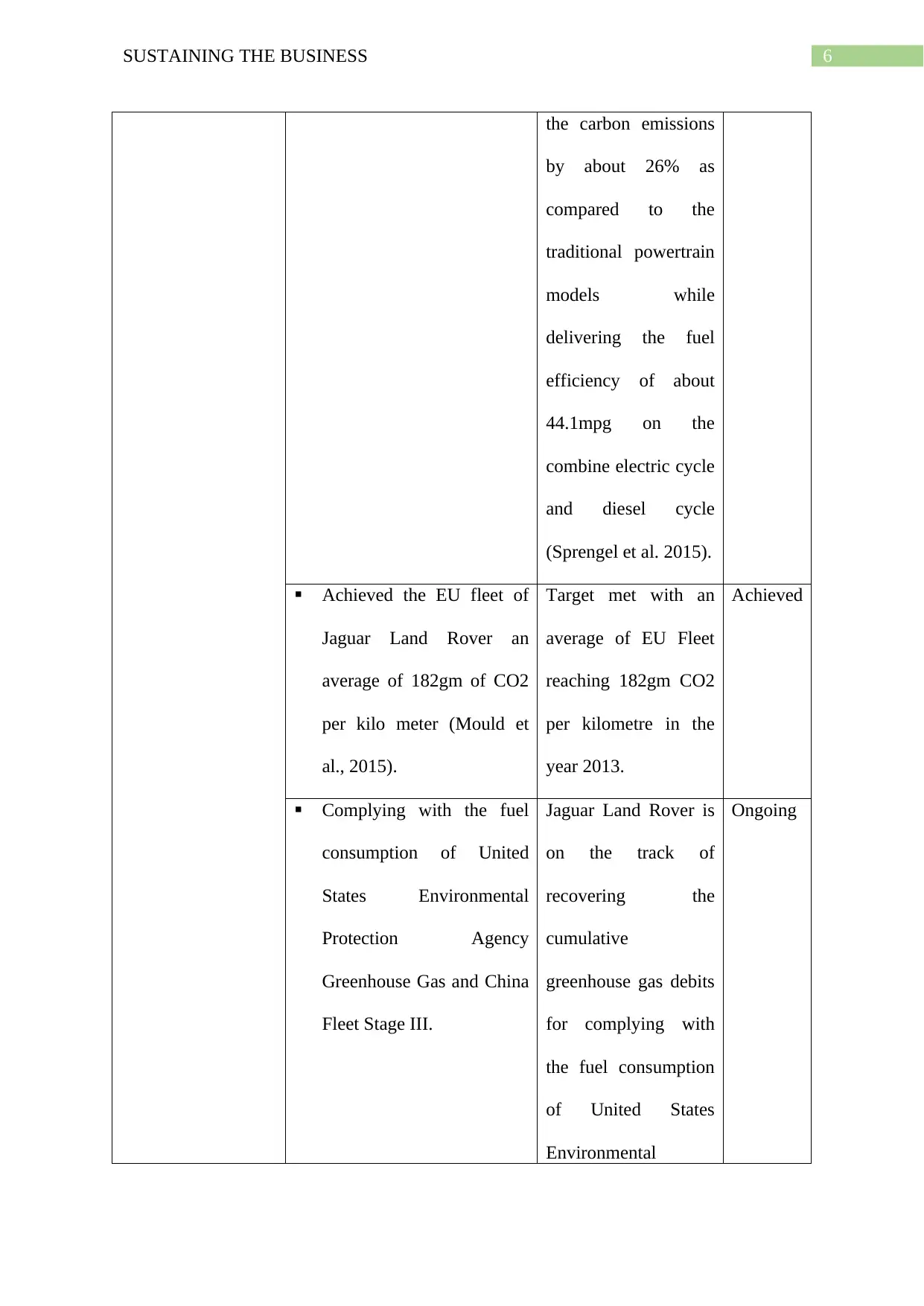
Key Performance Indicators
Priority Factors Targets for 2019/20 2019 Results Status
Innovating for
delivering
competitive tailpipe
carbon emissions
and fuel economy
Launched the first
production hybrid for the
European market.
Range Rover Sport
Hybrid and Range
Rover Hybrid, the
first ever premium
diesel SUV hybrids in
the world have been
launched by the
company that reduced
Achieved
of the company by means of comprising of some sustainable development into all their
corporate business plans and hence, in this way, they elevate their status to the same level as
the other imperatives. This is why, all the business functions of the company have some
collection of sustainability target that they are required to be working towards. The company
considers finance professionals are at the heart of the process of business planning, the
process of target setting and also in the performance measuring and reporting activities that
further helped the company to ensure that it is progressing towards meeting its sustainability
target. Furthermore, according to Jacobs (2017), the JLR has invested about 800 million
Euros over five years in the development and introduction of new technologies for improving
the environmental performance of its vehicles. One of the best example of the outcome of this
strategy is the new Jaguar XJ. This vehicle has benefitted from the investment in numerous
technologies and this has resulted in the reduction of energy use in the design, distribution
and manufacturing of the vehicle. With the same, it also makes the usage of lightweight
recyclable materials along with a new variety of more fuel efficient and high performing
engines.
Key Performance Indicators
Priority Factors Targets for 2019/20 2019 Results Status
Innovating for
delivering
competitive tailpipe
carbon emissions
and fuel economy
Launched the first
production hybrid for the
European market.
Range Rover Sport
Hybrid and Range
Rover Hybrid, the
first ever premium
diesel SUV hybrids in
the world have been
launched by the
company that reduced
Achieved
⊘ This is a preview!⊘
Do you want full access?
Subscribe today to unlock all pages.
Trusted by 1+ million students worldwide
6SUSTAINING THE BUSINESS
the carbon emissions
by about 26% as
compared to the
traditional powertrain
models while
delivering the fuel
efficiency of about
44.1mpg on the
combine electric cycle
and diesel cycle
(Sprengel et al. 2015).
Achieved the EU fleet of
Jaguar Land Rover an
average of 182gm of CO2
per kilo meter (Mould et
al., 2015).
Target met with an
average of EU Fleet
reaching 182gm CO2
per kilometre in the
year 2013.
Achieved
Complying with the fuel
consumption of United
States Environmental
Protection Agency
Greenhouse Gas and China
Fleet Stage III.
Jaguar Land Rover is
on the track of
recovering the
cumulative
greenhouse gas debits
for complying with
the fuel consumption
of United States
Environmental
Ongoing
the carbon emissions
by about 26% as
compared to the
traditional powertrain
models while
delivering the fuel
efficiency of about
44.1mpg on the
combine electric cycle
and diesel cycle
(Sprengel et al. 2015).
Achieved the EU fleet of
Jaguar Land Rover an
average of 182gm of CO2
per kilo meter (Mould et
al., 2015).
Target met with an
average of EU Fleet
reaching 182gm CO2
per kilometre in the
year 2013.
Achieved
Complying with the fuel
consumption of United
States Environmental
Protection Agency
Greenhouse Gas and China
Fleet Stage III.
Jaguar Land Rover is
on the track of
recovering the
cumulative
greenhouse gas debits
for complying with
the fuel consumption
of United States
Environmental
Ongoing
Paraphrase This Document
Need a fresh take? Get an instant paraphrase of this document with our AI Paraphraser

7SUSTAINING THE BUSINESS
Protection Agency
Greenhouse Gas and
China Fleet Stage III.
Reduction in the
impacts of products
over the life cycle
Data driven sustainable
solutions and life cycle
methodologies are embedded
over the supply chain of the
business
New processes are
established by means
of face-to-face
meetings for
improving the
dialogue and
information sharing
with the suppliers and
they are supported in
providing right data
using the agreed
standards and
frameworks.
Ongoing
The total environmental
impacts over the life cycle is
30 percent lower as compared
to the year 2007.
Life cycle carbon
dioxide impacts are
simulated by the
company at the
beginning of the
process of vehicle
development for all
the vehicle models
Information are
Partially
achieved.
Protection Agency
Greenhouse Gas and
China Fleet Stage III.
Reduction in the
impacts of products
over the life cycle
Data driven sustainable
solutions and life cycle
methodologies are embedded
over the supply chain of the
business
New processes are
established by means
of face-to-face
meetings for
improving the
dialogue and
information sharing
with the suppliers and
they are supported in
providing right data
using the agreed
standards and
frameworks.
Ongoing
The total environmental
impacts over the life cycle is
30 percent lower as compared
to the year 2007.
Life cycle carbon
dioxide impacts are
simulated by the
company at the
beginning of the
process of vehicle
development for all
the vehicle models
Information are
Partially
achieved.
8SUSTAINING THE BUSINESS
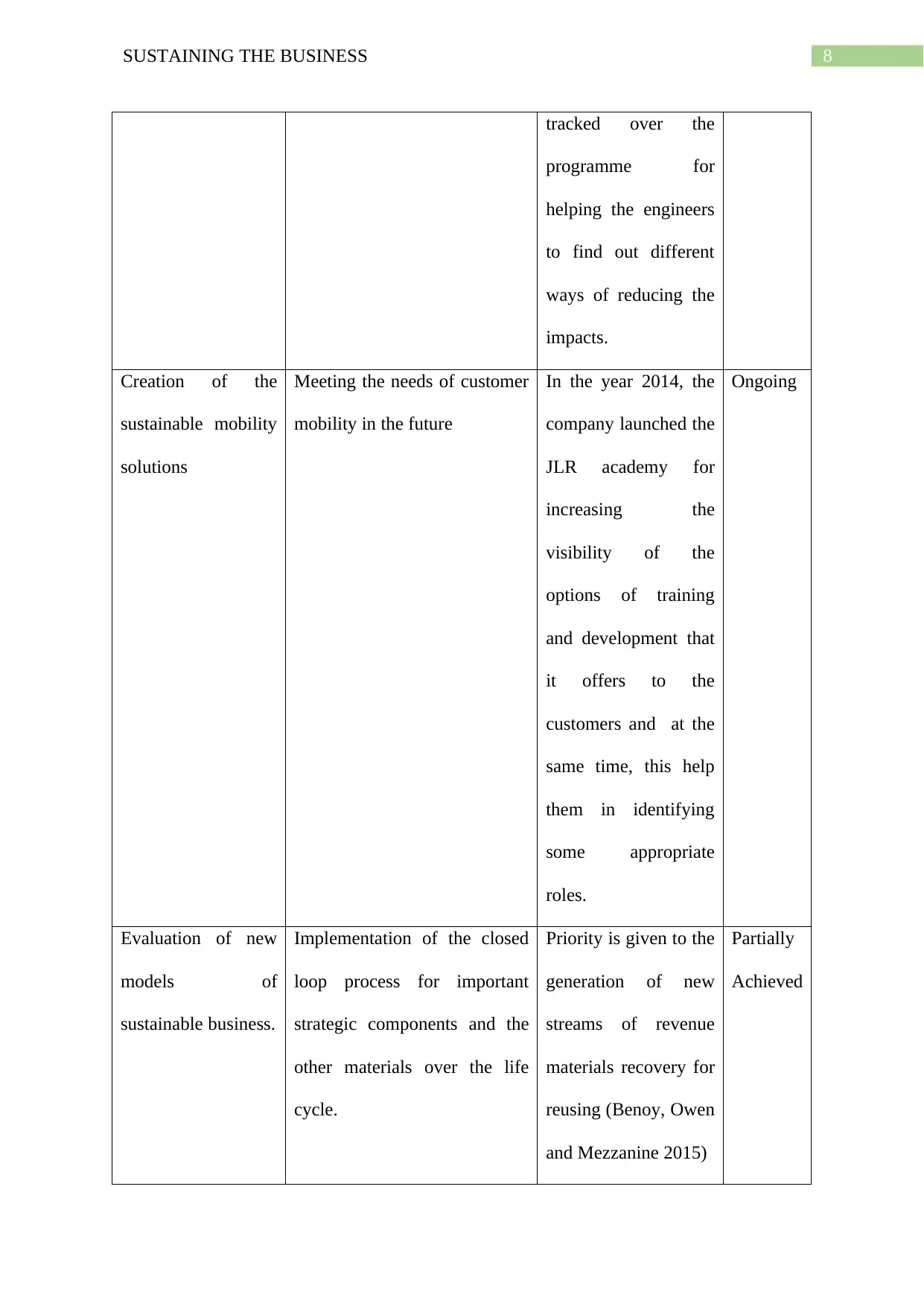
tracked over the
programme for
helping the engineers
to find out different
ways of reducing the
impacts.
Creation of the
sustainable mobility
solutions
Meeting the needs of customer
mobility in the future
In the year 2014, the
company launched the
JLR academy for
increasing the
visibility of the
options of training
and development that
it offers to the
customers and at the
same time, this help
them in identifying
some appropriate
roles.
Ongoing
Evaluation of new
models of
sustainable business.
Implementation of the closed
loop process for important
strategic components and the
other materials over the life
cycle.
Priority is given to the
generation of new
streams of revenue
materials recovery for
reusing (Benoy, Owen
and Mezzanine 2015)
Partially
Achieved
tracked over the
programme for
helping the engineers
to find out different
ways of reducing the
impacts.
Creation of the
sustainable mobility
solutions
Meeting the needs of customer
mobility in the future
In the year 2014, the
company launched the
JLR academy for
increasing the
visibility of the
options of training
and development that
it offers to the
customers and at the
same time, this help
them in identifying
some appropriate
roles.
Ongoing
Evaluation of new
models of
sustainable business.
Implementation of the closed
loop process for important
strategic components and the
other materials over the life
cycle.
Priority is given to the
generation of new
streams of revenue
materials recovery for
reusing (Benoy, Owen
and Mezzanine 2015)
Partially
Achieved
⊘ This is a preview!⊘
Do you want full access?
Subscribe today to unlock all pages.
Trusted by 1+ million students worldwide
9SUSTAINING THE BUSINESS
2.3. An analysis of failures within the organisation, which have resulted in the
difficulties experienced
Jaguar Land Rover has been considered to be an industry success story since Tata
Motors bought its struggling Land Rover SUC and the Jaguar sports sedan brands from the
Ford Motors in the year 2008. Since then, it was struggling and facing issue of near
bankruptcy. Very recently in the year 2018, the company made a great loss in its history. It
sank with 3.6 billion Euros into red as it fought with weak Chinese market, decreasing the
sales of diesel and a one-off downward revision to the business value (BBC News, 2018).
Like some of its competitors in the automobile market, the company has also faced a strong
impact of fall of diesel sales among the successive global pollution scandals and this is
uncertainty in relation to the Brexit. . As per Peternoster et al. (2014), there are several factors
that have led to the problems experienced by the company in recent years. The very first is
that of the China Crisis. Furthermore, the analysts at the time of the second quarter results of
Jaguar call in November that China has driven a strong deterioration in profits and it is the
single biggest challenge ever. Sales of company slumped to 44% in China at that time and it
is the collapse that Ken Gregor (JLR Chief Financial officer) blamed on the falling of
consumer confidence and then, import a tariff changes. As a response, the company
significantly cut the production for reducing the resulting to increase of the unsold cars in UK
and in its plat in Changshu. The downgrade of China to the fourth largest global market of
JLR on the basis of its ten months figures has made an end of the nation being the cash
machine of JLR. Furthermore, the second reason behind this loss of the company is of excess
capacity in the expansion of production network of the company. Chinese downturn was
coinciding with the starting of the new factory of JLR in Slovakia, the expansion of Chinese
plant, production start for the E-Pace SUC of Jaguar and the full-electric I-Pace that are being
2.3. An analysis of failures within the organisation, which have resulted in the
difficulties experienced
Jaguar Land Rover has been considered to be an industry success story since Tata
Motors bought its struggling Land Rover SUC and the Jaguar sports sedan brands from the
Ford Motors in the year 2008. Since then, it was struggling and facing issue of near
bankruptcy. Very recently in the year 2018, the company made a great loss in its history. It
sank with 3.6 billion Euros into red as it fought with weak Chinese market, decreasing the
sales of diesel and a one-off downward revision to the business value (BBC News, 2018).
Like some of its competitors in the automobile market, the company has also faced a strong
impact of fall of diesel sales among the successive global pollution scandals and this is
uncertainty in relation to the Brexit. . As per Peternoster et al. (2014), there are several factors
that have led to the problems experienced by the company in recent years. The very first is
that of the China Crisis. Furthermore, the analysts at the time of the second quarter results of
Jaguar call in November that China has driven a strong deterioration in profits and it is the
single biggest challenge ever. Sales of company slumped to 44% in China at that time and it
is the collapse that Ken Gregor (JLR Chief Financial officer) blamed on the falling of
consumer confidence and then, import a tariff changes. As a response, the company
significantly cut the production for reducing the resulting to increase of the unsold cars in UK
and in its plat in Changshu. The downgrade of China to the fourth largest global market of
JLR on the basis of its ten months figures has made an end of the nation being the cash
machine of JLR. Furthermore, the second reason behind this loss of the company is of excess
capacity in the expansion of production network of the company. Chinese downturn was
coinciding with the starting of the new factory of JLR in Slovakia, the expansion of Chinese
plant, production start for the E-Pace SUC of Jaguar and the full-electric I-Pace that are being
Paraphrase This Document
Need a fresh take? Get an instant paraphrase of this document with our AI Paraphraser
10SUSTAINING THE BUSINESS
made by Magna Steyr in Austria. Furthermore, the third factor in this regard is that of Jaguar
Falters. The company weighed on the success of Land Rover while Ford owned both the
brands and troubles of the company look to have returned.
Furthermore, apart from these, there are several other challenges that Jaguar Land
Rover is trying to overcome are in terms of Brexit, the tariffs of United States, quality and
diesel. The exit of Britain from the Europe trading bloc at the ending of the month of March
can cause all types of products for Jaguar Land Rover in terms of tariffs and border friction,
on the basis of the type of deal that is negotiated. Poor deal can wipe around a billion pounds
from the profits of Jaguar Land Rover. However, one of the good manufacturing decision that
the company made was locating a joint-venture plant in Slovakia as this gave a significant
JLR presence in European countries after United Kingdom leaves Europe. The other factor is
that of U.S tariffs. It is to mention that President Donald Trump has threatened the tariffs on
the cars from the European countries. According to Hutchins (2018), Jaguar Land Rover is a
“significantly exposed” firm. The biggest sales market of Jaguar Land Rover was North
America and that even beaten up United Kingdom and Europe.
2.4. An appraisal of the resilience of the organisation.
It is to note that Jaguar Land Rover is making expansion of a business wide
organisation review that is aimed towards reducing the size of the global workforce by 4500
people. The company is taking some decisive actions for delivering long term development
and growth in the face of different regulatory and geopolitical disruptions along with the
different technology challenges that are facing by the automotive industry. The programme
called “Charge and Accelerate” combines the efficiency related measures with the targeted or
aimed investment and this further safeguard the future of the company while ensuring that it
is maximising the opportunities that are created by the increasing demands for Electric,
made by Magna Steyr in Austria. Furthermore, the third factor in this regard is that of Jaguar
Falters. The company weighed on the success of Land Rover while Ford owned both the
brands and troubles of the company look to have returned.
Furthermore, apart from these, there are several other challenges that Jaguar Land
Rover is trying to overcome are in terms of Brexit, the tariffs of United States, quality and
diesel. The exit of Britain from the Europe trading bloc at the ending of the month of March
can cause all types of products for Jaguar Land Rover in terms of tariffs and border friction,
on the basis of the type of deal that is negotiated. Poor deal can wipe around a billion pounds
from the profits of Jaguar Land Rover. However, one of the good manufacturing decision that
the company made was locating a joint-venture plant in Slovakia as this gave a significant
JLR presence in European countries after United Kingdom leaves Europe. The other factor is
that of U.S tariffs. It is to mention that President Donald Trump has threatened the tariffs on
the cars from the European countries. According to Hutchins (2018), Jaguar Land Rover is a
“significantly exposed” firm. The biggest sales market of Jaguar Land Rover was North
America and that even beaten up United Kingdom and Europe.
2.4. An appraisal of the resilience of the organisation.
It is to note that Jaguar Land Rover is making expansion of a business wide
organisation review that is aimed towards reducing the size of the global workforce by 4500
people. The company is taking some decisive actions for delivering long term development
and growth in the face of different regulatory and geopolitical disruptions along with the
different technology challenges that are facing by the automotive industry. The programme
called “Charge and Accelerate” combines the efficiency related measures with the targeted or
aimed investment and this further safeguard the future of the company while ensuring that it
is maximising the opportunities that are created by the increasing demands for Electric,
11SUSTAINING THE BUSINESS
Autonomous, Shared and Connected technologies (Ozdilek 2017). One of the main
sustainable objectives of the company is building resilience to both the physical climate and
legislative change impacts. It is targeted to review the risks of climate change over all the
facilities of the company and thereafter, developing an adaptation and mitigation plan
(Visnjic, Wiengarten and Neely 2015). The company has already developed a mitigation plan
in the year 2014 on the basis of their review of risks associated with climate change. The
company also maintains a sustainable resilient supply chain in every fields where it operates
and along with this, all the tiers of one suppliers are expected to be ISO 14001 certified and
equivalent. The company upholds the highest social and environmental standards as it is
identified in the Supplier Sustainability Guide of the company and this further helps in
making it clear to all the Tier 1 suppliers in the company guidelines. According to the annual
report of 2018-19 of the company, “the ultimate goal of risk management in Jaguar Land
Rover is to continually assess the control environment to prevent and build resilience against
any internal or external uncertainties, both anticipated and unforeseen” (Tatamotors.com
2019) Effectively managing the changing operation environment and becoming resilient to
the sudden and unforeseen challenges actually help the company in supporting the long-term
sustainability of the company and ensure a long term profitable and healthy growth in the
market.
2.4. An evaluation of both internal and external data used by the organisation to make
decisions.
Internal Data
Employee feedback- Through taking employee feedbacks on a particular issue and
gaining some valuable constructive suggestions from their parts, Jaguar Land Rover easily
Autonomous, Shared and Connected technologies (Ozdilek 2017). One of the main
sustainable objectives of the company is building resilience to both the physical climate and
legislative change impacts. It is targeted to review the risks of climate change over all the
facilities of the company and thereafter, developing an adaptation and mitigation plan
(Visnjic, Wiengarten and Neely 2015). The company has already developed a mitigation plan
in the year 2014 on the basis of their review of risks associated with climate change. The
company also maintains a sustainable resilient supply chain in every fields where it operates
and along with this, all the tiers of one suppliers are expected to be ISO 14001 certified and
equivalent. The company upholds the highest social and environmental standards as it is
identified in the Supplier Sustainability Guide of the company and this further helps in
making it clear to all the Tier 1 suppliers in the company guidelines. According to the annual
report of 2018-19 of the company, “the ultimate goal of risk management in Jaguar Land
Rover is to continually assess the control environment to prevent and build resilience against
any internal or external uncertainties, both anticipated and unforeseen” (Tatamotors.com
2019) Effectively managing the changing operation environment and becoming resilient to
the sudden and unforeseen challenges actually help the company in supporting the long-term
sustainability of the company and ensure a long term profitable and healthy growth in the
market.
2.4. An evaluation of both internal and external data used by the organisation to make
decisions.
Internal Data
Employee feedback- Through taking employee feedbacks on a particular issue and
gaining some valuable constructive suggestions from their parts, Jaguar Land Rover easily
⊘ This is a preview!⊘
Do you want full access?
Subscribe today to unlock all pages.
Trusted by 1+ million students worldwide

1 out of 22


Related Documents


Your All-in-One AI-Powered Toolkit for Academic Success.
+13062052269
info@desklib.com
Available 24*7 on WhatsApp / Email
![[object Object]](/_next/static/media/star-bottom.7253800d.svg)
Unlock your academic potential
Copyright © 2020–2026 A2Z Services. All Rights Reserved. Developed and managed by ZUCOL.