Business and the Business Environment Report: JP Morgan Finance
VerifiedAdded on 2020/10/05
|18
|4992
|200
Report
AI Summary
This report provides a comprehensive analysis of the business environment, focusing on JP Morgan Finance and Investment. It begins with an introduction to the business environment and its impact on organizations. The report then delves into different types, sizes, and scopes of organizations, including sole traders, partnerships, limited companies, and public limited companies. Furthermore, it explores various organizational structures and functions. The report also examines macro-environmental factors using PESTLE analysis and conducts a SWOT analysis of JP Morgan Finance and Investment to evaluate its internal strengths, weaknesses, and external opportunities and threats. The report concludes with a summary of the key findings and a list of references.

Business and the Business
Environment
Environment

Paraphrase This Document
Need a fresh take? Get an instant paraphrase of this document with our AI Paraphraser
Table of Contents
INTRODUCTION...........................................................................................................................1
TASK 1............................................................................................................................................1
Organisation and its various types..........................................................................................1
Different types, size and scope of organisation......................................................................2
TASK 2............................................................................................................................................7
Organisation structure............................................................................................................7
Different organisational function...........................................................................................9
TASK 3..........................................................................................................................................10
Macro environmental factors by mentioning PESTLE analysis..........................................10
TASK 4..........................................................................................................................................12
SWOT Analysis of JP Morgan Finance and Investment......................................................12
CONCLUSION..............................................................................................................................14
REFERENCES..............................................................................................................................15
INTRODUCTION...........................................................................................................................1
TASK 1............................................................................................................................................1
Organisation and its various types..........................................................................................1
Different types, size and scope of organisation......................................................................2
TASK 2............................................................................................................................................7
Organisation structure............................................................................................................7
Different organisational function...........................................................................................9
TASK 3..........................................................................................................................................10
Macro environmental factors by mentioning PESTLE analysis..........................................10
TASK 4..........................................................................................................................................12
SWOT Analysis of JP Morgan Finance and Investment......................................................12
CONCLUSION..............................................................................................................................14
REFERENCES..............................................................................................................................15
INTRODUCTION
All internal and external factors that can affect or influence the organisational
environmental condition in a positive or negative manner come under business environment.
Every business can be established easily but it needs various types of resources, finance, proper
market conditions etc. (Bah and Fang, 2015). This report is based on JP Morgan Finance and
Investment company that has around 4400 offices across the world. The firm is of the leading
investment companies in UK. This report will cover different types, sizes and scope of
organisations. It will also cover two types of organisation's structures. Further, it will cover the
positive and negative impact of macro environment. Lastly, it will include the internal strengths
and weaknesses of JP Morgan Finance and Investment.
TASK 1
Organisation and its various types.
Organisation consists several people in a structured form and operate or run any business
activities with earning money for fulfilment various objectives and targets. It is created by person
or group of individuals which carry any business and make it a structured body (Botha, Kourie
and Snyman, 2014). They are managed and controlled by the board of directors so that their roles
and all responsibilities divides in the managers and leaders so that they can perform better in
their job.
All organisations establish or exist for a special purpose that have a strong sense in the
target market. Management team needs to fulfil the purpose so that they make a clear vision &
mission and do their business effectively. Every company has different kinds of purposes, goals
and objectives. In this context, it provides clothes, shelter, food, education, entertainment,
transport and many other requirements to their potential clients in the competitive environment.
All those organisations exist because earning money or profits through providing various
products and services (Bryman and Bell, 2015). They must require different types of resources
and funds to accomplish its all organisational activities.
All internal and external factors that can affect or influence the organisational
environmental condition in a positive or negative manner come under business environment.
Every business can be established easily but it needs various types of resources, finance, proper
market conditions etc. (Bah and Fang, 2015). This report is based on JP Morgan Finance and
Investment company that has around 4400 offices across the world. The firm is of the leading
investment companies in UK. This report will cover different types, sizes and scope of
organisations. It will also cover two types of organisation's structures. Further, it will cover the
positive and negative impact of macro environment. Lastly, it will include the internal strengths
and weaknesses of JP Morgan Finance and Investment.
TASK 1
Organisation and its various types.
Organisation consists several people in a structured form and operate or run any business
activities with earning money for fulfilment various objectives and targets. It is created by person
or group of individuals which carry any business and make it a structured body (Botha, Kourie
and Snyman, 2014). They are managed and controlled by the board of directors so that their roles
and all responsibilities divides in the managers and leaders so that they can perform better in
their job.
All organisations establish or exist for a special purpose that have a strong sense in the
target market. Management team needs to fulfil the purpose so that they make a clear vision &
mission and do their business effectively. Every company has different kinds of purposes, goals
and objectives. In this context, it provides clothes, shelter, food, education, entertainment,
transport and many other requirements to their potential clients in the competitive environment.
All those organisations exist because earning money or profits through providing various
products and services (Bryman and Bell, 2015). They must require different types of resources
and funds to accomplish its all organisational activities.
⊘ This is a preview!⊘
Do you want full access?
Subscribe today to unlock all pages.

Trusted by 1+ million students worldwide
In the United Kingdom, there are many types of sectors exist i.e. tertiary, primary and
secondary. These are described as follows:
Primary Sector – It is concerned through the extraction of raw materials for developing
many other products and it contains farming business, mining, forestry & logging, oil
extraction, diamond mining, fishing and many more fields (Business, 2014). It plays a
great part in economy and increased labour productivity that enables to workers to work
better.
Secondary Sector – It is known as the systematic process of transformation of raw
materials in its goods and services. It includes production, manufacturing and industry of
various sectors. The secondary sector often classifies into the light & heavy industry and
it forms a substantial part of gross domestic products. In this sector, certain types of
organisations exist for example, electrical, chemical, metallurgical, energy (according to
some sources, it is on the border of the tertiary sector), construction, food, textile &
clothing, consumer goods, glass and many more. Products and services that are produced
in such type of organisations are sold directly to the end consumers.
Tertiary Sector – It refers to those industries which provide intangible goods like
insurance, retail, travelling, tourism, banking, entertainment, financing, etc. These
organisations use manufactured goods as the raw material and offer many services to
customers (Carroll and Buchholtz, 2014). In the tertiary sector, it includes such type of
organisations computer & information technology, hotels & tourism, communication
service, insurance service, banking service, postal service, restaurants & cafes, pension
service, food & beverage service and transport services like – rail, bus, air, sea etc.
Different types, size and scope of organisation.
Organisations has different types and it owns and control by several types of persons or
groups. It may be owned and run by private and public or by both sector and it is also known as
mix ownership. In this context, different types of organisations are discussed as below:
Sole trader – It is a special type of business that is also known as proprietorship. It has a general
structure that an individual operates the whole organisational work. In this context, in such
businesses only trader is responsible for all dues such as financially as personally (Chang, 2016).
2
secondary. These are described as follows:
Primary Sector – It is concerned through the extraction of raw materials for developing
many other products and it contains farming business, mining, forestry & logging, oil
extraction, diamond mining, fishing and many more fields (Business, 2014). It plays a
great part in economy and increased labour productivity that enables to workers to work
better.
Secondary Sector – It is known as the systematic process of transformation of raw
materials in its goods and services. It includes production, manufacturing and industry of
various sectors. The secondary sector often classifies into the light & heavy industry and
it forms a substantial part of gross domestic products. In this sector, certain types of
organisations exist for example, electrical, chemical, metallurgical, energy (according to
some sources, it is on the border of the tertiary sector), construction, food, textile &
clothing, consumer goods, glass and many more. Products and services that are produced
in such type of organisations are sold directly to the end consumers.
Tertiary Sector – It refers to those industries which provide intangible goods like
insurance, retail, travelling, tourism, banking, entertainment, financing, etc. These
organisations use manufactured goods as the raw material and offer many services to
customers (Carroll and Buchholtz, 2014). In the tertiary sector, it includes such type of
organisations computer & information technology, hotels & tourism, communication
service, insurance service, banking service, postal service, restaurants & cafes, pension
service, food & beverage service and transport services like – rail, bus, air, sea etc.
Different types, size and scope of organisation.
Organisations has different types and it owns and control by several types of persons or
groups. It may be owned and run by private and public or by both sector and it is also known as
mix ownership. In this context, different types of organisations are discussed as below:
Sole trader – It is a special type of business that is also known as proprietorship. It has a general
structure that an individual operates the whole organisational work. In this context, in such
businesses only trader is responsible for all dues such as financially as personally (Chang, 2016).
2
Paraphrase This Document
Need a fresh take? Get an instant paraphrase of this document with our AI Paraphraser
He or she will keep record for all transactions, for example, revenue and expenses. In this
context, its major advantages and disadvantages are as follows:
Merits
The sole trader is boss who keeps all earnings or profits.
Sole trader business offers more personal services with local ties and roots so that it can
achieve requirements of its potential clients.
There is no need of recording and keeping any annual accounts so that it has no further
expenses (Charter, 2017).
Its businesses are started with low cost and maximum privacy in data keeping and it also
winds up the organisation easily.
Demerits
In these businesses, there are all liability and responsibility of debt and creditors are lay
down on that particular owner.
It is complicated to expand the business due to huge requirements of resources and
finance.
It has a small size so; sole trader cannot leverage buying power of its customers.
In these businesses, the owner has difficult to take holidays and complete income is taxed
under law.
It has limited business life.
Partnership – It is referring as to any business entity, that are run or operates by two or more
persons and they fix a ratio for profits and losses, is called partnership. It is a special type of
organisation and its business activities are dependent on the partnership deed, which is made by
all the partners and they also give their signature on it (Erasmus, Strydom and Rudansky-
Kloppers, 2016). It has two main types that are general and limited partnership. In the general
type of partnership, all partners conduct and manage the organisation with an assumption that
they are responsible for all debts and work. On the other hand, partners have limited liability and
they operate their organisation according to it. In this context, its major advantages and
disadvantages are as follows:
Merits
The main advantage is that it can be formed easily and there are no more legal formalities
needed for starting the organisation.
3
context, its major advantages and disadvantages are as follows:
Merits
The sole trader is boss who keeps all earnings or profits.
Sole trader business offers more personal services with local ties and roots so that it can
achieve requirements of its potential clients.
There is no need of recording and keeping any annual accounts so that it has no further
expenses (Charter, 2017).
Its businesses are started with low cost and maximum privacy in data keeping and it also
winds up the organisation easily.
Demerits
In these businesses, there are all liability and responsibility of debt and creditors are lay
down on that particular owner.
It is complicated to expand the business due to huge requirements of resources and
finance.
It has a small size so; sole trader cannot leverage buying power of its customers.
In these businesses, the owner has difficult to take holidays and complete income is taxed
under law.
It has limited business life.
Partnership – It is referring as to any business entity, that are run or operates by two or more
persons and they fix a ratio for profits and losses, is called partnership. It is a special type of
organisation and its business activities are dependent on the partnership deed, which is made by
all the partners and they also give their signature on it (Erasmus, Strydom and Rudansky-
Kloppers, 2016). It has two main types that are general and limited partnership. In the general
type of partnership, all partners conduct and manage the organisation with an assumption that
they are responsible for all debts and work. On the other hand, partners have limited liability and
they operate their organisation according to it. In this context, its major advantages and
disadvantages are as follows:
Merits
The main advantage is that it can be formed easily and there are no more legal formalities
needed for starting the organisation.
3
In such organisation, its capital requirements are fulfilled by all partners and it can handle
their business related expenses without any hurdle.
All liabilities and dues are divided among all partners so responsibilities are reduced.
Profits and all earnings are distributed among the partners according to their partnership
deed (Hair and et.al., 2015).
Demerits
All partners have unlimited liabilities and the organisation has limited life.
In such businesses, it is complicated to withdraw any amount.
All members of organisation have their own views and thoughts so, there are chances of
occurrence of dispute.
In such organisations each resource is uses by all partners jointly so that all resources can
be misuse by any partners.
Limited company – It is a form of company that has limited liability and at the end of its name,
it is compulsory to apply word “limited”. It is generally known as public limited company. Its
members have limited liability and it can measure from their responsibilities and dues.
Legal entity and responsibility – Limited company incorporates with all legal formalities so
that it is the legal entity. It consists of minimum seven members and number of directors cannot
be less than two (Hilton and Platt, 2013). Management have conducts different that are use in the
success of business that is run or operate the whole business, in order to achieve all desired
objectives and targets. It is also seen as a separate legal body and it has a right to own assets,
equipment as well as it can sue on another person or entity. In this context, its major advantages
and disadvantages are as follows:
Merits
The main benefit is limited liabilities of its members.
According to its nature, it is deemed to be a separate legal entity and exists beyond from
the life of its members.
It has tax benefit because the tax liability is only dues on its profits.
Management creates and maintain several reserves so that it can use these reserves in
many critical situations that may arise in achieving desired targets (Kaplan and et.al.,
2001).
Demerits
4
their business related expenses without any hurdle.
All liabilities and dues are divided among all partners so responsibilities are reduced.
Profits and all earnings are distributed among the partners according to their partnership
deed (Hair and et.al., 2015).
Demerits
All partners have unlimited liabilities and the organisation has limited life.
In such businesses, it is complicated to withdraw any amount.
All members of organisation have their own views and thoughts so, there are chances of
occurrence of dispute.
In such organisations each resource is uses by all partners jointly so that all resources can
be misuse by any partners.
Limited company – It is a form of company that has limited liability and at the end of its name,
it is compulsory to apply word “limited”. It is generally known as public limited company. Its
members have limited liability and it can measure from their responsibilities and dues.
Legal entity and responsibility – Limited company incorporates with all legal formalities so
that it is the legal entity. It consists of minimum seven members and number of directors cannot
be less than two (Hilton and Platt, 2013). Management have conducts different that are use in the
success of business that is run or operate the whole business, in order to achieve all desired
objectives and targets. It is also seen as a separate legal body and it has a right to own assets,
equipment as well as it can sue on another person or entity. In this context, its major advantages
and disadvantages are as follows:
Merits
The main benefit is limited liabilities of its members.
According to its nature, it is deemed to be a separate legal entity and exists beyond from
the life of its members.
It has tax benefit because the tax liability is only dues on its profits.
Management creates and maintain several reserves so that it can use these reserves in
many critical situations that may arise in achieving desired targets (Kaplan and et.al.,
2001).
Demerits
4
⊘ This is a preview!⊘
Do you want full access?
Subscribe today to unlock all pages.
Trusted by 1+ million students worldwide
There is huge amount require in the formation and incorporation process of a company.
It is the duty of management team to maintain all accounts and records in the prescribed
format.
The whole power is distributed among the equity shareholders so that decision making
process takes a lot of time and overall profitability can reduce.
In such organisations, lot of paper work is required and norms and regulations are also
strict for this function.
Requirement of huge cost of capital and different types of resources.
Public limited company – In the public limited company, management offers limited
responsibilities to its owners and directors. It also allows its members to transfer their share to
another share holder or any other person (Kolk, 2016). It has more rights compared to private
company. In London, there are many public limited companies for example, John Laing Group.
Legal structure – Every PLC has to liability to publish its annual accounts with all final
statement. There is an additional duty of its management team and directors to commence an
annual general meeting after the end of every financial year to check and provide full record of
its annual revenues and expenses in front of its shareholders. For its incorporation process, many
legal formalities are required and compulsory. In this context, its major advantages and
disadvantages are as follows:
Merits
The main advantage is that it can raise its capital through public issue of shares.
It is also achievable by these organisations that the public limited organisation listed on
one or more than one stock exchange and able to attract investment from mutual funds,
hedge funds and other institutional or financial traders.
There are many plans for growth and expansion opportunities are available for this type
of organisation (Noe and et.al., 2006).
It operates its business through new strategies towards accomplishment of all goals and
targets.
Demerits
5
It is the duty of management team to maintain all accounts and records in the prescribed
format.
The whole power is distributed among the equity shareholders so that decision making
process takes a lot of time and overall profitability can reduce.
In such organisations, lot of paper work is required and norms and regulations are also
strict for this function.
Requirement of huge cost of capital and different types of resources.
Public limited company – In the public limited company, management offers limited
responsibilities to its owners and directors. It also allows its members to transfer their share to
another share holder or any other person (Kolk, 2016). It has more rights compared to private
company. In London, there are many public limited companies for example, John Laing Group.
Legal structure – Every PLC has to liability to publish its annual accounts with all final
statement. There is an additional duty of its management team and directors to commence an
annual general meeting after the end of every financial year to check and provide full record of
its annual revenues and expenses in front of its shareholders. For its incorporation process, many
legal formalities are required and compulsory. In this context, its major advantages and
disadvantages are as follows:
Merits
The main advantage is that it can raise its capital through public issue of shares.
It is also achievable by these organisations that the public limited organisation listed on
one or more than one stock exchange and able to attract investment from mutual funds,
hedge funds and other institutional or financial traders.
There are many plans for growth and expansion opportunities are available for this type
of organisation (Noe and et.al., 2006).
It operates its business through new strategies towards accomplishment of all goals and
targets.
Demerits
5
Paraphrase This Document
Need a fresh take? Get an instant paraphrase of this document with our AI Paraphraser
Public limited company needs to top level transparency for ensuring its stake holders that
company carry on its business activities for growth and development.
It also requires higher level authority to control and manage its functions.
For making public limited company, there are huge financial expenses to meet all its
objectives.
Government and charity organisation – It is existing for public welfare and for charity
purpose. It runs or operates its business activities in the growth or development of citizens. The
management cannot distribute its profits in its members and use all profits for the business
purpose so it also known as non-profit organisation (Sekaran and Bougie, 2016). Its main
purpose is development of a particular community, state and nation. In this context, International
Finance Facility for Immunisation Company is one of the main charitable trust in UK. In this
context, its major advantages and disadvantages are as follows:
Merits
There is no liability of any tax for example, manufacturing tax, excise duty, income tax,
etc.
Such organisations receive a huge amount from donation from several persons or entities
and this amount is free from every tax.
In such organisations, there are many other benefits such as gift aid relief, stamp duty on
land and other premises.
Demerits
Its management team is known as trustees and they are unpaid worker.
In these types of organisations, management cannot raise any equity investment through
its charity amount.
TASK 2
Organisation structure
The organisational structure is defined as the critical hierarchical arrangement of
authorities. It is roles, characteristics, power and duties of every person in an organisation. It is a
system that is useful for determine its hierarchy inside the company and also identifies functions
and job of every authentic person such as employees, staff members, leaders, managers,
6
company carry on its business activities for growth and development.
It also requires higher level authority to control and manage its functions.
For making public limited company, there are huge financial expenses to meet all its
objectives.
Government and charity organisation – It is existing for public welfare and for charity
purpose. It runs or operates its business activities in the growth or development of citizens. The
management cannot distribute its profits in its members and use all profits for the business
purpose so it also known as non-profit organisation (Sekaran and Bougie, 2016). Its main
purpose is development of a particular community, state and nation. In this context, International
Finance Facility for Immunisation Company is one of the main charitable trust in UK. In this
context, its major advantages and disadvantages are as follows:
Merits
There is no liability of any tax for example, manufacturing tax, excise duty, income tax,
etc.
Such organisations receive a huge amount from donation from several persons or entities
and this amount is free from every tax.
In such organisations, there are many other benefits such as gift aid relief, stamp duty on
land and other premises.
Demerits
Its management team is known as trustees and they are unpaid worker.
In these types of organisations, management cannot raise any equity investment through
its charity amount.
TASK 2
Organisation structure
The organisational structure is defined as the critical hierarchical arrangement of
authorities. It is roles, characteristics, power and duties of every person in an organisation. It is a
system that is useful for determine its hierarchy inside the company and also identifies functions
and job of every authentic person such as employees, staff members, leaders, managers,
6
departmental head and board of directors (Smith, 2016). It is useful for every company so that,
this must be follow by every business in order to achieve all desired targets and goals. In this
context, there are different kinds of organisational structures that are the divisional structure,
traditional functional structure, the matrix structure and the flat organisational structure. There
are many merits and demerits of each organisational structure and a company can follow any
type of structure (Solomon and et.al., 2016). The JP Morgan Finance and Investment is United
States based company and offer financial service in more than 100 countries. It has a branch at
the London, UK and in its management, it follows two types of organisational structure that are
help to assigning the hierarchy of roles, duties and supervision. In this context, these are
described below:
Divisional organisational structure – It provides ability to segregate big departments
into the small sections in very big company. It is too much useful for every company to
enjoy some degree of autonomy and able to completes all functions, operations and
research & development in order to achieve organisational goals and objectives.
7
this must be follow by every business in order to achieve all desired targets and goals. In this
context, there are different kinds of organisational structures that are the divisional structure,
traditional functional structure, the matrix structure and the flat organisational structure. There
are many merits and demerits of each organisational structure and a company can follow any
type of structure (Solomon and et.al., 2016). The JP Morgan Finance and Investment is United
States based company and offer financial service in more than 100 countries. It has a branch at
the London, UK and in its management, it follows two types of organisational structure that are
help to assigning the hierarchy of roles, duties and supervision. In this context, these are
described below:
Divisional organisational structure – It provides ability to segregate big departments
into the small sections in very big company. It is too much useful for every company to
enjoy some degree of autonomy and able to completes all functions, operations and
research & development in order to achieve organisational goals and objectives.
7
⊘ This is a preview!⊘
Do you want full access?
Subscribe today to unlock all pages.
Trusted by 1+ million students worldwide
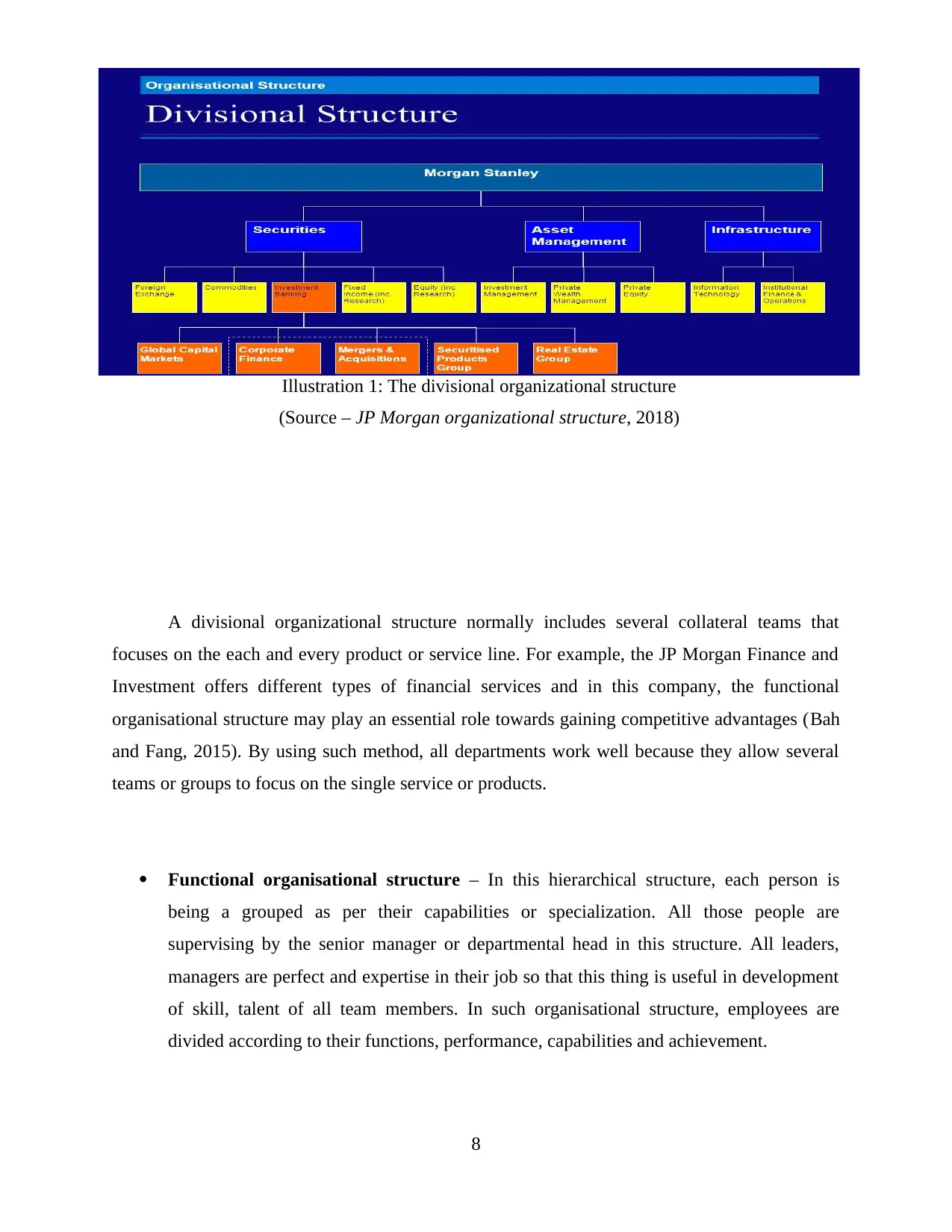
A divisional organizational structure normally includes several collateral teams that
focuses on the each and every product or service line. For example, the JP Morgan Finance and
Investment offers different types of financial services and in this company, the functional
organisational structure may play an essential role towards gaining competitive advantages (Bah
and Fang, 2015). By using such method, all departments work well because they allow several
teams or groups to focus on the single service or products.
Functional organisational structure – In this hierarchical structure, each person is
being a grouped as per their capabilities or specialization. All those people are
supervising by the senior manager or departmental head in this structure. All leaders,
managers are perfect and expertise in their job so that this thing is useful in development
of skill, talent of all team members. In such organisational structure, employees are
divided according to their functions, performance, capabilities and achievement.
8
Illustration 1: The divisional organizational structure
(Source – JP Morgan organizational structure, 2018)
focuses on the each and every product or service line. For example, the JP Morgan Finance and
Investment offers different types of financial services and in this company, the functional
organisational structure may play an essential role towards gaining competitive advantages (Bah
and Fang, 2015). By using such method, all departments work well because they allow several
teams or groups to focus on the single service or products.
Functional organisational structure – In this hierarchical structure, each person is
being a grouped as per their capabilities or specialization. All those people are
supervising by the senior manager or departmental head in this structure. All leaders,
managers are perfect and expertise in their job so that this thing is useful in development
of skill, talent of all team members. In such organisational structure, employees are
divided according to their functions, performance, capabilities and achievement.
8
Illustration 1: The divisional organizational structure
(Source – JP Morgan organizational structure, 2018)
Paraphrase This Document
Need a fresh take? Get an instant paraphrase of this document with our AI Paraphraser
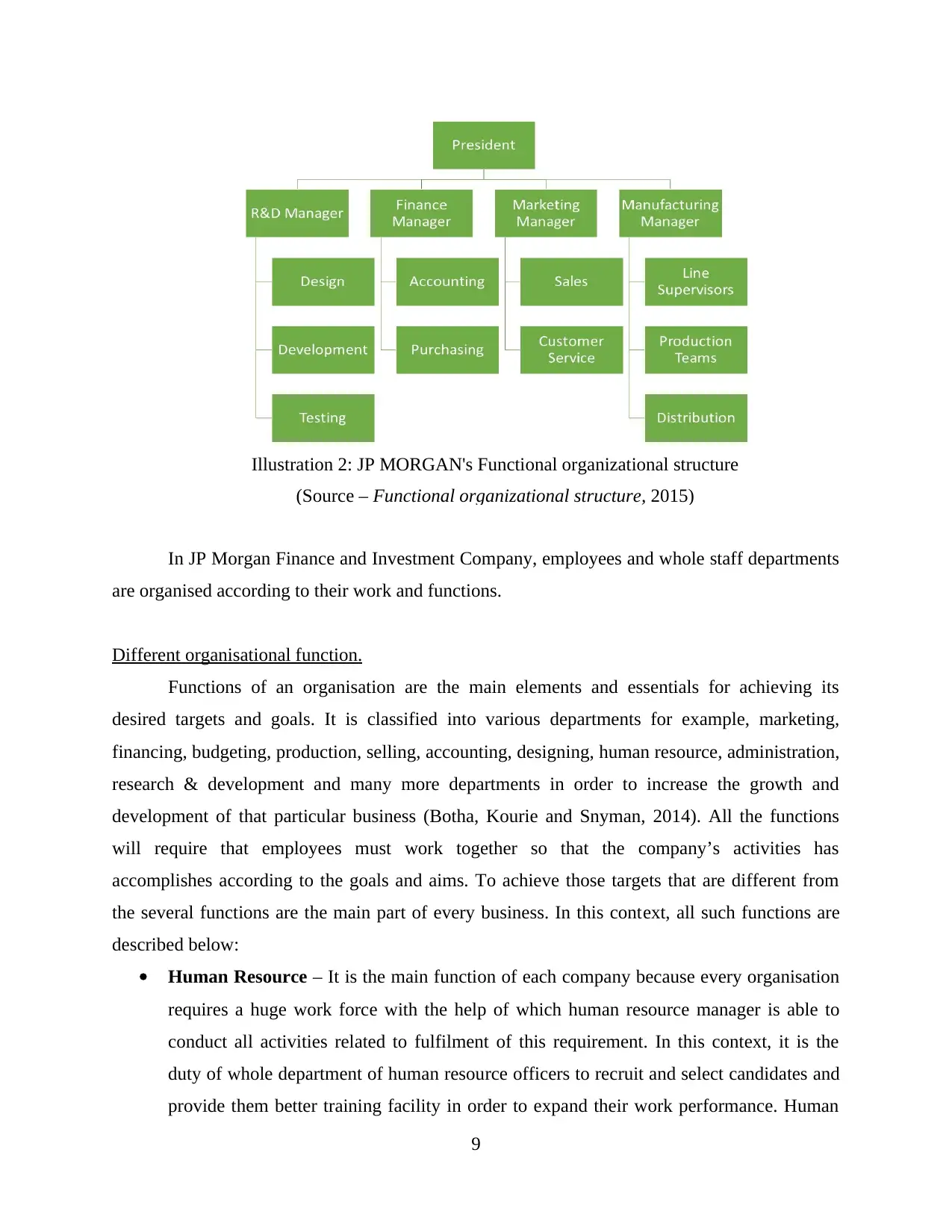
In JP Morgan Finance and Investment Company, employees and whole staff departments
are organised according to their work and functions.
Different organisational function.
Functions of an organisation are the main elements and essentials for achieving its
desired targets and goals. It is classified into various departments for example, marketing,
financing, budgeting, production, selling, accounting, designing, human resource, administration,
research & development and many more departments in order to increase the growth and
development of that particular business (Botha, Kourie and Snyman, 2014). All the functions
will require that employees must work together so that the company’s activities has
accomplishes according to the goals and aims. To achieve those targets that are different from
the several functions are the main part of every business. In this context, all such functions are
described below:
Human Resource – It is the main function of each company because every organisation
requires a huge work force with the help of which human resource manager is able to
conduct all activities related to fulfilment of this requirement. In this context, it is the
duty of whole department of human resource officers to recruit and select candidates and
provide them better training facility in order to expand their work performance. Human
9
Illustration 2: JP MORGAN's Functional organizational structure
(Source – Functional organizational structure, 2015)
are organised according to their work and functions.
Different organisational function.
Functions of an organisation are the main elements and essentials for achieving its
desired targets and goals. It is classified into various departments for example, marketing,
financing, budgeting, production, selling, accounting, designing, human resource, administration,
research & development and many more departments in order to increase the growth and
development of that particular business (Botha, Kourie and Snyman, 2014). All the functions
will require that employees must work together so that the company’s activities has
accomplishes according to the goals and aims. To achieve those targets that are different from
the several functions are the main part of every business. In this context, all such functions are
described below:
Human Resource – It is the main function of each company because every organisation
requires a huge work force with the help of which human resource manager is able to
conduct all activities related to fulfilment of this requirement. In this context, it is the
duty of whole department of human resource officers to recruit and select candidates and
provide them better training facility in order to expand their work performance. Human
9
Illustration 2: JP MORGAN's Functional organizational structure
(Source – Functional organizational structure, 2015)
resource always adopt an important role that contains development of their staff
members.
Marketing – This refers to promotion and advertisement of company's products and
services to gain competitive advantages. The marketing manager must introduce several
policies and plans to stable its product and services (Bryman and Bell, 2015). The
management also conduct research and development towards its growth and
accomplished all needs and wants of its potential customers.
Finance – This function is most essential because every company needs a huge amount
for investment for production process. In this context, the finance manager conducts
several functions and maintain contact to different financial institution. This function also
helps to company's other tasks in order to achieve all targets.
Information Technology – This function is use for the enhancement of digital
technology and internet for the organisational work (Business, 2014). The JP Morgan
Finance and Investment company's whole work is depends on their customer satisfaction
and internet because it provides financial services. It is useful in providing better services
to its clients.
Operation – This is the main essential function of every company to increase its
productivity and employee's performance. It will modify and enable to the company to
reduce costs, increase work performance, profitability and remain ahead of target
market’s competition.
TASK 3
Macro environmental factors by mentioning PESTLE analysis.
Every organisation may influence from its external environment so it is essential to
describes all external factors to prevent from it. Management of this organisation can uses the
special model that are discusses from PESTLE analysis. It provides too much information and
detail about productions and operating challenges to JP Morgan Finance and Investment
organisation. In this context, the PESTLE analysis for this company are describes as below:
Political Factors – It plays a significant role in demonstrating major rules and
regulations applied by government. This organisation provides various types of services
10
members.
Marketing – This refers to promotion and advertisement of company's products and
services to gain competitive advantages. The marketing manager must introduce several
policies and plans to stable its product and services (Bryman and Bell, 2015). The
management also conduct research and development towards its growth and
accomplished all needs and wants of its potential customers.
Finance – This function is most essential because every company needs a huge amount
for investment for production process. In this context, the finance manager conducts
several functions and maintain contact to different financial institution. This function also
helps to company's other tasks in order to achieve all targets.
Information Technology – This function is use for the enhancement of digital
technology and internet for the organisational work (Business, 2014). The JP Morgan
Finance and Investment company's whole work is depends on their customer satisfaction
and internet because it provides financial services. It is useful in providing better services
to its clients.
Operation – This is the main essential function of every company to increase its
productivity and employee's performance. It will modify and enable to the company to
reduce costs, increase work performance, profitability and remain ahead of target
market’s competition.
TASK 3
Macro environmental factors by mentioning PESTLE analysis.
Every organisation may influence from its external environment so it is essential to
describes all external factors to prevent from it. Management of this organisation can uses the
special model that are discusses from PESTLE analysis. It provides too much information and
detail about productions and operating challenges to JP Morgan Finance and Investment
organisation. In this context, the PESTLE analysis for this company are describes as below:
Political Factors – It plays a significant role in demonstrating major rules and
regulations applied by government. This organisation provides various types of services
10
⊘ This is a preview!⊘
Do you want full access?
Subscribe today to unlock all pages.
Trusted by 1+ million students worldwide

1 out of 18


Related Documents


Your All-in-One AI-Powered Toolkit for Academic Success.
+13062052269
info@desklib.com
Available 24*7 on WhatsApp / Email
![[object Object]](/_next/static/media/star-bottom.7253800d.svg)
Unlock your academic potential
Copyright © 2020–2026 A2Z Services. All Rights Reserved. Developed and managed by ZUCOL.