Business Law Assignment: The Doctrine of Agency of Necessity Analysis

Verified

Added on  2023/06/03

|5
|1268
|68
Report
AI Summary
This report delves into the legal concept of agency of necessity within the realm of business law. It elucidates how this agency arises in emergency situations where an agent, despite lacking prior authorization, must act on behalf of a principal to prevent potential harm or loss. The report outlines the four key conditions that define an agency of necessity, including the existence of an emergency, the inability to communicate with the principal, the agent's actions being in the principal's best interest, and the principal's competency. The report then examines relevant case law, such as Prager v Blaispiel, Stamp & Heacock, Ltd., Munro v. Willmott and Co., Springer v. Great Western Railway Company, and China-Pacific SA v Food Corp of India (The Winson), to illustrate the application of this doctrine. The analysis highlights the importance of agency of necessity in commercial law and the agent's decision-making power in urgent situations, while also acknowledging the critiques and philosophical considerations surrounding the doctrine. The report concludes by emphasizing the necessity of this legal principle in situations where immediate action is required to safeguard the principal's interests.
Document Page
Running head: BUSINESS LAW
Business Law
Name of the Student
Name of the University
Author Note
tabler-icon-diamond-filled.svg

Paraphrase This Document

Need a fresh take? Get an instant paraphrase of this document with our AI Paraphraser
Document Page
1BUSINESS LAW
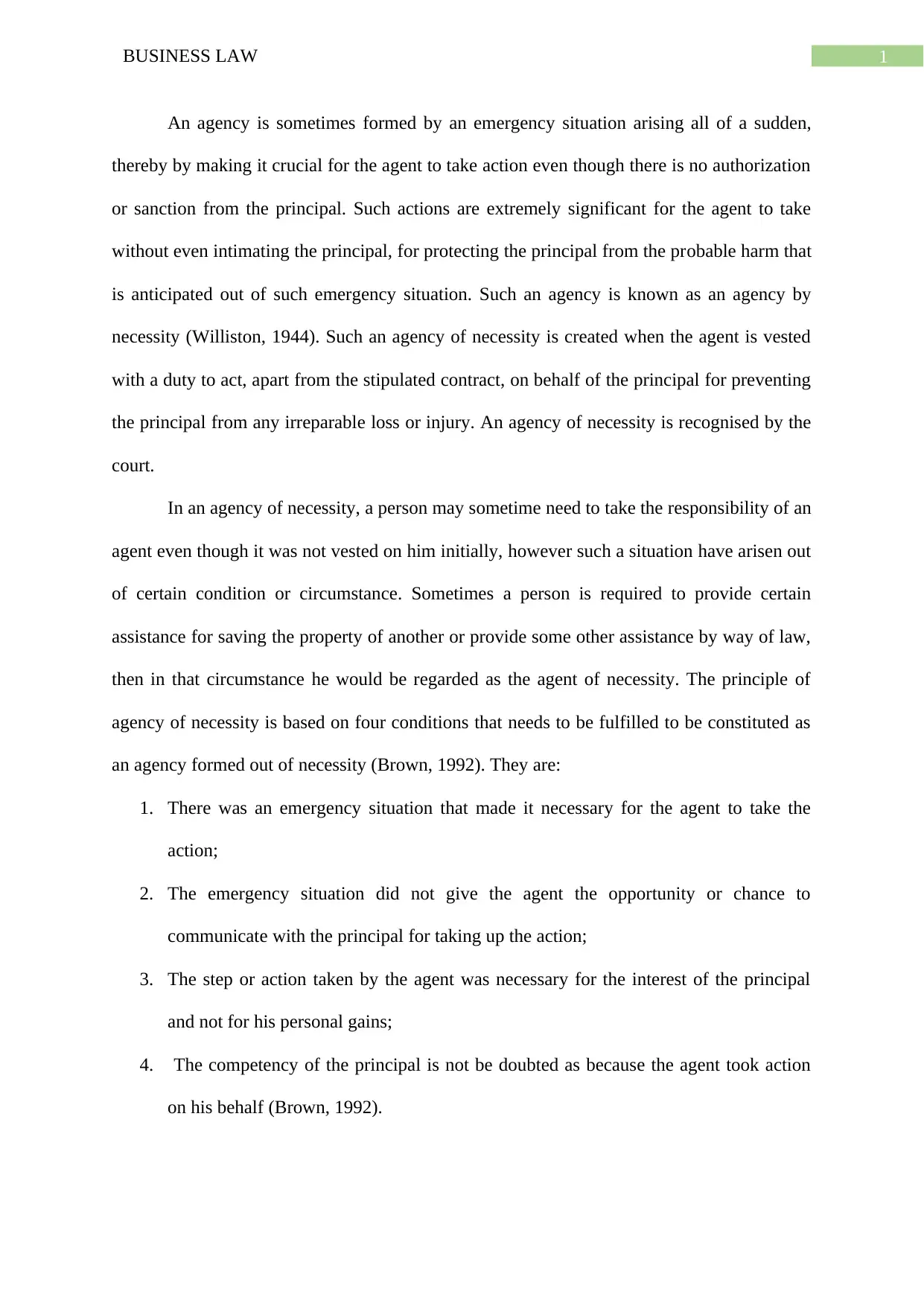
An agency is sometimes formed by an emergency situation arising all of a sudden,
thereby by making it crucial for the agent to take action even though there is no authorization
or sanction from the principal. Such actions are extremely significant for the agent to take
without even intimating the principal, for protecting the principal from the probable harm that
is anticipated out of such emergency situation. Such an agency is known as an agency by
necessity (Williston, 1944). Such an agency of necessity is created when the agent is vested
with a duty to act, apart from the stipulated contract, on behalf of the principal for preventing
the principal from any irreparable loss or injury. An agency of necessity is recognised by the
court.
In an agency of necessity, a person may sometime need to take the responsibility of an
agent even though it was not vested on him initially, however such a situation have arisen out
of certain condition or circumstance. Sometimes a person is required to provide certain
assistance for saving the property of another or provide some other assistance by way of law,
then in that circumstance he would be regarded as the agent of necessity. The principle of
agency of necessity is based on four conditions that needs to be fulfilled to be constituted as
an agency formed out of necessity (Brown, 1992). They are:
1. There was an emergency situation that made it necessary for the agent to take the
action;
2. The emergency situation did not give the agent the opportunity or chance to
communicate with the principal for taking up the action;
3. The step or action taken by the agent was necessary for the interest of the principal
and not for his personal gains;
4. The competency of the principal is not be doubted as because the agent took action
on his behalf (Brown, 1992).
Document Page
2BUSINESS LAW
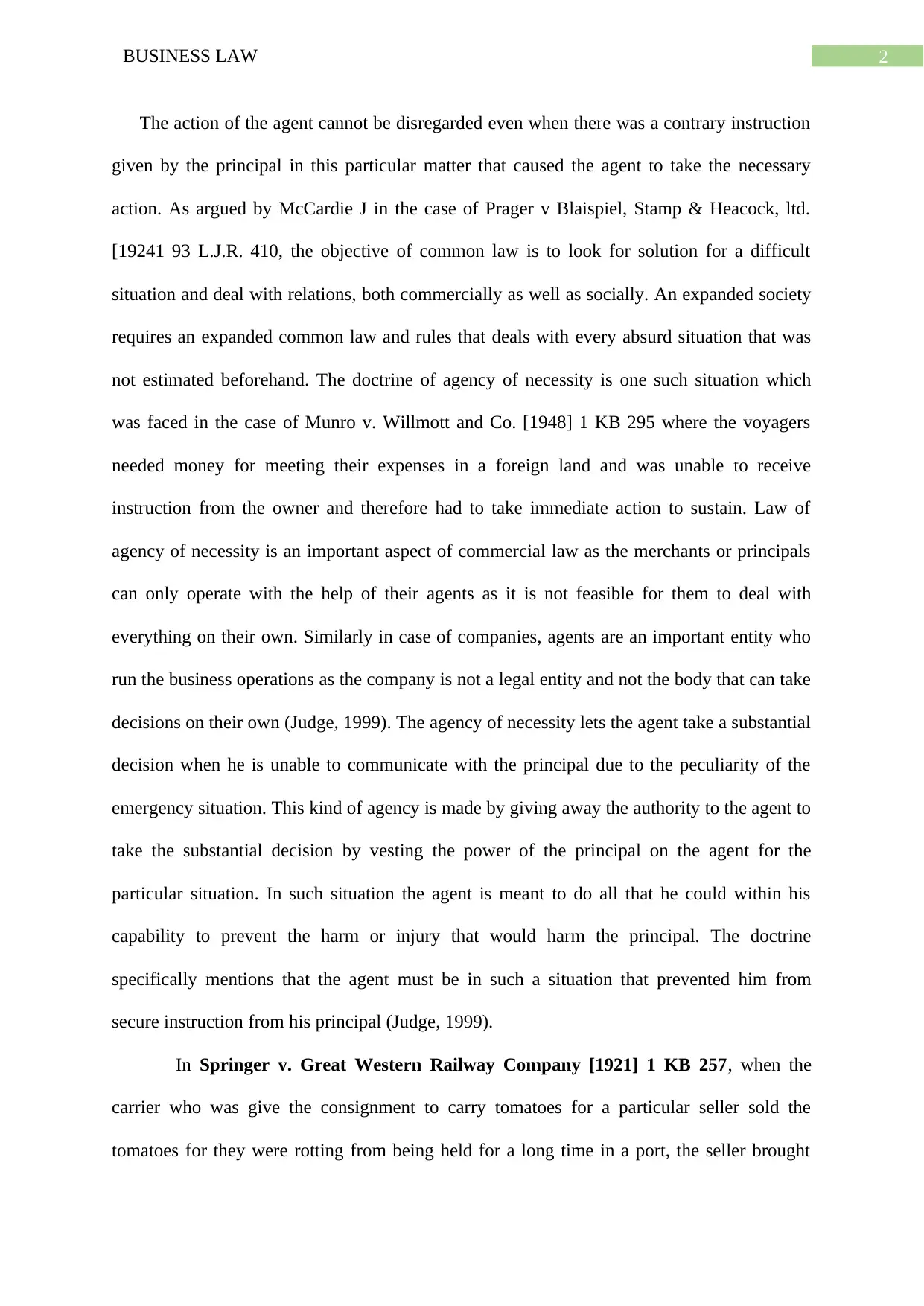
The action of the agent cannot be disregarded even when there was a contrary instruction
given by the principal in this particular matter that caused the agent to take the necessary
action. As argued by McCardie J in the case of Prager v Blaispiel, Stamp & Heacock, ltd.
[19241 93 L.J.R. 410, the objective of common law is to look for solution for a difficult
situation and deal with relations, both commercially as well as socially. An expanded society
requires an expanded common law and rules that deals with every absurd situation that was
not estimated beforehand. The doctrine of agency of necessity is one such situation which
was faced in the case of Munro v. Willmott and Co. [1948] 1 KB 295 where the voyagers
needed money for meeting their expenses in a foreign land and was unable to receive
instruction from the owner and therefore had to take immediate action to sustain. Law of
agency of necessity is an important aspect of commercial law as the merchants or principals
can only operate with the help of their agents as it is not feasible for them to deal with
everything on their own. Similarly in case of companies, agents are an important entity who
run the business operations as the company is not a legal entity and not the body that can take
decisions on their own (Judge, 1999). The agency of necessity lets the agent take a substantial
decision when he is unable to communicate with the principal due to the peculiarity of the
emergency situation. This kind of agency is made by giving away the authority to the agent to
take the substantial decision by vesting the power of the principal on the agent for the
particular situation. In such situation the agent is meant to do all that he could within his
capability to prevent the harm or injury that would harm the principal. The doctrine
specifically mentions that the agent must be in such a situation that prevented him from
secure instruction from his principal (Judge, 1999).
In Springer v. Great Western Railway Company [1921] 1 KB 257, when the
carrier who was give the consignment to carry tomatoes for a particular seller sold the
tomatoes for they were rotting from being held for a long time in a port, the seller brought
Document Page
3BUSINESS LAW
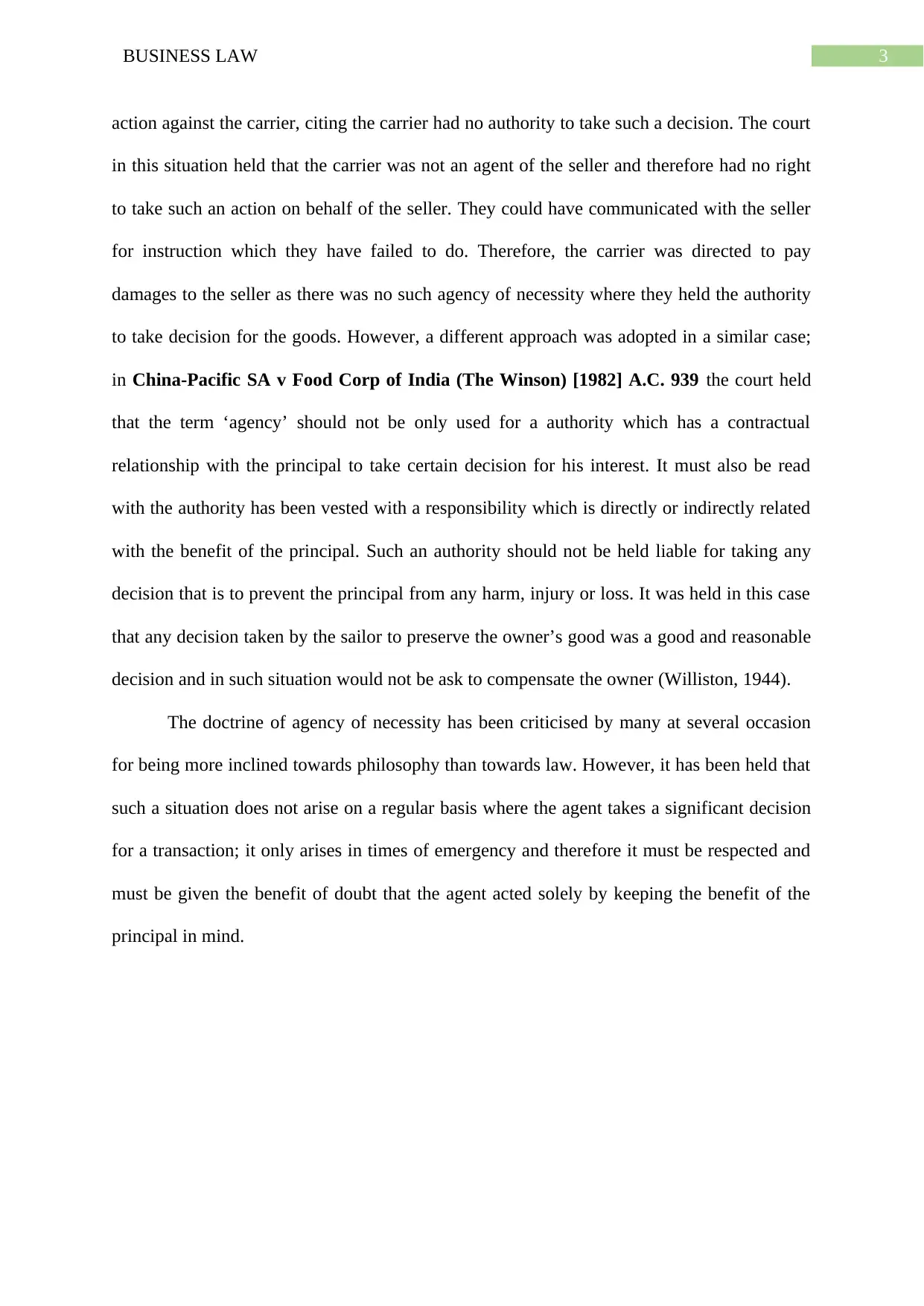
action against the carrier, citing the carrier had no authority to take such a decision. The court
in this situation held that the carrier was not an agent of the seller and therefore had no right
to take such an action on behalf of the seller. They could have communicated with the seller
for instruction which they have failed to do. Therefore, the carrier was directed to pay
damages to the seller as there was no such agency of necessity where they held the authority
to take decision for the goods. However, a different approach was adopted in a similar case;
in China-Pacific SA v Food Corp of India (The Winson) [1982] A.C. 939 the court held
that the term ‘agency’ should not be only used for a authority which has a contractual
relationship with the principal to take certain decision for his interest. It must also be read
with the authority has been vested with a responsibility which is directly or indirectly related
with the benefit of the principal. Such an authority should not be held liable for taking any
decision that is to prevent the principal from any harm, injury or loss. It was held in this case
that any decision taken by the sailor to preserve the owner’s good was a good and reasonable
decision and in such situation would not be ask to compensate the owner (Williston, 1944).
The doctrine of agency of necessity has been criticised by many at several occasion
for being more inclined towards philosophy than towards law. However, it has been held that
such a situation does not arise on a regular basis where the agent takes a significant decision
for a transaction; it only arises in times of emergency and therefore it must be respected and
must be given the benefit of doubt that the agent acted solely by keeping the benefit of the
principal in mind.
tabler-icon-diamond-filled.svg

Paraphrase This Document

Need a fresh take? Get an instant paraphrase of this document with our AI Paraphraser
Document Page
4BUSINESS LAW
References
Brown, I. (1992). Authority and Necessity in the Law of Agency. Mod. L. Rev., 55, 414.
China-Pacific SA v Food Corp of India (The Winson) [1982] A.C. 939
Judge, S. (1999). The Law of Agency. In Business Law (pp. 337-354). Palgrave, London.
Munro v. Willmott and Co. [1948] 1 KB 295
Prager v Blaispiel, Stamp & Heacock, ltd. [19241 93 L.J.R. 410
Springer v. Great Western Railway Company [1921] 1 KB 257
Williston, W. B. (1944). Agency of Necessity. Can. B. Rev., 22, 492.
chevron_up_icon
1 out of 5
circle_padding
hide_on_mobile
zoom_out_icon
[object Object]