Business Law Report: Legal and Business Issues of Alter Ego Theory
VerifiedAdded on 2023/03/31
|8
|1561
|87
Report
AI Summary
This report provides a comprehensive overview of the Alter Ego Theory within the context of business law. It begins by defining the legal concept of "alter ego" and its relation to piercing the corporate veil, where shareholders can be held liable for company debts, which is an exception to the principle of separate legal personality. The report explores the business issues associated with this theory, including the establishment of subsidiary companies and the factors considered in determining whether a subsidiary is an alter ego of its parent company. The report then applies the theory to the current business environment, discussing the impact of profit-driven strategies, economic challenges, and the influence of social media on business practices. It also examines the legal and public opinions regarding the alter ego doctrine, including the risks of personal liability for business owners, the application of corporate formalities, and the evolution of legal standards in determining alter ego status, including the impact of court decisions. The report uses multiple references to support its analysis and conclusions, providing a thorough exploration of the Alter Ego Theory and its implications.

BUSINESS LAW ASSIG 1
Business Law Assig
Name
Institution
Business Law Assig
Name
Institution
Paraphrase This Document
Need a fresh take? Get an instant paraphrase of this document with our AI Paraphraser

BUSINESS LAW ASSIG 2
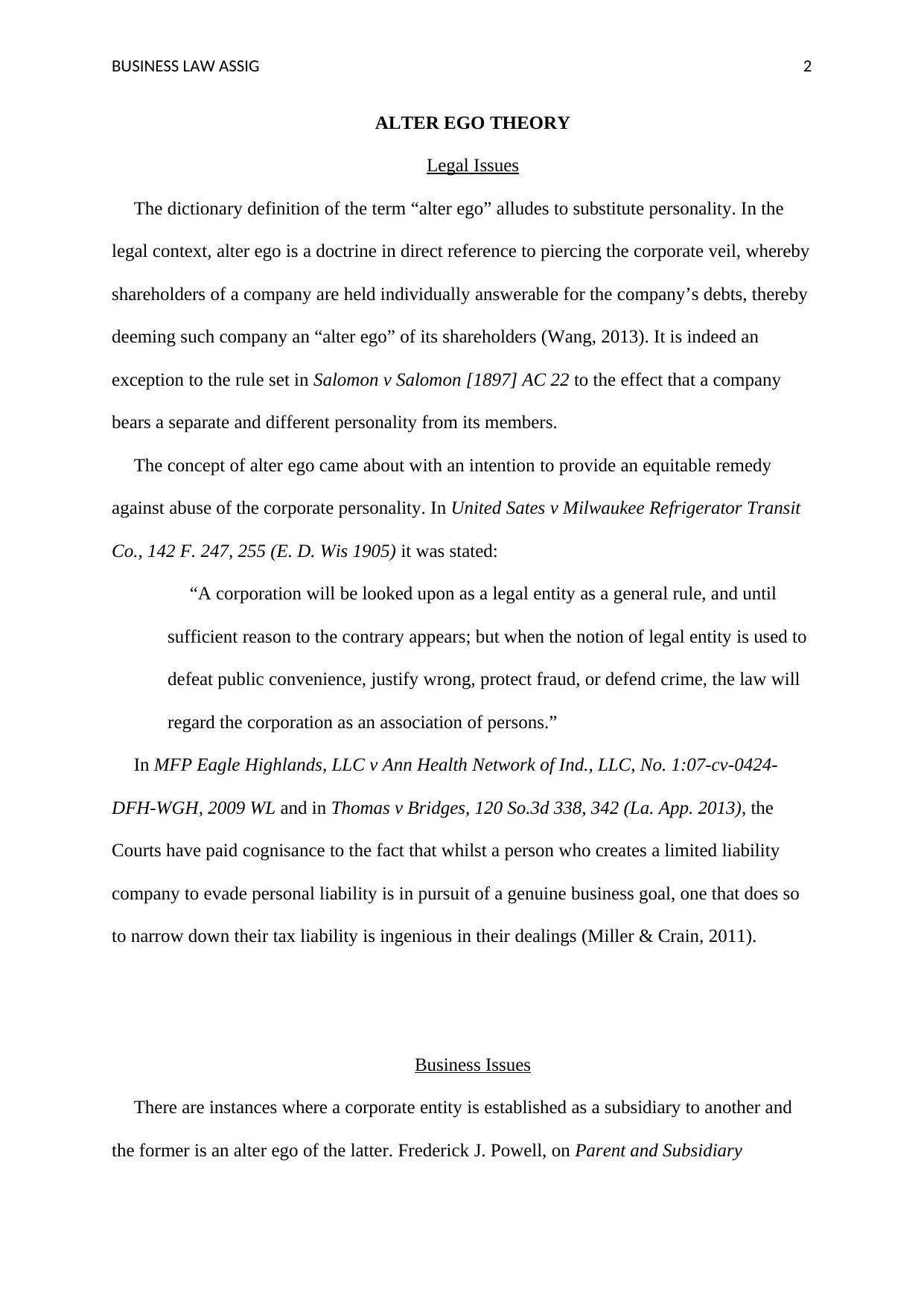
ALTER EGO THEORY
Legal Issues
The dictionary definition of the term “alter ego” alludes to substitute personality. In the
legal context, alter ego is a doctrine in direct reference to piercing the corporate veil, whereby
shareholders of a company are held individually answerable for the company’s debts, thereby
deeming such company an “alter ego” of its shareholders (Wang, 2013). It is indeed an
exception to the rule set in Salomon v Salomon [1897] AC 22 to the effect that a company
bears a separate and different personality from its members.
The concept of alter ego came about with an intention to provide an equitable remedy
against abuse of the corporate personality. In United Sates v Milwaukee Refrigerator Transit
Co., 142 F. 247, 255 (E. D. Wis 1905) it was stated:
“A corporation will be looked upon as a legal entity as a general rule, and until
sufficient reason to the contrary appears; but when the notion of legal entity is used to
defeat public convenience, justify wrong, protect fraud, or defend crime, the law will
regard the corporation as an association of persons.”
In MFP Eagle Highlands, LLC v Ann Health Network of Ind., LLC, No. 1:07-cv-0424-
DFH-WGH, 2009 WL and in Thomas v Bridges, 120 So.3d 338, 342 (La. App. 2013), the
Courts have paid cognisance to the fact that whilst a person who creates a limited liability
company to evade personal liability is in pursuit of a genuine business goal, one that does so
to narrow down their tax liability is ingenious in their dealings (Miller & Crain, 2011).
Business Issues
There are instances where a corporate entity is established as a subsidiary to another and
the former is an alter ego of the latter. Frederick J. Powell, on Parent and Subsidiary
ALTER EGO THEORY
Legal Issues
The dictionary definition of the term “alter ego” alludes to substitute personality. In the
legal context, alter ego is a doctrine in direct reference to piercing the corporate veil, whereby
shareholders of a company are held individually answerable for the company’s debts, thereby
deeming such company an “alter ego” of its shareholders (Wang, 2013). It is indeed an
exception to the rule set in Salomon v Salomon [1897] AC 22 to the effect that a company
bears a separate and different personality from its members.
The concept of alter ego came about with an intention to provide an equitable remedy
against abuse of the corporate personality. In United Sates v Milwaukee Refrigerator Transit
Co., 142 F. 247, 255 (E. D. Wis 1905) it was stated:
“A corporation will be looked upon as a legal entity as a general rule, and until
sufficient reason to the contrary appears; but when the notion of legal entity is used to
defeat public convenience, justify wrong, protect fraud, or defend crime, the law will
regard the corporation as an association of persons.”
In MFP Eagle Highlands, LLC v Ann Health Network of Ind., LLC, No. 1:07-cv-0424-
DFH-WGH, 2009 WL and in Thomas v Bridges, 120 So.3d 338, 342 (La. App. 2013), the
Courts have paid cognisance to the fact that whilst a person who creates a limited liability
company to evade personal liability is in pursuit of a genuine business goal, one that does so
to narrow down their tax liability is ingenious in their dealings (Miller & Crain, 2011).
Business Issues
There are instances where a corporate entity is established as a subsidiary to another and
the former is an alter ego of the latter. Frederick J. Powell, on Parent and Subsidiary

BUSINESS LAW ASSIG 3
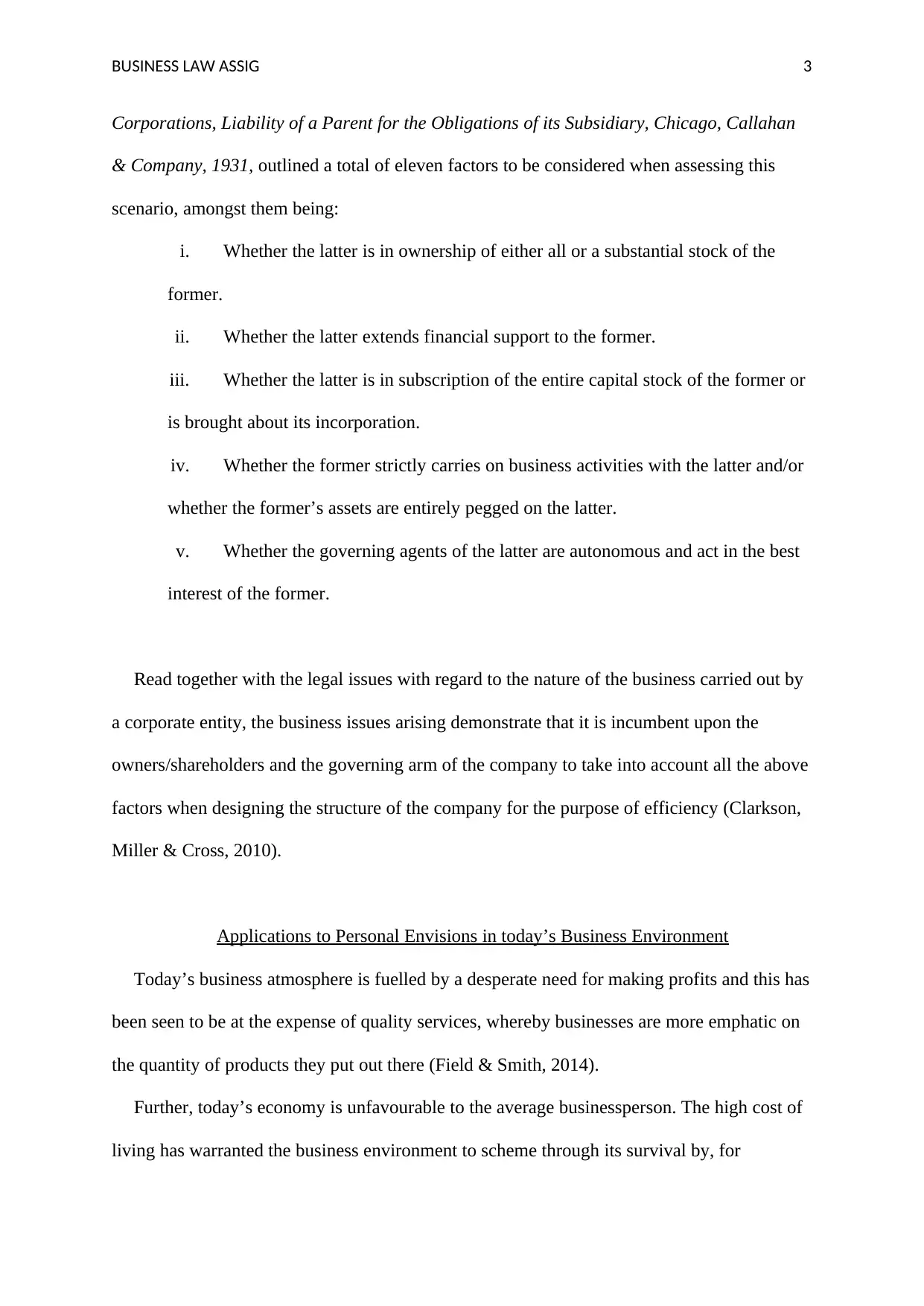
Corporations, Liability of a Parent for the Obligations of its Subsidiary, Chicago, Callahan
& Company, 1931, outlined a total of eleven factors to be considered when assessing this
scenario, amongst them being:
i. Whether the latter is in ownership of either all or a substantial stock of the
former.
ii. Whether the latter extends financial support to the former.
iii. Whether the latter is in subscription of the entire capital stock of the former or
is brought about its incorporation.
iv. Whether the former strictly carries on business activities with the latter and/or
whether the former’s assets are entirely pegged on the latter.
v. Whether the governing agents of the latter are autonomous and act in the best
interest of the former.
Read together with the legal issues with regard to the nature of the business carried out by
a corporate entity, the business issues arising demonstrate that it is incumbent upon the
owners/shareholders and the governing arm of the company to take into account all the above
factors when designing the structure of the company for the purpose of efficiency (Clarkson,
Miller & Cross, 2010).
Applications to Personal Envisions in today’s Business Environment
Today’s business atmosphere is fuelled by a desperate need for making profits and this has
been seen to be at the expense of quality services, whereby businesses are more emphatic on
the quantity of products they put out there (Field & Smith, 2014).
Further, today’s economy is unfavourable to the average businessperson. The high cost of
living has warranted the business environment to scheme through its survival by, for
Corporations, Liability of a Parent for the Obligations of its Subsidiary, Chicago, Callahan
& Company, 1931, outlined a total of eleven factors to be considered when assessing this
scenario, amongst them being:
i. Whether the latter is in ownership of either all or a substantial stock of the
former.
ii. Whether the latter extends financial support to the former.
iii. Whether the latter is in subscription of the entire capital stock of the former or
is brought about its incorporation.
iv. Whether the former strictly carries on business activities with the latter and/or
whether the former’s assets are entirely pegged on the latter.
v. Whether the governing agents of the latter are autonomous and act in the best
interest of the former.
Read together with the legal issues with regard to the nature of the business carried out by
a corporate entity, the business issues arising demonstrate that it is incumbent upon the
owners/shareholders and the governing arm of the company to take into account all the above
factors when designing the structure of the company for the purpose of efficiency (Clarkson,
Miller & Cross, 2010).
Applications to Personal Envisions in today’s Business Environment
Today’s business atmosphere is fuelled by a desperate need for making profits and this has
been seen to be at the expense of quality services, whereby businesses are more emphatic on
the quantity of products they put out there (Field & Smith, 2014).
Further, today’s economy is unfavourable to the average businessperson. The high cost of
living has warranted the business environment to scheme through its survival by, for
⊘ This is a preview!⊘
Do you want full access?
Subscribe today to unlock all pages.

Trusted by 1+ million students worldwide

BUSINESS LAW ASSIG 4
example, finding ways of evading tax. Successful business establishments are crowded in
urban centres and this has brought about massive competition of business space amongst
entrepreneurs (Oppenheim, 2017).
Further still, the traditional marketing methods have been overtaken by the current social
media influence which stresses mostly on numbers thereby raising more concern on how
many likes, views and shares their products get as opposed to the substance of the product.
This has driven away most of the older generation in product consumption as social media
influence is a tool for the younger generation to propel popularity at all costs (Cross & Miller,
2014). In this light, influencers have become a marketing tool for many companies and
expensive one at that.
From the above, it is my opinion that while embracing change and growing the economy,
it is important for companies in the current business environment to pay due regard to their
objects.
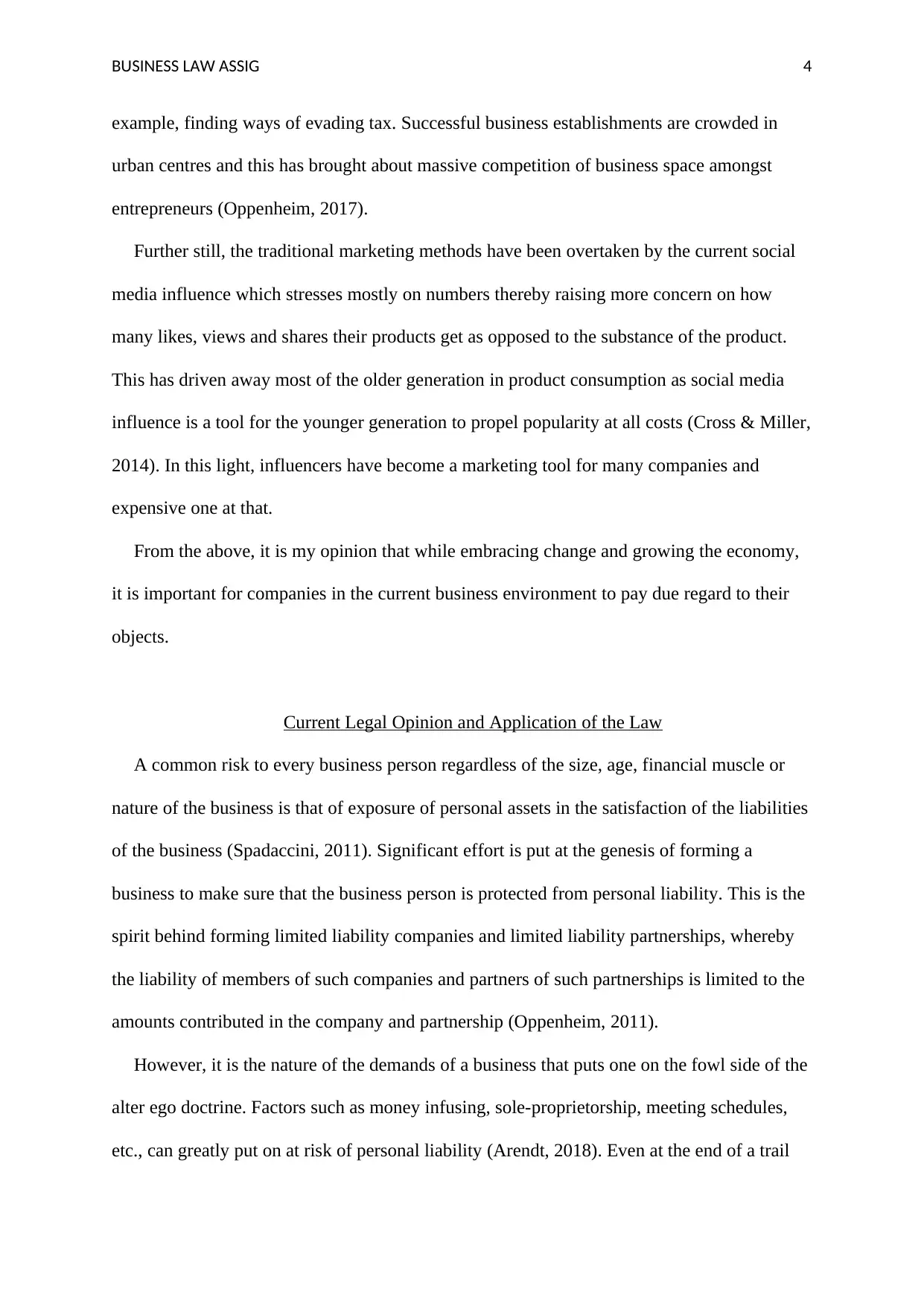
Current Legal Opinion and Application of the Law
A common risk to every business person regardless of the size, age, financial muscle or
nature of the business is that of exposure of personal assets in the satisfaction of the liabilities
of the business (Spadaccini, 2011). Significant effort is put at the genesis of forming a
business to make sure that the business person is protected from personal liability. This is the
spirit behind forming limited liability companies and limited liability partnerships, whereby
the liability of members of such companies and partners of such partnerships is limited to the
amounts contributed in the company and partnership (Oppenheim, 2011).
However, it is the nature of the demands of a business that puts one on the fowl side of the
alter ego doctrine. Factors such as money infusing, sole-proprietorship, meeting schedules,
etc., can greatly put on at risk of personal liability (Arendt, 2018). Even at the end of a trail
example, finding ways of evading tax. Successful business establishments are crowded in
urban centres and this has brought about massive competition of business space amongst
entrepreneurs (Oppenheim, 2017).
Further still, the traditional marketing methods have been overtaken by the current social
media influence which stresses mostly on numbers thereby raising more concern on how
many likes, views and shares their products get as opposed to the substance of the product.
This has driven away most of the older generation in product consumption as social media
influence is a tool for the younger generation to propel popularity at all costs (Cross & Miller,
2014). In this light, influencers have become a marketing tool for many companies and
expensive one at that.
From the above, it is my opinion that while embracing change and growing the economy,
it is important for companies in the current business environment to pay due regard to their
objects.
Current Legal Opinion and Application of the Law
A common risk to every business person regardless of the size, age, financial muscle or
nature of the business is that of exposure of personal assets in the satisfaction of the liabilities
of the business (Spadaccini, 2011). Significant effort is put at the genesis of forming a
business to make sure that the business person is protected from personal liability. This is the
spirit behind forming limited liability companies and limited liability partnerships, whereby
the liability of members of such companies and partners of such partnerships is limited to the
amounts contributed in the company and partnership (Oppenheim, 2011).
However, it is the nature of the demands of a business that puts one on the fowl side of the
alter ego doctrine. Factors such as money infusing, sole-proprietorship, meeting schedules,
etc., can greatly put on at risk of personal liability (Arendt, 2018). Even at the end of a trail
Paraphrase This Document
Need a fresh take? Get an instant paraphrase of this document with our AI Paraphraser

BUSINESS LAW ASSIG 5
and one was not individually named as a defendant, the risk of personal liability still stands in
the instance that the business is incapable to make good of the judgement against it. A
possible solution to this situation is inviting the court to amend its judgement to the effect that
one is put as a supplementary judgement debtor by way of a summary proceeding as opposed
to a full trial.
The alter ego doctrine operates to create a protection layer is between a business person
and the business itself in terms of liability. The subsistence of the layer is anchored in the
observance of various corporate formalities such as stock issuance, holding of meetings,
avoiding intertwining of assets, adequate capital, etc.
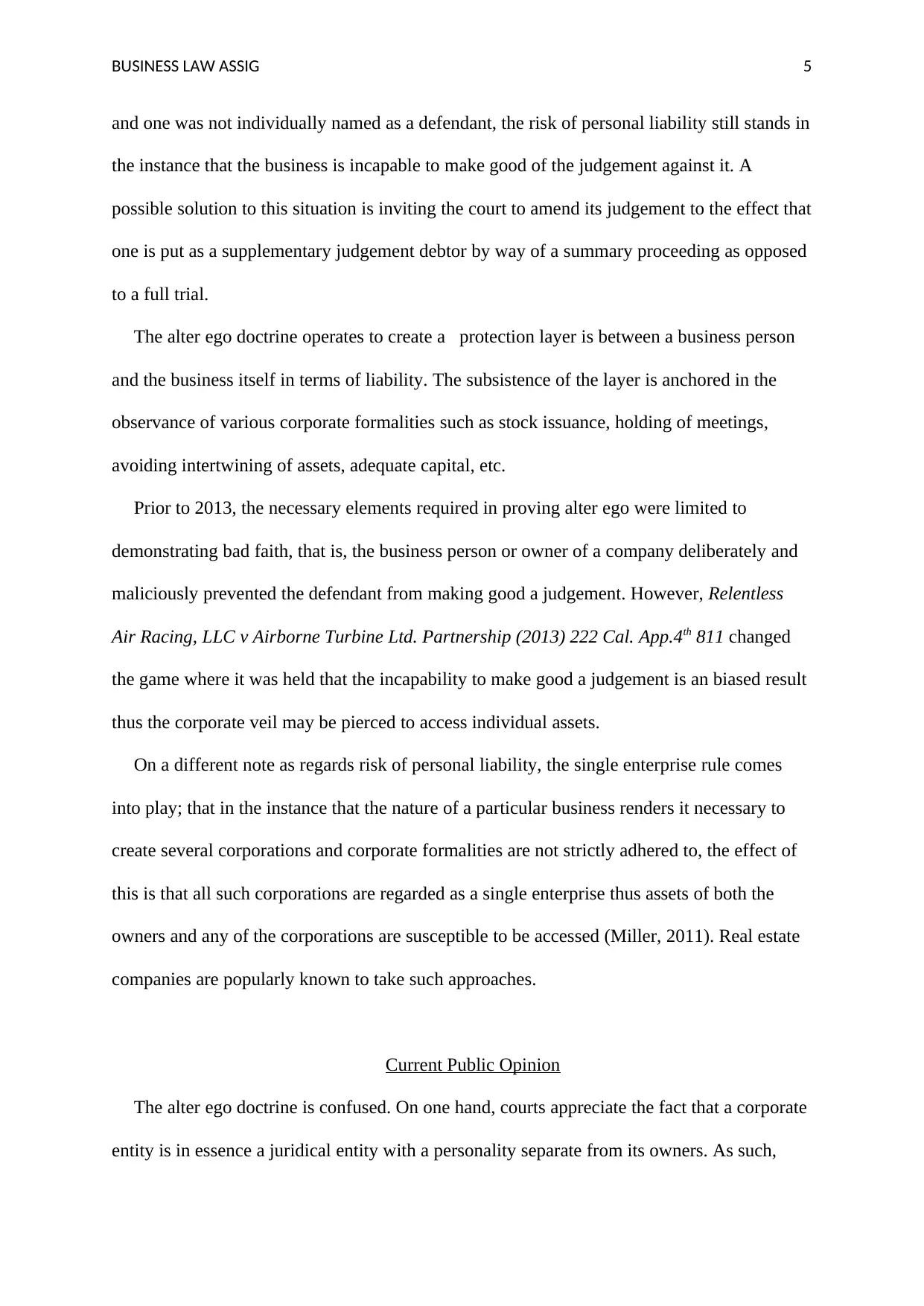
Prior to 2013, the necessary elements required in proving alter ego were limited to
demonstrating bad faith, that is, the business person or owner of a company deliberately and
maliciously prevented the defendant from making good a judgement. However, Relentless
Air Racing, LLC v Airborne Turbine Ltd. Partnership (2013) 222 Cal. App.4th 811 changed
the game where it was held that the incapability to make good a judgement is an biased result
thus the corporate veil may be pierced to access individual assets.
On a different note as regards risk of personal liability, the single enterprise rule comes
into play; that in the instance that the nature of a particular business renders it necessary to
create several corporations and corporate formalities are not strictly adhered to, the effect of
this is that all such corporations are regarded as a single enterprise thus assets of both the
owners and any of the corporations are susceptible to be accessed (Miller, 2011). Real estate
companies are popularly known to take such approaches.
Current Public Opinion
The alter ego doctrine is confused. On one hand, courts appreciate the fact that a corporate
entity is in essence a juridical entity with a personality separate from its owners. As such,
and one was not individually named as a defendant, the risk of personal liability still stands in
the instance that the business is incapable to make good of the judgement against it. A
possible solution to this situation is inviting the court to amend its judgement to the effect that
one is put as a supplementary judgement debtor by way of a summary proceeding as opposed
to a full trial.
The alter ego doctrine operates to create a protection layer is between a business person
and the business itself in terms of liability. The subsistence of the layer is anchored in the
observance of various corporate formalities such as stock issuance, holding of meetings,
avoiding intertwining of assets, adequate capital, etc.
Prior to 2013, the necessary elements required in proving alter ego were limited to
demonstrating bad faith, that is, the business person or owner of a company deliberately and
maliciously prevented the defendant from making good a judgement. However, Relentless
Air Racing, LLC v Airborne Turbine Ltd. Partnership (2013) 222 Cal. App.4th 811 changed
the game where it was held that the incapability to make good a judgement is an biased result
thus the corporate veil may be pierced to access individual assets.
On a different note as regards risk of personal liability, the single enterprise rule comes
into play; that in the instance that the nature of a particular business renders it necessary to
create several corporations and corporate formalities are not strictly adhered to, the effect of
this is that all such corporations are regarded as a single enterprise thus assets of both the
owners and any of the corporations are susceptible to be accessed (Miller, 2011). Real estate
companies are popularly known to take such approaches.
Current Public Opinion
The alter ego doctrine is confused. On one hand, courts appreciate the fact that a corporate
entity is in essence a juridical entity with a personality separate from its owners. As such,

BUSINESS LAW ASSIG 6
piercing the corporate veil is encouraged to be exercised cautiously. In the same breathe, it
has been acknowledged to be legitimate to form a corporate entity for the sole determination
of avoiding personal liability.
However, and on the other hand, the justifications of piercing the corporate veil are
numerous, imprecise and vague. For instance, the corporate veil may be pierced where a
corporate entity is an alter ego of its shareholders/members/owners where such corporation is
inadequately capitalized, where corporate formalities have not been complied with and where
such entity promoted fraudulent activities, injustice or illegalities.
There ought to be a rational structure to address the inconsistencies of the doctrine of alter
ego as the same is in essence a tool for statutory interpretation, equity and orderly disposition
of assets. The justifications for piercing the corporate veil are therefore proxies.
piercing the corporate veil is encouraged to be exercised cautiously. In the same breathe, it
has been acknowledged to be legitimate to form a corporate entity for the sole determination
of avoiding personal liability.
However, and on the other hand, the justifications of piercing the corporate veil are
numerous, imprecise and vague. For instance, the corporate veil may be pierced where a
corporate entity is an alter ego of its shareholders/members/owners where such corporation is
inadequately capitalized, where corporate formalities have not been complied with and where
such entity promoted fraudulent activities, injustice or illegalities.
There ought to be a rational structure to address the inconsistencies of the doctrine of alter
ego as the same is in essence a tool for statutory interpretation, equity and orderly disposition
of assets. The justifications for piercing the corporate veil are therefore proxies.
⊘ This is a preview!⊘
Do you want full access?
Subscribe today to unlock all pages.

Trusted by 1+ million students worldwide

BUSINESS LAW ASSIG 7
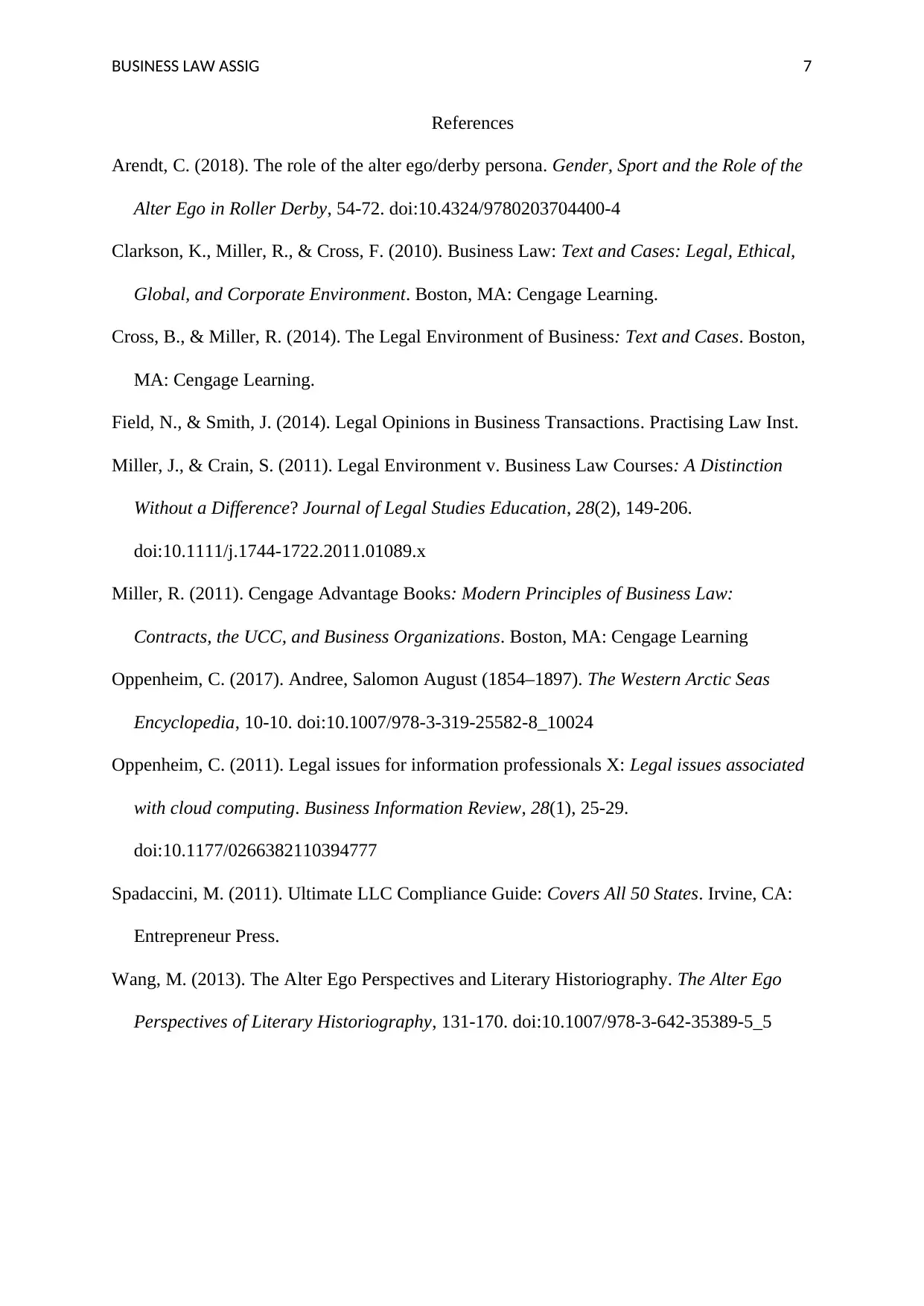
References
Arendt, C. (2018). The role of the alter ego/derby persona. Gender, Sport and the Role of the
Alter Ego in Roller Derby, 54-72. doi:10.4324/9780203704400-4
Clarkson, K., Miller, R., & Cross, F. (2010). Business Law: Text and Cases: Legal, Ethical,
Global, and Corporate Environment. Boston, MA: Cengage Learning.
Cross, B., & Miller, R. (2014). The Legal Environment of Business: Text and Cases. Boston,
MA: Cengage Learning.
Field, N., & Smith, J. (2014). Legal Opinions in Business Transactions. Practising Law Inst.
Miller, J., & Crain, S. (2011). Legal Environment v. Business Law Courses: A Distinction
Without a Difference? Journal of Legal Studies Education, 28(2), 149-206.
doi:10.1111/j.1744-1722.2011.01089.x
Miller, R. (2011). Cengage Advantage Books: Modern Principles of Business Law:
Contracts, the UCC, and Business Organizations. Boston, MA: Cengage Learning
Oppenheim, C. (2017). Andree, Salomon August (1854–1897). The Western Arctic Seas
Encyclopedia, 10-10. doi:10.1007/978-3-319-25582-8_10024
Oppenheim, C. (2011). Legal issues for information professionals X: Legal issues associated
with cloud computing. Business Information Review, 28(1), 25-29.
doi:10.1177/0266382110394777
Spadaccini, M. (2011). Ultimate LLC Compliance Guide: Covers All 50 States. Irvine, CA:
Entrepreneur Press.
Wang, M. (2013). The Alter Ego Perspectives and Literary Historiography. The Alter Ego
Perspectives of Literary Historiography, 131-170. doi:10.1007/978-3-642-35389-5_5
References
Arendt, C. (2018). The role of the alter ego/derby persona. Gender, Sport and the Role of the
Alter Ego in Roller Derby, 54-72. doi:10.4324/9780203704400-4
Clarkson, K., Miller, R., & Cross, F. (2010). Business Law: Text and Cases: Legal, Ethical,
Global, and Corporate Environment. Boston, MA: Cengage Learning.
Cross, B., & Miller, R. (2014). The Legal Environment of Business: Text and Cases. Boston,
MA: Cengage Learning.
Field, N., & Smith, J. (2014). Legal Opinions in Business Transactions. Practising Law Inst.
Miller, J., & Crain, S. (2011). Legal Environment v. Business Law Courses: A Distinction
Without a Difference? Journal of Legal Studies Education, 28(2), 149-206.
doi:10.1111/j.1744-1722.2011.01089.x
Miller, R. (2011). Cengage Advantage Books: Modern Principles of Business Law:
Contracts, the UCC, and Business Organizations. Boston, MA: Cengage Learning
Oppenheim, C. (2017). Andree, Salomon August (1854–1897). The Western Arctic Seas
Encyclopedia, 10-10. doi:10.1007/978-3-319-25582-8_10024
Oppenheim, C. (2011). Legal issues for information professionals X: Legal issues associated
with cloud computing. Business Information Review, 28(1), 25-29.
doi:10.1177/0266382110394777
Spadaccini, M. (2011). Ultimate LLC Compliance Guide: Covers All 50 States. Irvine, CA:
Entrepreneur Press.
Wang, M. (2013). The Alter Ego Perspectives and Literary Historiography. The Alter Ego
Perspectives of Literary Historiography, 131-170. doi:10.1007/978-3-642-35389-5_5
Paraphrase This Document
Need a fresh take? Get an instant paraphrase of this document with our AI Paraphraser

BUSINESS LAW ASSIG 8
1 out of 8
Related Documents
Your All-in-One AI-Powered Toolkit for Academic Success.
+13062052269
info@desklib.com
Available 24*7 on WhatsApp / Email
Unlock your academic potential
Copyright © 2020–2025 A2Z Services. All Rights Reserved. Developed and managed by ZUCOL.