Business Law Case Study: Canadian Legal Framework and Rights Analysis

Verified

Added on  2020/05/16

|5
|572
|96
Case Study
AI Summary
This case study analyzes Canadian business law, examining several key aspects. It begins by evaluating Winston's case under the Canadian Charter of Rights and Freedoms, focusing on the implications of section 6. The case study then examines the concept of stare decisis, and also the role of mediation, and how it applies to the case. Finally, the case study considers the rights of investors and the actions that could be taken, including the potential for claiming losses and the use of the Income Tax Act. The study concludes with the examination of the legal frameworks and how it impacts the business law.
Document Page
Running head: BUSINESS LAW
Case study
Name of the student:
Name of the university:
Author note
tabler-icon-diamond-filled.svg

Paraphrase This Document

Need a fresh take? Get an instant paraphrase of this document with our AI Paraphraser
Document Page
1BUSINESS LAW
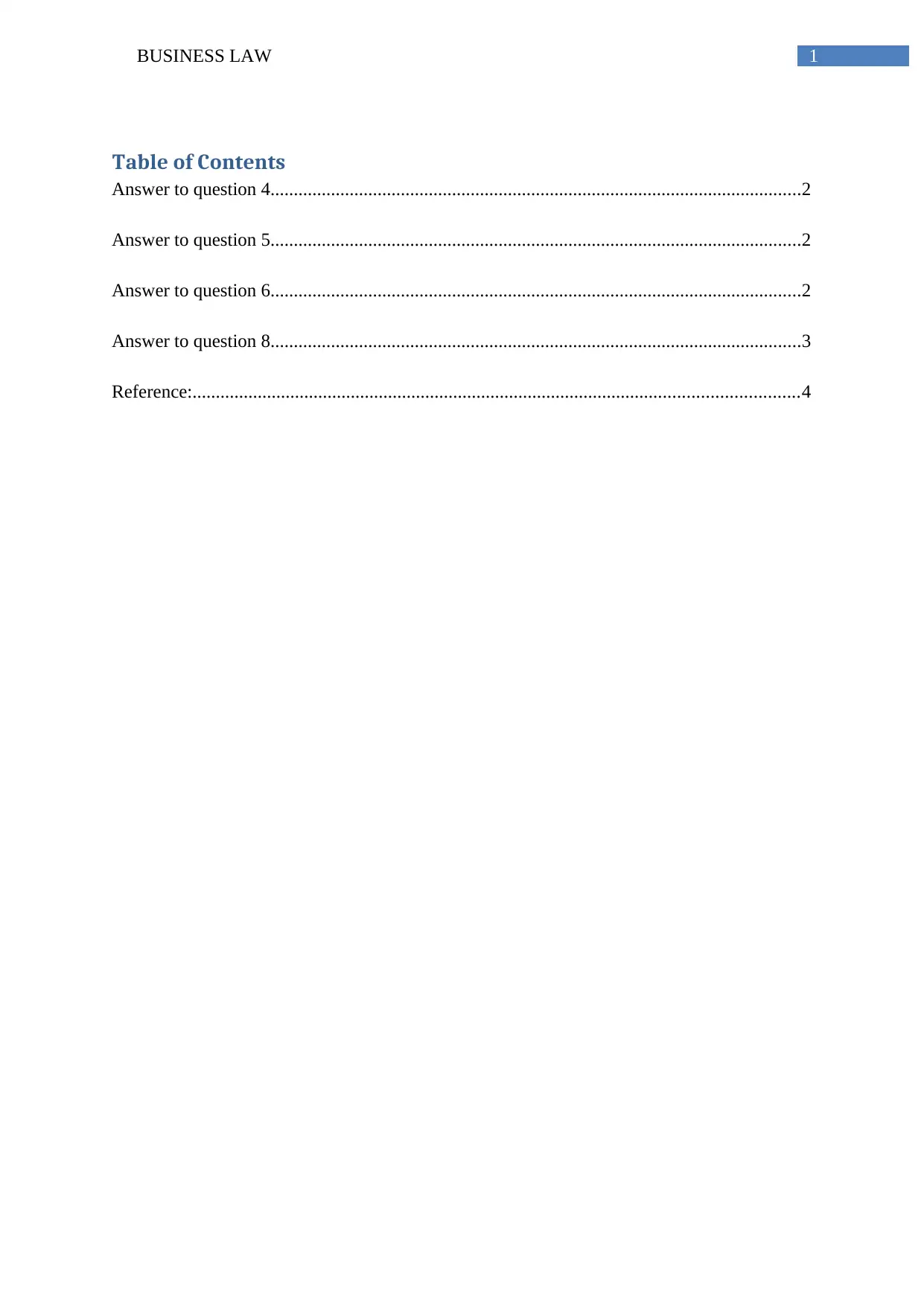
Table of Contents
Answer to question 4..................................................................................................................2
Answer to question 5..................................................................................................................2
Answer to question 6..................................................................................................................2
Answer to question 8..................................................................................................................3
Reference:..................................................................................................................................4
Document Page
2BUSINESS LAW
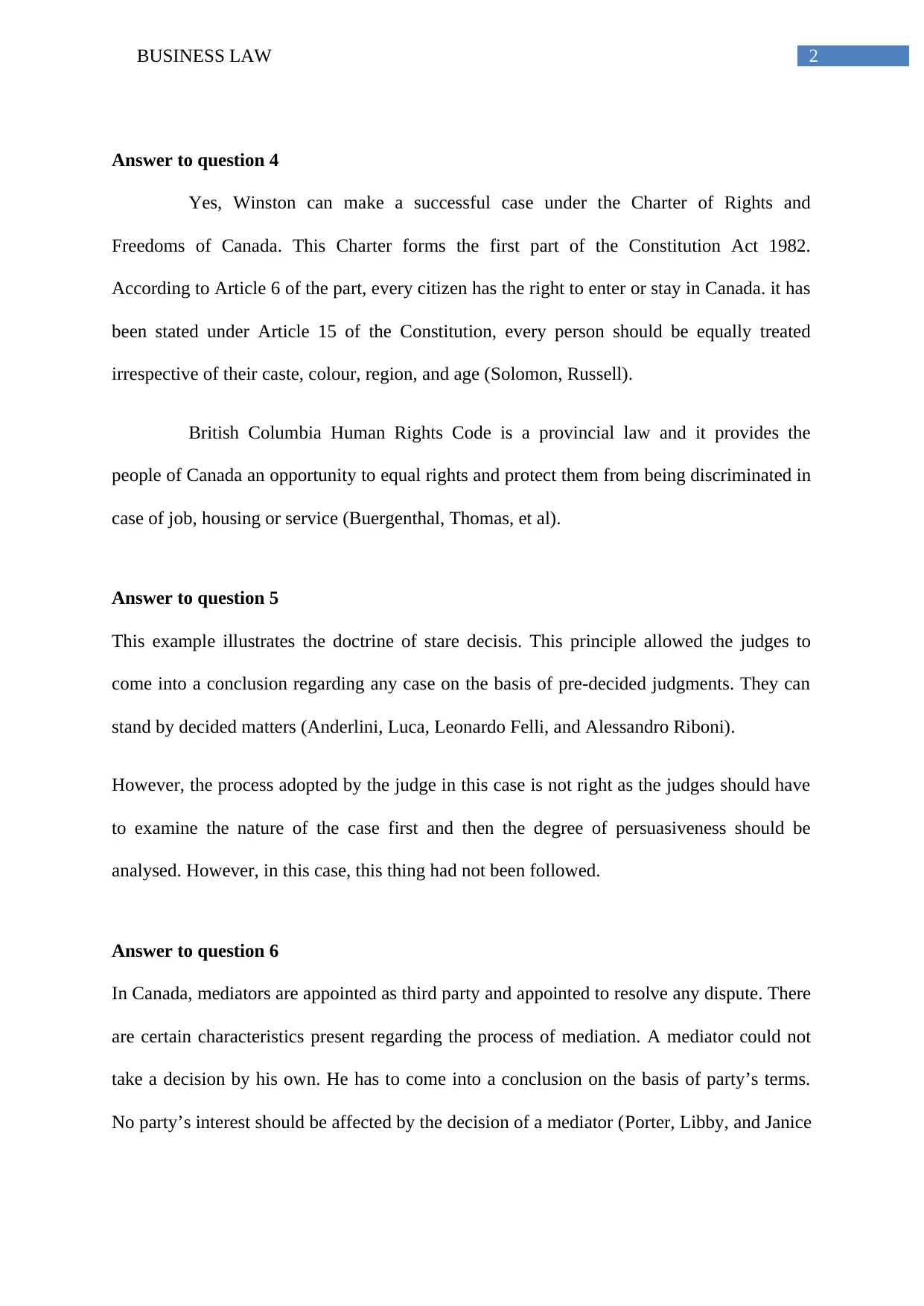
Answer to question 4
Yes, Winston can make a successful case under the Charter of Rights and
Freedoms of Canada. This Charter forms the first part of the Constitution Act 1982.
According to Article 6 of the part, every citizen has the right to enter or stay in Canada. it has
been stated under Article 15 of the Constitution, every person should be equally treated
irrespective of their caste, colour, region, and age (Solomon, Russell).
British Columbia Human Rights Code is a provincial law and it provides the
people of Canada an opportunity to equal rights and protect them from being discriminated in
case of job, housing or service (Buergenthal, Thomas, et al).
Answer to question 5
This example illustrates the doctrine of stare decisis. This principle allowed the judges to
come into a conclusion regarding any case on the basis of pre-decided judgments. They can
stand by decided matters (Anderlini, Luca, Leonardo Felli, and Alessandro Riboni).
However, the process adopted by the judge in this case is not right as the judges should have
to examine the nature of the case first and then the degree of persuasiveness should be
analysed. However, in this case, this thing had not been followed.
Answer to question 6
In Canada, mediators are appointed as third party and appointed to resolve any dispute. There
are certain characteristics present regarding the process of mediation. A mediator could not
take a decision by his own. He has to come into a conclusion on the basis of party’s terms.
No party’s interest should be affected by the decision of a mediator (Porter, Libby, and Janice
Document Page
3BUSINESS LAW
Barry). His decision should be impartial in nature. Therefore, in this case, mediator cannot
take decision freely and the nature of the decision should be impartial.
Answer to question 8
The investors of the firm may ask for qualifying the losses. The shares of the firm can also be
disposed of under section 50 (1) of the Income Tax Act. Additionally, cases can also be filed
against the firm if it fails to pay the due monies back to the investors.
tabler-icon-diamond-filled.svg

Paraphrase This Document

Need a fresh take? Get an instant paraphrase of this document with our AI Paraphraser
Document Page
4BUSINESS LAW
Reference:
Anderlini, Luca, Leonardo Felli, and Alessandro Riboni. "Why stare decisis?." Review of
Economic Dynamics 17.4 (2014): 726-738.
Buergenthal, Thomas, et al. International human rights in a nutshell. West Academic, 2017.
Porter, Libby, and Janice Barry. "Bounded recognition: urban planning and the textual
mediation of Indigenous rights in Canada and Australia." Critical Policy Studies 9.1 (2015):
22-40.
Solomon, Russell. "Reviewing Victoria’s Charter of rights and the limits to our
democracy." Alternative Law Journal 42.3 (2017): 195-199.
chevron_up_icon
1 out of 5
circle_padding
hide_on_mobile
zoom_out_icon
[object Object]