Business Law Report: Analysis of Legal Framework for Potato Council
VerifiedAdded on 2023/04/04
|10
|3263
|484
Report
AI Summary
This report delves into the realm of business law, focusing on its impact on the UK Potato Council, an agricultural entity involved in promoting and advising on potato-related matters. It begins with an introduction to the legal system and its fundamental role in business operations, including the diverse types of laws that govern various aspects of a business, such as licensing, employee relations, and environmental regulations. The report then analyzes the impacts of law on business, using the Potato Council as a case study, particularly examining the implications of employment law and the distinction between self-employment and employee status. The report also addresses business problems and their legal solutions, such as the procedures for registering a new business and the roles and responsibilities of directors. Secondary data from online sources, books, and journals are utilized to support the research, providing a comprehensive overview of business law principles and their practical application within the context of the potato industry.
BUSINESS LAW
1 | P a g e
1 | P a g e

Paraphrase This Document
Need a fresh take? Get an instant paraphrase of this document with our AI Paraphraser
Table of Contents
Introduction............................................................................................................................3
Legal system and its basic role...............................................................................................3
Impacts of law on business.....................................................................................................5
Business problems and legal solution to it.............................................................................6
Alternative Dispute or Legal Solutions..................................................................................8
Conclusion..............................................................................................................................9
Referencing List...................................................................................................................10
2 | P a g e
Introduction............................................................................................................................3
Legal system and its basic role...............................................................................................3
Impacts of law on business.....................................................................................................5
Business problems and legal solution to it.............................................................................6
Alternative Dispute or Legal Solutions..................................................................................8
Conclusion..............................................................................................................................9
Referencing List...................................................................................................................10
2 | P a g e
Introduction
Business laws are laws and regulations that affect the transactions in a business. It includes
laws which need to be followed by employees or customers relating to any business. From
starting a business, managing or selling a business all are guarded by some laws. The
business law consists of sets of rules that every type of business needs to follow. A business
law includes all the state or the central government rules required while conducting a
business (Miller and Cross, 2012). In the following research study, the researcher describes
and prepares for different scenarios related to the business law. The person works as an intern
under potato council and is involved in the growth of potatoes in the UK. The work with
which the person is involved involves promoting potatoes all over the world, advising the
government related to potatoes and provide advice that involves statistics. The council has an
Agricultural Experimental Centre and experiments the markets related to the potato. Every
business council needs to follow certain sets of laws and the Potato council is no different.
The researcher researches on the issues related to the legal procedures of the potato council
and provide several reports pertaining to the business. Secondary data is used that is
information from different online sources, books and journals are taken into consideration
while preparing the following reports.
Legal system and its basic role
A business law is used to conduct a particular business by a set of individuals. There may be
few types of business which are the sole proprietorship, a limited liability company or a
partnership business. The agriculture centre is a limited company. The companies need legal
paper works, requirements to get a legal license and payment of regular taxes (Brekoulakis,
2010). The tax structures and the implications of legal procedures are different for each type
of business. The natures are types of all the various laws also vary. The different types of
laws pertaining to any business of which one law is license laws. To operate a business a
proper type of license is essential and it is different for a different business like a software
company's license requirements may differ from a potato company's licence. The next type of
law is employee laws. Every employee in the business needs to be happy and satisfied.
Proper legal proceedings need to be followed while hiring, payments and during firing them.
Every organisation needs to undertake health and safety measures and for that, the rules of
the government are important to follow. Next set of laws is health, water or air pollution
laws. As potato is related to one of the basic foods of the consumers hence regulations of the
3 | P a g e
Business laws are laws and regulations that affect the transactions in a business. It includes
laws which need to be followed by employees or customers relating to any business. From
starting a business, managing or selling a business all are guarded by some laws. The
business law consists of sets of rules that every type of business needs to follow. A business
law includes all the state or the central government rules required while conducting a
business (Miller and Cross, 2012). In the following research study, the researcher describes
and prepares for different scenarios related to the business law. The person works as an intern
under potato council and is involved in the growth of potatoes in the UK. The work with
which the person is involved involves promoting potatoes all over the world, advising the
government related to potatoes and provide advice that involves statistics. The council has an
Agricultural Experimental Centre and experiments the markets related to the potato. Every
business council needs to follow certain sets of laws and the Potato council is no different.
The researcher researches on the issues related to the legal procedures of the potato council
and provide several reports pertaining to the business. Secondary data is used that is
information from different online sources, books and journals are taken into consideration
while preparing the following reports.
Legal system and its basic role
A business law is used to conduct a particular business by a set of individuals. There may be
few types of business which are the sole proprietorship, a limited liability company or a
partnership business. The agriculture centre is a limited company. The companies need legal
paper works, requirements to get a legal license and payment of regular taxes (Brekoulakis,
2010). The tax structures and the implications of legal procedures are different for each type
of business. The natures are types of all the various laws also vary. The different types of
laws pertaining to any business of which one law is license laws. To operate a business a
proper type of license is essential and it is different for a different business like a software
company's license requirements may differ from a potato company's licence. The next type of
law is employee laws. Every employee in the business needs to be happy and satisfied.
Proper legal proceedings need to be followed while hiring, payments and during firing them.
Every organisation needs to undertake health and safety measures and for that, the rules of
the government are important to follow. Next set of laws is health, water or air pollution
laws. As potato is related to one of the basic foods of the consumers hence regulations of the
3 | P a g e
⊘ This is a preview!⊘
Do you want full access?
Subscribe today to unlock all pages.

Trusted by 1+ million students worldwide
health department of UK is to be followed. Inspectors from fire and health departments may
visit the office for regular inspections to check whether the measures are properly followed.
The process of acquiring raw materials and disposition of the hazardous waste needs to be
done without been harmful to the environment and hence certain environmental laws also
needs to be followed (Chaffey and White, 2010). The Agriculture centre for potato adheres to
all these laws while functioning in the UK market. Intellectual property laws and copyright
rights are also important and every company need to have sufficient knowledge related to
these laws. The invention of a product and patenting ideas for products involve these laws.
The main agenda of any legal system is to support the functioning of a company that would
not harm the well-being of other people in the economy. A property law includes law
regarding buying and selling of tangible and intangible assets. EU laws involve the legal
factors of European Union. Any business groups in the UK involve this law which includes
the rights of the consumers and rights of employers (Crane and Matten, 2016). A commercial
law for a business includes the purchase and sales of goods and services.
The government of UK focuses on protecting the interests of the citizens and maintaining law
and order in the society. The power of making law lies within the parliament of a country.
The laws by a parliament are based on all the different fields such as trade and commerce,
currency, defence, insolvent or bankruptcy and on communication services. Different laws
are debated and passed by the parliament. First, a law in introduced in the Parliament which
is known as a bill. Before proposing a bill a discussion is held regarding the interested parties
and groups. Crane and Matten (2016), states that proposals may be made in white papers
followed by green papers sometimes which indicate those bills are kept under consideration.
A draft of the bill is introduced for examining before it can be placed in the two houses of a
legislature that is House of Commons or House of Lords. Most laws are introduced at the
beginning of each legislative session through the speech of the Queen. The members of
parliaments and members of House of the Lords first scrutinise the draft bill. Some bills may
apply to the whole country while some bills are related to some selected constitutions. A Bill
is introduced in the first meeting, discussed during the second meeting keeping in mind the
principles of the government and then on the third meeting after debate voting among the
members of the house of Common takes place. It the bill gets majority votes from House of
Commons, the government sends the bill to the House of Lords. After it gets passed from
both the houses it is sent to the Queen to get acceptance from the Royal Queen of UK, only
after the consent, it becomes an act of Parliament.
4 | P a g e
visit the office for regular inspections to check whether the measures are properly followed.
The process of acquiring raw materials and disposition of the hazardous waste needs to be
done without been harmful to the environment and hence certain environmental laws also
needs to be followed (Chaffey and White, 2010). The Agriculture centre for potato adheres to
all these laws while functioning in the UK market. Intellectual property laws and copyright
rights are also important and every company need to have sufficient knowledge related to
these laws. The invention of a product and patenting ideas for products involve these laws.
The main agenda of any legal system is to support the functioning of a company that would
not harm the well-being of other people in the economy. A property law includes law
regarding buying and selling of tangible and intangible assets. EU laws involve the legal
factors of European Union. Any business groups in the UK involve this law which includes
the rights of the consumers and rights of employers (Crane and Matten, 2016). A commercial
law for a business includes the purchase and sales of goods and services.
The government of UK focuses on protecting the interests of the citizens and maintaining law
and order in the society. The power of making law lies within the parliament of a country.
The laws by a parliament are based on all the different fields such as trade and commerce,
currency, defence, insolvent or bankruptcy and on communication services. Different laws
are debated and passed by the parliament. First, a law in introduced in the Parliament which
is known as a bill. Before proposing a bill a discussion is held regarding the interested parties
and groups. Crane and Matten (2016), states that proposals may be made in white papers
followed by green papers sometimes which indicate those bills are kept under consideration.
A draft of the bill is introduced for examining before it can be placed in the two houses of a
legislature that is House of Commons or House of Lords. Most laws are introduced at the
beginning of each legislative session through the speech of the Queen. The members of
parliaments and members of House of the Lords first scrutinise the draft bill. Some bills may
apply to the whole country while some bills are related to some selected constitutions. A Bill
is introduced in the first meeting, discussed during the second meeting keeping in mind the
principles of the government and then on the third meeting after debate voting among the
members of the house of Common takes place. It the bill gets majority votes from House of
Commons, the government sends the bill to the House of Lords. After it gets passed from
both the houses it is sent to the Queen to get acceptance from the Royal Queen of UK, only
after the consent, it becomes an act of Parliament.
4 | P a g e
Paraphrase This Document
Need a fresh take? Get an instant paraphrase of this document with our AI Paraphraser
Lobbyists have a great influence in the legislative process. A lobbyist can be officials elected
by the government or civil servants. A lobbyist can also be appointed by political parties and
they may involve in drafting the bill. Lobbyists influence various committees and provide
legislative solutions, and gather sponsor for the bills (Siedel and Haapio, 2010). Lobbyists
have several network and connections which developed with time and provide expert
legislative advice. They also bring forward the interests of the people regarding certain bills.
The people involve as lobbyist uses several political contacts and may also persuade public
opinions and connects them to political parties. They may take help from charities, labour
union, public and organisations to influence the legislative process. Hence professional
lobbyist also can influence the investments and employees interest of a company. Regular
entry in the fair can also be influenced.
Impacts of law on business
The potato council appointed cooks to provide cooking samples at the various fairs they have
attended as self-employed persons while after service the cooks claimed that under a law they
are employed by the council and would make a complaint to the employment tribunal. Self-
employment does not fall under the provisions of employment rights abided by the
companies. Self-employed people work independently and on their will and earnings are
direct in nature. It involves part-time business. The persons are not required to contribute
anything under insurances as they are not required to register themselves under any contract.
The main agenda of a self- employed person is to increase customers to expand revenues
(Wagona, 2014). While an employed person is entitled to the salary under the pay
commission of the government and company he works for. Self-employed person thinks
about opportunities, make new investments, and faces more responsibility regarding a
business. While an employed person is protected and supported by the legislation and has less
responsibility regarding a work. A self-employed person works autonomously and bears all
the risks. The costs and the expenses need to be bear alone along with advance tax payments
under the government laws based on the net income available. Self-employed persons are
entitled to pay 21% of income as social insurances and gets no paid left and unemployment
benefits. Whereas employed person gets paid leave and unemployment benefits where
applicable. 13.07% (under NI rules of the government) is deducted from their gross income
as social insurance schemes. The costs and risks are undertaken by the employers and are
bounded by the contract from the employer (Percival et al. 2013).
5 | P a g e
by the government or civil servants. A lobbyist can also be appointed by political parties and
they may involve in drafting the bill. Lobbyists influence various committees and provide
legislative solutions, and gather sponsor for the bills (Siedel and Haapio, 2010). Lobbyists
have several network and connections which developed with time and provide expert
legislative advice. They also bring forward the interests of the people regarding certain bills.
The people involve as lobbyist uses several political contacts and may also persuade public
opinions and connects them to political parties. They may take help from charities, labour
union, public and organisations to influence the legislative process. Hence professional
lobbyist also can influence the investments and employees interest of a company. Regular
entry in the fair can also be influenced.
Impacts of law on business
The potato council appointed cooks to provide cooking samples at the various fairs they have
attended as self-employed persons while after service the cooks claimed that under a law they
are employed by the council and would make a complaint to the employment tribunal. Self-
employment does not fall under the provisions of employment rights abided by the
companies. Self-employed people work independently and on their will and earnings are
direct in nature. It involves part-time business. The persons are not required to contribute
anything under insurances as they are not required to register themselves under any contract.
The main agenda of a self- employed person is to increase customers to expand revenues
(Wagona, 2014). While an employed person is entitled to the salary under the pay
commission of the government and company he works for. Self-employed person thinks
about opportunities, make new investments, and faces more responsibility regarding a
business. While an employed person is protected and supported by the legislation and has less
responsibility regarding a work. A self-employed person works autonomously and bears all
the risks. The costs and the expenses need to be bear alone along with advance tax payments
under the government laws based on the net income available. Self-employed persons are
entitled to pay 21% of income as social insurances and gets no paid left and unemployment
benefits. Whereas employed person gets paid leave and unemployment benefits where
applicable. 13.07% (under NI rules of the government) is deducted from their gross income
as social insurance schemes. The costs and risks are undertaken by the employers and are
bounded by the contract from the employer (Percival et al. 2013).
5 | P a g e
If the employment tribunal considers the cooks as employed then the council will be required
to prepare contracts for all the cooks. If the cooks had been self-employed then jobs would
have been provided to them only during cooking displays required however if they are
employed jobs for the whole year or unemployment benefits will be enjoyed by the cooks.
The wages would have to increase on the basis on payroll commission. Benefits like
maternity leave, paternity leaves or Adoption leave needs to be provided to the employees.
The workers cannot be unfairly dismissed even in a case of insolvency. The employees would
get benefits from the pension schemes or holiday leaves under the employees' law of the
government (Storbacka, 2011). If the cooks were self-employed they would have remained
deprived of all these benefits. Employment status depends on how the person works or is
directed to whom. The monthly or weekly wage gets fixed and is required to supply only
labour and no other materials. Employers' needs to operate under PAYE which is a way to
collect income tax and insurances from the people employed. Employees' payments include
salaries as well as bonuses provided from a workplace. For the employed people, the
employers are liable vicariously under government laws. The employers cannot do any act of
negligence or give preference to others and they also need to ascertain that the employees
work in authorised ways. The company was considering the cooks as self-employed as they
would not stay liable to any work of the employees or provided any benefits to them as
described in PAYE.
Business problems and legal solution to it
The Agricultural Experimental Centre is proposed to become an independent business
organisation. However to establish a business the organisation needs to follow certain
procedures for registering it. The business chose a business structure and register at a federal
or a state level. The different type of business structure has different type ways of
documenting. Then filing for the registration at a government office is required. The second
step is to choose a name for the particular business. The name needs to be completely unique
and should not clash with any other entity. Along with the name one designation needs to be
attaching with it such as Corporation, Ltd, Co., or Incorporated. To continue the register
process the agreements and incorporation articles needs to be provided to the registry office.
Preparing memorandum of association that includes the business clauses related to the
business is required (Siedel and Haapio, 2010). The business needs to obtain a Director
Identification Number. All future tax returns related to the business under the revenue
services would be completed using that ID number and also obtain Digital Significance
6 | P a g e
to prepare contracts for all the cooks. If the cooks had been self-employed then jobs would
have been provided to them only during cooking displays required however if they are
employed jobs for the whole year or unemployment benefits will be enjoyed by the cooks.
The wages would have to increase on the basis on payroll commission. Benefits like
maternity leave, paternity leaves or Adoption leave needs to be provided to the employees.
The workers cannot be unfairly dismissed even in a case of insolvency. The employees would
get benefits from the pension schemes or holiday leaves under the employees' law of the
government (Storbacka, 2011). If the cooks were self-employed they would have remained
deprived of all these benefits. Employment status depends on how the person works or is
directed to whom. The monthly or weekly wage gets fixed and is required to supply only
labour and no other materials. Employers' needs to operate under PAYE which is a way to
collect income tax and insurances from the people employed. Employees' payments include
salaries as well as bonuses provided from a workplace. For the employed people, the
employers are liable vicariously under government laws. The employers cannot do any act of
negligence or give preference to others and they also need to ascertain that the employees
work in authorised ways. The company was considering the cooks as self-employed as they
would not stay liable to any work of the employees or provided any benefits to them as
described in PAYE.
Business problems and legal solution to it
The Agricultural Experimental Centre is proposed to become an independent business
organisation. However to establish a business the organisation needs to follow certain
procedures for registering it. The business chose a business structure and register at a federal
or a state level. The different type of business structure has different type ways of
documenting. Then filing for the registration at a government office is required. The second
step is to choose a name for the particular business. The name needs to be completely unique
and should not clash with any other entity. Along with the name one designation needs to be
attaching with it such as Corporation, Ltd, Co., or Incorporated. To continue the register
process the agreements and incorporation articles needs to be provided to the registry office.
Preparing memorandum of association that includes the business clauses related to the
business is required (Siedel and Haapio, 2010). The business needs to obtain a Director
Identification Number. All future tax returns related to the business under the revenue
services would be completed using that ID number and also obtain Digital Significance
6 | P a g e
⊘ This is a preview!⊘
Do you want full access?
Subscribe today to unlock all pages.
Trusted by 1+ million students worldwide
Certificate is essential. Obtaining a business license is also essential which depends on the
type and area of operation of the business. Getting approval from the Companies House is
required after which through meetings the company may fulfil small formalities and set up
the entity as a business entity.
According to the law, the company needs to maintain books related to directors, secretaries,
members, Share allotments and etc. The board of directors are appointed generally by the
shareholders for a company. Wagona (2014), mentions that the directors set the goals for a
company and looks after the annual performance of the company. Board of directors also
deals with issues trying to maintain corporate social responsibility and protect company
ethics. The visions and goals for a business entity are set by the directors. They look after
maintaining the integrity and promoting values to all parts of the company. Directors update
the companies’ goals and policies from time to time (Siedel and Haapio, 2010). This group of
people sets up strategies which would help the employees to compete and sustain in the
competitive market. Hence they evaluate business plan considering the risks and
opportunities available. Implementations of ideas are done through them. They obtain the
reflective report on the strength, weakness, opportunities and threats of the company. Board
of directors also controls the internal operations and monitors the managers. They maintain a
good communication with each other and with the managers to obtain companies feedback.
Directors also communicate with the shareholders and works to fulfil their interests.
However for the success of any business raising capital is important especially for the start-
ups. Research on the different funding options needs to be done from both online and offline
sources. Equity financing is an important way to raise funds where a piece of business is
offered as ownership in exchange for funds (Percival et al. 2013). Funds can be raised
personally by using the methods of Bootstrapping that is investing from the savings. Funds
from small investors, venture capitalists, and relatives can also be raised. Another important
method of raising funds is debt financing which indicates borrowing money. Money can be
borrowed as loans from banking institutions in the form of different types of loans. Start-up
companies had no previous goodwill and hence the effective way of raising funds is through
debt financing. Hence there are both corporate and public ways to raise funds. Allocating
shares and securities thus appears to be an essential part of raising finance. Private securities
can be raised through stocks, shares, debentures (Miller and Cross, 2012). Securities need to
be subscribed, allocation of the securities to obtain the shares needs to be done within sixty
7 | P a g e
type and area of operation of the business. Getting approval from the Companies House is
required after which through meetings the company may fulfil small formalities and set up
the entity as a business entity.
According to the law, the company needs to maintain books related to directors, secretaries,
members, Share allotments and etc. The board of directors are appointed generally by the
shareholders for a company. Wagona (2014), mentions that the directors set the goals for a
company and looks after the annual performance of the company. Board of directors also
deals with issues trying to maintain corporate social responsibility and protect company
ethics. The visions and goals for a business entity are set by the directors. They look after
maintaining the integrity and promoting values to all parts of the company. Directors update
the companies’ goals and policies from time to time (Siedel and Haapio, 2010). This group of
people sets up strategies which would help the employees to compete and sustain in the
competitive market. Hence they evaluate business plan considering the risks and
opportunities available. Implementations of ideas are done through them. They obtain the
reflective report on the strength, weakness, opportunities and threats of the company. Board
of directors also controls the internal operations and monitors the managers. They maintain a
good communication with each other and with the managers to obtain companies feedback.
Directors also communicate with the shareholders and works to fulfil their interests.
However for the success of any business raising capital is important especially for the start-
ups. Research on the different funding options needs to be done from both online and offline
sources. Equity financing is an important way to raise funds where a piece of business is
offered as ownership in exchange for funds (Percival et al. 2013). Funds can be raised
personally by using the methods of Bootstrapping that is investing from the savings. Funds
from small investors, venture capitalists, and relatives can also be raised. Another important
method of raising funds is debt financing which indicates borrowing money. Money can be
borrowed as loans from banking institutions in the form of different types of loans. Start-up
companies had no previous goodwill and hence the effective way of raising funds is through
debt financing. Hence there are both corporate and public ways to raise funds. Allocating
shares and securities thus appears to be an essential part of raising finance. Private securities
can be raised through stocks, shares, debentures (Miller and Cross, 2012). Securities need to
be subscribed, allocation of the securities to obtain the shares needs to be done within sixty
7 | P a g e
Paraphrase This Document
Need a fresh take? Get an instant paraphrase of this document with our AI Paraphraser
days of applying for the share. Fulfilment of the interest of the shareholders needs to be given
first priority and allocation of the shares to shareholders needs to maintain Company’s Act.
Alternative Dispute or Legal Solutions
The Experiment Centre while entering into the market would make transactions to increase
business operations. While conducting market operations dispute between the partners might
arise. Before getting into the business an agreement on arbitration clause needs to be signed
by the parties concerned to avoid further legal disputes. In a case of business disputes, the
issues may be resolved outside the court or litigation through alternative dispute solution
(ADR). These ways include arbitration, mediation or even negotiation among the parties.
Arbitration is one of the main elements among the ADR processes (McGill, 2010).
Enforcement can be done in courts while the decisions and other process are taken privately.
It is more formal and involves a third party which is independent. Mediation is an informal
way, it involves fewer costs and is a quick process. Negotiation is also an informal way to
resolve the disputes and causes minimisation of damage in the business solution.
ADR processes are more flexible as the method to solve the dispute can be chosen as per
wise. The company can choose who can be its arbitrator. It involves a person who is not
biased but is an expert and after witnessing the issues provides suggestions. The expenses to
solve the dispute within the business are also reduced. The process of ADR is fast compared
to legal proceedings which are totally unpredictable (Mann and Roberts, 2011). The solutions
between the negotiable parties can be kept confidential while in a case of court proceedings
the information are made public and other companies may have access to it. ADR helps the
people involved to maintain cooperation and resolve the issues mutually. As it involves less
time and cost it provides less stress. Both the parties are more responsive and it helps to
maintain goodwill. Business relationships are not hampered while issues are solved. Disputes
relating to market investments, employees disputes, all can be solved through ADR. It deals
with issues which involve money and investments. Both the parties can discuss and solve the
issues voluntarily. The judge of the matter can be selected, unlike court proceedings.
Arbitration Clause:
The Customers associated with this company’s transactions need to ARBITRATE all
arising disputes with the company. Under the Arbitrate agreement, the consumers are
prohibited to bring in any lawsuit or take any legal action against the company.
8 | P a g e
first priority and allocation of the shares to shareholders needs to maintain Company’s Act.
Alternative Dispute or Legal Solutions
The Experiment Centre while entering into the market would make transactions to increase
business operations. While conducting market operations dispute between the partners might
arise. Before getting into the business an agreement on arbitration clause needs to be signed
by the parties concerned to avoid further legal disputes. In a case of business disputes, the
issues may be resolved outside the court or litigation through alternative dispute solution
(ADR). These ways include arbitration, mediation or even negotiation among the parties.
Arbitration is one of the main elements among the ADR processes (McGill, 2010).
Enforcement can be done in courts while the decisions and other process are taken privately.
It is more formal and involves a third party which is independent. Mediation is an informal
way, it involves fewer costs and is a quick process. Negotiation is also an informal way to
resolve the disputes and causes minimisation of damage in the business solution.
ADR processes are more flexible as the method to solve the dispute can be chosen as per
wise. The company can choose who can be its arbitrator. It involves a person who is not
biased but is an expert and after witnessing the issues provides suggestions. The expenses to
solve the dispute within the business are also reduced. The process of ADR is fast compared
to legal proceedings which are totally unpredictable (Mann and Roberts, 2011). The solutions
between the negotiable parties can be kept confidential while in a case of court proceedings
the information are made public and other companies may have access to it. ADR helps the
people involved to maintain cooperation and resolve the issues mutually. As it involves less
time and cost it provides less stress. Both the parties are more responsive and it helps to
maintain goodwill. Business relationships are not hampered while issues are solved. Disputes
relating to market investments, employees disputes, all can be solved through ADR. It deals
with issues which involve money and investments. Both the parties can discuss and solve the
issues voluntarily. The judge of the matter can be selected, unlike court proceedings.
Arbitration Clause:
The Customers associated with this company’s transactions need to ARBITRATE all
arising disputes with the company. Under the Arbitrate agreement, the consumers are
prohibited to bring in any lawsuit or take any legal action against the company.
8 | P a g e
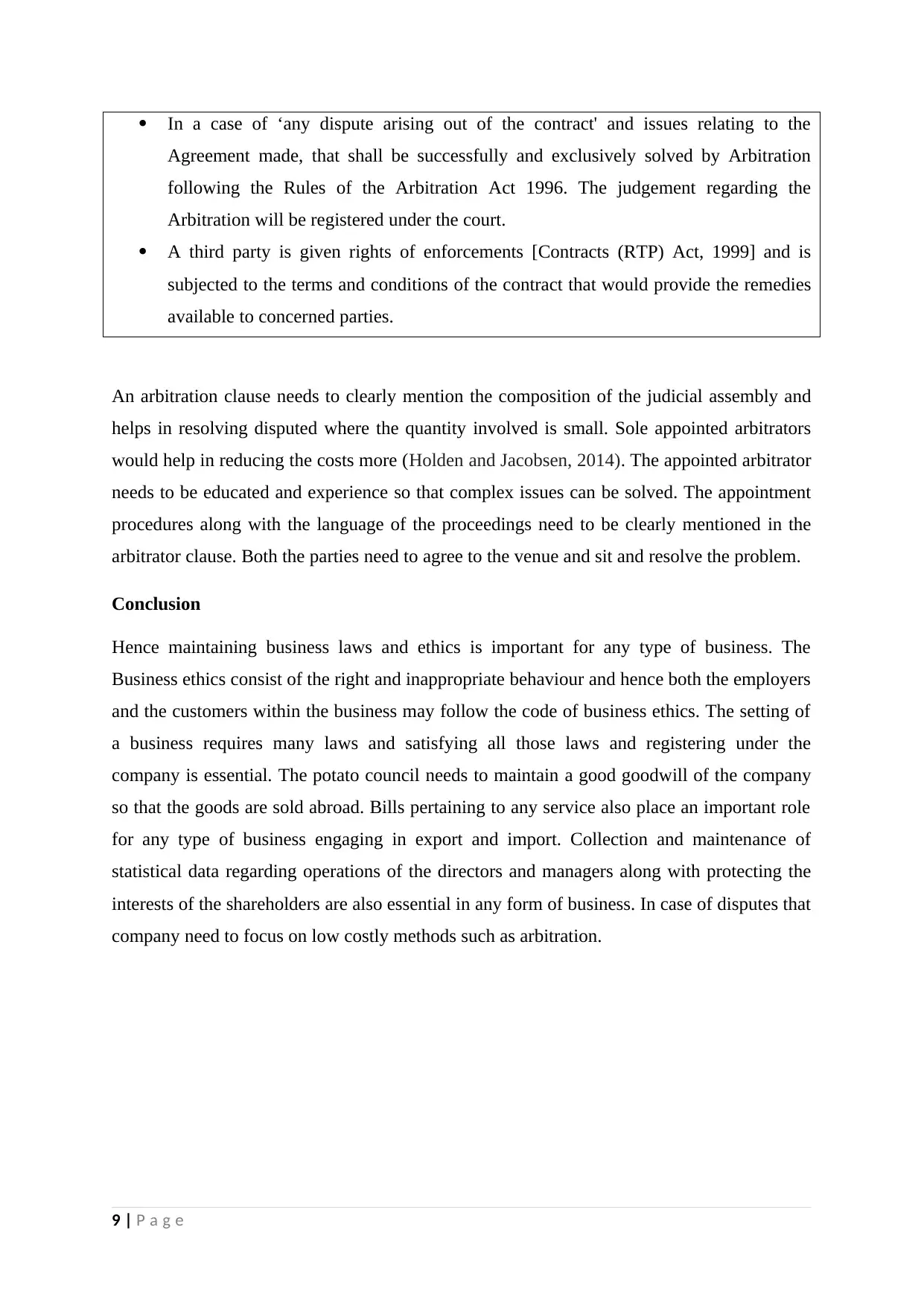
In a case of ‘any dispute arising out of the contract' and issues relating to the
Agreement made, that shall be successfully and exclusively solved by Arbitration
following the Rules of the Arbitration Act 1996. The judgement regarding the
Arbitration will be registered under the court.
A third party is given rights of enforcements [Contracts (RTP) Act, 1999] and is
subjected to the terms and conditions of the contract that would provide the remedies
available to concerned parties.
An arbitration clause needs to clearly mention the composition of the judicial assembly and
helps in resolving disputed where the quantity involved is small. Sole appointed arbitrators
would help in reducing the costs more (Holden and Jacobsen, 2014). The appointed arbitrator
needs to be educated and experience so that complex issues can be solved. The appointment
procedures along with the language of the proceedings need to be clearly mentioned in the
arbitrator clause. Both the parties need to agree to the venue and sit and resolve the problem.
Conclusion
Hence maintaining business laws and ethics is important for any type of business. The
Business ethics consist of the right and inappropriate behaviour and hence both the employers
and the customers within the business may follow the code of business ethics. The setting of
a business requires many laws and satisfying all those laws and registering under the
company is essential. The potato council needs to maintain a good goodwill of the company
so that the goods are sold abroad. Bills pertaining to any service also place an important role
for any type of business engaging in export and import. Collection and maintenance of
statistical data regarding operations of the directors and managers along with protecting the
interests of the shareholders are also essential in any form of business. In case of disputes that
company need to focus on low costly methods such as arbitration.
9 | P a g e
Agreement made, that shall be successfully and exclusively solved by Arbitration
following the Rules of the Arbitration Act 1996. The judgement regarding the
Arbitration will be registered under the court.
A third party is given rights of enforcements [Contracts (RTP) Act, 1999] and is
subjected to the terms and conditions of the contract that would provide the remedies
available to concerned parties.
An arbitration clause needs to clearly mention the composition of the judicial assembly and
helps in resolving disputed where the quantity involved is small. Sole appointed arbitrators
would help in reducing the costs more (Holden and Jacobsen, 2014). The appointed arbitrator
needs to be educated and experience so that complex issues can be solved. The appointment
procedures along with the language of the proceedings need to be clearly mentioned in the
arbitrator clause. Both the parties need to agree to the venue and sit and resolve the problem.
Conclusion
Hence maintaining business laws and ethics is important for any type of business. The
Business ethics consist of the right and inappropriate behaviour and hence both the employers
and the customers within the business may follow the code of business ethics. The setting of
a business requires many laws and satisfying all those laws and registering under the
company is essential. The potato council needs to maintain a good goodwill of the company
so that the goods are sold abroad. Bills pertaining to any service also place an important role
for any type of business engaging in export and import. Collection and maintenance of
statistical data regarding operations of the directors and managers along with protecting the
interests of the shareholders are also essential in any form of business. In case of disputes that
company need to focus on low costly methods such as arbitration.
9 | P a g e
⊘ This is a preview!⊘
Do you want full access?
Subscribe today to unlock all pages.
Trusted by 1+ million students worldwide
Referencing List
Brekoulakis, S.L. (2010). Third parties in international commercial arbitration. Oxford:
Oxford University Press.
Chaffey, D. and White, G. (2010). Business information management: improving
performance using information systems. Pearson Education.
Crane, A. and Matten, D. (2016). Business ethics: Managing corporate citizenship and
sustainability in the age of globalization. Oxford University Press.
Holden, C.W. and Jacobsen, S. (2014). Liquidity measurement problems in fast, competitive
markets: expensive and cheap solutions. The Journal of Finance, 69(4), pp.1747-1785.
Mann, R.A. and Roberts, B.S. (2011). Smith and Roberson’s business law. Cengage
Learning.
McGill, S. (2010). Consumer Arbitration Clause Enforcement: A Balanced Legislative
Response. American Business Law Journal, 47(3), pp.361-413.
Miller, R.L. and Cross, F.B. (2012). Business Law, Alternate Edition: Text and Summarized
Cases. Cengage Learning.
Percival, R.V., Schroeder, C.H., Miller, A.S. and Leape, J.P. (2013). Environmental
regulation: Law, science, and policy. Wolters Kluwer Law & Business.
Siedel, G.J. and Haapio, H. (2010). Using proactive law for competitive advantage. American
Business Law Journal, 47(4), pp.641-686.
Storbacka, K. (2011). A solution business model: Capabilities and management practices for
integrated solutions. Industrial Marketing Management, 40(5), pp.699-711.
Wagona, V. (2014). Present Situation, Problems and Solutions in the Legal System Related to
Corruption Control in Uganda. 8th International Training Course on Corruption Control in
Criminal Justice, Resource Material Series, (71).
10 | P a g e
Brekoulakis, S.L. (2010). Third parties in international commercial arbitration. Oxford:
Oxford University Press.
Chaffey, D. and White, G. (2010). Business information management: improving
performance using information systems. Pearson Education.
Crane, A. and Matten, D. (2016). Business ethics: Managing corporate citizenship and
sustainability in the age of globalization. Oxford University Press.
Holden, C.W. and Jacobsen, S. (2014). Liquidity measurement problems in fast, competitive
markets: expensive and cheap solutions. The Journal of Finance, 69(4), pp.1747-1785.
Mann, R.A. and Roberts, B.S. (2011). Smith and Roberson’s business law. Cengage
Learning.
McGill, S. (2010). Consumer Arbitration Clause Enforcement: A Balanced Legislative
Response. American Business Law Journal, 47(3), pp.361-413.
Miller, R.L. and Cross, F.B. (2012). Business Law, Alternate Edition: Text and Summarized
Cases. Cengage Learning.
Percival, R.V., Schroeder, C.H., Miller, A.S. and Leape, J.P. (2013). Environmental
regulation: Law, science, and policy. Wolters Kluwer Law & Business.
Siedel, G.J. and Haapio, H. (2010). Using proactive law for competitive advantage. American
Business Law Journal, 47(4), pp.641-686.
Storbacka, K. (2011). A solution business model: Capabilities and management practices for
integrated solutions. Industrial Marketing Management, 40(5), pp.699-711.
Wagona, V. (2014). Present Situation, Problems and Solutions in the Legal System Related to
Corruption Control in Uganda. 8th International Training Course on Corruption Control in
Criminal Justice, Resource Material Series, (71).
10 | P a g e

1 out of 10


Related Documents


Your All-in-One AI-Powered Toolkit for Academic Success.
+13062052269
info@desklib.com
Available 24*7 on WhatsApp / Email
![[object Object]](/_next/static/media/star-bottom.7253800d.svg)
Unlock your academic potential
Copyright © 2020–2026 A2Z Services. All Rights Reserved. Developed and managed by ZUCOL.