Business Law Report for Internship: Bedfordshire University
VerifiedAdded on 2021/02/21
|12
|4056
|54
Report
AI Summary
This business law report, prepared for an internship, comprehensively addresses several key legal concepts. It begins by outlining the roles of the executive, judiciary, and legislative branches of government within a business context, emphasizing their functions in upholding the rule of law. The report then delves into the remedies of specific performance, detailing its application in contract law and the limitations imposed by the courts, supported by relevant case studies like Nutbrown V Thornton and Cohen V Roche. Furthermore, it elucidates the differences between general partnerships and companies, focusing on aspects of separate legal entity and limited liability. Finally, the report concludes by examining the legal procedures for dismissing employees, providing a practical overview of this critical area of business law. The report aims to provide a solid understanding of core business law principles for aspiring legal professionals.
COURSE WORK
(BUSINESS LAW)
(BUSINESS LAW)

Paraphrase This Document
Need a fresh take? Get an instant paraphrase of this document with our AI Paraphraser
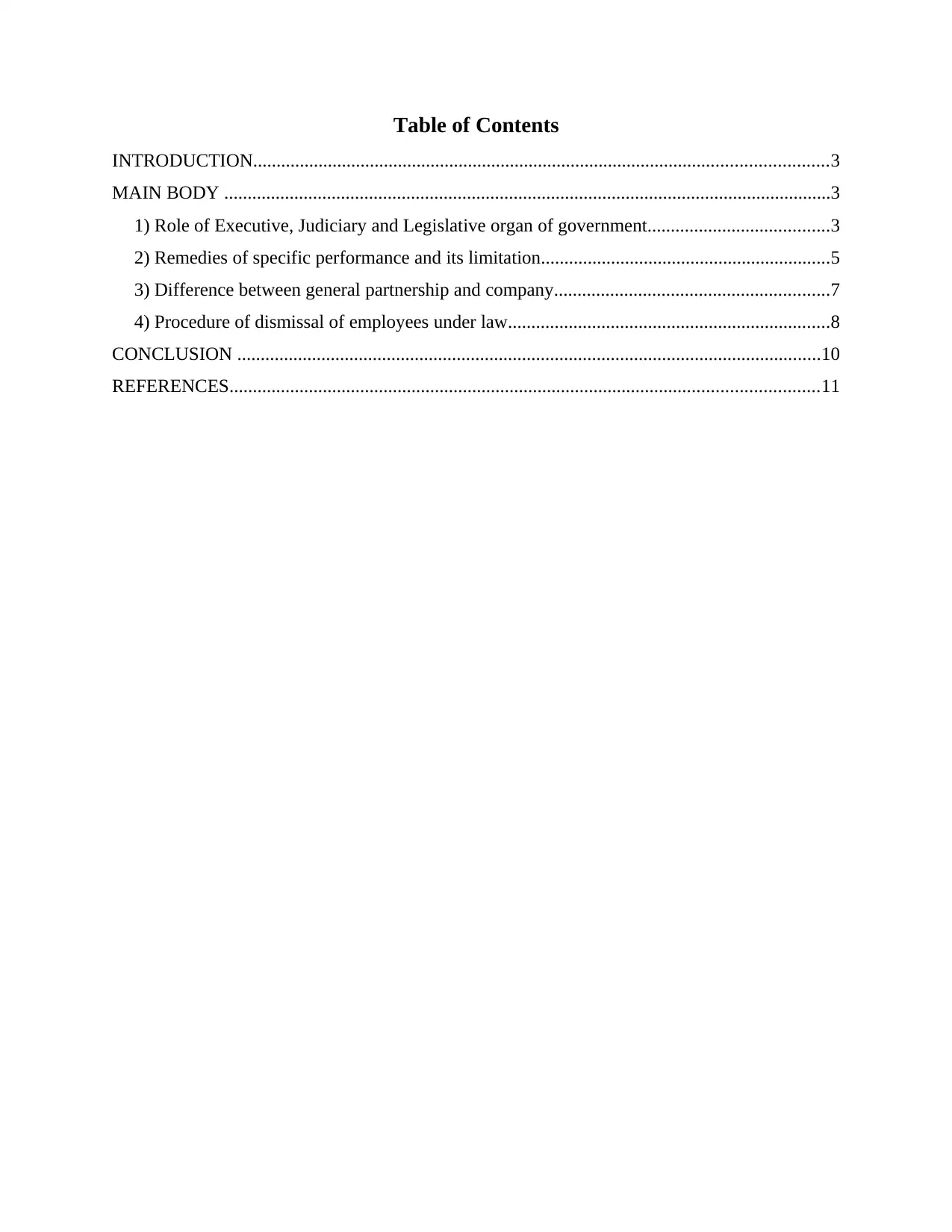
Table of Contents
INTRODUCTION...........................................................................................................................3
MAIN BODY ..................................................................................................................................3
1) Role of Executive, Judiciary and Legislative organ of government.......................................3
2) Remedies of specific performance and its limitation..............................................................5
3) Difference between general partnership and company...........................................................7
4) Procedure of dismissal of employees under law.....................................................................8
CONCLUSION .............................................................................................................................10
REFERENCES..............................................................................................................................11
INTRODUCTION...........................................................................................................................3
MAIN BODY ..................................................................................................................................3
1) Role of Executive, Judiciary and Legislative organ of government.......................................3
2) Remedies of specific performance and its limitation..............................................................5
3) Difference between general partnership and company...........................................................7
4) Procedure of dismissal of employees under law.....................................................................8
CONCLUSION .............................................................................................................................10
REFERENCES..............................................................................................................................11
INTRODUCTION
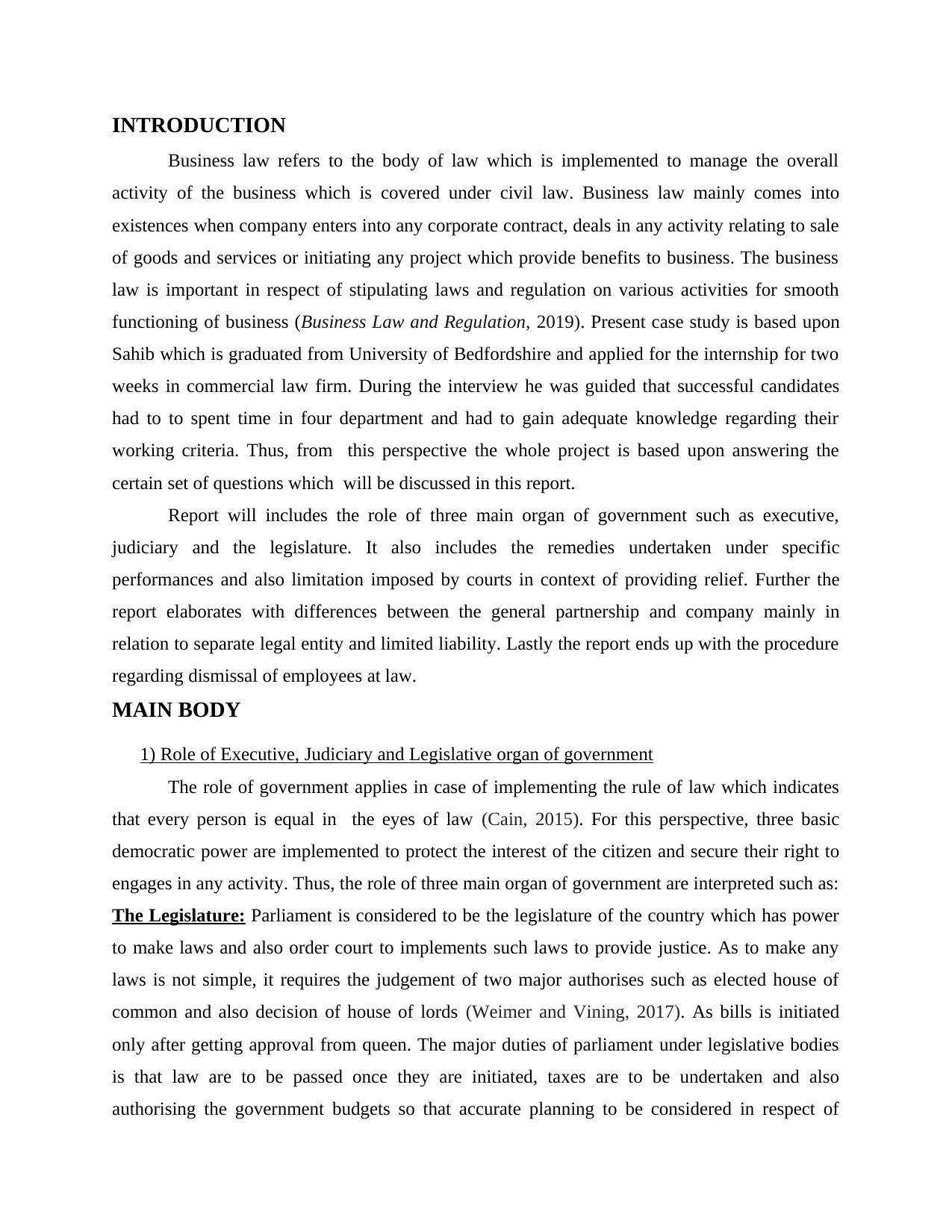
Business law refers to the body of law which is implemented to manage the overall
activity of the business which is covered under civil law. Business law mainly comes into
existences when company enters into any corporate contract, deals in any activity relating to sale
of goods and services or initiating any project which provide benefits to business. The business
law is important in respect of stipulating laws and regulation on various activities for smooth
functioning of business (Business Law and Regulation, 2019). Present case study is based upon
Sahib which is graduated from University of Bedfordshire and applied for the internship for two
weeks in commercial law firm. During the interview he was guided that successful candidates
had to to spent time in four department and had to gain adequate knowledge regarding their
working criteria. Thus, from this perspective the whole project is based upon answering the
certain set of questions which will be discussed in this report.
Report will includes the role of three main organ of government such as executive,
judiciary and the legislature. It also includes the remedies undertaken under specific
performances and also limitation imposed by courts in context of providing relief. Further the
report elaborates with differences between the general partnership and company mainly in
relation to separate legal entity and limited liability. Lastly the report ends up with the procedure
regarding dismissal of employees at law.
MAIN BODY
1) Role of Executive, Judiciary and Legislative organ of government
The role of government applies in case of implementing the rule of law which indicates
that every person is equal in the eyes of law (Cain, 2015). For this perspective, three basic
democratic power are implemented to protect the interest of the citizen and secure their right to
engages in any activity. Thus, the role of three main organ of government are interpreted such as:
The Legislature: Parliament is considered to be the legislature of the country which has power
to make laws and also order court to implements such laws to provide justice. As to make any
laws is not simple, it requires the judgement of two major authorises such as elected house of
common and also decision of house of lords (Weimer and Vining, 2017). As bills is initiated
only after getting approval from queen. The major duties of parliament under legislative bodies
is that law are to be passed once they are initiated, taxes are to be undertaken and also
authorising the government budgets so that accurate planning to be considered in respect of
Business law refers to the body of law which is implemented to manage the overall
activity of the business which is covered under civil law. Business law mainly comes into
existences when company enters into any corporate contract, deals in any activity relating to sale
of goods and services or initiating any project which provide benefits to business. The business
law is important in respect of stipulating laws and regulation on various activities for smooth
functioning of business (Business Law and Regulation, 2019). Present case study is based upon
Sahib which is graduated from University of Bedfordshire and applied for the internship for two
weeks in commercial law firm. During the interview he was guided that successful candidates
had to to spent time in four department and had to gain adequate knowledge regarding their
working criteria. Thus, from this perspective the whole project is based upon answering the
certain set of questions which will be discussed in this report.
Report will includes the role of three main organ of government such as executive,
judiciary and the legislature. It also includes the remedies undertaken under specific
performances and also limitation imposed by courts in context of providing relief. Further the
report elaborates with differences between the general partnership and company mainly in
relation to separate legal entity and limited liability. Lastly the report ends up with the procedure
regarding dismissal of employees at law.
MAIN BODY
1) Role of Executive, Judiciary and Legislative organ of government
The role of government applies in case of implementing the rule of law which indicates
that every person is equal in the eyes of law (Cain, 2015). For this perspective, three basic
democratic power are implemented to protect the interest of the citizen and secure their right to
engages in any activity. Thus, the role of three main organ of government are interpreted such as:
The Legislature: Parliament is considered to be the legislature of the country which has power
to make laws and also order court to implements such laws to provide justice. As to make any
laws is not simple, it requires the judgement of two major authorises such as elected house of
common and also decision of house of lords (Weimer and Vining, 2017). As bills is initiated
only after getting approval from queen. The major duties of parliament under legislative bodies
is that law are to be passed once they are initiated, taxes are to be undertaken and also
authorising the government budgets so that accurate planning to be considered in respect of
⊘ This is a preview!⊘
Do you want full access?
Subscribe today to unlock all pages.

Trusted by 1+ million students worldwide
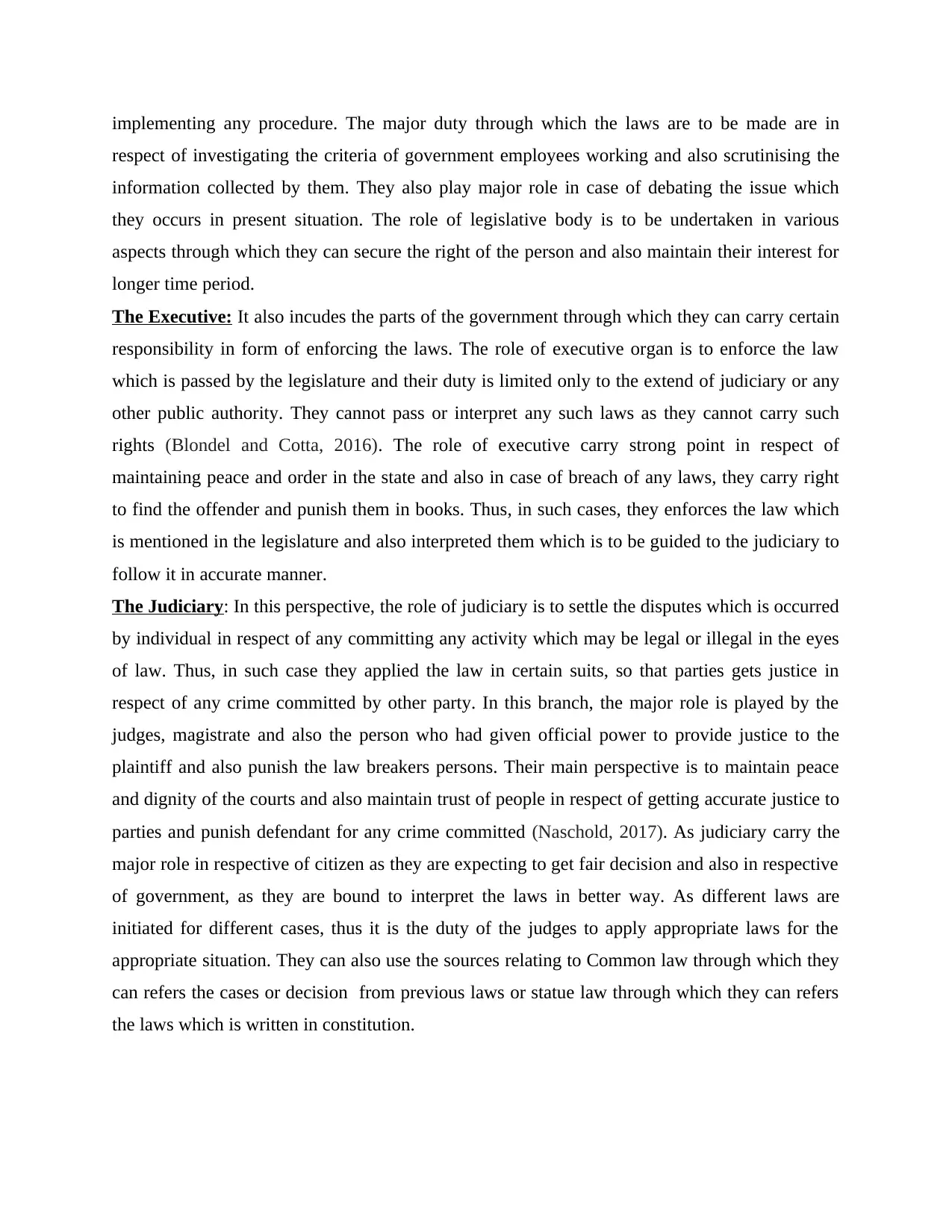
implementing any procedure. The major duty through which the laws are to be made are in
respect of investigating the criteria of government employees working and also scrutinising the
information collected by them. They also play major role in case of debating the issue which
they occurs in present situation. The role of legislative body is to be undertaken in various
aspects through which they can secure the right of the person and also maintain their interest for
longer time period.
The Executive: It also incudes the parts of the government through which they can carry certain
responsibility in form of enforcing the laws. The role of executive organ is to enforce the law
which is passed by the legislature and their duty is limited only to the extend of judiciary or any
other public authority. They cannot pass or interpret any such laws as they cannot carry such
rights (Blondel and Cotta, 2016). The role of executive carry strong point in respect of
maintaining peace and order in the state and also in case of breach of any laws, they carry right
to find the offender and punish them in books. Thus, in such cases, they enforces the law which
is mentioned in the legislature and also interpreted them which is to be guided to the judiciary to
follow it in accurate manner.
The Judiciary: In this perspective, the role of judiciary is to settle the disputes which is occurred
by individual in respect of any committing any activity which may be legal or illegal in the eyes
of law. Thus, in such case they applied the law in certain suits, so that parties gets justice in
respect of any crime committed by other party. In this branch, the major role is played by the
judges, magistrate and also the person who had given official power to provide justice to the
plaintiff and also punish the law breakers persons. Their main perspective is to maintain peace
and dignity of the courts and also maintain trust of people in respect of getting accurate justice to
parties and punish defendant for any crime committed (Naschold, 2017). As judiciary carry the
major role in respective of citizen as they are expecting to get fair decision and also in respective
of government, as they are bound to interpret the laws in better way. As different laws are
initiated for different cases, thus it is the duty of the judges to apply appropriate laws for the
appropriate situation. They can also use the sources relating to Common law through which they
can refers the cases or decision from previous laws or statue law through which they can refers
the laws which is written in constitution.
respect of investigating the criteria of government employees working and also scrutinising the
information collected by them. They also play major role in case of debating the issue which
they occurs in present situation. The role of legislative body is to be undertaken in various
aspects through which they can secure the right of the person and also maintain their interest for
longer time period.
The Executive: It also incudes the parts of the government through which they can carry certain
responsibility in form of enforcing the laws. The role of executive organ is to enforce the law
which is passed by the legislature and their duty is limited only to the extend of judiciary or any
other public authority. They cannot pass or interpret any such laws as they cannot carry such
rights (Blondel and Cotta, 2016). The role of executive carry strong point in respect of
maintaining peace and order in the state and also in case of breach of any laws, they carry right
to find the offender and punish them in books. Thus, in such cases, they enforces the law which
is mentioned in the legislature and also interpreted them which is to be guided to the judiciary to
follow it in accurate manner.
The Judiciary: In this perspective, the role of judiciary is to settle the disputes which is occurred
by individual in respect of any committing any activity which may be legal or illegal in the eyes
of law. Thus, in such case they applied the law in certain suits, so that parties gets justice in
respect of any crime committed by other party. In this branch, the major role is played by the
judges, magistrate and also the person who had given official power to provide justice to the
plaintiff and also punish the law breakers persons. Their main perspective is to maintain peace
and dignity of the courts and also maintain trust of people in respect of getting accurate justice to
parties and punish defendant for any crime committed (Naschold, 2017). As judiciary carry the
major role in respective of citizen as they are expecting to get fair decision and also in respective
of government, as they are bound to interpret the laws in better way. As different laws are
initiated for different cases, thus it is the duty of the judges to apply appropriate laws for the
appropriate situation. They can also use the sources relating to Common law through which they
can refers the cases or decision from previous laws or statue law through which they can refers
the laws which is written in constitution.
Paraphrase This Document
Need a fresh take? Get an instant paraphrase of this document with our AI Paraphraser
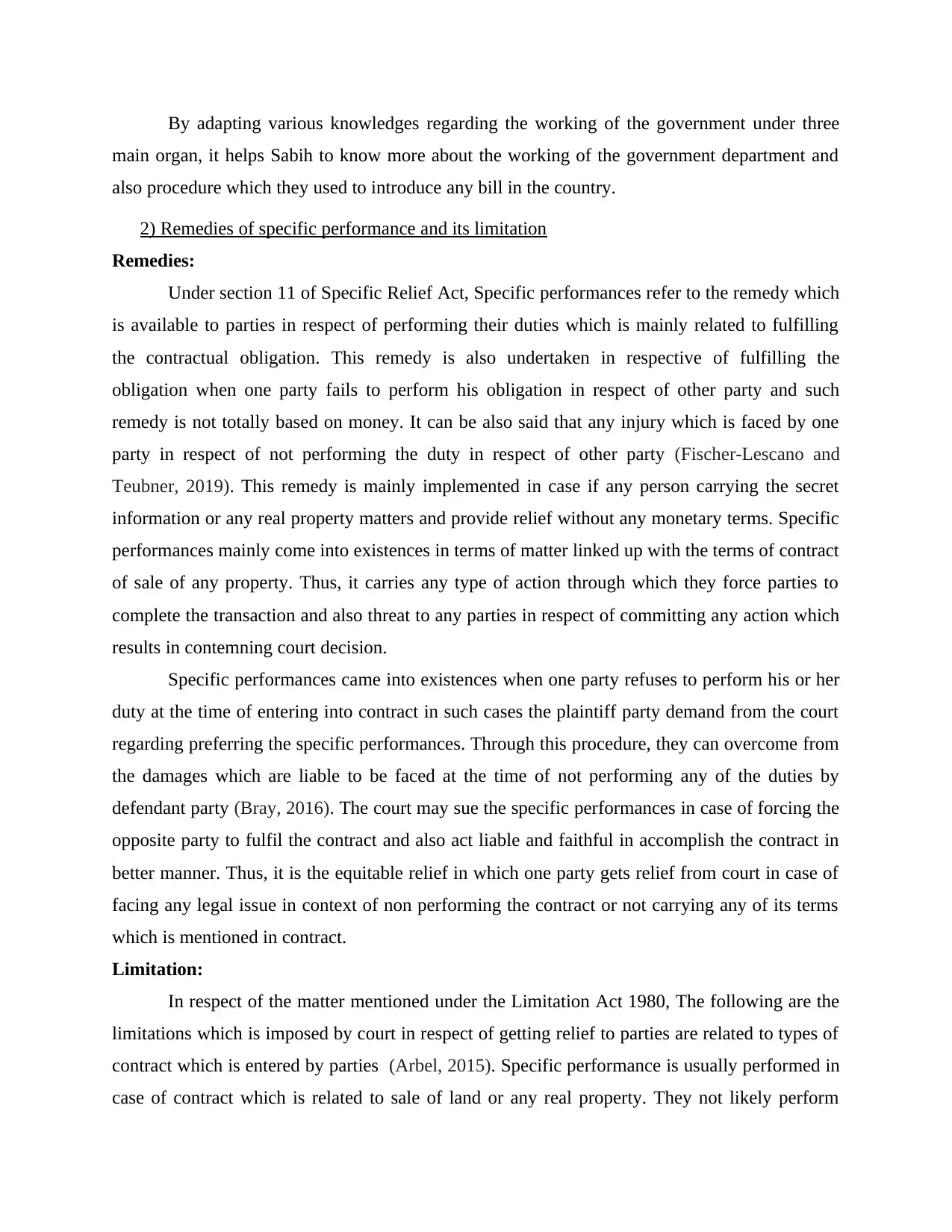
By adapting various knowledges regarding the working of the government under three
main organ, it helps Sabih to know more about the working of the government department and
also procedure which they used to introduce any bill in the country.
2) Remedies of specific performance and its limitation
Remedies:
Under section 11 of Specific Relief Act, Specific performances refer to the remedy which
is available to parties in respect of performing their duties which is mainly related to fulfilling
the contractual obligation. This remedy is also undertaken in respective of fulfilling the
obligation when one party fails to perform his obligation in respect of other party and such
remedy is not totally based on money. It can be also said that any injury which is faced by one
party in respect of not performing the duty in respect of other party (Fischer-Lescano and
Teubner, 2019). This remedy is mainly implemented in case if any person carrying the secret
information or any real property matters and provide relief without any monetary terms. Specific
performances mainly come into existences in terms of matter linked up with the terms of contract
of sale of any property. Thus, it carries any type of action through which they force parties to
complete the transaction and also threat to any parties in respect of committing any action which
results in contemning court decision.
Specific performances came into existences when one party refuses to perform his or her
duty at the time of entering into contract in such cases the plaintiff party demand from the court
regarding preferring the specific performances. Through this procedure, they can overcome from
the damages which are liable to be faced at the time of not performing any of the duties by
defendant party (Bray, 2016). The court may sue the specific performances in case of forcing the
opposite party to fulfil the contract and also act liable and faithful in accomplish the contract in
better manner. Thus, it is the equitable relief in which one party gets relief from court in case of
facing any legal issue in context of non performing the contract or not carrying any of its terms
which is mentioned in contract.
Limitation:
In respect of the matter mentioned under the Limitation Act 1980, The following are the
limitations which is imposed by court in respect of getting relief to parties are related to types of
contract which is entered by parties (Arbel, 2015). Specific performance is usually performed in
case of contract which is related to sale of land or any real property. They not likely perform
main organ, it helps Sabih to know more about the working of the government department and
also procedure which they used to introduce any bill in the country.
2) Remedies of specific performance and its limitation
Remedies:
Under section 11 of Specific Relief Act, Specific performances refer to the remedy which
is available to parties in respect of performing their duties which is mainly related to fulfilling
the contractual obligation. This remedy is also undertaken in respective of fulfilling the
obligation when one party fails to perform his obligation in respect of other party and such
remedy is not totally based on money. It can be also said that any injury which is faced by one
party in respect of not performing the duty in respect of other party (Fischer-Lescano and
Teubner, 2019). This remedy is mainly implemented in case if any person carrying the secret
information or any real property matters and provide relief without any monetary terms. Specific
performances mainly come into existences in terms of matter linked up with the terms of contract
of sale of any property. Thus, it carries any type of action through which they force parties to
complete the transaction and also threat to any parties in respect of committing any action which
results in contemning court decision.
Specific performances came into existences when one party refuses to perform his or her
duty at the time of entering into contract in such cases the plaintiff party demand from the court
regarding preferring the specific performances. Through this procedure, they can overcome from
the damages which are liable to be faced at the time of not performing any of the duties by
defendant party (Bray, 2016). The court may sue the specific performances in case of forcing the
opposite party to fulfil the contract and also act liable and faithful in accomplish the contract in
better manner. Thus, it is the equitable relief in which one party gets relief from court in case of
facing any legal issue in context of non performing the contract or not carrying any of its terms
which is mentioned in contract.
Limitation:
In respect of the matter mentioned under the Limitation Act 1980, The following are the
limitations which is imposed by court in respect of getting relief to parties are related to types of
contract which is entered by parties (Arbel, 2015). Specific performance is usually performed in
case of contract which is related to sale of land or any real property. They not likely perform
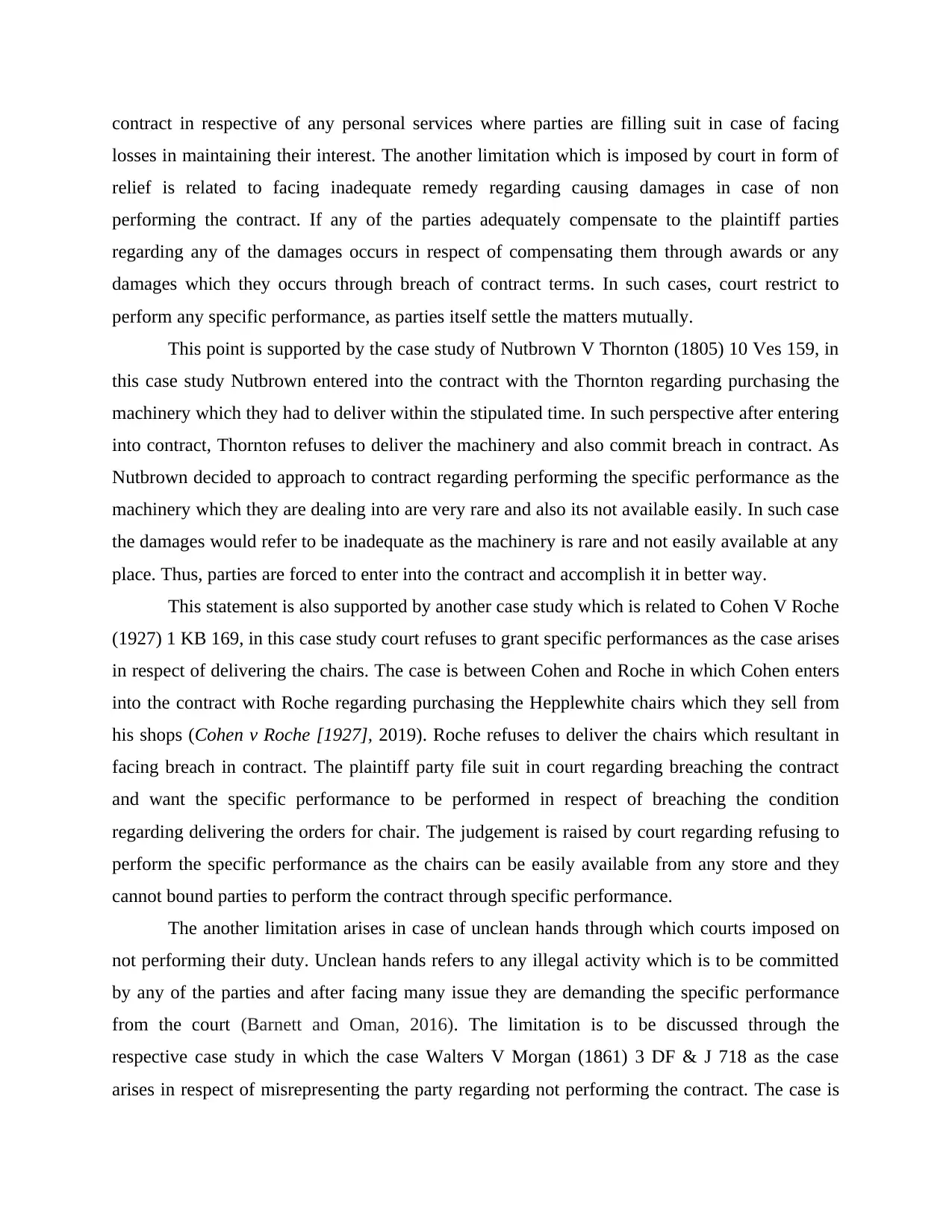
contract in respective of any personal services where parties are filling suit in case of facing
losses in maintaining their interest. The another limitation which is imposed by court in form of
relief is related to facing inadequate remedy regarding causing damages in case of non
performing the contract. If any of the parties adequately compensate to the plaintiff parties
regarding any of the damages occurs in respect of compensating them through awards or any
damages which they occurs through breach of contract terms. In such cases, court restrict to
perform any specific performance, as parties itself settle the matters mutually.
This point is supported by the case study of Nutbrown V Thornton (1805) 10 Ves 159, in
this case study Nutbrown entered into the contract with the Thornton regarding purchasing the
machinery which they had to deliver within the stipulated time. In such perspective after entering
into contract, Thornton refuses to deliver the machinery and also commit breach in contract. As
Nutbrown decided to approach to contract regarding performing the specific performance as the
machinery which they are dealing into are very rare and also its not available easily. In such case
the damages would refer to be inadequate as the machinery is rare and not easily available at any
place. Thus, parties are forced to enter into the contract and accomplish it in better way.
This statement is also supported by another case study which is related to Cohen V Roche
(1927) 1 KB 169, in this case study court refuses to grant specific performances as the case arises
in respect of delivering the chairs. The case is between Cohen and Roche in which Cohen enters
into the contract with Roche regarding purchasing the Hepplewhite chairs which they sell from
his shops (Cohen v Roche [1927], 2019). Roche refuses to deliver the chairs which resultant in
facing breach in contract. The plaintiff party file suit in court regarding breaching the contract
and want the specific performance to be performed in respect of breaching the condition
regarding delivering the orders for chair. The judgement is raised by court regarding refusing to
perform the specific performance as the chairs can be easily available from any store and they
cannot bound parties to perform the contract through specific performance.
The another limitation arises in case of unclean hands through which courts imposed on
not performing their duty. Unclean hands refers to any illegal activity which is to be committed
by any of the parties and after facing many issue they are demanding the specific performance
from the court (Barnett and Oman, 2016). The limitation is to be discussed through the
respective case study in which the case Walters V Morgan (1861) 3 DF & J 718 as the case
arises in respect of misrepresenting the party regarding not performing the contract. The case is
losses in maintaining their interest. The another limitation which is imposed by court in form of
relief is related to facing inadequate remedy regarding causing damages in case of non
performing the contract. If any of the parties adequately compensate to the plaintiff parties
regarding any of the damages occurs in respect of compensating them through awards or any
damages which they occurs through breach of contract terms. In such cases, court restrict to
perform any specific performance, as parties itself settle the matters mutually.
This point is supported by the case study of Nutbrown V Thornton (1805) 10 Ves 159, in
this case study Nutbrown entered into the contract with the Thornton regarding purchasing the
machinery which they had to deliver within the stipulated time. In such perspective after entering
into contract, Thornton refuses to deliver the machinery and also commit breach in contract. As
Nutbrown decided to approach to contract regarding performing the specific performance as the
machinery which they are dealing into are very rare and also its not available easily. In such case
the damages would refer to be inadequate as the machinery is rare and not easily available at any
place. Thus, parties are forced to enter into the contract and accomplish it in better way.
This statement is also supported by another case study which is related to Cohen V Roche
(1927) 1 KB 169, in this case study court refuses to grant specific performances as the case arises
in respect of delivering the chairs. The case is between Cohen and Roche in which Cohen enters
into the contract with Roche regarding purchasing the Hepplewhite chairs which they sell from
his shops (Cohen v Roche [1927], 2019). Roche refuses to deliver the chairs which resultant in
facing breach in contract. The plaintiff party file suit in court regarding breaching the contract
and want the specific performance to be performed in respect of breaching the condition
regarding delivering the orders for chair. The judgement is raised by court regarding refusing to
perform the specific performance as the chairs can be easily available from any store and they
cannot bound parties to perform the contract through specific performance.
The another limitation arises in case of unclean hands through which courts imposed on
not performing their duty. Unclean hands refers to any illegal activity which is to be committed
by any of the parties and after facing many issue they are demanding the specific performance
from the court (Barnett and Oman, 2016). The limitation is to be discussed through the
respective case study in which the case Walters V Morgan (1861) 3 DF & J 718 as the case
arises in respect of misrepresenting the party regarding not performing the contract. The case is
⊘ This is a preview!⊘
Do you want full access?
Subscribe today to unlock all pages.
Trusted by 1+ million students worldwide
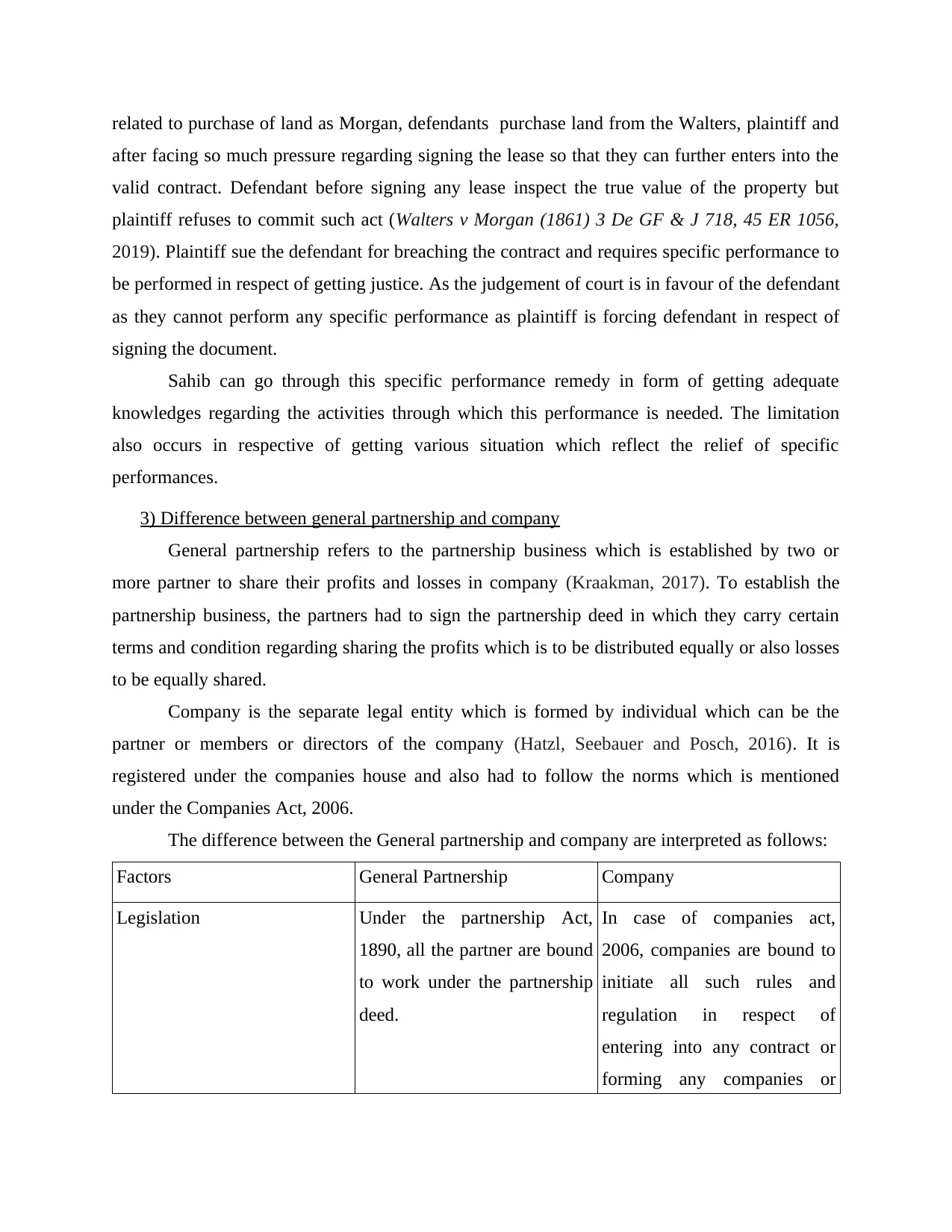
related to purchase of land as Morgan, defendants purchase land from the Walters, plaintiff and
after facing so much pressure regarding signing the lease so that they can further enters into the
valid contract. Defendant before signing any lease inspect the true value of the property but
plaintiff refuses to commit such act (Walters v Morgan (1861) 3 De GF & J 718, 45 ER 1056,
2019). Plaintiff sue the defendant for breaching the contract and requires specific performance to
be performed in respect of getting justice. As the judgement of court is in favour of the defendant
as they cannot perform any specific performance as plaintiff is forcing defendant in respect of
signing the document.
Sahib can go through this specific performance remedy in form of getting adequate
knowledges regarding the activities through which this performance is needed. The limitation
also occurs in respective of getting various situation which reflect the relief of specific
performances.
3) Difference between general partnership and company
General partnership refers to the partnership business which is established by two or
more partner to share their profits and losses in company (Kraakman, 2017). To establish the
partnership business, the partners had to sign the partnership deed in which they carry certain
terms and condition regarding sharing the profits which is to be distributed equally or also losses
to be equally shared.
Company is the separate legal entity which is formed by individual which can be the
partner or members or directors of the company (Hatzl, Seebauer and Posch, 2016). It is
registered under the companies house and also had to follow the norms which is mentioned
under the Companies Act, 2006.
The difference between the General partnership and company are interpreted as follows:
Factors General Partnership Company
Legislation Under the partnership Act,
1890, all the partner are bound
to work under the partnership
deed.
In case of companies act,
2006, companies are bound to
initiate all such rules and
regulation in respect of
entering into any contract or
forming any companies or
after facing so much pressure regarding signing the lease so that they can further enters into the
valid contract. Defendant before signing any lease inspect the true value of the property but
plaintiff refuses to commit such act (Walters v Morgan (1861) 3 De GF & J 718, 45 ER 1056,
2019). Plaintiff sue the defendant for breaching the contract and requires specific performance to
be performed in respect of getting justice. As the judgement of court is in favour of the defendant
as they cannot perform any specific performance as plaintiff is forcing defendant in respect of
signing the document.
Sahib can go through this specific performance remedy in form of getting adequate
knowledges regarding the activities through which this performance is needed. The limitation
also occurs in respective of getting various situation which reflect the relief of specific
performances.
3) Difference between general partnership and company
General partnership refers to the partnership business which is established by two or
more partner to share their profits and losses in company (Kraakman, 2017). To establish the
partnership business, the partners had to sign the partnership deed in which they carry certain
terms and condition regarding sharing the profits which is to be distributed equally or also losses
to be equally shared.
Company is the separate legal entity which is formed by individual which can be the
partner or members or directors of the company (Hatzl, Seebauer and Posch, 2016). It is
registered under the companies house and also had to follow the norms which is mentioned
under the Companies Act, 2006.
The difference between the General partnership and company are interpreted as follows:
Factors General Partnership Company
Legislation Under the partnership Act,
1890, all the partner are bound
to work under the partnership
deed.
In case of companies act,
2006, companies are bound to
initiate all such rules and
regulation in respect of
entering into any contract or
forming any companies or
Paraphrase This Document
Need a fresh take? Get an instant paraphrase of this document with our AI Paraphraser
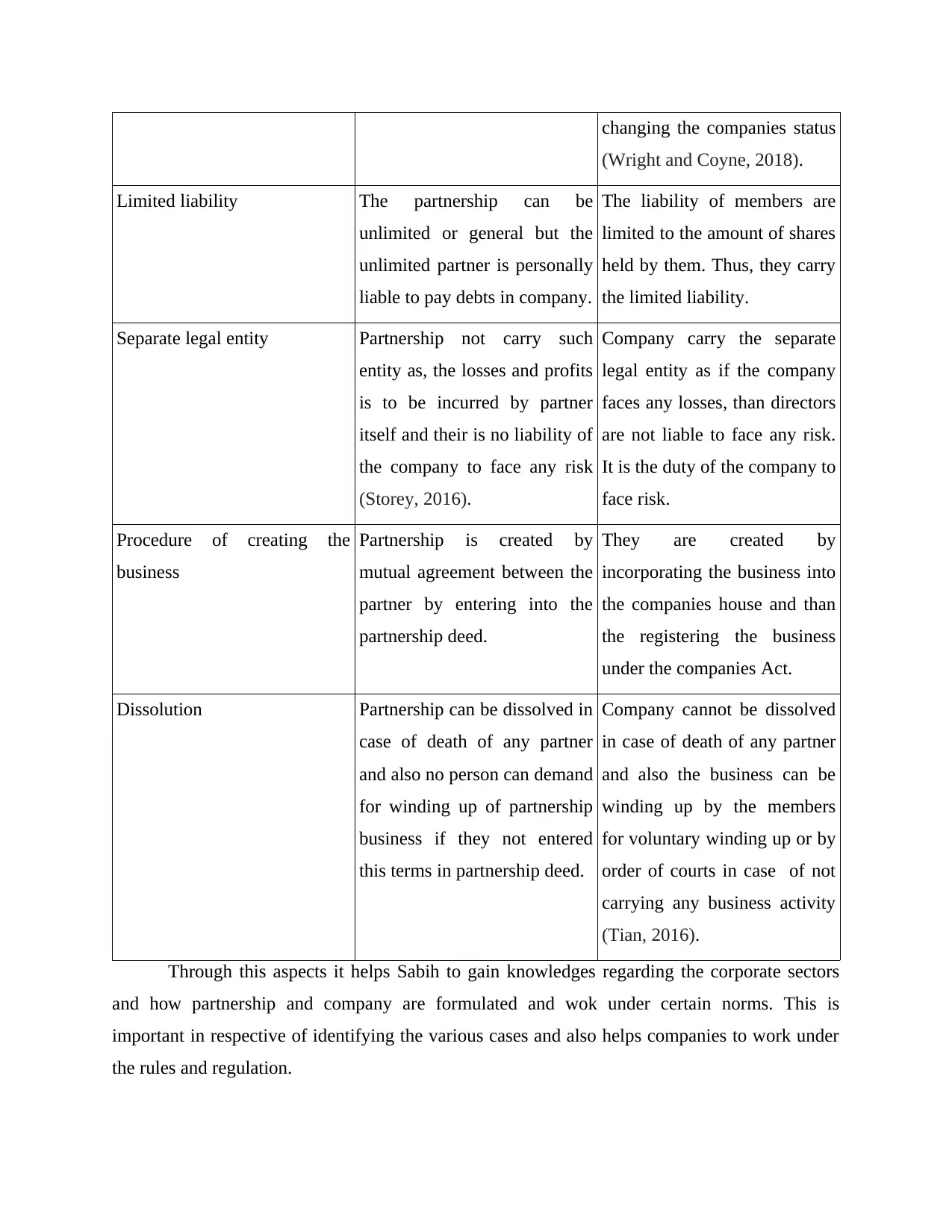
changing the companies status
(Wright and Coyne, 2018).
Limited liability The partnership can be
unlimited or general but the
unlimited partner is personally
liable to pay debts in company.
The liability of members are
limited to the amount of shares
held by them. Thus, they carry
the limited liability.
Separate legal entity Partnership not carry such
entity as, the losses and profits
is to be incurred by partner
itself and their is no liability of
the company to face any risk
(Storey, 2016).
Company carry the separate
legal entity as if the company
faces any losses, than directors
are not liable to face any risk.
It is the duty of the company to
face risk.
Procedure of creating the
business
Partnership is created by
mutual agreement between the
partner by entering into the
partnership deed.
They are created by
incorporating the business into
the companies house and than
the registering the business
under the companies Act.
Dissolution Partnership can be dissolved in
case of death of any partner
and also no person can demand
for winding up of partnership
business if they not entered
this terms in partnership deed.
Company cannot be dissolved
in case of death of any partner
and also the business can be
winding up by the members
for voluntary winding up or by
order of courts in case of not
carrying any business activity
(Tian, 2016).
Through this aspects it helps Sabih to gain knowledges regarding the corporate sectors
and how partnership and company are formulated and wok under certain norms. This is
important in respective of identifying the various cases and also helps companies to work under
the rules and regulation.
(Wright and Coyne, 2018).
Limited liability The partnership can be
unlimited or general but the
unlimited partner is personally
liable to pay debts in company.
The liability of members are
limited to the amount of shares
held by them. Thus, they carry
the limited liability.
Separate legal entity Partnership not carry such
entity as, the losses and profits
is to be incurred by partner
itself and their is no liability of
the company to face any risk
(Storey, 2016).
Company carry the separate
legal entity as if the company
faces any losses, than directors
are not liable to face any risk.
It is the duty of the company to
face risk.
Procedure of creating the
business
Partnership is created by
mutual agreement between the
partner by entering into the
partnership deed.
They are created by
incorporating the business into
the companies house and than
the registering the business
under the companies Act.
Dissolution Partnership can be dissolved in
case of death of any partner
and also no person can demand
for winding up of partnership
business if they not entered
this terms in partnership deed.
Company cannot be dissolved
in case of death of any partner
and also the business can be
winding up by the members
for voluntary winding up or by
order of courts in case of not
carrying any business activity
(Tian, 2016).
Through this aspects it helps Sabih to gain knowledges regarding the corporate sectors
and how partnership and company are formulated and wok under certain norms. This is
important in respective of identifying the various cases and also helps companies to work under
the rules and regulation.
4) Procedure of dismissal of employees under law
Employees can be dismissed if they violated any of the condition which is mentioned
under the Employment and Labour Law, 2016 or they can also be dismissed if their terms of the
employment are finished or completed within the set time (Countouris, 2016). Under the
employment Right Act, 1996, employees are to be dismissed in respect of getting the fair reason
by the employer and also they had adequate opportunity to present their case and evidence
regarding not committing any illegal activity (Njoya, 2016). It is conducted to be unfair in terms
of law if they dismissed employee on ground of pregnancy or the work which is beyond their
capacity or their terms of employments is completed. In such perspective the dismissal is
conducted in fair terms.
In respect of unfair terms, the dismissal is done in respect of violating any of the terms
which is important for every employee working in premises. As every company had to work
according to the norms and instruction which is mentioned by the government and also they are
bound to follow the guidances which is instructed by their superiors or leaders (Atkins and
Hoggett, 2018). In case of matter related to working in hazardous places, the company instruct
employees to wear the proper equipment through which they can save life by working at
hazardous places (Kirchner, Kremp and Magotsch, 2018). In case of breach committed by
employee in pertaining to work, it is the duty of the employer to give proper notice to employees
regarding the breach committed. After hearing the employee judgement regarding the particular
task, than accordingly the decision is to he interpreted. The unfair dismissal arises in case of not
giving adequate opportunity to employees to produce their judgement regarding the particular
task.
In case of Malloch V Aberdeen Corporation :HL 1971, the case is related to dismissal of
employee on grounds of conducting any theft activity without hearing his own perspective of
committing such crime (M A L L O C H V A B E R D E E N C O R P O R A T I O N : H L 1 9 7 1 ,
2019). As under the employment and labour law, if any person commit any breach or offences
regarding any of the activity, they are punishable under the court of laws. Thus, reasonable
opportunity is given by the employer to employee on grounds of giving proper notice before
dismissing him from job and also giving opportunity to identify the facts regarding committing
such crime.
Employees can be dismissed if they violated any of the condition which is mentioned
under the Employment and Labour Law, 2016 or they can also be dismissed if their terms of the
employment are finished or completed within the set time (Countouris, 2016). Under the
employment Right Act, 1996, employees are to be dismissed in respect of getting the fair reason
by the employer and also they had adequate opportunity to present their case and evidence
regarding not committing any illegal activity (Njoya, 2016). It is conducted to be unfair in terms
of law if they dismissed employee on ground of pregnancy or the work which is beyond their
capacity or their terms of employments is completed. In such perspective the dismissal is
conducted in fair terms.
In respect of unfair terms, the dismissal is done in respect of violating any of the terms
which is important for every employee working in premises. As every company had to work
according to the norms and instruction which is mentioned by the government and also they are
bound to follow the guidances which is instructed by their superiors or leaders (Atkins and
Hoggett, 2018). In case of matter related to working in hazardous places, the company instruct
employees to wear the proper equipment through which they can save life by working at
hazardous places (Kirchner, Kremp and Magotsch, 2018). In case of breach committed by
employee in pertaining to work, it is the duty of the employer to give proper notice to employees
regarding the breach committed. After hearing the employee judgement regarding the particular
task, than accordingly the decision is to he interpreted. The unfair dismissal arises in case of not
giving adequate opportunity to employees to produce their judgement regarding the particular
task.
In case of Malloch V Aberdeen Corporation :HL 1971, the case is related to dismissal of
employee on grounds of conducting any theft activity without hearing his own perspective of
committing such crime (M A L L O C H V A B E R D E E N C O R P O R A T I O N : H L 1 9 7 1 ,
2019). As under the employment and labour law, if any person commit any breach or offences
regarding any of the activity, they are punishable under the court of laws. Thus, reasonable
opportunity is given by the employer to employee on grounds of giving proper notice before
dismissing him from job and also giving opportunity to identify the facts regarding committing
such crime.
⊘ This is a preview!⊘
Do you want full access?
Subscribe today to unlock all pages.
Trusted by 1+ million students worldwide
The employees carry the rights in case of facing any discrimination regarding attaining
the work, they can file the suit under the Equality Act, 2010 (McDonald and Thompson, 2016).
Through this perspective, they can save the interest of employees and also take strict actions
against the company for discriminating the employees on the bases of caste, sex, colour, region
or religion.
CONCLUSION
From the above study the report is concluded that business law determine the overall
activity of the business and also helps companies to plan their working criteria according to
certain norms and instructions. In this report business law plays an important role in respective of
examined the various laws and regulation which is imposed by government and also executed to
public, so that it is interpreted to get accurate justice. This report is mainly prepared for Sabih
regarding preparing for the interview and for that various aspects are to be determined in
respective of getting the adequate knowledges regarding the system working. In this report, they
came to know about the working of the three main organs of the government and how the law is
to be made, enacted and interpreted to get better results. The topic which is discussed is relating
to specific performances in such case they are discussed in relevant to certain situation and also
court can limit to perform the specific performance if the suit can be easily solved by mutual
agreement. As there is huge differentiated between the company and partnership under the
separate legal entity concept and limited perspective. Thus, the final report concludes with
respect to getting various factors through which the employees can be dismissal under law and
they are affecting the rights which is mentioned under the Employment Act.
the work, they can file the suit under the Equality Act, 2010 (McDonald and Thompson, 2016).
Through this perspective, they can save the interest of employees and also take strict actions
against the company for discriminating the employees on the bases of caste, sex, colour, region
or religion.
CONCLUSION
From the above study the report is concluded that business law determine the overall
activity of the business and also helps companies to plan their working criteria according to
certain norms and instructions. In this report business law plays an important role in respective of
examined the various laws and regulation which is imposed by government and also executed to
public, so that it is interpreted to get accurate justice. This report is mainly prepared for Sabih
regarding preparing for the interview and for that various aspects are to be determined in
respective of getting the adequate knowledges regarding the system working. In this report, they
came to know about the working of the three main organs of the government and how the law is
to be made, enacted and interpreted to get better results. The topic which is discussed is relating
to specific performances in such case they are discussed in relevant to certain situation and also
court can limit to perform the specific performance if the suit can be easily solved by mutual
agreement. As there is huge differentiated between the company and partnership under the
separate legal entity concept and limited perspective. Thus, the final report concludes with
respect to getting various factors through which the employees can be dismissal under law and
they are affecting the rights which is mentioned under the Employment Act.
Paraphrase This Document
Need a fresh take? Get an instant paraphrase of this document with our AI Paraphraser
REFERENCES
Books and Journals
Arbel, Y. A., 2015. Contract remedies in action: Specific performance. W. Va. L. Rev. 118.
p.369.
Atkins, S. and Hoggett, B., 2018. Women and the Law. Institute of Advanced Legal Studies,
School of Advanced Study, University of London.
Barnett, R. E. and Oman, N. B., 2016. Contracts: Cases and Doctrine. Wolters Kluwer Law &
Business.
Blondel, J. and Cotta, M. eds., 2016. Party and government: an inquiry into the relationship
between governments and supporting parties in liberal democracies. Springer.
Bray, S. L., 2016. The System of Equitable Remedies. UCLA L. Rev. 63. p.530.
Cain, M. E., 2015. Society and the Policeman's Role. Routledge.
Countouris, N., 2016. The changing law of the employment relationship: comparative analyses
in the European context. Routledge.
Fischer-Lescano, A. and Teubner, G., 2019. Regime-collisions: the vain search for legal unity in
the fragmentation of global law. In Critical theory and legal autopoiesis. Manchester
University Press.
Hatzl, S., Seebauer, S. and Posch, A., 2016. Market-based vs. grassroots citizen participation
initiatives in photovoltaics: A qualitative comparison of niche development. Futures.
78. pp.57-70.
Kirchner, J., Kremp, P. R. and Magotsch, M., 2018. Key aspects of German employment and
labour law. Springer Berlin Heidelberg:.
Kraakman, R., 2017. The anatomy of corporate law: A comparative and functional approach.
Oxford University Press.
McDonald, P. and Thompson, P., 2016. Social media (tion) and the reshaping of public/private
boundaries in employment relations. International Journal of Management Reviews.
18(1). pp.69-84.
Naschold, F., 2017. New Frontiers in the Public Sector Management: Trends and Issues in State
and Local Government in Europe (Vol. 69). Walter de Gruyter GmbH & Co KG.
Njoya, W., 2016. Property in work: The employment relationship in the Anglo-American firm.
Routledge.
Books and Journals
Arbel, Y. A., 2015. Contract remedies in action: Specific performance. W. Va. L. Rev. 118.
p.369.
Atkins, S. and Hoggett, B., 2018. Women and the Law. Institute of Advanced Legal Studies,
School of Advanced Study, University of London.
Barnett, R. E. and Oman, N. B., 2016. Contracts: Cases and Doctrine. Wolters Kluwer Law &
Business.
Blondel, J. and Cotta, M. eds., 2016. Party and government: an inquiry into the relationship
between governments and supporting parties in liberal democracies. Springer.
Bray, S. L., 2016. The System of Equitable Remedies. UCLA L. Rev. 63. p.530.
Cain, M. E., 2015. Society and the Policeman's Role. Routledge.
Countouris, N., 2016. The changing law of the employment relationship: comparative analyses
in the European context. Routledge.
Fischer-Lescano, A. and Teubner, G., 2019. Regime-collisions: the vain search for legal unity in
the fragmentation of global law. In Critical theory and legal autopoiesis. Manchester
University Press.
Hatzl, S., Seebauer, S. and Posch, A., 2016. Market-based vs. grassroots citizen participation
initiatives in photovoltaics: A qualitative comparison of niche development. Futures.
78. pp.57-70.
Kirchner, J., Kremp, P. R. and Magotsch, M., 2018. Key aspects of German employment and
labour law. Springer Berlin Heidelberg:.
Kraakman, R., 2017. The anatomy of corporate law: A comparative and functional approach.
Oxford University Press.
McDonald, P. and Thompson, P., 2016. Social media (tion) and the reshaping of public/private
boundaries in employment relations. International Journal of Management Reviews.
18(1). pp.69-84.
Naschold, F., 2017. New Frontiers in the Public Sector Management: Trends and Issues in State
and Local Government in Europe (Vol. 69). Walter de Gruyter GmbH & Co KG.
Njoya, W., 2016. Property in work: The employment relationship in the Anglo-American firm.
Routledge.
Storey, D. J., 2016. Understanding the small business sector. Routledge.
Tian, X., 2016. Managing international business in China. Cambridge University Press.
Weimer, D. L. and Vining, A. R., 2017. Policy analysis: Concepts and practice. Routledge.
Wright, M. and Coyne, J., 2018. Management buy-outs. Routledge.
Online
Business Law and Regulation. 2019. [Online]. Available through:
<https://www.icaew.com/library/subject-gateways/law/business-law-and-regulation>.
Cohen v Roche [1927]. 2019. Online. Available Through:
<https://webstroke.co.uk/law/cases/cohen-v-roche-1927>.
M A L L O C H V A B E R D E E N C O R P O R A T I O N : H L 1 9 7 1 . 2019. Online. Available
Through: <https://swarb.co.uk/malloch-v-aberdeen-corporation-hl-1971/>.
Walters v Morgan (1861) 3 De GF & J 718, 45 ER 1056. 2019. Online. Available Through:
<https://auckland.rl.talis.com/items/AA4994A3-D7A5-7337-A3FF-
F1917A7FC082.html>.
Tian, X., 2016. Managing international business in China. Cambridge University Press.
Weimer, D. L. and Vining, A. R., 2017. Policy analysis: Concepts and practice. Routledge.
Wright, M. and Coyne, J., 2018. Management buy-outs. Routledge.
Online
Business Law and Regulation. 2019. [Online]. Available through:
<https://www.icaew.com/library/subject-gateways/law/business-law-and-regulation>.
Cohen v Roche [1927]. 2019. Online. Available Through:
<https://webstroke.co.uk/law/cases/cohen-v-roche-1927>.
M A L L O C H V A B E R D E E N C O R P O R A T I O N : H L 1 9 7 1 . 2019. Online. Available
Through: <https://swarb.co.uk/malloch-v-aberdeen-corporation-hl-1971/>.
Walters v Morgan (1861) 3 De GF & J 718, 45 ER 1056. 2019. Online. Available Through:
<https://auckland.rl.talis.com/items/AA4994A3-D7A5-7337-A3FF-
F1917A7FC082.html>.
⊘ This is a preview!⊘
Do you want full access?
Subscribe today to unlock all pages.
Trusted by 1+ million students worldwide

1 out of 12


Related Documents


Your All-in-One AI-Powered Toolkit for Academic Success.
+13062052269
info@desklib.com
Available 24*7 on WhatsApp / Email
![[object Object]](/_next/static/media/star-bottom.7253800d.svg)
Unlock your academic potential
Copyright © 2020–2026 A2Z Services. All Rights Reserved. Developed and managed by ZUCOL.