Business Law Assignment: Sources of Law, Government, and Company Law
VerifiedAdded on 2022/12/27
|10
|2273
|42
Report
AI Summary
This report provides a thorough analysis of various aspects of Business Law, encompassing key areas such as the sources of law, including common law, equity law, and legislation. It delves into the roles of different governmental bodies like the Monarch, Executive, Judiciary, and Legislature, specifically examining the functions of the House of Commons and the House of Lords within the UK legal framework. The report also critically evaluates the legal system by discussing recent reforms, notably the Woolf reforms, and their impact on the justice system. Furthermore, it examines company law, including company formation, status, characteristics, and different types of companies, along with employment law, contrasting self-employed individuals and employees through various tests. Contract law, with its essential elements, is also explored. Additional topics covered include the Insolvency Act 1986, the Equality Act 2010, environmental protection, redundancy, and data protection. The role of trade unions, Citizens Advice Bureau, and employment tribunals are discussed, along with negligence and its essentials. The report concludes with a comprehensive list of references.
Running head: BUSINESS LAW
Business Law
Name of the Student
Name of the University
Author Note
Business Law
Name of the Student
Name of the University
Author Note
Paraphrase This Document
Need a fresh take? Get an instant paraphrase of this document with our AI Paraphraser

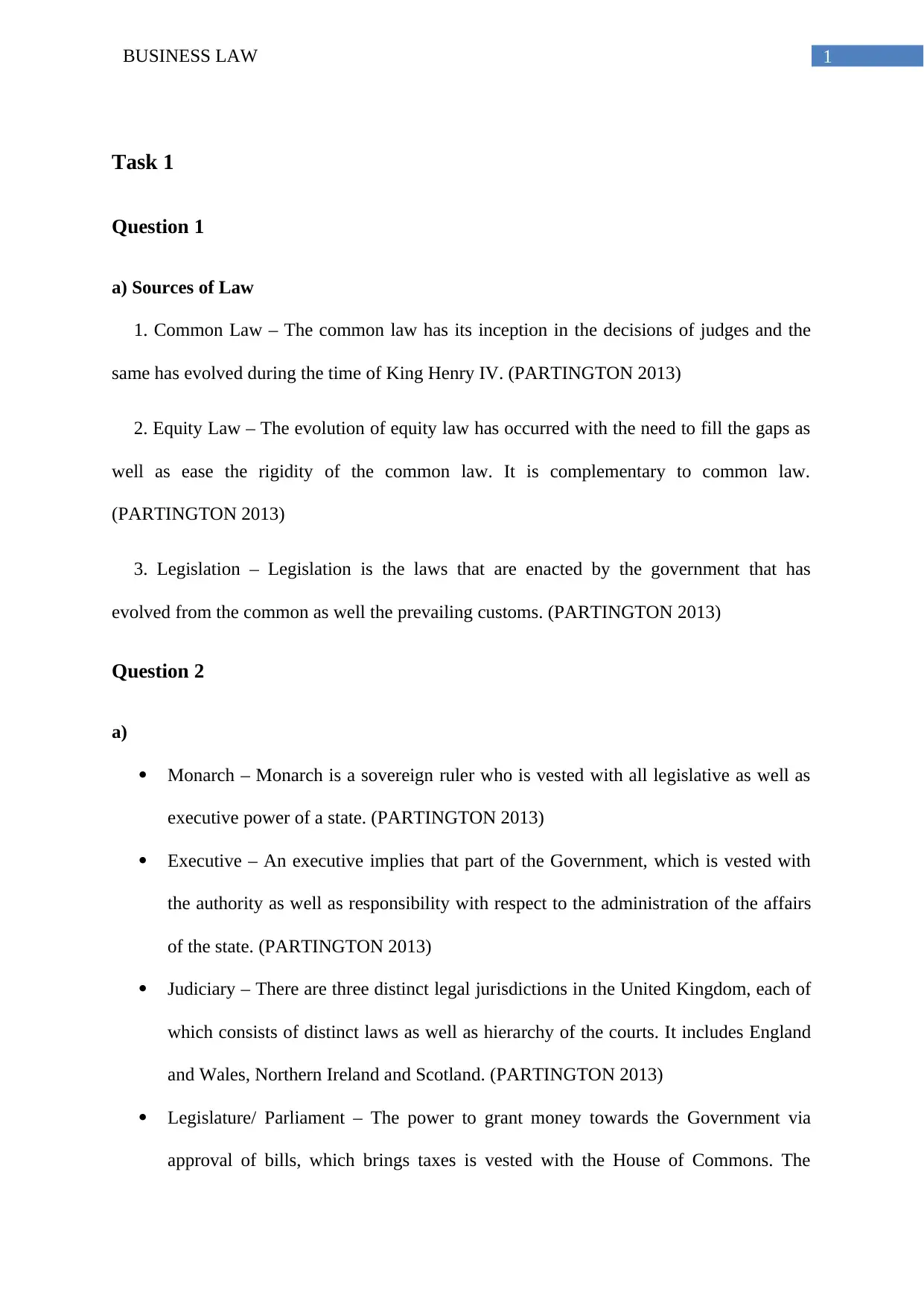
1BUSINESS LAW
Task 1
Question 1
a) Sources of Law
1. Common Law – The common law has its inception in the decisions of judges and the
same has evolved during the time of King Henry IV. (PARTINGTON 2013)
2. Equity Law – The evolution of equity law has occurred with the need to fill the gaps as
well as ease the rigidity of the common law. It is complementary to common law.
(PARTINGTON 2013)
3. Legislation – Legislation is the laws that are enacted by the government that has
evolved from the common as well the prevailing customs. (PARTINGTON 2013)
Question 2
a)
Monarch – Monarch is a sovereign ruler who is vested with all legislative as well as
executive power of a state. (PARTINGTON 2013)
Executive – An executive implies that part of the Government, which is vested with
the authority as well as responsibility with respect to the administration of the affairs
of the state. (PARTINGTON 2013)
Judiciary – There are three distinct legal jurisdictions in the United Kingdom, each of
which consists of distinct laws as well as hierarchy of the courts. It includes England
and Wales, Northern Ireland and Scotland. (PARTINGTON 2013)
Legislature/ Parliament – The power to grant money towards the Government via
approval of bills, which brings taxes is vested with the House of Commons. The
Task 1
Question 1
a) Sources of Law
1. Common Law – The common law has its inception in the decisions of judges and the
same has evolved during the time of King Henry IV. (PARTINGTON 2013)
2. Equity Law – The evolution of equity law has occurred with the need to fill the gaps as
well as ease the rigidity of the common law. It is complementary to common law.
(PARTINGTON 2013)
3. Legislation – Legislation is the laws that are enacted by the government that has
evolved from the common as well the prevailing customs. (PARTINGTON 2013)
Question 2
a)
Monarch – Monarch is a sovereign ruler who is vested with all legislative as well as
executive power of a state. (PARTINGTON 2013)
Executive – An executive implies that part of the Government, which is vested with
the authority as well as responsibility with respect to the administration of the affairs
of the state. (PARTINGTON 2013)
Judiciary – There are three distinct legal jurisdictions in the United Kingdom, each of
which consists of distinct laws as well as hierarchy of the courts. It includes England
and Wales, Northern Ireland and Scotland. (PARTINGTON 2013)
Legislature/ Parliament – The power to grant money towards the Government via
approval of bills, which brings taxes is vested with the House of Commons. The

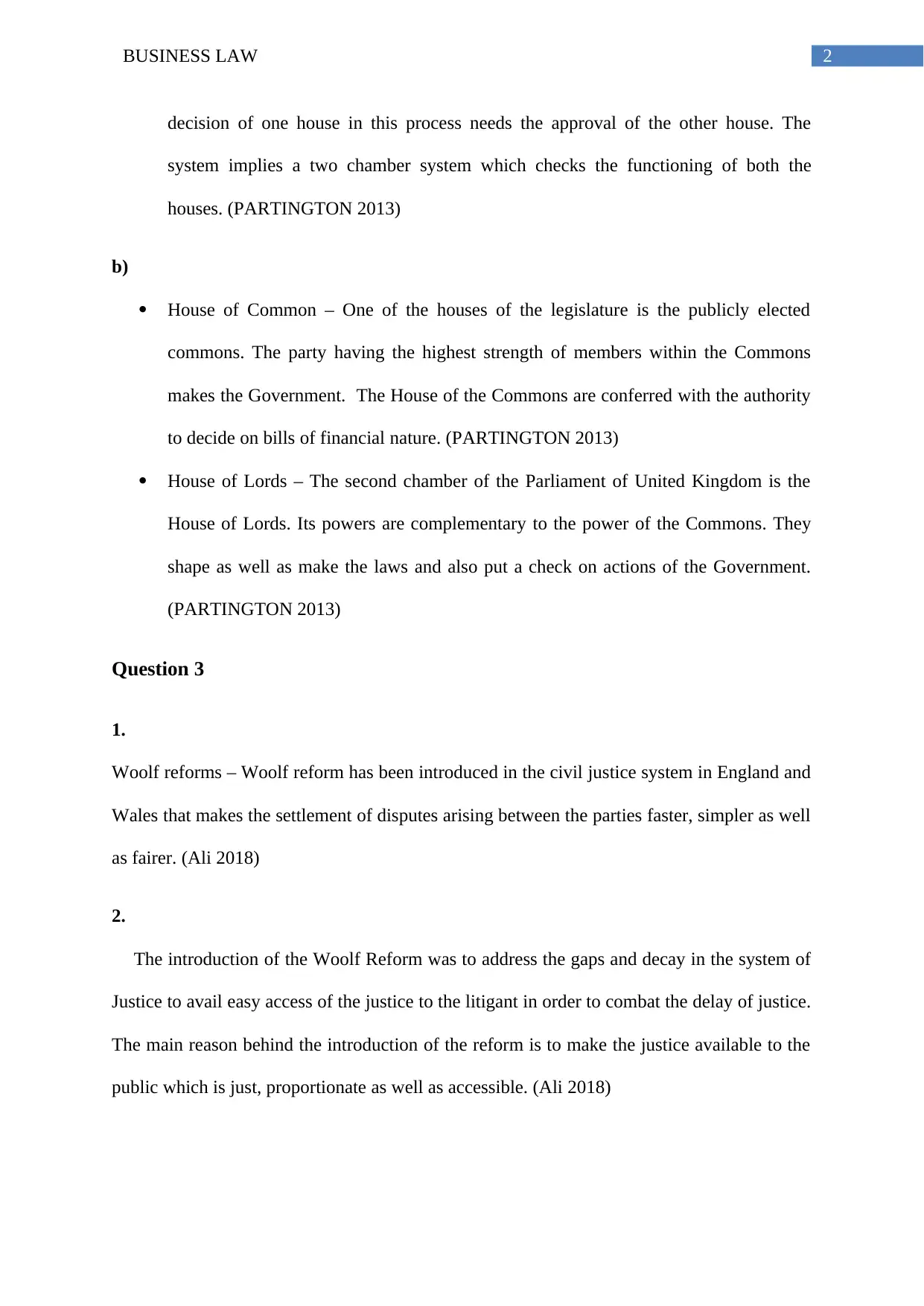
2BUSINESS LAW
decision of one house in this process needs the approval of the other house. The
system implies a two chamber system which checks the functioning of both the
houses. (PARTINGTON 2013)
b)
House of Common – One of the houses of the legislature is the publicly elected
commons. The party having the highest strength of members within the Commons
makes the Government. The House of the Commons are conferred with the authority
to decide on bills of financial nature. (PARTINGTON 2013)
House of Lords – The second chamber of the Parliament of United Kingdom is the
House of Lords. Its powers are complementary to the power of the Commons. They
shape as well as make the laws and also put a check on actions of the Government.
(PARTINGTON 2013)
Question 3
1.
Woolf reforms – Woolf reform has been introduced in the civil justice system in England and
Wales that makes the settlement of disputes arising between the parties faster, simpler as well
as fairer. (Ali 2018)
2.
The introduction of the Woolf Reform was to address the gaps and decay in the system of
Justice to avail easy access of the justice to the litigant in order to combat the delay of justice.
The main reason behind the introduction of the reform is to make the justice available to the
public which is just, proportionate as well as accessible. (Ali 2018)
decision of one house in this process needs the approval of the other house. The
system implies a two chamber system which checks the functioning of both the
houses. (PARTINGTON 2013)
b)
House of Common – One of the houses of the legislature is the publicly elected
commons. The party having the highest strength of members within the Commons
makes the Government. The House of the Commons are conferred with the authority
to decide on bills of financial nature. (PARTINGTON 2013)
House of Lords – The second chamber of the Parliament of United Kingdom is the
House of Lords. Its powers are complementary to the power of the Commons. They
shape as well as make the laws and also put a check on actions of the Government.
(PARTINGTON 2013)
Question 3
1.
Woolf reforms – Woolf reform has been introduced in the civil justice system in England and
Wales that makes the settlement of disputes arising between the parties faster, simpler as well
as fairer. (Ali 2018)
2.
The introduction of the Woolf Reform was to address the gaps and decay in the system of
Justice to avail easy access of the justice to the litigant in order to combat the delay of justice.
The main reason behind the introduction of the reform is to make the justice available to the
public which is just, proportionate as well as accessible. (Ali 2018)
⊘ This is a preview!⊘
Do you want full access?
Subscribe today to unlock all pages.

Trusted by 1+ million students worldwide

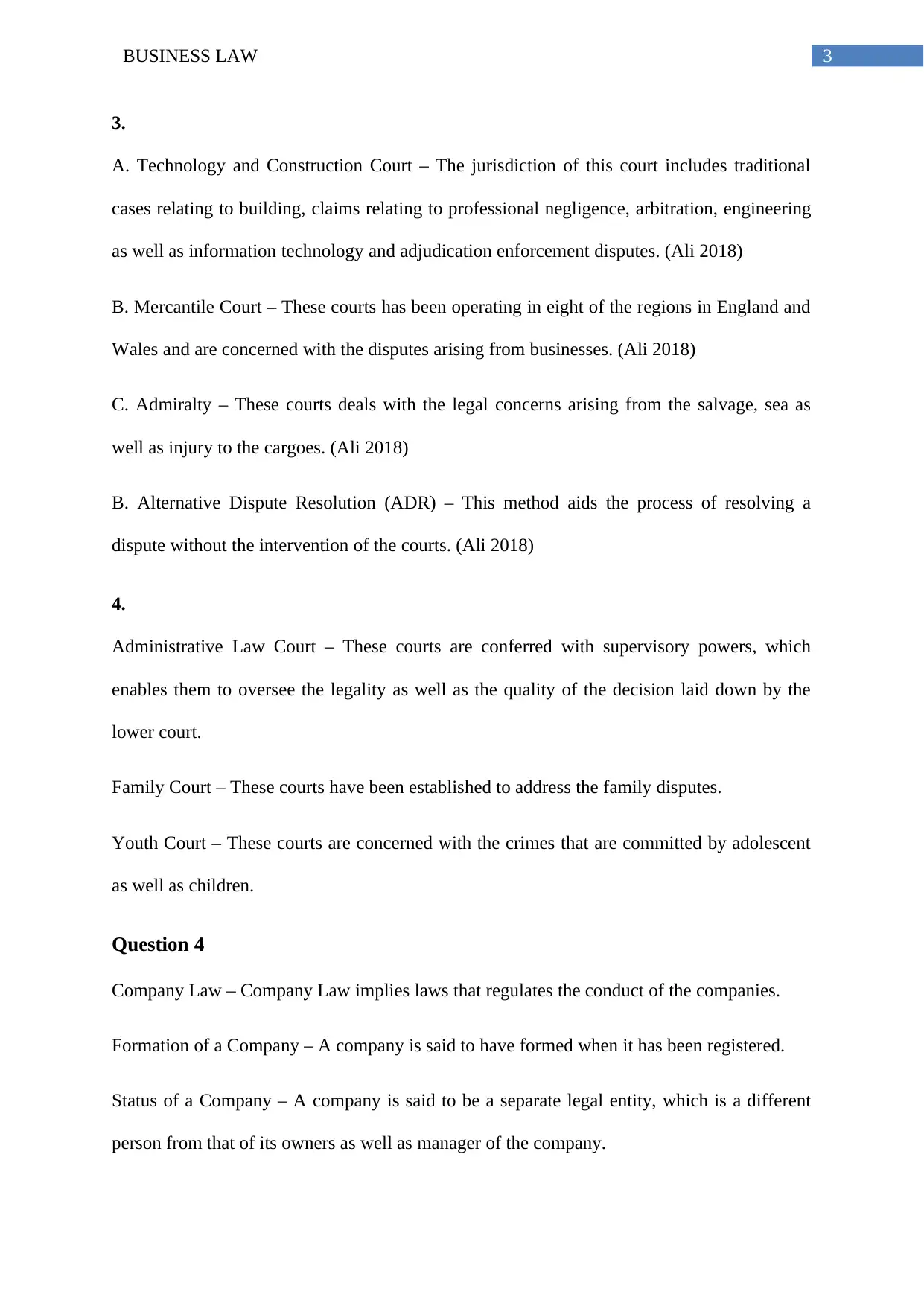
3BUSINESS LAW
3.
A. Technology and Construction Court – The jurisdiction of this court includes traditional
cases relating to building, claims relating to professional negligence, arbitration, engineering
as well as information technology and adjudication enforcement disputes. (Ali 2018)
B. Mercantile Court – These courts has been operating in eight of the regions in England and
Wales and are concerned with the disputes arising from businesses. (Ali 2018)
C. Admiralty – These courts deals with the legal concerns arising from the salvage, sea as
well as injury to the cargoes. (Ali 2018)
B. Alternative Dispute Resolution (ADR) – This method aids the process of resolving a
dispute without the intervention of the courts. (Ali 2018)
4.
Administrative Law Court – These courts are conferred with supervisory powers, which
enables them to oversee the legality as well as the quality of the decision laid down by the
lower court.
Family Court – These courts have been established to address the family disputes.
Youth Court – These courts are concerned with the crimes that are committed by adolescent
as well as children.
Question 4
Company Law – Company Law implies laws that regulates the conduct of the companies.
Formation of a Company – A company is said to have formed when it has been registered.
Status of a Company – A company is said to be a separate legal entity, which is a different
person from that of its owners as well as manager of the company.
3.
A. Technology and Construction Court – The jurisdiction of this court includes traditional
cases relating to building, claims relating to professional negligence, arbitration, engineering
as well as information technology and adjudication enforcement disputes. (Ali 2018)
B. Mercantile Court – These courts has been operating in eight of the regions in England and
Wales and are concerned with the disputes arising from businesses. (Ali 2018)
C. Admiralty – These courts deals with the legal concerns arising from the salvage, sea as
well as injury to the cargoes. (Ali 2018)
B. Alternative Dispute Resolution (ADR) – This method aids the process of resolving a
dispute without the intervention of the courts. (Ali 2018)
4.
Administrative Law Court – These courts are conferred with supervisory powers, which
enables them to oversee the legality as well as the quality of the decision laid down by the
lower court.
Family Court – These courts have been established to address the family disputes.
Youth Court – These courts are concerned with the crimes that are committed by adolescent
as well as children.
Question 4
Company Law – Company Law implies laws that regulates the conduct of the companies.
Formation of a Company – A company is said to have formed when it has been registered.
Status of a Company – A company is said to be a separate legal entity, which is a different
person from that of its owners as well as manager of the company.
Paraphrase This Document
Need a fresh take? Get an instant paraphrase of this document with our AI Paraphraser

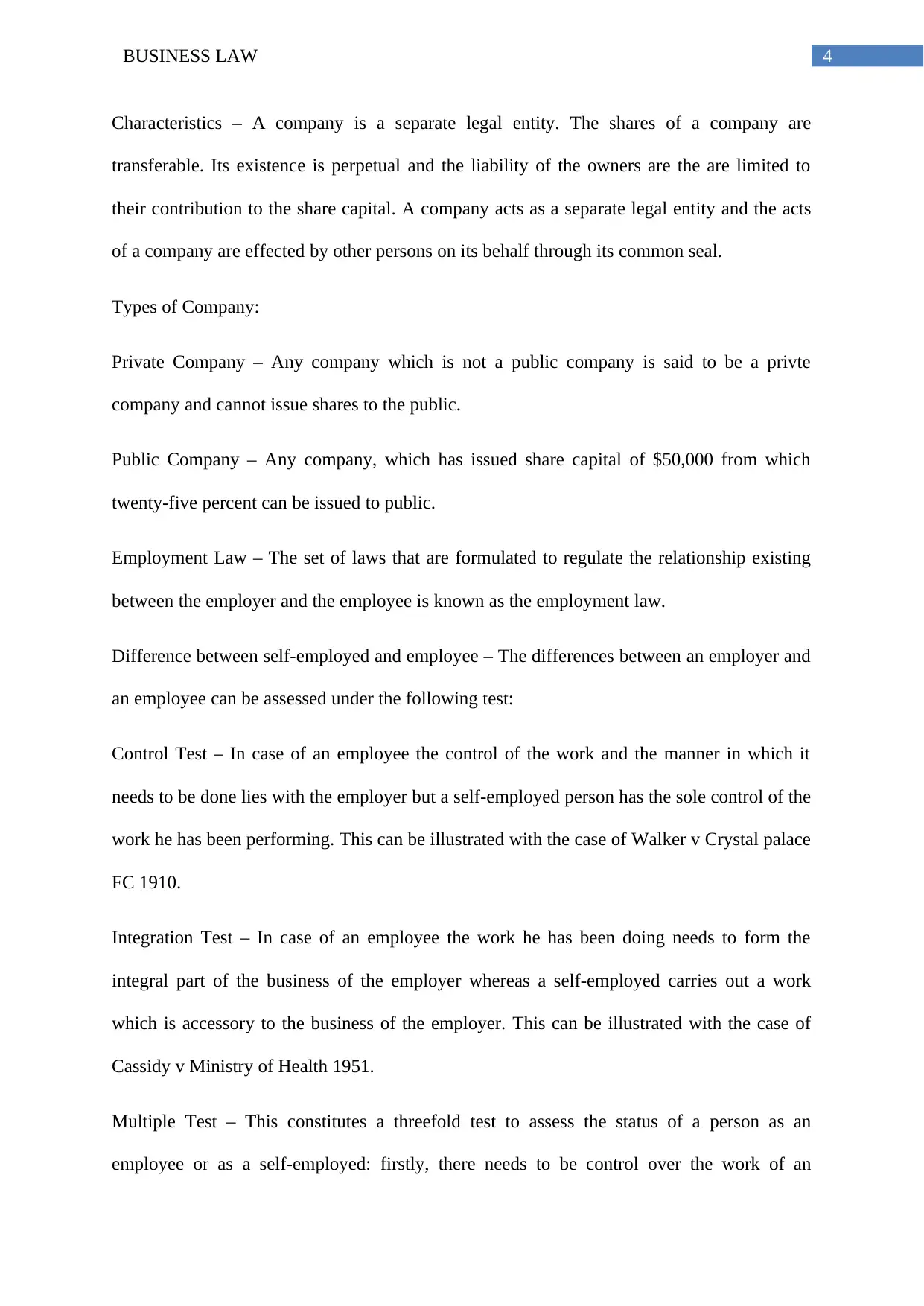
4BUSINESS LAW
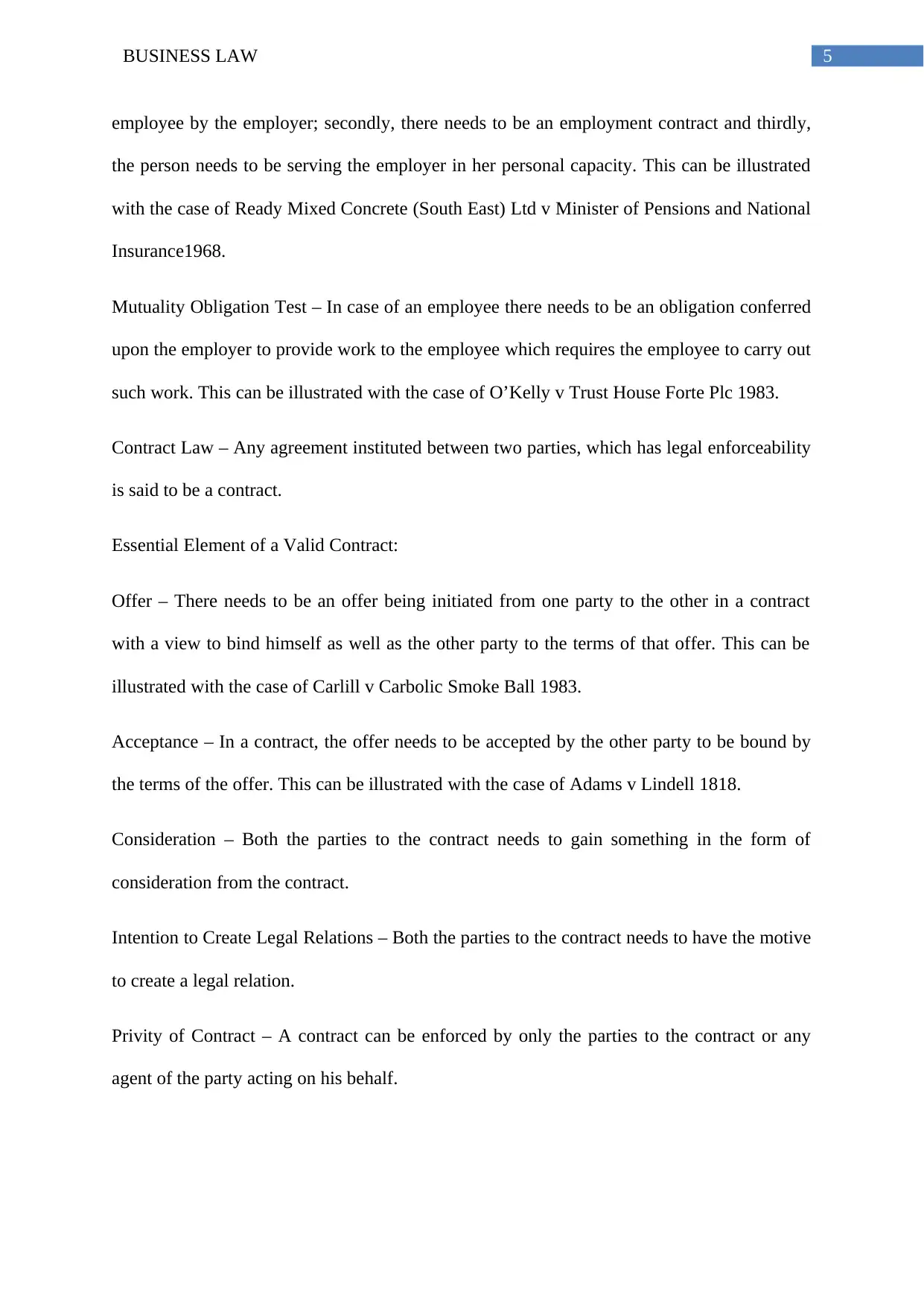
Characteristics – A company is a separate legal entity. The shares of a company are
transferable. Its existence is perpetual and the liability of the owners are the are limited to
their contribution to the share capital. A company acts as a separate legal entity and the acts
of a company are effected by other persons on its behalf through its common seal.
Types of Company:
Private Company – Any company which is not a public company is said to be a privte
company and cannot issue shares to the public.
Public Company – Any company, which has issued share capital of $50,000 from which
twenty-five percent can be issued to public.
Employment Law – The set of laws that are formulated to regulate the relationship existing
between the employer and the employee is known as the employment law.
Difference between self-employed and employee – The differences between an employer and
an employee can be assessed under the following test:
Control Test – In case of an employee the control of the work and the manner in which it
needs to be done lies with the employer but a self-employed person has the sole control of the
work he has been performing. This can be illustrated with the case of Walker v Crystal palace
FC 1910.
Integration Test – In case of an employee the work he has been doing needs to form the
integral part of the business of the employer whereas a self-employed carries out a work
which is accessory to the business of the employer. This can be illustrated with the case of
Cassidy v Ministry of Health 1951.
Multiple Test – This constitutes a threefold test to assess the status of a person as an
employee or as a self-employed: firstly, there needs to be control over the work of an
Characteristics – A company is a separate legal entity. The shares of a company are
transferable. Its existence is perpetual and the liability of the owners are the are limited to
their contribution to the share capital. A company acts as a separate legal entity and the acts
of a company are effected by other persons on its behalf through its common seal.
Types of Company:
Private Company – Any company which is not a public company is said to be a privte
company and cannot issue shares to the public.
Public Company – Any company, which has issued share capital of $50,000 from which
twenty-five percent can be issued to public.
Employment Law – The set of laws that are formulated to regulate the relationship existing
between the employer and the employee is known as the employment law.
Difference between self-employed and employee – The differences between an employer and
an employee can be assessed under the following test:
Control Test – In case of an employee the control of the work and the manner in which it
needs to be done lies with the employer but a self-employed person has the sole control of the
work he has been performing. This can be illustrated with the case of Walker v Crystal palace
FC 1910.
Integration Test – In case of an employee the work he has been doing needs to form the
integral part of the business of the employer whereas a self-employed carries out a work
which is accessory to the business of the employer. This can be illustrated with the case of
Cassidy v Ministry of Health 1951.
Multiple Test – This constitutes a threefold test to assess the status of a person as an
employee or as a self-employed: firstly, there needs to be control over the work of an

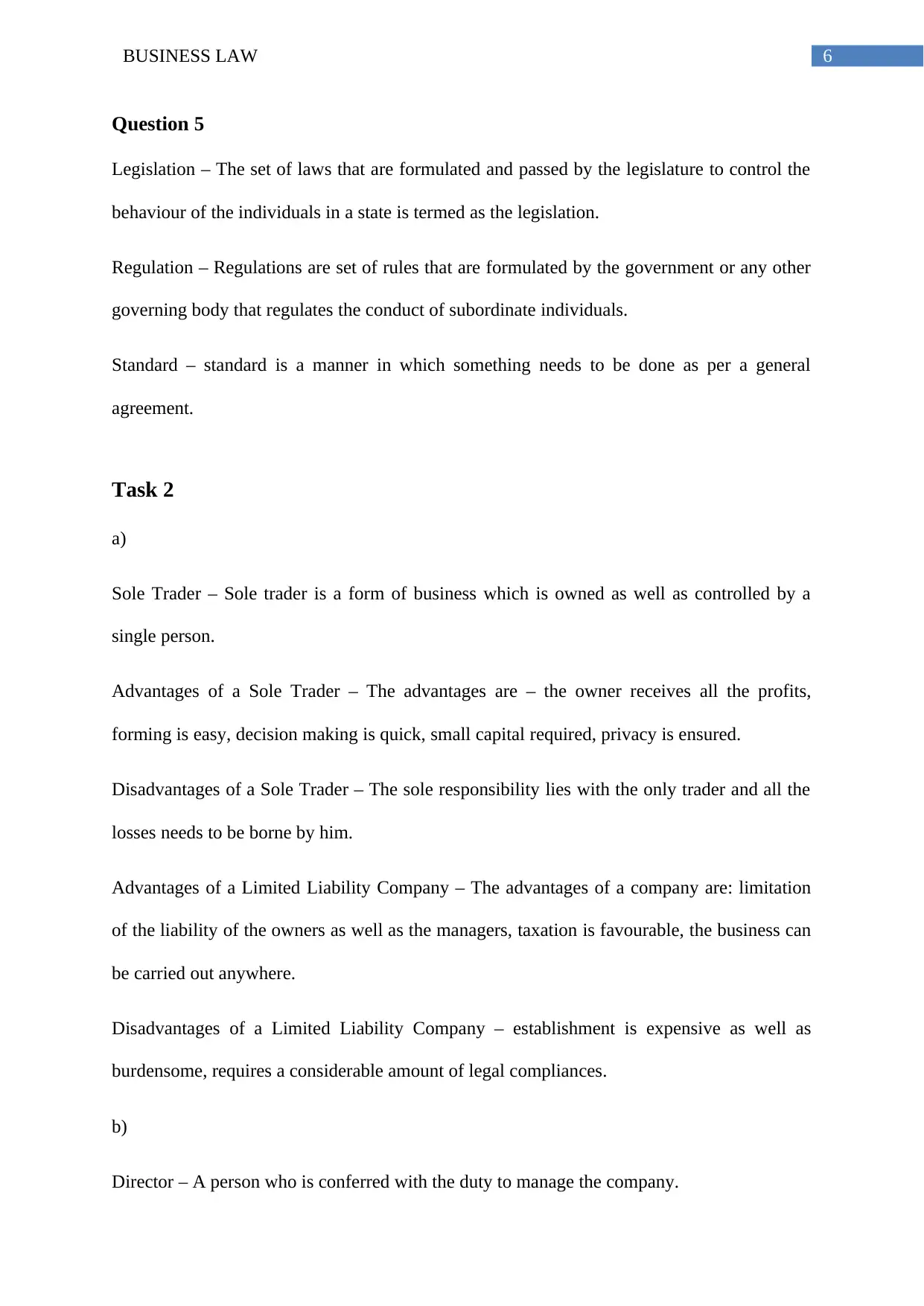
5BUSINESS LAW
employee by the employer; secondly, there needs to be an employment contract and thirdly,
the person needs to be serving the employer in her personal capacity. This can be illustrated
with the case of Ready Mixed Concrete (South East) Ltd v Minister of Pensions and National
Insurance1968.
Mutuality Obligation Test – In case of an employee there needs to be an obligation conferred
upon the employer to provide work to the employee which requires the employee to carry out
such work. This can be illustrated with the case of O’Kelly v Trust House Forte Plc 1983.
Contract Law – Any agreement instituted between two parties, which has legal enforceability
is said to be a contract.
Essential Element of a Valid Contract:
Offer – There needs to be an offer being initiated from one party to the other in a contract
with a view to bind himself as well as the other party to the terms of that offer. This can be
illustrated with the case of Carlill v Carbolic Smoke Ball 1983.
Acceptance – In a contract, the offer needs to be accepted by the other party to be bound by
the terms of the offer. This can be illustrated with the case of Adams v Lindell 1818.
Consideration – Both the parties to the contract needs to gain something in the form of
consideration from the contract.
Intention to Create Legal Relations – Both the parties to the contract needs to have the motive
to create a legal relation.
Privity of Contract – A contract can be enforced by only the parties to the contract or any
agent of the party acting on his behalf.
employee by the employer; secondly, there needs to be an employment contract and thirdly,
the person needs to be serving the employer in her personal capacity. This can be illustrated
with the case of Ready Mixed Concrete (South East) Ltd v Minister of Pensions and National
Insurance1968.
Mutuality Obligation Test – In case of an employee there needs to be an obligation conferred
upon the employer to provide work to the employee which requires the employee to carry out
such work. This can be illustrated with the case of O’Kelly v Trust House Forte Plc 1983.
Contract Law – Any agreement instituted between two parties, which has legal enforceability
is said to be a contract.
Essential Element of a Valid Contract:
Offer – There needs to be an offer being initiated from one party to the other in a contract
with a view to bind himself as well as the other party to the terms of that offer. This can be
illustrated with the case of Carlill v Carbolic Smoke Ball 1983.
Acceptance – In a contract, the offer needs to be accepted by the other party to be bound by
the terms of the offer. This can be illustrated with the case of Adams v Lindell 1818.
Consideration – Both the parties to the contract needs to gain something in the form of
consideration from the contract.
Intention to Create Legal Relations – Both the parties to the contract needs to have the motive
to create a legal relation.
Privity of Contract – A contract can be enforced by only the parties to the contract or any
agent of the party acting on his behalf.
⊘ This is a preview!⊘
Do you want full access?
Subscribe today to unlock all pages.

Trusted by 1+ million students worldwide

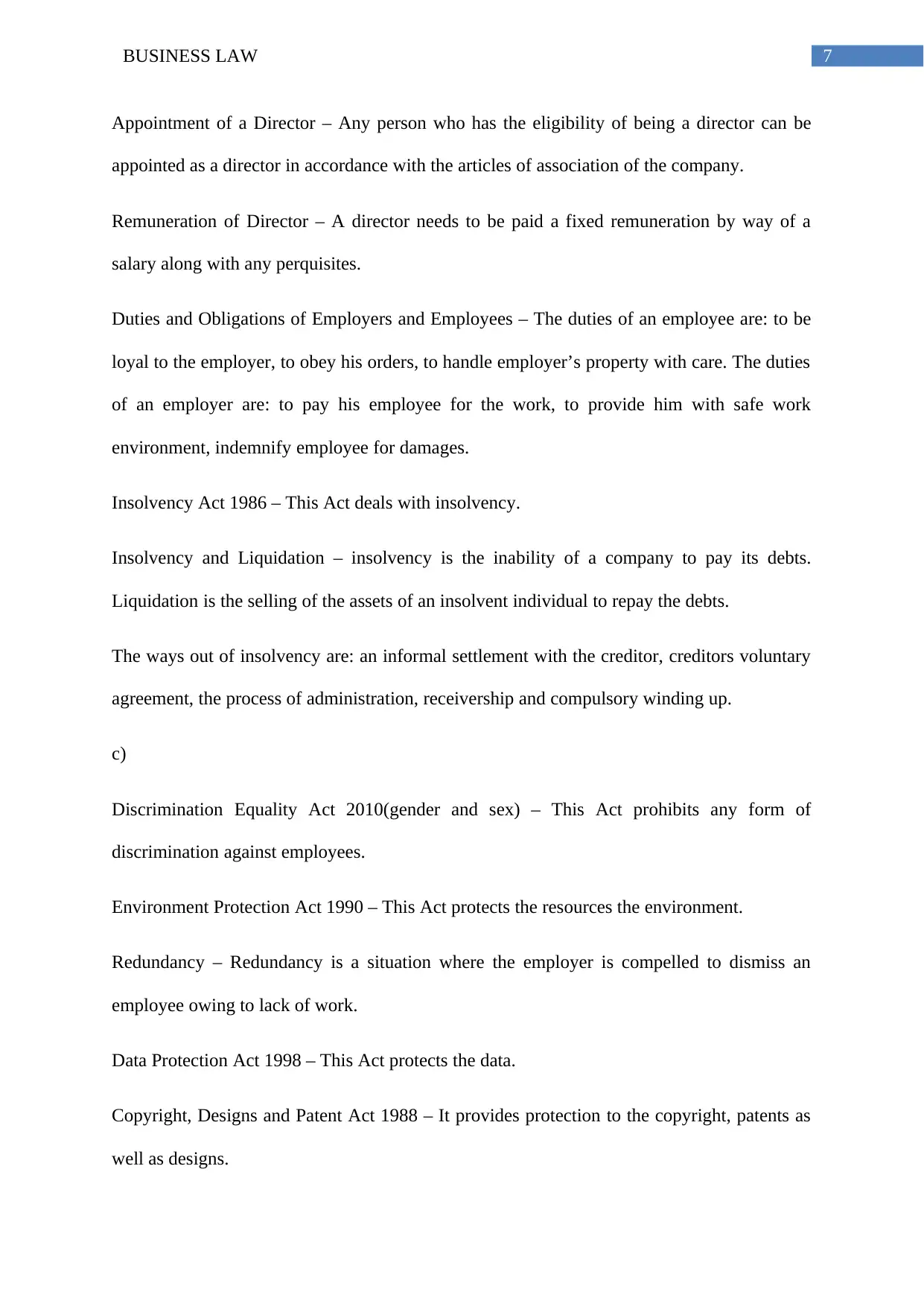
6BUSINESS LAW
Question 5
Legislation – The set of laws that are formulated and passed by the legislature to control the
behaviour of the individuals in a state is termed as the legislation.
Regulation – Regulations are set of rules that are formulated by the government or any other
governing body that regulates the conduct of subordinate individuals.
Standard – standard is a manner in which something needs to be done as per a general
agreement.
Task 2
a)
Sole Trader – Sole trader is a form of business which is owned as well as controlled by a
single person.
Advantages of a Sole Trader – The advantages are – the owner receives all the profits,
forming is easy, decision making is quick, small capital required, privacy is ensured.
Disadvantages of a Sole Trader – The sole responsibility lies with the only trader and all the
losses needs to be borne by him.
Advantages of a Limited Liability Company – The advantages of a company are: limitation
of the liability of the owners as well as the managers, taxation is favourable, the business can
be carried out anywhere.
Disadvantages of a Limited Liability Company – establishment is expensive as well as
burdensome, requires a considerable amount of legal compliances.
b)
Director – A person who is conferred with the duty to manage the company.
Question 5
Legislation – The set of laws that are formulated and passed by the legislature to control the
behaviour of the individuals in a state is termed as the legislation.
Regulation – Regulations are set of rules that are formulated by the government or any other
governing body that regulates the conduct of subordinate individuals.
Standard – standard is a manner in which something needs to be done as per a general
agreement.
Task 2
a)
Sole Trader – Sole trader is a form of business which is owned as well as controlled by a
single person.
Advantages of a Sole Trader – The advantages are – the owner receives all the profits,
forming is easy, decision making is quick, small capital required, privacy is ensured.
Disadvantages of a Sole Trader – The sole responsibility lies with the only trader and all the
losses needs to be borne by him.
Advantages of a Limited Liability Company – The advantages of a company are: limitation
of the liability of the owners as well as the managers, taxation is favourable, the business can
be carried out anywhere.
Disadvantages of a Limited Liability Company – establishment is expensive as well as
burdensome, requires a considerable amount of legal compliances.
b)
Director – A person who is conferred with the duty to manage the company.
Paraphrase This Document
Need a fresh take? Get an instant paraphrase of this document with our AI Paraphraser

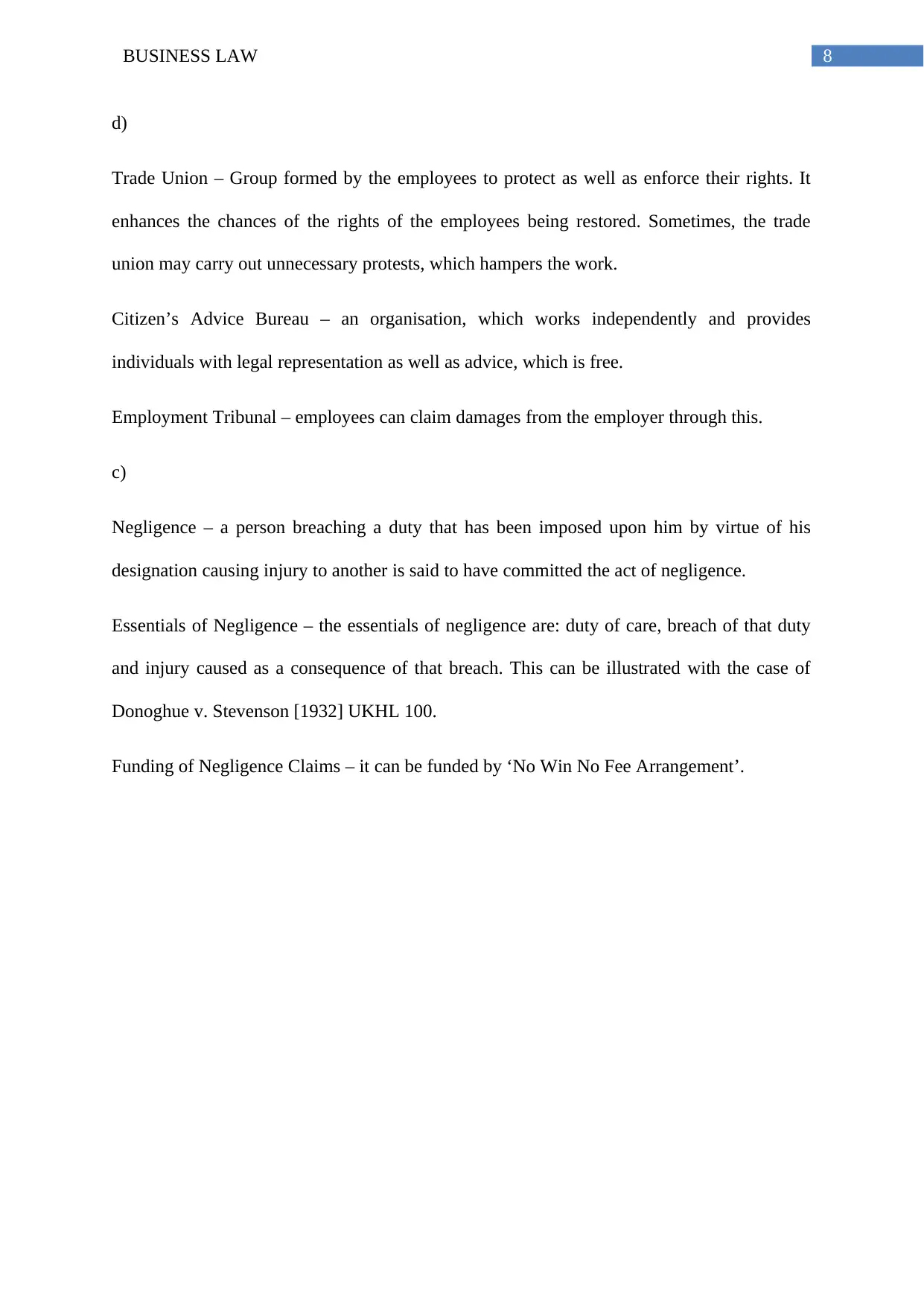
7BUSINESS LAW
Appointment of a Director – Any person who has the eligibility of being a director can be
appointed as a director in accordance with the articles of association of the company.
Remuneration of Director – A director needs to be paid a fixed remuneration by way of a
salary along with any perquisites.
Duties and Obligations of Employers and Employees – The duties of an employee are: to be
loyal to the employer, to obey his orders, to handle employer’s property with care. The duties
of an employer are: to pay his employee for the work, to provide him with safe work
environment, indemnify employee for damages.
Insolvency Act 1986 – This Act deals with insolvency.
Insolvency and Liquidation – insolvency is the inability of a company to pay its debts.
Liquidation is the selling of the assets of an insolvent individual to repay the debts.
The ways out of insolvency are: an informal settlement with the creditor, creditors voluntary
agreement, the process of administration, receivership and compulsory winding up.
c)
Discrimination Equality Act 2010(gender and sex) – This Act prohibits any form of
discrimination against employees.
Environment Protection Act 1990 – This Act protects the resources the environment.
Redundancy – Redundancy is a situation where the employer is compelled to dismiss an
employee owing to lack of work.
Data Protection Act 1998 – This Act protects the data.
Copyright, Designs and Patent Act 1988 – It provides protection to the copyright, patents as
well as designs.
Appointment of a Director – Any person who has the eligibility of being a director can be
appointed as a director in accordance with the articles of association of the company.
Remuneration of Director – A director needs to be paid a fixed remuneration by way of a
salary along with any perquisites.
Duties and Obligations of Employers and Employees – The duties of an employee are: to be
loyal to the employer, to obey his orders, to handle employer’s property with care. The duties
of an employer are: to pay his employee for the work, to provide him with safe work
environment, indemnify employee for damages.
Insolvency Act 1986 – This Act deals with insolvency.
Insolvency and Liquidation – insolvency is the inability of a company to pay its debts.
Liquidation is the selling of the assets of an insolvent individual to repay the debts.
The ways out of insolvency are: an informal settlement with the creditor, creditors voluntary
agreement, the process of administration, receivership and compulsory winding up.
c)
Discrimination Equality Act 2010(gender and sex) – This Act prohibits any form of
discrimination against employees.
Environment Protection Act 1990 – This Act protects the resources the environment.
Redundancy – Redundancy is a situation where the employer is compelled to dismiss an
employee owing to lack of work.
Data Protection Act 1998 – This Act protects the data.
Copyright, Designs and Patent Act 1988 – It provides protection to the copyright, patents as
well as designs.

8BUSINESS LAW
d)
Trade Union – Group formed by the employees to protect as well as enforce their rights. It
enhances the chances of the rights of the employees being restored. Sometimes, the trade
union may carry out unnecessary protests, which hampers the work.
Citizen’s Advice Bureau – an organisation, which works independently and provides
individuals with legal representation as well as advice, which is free.
Employment Tribunal – employees can claim damages from the employer through this.
c)
Negligence – a person breaching a duty that has been imposed upon him by virtue of his
designation causing injury to another is said to have committed the act of negligence.
Essentials of Negligence – the essentials of negligence are: duty of care, breach of that duty
and injury caused as a consequence of that breach. This can be illustrated with the case of
Donoghue v. Stevenson [1932] UKHL 100.
Funding of Negligence Claims – it can be funded by ‘No Win No Fee Arrangement’.
d)
Trade Union – Group formed by the employees to protect as well as enforce their rights. It
enhances the chances of the rights of the employees being restored. Sometimes, the trade
union may carry out unnecessary protests, which hampers the work.
Citizen’s Advice Bureau – an organisation, which works independently and provides
individuals with legal representation as well as advice, which is free.
Employment Tribunal – employees can claim damages from the employer through this.
c)
Negligence – a person breaching a duty that has been imposed upon him by virtue of his
designation causing injury to another is said to have committed the act of negligence.
Essentials of Negligence – the essentials of negligence are: duty of care, breach of that duty
and injury caused as a consequence of that breach. This can be illustrated with the case of
Donoghue v. Stevenson [1932] UKHL 100.
Funding of Negligence Claims – it can be funded by ‘No Win No Fee Arrangement’.
⊘ This is a preview!⊘
Do you want full access?
Subscribe today to unlock all pages.

Trusted by 1+ million students worldwide

9BUSINESS LAW
References
ANDREWS, N. (2011) Contract Law. Cambridge: Cambridge University Press.
DIGNAM, A. and LOWRY, J. (2012) Company Law. Oxford: Oxford University Press.
FRENCH, D., MAYSON, S. and RYAN, C. (2012) Company Law. Oxford: Oxford
University Press.
HONEYBALL, S. (2012) Employment Law. Oxford: Oxford University Press.
PARTINGTON, M. (2013) Introduction to the English Legal System. Oxford: Oxford
University Press.
Ali, S.F., 2018. Mediation in the UK courts: Efficiency, Confidence and Perceptions of
Justice. In Court Mediation Reform. Edward Elgar Publishing.
The Equality Act 2010
The Environment Protection Act 1990
The Data Protection Act 1998
The Copyright, Designs and Patent Act 1988
References
ANDREWS, N. (2011) Contract Law. Cambridge: Cambridge University Press.
DIGNAM, A. and LOWRY, J. (2012) Company Law. Oxford: Oxford University Press.
FRENCH, D., MAYSON, S. and RYAN, C. (2012) Company Law. Oxford: Oxford
University Press.
HONEYBALL, S. (2012) Employment Law. Oxford: Oxford University Press.
PARTINGTON, M. (2013) Introduction to the English Legal System. Oxford: Oxford
University Press.
Ali, S.F., 2018. Mediation in the UK courts: Efficiency, Confidence and Perceptions of
Justice. In Court Mediation Reform. Edward Elgar Publishing.
The Equality Act 2010
The Environment Protection Act 1990
The Data Protection Act 1998
The Copyright, Designs and Patent Act 1988
1 out of 10
Related Documents
Your All-in-One AI-Powered Toolkit for Academic Success.
+13062052269
info@desklib.com
Available 24*7 on WhatsApp / Email
Unlock your academic potential
Copyright © 2020–2025 A2Z Services. All Rights Reserved. Developed and managed by ZUCOL.