Business Law Report: Sources, Role of Government, and Company Law
VerifiedAdded on 2020/10/23
|18
|6868
|333
Report
AI Summary
This report on business law provides a comprehensive overview of various legal aspects relevant to businesses. It begins with an introduction to business law, encompassing rules and regulations for transactions, trade, and commerce. The report then delves into different sources of law, including English law, the concept of parliamentary sovereignty, and the role of statutes, delegated legislation, European Union laws, and common laws. It further explores the government's role in law-making, detailing the process from bill introduction to royal assent. The application of statutory and common law in justice courts is also discussed. The report highlights the impact of company, employment, and contract laws on business operations, emphasizing their significance in legal compliance and business practices. The assignment also presents and analyzes several case scenarios, applying the relevant laws, rules, and regulations to provide solutions. The report concludes with a summary of the key findings and a list of references used.
Business law

Paraphrase This Document
Need a fresh take? Get an instant paraphrase of this document with our AI Paraphraser
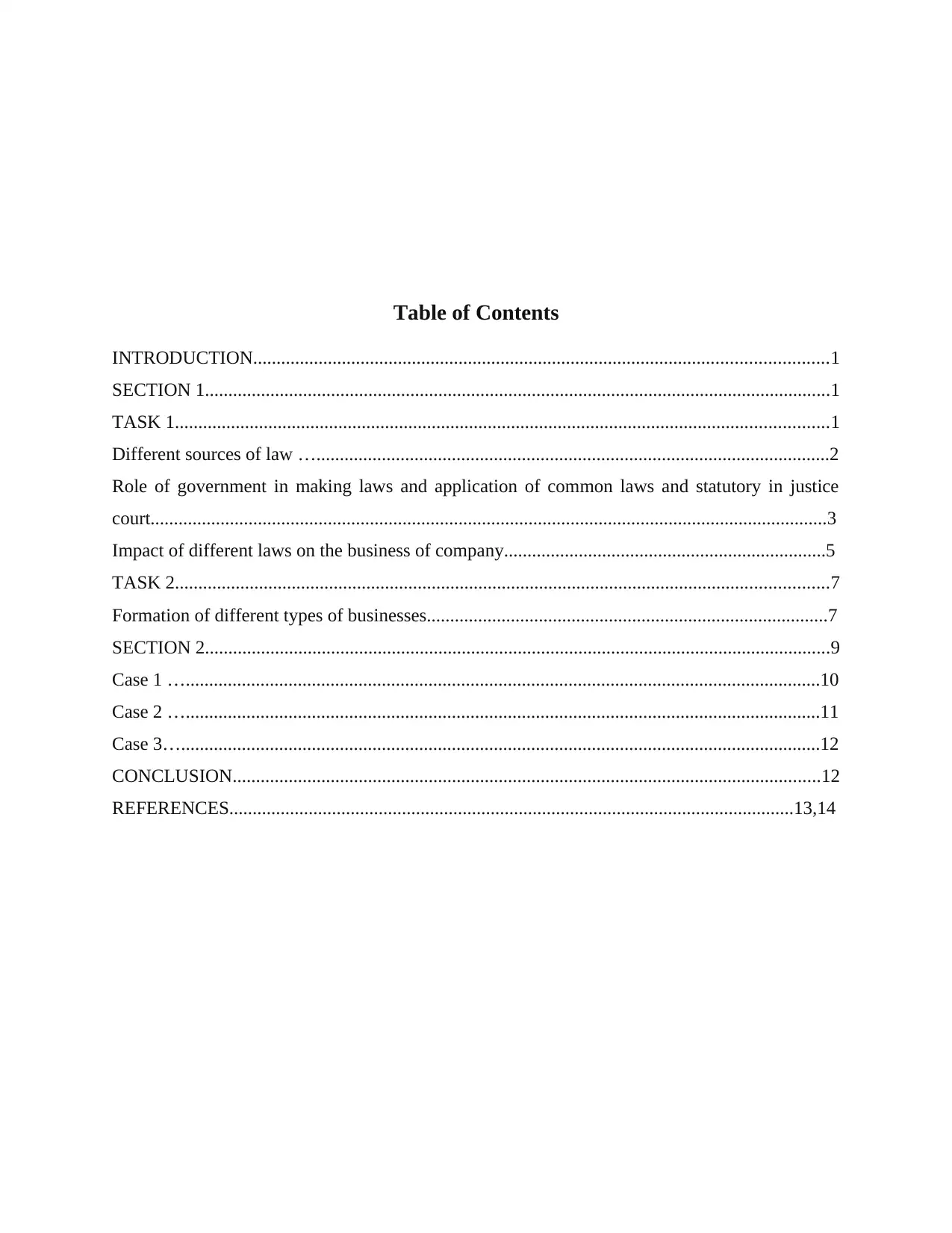
Table of Contents
INTRODUCTION...........................................................................................................................1
SECTION 1......................................................................................................................................1
TASK 1............................................................................................................................................1
Different sources of law …..............................................................................................................2
Role of government in making laws and application of common laws and statutory in justice
court.................................................................................................................................................3
Impact of different laws on the business of company.....................................................................5
TASK 2............................................................................................................................................7
Formation of different types of businesses......................................................................................7
SECTION 2......................................................................................................................................9
Case 1 …........................................................................................................................................10
Case 2 …........................................................................................................................................11
Case 3….........................................................................................................................................12
CONCLUSION..............................................................................................................................12
REFERENCES.........................................................................................................................13,14
INTRODUCTION...........................................................................................................................1
SECTION 1......................................................................................................................................1
TASK 1............................................................................................................................................1
Different sources of law …..............................................................................................................2
Role of government in making laws and application of common laws and statutory in justice
court.................................................................................................................................................3
Impact of different laws on the business of company.....................................................................5
TASK 2............................................................................................................................................7
Formation of different types of businesses......................................................................................7
SECTION 2......................................................................................................................................9
Case 1 …........................................................................................................................................10
Case 2 …........................................................................................................................................11
Case 3….........................................................................................................................................12
CONCLUSION..............................................................................................................................12
REFERENCES.........................................................................................................................13,14
INTRODUCTION
Business laws are the branch of law which concerns with making rules and regulations
regarding various business transactions, trade, merchandising, sales and commerce. It
includes law related to both public and private concerns. It is also termed as mercantile
law or commercial laws. It provides a particular framework for each business in order to
start them properly and also run the normal course of business activities. This
assignment includes a brief discussion about how the parliament is sovereign in context
with business law, discussion about different sources of laws, role of government in the
developing the laws, application of common law in justice of court and a brief
introduction of company, employment and contract laws along with their impact over the
business law. The study also includes a view regarding scenario of the cases provided
in the assignment along with discussion of all the laws, rules and regulations that can be
applicable in order to solve the cases. - (Scalia, 2018)
Different sources of law
English law can be defined as a legislation system UK (United Kingdom) with the help of
which legislation are being prepared (Sethi, 2016). As per this law, parliament has
power to make legal rules in the United Kingdom and all the rules made by the
parliament are being treated as valid law in the country.
“Parliament is sovereign” refers to superior power. UK parliament is a legal ruling
authority. It has power to make the laws in the country (Horton, 2017). If it thinks that
any law is of no use in the country or any law is having negative impact over the
country, it has also power to unmake or announce it to be invalid. No person has right to
make any action against the laws and legislations made by the parliament. It has right to
detect legality or illegality of any action or any agreement or any other perspective in
UK. The constitution of UK states that parliament is the most superior authority of the
country for creation of laws (Parliamentary Sovereignty, 2019). No court can override
the laws made by it. Sovereignty of parliament in United Kingdom makes the country
more independent in context with legal perspective. Parliament's sovereignty can be
termed as the most important factor of constitution of the country. UK constitution also
has a provision that no parliament have right to pass any law containing term that any
future parliament would have right to change the rules and laws passed in any
1
Business laws are the branch of law which concerns with making rules and regulations
regarding various business transactions, trade, merchandising, sales and commerce. It
includes law related to both public and private concerns. It is also termed as mercantile
law or commercial laws. It provides a particular framework for each business in order to
start them properly and also run the normal course of business activities. This
assignment includes a brief discussion about how the parliament is sovereign in context
with business law, discussion about different sources of laws, role of government in the
developing the laws, application of common law in justice of court and a brief
introduction of company, employment and contract laws along with their impact over the
business law. The study also includes a view regarding scenario of the cases provided
in the assignment along with discussion of all the laws, rules and regulations that can be
applicable in order to solve the cases. - (Scalia, 2018)
Different sources of law
English law can be defined as a legislation system UK (United Kingdom) with the help of
which legislation are being prepared (Sethi, 2016). As per this law, parliament has
power to make legal rules in the United Kingdom and all the rules made by the
parliament are being treated as valid law in the country.
“Parliament is sovereign” refers to superior power. UK parliament is a legal ruling
authority. It has power to make the laws in the country (Horton, 2017). If it thinks that
any law is of no use in the country or any law is having negative impact over the
country, it has also power to unmake or announce it to be invalid. No person has right to
make any action against the laws and legislations made by the parliament. It has right to
detect legality or illegality of any action or any agreement or any other perspective in
UK. The constitution of UK states that parliament is the most superior authority of the
country for creation of laws (Parliamentary Sovereignty, 2019). No court can override
the laws made by it. Sovereignty of parliament in United Kingdom makes the country
more independent in context with legal perspective. Parliament's sovereignty can be
termed as the most important factor of constitution of the country. UK constitution also
has a provision that no parliament have right to pass any law containing term that any
future parliament would have right to change the rules and laws passed in any
1
⊘ This is a preview!⊘
Do you want full access?
Subscribe today to unlock all pages.

Trusted by 1+ million students worldwide
parliament (Edge, 2017). This clause of UK constitution provides a stability in laws of
the country and prevent the country from frequent changes in the regulations.
Constitution has provided a power to make or undo any law. In addition to it, parliament
also have power to amend any existing law as per the changing situation of the country.
In this regard it can be said that the statement is fair that parliament is at sovereign
position in the country.
Statute, delegated legislations, European Union and common laws are mandatory to be
complied with in designated countries.
Statues are originated from the parliament. Its starting point is generally a green paper.
Statutes are the primary source of law as these come into force by the act of parliament.
It includes all the rules and regulations of the country. It comprises rules made by
supreme authority to command or prohibit something. Also, the rules ensure policies
which changes according to dynamic situations of country. Generally, statutes are the
written statements approved by both houses of parliament that is House of Commons
and House of Lords. As per the constitutions of this country, no agreement can be made
against rules of statues, also no judgement can be passed against the statutes of
country by any court. The Delegated Legislations are the authorities given by an Act of
parliament to any minister or other parties to make laws for the country. These
legislations are not passed by the act of parliament (Dicey, 2017). But the signature of
the authorised persons are made on the basis of parent acts. It can be of numerous
types like, order of council, order of ministry, rules and regulations set by any
procedure, etcetera (etc).
Then European Union (EU) laws are implemented directives into the nation of all the
member of states (Cumming and Zahra, 2016). The laws of European Union have
power to influence the laws and regulations of its member states. Finally the Common
laws are those which are prepared taking into account all the past judgements of the
court. The constitution of the UK has a clause that all the judgements of higher level of
court would be considered as law to be followed by lower level courts for the purpose of
their judgements. Therefore, the laws are termed as judge-made law or judicial
precedent.
2
the country and prevent the country from frequent changes in the regulations.
Constitution has provided a power to make or undo any law. In addition to it, parliament
also have power to amend any existing law as per the changing situation of the country.
In this regard it can be said that the statement is fair that parliament is at sovereign
position in the country.
Statute, delegated legislations, European Union and common laws are mandatory to be
complied with in designated countries.
Statues are originated from the parliament. Its starting point is generally a green paper.
Statutes are the primary source of law as these come into force by the act of parliament.
It includes all the rules and regulations of the country. It comprises rules made by
supreme authority to command or prohibit something. Also, the rules ensure policies
which changes according to dynamic situations of country. Generally, statutes are the
written statements approved by both houses of parliament that is House of Commons
and House of Lords. As per the constitutions of this country, no agreement can be made
against rules of statues, also no judgement can be passed against the statutes of
country by any court. The Delegated Legislations are the authorities given by an Act of
parliament to any minister or other parties to make laws for the country. These
legislations are not passed by the act of parliament (Dicey, 2017). But the signature of
the authorised persons are made on the basis of parent acts. It can be of numerous
types like, order of council, order of ministry, rules and regulations set by any
procedure, etcetera (etc).
Then European Union (EU) laws are implemented directives into the nation of all the
member of states (Cumming and Zahra, 2016). The laws of European Union have
power to influence the laws and regulations of its member states. Finally the Common
laws are those which are prepared taking into account all the past judgements of the
court. The constitution of the UK has a clause that all the judgements of higher level of
court would be considered as law to be followed by lower level courts for the purpose of
their judgements. Therefore, the laws are termed as judge-made law or judicial
precedent.
2
Paraphrase This Document
Need a fresh take? Get an instant paraphrase of this document with our AI Paraphraser
Role of government in making laws and application of common laws and
statutory in justice court
Laws is made by the Act of parliament. For the purpose of making or amending any law,
a document containing details about the introduction of new law or amendment in any
existing law is being presented in front of parliament (Scalia, A., 2018). The concerned
departments prepare a bill regarding the proposal. The bill includes the policies, leading
responsibilities and other major details regarding the proposals and present it in front of
policy officials.
The policy officials create instructions for the lawyers of department. These are treated
as the basic instructions to be followed by them for the purpose of explaining the current
laws and changes required in the laws about the bill. The bill is passed by the
parliament after following different stages of both the houses of parliament which are
House of Lords and House of Common. Hence the readings.
At the First reading bill is being read thoroughly. The bill contains all the points and
details related to changing any law or developing any new law is read into the
parliament for bringing its further stage of parliament. This is followed by the Second
reading. In this stage, a debate is being held in the chamber of parliament among
different ministers of Government of the country (The role of statutory interpretation in
law-making through the courts, 2019). In the debate all the ministers discuss various
pros and cons of the proposed bill, leading on to the Third reading. At this stage,
committees propose amendments in the bill. Government makes the changes as per
the proposal of committees and give an effect to the amendments in the existing bills.
When this is ascertained, it leads onto the Committee stage whereby at this stage, all
the facts of the bill are considered line by line. Generally, it is carried out by the public
bill committee or the chambers of the country (Blind, Petersen and Riillo, 2017). In the
House of Commons, both oral and written evidences are taken into account. Here the
committees propose amendments in the bill. Government makes changes as per the
proposal of committees and give an effect to the amendments in the existing bills. The
Report stage is performed by the chambers in both the houses. All the amendments
are discussed in this stage (Dhingra, 2016). They can also make changes in the
amendments made in the earlier stage. A general discussion is done on the bill
3
statutory in justice court
Laws is made by the Act of parliament. For the purpose of making or amending any law,
a document containing details about the introduction of new law or amendment in any
existing law is being presented in front of parliament (Scalia, A., 2018). The concerned
departments prepare a bill regarding the proposal. The bill includes the policies, leading
responsibilities and other major details regarding the proposals and present it in front of
policy officials.
The policy officials create instructions for the lawyers of department. These are treated
as the basic instructions to be followed by them for the purpose of explaining the current
laws and changes required in the laws about the bill. The bill is passed by the
parliament after following different stages of both the houses of parliament which are
House of Lords and House of Common. Hence the readings.
At the First reading bill is being read thoroughly. The bill contains all the points and
details related to changing any law or developing any new law is read into the
parliament for bringing its further stage of parliament. This is followed by the Second
reading. In this stage, a debate is being held in the chamber of parliament among
different ministers of Government of the country (The role of statutory interpretation in
law-making through the courts, 2019). In the debate all the ministers discuss various
pros and cons of the proposed bill, leading on to the Third reading. At this stage,
committees propose amendments in the bill. Government makes the changes as per
the proposal of committees and give an effect to the amendments in the existing bills.
When this is ascertained, it leads onto the Committee stage whereby at this stage, all
the facts of the bill are considered line by line. Generally, it is carried out by the public
bill committee or the chambers of the country (Blind, Petersen and Riillo, 2017). In the
House of Commons, both oral and written evidences are taken into account. Here the
committees propose amendments in the bill. Government makes changes as per the
proposal of committees and give an effect to the amendments in the existing bills. The
Report stage is performed by the chambers in both the houses. All the amendments
are discussed in this stage (Dhingra, 2016). They can also make changes in the
amendments made in the earlier stage. A general discussion is done on the bill
3
proposed along with the amendments made at different stages. Although, no
amendments can be made by the committees at this stage.
In the Later stage, the completion of all the above stages in one house of parliament,
the bill is proposed at another house of parliament. All the above stages are followed by
the other house of parliament as well. In case, any amendment is made by the other
house, it will be again proposed to first house and all the above process will be followed
again by the first house (Sadgrove, 2016.). This process will continue until both the
houses reach at a single agreement. After the agreement between both houses, bill is
being called passed by both houses of parliament. Without the consent of the monarch,
the bill cannot be finally passed.
Royal assent and beyond is when the bill is passed by both houses of parliament, it is
termed as a law. At this stage, law is presented in front of the queen of UK. After getting
assent of the queen, the parliament declares the law as an Act. Hence, as it can be
seen that government plays a vital role in each stage of parliament of passing the bill.
Application of statutory and common law in justice of court
As per the constitution of United Kingdom, no justice can be given by any court which
have an overruling effect over any existing law of the country. Judge need to interpret
the laws of country thoroughly before giving any decision (Lewis, 2017). In addition, all
the statuaries and legislation need to be read, interpret and understand in the exact
format in which they are written. The laws cannot be altered or miss leaded as per
dynamics of case of in justice court. Further, common laws are the judgements given by
the higher level of court. These laws are having binding effect over the lower level
courts which means that lower level courts need to follow all the judgements of the
higher courts. They do not have right to override the higher court justice. Shaw v DPP
[1962] AC 220 jurisdiction supports the common law.
How the courts interpret statutory law is that, when they set out to interpret a statute,
they start by looking at the plain language of the law. If the law is clear, the courts
conclude that the law means what it says. The courts presume that the legislature
intends to give meaning to every word in the law. They reject the idea that the
legislature would have put in extra words that do not mean anything.
4
amendments can be made by the committees at this stage.
In the Later stage, the completion of all the above stages in one house of parliament,
the bill is proposed at another house of parliament. All the above stages are followed by
the other house of parliament as well. In case, any amendment is made by the other
house, it will be again proposed to first house and all the above process will be followed
again by the first house (Sadgrove, 2016.). This process will continue until both the
houses reach at a single agreement. After the agreement between both houses, bill is
being called passed by both houses of parliament. Without the consent of the monarch,
the bill cannot be finally passed.
Royal assent and beyond is when the bill is passed by both houses of parliament, it is
termed as a law. At this stage, law is presented in front of the queen of UK. After getting
assent of the queen, the parliament declares the law as an Act. Hence, as it can be
seen that government plays a vital role in each stage of parliament of passing the bill.
Application of statutory and common law in justice of court
As per the constitution of United Kingdom, no justice can be given by any court which
have an overruling effect over any existing law of the country. Judge need to interpret
the laws of country thoroughly before giving any decision (Lewis, 2017). In addition, all
the statuaries and legislation need to be read, interpret and understand in the exact
format in which they are written. The laws cannot be altered or miss leaded as per
dynamics of case of in justice court. Further, common laws are the judgements given by
the higher level of court. These laws are having binding effect over the lower level
courts which means that lower level courts need to follow all the judgements of the
higher courts. They do not have right to override the higher court justice. Shaw v DPP
[1962] AC 220 jurisdiction supports the common law.
How the courts interpret statutory law is that, when they set out to interpret a statute,
they start by looking at the plain language of the law. If the law is clear, the courts
conclude that the law means what it says. The courts presume that the legislature
intends to give meaning to every word in the law. They reject the idea that the
legislature would have put in extra words that do not mean anything.
4
⊘ This is a preview!⊘
Do you want full access?
Subscribe today to unlock all pages.
Trusted by 1+ million students worldwide
The courts try to follow the intent of the legislature. To determine legislative intent, they
might look at prior drafts or even the debate surrounding passage of the law. When a
word is ambiguous, they look at its context. In criminal matters, when there is an
ambiguity, the accused gets the benefit of the doubt.
There are different laws that have impact over the company's day to day
operations like company law, employment law, contract law, etc.
Company law contains all the provisions relating to each activities of a business entity
(Carter and Burke, 2017). Each and every course of action in the business need to be
comply with the provisions of law. In UK, there is Company Act 2006, which contains all
the rules and regulations that need to be followed by each company while running its
operations. Company law provides provisions for the company at the time of it comes
into existence, to run its day to day activities and for its winding up activities as well. For
example: as per the company law, both business and its owners are the separate legal
entity. In this regard, company needs to record the transactions made between the
owner and the company. In case, parliament makes any amendment in the company
law, it has to make the amendments in its policies as per the amendments of law to
prevent itself from any legal proceedings.
Legislations are the bills which have been passed by the act of parliament. These are
passed by the regulatory authorities of the country (Hammond, 2017). Legislations do
not include long description of any law or clause. These are the legal frameworks
according to which a government body need to perform their tasks.
Employment law requires that employees welfare and health and safety measure are
met. The company can be run by a certain number of employees but in the same time a
single person can also run a business by itself. Hence, it has to follow employment
laws as well. Company law provides the rules and regulations to prevent the rights of all
the employees at their work place (Gibbs and O’Neill, 2015). It includes all the rules that
need to be followed by the employers. In case of overriding any provision of this law,
employer can be panellised by the government or may has to pay fine or interest as
well.
Standards can be defined as minimum range of quality or safety or efficiency that need
to be involved in any product or services. It provides a general criteria about completion
5
might look at prior drafts or even the debate surrounding passage of the law. When a
word is ambiguous, they look at its context. In criminal matters, when there is an
ambiguity, the accused gets the benefit of the doubt.
There are different laws that have impact over the company's day to day
operations like company law, employment law, contract law, etc.
Company law contains all the provisions relating to each activities of a business entity
(Carter and Burke, 2017). Each and every course of action in the business need to be
comply with the provisions of law. In UK, there is Company Act 2006, which contains all
the rules and regulations that need to be followed by each company while running its
operations. Company law provides provisions for the company at the time of it comes
into existence, to run its day to day activities and for its winding up activities as well. For
example: as per the company law, both business and its owners are the separate legal
entity. In this regard, company needs to record the transactions made between the
owner and the company. In case, parliament makes any amendment in the company
law, it has to make the amendments in its policies as per the amendments of law to
prevent itself from any legal proceedings.
Legislations are the bills which have been passed by the act of parliament. These are
passed by the regulatory authorities of the country (Hammond, 2017). Legislations do
not include long description of any law or clause. These are the legal frameworks
according to which a government body need to perform their tasks.
Employment law requires that employees welfare and health and safety measure are
met. The company can be run by a certain number of employees but in the same time a
single person can also run a business by itself. Hence, it has to follow employment
laws as well. Company law provides the rules and regulations to prevent the rights of all
the employees at their work place (Gibbs and O’Neill, 2015). It includes all the rules that
need to be followed by the employers. In case of overriding any provision of this law,
employer can be panellised by the government or may has to pay fine or interest as
well.
Standards can be defined as minimum range of quality or safety or efficiency that need
to be involved in any product or services. It provides a general criteria about completion
5
Paraphrase This Document
Need a fresh take? Get an instant paraphrase of this document with our AI Paraphraser
of any business. Further, standards are also guidelines and rules for the purpose of
processing and producing any product or services (Frost, 2015). In legal context,
standards are the details in order to establish understanding of legislations along with its
long term policies and objectives. In this regard, government prepares standards to
provide protection to the environment, public along with making the legislation
understandable to the public.
The Fair Labour Standards Act (FLSA) prescribes standards for wages and overtime
pay, which affect most private and public employment this provides that company need
to pay a minimum amount of wages to its employees. In case, company pays wages
less than the set amount of wages by parliament, it is liable to pay sort of penalties to
the government in this regard. On the other hand, as per the employment act, company
cannot discriminate any employee on the basis of their religion, sex, colour or any other
personal factors. In case, company starts discriminating its employees on these bases,
directors of the company may become liable to pay a huge amount of fine.
Contract law requires that each business transaction of the company needs to be
performed as per the provisions of contract law (Warren, 2018). It has to prepare all the
agreements of dealing with another business entity or person, need to follow all the
provisions of the contract law of country. United Kingdom's parliament has passed
Contract Act 1999 which controls the rules and regulations regarding completion of
each kind of contract in the country.
Follow up of the contract law reduces the probability of ambiguous and cheating. On the
other hand, by following all the provisions of contract law, organisation can increase the
certainty in the contract and also eliminates the probability of legal proceedings on the
company. For example: if a company makes a contract without taking into account the
provisions of contract law, and another party to the contract denies performing their part
of performance, company cannot approach the court in this regard, as due to non-
compliance of law, the agreement between parties cannot be termed as contract.
Regulations are the rules developed by the individual ministers, any designated
authority or within the supervision of any legal authority. It includes the general
principles and details about application of any law. Regulations provides way to follow
the laws of the country. Regulations also provide instruction to general public and the
6
processing and producing any product or services (Frost, 2015). In legal context,
standards are the details in order to establish understanding of legislations along with its
long term policies and objectives. In this regard, government prepares standards to
provide protection to the environment, public along with making the legislation
understandable to the public.
The Fair Labour Standards Act (FLSA) prescribes standards for wages and overtime
pay, which affect most private and public employment this provides that company need
to pay a minimum amount of wages to its employees. In case, company pays wages
less than the set amount of wages by parliament, it is liable to pay sort of penalties to
the government in this regard. On the other hand, as per the employment act, company
cannot discriminate any employee on the basis of their religion, sex, colour or any other
personal factors. In case, company starts discriminating its employees on these bases,
directors of the company may become liable to pay a huge amount of fine.
Contract law requires that each business transaction of the company needs to be
performed as per the provisions of contract law (Warren, 2018). It has to prepare all the
agreements of dealing with another business entity or person, need to follow all the
provisions of the contract law of country. United Kingdom's parliament has passed
Contract Act 1999 which controls the rules and regulations regarding completion of
each kind of contract in the country.
Follow up of the contract law reduces the probability of ambiguous and cheating. On the
other hand, by following all the provisions of contract law, organisation can increase the
certainty in the contract and also eliminates the probability of legal proceedings on the
company. For example: if a company makes a contract without taking into account the
provisions of contract law, and another party to the contract denies performing their part
of performance, company cannot approach the court in this regard, as due to non-
compliance of law, the agreement between parties cannot be termed as contract.
Regulations are the rules developed by the individual ministers, any designated
authority or within the supervision of any legal authority. It includes the general
principles and details about application of any law. Regulations provides way to follow
the laws of the country. Regulations also provide instruction to general public and the
6
businesses and other entities of the country about how any law need to be enforced in
their operations.
TASK 2
There are different types of business organisations for each type of business structure.
Sole proprietors have the easiest way of form a business. Sole proprietorship and
owned and controlled by a single person. Further, in legal sense, both business and
sole proprietor are not distinct from each other. It does not require any documents
regarding incorporation. Although, proprietor need to obtain a licence to operate its
business activities. In this type of business structure, the sole proprietors are the only
owners of the firm. Further, owner of the company is personally liable to repay the debts
on the company. (Panibratov, 2015)
In order to form a limited liability company it is necessary to obtain a certificate of
formation of the company from the registrar of the country (Martins, Rindova and
Greenbaum, 2015). It needs to prepare memorandum and articles of association which
contains all the rules and regulations of the company. Members of Limited Liability
Company are the owners of the company who have limited liability up to the amount of
shares hold by them in the company (Types of Business Formations, 2019).
Government provides it an option to be taxed either like a corporation or like a
partnership company.
Partnership firm is formed when two or more individual’s starts doing business
together for the purpose of earning profit from it. There is no restriction to form any
document or certificate to be in partnership business. However, partners of the firm
prepare a partnership agreement before formation of the business. This document
contains all the rules and regulations of performing business activities and also all the
negotiation points decided among the partners in order to eliminate any future dispute.
Basis Incorporated business Unincorporated business
shares It can issue its shares to the public. Members of the unincorporated
business are the shareholders of it.
Legal entity Incorporated businesses have their Unincorporated businesses do not
7
their operations.
TASK 2
There are different types of business organisations for each type of business structure.
Sole proprietors have the easiest way of form a business. Sole proprietorship and
owned and controlled by a single person. Further, in legal sense, both business and
sole proprietor are not distinct from each other. It does not require any documents
regarding incorporation. Although, proprietor need to obtain a licence to operate its
business activities. In this type of business structure, the sole proprietors are the only
owners of the firm. Further, owner of the company is personally liable to repay the debts
on the company. (Panibratov, 2015)
In order to form a limited liability company it is necessary to obtain a certificate of
formation of the company from the registrar of the country (Martins, Rindova and
Greenbaum, 2015). It needs to prepare memorandum and articles of association which
contains all the rules and regulations of the company. Members of Limited Liability
Company are the owners of the company who have limited liability up to the amount of
shares hold by them in the company (Types of Business Formations, 2019).
Government provides it an option to be taxed either like a corporation or like a
partnership company.
Partnership firm is formed when two or more individual’s starts doing business
together for the purpose of earning profit from it. There is no restriction to form any
document or certificate to be in partnership business. However, partners of the firm
prepare a partnership agreement before formation of the business. This document
contains all the rules and regulations of performing business activities and also all the
negotiation points decided among the partners in order to eliminate any future dispute.
Basis Incorporated business Unincorporated business
shares It can issue its shares to the public. Members of the unincorporated
business are the shareholders of it.
Legal entity Incorporated businesses have their Unincorporated businesses do not
7
⊘ This is a preview!⊘
Do you want full access?
Subscribe today to unlock all pages.
Trusted by 1+ million students worldwide
separate legal personality. have any such legal personality.
(Panibratov, 2015)
Funds It can take funds from bank loans,
angle inventors, crowdfunding, etc.
It is not an easy task for
unincorporated business to generate
funds from any source.
Legal formation Incorporated business needs to form a
set procedure mentioned in their
applicable laws.
The law has not provided any
formation procedures to form an
unincorporated business
Management These are managed by the team of
some professionals.
Owners of unincorporated business
manages its affairs.
Example Company Partnership
Advantage and disadvantage of company and Partnership Company.
Company can be termed as a business structure which have various owners. The
owners of a company are personally liable for paying debts of the company up to the
amount of shares held by them. The major advantage of the company is that it does not
get affected by the death, insolvency or psychopathy of its owners. Company and owner
both are separate from each other. Shareholders of a company are its real owners.
They are liable up to the amount of shares held by them. Public companies are easy to
be expanded, as there is no limit regarding number of shareholders in it. Company can
easily get fund for the expansion purpose by issuing shares in the market. They can
also get advantage by having number of owners as its liability gets divided among
various members. It leads in division of liability of the business in numerous hands and
results in reduction of liability over single person. The disadvantage of company is the
result of having number of owners in the form of shareholders, there is no secrecy of the
company regarding its policy and procedures (Mazur, 2016). Because these need to be
discussed with its owners before developing or innovating. There is more legal
restrictions over the company for performing its normal course of business operations.
In addition, government has also provided various tasks to be followed while
8
(Panibratov, 2015)
Funds It can take funds from bank loans,
angle inventors, crowdfunding, etc.
It is not an easy task for
unincorporated business to generate
funds from any source.
Legal formation Incorporated business needs to form a
set procedure mentioned in their
applicable laws.
The law has not provided any
formation procedures to form an
unincorporated business
Management These are managed by the team of
some professionals.
Owners of unincorporated business
manages its affairs.
Example Company Partnership
Advantage and disadvantage of company and Partnership Company.
Company can be termed as a business structure which have various owners. The
owners of a company are personally liable for paying debts of the company up to the
amount of shares held by them. The major advantage of the company is that it does not
get affected by the death, insolvency or psychopathy of its owners. Company and owner
both are separate from each other. Shareholders of a company are its real owners.
They are liable up to the amount of shares held by them. Public companies are easy to
be expanded, as there is no limit regarding number of shareholders in it. Company can
easily get fund for the expansion purpose by issuing shares in the market. They can
also get advantage by having number of owners as its liability gets divided among
various members. It leads in division of liability of the business in numerous hands and
results in reduction of liability over single person. The disadvantage of company is the
result of having number of owners in the form of shareholders, there is no secrecy of the
company regarding its policy and procedures (Mazur, 2016). Because these need to be
discussed with its owners before developing or innovating. There is more legal
restrictions over the company for performing its normal course of business operations.
In addition, government has also provided various tasks to be followed while
8
Paraphrase This Document
Need a fresh take? Get an instant paraphrase of this document with our AI Paraphraser
incorporating any business along with various stages through which company's
formation procedure need to be performed.
Partnership can be formed when two or more members come together and agreed
upon a single term in order to perform the business activities and share its profit and
loss. As an advantage for partnership it is easy to change terms of the agreement.
Innovation in the partnership agreement needs consent of all the partners or majority of
the partners as per their agreement only to make any changes in the partnership
agreement. (Meissner, 2015). There is only fewer restrictions provided by the
government in order to form or run the business of partnership firm. A partnership
involves ability, talent and skills of all the partners. They can perform the business
activities as per their own ability (Stöcker, 2017) and help the business to grow
smoothly. Most important disadvantage of the partnership firm is that it involves
unlimited risk of its partners. All the partners have unlimited liabilities in partnership
business. Partnership firm and its members are not separate from each other. Hence, it
dissolves with the death of all the partners of the business. Further, as all the rules and
regulations of the firm are framed as per the suitability of its partners and government
have less interference in this business structure, public have less faith on it. From the
above discussion it can be analysed that JPM publishing can form a company. – need
to expand
Case 1
Issue:
Is creditors' petition of winding up of company is valid?
Rules:
Winding up petition:
Winding up petition refers to an action of creditors against the company to liquidate the
business assets and pay their debts. It results in closing off of the business.
Rules to file petition:
Petition can be filled by the creditors in front of court to wind up the business if the
company has made any default in payment of debt of creditors. For the purpose of filing petition
against the company, creditors need to follow steps provided by the government and also file all
the required documents in front of the court.
9
formation procedure need to be performed.
Partnership can be formed when two or more members come together and agreed
upon a single term in order to perform the business activities and share its profit and
loss. As an advantage for partnership it is easy to change terms of the agreement.
Innovation in the partnership agreement needs consent of all the partners or majority of
the partners as per their agreement only to make any changes in the partnership
agreement. (Meissner, 2015). There is only fewer restrictions provided by the
government in order to form or run the business of partnership firm. A partnership
involves ability, talent and skills of all the partners. They can perform the business
activities as per their own ability (Stöcker, 2017) and help the business to grow
smoothly. Most important disadvantage of the partnership firm is that it involves
unlimited risk of its partners. All the partners have unlimited liabilities in partnership
business. Partnership firm and its members are not separate from each other. Hence, it
dissolves with the death of all the partners of the business. Further, as all the rules and
regulations of the firm are framed as per the suitability of its partners and government
have less interference in this business structure, public have less faith on it. From the
above discussion it can be analysed that JPM publishing can form a company. – need
to expand
Case 1
Issue:
Is creditors' petition of winding up of company is valid?
Rules:
Winding up petition:
Winding up petition refers to an action of creditors against the company to liquidate the
business assets and pay their debts. It results in closing off of the business.
Rules to file petition:
Petition can be filled by the creditors in front of court to wind up the business if the
company has made any default in payment of debt of creditors. For the purpose of filing petition
against the company, creditors need to follow steps provided by the government and also file all
the required documents in front of the court.
9
Petition of creditors can be approved as per Insolvency Act, company could declare as
insolvent. Because, company cannot be said to be wind up only on the basis of failure in paying
debts.
If the creditors file petition against the company, it needs to serve advertisement in the
newspaper and also inform to official Gazette in this regard. As a result, other creditors might
support the winding up petition. It may result in approval of the petition in court. (Hammond,
2017).
Winding up procedure:
In case of approval of petition, company need to appoint a liquidator who will perform
the liquidation procedure in order to liquidate the assets to pay the debts. All the creditors are
being paid by liquidator on pro rata bases (How does the winding up petition process work?
2019). In addition, they are paid as per the priorities. Winding up activity includes selling all
assets, paying off creditors, and distributing remaining assets to the partners or shareholders.
Cases:
In Mann vs Goldstein case, Mr. Sidney filed a petition against Peter and Anita Mann to
wind up their company as a result of failure of paying the debt. Further, Peter and Anita Mann
filed an injunction against the winding up petition, on the ground that all the unpaid debts were
under dispute. In this case, court held that creditor cannot file petition against the company as
company's debts are under dispute. Hence, court rejected the petition of court.
In PARMANENT HOUSES (HOLDINGS) LTD. 1988 BCLC 563(CH D) case, the
company made default in payment of interest of the debenture holders. When the debenture
holders applied to court, the court held the company as a defaulter and ordered it to pay the
interest amount to the holders along with penalties for the non payment.
Application
As per the above-mentioned rules and pre-decided case, it can be analysed that creditors
can file the petition against court if any company fails to pay their debts. But before giving
judgement for winding up, court need to held a solvency test of the company as per the
insolvency Act 1986. In case, company declares insolvent as per the Insolvency Act 1986,
creditors' petition for winding up could be approved by the court.
10
insolvent. Because, company cannot be said to be wind up only on the basis of failure in paying
debts.
If the creditors file petition against the company, it needs to serve advertisement in the
newspaper and also inform to official Gazette in this regard. As a result, other creditors might
support the winding up petition. It may result in approval of the petition in court. (Hammond,
2017).
Winding up procedure:
In case of approval of petition, company need to appoint a liquidator who will perform
the liquidation procedure in order to liquidate the assets to pay the debts. All the creditors are
being paid by liquidator on pro rata bases (How does the winding up petition process work?
2019). In addition, they are paid as per the priorities. Winding up activity includes selling all
assets, paying off creditors, and distributing remaining assets to the partners or shareholders.
Cases:
In Mann vs Goldstein case, Mr. Sidney filed a petition against Peter and Anita Mann to
wind up their company as a result of failure of paying the debt. Further, Peter and Anita Mann
filed an injunction against the winding up petition, on the ground that all the unpaid debts were
under dispute. In this case, court held that creditor cannot file petition against the company as
company's debts are under dispute. Hence, court rejected the petition of court.
In PARMANENT HOUSES (HOLDINGS) LTD. 1988 BCLC 563(CH D) case, the
company made default in payment of interest of the debenture holders. When the debenture
holders applied to court, the court held the company as a defaulter and ordered it to pay the
interest amount to the holders along with penalties for the non payment.
Application
As per the above-mentioned rules and pre-decided case, it can be analysed that creditors
can file the petition against court if any company fails to pay their debts. But before giving
judgement for winding up, court need to held a solvency test of the company as per the
insolvency Act 1986. In case, company declares insolvent as per the Insolvency Act 1986,
creditors' petition for winding up could be approved by the court.
10
⊘ This is a preview!⊘
Do you want full access?
Subscribe today to unlock all pages.
Trusted by 1+ million students worldwide

1 out of 18


Related Documents


Your All-in-One AI-Powered Toolkit for Academic Success.
+13062052269
info@desklib.com
Available 24*7 on WhatsApp / Email
![[object Object]](/_next/static/media/star-bottom.7253800d.svg)
Unlock your academic potential
Copyright © 2020–2026 A2Z Services. All Rights Reserved. Developed and managed by ZUCOL.