Business Law Case Study: Bowling Alley Incident and Legal Issues

Verified

Added on  2021/06/14

|4
|695
|76
Case Study
AI Summary
This business law case study examines a negligence claim arising from an incident at a bowling alley. The analysis focuses on the duty of care owed to customers, specifically addressing whether the bowling alley met the required standard of care concerning uneven flooring. The case explores the concept of negligence, the standard of care expected of a reasonable person, and the potential damages suffered by the injured party, including loss of income. The document discusses the bowling alley's defense, emphasizing the provided warning sign. Furthermore, it outlines different types of damages, including actual, pecuniary, punitive, and liquidated damages, referencing relevant legal precedents such as Ratych v. Bloomer and Whiten v Pilot Insurance Co. The study provides a comprehensive overview of the legal issues involved, offering insights into the application of legal principles in a practical business context.
Document Page
Running head: BUSINESS LAW
Business law
Name of the Student
Name of the University
Author Note
tabler-icon-diamond-filled.svg

Paraphrase This Document

Need a fresh take? Get an instant paraphrase of this document with our AI Paraphraser
Document Page
1BUSINESS LAW
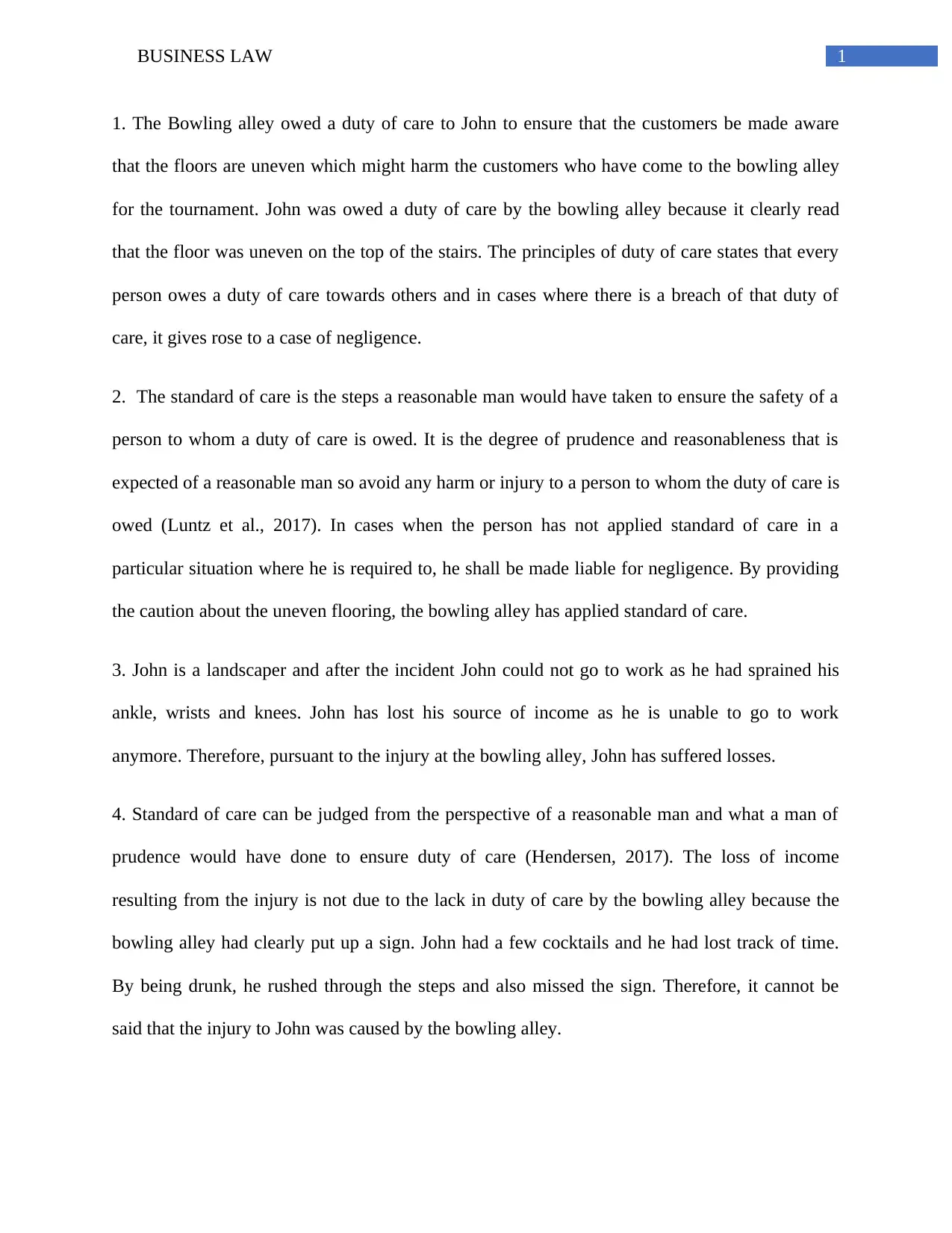
1. The Bowling alley owed a duty of care to John to ensure that the customers be made aware
that the floors are uneven which might harm the customers who have come to the bowling alley
for the tournament. John was owed a duty of care by the bowling alley because it clearly read
that the floor was uneven on the top of the stairs. The principles of duty of care states that every
person owes a duty of care towards others and in cases where there is a breach of that duty of
care, it gives rose to a case of negligence.
2. The standard of care is the steps a reasonable man would have taken to ensure the safety of a
person to whom a duty of care is owed. It is the degree of prudence and reasonableness that is
expected of a reasonable man so avoid any harm or injury to a person to whom the duty of care is
owed (Luntz et al., 2017). In cases when the person has not applied standard of care in a
particular situation where he is required to, he shall be made liable for negligence. By providing
the caution about the uneven flooring, the bowling alley has applied standard of care.
3. John is a landscaper and after the incident John could not go to work as he had sprained his
ankle, wrists and knees. John has lost his source of income as he is unable to go to work
anymore. Therefore, pursuant to the injury at the bowling alley, John has suffered losses.
4. Standard of care can be judged from the perspective of a reasonable man and what a man of
prudence would have done to ensure duty of care (Hendersen, 2017). The loss of income
resulting from the injury is not due to the lack in duty of care by the bowling alley because the
bowling alley had clearly put up a sign. John had a few cocktails and he had lost track of time.
By being drunk, he rushed through the steps and also missed the sign. Therefore, it cannot be
said that the injury to John was caused by the bowling alley.
Document Page
2BUSINESS LAW
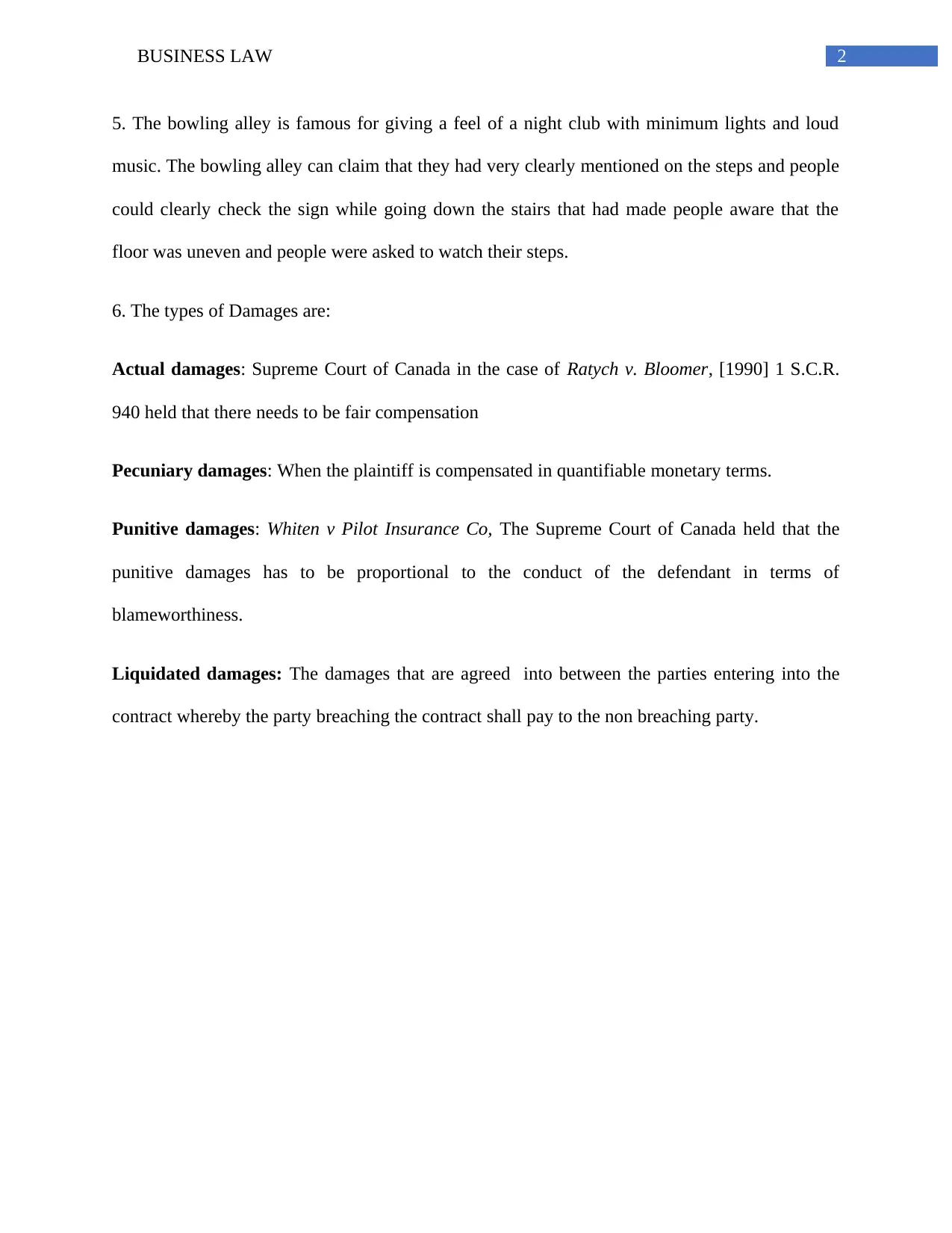
5. The bowling alley is famous for giving a feel of a night club with minimum lights and loud
music. The bowling alley can claim that they had very clearly mentioned on the steps and people
could clearly check the sign while going down the stairs that had made people aware that the
floor was uneven and people were asked to watch their steps.
6. The types of Damages are:
Actual damages: Supreme Court of Canada in the case of Ratych v. Bloomer, [1990] 1 S.C.R.
940 held that there needs to be fair compensation
Pecuniary damages: When the plaintiff is compensated in quantifiable monetary terms.
Punitive damages: Whiten v Pilot Insurance Co, The Supreme Court of Canada held that the
punitive damages has to be proportional to the conduct of the defendant in terms of
blameworthiness.
Liquidated damages: The damages that are agreed into between the parties entering into the
contract whereby the party breaching the contract shall pay to the non breaching party.
Document Page
3BUSINESS LAW
References
Henderson Jr, J. A. (2017). Learned Hand's Paradox: An Essay on Custom in Negligence
Law. Cal. L. Rev., 105, 165.
Luntz, H., Hambly, D., Burns, K., Dietrich, J., Foster, N., Grant, G., & Harder, S. (2017). Torts:
cases and commentary. LexisNexis Butterworths.
Ratych v. Bloomer, [1990] 1 S.C.R. 940
Whiten v Pilot Insurance Co
chevron_up_icon
1 out of 4
circle_padding
hide_on_mobile
zoom_out_icon
[object Object]