Business Law for Managers: Consideration, Negligence, Directors
VerifiedAdded on 2020/01/23
|12
|4012
|650
Report
AI Summary
This report provides a comprehensive overview of business law, focusing on three key areas: consideration, negligence, and the roles of directors and agents under the Company Act 2006. The report begins by defining business law and its relevance, followed by an in-depth analysis of consideration, including its essential elements, different types (executory, executed, and past), and the impact of the Williams v Roffey case. It then examines the concept of negligence in tort law, including the neighbor principle established in Donoghue v Stevenson, and the elements of a negligence tort. Finally, the report considers the roles and responsibilities of directors and agents within a company. The report utilizes case studies to illustrate legal principles and provides a practical understanding of business law concepts.
BUSINESS LAW FOR
MANAGERS
MANAGERS

Paraphrase This Document
Need a fresh take? Get an instant paraphrase of this document with our AI Paraphraser

Table of Contents
Executive Summary .......................................................................................................................1
Main body........................................................................................................................................1
Conclusion.......................................................................................................................................8
References........................................................................................................................................8
Executive Summary .......................................................................................................................1
Main body........................................................................................................................................1
Conclusion.......................................................................................................................................8
References........................................................................................................................................8
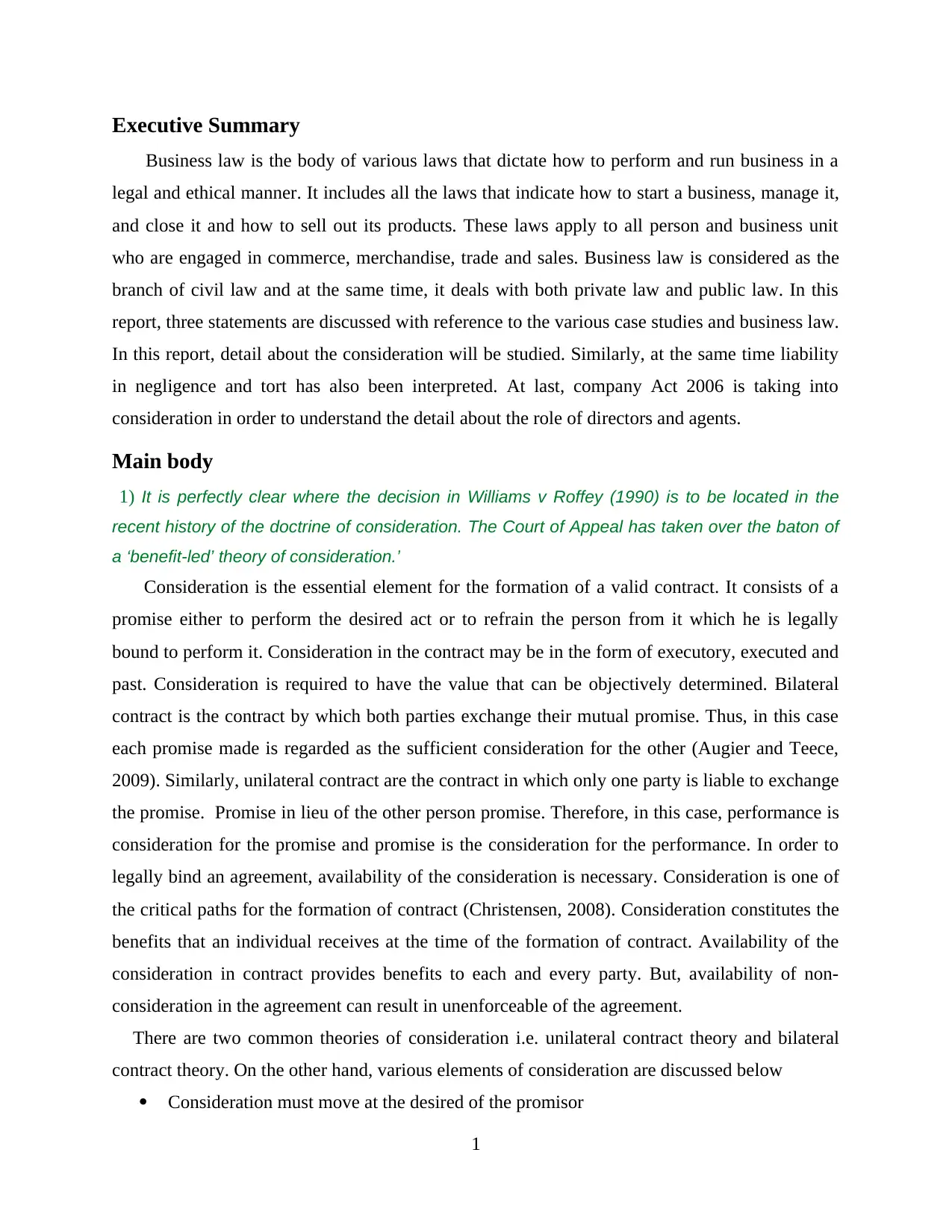
Executive Summary
Business law is the body of various laws that dictate how to perform and run business in a
legal and ethical manner. It includes all the laws that indicate how to start a business, manage it,
and close it and how to sell out its products. These laws apply to all person and business unit
who are engaged in commerce, merchandise, trade and sales. Business law is considered as the
branch of civil law and at the same time, it deals with both private law and public law. In this
report, three statements are discussed with reference to the various case studies and business law.
In this report, detail about the consideration will be studied. Similarly, at the same time liability
in negligence and tort has also been interpreted. At last, company Act 2006 is taking into
consideration in order to understand the detail about the role of directors and agents.
Main body
1) It is perfectly clear where the decision in Williams v Roffey (1990) is to be located in the
recent history of the doctrine of consideration. The Court of Appeal has taken over the baton of
a ‘benefit-led’ theory of consideration.’
Consideration is the essential element for the formation of a valid contract. It consists of a
promise either to perform the desired act or to refrain the person from it which he is legally
bound to perform it. Consideration in the contract may be in the form of executory, executed and
past. Consideration is required to have the value that can be objectively determined. Bilateral
contract is the contract by which both parties exchange their mutual promise. Thus, in this case
each promise made is regarded as the sufficient consideration for the other (Augier and Teece,
2009). Similarly, unilateral contract are the contract in which only one party is liable to exchange
the promise. Promise in lieu of the other person promise. Therefore, in this case, performance is
consideration for the promise and promise is the consideration for the performance. In order to
legally bind an agreement, availability of the consideration is necessary. Consideration is one of
the critical paths for the formation of contract (Christensen, 2008). Consideration constitutes the
benefits that an individual receives at the time of the formation of contract. Availability of the
consideration in contract provides benefits to each and every party. But, availability of non-
consideration in the agreement can result in unenforceable of the agreement.
There are two common theories of consideration i.e. unilateral contract theory and bilateral
contract theory. On the other hand, various elements of consideration are discussed below
Consideration must move at the desired of the promisor
1
Business law is the body of various laws that dictate how to perform and run business in a
legal and ethical manner. It includes all the laws that indicate how to start a business, manage it,
and close it and how to sell out its products. These laws apply to all person and business unit
who are engaged in commerce, merchandise, trade and sales. Business law is considered as the
branch of civil law and at the same time, it deals with both private law and public law. In this
report, three statements are discussed with reference to the various case studies and business law.
In this report, detail about the consideration will be studied. Similarly, at the same time liability
in negligence and tort has also been interpreted. At last, company Act 2006 is taking into
consideration in order to understand the detail about the role of directors and agents.
Main body
1) It is perfectly clear where the decision in Williams v Roffey (1990) is to be located in the
recent history of the doctrine of consideration. The Court of Appeal has taken over the baton of
a ‘benefit-led’ theory of consideration.’
Consideration is the essential element for the formation of a valid contract. It consists of a
promise either to perform the desired act or to refrain the person from it which he is legally
bound to perform it. Consideration in the contract may be in the form of executory, executed and
past. Consideration is required to have the value that can be objectively determined. Bilateral
contract is the contract by which both parties exchange their mutual promise. Thus, in this case
each promise made is regarded as the sufficient consideration for the other (Augier and Teece,
2009). Similarly, unilateral contract are the contract in which only one party is liable to exchange
the promise. Promise in lieu of the other person promise. Therefore, in this case, performance is
consideration for the promise and promise is the consideration for the performance. In order to
legally bind an agreement, availability of the consideration is necessary. Consideration is one of
the critical paths for the formation of contract (Christensen, 2008). Consideration constitutes the
benefits that an individual receives at the time of the formation of contract. Availability of the
consideration in contract provides benefits to each and every party. But, availability of non-
consideration in the agreement can result in unenforceable of the agreement.
There are two common theories of consideration i.e. unilateral contract theory and bilateral
contract theory. On the other hand, various elements of consideration are discussed below
Consideration must move at the desired of the promisor
1
⊘ This is a preview!⊘
Do you want full access?
Subscribe today to unlock all pages.

Trusted by 1+ million students worldwide
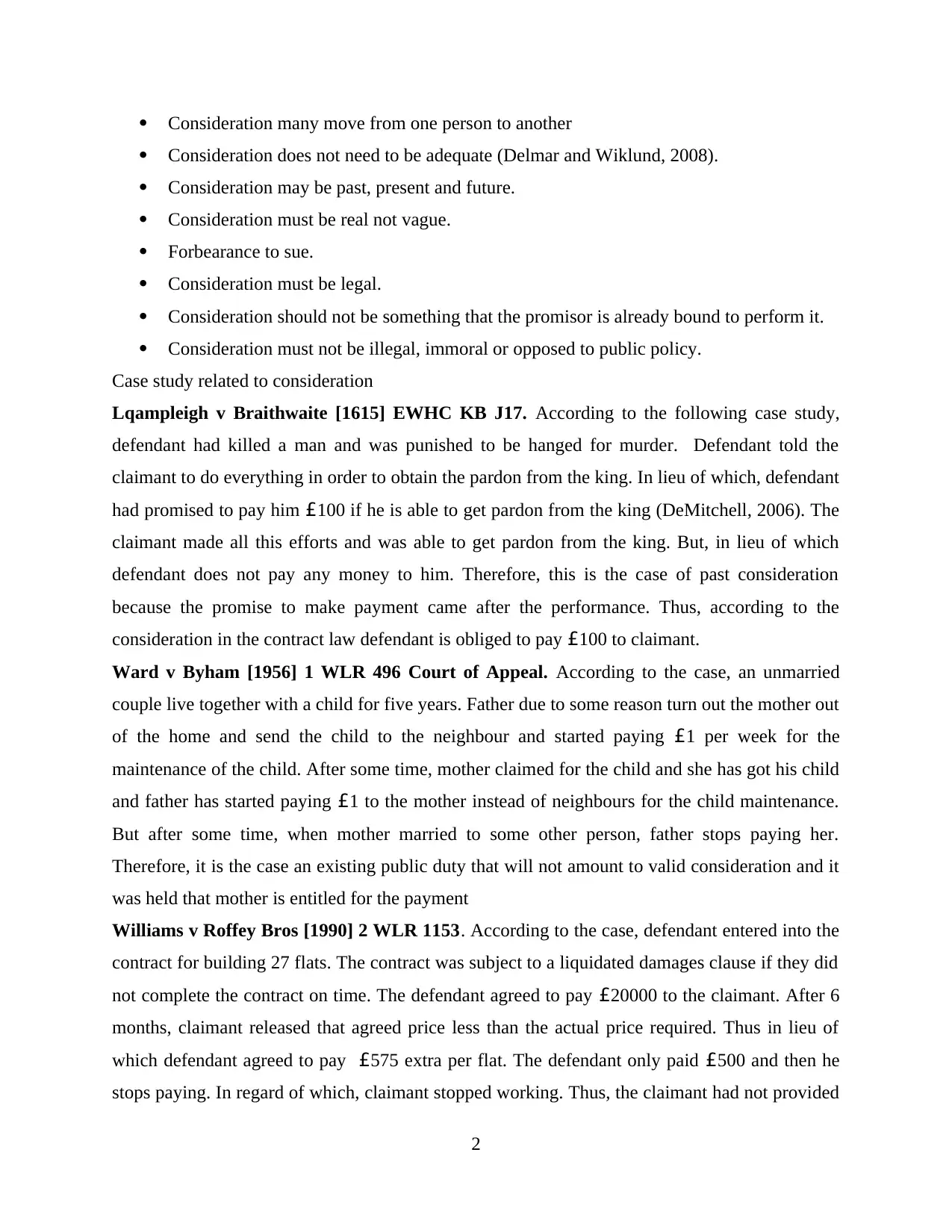
Consideration many move from one person to another
Consideration does not need to be adequate (Delmar and Wiklund, 2008).
Consideration may be past, present and future.
Consideration must be real not vague.
Forbearance to sue.
Consideration must be legal.
Consideration should not be something that the promisor is already bound to perform it.
Consideration must not be illegal, immoral or opposed to public policy.
Case study related to consideration
Lqampleigh v Braithwaite [1615] EWHC KB J17. According to the following case study,
defendant had killed a man and was punished to be hanged for murder. Defendant told the
claimant to do everything in order to obtain the pardon from the king. In lieu of which, defendant
had promised to pay him £100 if he is able to get pardon from the king (DeMitchell, 2006). The
claimant made all this efforts and was able to get pardon from the king. But, in lieu of which
defendant does not pay any money to him. Therefore, this is the case of past consideration
because the promise to make payment came after the performance. Thus, according to the
consideration in the contract law defendant is obliged to pay £100 to claimant.
Ward v Byham [1956] 1 WLR 496 Court of Appeal. According to the case, an unmarried
couple live together with a child for five years. Father due to some reason turn out the mother out
of the home and send the child to the neighbour and started paying £1 per week for the
maintenance of the child. After some time, mother claimed for the child and she has got his child
and father has started paying £1 to the mother instead of neighbours for the child maintenance.
But after some time, when mother married to some other person, father stops paying her.
Therefore, it is the case an existing public duty that will not amount to valid consideration and it
was held that mother is entitled for the payment
Williams v Roffey Bros [1990] 2 WLR 1153. According to the case, defendant entered into the
contract for building 27 flats. The contract was subject to a liquidated damages clause if they did
not complete the contract on time. The defendant agreed to pay £20000 to the claimant. After 6
months, claimant released that agreed price less than the actual price required. Thus in lieu of
which defendant agreed to pay £575 extra per flat. The defendant only paid £500 and then he
stops paying. In regard of which, claimant stopped working. Thus, the claimant had not provided
2
Consideration does not need to be adequate (Delmar and Wiklund, 2008).
Consideration may be past, present and future.
Consideration must be real not vague.
Forbearance to sue.
Consideration must be legal.
Consideration should not be something that the promisor is already bound to perform it.
Consideration must not be illegal, immoral or opposed to public policy.
Case study related to consideration
Lqampleigh v Braithwaite [1615] EWHC KB J17. According to the following case study,
defendant had killed a man and was punished to be hanged for murder. Defendant told the
claimant to do everything in order to obtain the pardon from the king. In lieu of which, defendant
had promised to pay him £100 if he is able to get pardon from the king (DeMitchell, 2006). The
claimant made all this efforts and was able to get pardon from the king. But, in lieu of which
defendant does not pay any money to him. Therefore, this is the case of past consideration
because the promise to make payment came after the performance. Thus, according to the
consideration in the contract law defendant is obliged to pay £100 to claimant.
Ward v Byham [1956] 1 WLR 496 Court of Appeal. According to the case, an unmarried
couple live together with a child for five years. Father due to some reason turn out the mother out
of the home and send the child to the neighbour and started paying £1 per week for the
maintenance of the child. After some time, mother claimed for the child and she has got his child
and father has started paying £1 to the mother instead of neighbours for the child maintenance.
But after some time, when mother married to some other person, father stops paying her.
Therefore, it is the case an existing public duty that will not amount to valid consideration and it
was held that mother is entitled for the payment
Williams v Roffey Bros [1990] 2 WLR 1153. According to the case, defendant entered into the
contract for building 27 flats. The contract was subject to a liquidated damages clause if they did
not complete the contract on time. The defendant agreed to pay £20000 to the claimant. After 6
months, claimant released that agreed price less than the actual price required. Thus in lieu of
which defendant agreed to pay £575 extra per flat. The defendant only paid £500 and then he
stops paying. In regard of which, claimant stopped working. Thus, the claimant had not provided
2
Paraphrase This Document
Need a fresh take? Get an instant paraphrase of this document with our AI Paraphraser
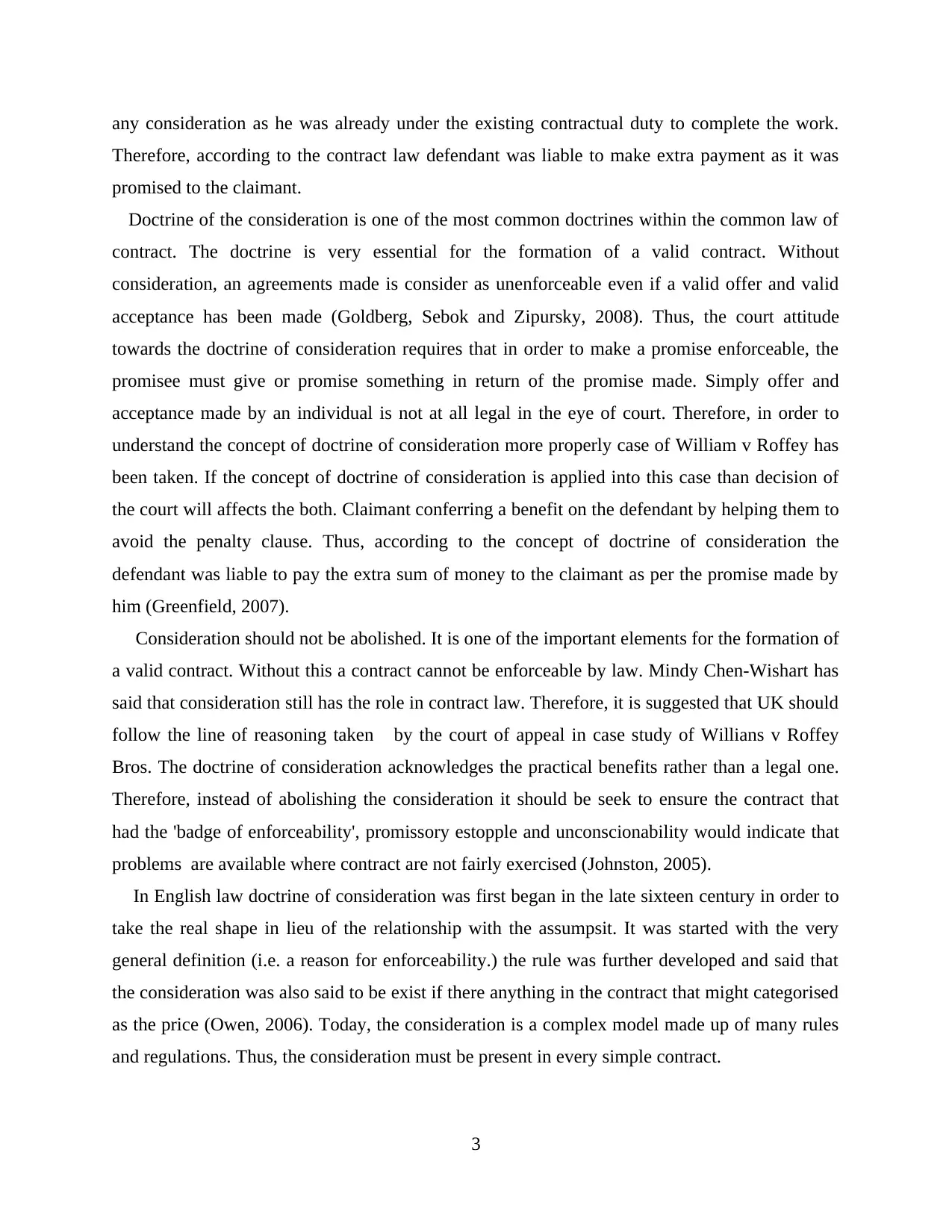
any consideration as he was already under the existing contractual duty to complete the work.
Therefore, according to the contract law defendant was liable to make extra payment as it was
promised to the claimant.
Doctrine of the consideration is one of the most common doctrines within the common law of
contract. The doctrine is very essential for the formation of a valid contract. Without
consideration, an agreements made is consider as unenforceable even if a valid offer and valid
acceptance has been made (Goldberg, Sebok and Zipursky, 2008). Thus, the court attitude
towards the doctrine of consideration requires that in order to make a promise enforceable, the
promisee must give or promise something in return of the promise made. Simply offer and
acceptance made by an individual is not at all legal in the eye of court. Therefore, in order to
understand the concept of doctrine of consideration more properly case of William v Roffey has
been taken. If the concept of doctrine of consideration is applied into this case than decision of
the court will affects the both. Claimant conferring a benefit on the defendant by helping them to
avoid the penalty clause. Thus, according to the concept of doctrine of consideration the
defendant was liable to pay the extra sum of money to the claimant as per the promise made by
him (Greenfield, 2007).
Consideration should not be abolished. It is one of the important elements for the formation of
a valid contract. Without this a contract cannot be enforceable by law. Mindy Chen-Wishart has
said that consideration still has the role in contract law. Therefore, it is suggested that UK should
follow the line of reasoning taken by the court of appeal in case study of Willians v Roffey
Bros. The doctrine of consideration acknowledges the practical benefits rather than a legal one.
Therefore, instead of abolishing the consideration it should be seek to ensure the contract that
had the 'badge of enforceability', promissory estopple and unconscionability would indicate that
problems are available where contract are not fairly exercised (Johnston, 2005).
In English law doctrine of consideration was first began in the late sixteen century in order to
take the real shape in lieu of the relationship with the assumpsit. It was started with the very
general definition (i.e. a reason for enforceability.) the rule was further developed and said that
the consideration was also said to be exist if there anything in the contract that might categorised
as the price (Owen, 2006). Today, the consideration is a complex model made up of many rules
and regulations. Thus, the consideration must be present in every simple contract.
3
Therefore, according to the contract law defendant was liable to make extra payment as it was
promised to the claimant.
Doctrine of the consideration is one of the most common doctrines within the common law of
contract. The doctrine is very essential for the formation of a valid contract. Without
consideration, an agreements made is consider as unenforceable even if a valid offer and valid
acceptance has been made (Goldberg, Sebok and Zipursky, 2008). Thus, the court attitude
towards the doctrine of consideration requires that in order to make a promise enforceable, the
promisee must give or promise something in return of the promise made. Simply offer and
acceptance made by an individual is not at all legal in the eye of court. Therefore, in order to
understand the concept of doctrine of consideration more properly case of William v Roffey has
been taken. If the concept of doctrine of consideration is applied into this case than decision of
the court will affects the both. Claimant conferring a benefit on the defendant by helping them to
avoid the penalty clause. Thus, according to the concept of doctrine of consideration the
defendant was liable to pay the extra sum of money to the claimant as per the promise made by
him (Greenfield, 2007).
Consideration should not be abolished. It is one of the important elements for the formation of
a valid contract. Without this a contract cannot be enforceable by law. Mindy Chen-Wishart has
said that consideration still has the role in contract law. Therefore, it is suggested that UK should
follow the line of reasoning taken by the court of appeal in case study of Willians v Roffey
Bros. The doctrine of consideration acknowledges the practical benefits rather than a legal one.
Therefore, instead of abolishing the consideration it should be seek to ensure the contract that
had the 'badge of enforceability', promissory estopple and unconscionability would indicate that
problems are available where contract are not fairly exercised (Johnston, 2005).
In English law doctrine of consideration was first began in the late sixteen century in order to
take the real shape in lieu of the relationship with the assumpsit. It was started with the very
general definition (i.e. a reason for enforceability.) the rule was further developed and said that
the consideration was also said to be exist if there anything in the contract that might categorised
as the price (Owen, 2006). Today, the consideration is a complex model made up of many rules
and regulations. Thus, the consideration must be present in every simple contract.
3
Yes, the performance of the existing consideration is good enough. The concept of
consideration should not be abolished. The concept of consideration helps to various parties and
entities to form a valid contract which is enforceable by law. If valid offer and valid acceptance
is present and consideration is missing than in that case a valid contract which is enforceable by
law will not be formed (Pettet, 2005). The concept of consideration and the doctrine of the
consideration protect the interest of the claimant against the fraud or illegal practice taken into
consideration by the defendant.
Yes, the concept of the consideration should be passed. Because the concept of the
consideration aid the entities entering into the agreement to form a valid contract. Without the
availability of consideration a valid contract cannot be formed. The concept of consideration is
applied in each and every contract no matter whether it is a simple one or complicated one
(Porat, 2009).
Ward v Byham follows the consideration concept where as R v Select Move doesn’t follow.
The reason behind this is that a practical benefit can be found as the consideration where the
promise to pay the extra money has been made in the case of Ward v Byham. The consideration
cannot take place in the case where payment of debt need to made with reference to the case of R
v SelectMove Ltd [1995]. Thus, the concept of consideration is only applicable for the extra or
advance payment made; it is not applicable for the payment made for debts.
2) The common law aims to strike a reasonable balance between enforcing high standards of
professional conduct whilst maintaining a fair and realistic understanding of the inherent risk in
business transactions
A tort is the wrongful act undertaken by one person against another person and for which
the law provides the remedies (Schaffer and et.al, 2011). There are three types of tort that mainly
cause injury to the another individual. According to the civil law, tort is the grounds for the legal
proceeding to compensate the injured party for the damages or injury suffered. For example- if a
person slip in the grocery shop while walking due to the banana that has fallen from the shelf. In
that case injured party will be known as plaintiff and the grocery store will be considered as the
tortfeasor.
A negligence tort means a tort that is committed by the failure to the act as reasonable
person to whom an individual owes a duty. It can also be said as negligence tort are not
deliberate, there should be an injury resulting from the breach of the duties (Schwartz and Rowe,
4
consideration should not be abolished. The concept of consideration helps to various parties and
entities to form a valid contract which is enforceable by law. If valid offer and valid acceptance
is present and consideration is missing than in that case a valid contract which is enforceable by
law will not be formed (Pettet, 2005). The concept of consideration and the doctrine of the
consideration protect the interest of the claimant against the fraud or illegal practice taken into
consideration by the defendant.
Yes, the concept of the consideration should be passed. Because the concept of the
consideration aid the entities entering into the agreement to form a valid contract. Without the
availability of consideration a valid contract cannot be formed. The concept of consideration is
applied in each and every contract no matter whether it is a simple one or complicated one
(Porat, 2009).
Ward v Byham follows the consideration concept where as R v Select Move doesn’t follow.
The reason behind this is that a practical benefit can be found as the consideration where the
promise to pay the extra money has been made in the case of Ward v Byham. The consideration
cannot take place in the case where payment of debt need to made with reference to the case of R
v SelectMove Ltd [1995]. Thus, the concept of consideration is only applicable for the extra or
advance payment made; it is not applicable for the payment made for debts.
2) The common law aims to strike a reasonable balance between enforcing high standards of
professional conduct whilst maintaining a fair and realistic understanding of the inherent risk in
business transactions
A tort is the wrongful act undertaken by one person against another person and for which
the law provides the remedies (Schaffer and et.al, 2011). There are three types of tort that mainly
cause injury to the another individual. According to the civil law, tort is the grounds for the legal
proceeding to compensate the injured party for the damages or injury suffered. For example- if a
person slip in the grocery shop while walking due to the banana that has fallen from the shelf. In
that case injured party will be known as plaintiff and the grocery store will be considered as the
tortfeasor.
A negligence tort means a tort that is committed by the failure to the act as reasonable
person to whom an individual owes a duty. It can also be said as negligence tort are not
deliberate, there should be an injury resulting from the breach of the duties (Schwartz and Rowe,
4
⊘ This is a preview!⊘
Do you want full access?
Subscribe today to unlock all pages.
Trusted by 1+ million students worldwide
2010). The negligence act find out in the particular tort result to a monetary damages or personal
injury. The elements which constitute a negligent tort are as follows: the individual who owes the
duty must violate the promise or obligation, the injury caused to the person essential is
foreseeable as a result of the person's negligent actions.
With references to the case of Donoghue v Stevenson the Neighbour principle is based on the
concept of the Christian principle of 'loving your neighbour'. This principle of the English law
states that a person should take into consideration all necessary measures in order to avoid any
omission or acts that might cause injury to the neighbour. Neighbour includes all those persons
who are directly affected by the act. In the case of Donoghue v Stevenson; Stevenson has not
taken into the consideration the concept of neighbour principle due to which Mrs. Donoghue has
suffered a personal injury.
With reference to the Donoghue v Stevenson Neighbour principle is the test in order to find
out the duty of care if a person does not take into consideration the usually degree of precaution.
Which in turn may cause injury or damage to another person health or property. Duty of care is
the first and the basic element of the negligence. Thus, according to this principle the
manufacture of the ginger bear has the duty of care towards Mrs. Donoghue. In lieu of which
Mrs. Donoghue has the right to sue the manufacture for his act of negligence.
Economic loss refers to the financial loss that only occurs in the balance sheet rather than any
physical or personal injury to the person or the property (Simons, 2007). With reference to the
case of Caparo Industries plc v Dickman [1990] 2 AC 605 House of Lords. It is one of the most
important distinctions always need to be observed that lies in the law's essentially different
approach to various kind of damages which one party suffer due to the mistake of the any
another person. According to the case there was no sufficient closeness between the Caparo and
the auditors. Auditors were not aware of the purpose for which actually account of used and he
was also unaware about the existence of Caparo. This in turn resulted in the Economic loss.
Caparo test is the three stage Lord Bridge stage test for imposing a duty of care with reference
to the Caparo Industries Plc v Dickmnan [1990] 2 AC 605 Lord Bridge's . Under the Caparo test
the claimant need to establish the following things. Firstly, there must be a relationship of
proximity. Secondly, the harm was reasonably foreseeable and lastly, it should be fair, just and
reasonable to impose a duty of care. This test is the combination of neighbour test and the Anns
5
injury. The elements which constitute a negligent tort are as follows: the individual who owes the
duty must violate the promise or obligation, the injury caused to the person essential is
foreseeable as a result of the person's negligent actions.
With references to the case of Donoghue v Stevenson the Neighbour principle is based on the
concept of the Christian principle of 'loving your neighbour'. This principle of the English law
states that a person should take into consideration all necessary measures in order to avoid any
omission or acts that might cause injury to the neighbour. Neighbour includes all those persons
who are directly affected by the act. In the case of Donoghue v Stevenson; Stevenson has not
taken into the consideration the concept of neighbour principle due to which Mrs. Donoghue has
suffered a personal injury.
With reference to the Donoghue v Stevenson Neighbour principle is the test in order to find
out the duty of care if a person does not take into consideration the usually degree of precaution.
Which in turn may cause injury or damage to another person health or property. Duty of care is
the first and the basic element of the negligence. Thus, according to this principle the
manufacture of the ginger bear has the duty of care towards Mrs. Donoghue. In lieu of which
Mrs. Donoghue has the right to sue the manufacture for his act of negligence.
Economic loss refers to the financial loss that only occurs in the balance sheet rather than any
physical or personal injury to the person or the property (Simons, 2007). With reference to the
case of Caparo Industries plc v Dickman [1990] 2 AC 605 House of Lords. It is one of the most
important distinctions always need to be observed that lies in the law's essentially different
approach to various kind of damages which one party suffer due to the mistake of the any
another person. According to the case there was no sufficient closeness between the Caparo and
the auditors. Auditors were not aware of the purpose for which actually account of used and he
was also unaware about the existence of Caparo. This in turn resulted in the Economic loss.
Caparo test is the three stage Lord Bridge stage test for imposing a duty of care with reference
to the Caparo Industries Plc v Dickmnan [1990] 2 AC 605 Lord Bridge's . Under the Caparo test
the claimant need to establish the following things. Firstly, there must be a relationship of
proximity. Secondly, the harm was reasonably foreseeable and lastly, it should be fair, just and
reasonable to impose a duty of care. This test is the combination of neighbour test and the Anns
5
Paraphrase This Document
Need a fresh take? Get an instant paraphrase of this document with our AI Paraphraser
test. Duty of care arises when an individual or a group perform any activities that could
reasonably be harm another person either mentally, physically and economically.
Economic loss is the loss that is suffered by the person or a group of person due to the
unresponsive behaviour or omission of the necessary act. The case of Hedley Byrne v Heller
Patners Ltd. is a case of English tort law that indicates purely about the economic loss condition
that arise due to the negligent misstatement. Prior to the decision, the belief that the one party
may owe the duty of care for the other party made in reliance has been rejected. Which has
resulted in the remedy for such losses that are state in the contract law. Therefore, the House of
Lords the existing position in order to recognise the liability for the pure economic loss that are
not arising out of the contractual relationship.
3) The Companies Act 2006 will not change the essential nature of directors duties, the duties
are couched in largely discretional and unclear terms, in which no method of enforcement of
directors' general duties by non-shareholders is provided.’
With reference to the 'Companies Act 2006' Directors are the individual who speaks on
behalf of the company as an agent. These directors are the representative of the companies with
certain duties. Directors of the company usually refer to the vice president or CEO in order to
inform them about the progress of the company. Directors commonly refer to the lower level
executive but in many big organisations this title is used as the associate director more often
(Simons, 2007). In much large business organisation regional directors are also appointed who
are responsible for the operations of the particular areas.
Fiduciary duty is one of the most important professional obligations. It is a duty which
normally provides the project to the individual who have entered into the legal and financial
contract with the other individual or entity (Sitkoff, 2011). Importance of this duty is that it
provides various benefits to the investor in lieu of the commission that is normally charged by
the agents. The agents who are bound by fiduciary duty are not liable to charge any commission
from the investors.
The previous company law before Companies Act 2006 was Company Act 1985. It is the act
enacted by the Parliament of the UK of Great Britain and Northern Ireland. This act enable the
companies need to be formed by the registration and at the same time set out various
responsibilities for the companies and their secretariats and managers (Steele, 2009). Later on
this company act was reformed and Company Act 2006 was formed. Reformation of the
6
reasonably be harm another person either mentally, physically and economically.
Economic loss is the loss that is suffered by the person or a group of person due to the
unresponsive behaviour or omission of the necessary act. The case of Hedley Byrne v Heller
Patners Ltd. is a case of English tort law that indicates purely about the economic loss condition
that arise due to the negligent misstatement. Prior to the decision, the belief that the one party
may owe the duty of care for the other party made in reliance has been rejected. Which has
resulted in the remedy for such losses that are state in the contract law. Therefore, the House of
Lords the existing position in order to recognise the liability for the pure economic loss that are
not arising out of the contractual relationship.
3) The Companies Act 2006 will not change the essential nature of directors duties, the duties
are couched in largely discretional and unclear terms, in which no method of enforcement of
directors' general duties by non-shareholders is provided.’
With reference to the 'Companies Act 2006' Directors are the individual who speaks on
behalf of the company as an agent. These directors are the representative of the companies with
certain duties. Directors of the company usually refer to the vice president or CEO in order to
inform them about the progress of the company. Directors commonly refer to the lower level
executive but in many big organisations this title is used as the associate director more often
(Simons, 2007). In much large business organisation regional directors are also appointed who
are responsible for the operations of the particular areas.
Fiduciary duty is one of the most important professional obligations. It is a duty which
normally provides the project to the individual who have entered into the legal and financial
contract with the other individual or entity (Sitkoff, 2011). Importance of this duty is that it
provides various benefits to the investor in lieu of the commission that is normally charged by
the agents. The agents who are bound by fiduciary duty are not liable to charge any commission
from the investors.
The previous company law before Companies Act 2006 was Company Act 1985. It is the act
enacted by the Parliament of the UK of Great Britain and Northern Ireland. This act enable the
companies need to be formed by the registration and at the same time set out various
responsibilities for the companies and their secretariats and managers (Steele, 2009). Later on
this company act was reformed and Company Act 2006 was formed. Reformation of the
6
previous law was made in order to undertaken the certain the key provision. Some of the
provision is:-
The act codifies certain existing law principles that are related to the roles and duties of
the directors.
It implements the European Union's Takeover and the Transparency Obligations.
Various new provisions have been introduced for the public and private companies.
Thus, the main reason for the reform of the act was intended to make wide range of amendments
to previous legislative act. The company law was reformed in order to develop an enterprise
culture in the UK. This law was reformed by the Chancellor of Exchequer in June 2001. Their
main aim for the reformation of the law was to create in Britain a true enterprise culture where
chance of succeeding the business is open for all.
After the reformation of the act many changes have taken place in the duties and roles of the
directors. New law impose the concept of the fiduciary duty, duty of skill and care and statutory
duties which was not imposed before. Directors retain the discretion to make the ultimate course
of actions that are beneficial for the company. Directors are now required to follow the structure
which they were not following before.
Various section of the Company Act 2006 regarding the directors duties are as follows:-
Section 171 of the Company Act 2006 was formed in order to codify the duty to act
within powers in accordance with the terms on which they were granted.
Section172 was formed to systematize the duty to promote the success of the company.
This section was introduced top enshrines in statute that referred to the principle (Davies,
2007).
Section 173 was formed in order to exercise independent judgement. In this section
powers of the directors are independently exercise.
Section 175 was formed in order to avoid the conflicts of interest. This duty replaces the
no-conflict rule applying to directors.
Section 176 was developed in order to codify the duty not to accept benefits from the
third parties. This section codifies the rule prohibiting the exploitation of the position of
the director for their own personal benefit.
Section 177 was developed in order to declare interest in proposed transactions. This
section requires a director to expose the interest that he has in relation to the company.
7
provision is:-
The act codifies certain existing law principles that are related to the roles and duties of
the directors.
It implements the European Union's Takeover and the Transparency Obligations.
Various new provisions have been introduced for the public and private companies.
Thus, the main reason for the reform of the act was intended to make wide range of amendments
to previous legislative act. The company law was reformed in order to develop an enterprise
culture in the UK. This law was reformed by the Chancellor of Exchequer in June 2001. Their
main aim for the reformation of the law was to create in Britain a true enterprise culture where
chance of succeeding the business is open for all.
After the reformation of the act many changes have taken place in the duties and roles of the
directors. New law impose the concept of the fiduciary duty, duty of skill and care and statutory
duties which was not imposed before. Directors retain the discretion to make the ultimate course
of actions that are beneficial for the company. Directors are now required to follow the structure
which they were not following before.
Various section of the Company Act 2006 regarding the directors duties are as follows:-
Section 171 of the Company Act 2006 was formed in order to codify the duty to act
within powers in accordance with the terms on which they were granted.
Section172 was formed to systematize the duty to promote the success of the company.
This section was introduced top enshrines in statute that referred to the principle (Davies,
2007).
Section 173 was formed in order to exercise independent judgement. In this section
powers of the directors are independently exercise.
Section 175 was formed in order to avoid the conflicts of interest. This duty replaces the
no-conflict rule applying to directors.
Section 176 was developed in order to codify the duty not to accept benefits from the
third parties. This section codifies the rule prohibiting the exploitation of the position of
the director for their own personal benefit.
Section 177 was developed in order to declare interest in proposed transactions. This
section requires a director to expose the interest that he has in relation to the company.
7
⊘ This is a preview!⊘
Do you want full access?
Subscribe today to unlock all pages.
Trusted by 1+ million students worldwide
Case related to these section of Neptune Ltd v Fitzgerald [1995] 3 WLR 108. The case is
concerned with the responsibility of the directors under the section 177 of the companies act. In
this director of private company authorised payment of £100,000 which he claim from the
company under the contract of employment. This problem was faced when the ownership of the
company was changed and the director had not made necessary declaration.
Conclusion
From the following report it is interpreted that for the formation of the valid contract availability
of the consideration is necessary. Thus, at the same time it is also concluded that following the
concept of negligence tort and neighbor principle is necessary at the time of forming duty of
care. At last in this report various changes that take place in the directors’ duties due to the
reform of the company act are concluded.
8
concerned with the responsibility of the directors under the section 177 of the companies act. In
this director of private company authorised payment of £100,000 which he claim from the
company under the contract of employment. This problem was faced when the ownership of the
company was changed and the director had not made necessary declaration.
Conclusion
From the following report it is interpreted that for the formation of the valid contract availability
of the consideration is necessary. Thus, at the same time it is also concluded that following the
concept of negligence tort and neighbor principle is necessary at the time of forming duty of
care. At last in this report various changes that take place in the directors’ duties due to the
reform of the company act are concluded.
8
Paraphrase This Document
Need a fresh take? Get an instant paraphrase of this document with our AI Paraphraser
References
Books and Journals
Augier, M. and Teece, D.J., 2009. Dynamic capabilities and the role of managers in business
strategy and economic performance. Organization Science, 20(2), pp.410-421.
Christensen, S.L., 2008. The role of law in models of ethical behavior. Journal of Business
Ethics, 77(4), pp.451-461.
Delmar, F. and Wiklund, J., 2008. The effect of small business managers’ growth motivation on
firm growth: A longitudinal study. Entrepreneurship Theory and Practice, 32(3),
pp.437-457.
DeMitchell, T.A., 2006. Negligence: What Principals Need to Know about Avoiding Liability.
Rowman & Littlefield Education.
Goldberg, J.C., Sebok, A.J. and Zipursky, B.C., 2008. Tort Law: Responsibilities and Redress.
Aspen Publishers.
Greenfield, K., 2007. Saving the World with Corporate Law. Emory LJ, 57, p.947.
Johnston, J.F., 2005. Natural law and the fiduciary duties of business managers. Business and
Religion: A Clash of Civilizations, 279, pp.289-90.
Owen, D.G., 2006. Five Elements of Negligence, The. Hofstra L. Rev., 35, p.1671.
Pettet, B., 2005. Company law. Pearson Education.
Porat, A., 2009. Symposium: Third Restatement of Torts:'Expanding Liability for Negligence
Per-Se'. Wake Forest Law Review, 44, p.979.
Schaffer, R., Agusti, F., Dhooge, L. and Earle, B., 2011. International business law and its
environment. Cengage Learning.
Schwartz, V.E. and Rowe, E.F., 2010. Comparative negligence. LexisNexis.
Simons, K.W., 2007. Crime/Tort Distinction: Legal Doctrine and Normative Perspectives, The.
Widener LJ, 17, p.719.
Simons, K.W., 2007. Tort negligence, cost-benefit analysis, and tradeoffs: A closer look at the
controversy. Loy. LAL Rev., 41, p.1171.
Sitkoff, R.H., 2011. The Economic Structure of Fiduciary Law.
Steele, M.T., 2009. Freedom of Contract and Default Contractual Duties in Delaware Limited
Partnerships and Limited Liability Companies. American Business Law Journal, 46(2),
pp.221-242.
9
Books and Journals
Augier, M. and Teece, D.J., 2009. Dynamic capabilities and the role of managers in business
strategy and economic performance. Organization Science, 20(2), pp.410-421.
Christensen, S.L., 2008. The role of law in models of ethical behavior. Journal of Business
Ethics, 77(4), pp.451-461.
Delmar, F. and Wiklund, J., 2008. The effect of small business managers’ growth motivation on
firm growth: A longitudinal study. Entrepreneurship Theory and Practice, 32(3),
pp.437-457.
DeMitchell, T.A., 2006. Negligence: What Principals Need to Know about Avoiding Liability.
Rowman & Littlefield Education.
Goldberg, J.C., Sebok, A.J. and Zipursky, B.C., 2008. Tort Law: Responsibilities and Redress.
Aspen Publishers.
Greenfield, K., 2007. Saving the World with Corporate Law. Emory LJ, 57, p.947.
Johnston, J.F., 2005. Natural law and the fiduciary duties of business managers. Business and
Religion: A Clash of Civilizations, 279, pp.289-90.
Owen, D.G., 2006. Five Elements of Negligence, The. Hofstra L. Rev., 35, p.1671.
Pettet, B., 2005. Company law. Pearson Education.
Porat, A., 2009. Symposium: Third Restatement of Torts:'Expanding Liability for Negligence
Per-Se'. Wake Forest Law Review, 44, p.979.
Schaffer, R., Agusti, F., Dhooge, L. and Earle, B., 2011. International business law and its
environment. Cengage Learning.
Schwartz, V.E. and Rowe, E.F., 2010. Comparative negligence. LexisNexis.
Simons, K.W., 2007. Crime/Tort Distinction: Legal Doctrine and Normative Perspectives, The.
Widener LJ, 17, p.719.
Simons, K.W., 2007. Tort negligence, cost-benefit analysis, and tradeoffs: A closer look at the
controversy. Loy. LAL Rev., 41, p.1171.
Sitkoff, R.H., 2011. The Economic Structure of Fiduciary Law.
Steele, M.T., 2009. Freedom of Contract and Default Contractual Duties in Delaware Limited
Partnerships and Limited Liability Companies. American Business Law Journal, 46(2),
pp.221-242.
9

Online
Davies, J., 2007. A guide to directors’ responsibilities under the Companies Act 2006 .
Available through:<http://www.accaglobal.com/content/dam/acca/global/PDF-
technical/business-law/tech-tp-cdd.pdf> [Assessed on 6th January, 2016].
10
Davies, J., 2007. A guide to directors’ responsibilities under the Companies Act 2006 .
Available through:<http://www.accaglobal.com/content/dam/acca/global/PDF-
technical/business-law/tech-tp-cdd.pdf> [Assessed on 6th January, 2016].
10
⊘ This is a preview!⊘
Do you want full access?
Subscribe today to unlock all pages.
Trusted by 1+ million students worldwide

1 out of 12


Related Documents


Your All-in-One AI-Powered Toolkit for Academic Success.
+13062052269
info@desklib.com
Available 24*7 on WhatsApp / Email
![[object Object]](/_next/static/media/star-bottom.7253800d.svg)
Unlock your academic potential
Copyright © 2020–2026 A2Z Services. All Rights Reserved. Developed and managed by ZUCOL.