Business Law Case Study: Contract, Consumer Law, and the Goods Act
VerifiedAdded on 2020/03/23
|5
|1336
|42
Case Study
AI Summary
This case study analyzes a business law scenario involving a consumer, Charlie, and two companies, EnviroPro Pty Ltd and Clean Aqua Pty Ltd. The first issue examines whether Charlie can sue EnviroPro for misrepresentation related to a water purifier, focusing on contract law principles, the Goods Act (Victoria), and the concept of 'puffery.' The analysis considers whether the salesperson's statements constituted contractual terms and the validity of any exclusion clauses. The second issue assesses whether Charlie has grounds to sue Clean Aqua under the Australian Consumer Law (ACL), considering warranties and the company's liability for the product's effects on Charlie's health, despite the company's warning about the product's effectiveness. The case study applies relevant legal principles and precedents to determine the outcome of potential legal actions, concluding that Charlie has a strong case against EnviroPro but not against Clean Aqua.
Running head: BUSINESS LAW
Business Law
Name of the student
Name of the university
Author note
Business Law
Name of the student
Name of the university
Author note
Paraphrase This Document
Need a fresh take? Get an instant paraphrase of this document with our AI Paraphraser

1
BUSINESS LAW
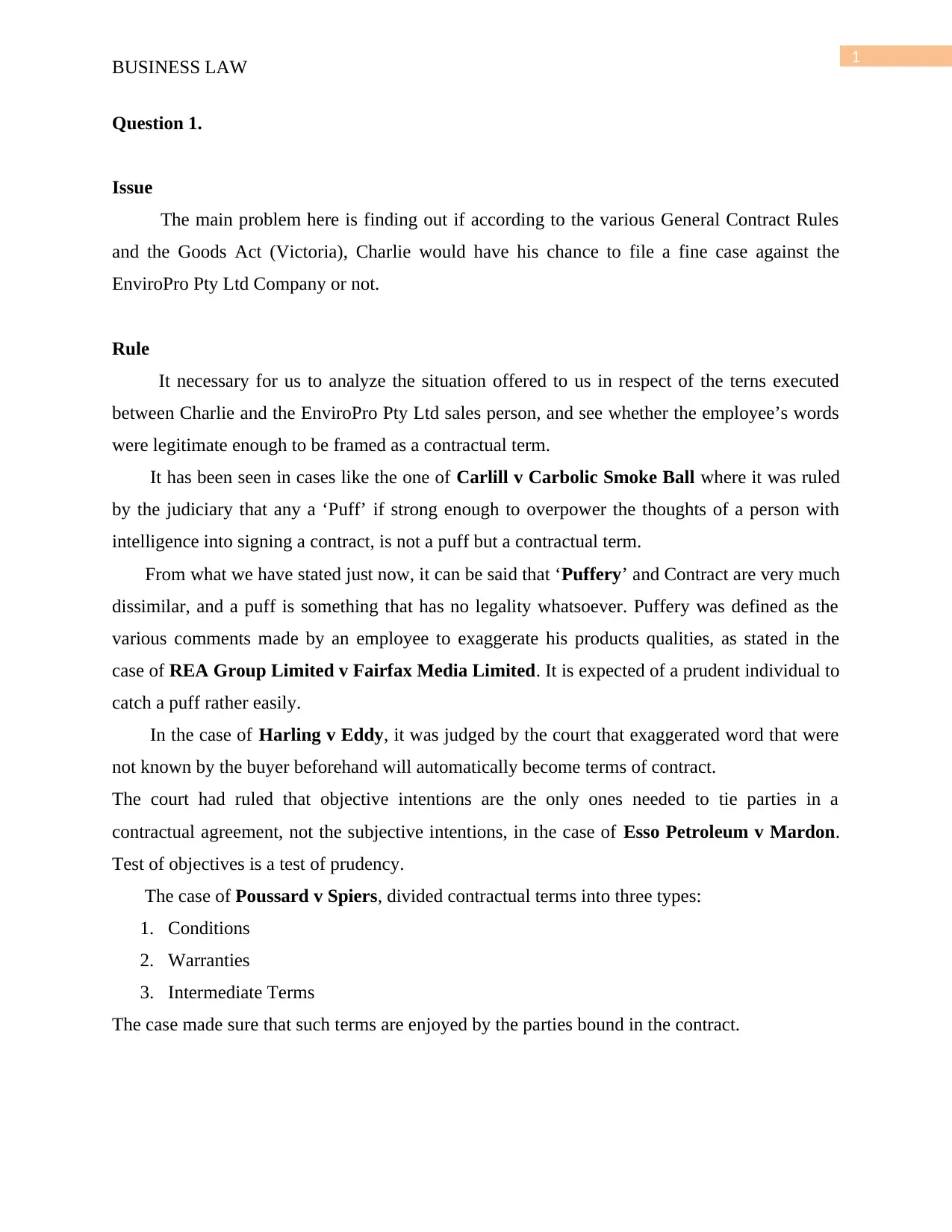
Question 1.
Issue
The main problem here is finding out if according to the various General Contract Rules
and the Goods Act (Victoria), Charlie would have his chance to file a fine case against the
EnviroPro Pty Ltd Company or not.
Rule
It necessary for us to analyze the situation offered to us in respect of the terns executed
between Charlie and the EnviroPro Pty Ltd sales person, and see whether the employee’s words
were legitimate enough to be framed as a contractual term.
It has been seen in cases like the one of Carlill v Carbolic Smoke Ball where it was ruled
by the judiciary that any a ‘Puff’ if strong enough to overpower the thoughts of a person with
intelligence into signing a contract, is not a puff but a contractual term.
From what we have stated just now, it can be said that ‘Puffery’ and Contract are very much
dissimilar, and a puff is something that has no legality whatsoever. Puffery was defined as the
various comments made by an employee to exaggerate his products qualities, as stated in the
case of REA Group Limited v Fairfax Media Limited. It is expected of a prudent individual to
catch a puff rather easily.
In the case of Harling v Eddy, it was judged by the court that exaggerated word that were
not known by the buyer beforehand will automatically become terms of contract.
The court had ruled that objective intentions are the only ones needed to tie parties in a
contractual agreement, not the subjective intentions, in the case of Esso Petroleum v Mardon.
Test of objectives is a test of prudency.
The case of Poussard v Spiers, divided contractual terms into three types:
1. Conditions
2. Warranties
3. Intermediate Terms
The case made sure that such terms are enjoyed by the parties bound in the contract.
BUSINESS LAW
Question 1.
Issue
The main problem here is finding out if according to the various General Contract Rules
and the Goods Act (Victoria), Charlie would have his chance to file a fine case against the
EnviroPro Pty Ltd Company or not.
Rule
It necessary for us to analyze the situation offered to us in respect of the terns executed
between Charlie and the EnviroPro Pty Ltd sales person, and see whether the employee’s words
were legitimate enough to be framed as a contractual term.
It has been seen in cases like the one of Carlill v Carbolic Smoke Ball where it was ruled
by the judiciary that any a ‘Puff’ if strong enough to overpower the thoughts of a person with
intelligence into signing a contract, is not a puff but a contractual term.
From what we have stated just now, it can be said that ‘Puffery’ and Contract are very much
dissimilar, and a puff is something that has no legality whatsoever. Puffery was defined as the
various comments made by an employee to exaggerate his products qualities, as stated in the
case of REA Group Limited v Fairfax Media Limited. It is expected of a prudent individual to
catch a puff rather easily.
In the case of Harling v Eddy, it was judged by the court that exaggerated word that were
not known by the buyer beforehand will automatically become terms of contract.
The court had ruled that objective intentions are the only ones needed to tie parties in a
contractual agreement, not the subjective intentions, in the case of Esso Petroleum v Mardon.
Test of objectives is a test of prudency.
The case of Poussard v Spiers, divided contractual terms into three types:
1. Conditions
2. Warranties
3. Intermediate Terms
The case made sure that such terms are enjoyed by the parties bound in the contract.

2
BUSINESS LAW
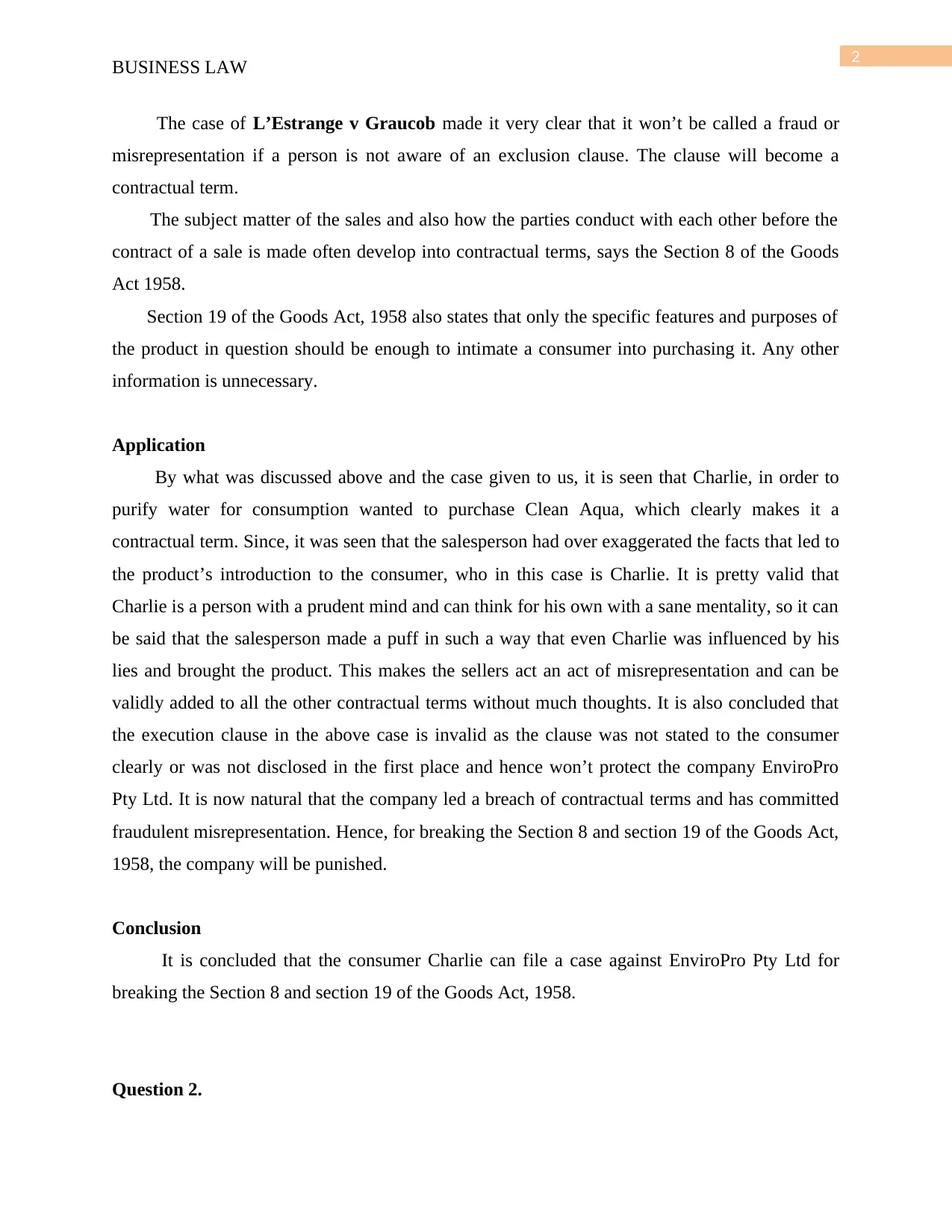
The case of L’Estrange v Graucob made it very clear that it won’t be called a fraud or
misrepresentation if a person is not aware of an exclusion clause. The clause will become a
contractual term.
The subject matter of the sales and also how the parties conduct with each other before the
contract of a sale is made often develop into contractual terms, says the Section 8 of the Goods
Act 1958.
Section 19 of the Goods Act, 1958 also states that only the specific features and purposes of
the product in question should be enough to intimate a consumer into purchasing it. Any other
information is unnecessary.
Application
By what was discussed above and the case given to us, it is seen that Charlie, in order to
purify water for consumption wanted to purchase Clean Aqua, which clearly makes it a
contractual term. Since, it was seen that the salesperson had over exaggerated the facts that led to
the product’s introduction to the consumer, who in this case is Charlie. It is pretty valid that
Charlie is a person with a prudent mind and can think for his own with a sane mentality, so it can
be said that the salesperson made a puff in such a way that even Charlie was influenced by his
lies and brought the product. This makes the sellers act an act of misrepresentation and can be
validly added to all the other contractual terms without much thoughts. It is also concluded that
the execution clause in the above case is invalid as the clause was not stated to the consumer
clearly or was not disclosed in the first place and hence won’t protect the company EnviroPro
Pty Ltd. It is now natural that the company led a breach of contractual terms and has committed
fraudulent misrepresentation. Hence, for breaking the Section 8 and section 19 of the Goods Act,
1958, the company will be punished.
Conclusion
It is concluded that the consumer Charlie can file a case against EnviroPro Pty Ltd for
breaking the Section 8 and section 19 of the Goods Act, 1958.
Question 2.
BUSINESS LAW
The case of L’Estrange v Graucob made it very clear that it won’t be called a fraud or
misrepresentation if a person is not aware of an exclusion clause. The clause will become a
contractual term.
The subject matter of the sales and also how the parties conduct with each other before the
contract of a sale is made often develop into contractual terms, says the Section 8 of the Goods
Act 1958.
Section 19 of the Goods Act, 1958 also states that only the specific features and purposes of
the product in question should be enough to intimate a consumer into purchasing it. Any other
information is unnecessary.
Application
By what was discussed above and the case given to us, it is seen that Charlie, in order to
purify water for consumption wanted to purchase Clean Aqua, which clearly makes it a
contractual term. Since, it was seen that the salesperson had over exaggerated the facts that led to
the product’s introduction to the consumer, who in this case is Charlie. It is pretty valid that
Charlie is a person with a prudent mind and can think for his own with a sane mentality, so it can
be said that the salesperson made a puff in such a way that even Charlie was influenced by his
lies and brought the product. This makes the sellers act an act of misrepresentation and can be
validly added to all the other contractual terms without much thoughts. It is also concluded that
the execution clause in the above case is invalid as the clause was not stated to the consumer
clearly or was not disclosed in the first place and hence won’t protect the company EnviroPro
Pty Ltd. It is now natural that the company led a breach of contractual terms and has committed
fraudulent misrepresentation. Hence, for breaking the Section 8 and section 19 of the Goods Act,
1958, the company will be punished.
Conclusion
It is concluded that the consumer Charlie can file a case against EnviroPro Pty Ltd for
breaking the Section 8 and section 19 of the Goods Act, 1958.
Question 2.
⊘ This is a preview!⊘
Do you want full access?
Subscribe today to unlock all pages.

Trusted by 1+ million students worldwide

3
BUSINESS LAW
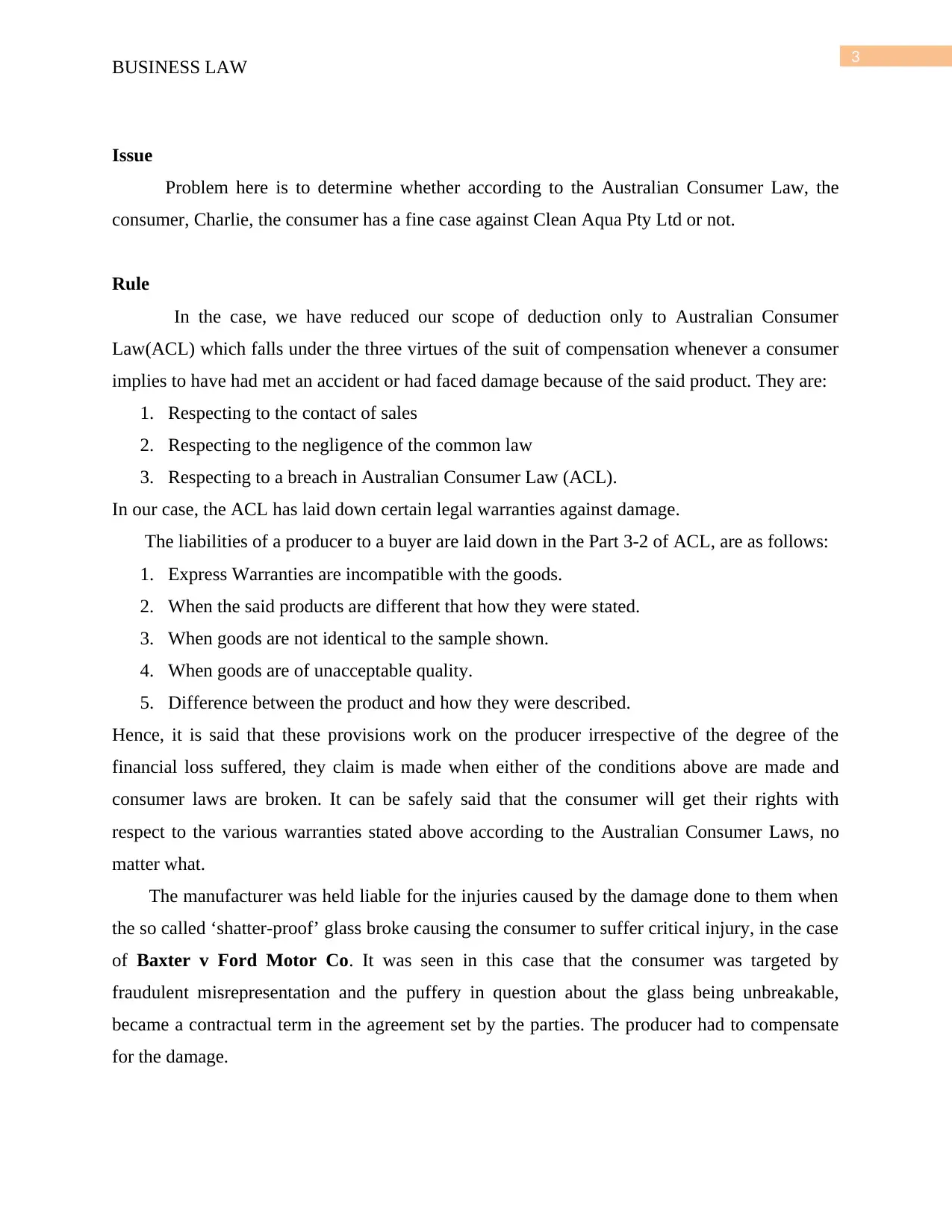
Issue
Problem here is to determine whether according to the Australian Consumer Law, the
consumer, Charlie, the consumer has a fine case against Clean Aqua Pty Ltd or not.
Rule
In the case, we have reduced our scope of deduction only to Australian Consumer
Law(ACL) which falls under the three virtues of the suit of compensation whenever a consumer
implies to have had met an accident or had faced damage because of the said product. They are:
1. Respecting to the contact of sales
2. Respecting to the negligence of the common law
3. Respecting to a breach in Australian Consumer Law (ACL).
In our case, the ACL has laid down certain legal warranties against damage.
The liabilities of a producer to a buyer are laid down in the Part 3-2 of ACL, are as follows:
1. Express Warranties are incompatible with the goods.
2. When the said products are different that how they were stated.
3. When goods are not identical to the sample shown.
4. When goods are of unacceptable quality.
5. Difference between the product and how they were described.
Hence, it is said that these provisions work on the producer irrespective of the degree of the
financial loss suffered, they claim is made when either of the conditions above are made and
consumer laws are broken. It can be safely said that the consumer will get their rights with
respect to the various warranties stated above according to the Australian Consumer Laws, no
matter what.
The manufacturer was held liable for the injuries caused by the damage done to them when
the so called ‘shatter-proof’ glass broke causing the consumer to suffer critical injury, in the case
of Baxter v Ford Motor Co. It was seen in this case that the consumer was targeted by
fraudulent misrepresentation and the puffery in question about the glass being unbreakable,
became a contractual term in the agreement set by the parties. The producer had to compensate
for the damage.
BUSINESS LAW
Issue
Problem here is to determine whether according to the Australian Consumer Law, the
consumer, Charlie, the consumer has a fine case against Clean Aqua Pty Ltd or not.
Rule
In the case, we have reduced our scope of deduction only to Australian Consumer
Law(ACL) which falls under the three virtues of the suit of compensation whenever a consumer
implies to have had met an accident or had faced damage because of the said product. They are:
1. Respecting to the contact of sales
2. Respecting to the negligence of the common law
3. Respecting to a breach in Australian Consumer Law (ACL).
In our case, the ACL has laid down certain legal warranties against damage.
The liabilities of a producer to a buyer are laid down in the Part 3-2 of ACL, are as follows:
1. Express Warranties are incompatible with the goods.
2. When the said products are different that how they were stated.
3. When goods are not identical to the sample shown.
4. When goods are of unacceptable quality.
5. Difference between the product and how they were described.
Hence, it is said that these provisions work on the producer irrespective of the degree of the
financial loss suffered, they claim is made when either of the conditions above are made and
consumer laws are broken. It can be safely said that the consumer will get their rights with
respect to the various warranties stated above according to the Australian Consumer Laws, no
matter what.
The manufacturer was held liable for the injuries caused by the damage done to them when
the so called ‘shatter-proof’ glass broke causing the consumer to suffer critical injury, in the case
of Baxter v Ford Motor Co. It was seen in this case that the consumer was targeted by
fraudulent misrepresentation and the puffery in question about the glass being unbreakable,
became a contractual term in the agreement set by the parties. The producer had to compensate
for the damage.
Paraphrase This Document
Need a fresh take? Get an instant paraphrase of this document with our AI Paraphraser

4
BUSINESS LAW
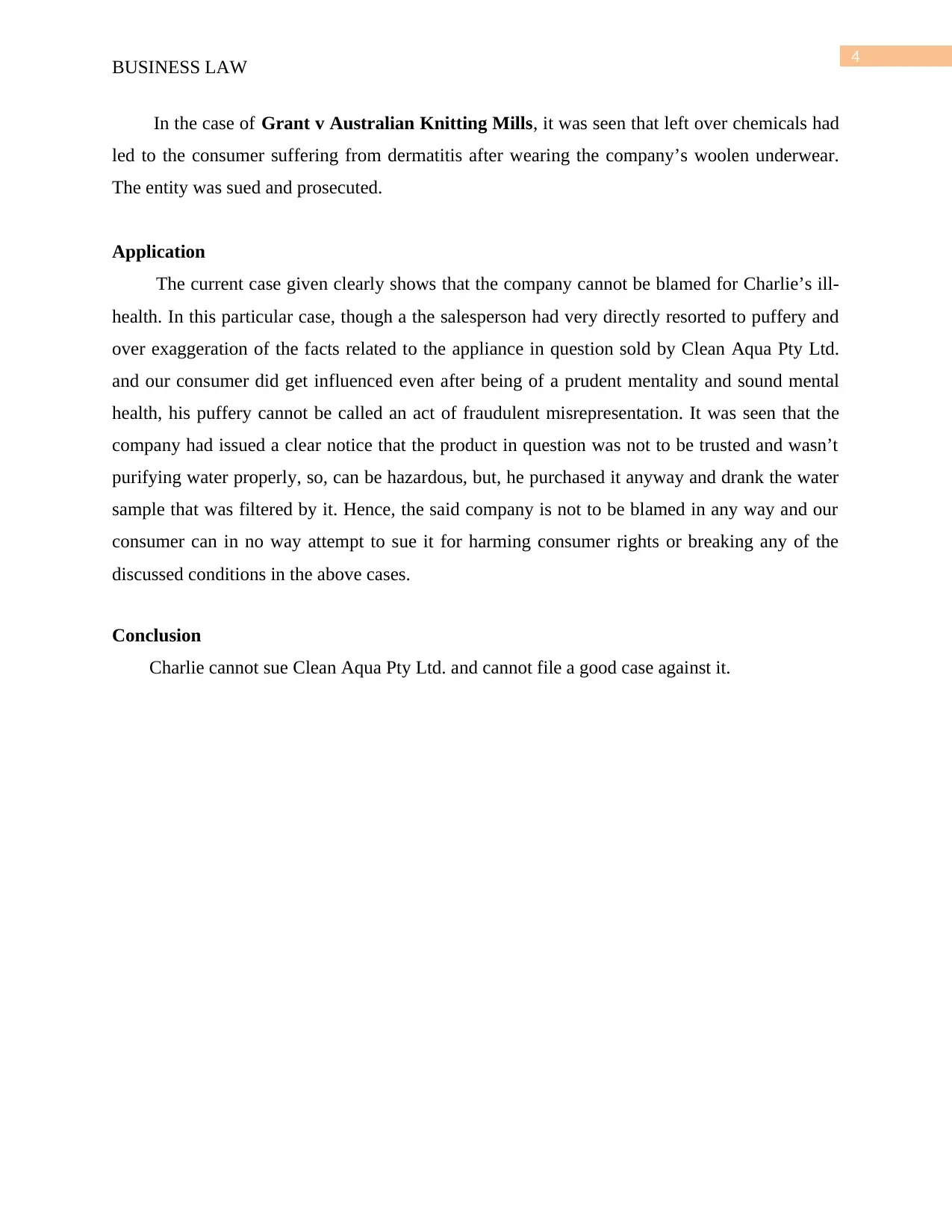
In the case of Grant v Australian Knitting Mills, it was seen that left over chemicals had
led to the consumer suffering from dermatitis after wearing the company’s woolen underwear.
The entity was sued and prosecuted.
Application
The current case given clearly shows that the company cannot be blamed for Charlie’s ill-
health. In this particular case, though a the salesperson had very directly resorted to puffery and
over exaggeration of the facts related to the appliance in question sold by Clean Aqua Pty Ltd.
and our consumer did get influenced even after being of a prudent mentality and sound mental
health, his puffery cannot be called an act of fraudulent misrepresentation. It was seen that the
company had issued a clear notice that the product in question was not to be trusted and wasn’t
purifying water properly, so, can be hazardous, but, he purchased it anyway and drank the water
sample that was filtered by it. Hence, the said company is not to be blamed in any way and our
consumer can in no way attempt to sue it for harming consumer rights or breaking any of the
discussed conditions in the above cases.
Conclusion
Charlie cannot sue Clean Aqua Pty Ltd. and cannot file a good case against it.
BUSINESS LAW
In the case of Grant v Australian Knitting Mills, it was seen that left over chemicals had
led to the consumer suffering from dermatitis after wearing the company’s woolen underwear.
The entity was sued and prosecuted.
Application
The current case given clearly shows that the company cannot be blamed for Charlie’s ill-
health. In this particular case, though a the salesperson had very directly resorted to puffery and
over exaggeration of the facts related to the appliance in question sold by Clean Aqua Pty Ltd.
and our consumer did get influenced even after being of a prudent mentality and sound mental
health, his puffery cannot be called an act of fraudulent misrepresentation. It was seen that the
company had issued a clear notice that the product in question was not to be trusted and wasn’t
purifying water properly, so, can be hazardous, but, he purchased it anyway and drank the water
sample that was filtered by it. Hence, the said company is not to be blamed in any way and our
consumer can in no way attempt to sue it for harming consumer rights or breaking any of the
discussed conditions in the above cases.
Conclusion
Charlie cannot sue Clean Aqua Pty Ltd. and cannot file a good case against it.
1 out of 5
Related Documents
Your All-in-One AI-Powered Toolkit for Academic Success.
+13062052269
info@desklib.com
Available 24*7 on WhatsApp / Email
Unlock your academic potential
Copyright © 2020–2025 A2Z Services. All Rights Reserved. Developed and managed by ZUCOL.