Law for Business Managers: Contract, Tort and Corporation Law
VerifiedAdded on 2023/01/13
|12
|3777
|27
Report
AI Summary
This report provides a detailed analysis of several aspects of business law, including contract law, tort law, and corporate law. The report begins with an examination of the binding nature of promises, analyzing three distinct scenarios and referencing relevant case law such as Balfour v Balfour and Hyde v Wrench to determine their legal validity. The second part of the report delves into the doctrine of tort, specifically focusing on a case involving Samantha's injury at a bank. The analysis follows the IRAC method (Issue, Rule, Application, Conclusion) to determine the liability of Extortionate PLC for negligence. The report assesses the elements of duty, breach of duty, causation, and injury, and considers different types of torts to ascertain the bank's responsibility. Finally, the report includes a discussion on the definition of a corporation as a legal entity.
Law For Business
Manager
Manager

Paraphrase This Document
Need a fresh take? Get an instant paraphrase of this document with our AI Paraphraser
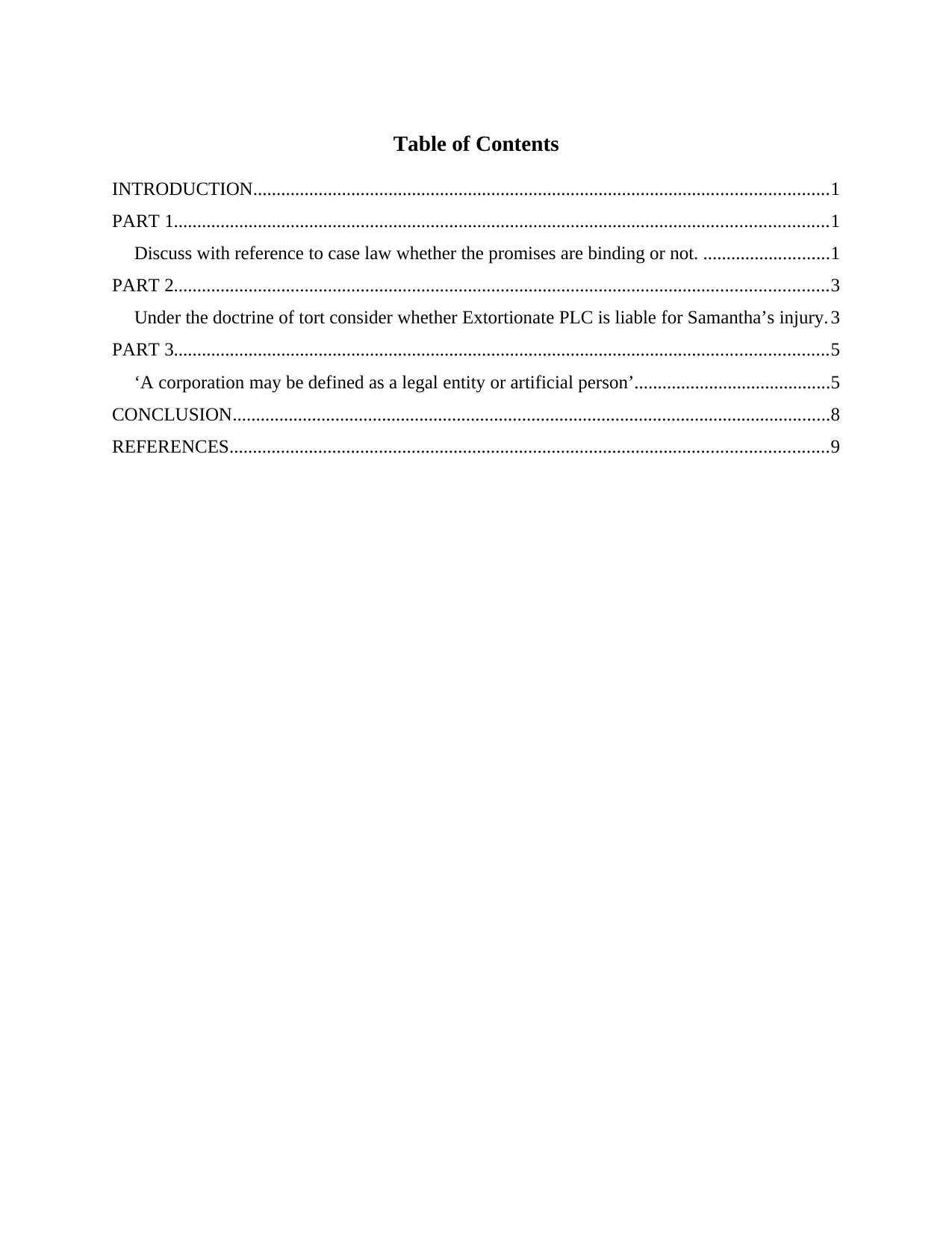
Table of Contents
INTRODUCTION...........................................................................................................................1
PART 1............................................................................................................................................1
Discuss with reference to case law whether the promises are binding or not. ...........................1
PART 2............................................................................................................................................3
Under the doctrine of tort consider whether Extortionate PLC is liable for Samantha’s injury. 3
PART 3............................................................................................................................................5
‘A corporation may be defined as a legal entity or artificial person’..........................................5
CONCLUSION................................................................................................................................8
REFERENCES................................................................................................................................9
INTRODUCTION...........................................................................................................................1
PART 1............................................................................................................................................1
Discuss with reference to case law whether the promises are binding or not. ...........................1
PART 2............................................................................................................................................3
Under the doctrine of tort consider whether Extortionate PLC is liable for Samantha’s injury. 3
PART 3............................................................................................................................................5
‘A corporation may be defined as a legal entity or artificial person’..........................................5
CONCLUSION................................................................................................................................8
REFERENCES................................................................................................................................9

⊘ This is a preview!⊘
Do you want full access?
Subscribe today to unlock all pages.

Trusted by 1+ million students worldwide
INTRODUCTION
Business managers are the individuals who helps small and large business organisations
to operate and perform various business activities. A effective business managers helps
organisations to perform functions in effective and productive manner. As a manager they
perform all their operations in a direction which help in achieving all the set goals and business
objectives. Together with this a business manager ensures that all the laws that are implemented
on a businesses are followed in the most effective manner. UK have a different laws and
regulations that govern all the business organisations that operate in that economy (Alam
Choudhury and Nurul Alam, 2013). A business while operating needs to follow various laws and
regulations together with business law and some of other laws are contract law, property law,
employment law etc. A business manager ensures that all the requirements that a business is
liable to accomplished are met by these organisations or not.
In this project report that are different cases are provided and advise needs to be provided
on the basis of contract law and Tort law. A statement is provided and laws that supports such
statement needs to be provided in this project report.
PART 1
Discuss with reference to case law whether the promises are binding or not.
While operating business activities there are certain acts that needs to be performed in
future and promises are made for these activities in present. In this two individuals promisor and
promisee are involved and make assurance for performance of act in future on happening or
accomplishment of some activities (Brammer, Jackson and Matten, 2012). When promise is
made in written form then it become an agreement which is legally binding on both the parties
involved. Their are different kind of promises and some of them are binding by law and some of
them are not binding by law to perform. In the present case three different promises are made
and on the basis of accuracy of the promises analysis will be made whether these laws are
binding or not. A promise can be made in oral and written form but certain rules must be
considered in the process of accomplishing these promises which are as follows-
A promise will be considered binding when made for appropriate consideration. As
consideration is important to validate the promise.
1
Business managers are the individuals who helps small and large business organisations
to operate and perform various business activities. A effective business managers helps
organisations to perform functions in effective and productive manner. As a manager they
perform all their operations in a direction which help in achieving all the set goals and business
objectives. Together with this a business manager ensures that all the laws that are implemented
on a businesses are followed in the most effective manner. UK have a different laws and
regulations that govern all the business organisations that operate in that economy (Alam
Choudhury and Nurul Alam, 2013). A business while operating needs to follow various laws and
regulations together with business law and some of other laws are contract law, property law,
employment law etc. A business manager ensures that all the requirements that a business is
liable to accomplished are met by these organisations or not.
In this project report that are different cases are provided and advise needs to be provided
on the basis of contract law and Tort law. A statement is provided and laws that supports such
statement needs to be provided in this project report.
PART 1
Discuss with reference to case law whether the promises are binding or not.
While operating business activities there are certain acts that needs to be performed in
future and promises are made for these activities in present. In this two individuals promisor and
promisee are involved and make assurance for performance of act in future on happening or
accomplishment of some activities (Brammer, Jackson and Matten, 2012). When promise is
made in written form then it become an agreement which is legally binding on both the parties
involved. Their are different kind of promises and some of them are binding by law and some of
them are not binding by law to perform. In the present case three different promises are made
and on the basis of accuracy of the promises analysis will be made whether these laws are
binding or not. A promise can be made in oral and written form but certain rules must be
considered in the process of accomplishing these promises which are as follows-
A promise will be considered binding when made for appropriate consideration. As
consideration is important to validate the promise.
1
Paraphrase This Document
Need a fresh take? Get an instant paraphrase of this document with our AI Paraphraser
Promise when made on conditional basis then accomplishment of condition make the
promise binding to be performed as per law.
Acceptance to the promise must be made by both the parties in unbiased manner.
When promise is made enforceable then it must be seen that performing promise is in the
best interest of the both the parties involved in the contract (Cuervo-Cazurra, 2016).
Terms of the promise must be clear and defined so that both the parties got agreed on the
same thing by understanding the whole situation in accurate manner.
Performance of promise must be done with mutual consent. i.e. a promise to be termed as
valid needs to be properly offered and accepted by the parties involved in it.
a) This was one of the situation where Sergio had promised his son that if will leave
hospitality industry and start to build his career as a solicitor. Father had ensure that £5,000 will
be only given in that situation where he will work as per the given situation. Here, it can be
easily determined that it is one of the legal binding form of contract where consideration has
been made by father.
It was one of the case which matches with Balfour v Balfour [1919]. This case was
ensure that once they start to live separate they will not interfere. Even Mr. Balfour will have the
liability to pay £30 on regular monthly instalment method.
b) Here, Sergio's promise was with Liam who was one of the employee in the organisation
who used to perform even in that respective situation where company used to require her in
emergency situation. Looking at the outstanding performance of the employee, promise was
made to £500 because she used to leave lunch as well in that particular situation. In simply
words, past performance was considered which makes the agreement legal binding in nature.
One of the similar case which can be fitted in this particular situation is between Grange
Vs. Abellio London Ltd. This case says that employees must be given the opportunity to take the
lunch (Wood and Logsdon, 2017). If in any of the circumstances, this types of situation occurs
then agreement will not be considered as legal binding in nature. But, case scenario clarify that,
promise was made by the party on the basis of urgent basis work which may occur in the
corporate sector.
c) The promise had been done to Natasha on the basis of work, if she will perform her part
of work then she will be paid £10. The consideration is also available in this case as money will
2
promise binding to be performed as per law.
Acceptance to the promise must be made by both the parties in unbiased manner.
When promise is made enforceable then it must be seen that performing promise is in the
best interest of the both the parties involved in the contract (Cuervo-Cazurra, 2016).
Terms of the promise must be clear and defined so that both the parties got agreed on the
same thing by understanding the whole situation in accurate manner.
Performance of promise must be done with mutual consent. i.e. a promise to be termed as
valid needs to be properly offered and accepted by the parties involved in it.
a) This was one of the situation where Sergio had promised his son that if will leave
hospitality industry and start to build his career as a solicitor. Father had ensure that £5,000 will
be only given in that situation where he will work as per the given situation. Here, it can be
easily determined that it is one of the legal binding form of contract where consideration has
been made by father.
It was one of the case which matches with Balfour v Balfour [1919]. This case was
ensure that once they start to live separate they will not interfere. Even Mr. Balfour will have the
liability to pay £30 on regular monthly instalment method.
b) Here, Sergio's promise was with Liam who was one of the employee in the organisation
who used to perform even in that respective situation where company used to require her in
emergency situation. Looking at the outstanding performance of the employee, promise was
made to £500 because she used to leave lunch as well in that particular situation. In simply
words, past performance was considered which makes the agreement legal binding in nature.
One of the similar case which can be fitted in this particular situation is between Grange
Vs. Abellio London Ltd. This case says that employees must be given the opportunity to take the
lunch (Wood and Logsdon, 2017). If in any of the circumstances, this types of situation occurs
then agreement will not be considered as legal binding in nature. But, case scenario clarify that,
promise was made by the party on the basis of urgent basis work which may occur in the
corporate sector.
c) The promise had been done to Natasha on the basis of work, if she will perform her part
of work then she will be paid £10. The consideration is also available in this case as money will
2
be only given in that respective situation where delivery of newspaper will be made before 8am
in the morning. This is the reason that promise made by Sergio to Natasha was legally binding in
nature.
One of the case which can be discussed in this respective situation is between Hyde v
Wrench (1840). This case said that acceptance must be their to make any of the contract legally
binding in nature (Westbrook, 2015). As counter offer was not made and even if she starts to
perform her part of work then it will be counted as a legal binding agreement.
PART 2
Under the doctrine of tort consider whether Extortionate PLC is liable for Samantha’s injury.
Situation of the Case: The whole of the case is connected with negligence. It was
Extortionate Plc who didn't perform their part of work. Samantha went to bank for the purpose of
finding all of the requirement which are necessary for applying at the time of taking loan. After
collecting all of the necessary information, it was found that Samantha tripped and fell down. In
this accident, she got injured and the main reason was the carelessness because one of her friend
told that similar sort of accident had already taken place. Still having the knowledge, the
management of bank is not giving any of the focus for placing the carpet in necessary way.
It is the case where detail examine is required to find whether there was any of the fault
of or not in the case. For having detail knowledge, it is necessary to solve the case with the IRAC
format. In this formate, I is for issues in which it will be focused that what where the main
problem with the case. Secondly, R is for mentioning the rules. It is necessary that each and
every rules and regulation must be followed. A is for applicable of rules in the given scenario
and on that particular basis, decision is required to be declared in conclusion. For better
understanding case has been discussed below:
Issue: The main issue in this respective case is to find that where Samantha’s got injury
of her own fault or is is Extortionate Plc who created issues for her. The main reason to raise
question is that one of her friend informed that similar form of accident had already taken place
where customers got injury. This was the news which was mentioned by number of innocent
person who has to suffer in the bank at the time of visit (Tsalikis and Fritzsche, 2013). Here, it
will be necessary to check all of the points to find whether Samantha got injured just because of
bank or not. If yes what are their liabilities.
3
in the morning. This is the reason that promise made by Sergio to Natasha was legally binding in
nature.
One of the case which can be discussed in this respective situation is between Hyde v
Wrench (1840). This case said that acceptance must be their to make any of the contract legally
binding in nature (Westbrook, 2015). As counter offer was not made and even if she starts to
perform her part of work then it will be counted as a legal binding agreement.
PART 2
Under the doctrine of tort consider whether Extortionate PLC is liable for Samantha’s injury.
Situation of the Case: The whole of the case is connected with negligence. It was
Extortionate Plc who didn't perform their part of work. Samantha went to bank for the purpose of
finding all of the requirement which are necessary for applying at the time of taking loan. After
collecting all of the necessary information, it was found that Samantha tripped and fell down. In
this accident, she got injured and the main reason was the carelessness because one of her friend
told that similar sort of accident had already taken place. Still having the knowledge, the
management of bank is not giving any of the focus for placing the carpet in necessary way.
It is the case where detail examine is required to find whether there was any of the fault
of or not in the case. For having detail knowledge, it is necessary to solve the case with the IRAC
format. In this formate, I is for issues in which it will be focused that what where the main
problem with the case. Secondly, R is for mentioning the rules. It is necessary that each and
every rules and regulation must be followed. A is for applicable of rules in the given scenario
and on that particular basis, decision is required to be declared in conclusion. For better
understanding case has been discussed below:
Issue: The main issue in this respective case is to find that where Samantha’s got injury
of her own fault or is is Extortionate Plc who created issues for her. The main reason to raise
question is that one of her friend informed that similar form of accident had already taken place
where customers got injury. This was the news which was mentioned by number of innocent
person who has to suffer in the bank at the time of visit (Tsalikis and Fritzsche, 2013). Here, it
will be necessary to check all of the points to find whether Samantha got injured just because of
bank or not. If yes what are their liabilities.
3
⊘ This is a preview!⊘
Do you want full access?
Subscribe today to unlock all pages.
Trusted by 1+ million students worldwide
Rules: The given scenario, indicates that law of tort is needed to be consider the terms
and condition of case. It is mandatory to understand in beginning that tort of law is simply a civil
wrong. This types of situation only occurs when any of the innocent person has to face
difficulties just because of the work performed by them. If in any of the circumstances, this types
of situation occurs then it will be the responsibility of plaintiff to prove the element of tort of
law.
In another words, it is needed to understand that this types of problem only occur
whenever there is the breach in duty. This types of cases can be sorted out in the civil court
where it is needed to find that what are the main causes of breach of duty and according to that
liability occurs upon the defaulter. To ensure that tort of negligence has occurred, four elements
are to be proved and they are Duty, breach of duty, Causation and Injury (Stillman II, 2016) .
Also, claim on the injury can only be made on the three different area and they are:
Intentional Tort: The type of mistake which has been performed by any of the party even
after having the knowledge on it. In this types of breach, it is necessary that each and
every damages must be paid by the party which had been found guilt at the time of
performing the default. But, at initial stage innocent party has to suffer from various kind
of problems (Law of Tort. 2019).
Negligence tort: It is also a law of tort where it is necessary for the plaintiff to
understand that they are the one who is required to make clear that they are able to prove
each and every points of default. The main points which plaintiff is required to prove is
that the work which has been performed by the party is completely against the law where
they had a knowledge that if they will this particular task then problem will occur for
them. Here, final decision is always declared by the jury who has to consider each and
every points which has been mentioned by defaulter and plaintiff (Lowenstein, 2013).
Although, this points are needed to be proved by it can be only completed in that
respective situation where element of tort of law can be proved.
Strict Liability: This are those situation where doctrine simply explains that it is the
responsibilities of a person to give the damages. In any of the situation, there will not be
any of the requirement for plaintiff to prove any of the elements as civil law express that
those points are wrong and it must compensated. In simple words, whenever any of the
default will be done, it will be defaulter who have to pay all of the damages.
4
and condition of case. It is mandatory to understand in beginning that tort of law is simply a civil
wrong. This types of situation only occurs when any of the innocent person has to face
difficulties just because of the work performed by them. If in any of the circumstances, this types
of situation occurs then it will be the responsibility of plaintiff to prove the element of tort of
law.
In another words, it is needed to understand that this types of problem only occur
whenever there is the breach in duty. This types of cases can be sorted out in the civil court
where it is needed to find that what are the main causes of breach of duty and according to that
liability occurs upon the defaulter. To ensure that tort of negligence has occurred, four elements
are to be proved and they are Duty, breach of duty, Causation and Injury (Stillman II, 2016) .
Also, claim on the injury can only be made on the three different area and they are:
Intentional Tort: The type of mistake which has been performed by any of the party even
after having the knowledge on it. In this types of breach, it is necessary that each and
every damages must be paid by the party which had been found guilt at the time of
performing the default. But, at initial stage innocent party has to suffer from various kind
of problems (Law of Tort. 2019).
Negligence tort: It is also a law of tort where it is necessary for the plaintiff to
understand that they are the one who is required to make clear that they are able to prove
each and every points of default. The main points which plaintiff is required to prove is
that the work which has been performed by the party is completely against the law where
they had a knowledge that if they will this particular task then problem will occur for
them. Here, final decision is always declared by the jury who has to consider each and
every points which has been mentioned by defaulter and plaintiff (Lowenstein, 2013).
Although, this points are needed to be proved by it can be only completed in that
respective situation where element of tort of law can be proved.
Strict Liability: This are those situation where doctrine simply explains that it is the
responsibilities of a person to give the damages. In any of the situation, there will not be
any of the requirement for plaintiff to prove any of the elements as civil law express that
those points are wrong and it must compensated. In simple words, whenever any of the
default will be done, it will be defaulter who have to pay all of the damages.
4
Paraphrase This Document
Need a fresh take? Get an instant paraphrase of this document with our AI Paraphraser
Application: By looking at the above rules and regulation, it is understood that the above
case scenario has the problem of tort of negligence. It was determined because Extortionate Plc
had the knowledge that number of accident had already occurred in the same place. It was their
responsibilities to fix the carpet after having the knowledge that the main reason behind the
accident is improper fixing of carpet. It is needed to understand that if Extortionate Plc could
have focused that customers are facing the problem just because of the carpet then solution could
have been found (Kock, Santaló and Diestre, 2012). Although, it seems that the mistake was
performed by the side of bank only but still it is required for Samantha to prove all of the
elements. Below, there is the description which is required to be given by Samantha in the court
room.
It was the duty of bank that they must had placed the carpet properly. But, duty was not
performed by the side of bank which clears that breach had occurred. Thirdly, it is the
responsibility to bring up the changes due to which injury had occurred to Samantha. This are the
main which might be helpful for the jury to decide their judgement.
Conclusion: From the detail, analysis of the case, it can be said that it will be bank who
has the responsibility to pay of the damages to Samantha. Here, liability of Extortionate Plc will
be to replace the carpet in the bank so similar form result will not occur again.
PART 3
‘A corporation may be defined as a legal entity or artificial person’
Corporation is a form of business organisation that declares business as a separate legal
entity and all the activities are performed by group of individuals known as directors.
Establishment of a business as a separate legal entity brings various advantages to business as it
leads to treat business different form its owners and operators. According to Companies Act,
2006 a business registered as a company or a corporation is available with some of the
characteristics that differentiate this form which other business establishments. Common seal,
capacity to contract, sue and be sued, perpetual succession, own a property on its name are some
of the characteristics that corporation possess.
A corporation is created as per law with a separate legal entity and recognised as a
different body form its owners. All the operations of business are performed by corporation in
the capacity of an artificial person. All the rights and liabilities that belongs to corporation can
5
case scenario has the problem of tort of negligence. It was determined because Extortionate Plc
had the knowledge that number of accident had already occurred in the same place. It was their
responsibilities to fix the carpet after having the knowledge that the main reason behind the
accident is improper fixing of carpet. It is needed to understand that if Extortionate Plc could
have focused that customers are facing the problem just because of the carpet then solution could
have been found (Kock, Santaló and Diestre, 2012). Although, it seems that the mistake was
performed by the side of bank only but still it is required for Samantha to prove all of the
elements. Below, there is the description which is required to be given by Samantha in the court
room.
It was the duty of bank that they must had placed the carpet properly. But, duty was not
performed by the side of bank which clears that breach had occurred. Thirdly, it is the
responsibility to bring up the changes due to which injury had occurred to Samantha. This are the
main which might be helpful for the jury to decide their judgement.
Conclusion: From the detail, analysis of the case, it can be said that it will be bank who
has the responsibility to pay of the damages to Samantha. Here, liability of Extortionate Plc will
be to replace the carpet in the bank so similar form result will not occur again.
PART 3
‘A corporation may be defined as a legal entity or artificial person’
Corporation is a form of business organisation that declares business as a separate legal
entity and all the activities are performed by group of individuals known as directors.
Establishment of a business as a separate legal entity brings various advantages to business as it
leads to treat business different form its owners and operators. According to Companies Act,
2006 a business registered as a company or a corporation is available with some of the
characteristics that differentiate this form which other business establishments. Common seal,
capacity to contract, sue and be sued, perpetual succession, own a property on its name are some
of the characteristics that corporation possess.
A corporation is created as per law with a separate legal entity and recognised as a
different body form its owners. All the operations of business are performed by corporation in
the capacity of an artificial person. All the rights and liabilities that belongs to corporation can
5
not be transferred to its owners (Gras and Mendoza-Abarca, 2014). As owners in the corporation
business available with an grate advantage of limited liability. This says that when any for of
liability is created in the corporation business then owners can not be called to make payments.
Owners are liable to make payment up to an unpaid amount and not more then that. A
corporation as a artificial person is available with separate rights, duties and obligations same as
any living being. To understand the concept of artificial persona some of its features needs to be
considered which are as follows-
All the legal matters related to artificial person imposes liability on artificial person only.
Operations of a corporation business are performed by set of individuals and all their
decisions are taken in the best interest of business. Directors are the agents of the
company and act as its brain. They share a fiduciary relationship with business. In uneven
circumstances no director could be held responsible for the act of business unless there is
a breach of fiduciary relationship (Heminway, 2017).
As an separate legal entity all the legal cases will be filled in the name of business,
property will be held in the name of corporation, contracts will be made in the name of
corporation.
Tax liability of corporations are that of the business only.
All the documents must be available with common seal of business to make the legal and
valid in the eyes of law.
Corporations can be established for profits and also some times they are initiated with a
motive of non profit making organisation. When corporation is established as NPO then also it
possess separate legal entity and acts as an artificial person. Owners of the business received
dividend and capital appreciation as return on their investment. Corporation is considered as an
artificial person because this form of business entity can perform all the activities as an
individual but can not perform functions as an human body.
Separate legal entity verdict has held in some of the prior cases and Salomon v Salomon
and Co. Ltd [1897] case is one of the benchmark case among them. In this case the process of
liquidation was initiated in the company and as a majority shareholder Salomon was asked to pay
debt of unsecured creditors (Salmon Vs. Salmon & Co. Ltd., 2019). When the case was filled in
the court then it was decided that company and owners of business are two separate entity. No
owner can be held liable for the debt that are raised by the company through its act.
6
business available with an grate advantage of limited liability. This says that when any for of
liability is created in the corporation business then owners can not be called to make payments.
Owners are liable to make payment up to an unpaid amount and not more then that. A
corporation as a artificial person is available with separate rights, duties and obligations same as
any living being. To understand the concept of artificial persona some of its features needs to be
considered which are as follows-
All the legal matters related to artificial person imposes liability on artificial person only.
Operations of a corporation business are performed by set of individuals and all their
decisions are taken in the best interest of business. Directors are the agents of the
company and act as its brain. They share a fiduciary relationship with business. In uneven
circumstances no director could be held responsible for the act of business unless there is
a breach of fiduciary relationship (Heminway, 2017).
As an separate legal entity all the legal cases will be filled in the name of business,
property will be held in the name of corporation, contracts will be made in the name of
corporation.
Tax liability of corporations are that of the business only.
All the documents must be available with common seal of business to make the legal and
valid in the eyes of law.
Corporations can be established for profits and also some times they are initiated with a
motive of non profit making organisation. When corporation is established as NPO then also it
possess separate legal entity and acts as an artificial person. Owners of the business received
dividend and capital appreciation as return on their investment. Corporation is considered as an
artificial person because this form of business entity can perform all the activities as an
individual but can not perform functions as an human body.
Separate legal entity verdict has held in some of the prior cases and Salomon v Salomon
and Co. Ltd [1897] case is one of the benchmark case among them. In this case the process of
liquidation was initiated in the company and as a majority shareholder Salomon was asked to pay
debt of unsecured creditors (Salmon Vs. Salmon & Co. Ltd., 2019). When the case was filled in
the court then it was decided that company and owners of business are two separate entity. No
owner can be held liable for the debt that are raised by the company through its act.
6
⊘ This is a preview!⊘
Do you want full access?
Subscribe today to unlock all pages.
Trusted by 1+ million students worldwide
Some of the features that are provided to corporation business supports the concept of
separate legal entity and artificial person are as follows-
Perceptual succession: As per this feature existence of corporation is not affected by
owners entity. i.e. owners may come and go but business will remain their. Existence of
corporation can come to end with compulsory or voluntary winding up.
Right to sue and and sued: Corporation possess power to sue any individual and
business on their own name for any illegal act. On the contrary corporations also can be sued by
other on their own name.
Right to contract: All the contracts that business organisations like a corporation entered
are made in the name of business. To make each contract valid and show acceptance of
corporation a common seal must be available on such documents (Kitching and Smallbone,
2012).
Own properties: Assets in the business are purchased and sold in the name of business
only. As a artificial person a corporation is allowed ho hold property in the name of its own.
So, it can be said that it is right to define corporation as an artificial person or a separate
legal entity.
7
separate legal entity and artificial person are as follows-
Perceptual succession: As per this feature existence of corporation is not affected by
owners entity. i.e. owners may come and go but business will remain their. Existence of
corporation can come to end with compulsory or voluntary winding up.
Right to sue and and sued: Corporation possess power to sue any individual and
business on their own name for any illegal act. On the contrary corporations also can be sued by
other on their own name.
Right to contract: All the contracts that business organisations like a corporation entered
are made in the name of business. To make each contract valid and show acceptance of
corporation a common seal must be available on such documents (Kitching and Smallbone,
2012).
Own properties: Assets in the business are purchased and sold in the name of business
only. As a artificial person a corporation is allowed ho hold property in the name of its own.
So, it can be said that it is right to define corporation as an artificial person or a separate
legal entity.
7
Paraphrase This Document
Need a fresh take? Get an instant paraphrase of this document with our AI Paraphraser
CONCLUSION
From the above project report it has been concluded that business managers are very
important for each business organisation in order to operate all the activities in effective and
legal manner. Business managers are available with all the required knowledge regarding various
laws that helps a organisation to perform as per set guidelines to attain defined goals. A promise
when made may or may not be required to be made and this judgement needs to be made as per
specific law that deals with various forms of promises made in business transactions. Tort law
helps to judge some wrongful act conducted by an individual with other. As per this act
appropriate amount of liability is created by defendant on plaintiff. A corporation is available
with specific feature of separate legal entity and this needs to be proved with the help of
Companies Law, 2006.
8
From the above project report it has been concluded that business managers are very
important for each business organisation in order to operate all the activities in effective and
legal manner. Business managers are available with all the required knowledge regarding various
laws that helps a organisation to perform as per set guidelines to attain defined goals. A promise
when made may or may not be required to be made and this judgement needs to be made as per
specific law that deals with various forms of promises made in business transactions. Tort law
helps to judge some wrongful act conducted by an individual with other. As per this act
appropriate amount of liability is created by defendant on plaintiff. A corporation is available
with specific feature of separate legal entity and this needs to be proved with the help of
Companies Law, 2006.
8
REFERENCES
Books and Journals
Alam Choudhury, M. and Nurul Alam, M., 2013. Corporate governance in Islamic
perspective. International journal of Islamic and Middle Eastern finance and
management. 6(3). pp.180-199.
Brammer, S., Jackson, G. and Matten, D., 2012. Corporate social responsibility and institutional
theory: New perspectives on private governance. Socio-economic review. 10(1). pp.3-
28.
Cuervo-Cazurra, A., 2016. Corruption in international business. Journal of World
Business. 51(1). pp.35-49.
Gras, D. and Mendoza-Abarca, K. I., 2014. Risky business? The survival implications of
exploiting commercial opportunities by nonprofits. Journal of Business
Venturing. 29(3). pp.392-404.
Heminway, J. M., 2017. Shareholder wealth maximization as a function of statutes, decisional
law, and organic documents. Wash. & Lee L. Rev. 74. p.939.
Kitching, J. and Smallbone, D., 2012. Are freelancers a neglected form of small
business?. Journal of Small Business and Enterprise Development. 19(1). pp.74-91.
Kock, C. J., Santaló, J. and Diestre, L., 2012. Corporate governance and the environment: what
type of governance creates greener companies?. Journal of Management Studies. 49(3).
pp.492-514.
Lowenstein*, H., 2013. Building the Manager's Tool Box: Reflections of a Former Business
Dean on the State of Law in the Business Curriculum. Journal of Legal Studies
Education. 30(2). pp.347-378.
Stillman II, R. J., 2016. The city manager: professional helping hand, or political hired hand?.
In Local Government Management: Current Issues and Best Practices (pp. 24-37).
Routledge.
Tsalikis, J. and Fritzsche, D. J., 2013. Business ethics: A literature review with a focus on
marketing ethics. In Citation Classics from the Journal of Business Ethics (pp. 337-
404). Springer, Dordrecht.
Westbrook, A. D., 2015. Does Banking Law Have Something to Teach Corporations Law about
Directors' Duties. Washburn LJ. 55. p.397.
Wood, D. J. and Logsdon, J. M., 2017. Theorising business citizenship. In Perspectives on
corporate citizenship (pp. 83-103). Routledge.
Online
Salmon Vs. Salmon & Co. Ltd. 2019 [Online]. Available Through:
<https://writepass.com/journal/2016/11/the-doctrine-of-separate-legal-entity-a-case-of-
salomon-vs-salomon-co-ltd/>
Law of Tort. 2019 [Online]. Available Through: <https://tort.laws.com/tort-law>
9
Books and Journals
Alam Choudhury, M. and Nurul Alam, M., 2013. Corporate governance in Islamic
perspective. International journal of Islamic and Middle Eastern finance and
management. 6(3). pp.180-199.
Brammer, S., Jackson, G. and Matten, D., 2012. Corporate social responsibility and institutional
theory: New perspectives on private governance. Socio-economic review. 10(1). pp.3-
28.
Cuervo-Cazurra, A., 2016. Corruption in international business. Journal of World
Business. 51(1). pp.35-49.
Gras, D. and Mendoza-Abarca, K. I., 2014. Risky business? The survival implications of
exploiting commercial opportunities by nonprofits. Journal of Business
Venturing. 29(3). pp.392-404.
Heminway, J. M., 2017. Shareholder wealth maximization as a function of statutes, decisional
law, and organic documents. Wash. & Lee L. Rev. 74. p.939.
Kitching, J. and Smallbone, D., 2012. Are freelancers a neglected form of small
business?. Journal of Small Business and Enterprise Development. 19(1). pp.74-91.
Kock, C. J., Santaló, J. and Diestre, L., 2012. Corporate governance and the environment: what
type of governance creates greener companies?. Journal of Management Studies. 49(3).
pp.492-514.
Lowenstein*, H., 2013. Building the Manager's Tool Box: Reflections of a Former Business
Dean on the State of Law in the Business Curriculum. Journal of Legal Studies
Education. 30(2). pp.347-378.
Stillman II, R. J., 2016. The city manager: professional helping hand, or political hired hand?.
In Local Government Management: Current Issues and Best Practices (pp. 24-37).
Routledge.
Tsalikis, J. and Fritzsche, D. J., 2013. Business ethics: A literature review with a focus on
marketing ethics. In Citation Classics from the Journal of Business Ethics (pp. 337-
404). Springer, Dordrecht.
Westbrook, A. D., 2015. Does Banking Law Have Something to Teach Corporations Law about
Directors' Duties. Washburn LJ. 55. p.397.
Wood, D. J. and Logsdon, J. M., 2017. Theorising business citizenship. In Perspectives on
corporate citizenship (pp. 83-103). Routledge.
Online
Salmon Vs. Salmon & Co. Ltd. 2019 [Online]. Available Through:
<https://writepass.com/journal/2016/11/the-doctrine-of-separate-legal-entity-a-case-of-
salomon-vs-salomon-co-ltd/>
Law of Tort. 2019 [Online]. Available Through: <https://tort.laws.com/tort-law>
9
⊘ This is a preview!⊘
Do you want full access?
Subscribe today to unlock all pages.
Trusted by 1+ million students worldwide

1 out of 12


Related Documents


Your All-in-One AI-Powered Toolkit for Academic Success.
+13062052269
info@desklib.com
Available 24*7 on WhatsApp / Email
![[object Object]](/_next/static/media/star-bottom.7253800d.svg)
Unlock your academic potential
Copyright © 2020–2026 A2Z Services. All Rights Reserved. Developed and managed by ZUCOL.