Law for Business Managers: Promises, Torts, and Corporate Entities
VerifiedAdded on 2023/01/16
|10
|3539
|73
Report
AI Summary
This report delves into key areas of business law, providing a detailed examination of contracts, torts, and corporate entities. Part 1 analyzes the binding nature of promises through case law, considering scenarios involving Sergio, his son, secretary, and an employee. Part 2 focuses on tort law, specifically assessing Extortionate PLC's liability for Samantha's injury under the doctrine of tort, exploring the concepts of negligence and strict liability. The report concludes with a discussion on corporate entities, emphasizing the concept of corporations as legal entities and artificial persons, differentiating them from their owners. The report uses relevant case laws and legal principles to provide a comprehensive understanding of the subject matter.
Law for Business
Managers
Managers

Paraphrase This Document
Need a fresh take? Get an instant paraphrase of this document with our AI Paraphraser
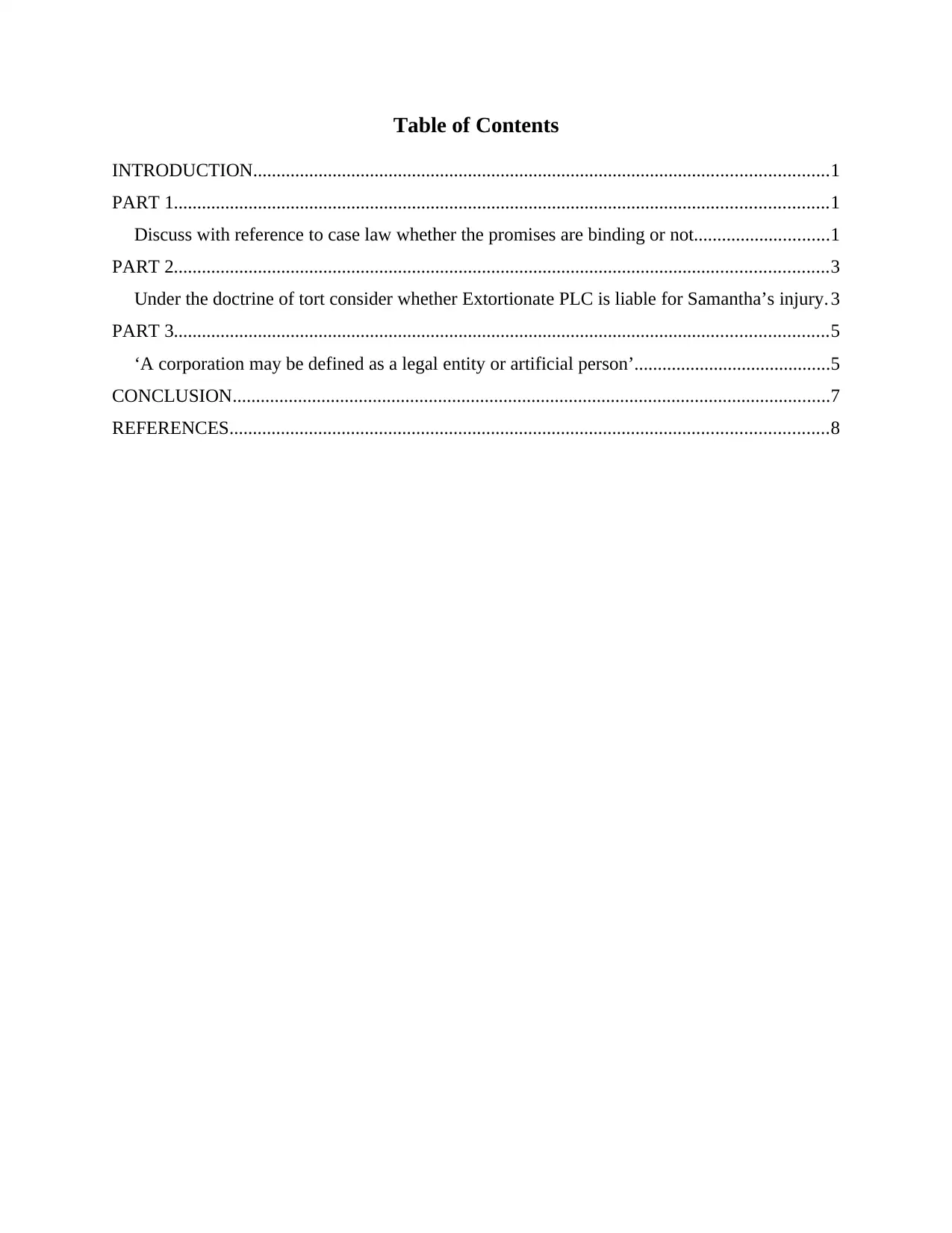
Table of Contents
INTRODUCTION...........................................................................................................................1
PART 1............................................................................................................................................1
Discuss with reference to case law whether the promises are binding or not.............................1
PART 2............................................................................................................................................3
Under the doctrine of tort consider whether Extortionate PLC is liable for Samantha’s injury. 3
PART 3............................................................................................................................................5
‘A corporation may be defined as a legal entity or artificial person’..........................................5
CONCLUSION................................................................................................................................7
REFERENCES................................................................................................................................8
INTRODUCTION...........................................................................................................................1
PART 1............................................................................................................................................1
Discuss with reference to case law whether the promises are binding or not.............................1
PART 2............................................................................................................................................3
Under the doctrine of tort consider whether Extortionate PLC is liable for Samantha’s injury. 3
PART 3............................................................................................................................................5
‘A corporation may be defined as a legal entity or artificial person’..........................................5
CONCLUSION................................................................................................................................7
REFERENCES................................................................................................................................8
INTRODUCTION
Business managers are the individuals who are responsible for supervising and managing
all the business activities that are required for effective performance. Business managers make
sure that performance of business activities are done in such manner so that goals and objectives
of business can be achieved in the most profitable manner. Business managers make sure that all
the operation of business are performed in such manner that applied laws are effectively
complied. In business legal system various rules and regulations are included which are formed
by the regulating authority so that accomplishment of all the legal requirements can be made
certain (Adriano, 2015). All the functioning of the business are maintained by the law and in
order to make business regulations effective various laws such as contract law, employment law,
property law, intellectual right act and bankruptcy act is implied. Manager of the business make
sure that all these laws are effectively followed by the business organisation.
In this project report a detailed knowledge and understanding needs to be demonstrated
and elaborated in the key areas of business law. Their are various cases are provided and these
will be resolved following all the legal rules and guidelines that are provided in the legal context.
PART 1
Discuss with reference to case law whether the promises are binding or not
Activities and task that will be performed in future are made certain to a level with proper
offer and acceptance that leads to generation of legal contract with proper consideration. When
promises are made and a made in writing then they are considered as agreement among two
parties and it become legally compulsory on both the parties to make the contract certain. A
promise made by one person to another is a valuable consideration to make an legal agreement.
Their are different kind of promises that an individual made while operating day-to-day business
operations (Anderson and et. al., 2015). In this case Sergio made different promises to Alexander
his son, Liam his secretary and Natasha one of this business employee. In order to understand
legal binding of a promise certain rules related to promise needs to be understand which are as
follows-
A promise will be termed as binding only when consideration for such promise will be
present in the transaction. A consideration in any form is important in order to make a
promise legally binding.
1
Business managers are the individuals who are responsible for supervising and managing
all the business activities that are required for effective performance. Business managers make
sure that performance of business activities are done in such manner so that goals and objectives
of business can be achieved in the most profitable manner. Business managers make sure that all
the operation of business are performed in such manner that applied laws are effectively
complied. In business legal system various rules and regulations are included which are formed
by the regulating authority so that accomplishment of all the legal requirements can be made
certain (Adriano, 2015). All the functioning of the business are maintained by the law and in
order to make business regulations effective various laws such as contract law, employment law,
property law, intellectual right act and bankruptcy act is implied. Manager of the business make
sure that all these laws are effectively followed by the business organisation.
In this project report a detailed knowledge and understanding needs to be demonstrated
and elaborated in the key areas of business law. Their are various cases are provided and these
will be resolved following all the legal rules and guidelines that are provided in the legal context.
PART 1
Discuss with reference to case law whether the promises are binding or not
Activities and task that will be performed in future are made certain to a level with proper
offer and acceptance that leads to generation of legal contract with proper consideration. When
promises are made and a made in writing then they are considered as agreement among two
parties and it become legally compulsory on both the parties to make the contract certain. A
promise made by one person to another is a valuable consideration to make an legal agreement.
Their are different kind of promises that an individual made while operating day-to-day business
operations (Anderson and et. al., 2015). In this case Sergio made different promises to Alexander
his son, Liam his secretary and Natasha one of this business employee. In order to understand
legal binding of a promise certain rules related to promise needs to be understand which are as
follows-
A promise will be termed as binding only when consideration for such promise will be
present in the transaction. A consideration in any form is important in order to make a
promise legally binding.
1
⊘ This is a preview!⊘
Do you want full access?
Subscribe today to unlock all pages.

Trusted by 1+ million students worldwide
A promise which involves any condition then in order to make promise binding that
condition must be accomplished on priority basis.
Parties involved in the contract must have contractual competent to make a promise.
Promise made by both the parties must possess mutual consent to make the promise.
Any condition which can be interpreted in two different manner then clarity must be
provided in order to a promise binding on the parties involved.
Apart form all these conditions there are certain law full situations which make
implication of promise legally binding on the parties involved.
On the basis of these rules and laws that are specifically made for promises cases
provided in the question will be provided with legal solutions as follows-
(a) To give his son Alexander £5,000 if he abandoned his career as a chef and qualified as a
solicitor
In this case, Sergio made a promise to his son to provide £5,000 if he abandoned his
career as a chef and qualified as a solicitor. In this promise agreement, promise is taken place
among father and a son. This is a binding promise when Alexander quit his career as chef and
start developing as solicitor.
A promise among family which involves consideration has held before and Balfour v
Balfour [1919], is one of the landmark case that has held. In this case husband needs to make
payment for her maintenance one they start living apart (Christie and Sanders, 2012). This
consideration involves a condition of living apart. This case verdict made the present care legally
binding when the condition is accomplished by Alexander.
b) To pay his secretary Liam £500 for having been willing to give up his lunch hour when
necessary during the previous three months
A promise to secretary is made for extra payment of £500 for providing extra working
time during lunch hours form the last three months. This is termed as a legally binding promise
as performance is based on the activities which is accomplished in the past.
Grange Vs. Abellio London Ltd., case that has held earlier which says that no employee
is bound to work during break or lunch time. If performance is made in such duration then no
agreement will be made legally binding to such extra work. As in this case Sergio made a
promise to make extra payment for the work then this promise needs to be accomplished.
2
condition must be accomplished on priority basis.
Parties involved in the contract must have contractual competent to make a promise.
Promise made by both the parties must possess mutual consent to make the promise.
Any condition which can be interpreted in two different manner then clarity must be
provided in order to a promise binding on the parties involved.
Apart form all these conditions there are certain law full situations which make
implication of promise legally binding on the parties involved.
On the basis of these rules and laws that are specifically made for promises cases
provided in the question will be provided with legal solutions as follows-
(a) To give his son Alexander £5,000 if he abandoned his career as a chef and qualified as a
solicitor
In this case, Sergio made a promise to his son to provide £5,000 if he abandoned his
career as a chef and qualified as a solicitor. In this promise agreement, promise is taken place
among father and a son. This is a binding promise when Alexander quit his career as chef and
start developing as solicitor.
A promise among family which involves consideration has held before and Balfour v
Balfour [1919], is one of the landmark case that has held. In this case husband needs to make
payment for her maintenance one they start living apart (Christie and Sanders, 2012). This
consideration involves a condition of living apart. This case verdict made the present care legally
binding when the condition is accomplished by Alexander.
b) To pay his secretary Liam £500 for having been willing to give up his lunch hour when
necessary during the previous three months
A promise to secretary is made for extra payment of £500 for providing extra working
time during lunch hours form the last three months. This is termed as a legally binding promise
as performance is based on the activities which is accomplished in the past.
Grange Vs. Abellio London Ltd., case that has held earlier which says that no employee
is bound to work during break or lunch time. If performance is made in such duration then no
agreement will be made legally binding to such extra work. As in this case Sergio made a
promise to make extra payment for the work then this promise needs to be accomplished.
2
Paraphrase This Document
Need a fresh take? Get an instant paraphrase of this document with our AI Paraphraser
(c)To pay Natasha, who has a contract with a local newsagent to deliver newspaper in the
area, £10 if she delivers it by 8am every day for one month and if she manages to put the
newspaper through the letterbox without tearing.
A promise is made to Natasha for paying an amount of £10 when she made delivery of
newspapers before 8am and put these in later box without tearing (Cornford, 2016). An offer is
made and acceptance is done by both the parties which made Sergio legally binding to perform
promise.
The case decision is influenced through a landmark case Hyde v Wrench (1840),which
explains that offer and acceptance needs to be made on the same terms and conditions to make it
legal and valid. Here, this condition is fulfilled by Sergio and Natasha so the promise become
legally binding among them.
PART 2
Under the doctrine of tort consider whether Extortionate PLC is liable for Samantha’s injury
Case Scenario: In this case Samantha went to local bank, Extortionate PLC to make
enquiry about her loan for new business start-up. While leaving the bank she tripped and fell
down from stairs. To break her fall she used her hands and this leads to subsequently broke her
wrist and injured her hands. She was informed by one of her friend that she is not the one who
suffered such injuries there are some other clients who also got troubled in the same manner.
Issue: One of the most common issue that arises in this case is that whether Samantha is
liable to make any form of claim for her injuries. As following from bank stairs does not leads to
generate any default form bank's side. But in this case the situation of falling down form stairs is
not only with Samantha as their were many other bank's client who also got troubled with the
same issue. When many people are injured in same kind then it can be seen that there is
something wrong as not many people can make same mistakes as Samantha made. When more
and more individuals are getting injured by falling from bank stairs then it needs to be identified
whether bank will be liable for such injuries or not.
Rule: To resolve such cases “Law of Tort” is used to apply on such situations and find
best solution (Law of Tort, 2019). Law of tort is applicable in the situation when any activity
leads to generation of civil wrongful act due to some accident or with intentional purpose. When
any party is involved in an activity which leads to any form of civil breach then other party who
3
area, £10 if she delivers it by 8am every day for one month and if she manages to put the
newspaper through the letterbox without tearing.
A promise is made to Natasha for paying an amount of £10 when she made delivery of
newspapers before 8am and put these in later box without tearing (Cornford, 2016). An offer is
made and acceptance is done by both the parties which made Sergio legally binding to perform
promise.
The case decision is influenced through a landmark case Hyde v Wrench (1840),which
explains that offer and acceptance needs to be made on the same terms and conditions to make it
legal and valid. Here, this condition is fulfilled by Sergio and Natasha so the promise become
legally binding among them.
PART 2
Under the doctrine of tort consider whether Extortionate PLC is liable for Samantha’s injury
Case Scenario: In this case Samantha went to local bank, Extortionate PLC to make
enquiry about her loan for new business start-up. While leaving the bank she tripped and fell
down from stairs. To break her fall she used her hands and this leads to subsequently broke her
wrist and injured her hands. She was informed by one of her friend that she is not the one who
suffered such injuries there are some other clients who also got troubled in the same manner.
Issue: One of the most common issue that arises in this case is that whether Samantha is
liable to make any form of claim for her injuries. As following from bank stairs does not leads to
generate any default form bank's side. But in this case the situation of falling down form stairs is
not only with Samantha as their were many other bank's client who also got troubled with the
same issue. When many people are injured in same kind then it can be seen that there is
something wrong as not many people can make same mistakes as Samantha made. When more
and more individuals are getting injured by falling from bank stairs then it needs to be identified
whether bank will be liable for such injuries or not.
Rule: To resolve such cases “Law of Tort” is used to apply on such situations and find
best solution (Law of Tort, 2019). Law of tort is applicable in the situation when any activity
leads to generation of civil wrongful act due to some accident or with intentional purpose. When
any party is involved in an activity which leads to any form of civil breach then other party who
3
suffered damages is liable to make all the claims in order to recover for such loss incurred. The
law is also applicable on personal injuries to an individual and that injured person is allowed to
claim the compensation for all the damages in monetary and non-monetary terms suffered. To
apply law of tort some of the essential elements such as duty, breach of duty, injury and cautions
must be present. Their are different types of tort which are described as follows-
Intentional Tort: In this form of tort one individual by knowing all the facts and results
of the act perform such activities in order to injure and make other person suffer. The act is not
considered as an act of negligence and application of civil litigation is made.
Negligence Tort: In this tort damages is caused to plaintiff due to negligence made by the
defendant while performing various activities (Crawford and et. al., 2015). When act of
negligence is performed then duty to prove such negligence lies on plaintiff in order to claim the
required damages. Their must be a relation in the negligence and the injury suffered by the
plaintiff. Existence of all the elements of the tort law must be their so that case when filled to the
court is held in the most appropriate manner.
Strict liability: This form of tort is created with actions performed by a person
irrespective of the intention leads to generation of any civil wrong. Plaintiff in order to make
claim for damages needs to prove that action of defendant is related with the injury suffered by
the person. Strict liabilities are implemented so that no individual suffered any form of loss form
act performed by other person.
Application: Injury in wrist and hands to Samantha cased due to fall form stairs and this
was a complete negligence on part of Extortionate PLC as carpet which was their in the middle
was not kept aside. In this case majority mistake was on part of bank as no actions was taken by
them to remove the carpet after various incidences already taken place their. Management of the
bank become careless as no action is taken by them when various clients fall form stairs to keep
the carpet in right manner (Deakin and Markesinis, 2019). In this case tort of negligence is
applicable on bank. To claim the damages all the liability to prove such damages lies in the
hands of When Samantha. When she was informed with the details regarding past injuries to
bank's client in the same manner then proof for negligence become available with Samantha.
Now, Samantha in order to claim the required damages needs to prove that all the elements of
torn was present their in the act.
4
law is also applicable on personal injuries to an individual and that injured person is allowed to
claim the compensation for all the damages in monetary and non-monetary terms suffered. To
apply law of tort some of the essential elements such as duty, breach of duty, injury and cautions
must be present. Their are different types of tort which are described as follows-
Intentional Tort: In this form of tort one individual by knowing all the facts and results
of the act perform such activities in order to injure and make other person suffer. The act is not
considered as an act of negligence and application of civil litigation is made.
Negligence Tort: In this tort damages is caused to plaintiff due to negligence made by the
defendant while performing various activities (Crawford and et. al., 2015). When act of
negligence is performed then duty to prove such negligence lies on plaintiff in order to claim the
required damages. Their must be a relation in the negligence and the injury suffered by the
plaintiff. Existence of all the elements of the tort law must be their so that case when filled to the
court is held in the most appropriate manner.
Strict liability: This form of tort is created with actions performed by a person
irrespective of the intention leads to generation of any civil wrong. Plaintiff in order to make
claim for damages needs to prove that action of defendant is related with the injury suffered by
the person. Strict liabilities are implemented so that no individual suffered any form of loss form
act performed by other person.
Application: Injury in wrist and hands to Samantha cased due to fall form stairs and this
was a complete negligence on part of Extortionate PLC as carpet which was their in the middle
was not kept aside. In this case majority mistake was on part of bank as no actions was taken by
them to remove the carpet after various incidences already taken place their. Management of the
bank become careless as no action is taken by them when various clients fall form stairs to keep
the carpet in right manner (Deakin and Markesinis, 2019). In this case tort of negligence is
applicable on bank. To claim the damages all the liability to prove such damages lies in the
hands of When Samantha. When she was informed with the details regarding past injuries to
bank's client in the same manner then proof for negligence become available with Samantha.
Now, Samantha in order to claim the required damages needs to prove that all the elements of
torn was present their in the act.
4
⊘ This is a preview!⊘
Do you want full access?
Subscribe today to unlock all pages.
Trusted by 1+ million students worldwide
Law of tort specifies that keeping or placing that carpet which causes number of
accidents to bank's client was a clear case of negligence. This leads to different injuries to
different clients and when negligence is proved by the plaintiff then bank will be liable to make
payment for all the amount for damages suffered by clients.
Conclusion: Analysing Samantha’s case helps to identify that main default in this case is
of the bank as its negligence become reason foe all the injuries to different clients. When
Samantha will become eligible to prove that damages are suffered due to negligence of bank then
she will become eligible to claim the amount of damages suffered.
PART 3
‘A corporation may be defined as a legal entity or artificial person’.
Business organisations and corporations when established as per law then provided with
one of the most special and important feature of having a separate legal entity in eyes of law.
This separate entity make business different form its owners and investors and all the operations
are performed by business a an artificial person (Frankel, Laby and Schwing, 2015). A detailed
description that helps in justifying this statement in more appropriate manner is provided here
under.
A corporation is available with a feature of separate legal entity which make it different
from that of its owners. As a separate legal entity all the rights and responsibilities available to
the organisation is different form all the individual rights and responsibilities. When a
organisation is available with a separate legal entity feature then all the operations are performed
in capacity of artificial persona. All the rights and responsibilities in relation to enter in a
contract, borrow or land finances, hire employees, invest, sue and be sued, purchasing and
selling assets and paying taxes all are available to corporations. Corporations despite of having
legal entity are available with feature of limited liability. This justifies that all the stakeholders in
the business are liable to make payments up to some agreed amount and after that no liability is
that of the stakeholders (Lewis and Morris, 2012).
In order to make a corporation a legal entity all the business operations must be
performed to generate more and more amount of profits. Another objectives with profit
generation do not hinder legal entity of corporation. As a artificial person all the decisions in the
business are taken form board of directors who leads to manage all the operations in the most
5
accidents to bank's client was a clear case of negligence. This leads to different injuries to
different clients and when negligence is proved by the plaintiff then bank will be liable to make
payment for all the amount for damages suffered by clients.
Conclusion: Analysing Samantha’s case helps to identify that main default in this case is
of the bank as its negligence become reason foe all the injuries to different clients. When
Samantha will become eligible to prove that damages are suffered due to negligence of bank then
she will become eligible to claim the amount of damages suffered.
PART 3
‘A corporation may be defined as a legal entity or artificial person’.
Business organisations and corporations when established as per law then provided with
one of the most special and important feature of having a separate legal entity in eyes of law.
This separate entity make business different form its owners and investors and all the operations
are performed by business a an artificial person (Frankel, Laby and Schwing, 2015). A detailed
description that helps in justifying this statement in more appropriate manner is provided here
under.
A corporation is available with a feature of separate legal entity which make it different
from that of its owners. As a separate legal entity all the rights and responsibilities available to
the organisation is different form all the individual rights and responsibilities. When a
organisation is available with a separate legal entity feature then all the operations are performed
in capacity of artificial persona. All the rights and responsibilities in relation to enter in a
contract, borrow or land finances, hire employees, invest, sue and be sued, purchasing and
selling assets and paying taxes all are available to corporations. Corporations despite of having
legal entity are available with feature of limited liability. This justifies that all the stakeholders in
the business are liable to make payments up to some agreed amount and after that no liability is
that of the stakeholders (Lewis and Morris, 2012).
In order to make a corporation a legal entity all the business operations must be
performed to generate more and more amount of profits. Another objectives with profit
generation do not hinder legal entity of corporation. As a artificial person all the decisions in the
business are taken form board of directors who leads to manage all the operations in the most
5
Paraphrase This Document
Need a fresh take? Get an instant paraphrase of this document with our AI Paraphraser
profitable manner. As an artificial person a corporation can perform all the operations to that of a
individual. Having a separate legal entity of the business helps in long term existence of business
as there is no effect for change of ownership (Gilbert, 2016). Any amount of owners and
investors may come and go but business will be keep going unless some circumstances created
for winding up. As owners and investors are liable for the the profits generated in the business
and amount of liability is limited to certain amount this makes corporation business more
attractive. All the operations form establishment to winding up needs to be performed as per
companies act in order to make the operation legal.
Analysing the given statement provides that a corporation is termed as a legal entity as
well as an artificial person as business operations are performed as a separate legal entity.
Operations of corporations are performed by directors on behalf of organisation, all the contracts
are made in the name of corporations and performance are accomplished by employees working
for corporations. Earnings are made by employees of corporations and income is taxed in the
name of business organisation. Any dispute arises among complies employees and outside world
and cases are filled in name of business. As all these features helps to identify that corporation
business is provided with a feature to possess a separate legal entity.
Salomon v Salomon & Co Ltd., [1896] is one of the landmark case that has held to
justify the concept of corporate legal entity as well as concept of artificial person. In this case a
issue arises from claim maid by unsecured creditors in the process of liquidation process of the
organisation (Salmon Vs. Salmon & Co. Ltd., 2019). As Salomon was one of the majority
shareholder in the organisation in the company. Now, the issue is that whether he can be held
liable for the dent of unsecured creditors. When the case is filled in the court then in that case a
landmark verdict is held which says that despite of having the majority of shares in the
organisation Salomon can not be held liable for the dent of creditors. In this case company is
treated as a separate legal entity in the eyes of law and no shareholder can be held liable for the
amount needs to be paid by creditors.
Some of the features that corporations possess helps to held the feature of artificial person
valid. These features are as follows-
Capacity to contract: As a separate legal entity a corporation possess all the powers to
enter into a contract in the name of business. It also includes contracts that are related to hiring
employees in business organisation.
6
individual. Having a separate legal entity of the business helps in long term existence of business
as there is no effect for change of ownership (Gilbert, 2016). Any amount of owners and
investors may come and go but business will be keep going unless some circumstances created
for winding up. As owners and investors are liable for the the profits generated in the business
and amount of liability is limited to certain amount this makes corporation business more
attractive. All the operations form establishment to winding up needs to be performed as per
companies act in order to make the operation legal.
Analysing the given statement provides that a corporation is termed as a legal entity as
well as an artificial person as business operations are performed as a separate legal entity.
Operations of corporations are performed by directors on behalf of organisation, all the contracts
are made in the name of corporations and performance are accomplished by employees working
for corporations. Earnings are made by employees of corporations and income is taxed in the
name of business organisation. Any dispute arises among complies employees and outside world
and cases are filled in name of business. As all these features helps to identify that corporation
business is provided with a feature to possess a separate legal entity.
Salomon v Salomon & Co Ltd., [1896] is one of the landmark case that has held to
justify the concept of corporate legal entity as well as concept of artificial person. In this case a
issue arises from claim maid by unsecured creditors in the process of liquidation process of the
organisation (Salmon Vs. Salmon & Co. Ltd., 2019). As Salomon was one of the majority
shareholder in the organisation in the company. Now, the issue is that whether he can be held
liable for the dent of unsecured creditors. When the case is filled in the court then in that case a
landmark verdict is held which says that despite of having the majority of shares in the
organisation Salomon can not be held liable for the dent of creditors. In this case company is
treated as a separate legal entity in the eyes of law and no shareholder can be held liable for the
amount needs to be paid by creditors.
Some of the features that corporations possess helps to held the feature of artificial person
valid. These features are as follows-
Capacity to contract: As a separate legal entity a corporation possess all the powers to
enter into a contract in the name of business. It also includes contracts that are related to hiring
employees in business organisation.
6
Perpetual success: A corporation is not affected with change in ownership and business
operations continued to be conducted irrespective of the owner come and go. This leads to
generation of perpetual success for business. Organisation will stop performing activities only
when winding up is initiated.
Right to enter in a contract: A corporation possess all the rights to enter into a contract
in their own name. Performance of contract is made by the employees of the business but all the
roles and responsibilities related to contract is that of the corporation.
Sue and be sued: Corporation possess all the power to sue any of the party when
perform illegal activity. At the same time corporation on its own name can be sued by any party
for performance and non performance of the required activity (Oliphant, 2012).
Property ownership: Initiating a business as corporation leads to generation of power to
business for purchasing various assets in the name of business. All the assets or property in a
businesses are registered in the name of a business.
Common seal: A company being an artificial person uses a common seal as a substitute
for its signature. Through common authority for validate of transaction is provided. A document
which do not possess common seal of company will be termed as invalid in the eyes of law.
CONCLUSION
From the above project report on law for business managers, it has been concluded that
laws and regulations that are implemented on businesses and its managers helps to ensure that all
the activities are performed in lawful manner. Corporate law, company law, contract law and
several other laws are specifically designed in order to ensure that all the operations will be
performed as per regulations and guidelines designed in the law. Managers of business ensures
that operations are performed in such manner that effective level of efficiency is achieved and
together with this legal compliances are met. Several cases arises in day-to-day operations of
business activities and through laws and decisions of the previous cases these issues are resolved
in the most efficient manner.
7
operations continued to be conducted irrespective of the owner come and go. This leads to
generation of perpetual success for business. Organisation will stop performing activities only
when winding up is initiated.
Right to enter in a contract: A corporation possess all the rights to enter into a contract
in their own name. Performance of contract is made by the employees of the business but all the
roles and responsibilities related to contract is that of the corporation.
Sue and be sued: Corporation possess all the power to sue any of the party when
perform illegal activity. At the same time corporation on its own name can be sued by any party
for performance and non performance of the required activity (Oliphant, 2012).
Property ownership: Initiating a business as corporation leads to generation of power to
business for purchasing various assets in the name of business. All the assets or property in a
businesses are registered in the name of a business.
Common seal: A company being an artificial person uses a common seal as a substitute
for its signature. Through common authority for validate of transaction is provided. A document
which do not possess common seal of company will be termed as invalid in the eyes of law.
CONCLUSION
From the above project report on law for business managers, it has been concluded that
laws and regulations that are implemented on businesses and its managers helps to ensure that all
the activities are performed in lawful manner. Corporate law, company law, contract law and
several other laws are specifically designed in order to ensure that all the operations will be
performed as per regulations and guidelines designed in the law. Managers of business ensures
that operations are performed in such manner that effective level of efficiency is achieved and
together with this legal compliances are met. Several cases arises in day-to-day operations of
business activities and through laws and decisions of the previous cases these issues are resolved
in the most efficient manner.
7
⊘ This is a preview!⊘
Do you want full access?
Subscribe today to unlock all pages.
Trusted by 1+ million students worldwide
REFERENCES
Books and Journals
Adriano, E.A.Q., 2015. The natural person, legal entity or juridical person and juridical
personality. Penn St. JL & Int'l Aff. 4. p.363.
Anderson, S. and et. al., 2015. Violence prevention and municipal licensing of indoor sex work
venues in the Greater Vancouver Area: narratives of migrant sex workers, managers and
business owners. Culture, health & sexuality. 17(7). pp.825-841.
Christie, G.C. and Sanders, J., 2012. Advanced Torts: Cases and Materials. West.
Cornford, T., 2016. Towards a public law of tort. Routledge.
Crawford, G. C. and et. al., 2015. Power law distributions in entrepreneurship: Implications for
theory and research. Journal of Business Venturing. 30(5). pp.696-713.
Deakin, S. and Markesinis, B., 2019. Markesinis and Deakin's Tort law. Oxford University
Press, USA.
Frankel, T., Laby, A. B. and Schwing, A. T., 2015. The regulation of money managers: mutual
funds and advisers(Vol. 3). Wolters Kluwer Law & Business.
Gilbert, J., 2016. Ethics for managers: philosophical foundations and business realities.
Routledge.
Lewis, R. and Morris, A., 2012. Tort law culture: Image and reality. Journal of Law and Society.
39(4). pp.562-592.
Oliphant, K., 2012. Cultures of tort law in Europe.
Online
Salmon Vs. Salmon & Co. Ltd. 2019 [Online]. Available Through:
<https://writepass.com/journal/2016/11/the-doctrine-of-separate-legal-entity-a-case-of-
salomon-vs-salomon-co-ltd/>
Law of Tort. 2019 [Online]. Available Through: <https://tort.laws.com/tort-law>
8
Books and Journals
Adriano, E.A.Q., 2015. The natural person, legal entity or juridical person and juridical
personality. Penn St. JL & Int'l Aff. 4. p.363.
Anderson, S. and et. al., 2015. Violence prevention and municipal licensing of indoor sex work
venues in the Greater Vancouver Area: narratives of migrant sex workers, managers and
business owners. Culture, health & sexuality. 17(7). pp.825-841.
Christie, G.C. and Sanders, J., 2012. Advanced Torts: Cases and Materials. West.
Cornford, T., 2016. Towards a public law of tort. Routledge.
Crawford, G. C. and et. al., 2015. Power law distributions in entrepreneurship: Implications for
theory and research. Journal of Business Venturing. 30(5). pp.696-713.
Deakin, S. and Markesinis, B., 2019. Markesinis and Deakin's Tort law. Oxford University
Press, USA.
Frankel, T., Laby, A. B. and Schwing, A. T., 2015. The regulation of money managers: mutual
funds and advisers(Vol. 3). Wolters Kluwer Law & Business.
Gilbert, J., 2016. Ethics for managers: philosophical foundations and business realities.
Routledge.
Lewis, R. and Morris, A., 2012. Tort law culture: Image and reality. Journal of Law and Society.
39(4). pp.562-592.
Oliphant, K., 2012. Cultures of tort law in Europe.
Online
Salmon Vs. Salmon & Co. Ltd. 2019 [Online]. Available Through:
<https://writepass.com/journal/2016/11/the-doctrine-of-separate-legal-entity-a-case-of-
salomon-vs-salomon-co-ltd/>
Law of Tort. 2019 [Online]. Available Through: <https://tort.laws.com/tort-law>
8

1 out of 10


Related Documents


Your All-in-One AI-Powered Toolkit for Academic Success.
+13062052269
info@desklib.com
Available 24*7 on WhatsApp / Email
![[object Object]](/_next/static/media/star-bottom.7253800d.svg)
Unlock your academic potential
Copyright © 2020–2026 A2Z Services. All Rights Reserved. Developed and managed by ZUCOL.