Business Law Case: Analyzing Debt Recovery and Auction Regulations

Verified

Added on  2023/06/03

|5
|1194
|234
Case Study
AI Summary
This case study delves into the legal aspects of debt recovery and auction processes within the framework of Australian Business Law. It examines a scenario where Sarah seeks to recover debts from Markus, outlining the permissible methods and communication protocols under the Australian Consumer Law and guidelines from the Australian Securities and Investments Commission (ASIC). The analysis extends to the legality of auctioning off Markus's assets, differentiating between items he solely owns and those co-owned or claimed by others, referencing relevant legal precedents such as DUV 17 v Minister for Immigration and Border Protection [2018] FCCA 757 and the Migration Act 1958. Desklib provides a platform for students to access similar solved assignments and study resources.
Document Page
Running head: BUSINESS LAW
Business Law
Name of the Student
Name of the University
Author Note
tabler-icon-diamond-filled.svg

Paraphrase This Document

Need a fresh take? Get an instant paraphrase of this document with our AI Paraphraser
Document Page
1BUSINESS LAW
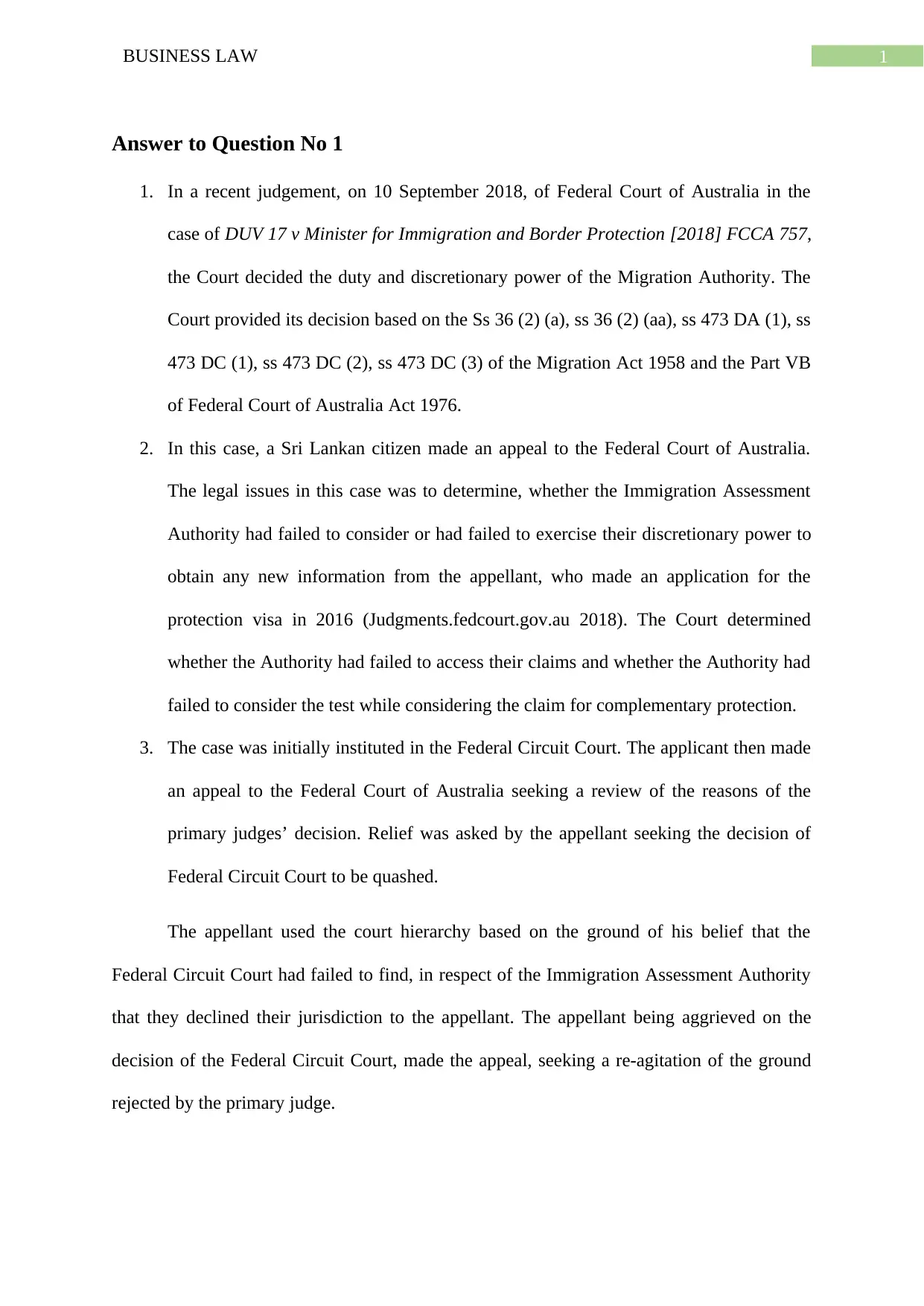
Answer to Question No 1
1. In a recent judgement, on 10 September 2018, of Federal Court of Australia in the
case of DUV 17 v Minister for Immigration and Border Protection [2018] FCCA 757,
the Court decided the duty and discretionary power of the Migration Authority. The
Court provided its decision based on the Ss 36 (2) (a), ss 36 (2) (aa), ss 473 DA (1), ss
473 DC (1), ss 473 DC (2), ss 473 DC (3) of the Migration Act 1958 and the Part VB
of Federal Court of Australia Act 1976.
2. In this case, a Sri Lankan citizen made an appeal to the Federal Court of Australia.
The legal issues in this case was to determine, whether the Immigration Assessment
Authority had failed to consider or had failed to exercise their discretionary power to
obtain any new information from the appellant, who made an application for the
protection visa in 2016 (Judgments.fedcourt.gov.au 2018). The Court determined
whether the Authority had failed to access their claims and whether the Authority had
failed to consider the test while considering the claim for complementary protection.
3. The case was initially instituted in the Federal Circuit Court. The applicant then made
an appeal to the Federal Court of Australia seeking a review of the reasons of the
primary judges’ decision. Relief was asked by the appellant seeking the decision of
Federal Circuit Court to be quashed.
The appellant used the court hierarchy based on the ground of his belief that the
Federal Circuit Court had failed to find, in respect of the Immigration Assessment Authority
that they declined their jurisdiction to the appellant. The appellant being aggrieved on the
decision of the Federal Circuit Court, made the appeal, seeking a re-agitation of the ground
rejected by the primary judge.
Document Page
2BUSINESS LAW
Answer to Question No 2.
a) Debt is an amount of money which is owed by a debtor to a creditor and can be
enforceable legally. In a circumstances, a debtor fails to pay the creditor the sum of money
which he owed, the creditor can follow the debt recovery process following the guidelines
provided in the Australian Consumer Law and the Australian Competition and Consumer
Commission. Debt Recovery is the legal method and procedure that the creditor might initiate
to get his money back, which he owes to the creditor (Accc.gov.au 2018). Debt collection is
required where a creditor and collector seeking for securing payment from a person who is
legally bound make the payment of the money that they owed.
Australian Securities and Investments Commission (ASIC) and the Australian
Competition and Consumer Commission provides the law related to debt collection in the
Debt Collection Guideline for Collectors and Creditors. For the purpose of recovering debts,
the creditor must make a communication with the debtor for:
Giving information about the account of the debtor
Conveying the demand for payment
Explaining the consequences for non-payment of debt and any legal remedies that is
available to the creditor
Making arrangements for repaying the debt
Making a settlement proposal or an alternative payment method
Reviewing the existing arrangements
Ascertaining the reason why the debtor did not respond to the contact of creditor
earlier
Making an investigation of whether the debtor has changed his location
Inspecting or recovering a security interest (Asic.gov.au. 2016).
Document Page
3BUSINESS LAW
In this case, Sarah can recover the debts from Markus by using the debt recovering
process. Sarah can, at first, communicate with Markus and enquire whether he can make the
payment and state the consequences if he fails. They can come to an arrangement or
settlement after making necessary discussion. Based on the process they choose, Sarah can
make an investigation as to the recovering of a security arrangement. The best method to be
used for debt recovering in this case shall be to contact Markus to collect the debt. If he
refuses or fails to pay it within time, then Sarah should take a legal action against him. The
Court has a variety of options available for the process of debt collection. The methods
includes seizing of property to seize the goods of the debtor and selling it in at an auction.
b) An auction is the process of selling and buying goods or services by making them
available for bid, taking bids and selling it to the highest bidder. The seller is obliged to
provide a goods in auction which holds clear title to it. The goods must be free from any kind
of charges, debts or mortgages (Consumer.vic.gov.au. 2018). The seller or the auctioneer
must not deceive or mislead the purchaser. According to the Australian Competition and
Consumer Commission, consumers that buys good in an auction, shall be entitled to receive
clear title to the good. In order to sell a good at an auction, the person must own the goods
himself.
In order to docket for auction, the goods which belongs to Markus or to which he has
the ownership can be made available. The motor bike costing $1000, the $1000 water bed
and the welding gear valued $600 can be docketed for auction as he has the ownership to it.
The computer which he co-owns with his sister, cannot be made available for the auction as
Markus does not hold the clear title to it. Without the evidence the TV set also cannot be
made available for selling at auction as he claimed that is the property of his mother. If it is
proved that the TV belongs to Markus only, then the sheriff can docket the TV for auction
also. No such good can be docketed for auction to which Markus does not possess clear title.
tabler-icon-diamond-filled.svg

Paraphrase This Document

Need a fresh take? Get an instant paraphrase of this document with our AI Paraphraser
Document Page
4BUSINESS LAW
Reference:
Accc.gov.au. 2018. [online] Available at: https://www.accc.gov.au/business/treating-
customers-fairly/debt-collection [Accessed 15 Oct. 2018].
Asic.gov.au. 2016. [online] Available at: https://download.asic.gov.au/media/3549402/rg96-
published-29-february-2016.pdf [Accessed 15 Oct. 2018].
Consumer.vic.gov.au. 2018. [online] Available at:
https://www.consumer.vic.gov.au/housing/buying-and-selling-property/buying-property/
buying-property-at-auction [Accessed 15 Oct. 2018].
DUV 17 v Minister for Immigration and Border Protection 2018 FCCA 757
Federal Court of Australia Act 1976
Judgments.fedcourt.gov.au. 2018. [online] Available at:
http://www.judgments.fedcourt.gov.au/judgments/Judgments/fca/single/2018/2018fca1492
[Accessed 15 Oct. 2018].
Migration Act 1958
chevron_up_icon
1 out of 5
circle_padding
hide_on_mobile
zoom_out_icon
[object Object]