Business Law: Good Faith, Company Interest, and Directors' Duties
VerifiedAdded on 2020/02/19
|14
|3676
|228
Report
AI Summary
This report delves into the core principles of business law, specifically focusing on the concepts of 'good faith' and the 'best interest of the company' within the framework of the Australian Corporations Act 2001. It explores the interconnectedness of these terms, emphasizing the fiduciary duties of company directors towards shareholders and stakeholders. The report defines 'good faith' as acting sincerely and responsibly, as outlined in sections 181 and 184 of the Act, highlighting the importance of directors prioritizing company and shareholder interests. It also differentiates between the 'best interest of the company' (primarily concerning shareholders) and the 'interest of the company as a whole,' broadening the scope to encompass all stakeholders. The report references key legal precedents, such as ASIC v Adler (2002) and ASIC v Macro Realty Developments Pty Ltd (2016), to illustrate violations of good faith and fiduciary duties. Furthermore, it discusses the significance of directors' care, diligence, and loyalty, as well as the penalties for breaching these duties, ensuring the protection of shareholder rights and the overall prosperity of the company. The report concludes by contrasting the 'best interest of the company' and the 'interest of the company as a whole', highlighting the broader scope of the latter, which extends beyond shareholders to encompass all stakeholders.
Running head: BUSINESS LAW
Business Law
Name of the student:
Name of the university:
Author note
Business Law
Name of the student:
Name of the university:
Author note

Paraphrase This Document
Need a fresh take? Get an instant paraphrase of this document with our AI Paraphraser
1BUSINESS LAW
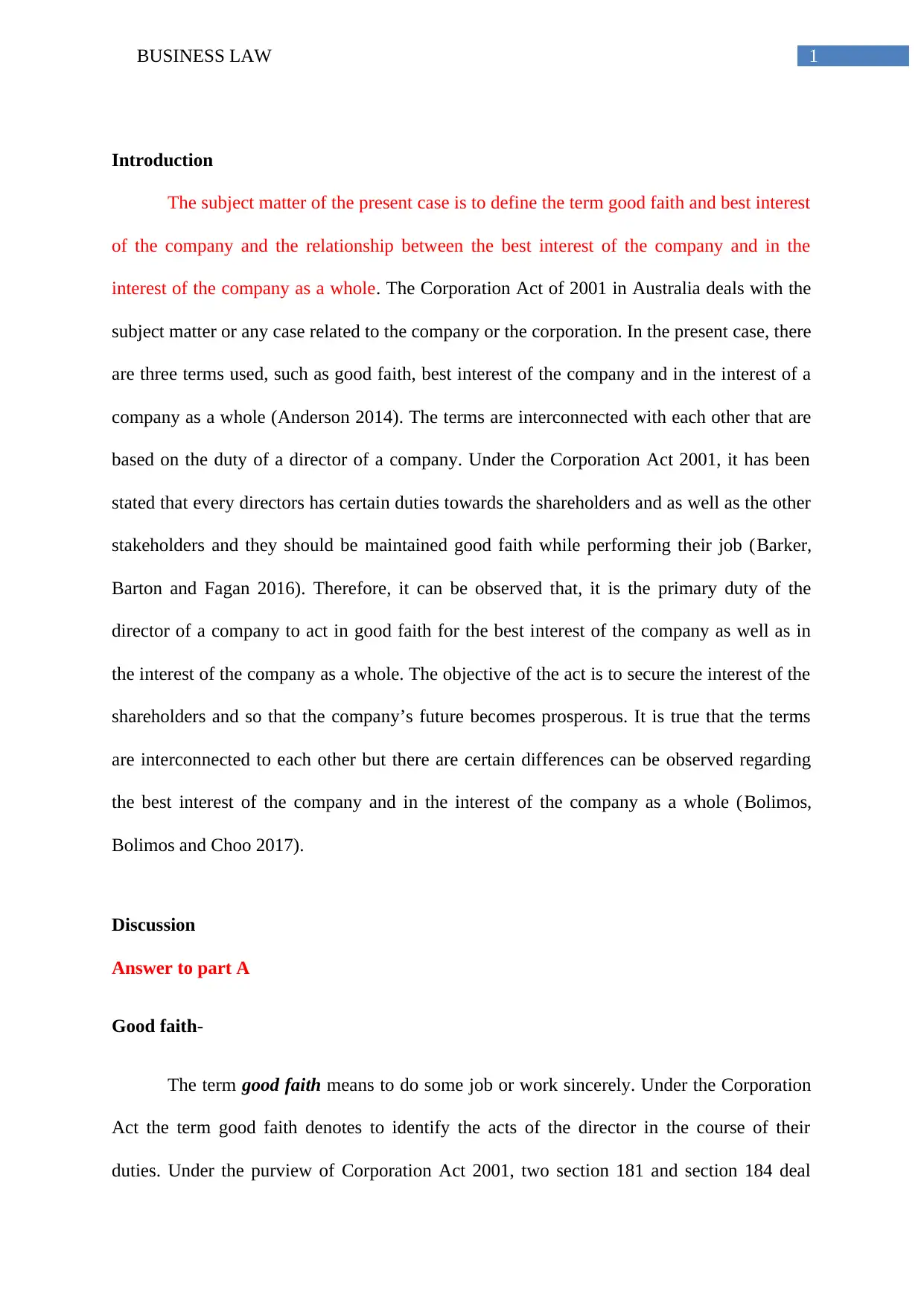
Introduction
The subject matter of the present case is to define the term good faith and best interest
of the company and the relationship between the best interest of the company and in the
interest of the company as a whole. The Corporation Act of 2001 in Australia deals with the
subject matter or any case related to the company or the corporation. In the present case, there
are three terms used, such as good faith, best interest of the company and in the interest of a
company as a whole (Anderson 2014). The terms are interconnected with each other that are
based on the duty of a director of a company. Under the Corporation Act 2001, it has been
stated that every directors has certain duties towards the shareholders and as well as the other
stakeholders and they should be maintained good faith while performing their job (Barker,
Barton and Fagan 2016). Therefore, it can be observed that, it is the primary duty of the
director of a company to act in good faith for the best interest of the company as well as in
the interest of the company as a whole. The objective of the act is to secure the interest of the
shareholders and so that the company’s future becomes prosperous. It is true that the terms
are interconnected to each other but there are certain differences can be observed regarding
the best interest of the company and in the interest of the company as a whole (Bolimos,
Bolimos and Choo 2017).
Discussion
Answer to part A
Good faith-
The term good faith means to do some job or work sincerely. Under the Corporation
Act the term good faith denotes to identify the acts of the director in the course of their
duties. Under the purview of Corporation Act 2001, two section 181 and section 184 deal
Introduction
The subject matter of the present case is to define the term good faith and best interest
of the company and the relationship between the best interest of the company and in the
interest of the company as a whole. The Corporation Act of 2001 in Australia deals with the
subject matter or any case related to the company or the corporation. In the present case, there
are three terms used, such as good faith, best interest of the company and in the interest of a
company as a whole (Anderson 2014). The terms are interconnected with each other that are
based on the duty of a director of a company. Under the Corporation Act 2001, it has been
stated that every directors has certain duties towards the shareholders and as well as the other
stakeholders and they should be maintained good faith while performing their job (Barker,
Barton and Fagan 2016). Therefore, it can be observed that, it is the primary duty of the
director of a company to act in good faith for the best interest of the company as well as in
the interest of the company as a whole. The objective of the act is to secure the interest of the
shareholders and so that the company’s future becomes prosperous. It is true that the terms
are interconnected to each other but there are certain differences can be observed regarding
the best interest of the company and in the interest of the company as a whole (Bolimos,
Bolimos and Choo 2017).
Discussion
Answer to part A
Good faith-
The term good faith means to do some job or work sincerely. Under the Corporation
Act the term good faith denotes to identify the acts of the director in the course of their
duties. Under the purview of Corporation Act 2001, two section 181 and section 184 deal
2BUSINESS LAW
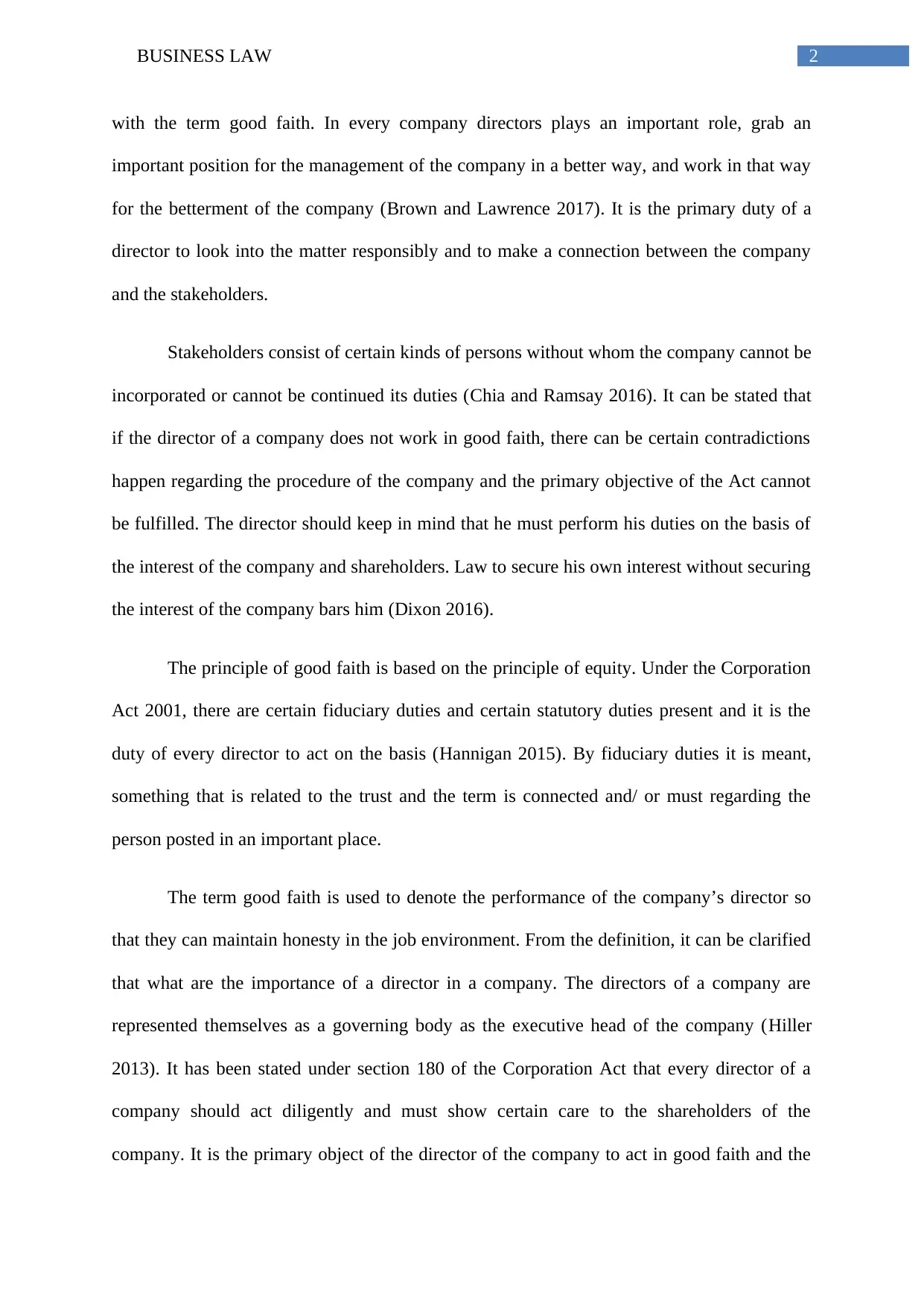
with the term good faith. In every company directors plays an important role, grab an
important position for the management of the company in a better way, and work in that way
for the betterment of the company (Brown and Lawrence 2017). It is the primary duty of a
director to look into the matter responsibly and to make a connection between the company
and the stakeholders.
Stakeholders consist of certain kinds of persons without whom the company cannot be
incorporated or cannot be continued its duties (Chia and Ramsay 2016). It can be stated that
if the director of a company does not work in good faith, there can be certain contradictions
happen regarding the procedure of the company and the primary objective of the Act cannot
be fulfilled. The director should keep in mind that he must perform his duties on the basis of
the interest of the company and shareholders. Law to secure his own interest without securing
the interest of the company bars him (Dixon 2016).
The principle of good faith is based on the principle of equity. Under the Corporation
Act 2001, there are certain fiduciary duties and certain statutory duties present and it is the
duty of every director to act on the basis (Hannigan 2015). By fiduciary duties it is meant,
something that is related to the trust and the term is connected and/ or must regarding the
person posted in an important place.
The term good faith is used to denote the performance of the company’s director so
that they can maintain honesty in the job environment. From the definition, it can be clarified
that what are the importance of a director in a company. The directors of a company are
represented themselves as a governing body as the executive head of the company (Hiller
2013). It has been stated under section 180 of the Corporation Act that every director of a
company should act diligently and must show certain care to the shareholders of the
company. It is the primary object of the director of the company to act in good faith and the
with the term good faith. In every company directors plays an important role, grab an
important position for the management of the company in a better way, and work in that way
for the betterment of the company (Brown and Lawrence 2017). It is the primary duty of a
director to look into the matter responsibly and to make a connection between the company
and the stakeholders.
Stakeholders consist of certain kinds of persons without whom the company cannot be
incorporated or cannot be continued its duties (Chia and Ramsay 2016). It can be stated that
if the director of a company does not work in good faith, there can be certain contradictions
happen regarding the procedure of the company and the primary objective of the Act cannot
be fulfilled. The director should keep in mind that he must perform his duties on the basis of
the interest of the company and shareholders. Law to secure his own interest without securing
the interest of the company bars him (Dixon 2016).
The principle of good faith is based on the principle of equity. Under the Corporation
Act 2001, there are certain fiduciary duties and certain statutory duties present and it is the
duty of every director to act on the basis (Hannigan 2015). By fiduciary duties it is meant,
something that is related to the trust and the term is connected and/ or must regarding the
person posted in an important place.
The term good faith is used to denote the performance of the company’s director so
that they can maintain honesty in the job environment. From the definition, it can be clarified
that what are the importance of a director in a company. The directors of a company are
represented themselves as a governing body as the executive head of the company (Hiller
2013). It has been stated under section 180 of the Corporation Act that every director of a
company should act diligently and must show certain care to the shareholders of the
company. It is the primary object of the director of the company to act in good faith and the
⊘ This is a preview!⊘
Do you want full access?
Subscribe today to unlock all pages.

Trusted by 1+ million students worldwide
3BUSINESS LAW
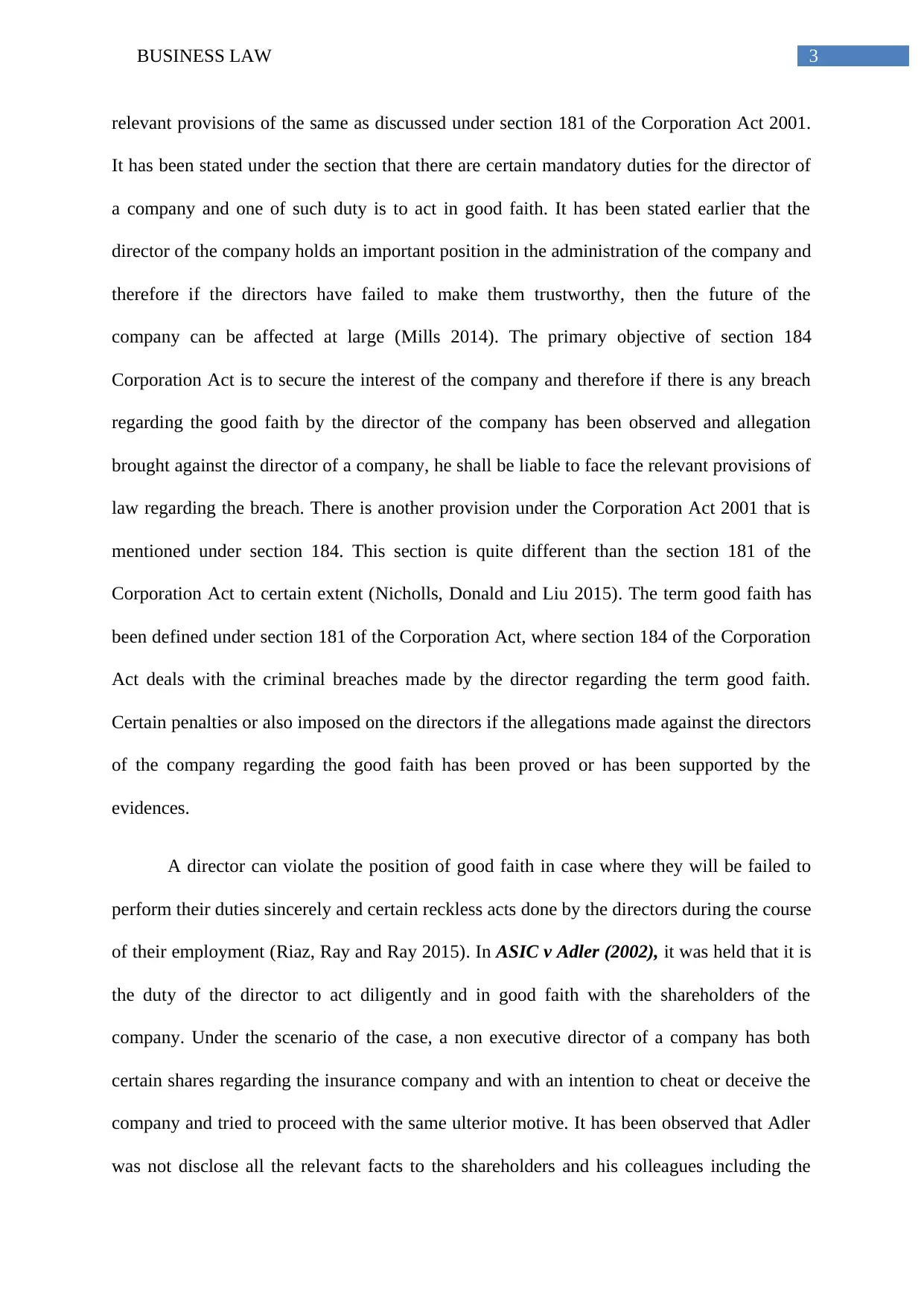
relevant provisions of the same as discussed under section 181 of the Corporation Act 2001.
It has been stated under the section that there are certain mandatory duties for the director of
a company and one of such duty is to act in good faith. It has been stated earlier that the
director of the company holds an important position in the administration of the company and
therefore if the directors have failed to make them trustworthy, then the future of the
company can be affected at large (Mills 2014). The primary objective of section 184
Corporation Act is to secure the interest of the company and therefore if there is any breach
regarding the good faith by the director of the company has been observed and allegation
brought against the director of a company, he shall be liable to face the relevant provisions of
law regarding the breach. There is another provision under the Corporation Act 2001 that is
mentioned under section 184. This section is quite different than the section 181 of the
Corporation Act to certain extent (Nicholls, Donald and Liu 2015). The term good faith has
been defined under section 181 of the Corporation Act, where section 184 of the Corporation
Act deals with the criminal breaches made by the director regarding the term good faith.
Certain penalties or also imposed on the directors if the allegations made against the directors
of the company regarding the good faith has been proved or has been supported by the
evidences.
A director can violate the position of good faith in case where they will be failed to
perform their duties sincerely and certain reckless acts done by the directors during the course
of their employment (Riaz, Ray and Ray 2015). In ASIC v Adler (2002), it was held that it is
the duty of the director to act diligently and in good faith with the shareholders of the
company. Under the scenario of the case, a non executive director of a company has both
certain shares regarding the insurance company and with an intention to cheat or deceive the
company and tried to proceed with the same ulterior motive. It has been observed that Adler
was not disclose all the relevant facts to the shareholders and his colleagues including the
relevant provisions of the same as discussed under section 181 of the Corporation Act 2001.
It has been stated under the section that there are certain mandatory duties for the director of
a company and one of such duty is to act in good faith. It has been stated earlier that the
director of the company holds an important position in the administration of the company and
therefore if the directors have failed to make them trustworthy, then the future of the
company can be affected at large (Mills 2014). The primary objective of section 184
Corporation Act is to secure the interest of the company and therefore if there is any breach
regarding the good faith by the director of the company has been observed and allegation
brought against the director of a company, he shall be liable to face the relevant provisions of
law regarding the breach. There is another provision under the Corporation Act 2001 that is
mentioned under section 184. This section is quite different than the section 181 of the
Corporation Act to certain extent (Nicholls, Donald and Liu 2015). The term good faith has
been defined under section 181 of the Corporation Act, where section 184 of the Corporation
Act deals with the criminal breaches made by the director regarding the term good faith.
Certain penalties or also imposed on the directors if the allegations made against the directors
of the company regarding the good faith has been proved or has been supported by the
evidences.
A director can violate the position of good faith in case where they will be failed to
perform their duties sincerely and certain reckless acts done by the directors during the course
of their employment (Riaz, Ray and Ray 2015). In ASIC v Adler (2002), it was held that it is
the duty of the director to act diligently and in good faith with the shareholders of the
company. Under the scenario of the case, a non executive director of a company has both
certain shares regarding the insurance company and with an intention to cheat or deceive the
company and tried to proceed with the same ulterior motive. It has been observed that Adler
was not disclose all the relevant facts to the shareholders and his colleagues including the
Paraphrase This Document
Need a fresh take? Get an instant paraphrase of this document with our AI Paraphraser
4BUSINESS LAW
other directors of the company and therefore held liable under the provision of the section
181 of the Corporation Act regarding violation of the position of good faith.
In ASIC v Macro Realty Developments Pty Ltd (2016) it has been observed that the fiduciary
duties of a director has been violated by the development company and therefore help liable
under section 181 of the Corporation Act 2001.
Best interest of the company –
The term best interest of the company stands on the interest of the shareholders. It is
no doubt that the shareholders of a company are playing an important role in the
administration of the company. The economic backbone of the company is very much
dependent on the sets of the shareholders on certain circumstances. Shareholders are buying
the share of a company and hence they help the Company to gain liquid cash. Being holding a
fiduciary position it is that the duty of a director to act for the benefit of the shareholders and
to secure the interest of the shareholders. Except the investment every shareholder of a
company and holding certain important places regarding the appointment of the director and
regarding the participation in the Annual General Meeting of the company.
The Corporation Act 2001 was enacted to secure the interest of the company as well
as the interest of the shareholders. It helps to give security to the shareholders from the
arbitrary acts of the directors. Care intelligence at the most important thing for the directors
of a company while communicated to the shareholders. The provision regarding the section
180 of the Corporation Act states about the care and diligence of the director of a company.
In ASIC v Cassimetes, it has been held at the director of certain duty towards the
shareholders and act for the interest of the shareholders as a whole. The Directors are stopped
by the Corporation Act to receive the shareholders of a company of to snatch away the basic
right of the shareholders. In this case the directors of the storm company have projected a
other directors of the company and therefore held liable under the provision of the section
181 of the Corporation Act regarding violation of the position of good faith.
In ASIC v Macro Realty Developments Pty Ltd (2016) it has been observed that the fiduciary
duties of a director has been violated by the development company and therefore help liable
under section 181 of the Corporation Act 2001.
Best interest of the company –
The term best interest of the company stands on the interest of the shareholders. It is
no doubt that the shareholders of a company are playing an important role in the
administration of the company. The economic backbone of the company is very much
dependent on the sets of the shareholders on certain circumstances. Shareholders are buying
the share of a company and hence they help the Company to gain liquid cash. Being holding a
fiduciary position it is that the duty of a director to act for the benefit of the shareholders and
to secure the interest of the shareholders. Except the investment every shareholder of a
company and holding certain important places regarding the appointment of the director and
regarding the participation in the Annual General Meeting of the company.
The Corporation Act 2001 was enacted to secure the interest of the company as well
as the interest of the shareholders. It helps to give security to the shareholders from the
arbitrary acts of the directors. Care intelligence at the most important thing for the directors
of a company while communicated to the shareholders. The provision regarding the section
180 of the Corporation Act states about the care and diligence of the director of a company.
In ASIC v Cassimetes, it has been held at the director of certain duty towards the
shareholders and act for the interest of the shareholders as a whole. The Directors are stopped
by the Corporation Act to receive the shareholders of a company of to snatch away the basic
right of the shareholders. In this case the directors of the storm company have projected a
5BUSINESS LAW
business model and announced the shareholders of the investors to invest their money into the
project 2 on a lump sum amount after the maturity of the period. The director of the company
had failed to make the investors aware about the risk of the investment and after financial
break down, all the invested money had lost. Therefore, there is a clear laxity regarding the
interest of the shareholders have been observed in this case.
Director of a company should have the intention to work in such a manner so that the
acts can be resulted in the prosperity of the company and should have some intentions to
work positively. In a company, directors are holding such important position and therefore it
can be said that the directors of a company have certain fiduciary duties to be performed
during the course of their business. The law has prescribed certain provisions on the fiduciary
duties and it is stated under the act that the directors should be performed their duties or the
fiduciary duties honestly (Hiller 2013). From this aspect, it is their responsibility to deal with
the shareholders with due diligence.
In Sharp &Ors. v Blank and Ors. (2015), it was observed by the court that every
director should be loyal when acting with the shareholders of the company and have to
provide relevant information regarding any kind of works.
In Starlink International Group v Coles Super market, it was a list against the
supermarket that a contract have been signed in between the company and the supermarket
and afterwards the contract, the Supermarket head terminated all the provisions of the
contract without maintain the relevant provisions to this aspect. Therefore, a case was filed
against the supermarket and the court ordered that the supermarket has failed to show any
evidences regarding the diligence performed by the supermarket regarding the contract.
business model and announced the shareholders of the investors to invest their money into the
project 2 on a lump sum amount after the maturity of the period. The director of the company
had failed to make the investors aware about the risk of the investment and after financial
break down, all the invested money had lost. Therefore, there is a clear laxity regarding the
interest of the shareholders have been observed in this case.
Director of a company should have the intention to work in such a manner so that the
acts can be resulted in the prosperity of the company and should have some intentions to
work positively. In a company, directors are holding such important position and therefore it
can be said that the directors of a company have certain fiduciary duties to be performed
during the course of their business. The law has prescribed certain provisions on the fiduciary
duties and it is stated under the act that the directors should be performed their duties or the
fiduciary duties honestly (Hiller 2013). From this aspect, it is their responsibility to deal with
the shareholders with due diligence.
In Sharp &Ors. v Blank and Ors. (2015), it was observed by the court that every
director should be loyal when acting with the shareholders of the company and have to
provide relevant information regarding any kind of works.
In Starlink International Group v Coles Super market, it was a list against the
supermarket that a contract have been signed in between the company and the supermarket
and afterwards the contract, the Supermarket head terminated all the provisions of the
contract without maintain the relevant provisions to this aspect. Therefore, a case was filed
against the supermarket and the court ordered that the supermarket has failed to show any
evidences regarding the diligence performed by the supermarket regarding the contract.
⊘ This is a preview!⊘
Do you want full access?
Subscribe today to unlock all pages.
Trusted by 1+ million students worldwide
6BUSINESS LAW
Answer to part B
Best interest of the company:
The second question of this paper is based on the differences between the best interest
of the company and in the interest of the company as a whole and through this chapter, it has
been mentioned in a detailed way. It is clear from the previous answer that the time best
interest of the company is interconnected with the interest of the shareholders of the
company. It is an obligation to the directors of the company to act in good faith regarding the
shareholders and penalties are provided in the provision of the Corporation Act if any breach
has happened by the directors to this respect. In Hutton v Wester Cork Railway Co. (1883), it
was observed that the director of a company hold certain fiduciary positions and therefore it
is their ability to act for the interest of the shareholders (Tills and Wills 2016).
It is of no doubt that the shareholders of the company hold certain important position
in the company and there's interest should be secured by the directors as they hold certain
fiduciary position in the company. In the profession of Australia, shareholders are playing an
important role regarding the administration of the company. Therefore, it is there right to get
certain benefits so that there interest can be secured and it is the duty of the director of the
company to disclose all the relevant facts and matters to facilitate the process of securing the
interest.
In the interest as a whole-
The term interest of the company as a whole is not limited to the shareholders of the
company only, but it means the interest of the company as a whole. In every company the
administration of the executive works are performed by the stakeholders that include the
Answer to part B
Best interest of the company:
The second question of this paper is based on the differences between the best interest
of the company and in the interest of the company as a whole and through this chapter, it has
been mentioned in a detailed way. It is clear from the previous answer that the time best
interest of the company is interconnected with the interest of the shareholders of the
company. It is an obligation to the directors of the company to act in good faith regarding the
shareholders and penalties are provided in the provision of the Corporation Act if any breach
has happened by the directors to this respect. In Hutton v Wester Cork Railway Co. (1883), it
was observed that the director of a company hold certain fiduciary positions and therefore it
is their ability to act for the interest of the shareholders (Tills and Wills 2016).
It is of no doubt that the shareholders of the company hold certain important position
in the company and there's interest should be secured by the directors as they hold certain
fiduciary position in the company. In the profession of Australia, shareholders are playing an
important role regarding the administration of the company. Therefore, it is there right to get
certain benefits so that there interest can be secured and it is the duty of the director of the
company to disclose all the relevant facts and matters to facilitate the process of securing the
interest.
In the interest as a whole-
The term interest of the company as a whole is not limited to the shareholders of the
company only, but it means the interest of the company as a whole. In every company the
administration of the executive works are performed by the stakeholders that include the
Paraphrase This Document
Need a fresh take? Get an instant paraphrase of this document with our AI Paraphraser
7BUSINESS LAW
director also. Therefore, it can be said that the administrative over the executive duties of a
company is depended all the acts of the stakeholders. In Aberdeen Ry. V Blaikie(1854), it
was observed that a director of a company has to show interest for the stakeholders as a
whole and should not be Limited after certain categories of the stakeholders.
Relationship between the two terms:
It can be observed that a company is a separate legal entity through different case
laws. It has also been mentioned that the stakeholders are the part of it and the company
cannot make any steps or move without the directors and the other stakeholders. Sometimes,
it can be seen that the directors are also included under the definition of the stakeholders. The
directors are represented the company in various occasions and therefore it is the duty to act
in good faith or to act diligently. Under the Corporation Act there are certain provisions
dealing with the acts of the directors and regarding the breach in the director’s duties (Li
2014).
In Salomon v Salomon (1897), it can be stated that a company is a separate legal
entity and therefore it is the duty of the director of a company to act for the interest of the
company and not to the interests of the specific person of the company (Viven-Wilksch
2015). It is a historical case regarding the company act and the principle of lifting the
corporate veil has been raised from the case. In Sharp v Blank & others, certain
contradictory profession was made as against the case of Solomon. In this case, it was
observed by the court that share holders at the part of the company and company is not
separate from the shareholders or the stakeholders. The principle of interest of the company
as a whole has been established in this case and it was held by the court that the director of a
company should act by maintaining the following principles laid down under the previous
case (Welsh 2014).
director also. Therefore, it can be said that the administrative over the executive duties of a
company is depended all the acts of the stakeholders. In Aberdeen Ry. V Blaikie(1854), it
was observed that a director of a company has to show interest for the stakeholders as a
whole and should not be Limited after certain categories of the stakeholders.
Relationship between the two terms:
It can be observed that a company is a separate legal entity through different case
laws. It has also been mentioned that the stakeholders are the part of it and the company
cannot make any steps or move without the directors and the other stakeholders. Sometimes,
it can be seen that the directors are also included under the definition of the stakeholders. The
directors are represented the company in various occasions and therefore it is the duty to act
in good faith or to act diligently. Under the Corporation Act there are certain provisions
dealing with the acts of the directors and regarding the breach in the director’s duties (Li
2014).
In Salomon v Salomon (1897), it can be stated that a company is a separate legal
entity and therefore it is the duty of the director of a company to act for the interest of the
company and not to the interests of the specific person of the company (Viven-Wilksch
2015). It is a historical case regarding the company act and the principle of lifting the
corporate veil has been raised from the case. In Sharp v Blank & others, certain
contradictory profession was made as against the case of Solomon. In this case, it was
observed by the court that share holders at the part of the company and company is not
separate from the shareholders or the stakeholders. The principle of interest of the company
as a whole has been established in this case and it was held by the court that the director of a
company should act by maintaining the following principles laid down under the previous
case (Welsh 2014).
8BUSINESS LAW
In Perceval v Wright (1902), an allegation against the director has been made and it
was stated that he had failed to provide sufficient interest to the company while performing
his duties. The presiding officer of the case was point out certain relevant provisions
regarding the apps of the detector and stated that the primary object of a director is to secure
the interest of the company and the interest of the shareholders at the secondary object.
From the above statement, it is to be stated that there is a difference between the two
terms. By best interest of the company, it means for the interest of the shareholders and in the
interest of the company as a whole means for the interest of the company only. In the later
part, it is to be observed from the various decisions of the court that company is a separate
legal entity and shareholders are just a part of it (Whincop 2017). It is to be stated that the
director of a company should have to take personal care to the company only and not to the
shareholders. Therefore, it can be stated that the two terms are contradictory in nature.
However, both the terms are inter-related to each other as both the terms are connected to the
interest of the company.
Conclusion-
Therefore, it is cleared from the above mentioned discussion that all the three terms of
this case that is the good faith, best interest of the company and in the interest of the company
as a whole is interconnected to each other. There is a prolonged study about the director’s
duties and responsibilities towards the company and the shareholders has been discussed in
this paper. All the relevant principles of law as well as a profession of the Corporation Act
2001 have been discussed in this paper. The contradiction between the best interest of the
company and in the interest of the company as a whole is still remain unsolved. There are
different notions about the same has been taken place in different cases. How work the main
outcome of the paper is that director is holds certain fiduciary position in the management of
In Perceval v Wright (1902), an allegation against the director has been made and it
was stated that he had failed to provide sufficient interest to the company while performing
his duties. The presiding officer of the case was point out certain relevant provisions
regarding the apps of the detector and stated that the primary object of a director is to secure
the interest of the company and the interest of the shareholders at the secondary object.
From the above statement, it is to be stated that there is a difference between the two
terms. By best interest of the company, it means for the interest of the shareholders and in the
interest of the company as a whole means for the interest of the company only. In the later
part, it is to be observed from the various decisions of the court that company is a separate
legal entity and shareholders are just a part of it (Whincop 2017). It is to be stated that the
director of a company should have to take personal care to the company only and not to the
shareholders. Therefore, it can be stated that the two terms are contradictory in nature.
However, both the terms are inter-related to each other as both the terms are connected to the
interest of the company.
Conclusion-
Therefore, it is cleared from the above mentioned discussion that all the three terms of
this case that is the good faith, best interest of the company and in the interest of the company
as a whole is interconnected to each other. There is a prolonged study about the director’s
duties and responsibilities towards the company and the shareholders has been discussed in
this paper. All the relevant principles of law as well as a profession of the Corporation Act
2001 have been discussed in this paper. The contradiction between the best interest of the
company and in the interest of the company as a whole is still remain unsolved. There are
different notions about the same has been taken place in different cases. How work the main
outcome of the paper is that director is holds certain fiduciary position in the management of
⊘ This is a preview!⊘
Do you want full access?
Subscribe today to unlock all pages.
Trusted by 1+ million students worldwide
9BUSINESS LAW
the company and he has to secure the interests of the company as well as the interests of the
shareholders during the performance of his duty.
the company and he has to secure the interests of the company as well as the interests of the
shareholders during the performance of his duty.
Paraphrase This Document
Need a fresh take? Get an instant paraphrase of this document with our AI Paraphraser
10BUSINESS LAW
Reference:
Aberdeen Ry. V Blaikie (1854) UKHL 1
Anderson, H., 2014. Directors' Liability for Fraudulent Phoenix Activity—A Comparison
of the Australian and UK Approaches. Journal of Corporate Law Studies, 14(1), pp.139-
173.
ASIC v Adler (2002) NSWSC 171
ASIC v Casemates [2016] FCA 1023
ASIC v Macro Realty Developments Pty Ltd (2016) FCA 292
Barker, S., Baker-Jones, M., Barton, E. and Fagan, E., 2016. Climate change and the
fiduciary duties of pension fund trustees–lessons from the Australian law. Journal of
Sustainable Finance & Investment, 6(3), pp.211-244.
Bolimos, I.A., Bolimos, I.A., Choo, K.K.R. and Choo, K.K.R., 2017. Online fraud
offending within an Australian jurisdiction. Journal of Financial Crime, 24(2), pp.277-
308.
Brown, A.J. and Lawrence, S.A., 2017. STRENGTH OF ORGANISATIONAL
WHISTLEBLOWING PROCESSES–ANALYSIS FROM AUSTRALIA & NEW
ZEALAND.
Chia, H.X. and Ramsay, I., 2016. An Analysis of Shareholder Resolutions Involving
Australian Listed Companies from 2004 to 2013.
Reference:
Aberdeen Ry. V Blaikie (1854) UKHL 1
Anderson, H., 2014. Directors' Liability for Fraudulent Phoenix Activity—A Comparison
of the Australian and UK Approaches. Journal of Corporate Law Studies, 14(1), pp.139-
173.
ASIC v Adler (2002) NSWSC 171
ASIC v Casemates [2016] FCA 1023
ASIC v Macro Realty Developments Pty Ltd (2016) FCA 292
Barker, S., Baker-Jones, M., Barton, E. and Fagan, E., 2016. Climate change and the
fiduciary duties of pension fund trustees–lessons from the Australian law. Journal of
Sustainable Finance & Investment, 6(3), pp.211-244.
Bolimos, I.A., Bolimos, I.A., Choo, K.K.R. and Choo, K.K.R., 2017. Online fraud
offending within an Australian jurisdiction. Journal of Financial Crime, 24(2), pp.277-
308.
Brown, A.J. and Lawrence, S.A., 2017. STRENGTH OF ORGANISATIONAL
WHISTLEBLOWING PROCESSES–ANALYSIS FROM AUSTRALIA & NEW
ZEALAND.
Chia, H.X. and Ramsay, I., 2016. An Analysis of Shareholder Resolutions Involving
Australian Listed Companies from 2004 to 2013.
11BUSINESS LAW
de Melo Bandeira, G.C.S., 2013. “Corruption” and social and economic criminal law:
Criminology, criminal policy, political science and law & economics–A new idea about
criminal liability of legal entities. Tékhne, 11(2), pp.105-113.
Dixon, O., 2016. Honesty without Fear-Whistleblower Anti-Retaliation Protections in
Corporate Codes of Conduct. Melb. UL Rev., 40, p.168.
Hannigan, B., 2015. Company law. Oxford University Press, USA.
Hiller, J.S., 2013. The benefit corporation and corporate social responsibility. Journal of
Business Ethics, 118(2), pp.287-301. Hiller, J.S., 2013. The benefit corporation and
corporate social responsibility. Journal of Business Ethics, 118(2), pp.287-301.
Huggins, A., Simnett, R. and Hargovan, A., 2015. Integrated reporting and directors’
concerns about personal liability exposure: Law reform options. Company and Securities
Law Journal, 33, pp.176-195.
Hutton v Wester Cork Railway Co. (1883)23 Ch D 654
Li, Y., 2014. The impact of corporate governance on the corporate social responsibility of
small corporation in australia: a structural equation modeling approach. In WEI
International Academic Conference Proceeding, New Orleans, USA.
Mills, C.W., 2014. The racial contract. Cornell University Press.
Nicholls, R., Donald, M.S. and Liu, K., 2015. It's a Small World after All: Using Social
Network Analysis to Investigate Systemic Risk in the Australian Superannuation Sector.
Percival v Wright [1902] 2 Ch. 401
de Melo Bandeira, G.C.S., 2013. “Corruption” and social and economic criminal law:
Criminology, criminal policy, political science and law & economics–A new idea about
criminal liability of legal entities. Tékhne, 11(2), pp.105-113.
Dixon, O., 2016. Honesty without Fear-Whistleblower Anti-Retaliation Protections in
Corporate Codes of Conduct. Melb. UL Rev., 40, p.168.
Hannigan, B., 2015. Company law. Oxford University Press, USA.
Hiller, J.S., 2013. The benefit corporation and corporate social responsibility. Journal of
Business Ethics, 118(2), pp.287-301. Hiller, J.S., 2013. The benefit corporation and
corporate social responsibility. Journal of Business Ethics, 118(2), pp.287-301.
Huggins, A., Simnett, R. and Hargovan, A., 2015. Integrated reporting and directors’
concerns about personal liability exposure: Law reform options. Company and Securities
Law Journal, 33, pp.176-195.
Hutton v Wester Cork Railway Co. (1883)23 Ch D 654
Li, Y., 2014. The impact of corporate governance on the corporate social responsibility of
small corporation in australia: a structural equation modeling approach. In WEI
International Academic Conference Proceeding, New Orleans, USA.
Mills, C.W., 2014. The racial contract. Cornell University Press.
Nicholls, R., Donald, M.S. and Liu, K., 2015. It's a Small World after All: Using Social
Network Analysis to Investigate Systemic Risk in the Australian Superannuation Sector.
Percival v Wright [1902] 2 Ch. 401
⊘ This is a preview!⊘
Do you want full access?
Subscribe today to unlock all pages.
Trusted by 1+ million students worldwide

1 out of 14


Related Documents


Your All-in-One AI-Powered Toolkit for Academic Success.
+13062052269
info@desklib.com
Available 24*7 on WhatsApp / Email
![[object Object]](/_next/static/media/star-bottom.7253800d.svg)
Unlock your academic potential
Copyright © 2020–2026 A2Z Services. All Rights Reserved. Developed and managed by ZUCOL.