Legal Implications of Business in Brazil and China: Report
VerifiedAdded on 2020/04/15
|17
|3338
|118
Report
AI Summary
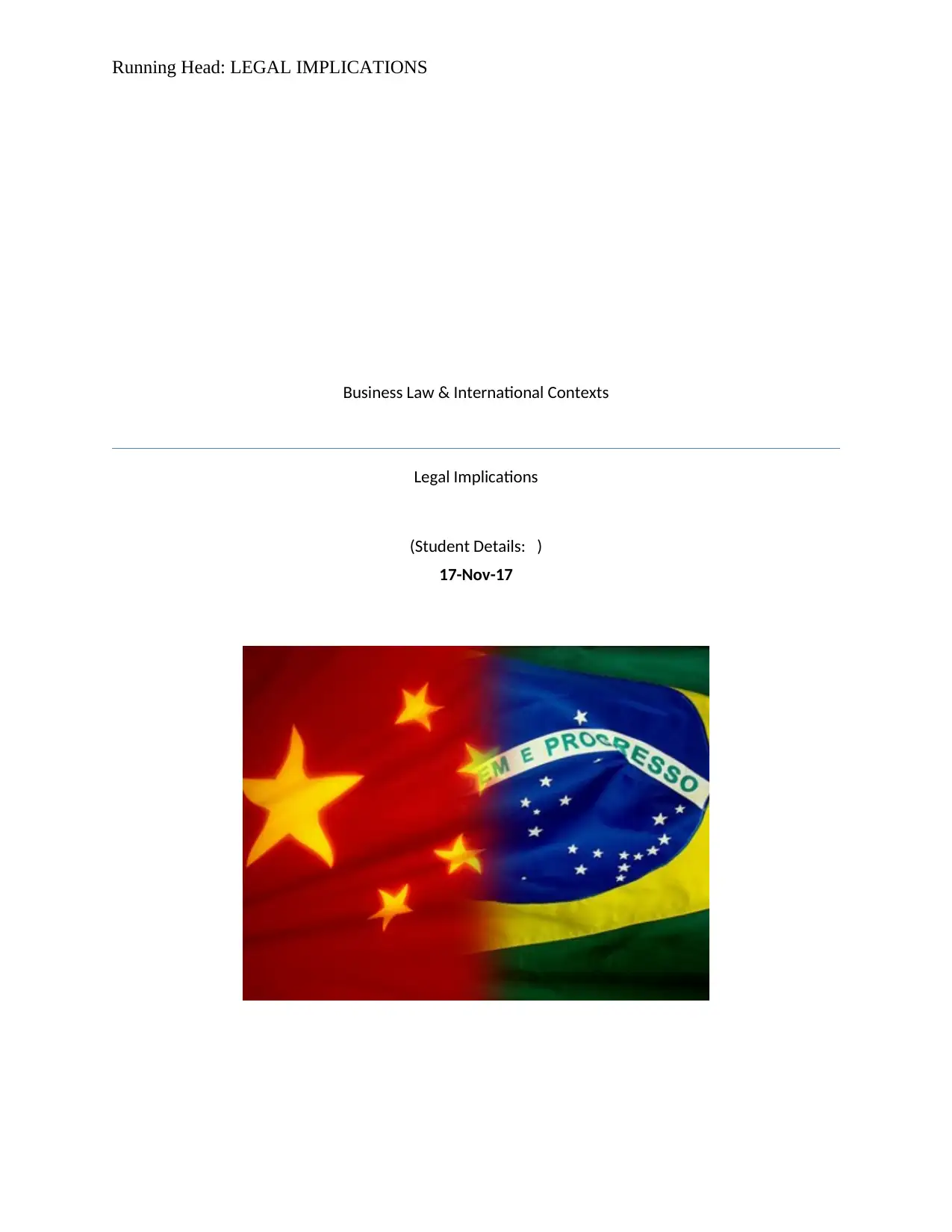
This report, prepared for the Board of Directors of an Australian organization, provides a detailed analysis of the legal implications of conducting business in Brazil and China. It covers various aspects, including commercial and legal arrangements, regional economic integration, the international monetary system, and current trends. The report delves into cultural sensitivity, examining both similarities and differences between the two nations. Furthermore, it presents an in-depth analysis of the internal and external business environments of both countries using SWOT and PESTLE analyses, respectively. The report concludes with an ethical perspective and provides a comprehensive overview of the challenges and opportunities associated with international business ventures in these two significant global markets.
Running Head: LEGAL IMPLICATIONS
Business Law & International Contexts
Legal Implications
(Student Details: )
17-Nov-17
Business Law & International Contexts
Legal Implications
(Student Details: )
17-Nov-17

Paraphrase This Document
Need a fresh take? Get an instant paraphrase of this document with our AI Paraphraser
LEGAL IMPLICATIONS
Contents
Introduction......................................................................................................................................4
Global Perspective...........................................................................................................................4
Commercial and Legal Arrangements.........................................................................................4
Regional Economic Integration...................................................................................................5
International Monetary System....................................................................................................6
Current Trends and Developments..............................................................................................7
Cultural Sensitivity......................................................................................................................7
Business Environment.....................................................................................................................8
Internal.........................................................................................................................................8
External......................................................................................................................................11
Political..................................................................................................................................11
Economical............................................................................................................................11
Social.....................................................................................................................................11
Technological........................................................................................................................12
Legal......................................................................................................................................12
2
Contents
Introduction......................................................................................................................................4
Global Perspective...........................................................................................................................4
Commercial and Legal Arrangements.........................................................................................4
Regional Economic Integration...................................................................................................5
International Monetary System....................................................................................................6
Current Trends and Developments..............................................................................................7
Cultural Sensitivity......................................................................................................................7
Business Environment.....................................................................................................................8
Internal.........................................................................................................................................8
External......................................................................................................................................11
Political..................................................................................................................................11
Economical............................................................................................................................11
Social.....................................................................................................................................11
Technological........................................................................................................................12
Legal......................................................................................................................................12
2
LEGAL IMPLICATIONS
Environmental........................................................................................................................12
Political..................................................................................................................................12
Economical............................................................................................................................13
Social.....................................................................................................................................13
Technological........................................................................................................................13
Legal......................................................................................................................................13
Environmental........................................................................................................................13
Ethical Perspective.........................................................................................................................13
Conclusion.....................................................................................................................................14
References......................................................................................................................................16
3
Environmental........................................................................................................................12
Political..................................................................................................................................12
Economical............................................................................................................................13
Social.....................................................................................................................................13
Technological........................................................................................................................13
Legal......................................................................................................................................13
Environmental........................................................................................................................13
Ethical Perspective.........................................................................................................................13
Conclusion.....................................................................................................................................14
References......................................................................................................................................16
3
⊘ This is a preview!⊘
Do you want full access?
Subscribe today to unlock all pages.

Trusted by 1+ million students worldwide
LEGAL IMPLICATIONS
Introduction
Running a business is not an easy task due to the different factors which have an impact
on the business. This is in terms of the factors over which the business has no control. These
include the factors like regulatory compliance, social, political, financial, environmental and
legal issues. The problems are increased when it comes to running a business in the international
markets. This is because for carrying on a business in international market, the company has to
follow the laws of not only the home nation, but of the target nations as well. The problem is
amplified when the business has to be carried in different nations across the world. When such a
situation is presented, the different issues raised in the global perspective have to undertaken
(Hamilton & Webster, 2015).
In the following parts, a brief has been prepared for the Board of Directors of Australian
organization which would highlight the legal implications of dealing with parties of Brazil and
China. In doing so a number of aspects would be analysed, which would include the legal
arrangements which are needed for carrying on the business, cultural sensitivity, monetary
system, in addition to the internal and external business environment and the ethical
considerations in carrying on business in the two nations.
Global Perspective
Commercial and Legal Arrangements
A key part of running business in the global market is to look after the commercial and
the legal arrangements. The People’s Republic of China has a civil law system, which consists of
4
Introduction
Running a business is not an easy task due to the different factors which have an impact
on the business. This is in terms of the factors over which the business has no control. These
include the factors like regulatory compliance, social, political, financial, environmental and
legal issues. The problems are increased when it comes to running a business in the international
markets. This is because for carrying on a business in international market, the company has to
follow the laws of not only the home nation, but of the target nations as well. The problem is
amplified when the business has to be carried in different nations across the world. When such a
situation is presented, the different issues raised in the global perspective have to undertaken
(Hamilton & Webster, 2015).
In the following parts, a brief has been prepared for the Board of Directors of Australian
organization which would highlight the legal implications of dealing with parties of Brazil and
China. In doing so a number of aspects would be analysed, which would include the legal
arrangements which are needed for carrying on the business, cultural sensitivity, monetary
system, in addition to the internal and external business environment and the ethical
considerations in carrying on business in the two nations.
Global Perspective
Commercial and Legal Arrangements
A key part of running business in the global market is to look after the commercial and
the legal arrangements. The People’s Republic of China has a civil law system, which consists of
4
Paraphrase This Document
Need a fresh take? Get an instant paraphrase of this document with our AI Paraphraser
LEGAL IMPLICATIONS
administrative rules, regulations and statutes. Apart from this, the Supreme Court of China is
responsible for issuing the interpretations which have to be adhered by the lower courts while
adjudicating the cases. However, the lowers courts are not under the obligation of following the
rulings of higher courts even though as a practice this is usually done. Unlike US, China does not
have a federal system. Hence, there is no applicability of precedent in the nation. Two key forms
of business vehicles can be used in the nation, which includes partnerships and companies
(Ambler, Witzel, Xi & Zou, 2008).
Like China, Brazil is a civil law nation. Though unlike China, the legal system of Brazil
is based on codes and legislations which are enacted by the federal, the state and the municipal
legislatures. In terms of the business vehicles, the common form includes corporations, i.e.,
sociedade anônima, and limited liability companies, i.e., sociedade limitada (Bingemer &
Thompson, 2017).
Regional Economic Integration
Regional Economic Integration denotes the efforts which are put in place for promoting
fair and free trade based on the region. When it comes to China, the foreign companies are
allowed to sell their goods and services in the nation in a direct manner. However, in doing so,
there is a need to comply with the import regulations which are applicable. Trade can also be
conducted in the nation by forming branches and subsidiaries, appointment of distributor or/and
agency, and entering in franchisee agreements with the qualified partners (Lewis, 2016).
In case of Brazil, the majority of overseas companies can conduct their business in t eh
nation through affiliates and subsidiaries. Where a decision is taken by a foreign company to
form a branch in the nation, the branch would be subjected to and governed under the laws of the
5
administrative rules, regulations and statutes. Apart from this, the Supreme Court of China is
responsible for issuing the interpretations which have to be adhered by the lower courts while
adjudicating the cases. However, the lowers courts are not under the obligation of following the
rulings of higher courts even though as a practice this is usually done. Unlike US, China does not
have a federal system. Hence, there is no applicability of precedent in the nation. Two key forms
of business vehicles can be used in the nation, which includes partnerships and companies
(Ambler, Witzel, Xi & Zou, 2008).
Like China, Brazil is a civil law nation. Though unlike China, the legal system of Brazil
is based on codes and legislations which are enacted by the federal, the state and the municipal
legislatures. In terms of the business vehicles, the common form includes corporations, i.e.,
sociedade anônima, and limited liability companies, i.e., sociedade limitada (Bingemer &
Thompson, 2017).
Regional Economic Integration
Regional Economic Integration denotes the efforts which are put in place for promoting
fair and free trade based on the region. When it comes to China, the foreign companies are
allowed to sell their goods and services in the nation in a direct manner. However, in doing so,
there is a need to comply with the import regulations which are applicable. Trade can also be
conducted in the nation by forming branches and subsidiaries, appointment of distributor or/and
agency, and entering in franchisee agreements with the qualified partners (Lewis, 2016).
In case of Brazil, the majority of overseas companies can conduct their business in t eh
nation through affiliates and subsidiaries. Where a decision is taken by a foreign company to
form a branch in the nation, the branch would be subjected to and governed under the laws of the
5
LEGAL IMPLICATIONS
nation. The formation of such a branch would also require the authorization, which is granted
through the ministerial ordinance, and this is a lengthy bureaucratic process (Bingemer &
Thompson, 2017).
International Monetary System
In China, there are a number of regulations surrounding the exchange control and
currency. A foreign investor in Chian in a foreign investment enterprise, where 25% of the
registered capital includes foreign investment accounts, has the legal entitlement of converting
the after tax dividends which are derived from these enterprises to foreign currency and these can
be remitted overseas based on the applicable regulations (Lewis, 2016).
In Brazil, the obligations have to be executed in the national currency, i.e., in reais. If the
same is not done, Decree-Law No 857/1969 would make it null and void. When it comes to the
obligations which take place between natural person or entities domiciled in Brazil and natural
persons or entities domiciled abroad, the same has to be paid, based on Law No 9,069/1995, in
an exclusive manner through institutions which are authorized to operate in foreign exchange
market. This authorization is granted by the Central Bank, which effectively controls the foreign
exchange market. Though, at some instances, there is a need to obtain approval from the
Securities and Exchange Commission. The transfer of funds from or to a place outside Brazil is,
save for some exceptions, not subjected to limitations regarding the amount and the prior
authorization from the pertinent authorities of the nation (Bingemer & Thompson, 2017).
6
nation. The formation of such a branch would also require the authorization, which is granted
through the ministerial ordinance, and this is a lengthy bureaucratic process (Bingemer &
Thompson, 2017).
International Monetary System
In China, there are a number of regulations surrounding the exchange control and
currency. A foreign investor in Chian in a foreign investment enterprise, where 25% of the
registered capital includes foreign investment accounts, has the legal entitlement of converting
the after tax dividends which are derived from these enterprises to foreign currency and these can
be remitted overseas based on the applicable regulations (Lewis, 2016).
In Brazil, the obligations have to be executed in the national currency, i.e., in reais. If the
same is not done, Decree-Law No 857/1969 would make it null and void. When it comes to the
obligations which take place between natural person or entities domiciled in Brazil and natural
persons or entities domiciled abroad, the same has to be paid, based on Law No 9,069/1995, in
an exclusive manner through institutions which are authorized to operate in foreign exchange
market. This authorization is granted by the Central Bank, which effectively controls the foreign
exchange market. Though, at some instances, there is a need to obtain approval from the
Securities and Exchange Commission. The transfer of funds from or to a place outside Brazil is,
save for some exceptions, not subjected to limitations regarding the amount and the prior
authorization from the pertinent authorities of the nation (Bingemer & Thompson, 2017).
6
⊘ This is a preview!⊘
Do you want full access?
Subscribe today to unlock all pages.
Trusted by 1+ million students worldwide
LEGAL IMPLICATIONS
Current Trends and Developments
At present, the people from out of China are required to operate and invest in China
through the special investment vehicles present under the different acts and are also subjected to
the diversified rules from the domestic Chinese companies. January 19th, 2015 came with the
circulation of draft version by the Ministry of Commerce of the new Foreign Investment law.
The public comment period expired back in February 2015. Once formally accepted, the present
regulations and laws surrounding governing foreign invested entities would be replaced and
repealed. This would result in all of the foreign investment entities converting into corporate
entities or limited liability companies based on the company law. Though, before the same is
brought into action, there are several steps needed which includes multiple rounds of reviews
(Lewis, 2016).
In Brazil, the Congress is under continued discussing on a new Commercial Code which
would cover the provisions on legal entities and this proposal is deemed as a very controversial
one. There is a consideration going on in the Federal Government for removing or lifting the
barriers towards the acquisition of the rural land by the overseas nationals, and in the acquisition
in Brazilian commercial airline companies, of equity interest by the overseas nationals, which is
an increase from the present 20% limitation (Bingemer & Thompson, 2017).
Cultural Sensitivity
Cultural sensitivity refers to the awareness of the similarities and differences in culture,
which exists between the people from different areas, based on their values of right and wrong,
positive and negative, and better and worse. Between China and Brazil, there are both
7
Current Trends and Developments
At present, the people from out of China are required to operate and invest in China
through the special investment vehicles present under the different acts and are also subjected to
the diversified rules from the domestic Chinese companies. January 19th, 2015 came with the
circulation of draft version by the Ministry of Commerce of the new Foreign Investment law.
The public comment period expired back in February 2015. Once formally accepted, the present
regulations and laws surrounding governing foreign invested entities would be replaced and
repealed. This would result in all of the foreign investment entities converting into corporate
entities or limited liability companies based on the company law. Though, before the same is
brought into action, there are several steps needed which includes multiple rounds of reviews
(Lewis, 2016).
In Brazil, the Congress is under continued discussing on a new Commercial Code which
would cover the provisions on legal entities and this proposal is deemed as a very controversial
one. There is a consideration going on in the Federal Government for removing or lifting the
barriers towards the acquisition of the rural land by the overseas nationals, and in the acquisition
in Brazilian commercial airline companies, of equity interest by the overseas nationals, which is
an increase from the present 20% limitation (Bingemer & Thompson, 2017).
Cultural Sensitivity
Cultural sensitivity refers to the awareness of the similarities and differences in culture,
which exists between the people from different areas, based on their values of right and wrong,
positive and negative, and better and worse. Between China and Brazil, there are both
7
Paraphrase This Document
Need a fresh take? Get an instant paraphrase of this document with our AI Paraphraser
LEGAL IMPLICATIONS
The people of both the nations are not uncomfortable in getting straight to the point in the
matter of finalizing the deal. There is a common preference towards socializing and getting to
know the party with which the business is being carried on. In order to build a good rapport,
considerable time has to be spent and a relaxed and pleasant relationship has to be formed before
business is discussed. Both nations appreciate authority and hierarchy levels. The approach of
business people of these nations is negotiating with the people instead of the company and for
this purpose; and instead of opting for telephonic communications or written communications the
face to face meetings are preferred (Véras & Véras, 2011).
Apart from the cultural similarities between the two nations, there are quite of lot of
differentiating factors too. China considers the exchange of business cards as a ceremonious
matter; whilst Brazil deems it as just a manner of exchanging information. Interruption while
speaking is not tolerated in Chinese culture, whilst the same is still acceptable in Brazil. A direct
eye contact is deemed as disrespectful for Chinese people, whilst Brazilians deem it as a sign of
honesty. Brazilians also accept backslapping and hugging, whilst in Chinese people, this is not
acceptable in any situation (Véras & Véras, 2011).
Business Environment
Internal
The best manner of highlighting the internal environment of any nation, a SWOT analysis
proves the best option. A SWOT analysis denotes the strengths, weaknesses, opportunities and
threat before a nation, on the basis of different factors.
8
The people of both the nations are not uncomfortable in getting straight to the point in the
matter of finalizing the deal. There is a common preference towards socializing and getting to
know the party with which the business is being carried on. In order to build a good rapport,
considerable time has to be spent and a relaxed and pleasant relationship has to be formed before
business is discussed. Both nations appreciate authority and hierarchy levels. The approach of
business people of these nations is negotiating with the people instead of the company and for
this purpose; and instead of opting for telephonic communications or written communications the
face to face meetings are preferred (Véras & Véras, 2011).
Apart from the cultural similarities between the two nations, there are quite of lot of
differentiating factors too. China considers the exchange of business cards as a ceremonious
matter; whilst Brazil deems it as just a manner of exchanging information. Interruption while
speaking is not tolerated in Chinese culture, whilst the same is still acceptable in Brazil. A direct
eye contact is deemed as disrespectful for Chinese people, whilst Brazilians deem it as a sign of
honesty. Brazilians also accept backslapping and hugging, whilst in Chinese people, this is not
acceptable in any situation (Véras & Véras, 2011).
Business Environment
Internal
The best manner of highlighting the internal environment of any nation, a SWOT analysis
proves the best option. A SWOT analysis denotes the strengths, weaknesses, opportunities and
threat before a nation, on the basis of different factors.
8
LEGAL IMPLICATIONS
Brazil is a leading global services destination owing to it being a substitute location for
business.
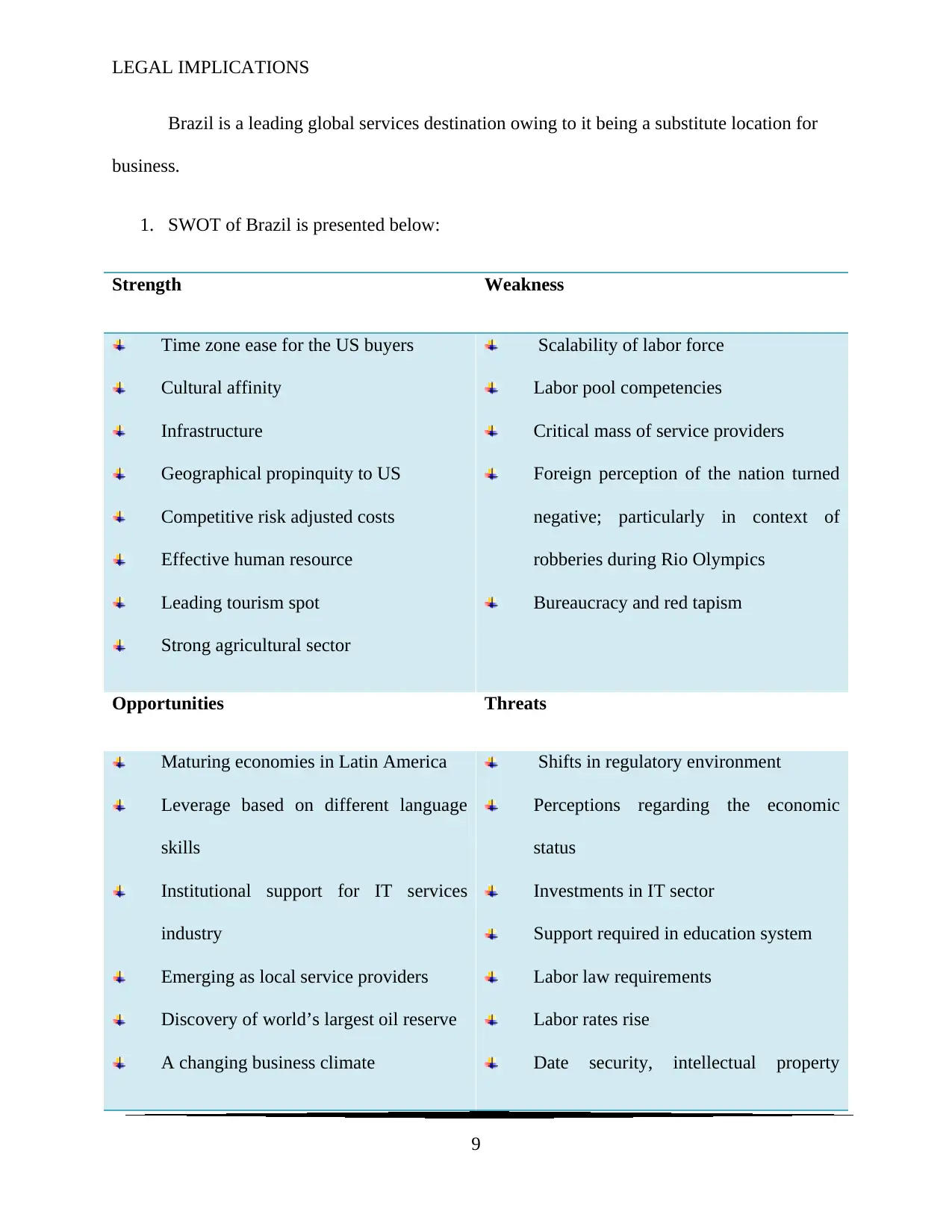
1. SWOT of Brazil is presented below:
Strength Weakness
Time zone ease for the US buyers
Cultural affinity
Infrastructure
Geographical propinquity to US
Competitive risk adjusted costs
Effective human resource
Leading tourism spot
Strong agricultural sector
Scalability of labor force
Labor pool competencies
Critical mass of service providers
Foreign perception of the nation turned
negative; particularly in context of
robberies during Rio Olympics
Bureaucracy and red tapism
Opportunities Threats
Maturing economies in Latin America
Leverage based on different language
skills
Institutional support for IT services
industry
Emerging as local service providers
Discovery of world’s largest oil reserve
A changing business climate
Shifts in regulatory environment
Perceptions regarding the economic
status
Investments in IT sector
Support required in education system
Labor law requirements
Labor rates rise
Date security, intellectual property
9
Brazil is a leading global services destination owing to it being a substitute location for
business.
1. SWOT of Brazil is presented below:
Strength Weakness
Time zone ease for the US buyers
Cultural affinity
Infrastructure
Geographical propinquity to US
Competitive risk adjusted costs
Effective human resource
Leading tourism spot
Strong agricultural sector
Scalability of labor force
Labor pool competencies
Critical mass of service providers
Foreign perception of the nation turned
negative; particularly in context of
robberies during Rio Olympics
Bureaucracy and red tapism
Opportunities Threats
Maturing economies in Latin America
Leverage based on different language
skills
Institutional support for IT services
industry
Emerging as local service providers
Discovery of world’s largest oil reserve
A changing business climate
Shifts in regulatory environment
Perceptions regarding the economic
status
Investments in IT sector
Support required in education system
Labor law requirements
Labor rates rise
Date security, intellectual property
9
⊘ This is a preview!⊘
Do you want full access?
Subscribe today to unlock all pages.
Trusted by 1+ million students worldwide
LEGAL IMPLICATIONS
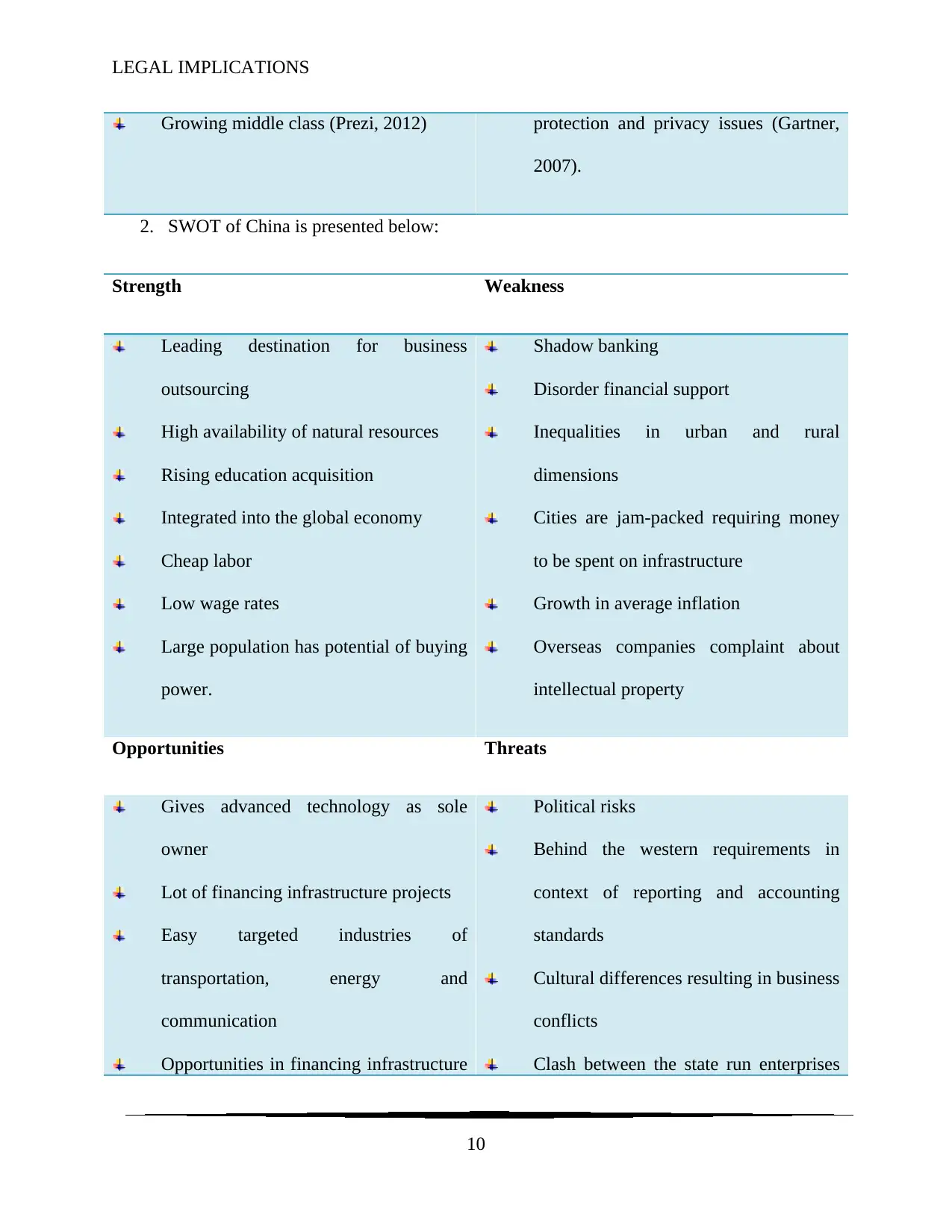
Growing middle class (Prezi, 2012) protection and privacy issues (Gartner,
2007).
2. SWOT of China is presented below:
Strength Weakness
Leading destination for business
outsourcing
High availability of natural resources
Rising education acquisition
Integrated into the global economy
Cheap labor
Low wage rates
Large population has potential of buying
power.
Shadow banking
Disorder financial support
Inequalities in urban and rural
dimensions
Cities are jam-packed requiring money
to be spent on infrastructure
Growth in average inflation
Overseas companies complaint about
intellectual property
Opportunities Threats
Gives advanced technology as sole
owner
Lot of financing infrastructure projects
Easy targeted industries of
transportation, energy and
communication
Opportunities in financing infrastructure
Political risks
Behind the western requirements in
context of reporting and accounting
standards
Cultural differences resulting in business
conflicts
Clash between the state run enterprises
10
Growing middle class (Prezi, 2012) protection and privacy issues (Gartner,
2007).
2. SWOT of China is presented below:
Strength Weakness
Leading destination for business
outsourcing
High availability of natural resources
Rising education acquisition
Integrated into the global economy
Cheap labor
Low wage rates
Large population has potential of buying
power.
Shadow banking
Disorder financial support
Inequalities in urban and rural
dimensions
Cities are jam-packed requiring money
to be spent on infrastructure
Growth in average inflation
Overseas companies complaint about
intellectual property
Opportunities Threats
Gives advanced technology as sole
owner
Lot of financing infrastructure projects
Easy targeted industries of
transportation, energy and
communication
Opportunities in financing infrastructure
Political risks
Behind the western requirements in
context of reporting and accounting
standards
Cultural differences resulting in business
conflicts
Clash between the state run enterprises
10
Paraphrase This Document
Need a fresh take? Get an instant paraphrase of this document with our AI Paraphraser
LEGAL IMPLICATIONS
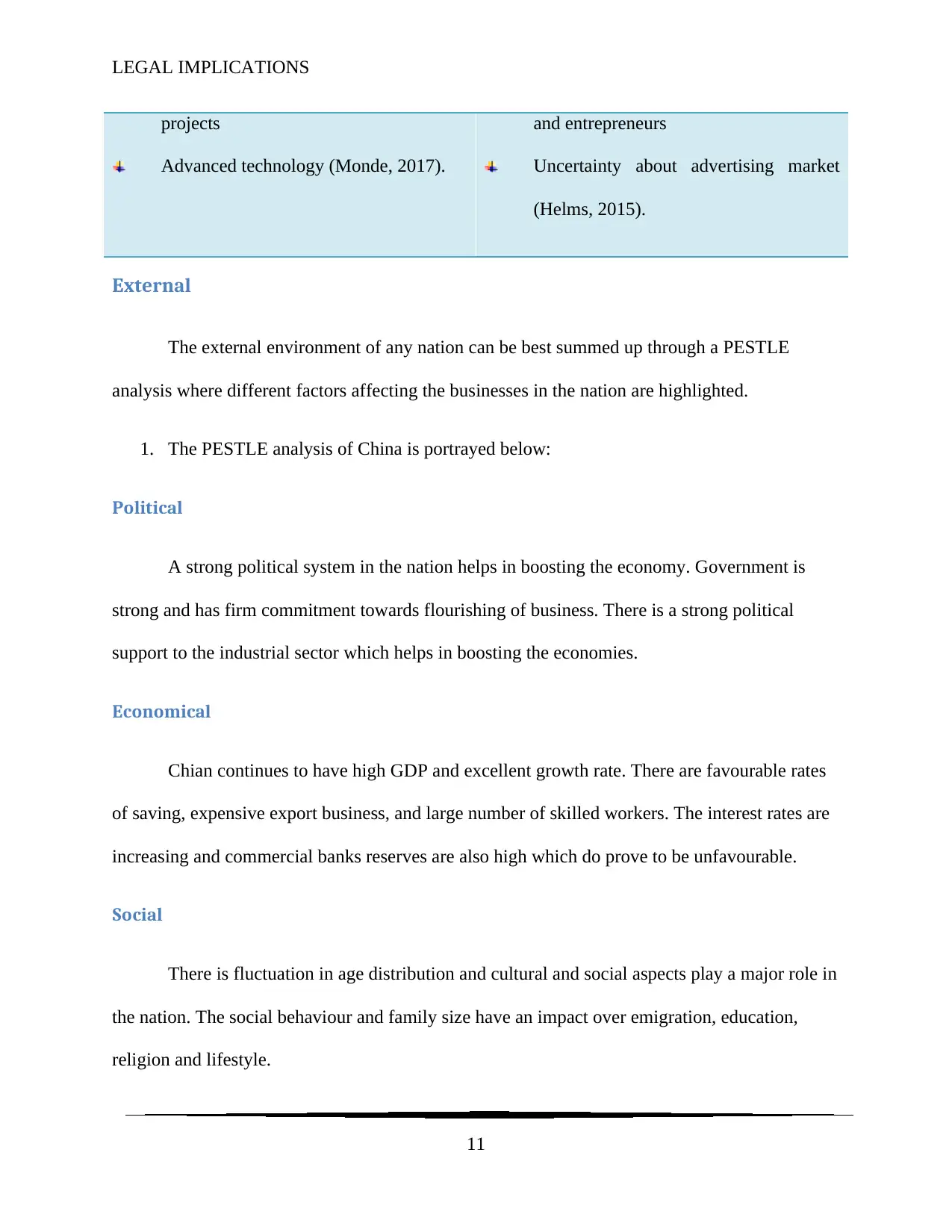
projects
Advanced technology (Monde, 2017).
and entrepreneurs
Uncertainty about advertising market
(Helms, 2015).
External
The external environment of any nation can be best summed up through a PESTLE
analysis where different factors affecting the businesses in the nation are highlighted.
1. The PESTLE analysis of China is portrayed below:
Political
A strong political system in the nation helps in boosting the economy. Government is
strong and has firm commitment towards flourishing of business. There is a strong political
support to the industrial sector which helps in boosting the economies.
Economical
Chian continues to have high GDP and excellent growth rate. There are favourable rates
of saving, expensive export business, and large number of skilled workers. The interest rates are
increasing and commercial banks reserves are also high which do prove to be unfavourable.
Social
There is fluctuation in age distribution and cultural and social aspects play a major role in
the nation. The social behaviour and family size have an impact over emigration, education,
religion and lifestyle.
11
projects
Advanced technology (Monde, 2017).
and entrepreneurs
Uncertainty about advertising market
(Helms, 2015).
External
The external environment of any nation can be best summed up through a PESTLE
analysis where different factors affecting the businesses in the nation are highlighted.
1. The PESTLE analysis of China is portrayed below:
Political
A strong political system in the nation helps in boosting the economy. Government is
strong and has firm commitment towards flourishing of business. There is a strong political
support to the industrial sector which helps in boosting the economies.
Economical
Chian continues to have high GDP and excellent growth rate. There are favourable rates
of saving, expensive export business, and large number of skilled workers. The interest rates are
increasing and commercial banks reserves are also high which do prove to be unfavourable.
Social
There is fluctuation in age distribution and cultural and social aspects play a major role in
the nation. The social behaviour and family size have an impact over emigration, education,
religion and lifestyle.
11
LEGAL IMPLICATIONS
Technological
The nation is amongst the world leaders in technology where new mechanisms of
distribution, production technology and new methods of working are constantly brought forward.
Legal
Due to the growth in e-commerce, regulations have been formed with regards to their
protection, and taxation. Though, there are no regulations to support privacy or recognition of
digital structures.
Environmental
The nation is famous for its environmental related issues due to high pollution in the
nation, coupled with regular smog incidents. Though, steps are taken to curb this in line of
reducing vehicles (Kasi, 2015).
2. The PESTLE analysis of Brazil is portrayed below:
Political
The nation became democracy in 1980’s. A huge problem in the nation is corruption
which continues to go worse. This goes to such an extent that even when a small business has to
be opened up in the nation, the same cannot be done till the time payments are made to the
officials of government. Owing to the dissatisfaction amongst the people, mass protests were
carried out in 2016 against Dilma Rouseff, which shows that before investing in business
operations in the nation, there is a need to consider the political situation of the nation.
12
Technological
The nation is amongst the world leaders in technology where new mechanisms of
distribution, production technology and new methods of working are constantly brought forward.
Legal
Due to the growth in e-commerce, regulations have been formed with regards to their
protection, and taxation. Though, there are no regulations to support privacy or recognition of
digital structures.
Environmental
The nation is famous for its environmental related issues due to high pollution in the
nation, coupled with regular smog incidents. Though, steps are taken to curb this in line of
reducing vehicles (Kasi, 2015).
2. The PESTLE analysis of Brazil is portrayed below:
Political
The nation became democracy in 1980’s. A huge problem in the nation is corruption
which continues to go worse. This goes to such an extent that even when a small business has to
be opened up in the nation, the same cannot be done till the time payments are made to the
officials of government. Owing to the dissatisfaction amongst the people, mass protests were
carried out in 2016 against Dilma Rouseff, which shows that before investing in business
operations in the nation, there is a need to consider the political situation of the nation.
12
⊘ This is a preview!⊘
Do you want full access?
Subscribe today to unlock all pages.
Trusted by 1+ million students worldwide

1 out of 17


Related Documents


Your All-in-One AI-Powered Toolkit for Academic Success.
+13062052269
info@desklib.com
Available 24*7 on WhatsApp / Email
![[object Object]](/_next/static/media/star-bottom.7253800d.svg)
Unlock your academic potential
Copyright © 2020–2026 A2Z Services. All Rights Reserved. Developed and managed by ZUCOL.