Business Law: Legal System, Business Organizations, and Disputes
VerifiedAdded on 2023/01/12
|12
|4047
|51
Report
AI Summary
This report provides a comprehensive overview of business law, examining its impact on various aspects of business operations. It begins with an introduction to business law, defining its scope and importance. The report then delves into specific areas of law, including company law, employment law, and contract law, illustrating their potential impact with practical examples. It differentiates between legislation, regulations, and standards to analyze their effect on businesses. The report also offers a critical evaluation of the legal system and law, highlighting the role of government in law-making. Furthermore, it explores different types of business organizations, explaining their legal formation, funding, and management, along with their respective advantages and disadvantages. The report concludes by recommending legal solutions for resolving disputes, comparing sources of legal advice and support, and evaluating the effectiveness of these solutions.

BUSINESS LAW

Paraphrase This Document
Need a fresh take? Get an instant paraphrase of this document with our AI Paraphraser
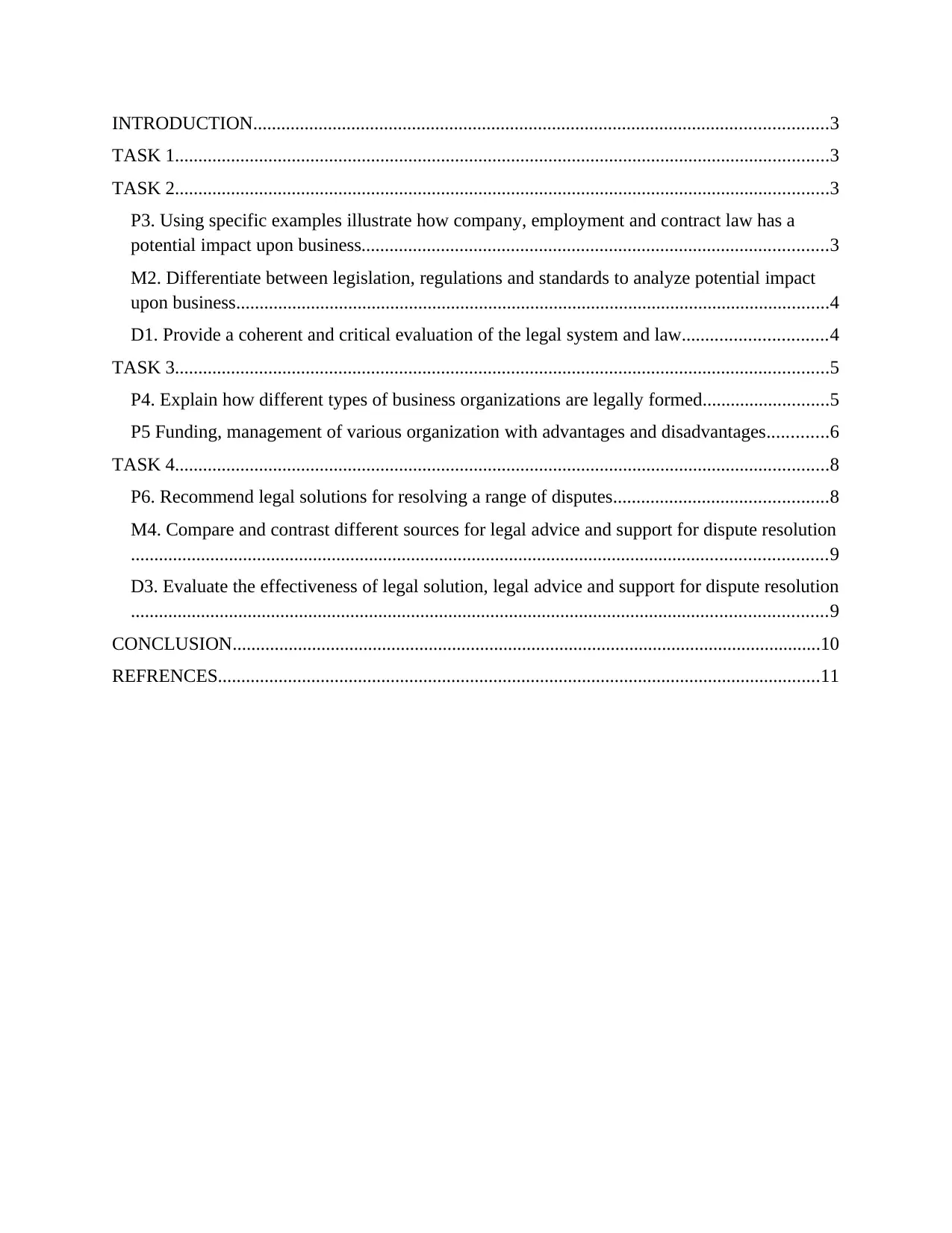
INTRODUCTION...........................................................................................................................3
TASK 1............................................................................................................................................3
TASK 2............................................................................................................................................3
P3. Using specific examples illustrate how company, employment and contract law has a
potential impact upon business....................................................................................................3
M2. Differentiate between legislation, regulations and standards to analyze potential impact
upon business...............................................................................................................................4
D1. Provide a coherent and critical evaluation of the legal system and law...............................4
TASK 3............................................................................................................................................5
P4. Explain how different types of business organizations are legally formed...........................5
P5 Funding, management of various organization with advantages and disadvantages.............6
TASK 4............................................................................................................................................8
P6. Recommend legal solutions for resolving a range of disputes..............................................8
M4. Compare and contrast different sources for legal advice and support for dispute resolution
.....................................................................................................................................................9
D3. Evaluate the effectiveness of legal solution, legal advice and support for dispute resolution
.....................................................................................................................................................9
CONCLUSION..............................................................................................................................10
REFRENCES.................................................................................................................................11
TASK 1............................................................................................................................................3
TASK 2............................................................................................................................................3
P3. Using specific examples illustrate how company, employment and contract law has a
potential impact upon business....................................................................................................3
M2. Differentiate between legislation, regulations and standards to analyze potential impact
upon business...............................................................................................................................4
D1. Provide a coherent and critical evaluation of the legal system and law...............................4
TASK 3............................................................................................................................................5
P4. Explain how different types of business organizations are legally formed...........................5
P5 Funding, management of various organization with advantages and disadvantages.............6
TASK 4............................................................................................................................................8
P6. Recommend legal solutions for resolving a range of disputes..............................................8
M4. Compare and contrast different sources for legal advice and support for dispute resolution
.....................................................................................................................................................9
D3. Evaluate the effectiveness of legal solution, legal advice and support for dispute resolution
.....................................................................................................................................................9
CONCLUSION..............................................................................................................................10
REFRENCES.................................................................................................................................11
INTRODUCTION
Business law is considered to be as rules and regulations which are applicable upon all
business organizations which comes together to achieve goals and objectives. These laws are
dynamic in nature and have wider scope because of their tendency to deal with issues that affects
business in various aspects. In a broader manner it can be explained as that framework which is
formed in order to manage selling of product and services as per standards of the business. In the
following assignment sources of law, role of government in law making and evaluation of law is
done. Also various types of organization, management, are funding. Both advantages and
disadvantages is covered. Solutions related to legal issues are going to be covered.
TASK 1
Covered in PPT
TASK 2
P3. Using specific examples illustrate how company, employment and contract law has a
potential impact upon business
Government of UK has formed various kind of laws which are important in order to
regulate business organization and functions. Such legislation has drastic impact and
effectiveness over an organization. That is explained as follows:
Company law: These are that type of laws formed for the purpose helping in establishing
of an business organization within the frame work of law and also provide legal framework for
it. All these laws are mentioned under the Companies Act of 2006. This act bought a revolution
by reducing complexity of forming a business organization. This can be further understood with
example that is(Hamad, Elbeltagi. and El‐Gohary, 2018) . For example, ZRT is an company and
is willing to expand itself. For this purpose fund raising is done but the fund collected is not
being used in appropriate manner. Under such situation a case can be filed against the
organization.
Employment law: As this is very important aspect of business organization which
requires manpower to perform its task and completing them within given time period. So
employment law gives an opportunity to select an individual to work in an organization.
These laws also speak about right and duties which has to be followed by employees in
an organization. Also this act ensures safety and security of employee has to be kept in
mind. Under employment act of 2002 these are covered. For example an employee
working in an organization with full dedication has been abused and discriminated
Business law is considered to be as rules and regulations which are applicable upon all
business organizations which comes together to achieve goals and objectives. These laws are
dynamic in nature and have wider scope because of their tendency to deal with issues that affects
business in various aspects. In a broader manner it can be explained as that framework which is
formed in order to manage selling of product and services as per standards of the business. In the
following assignment sources of law, role of government in law making and evaluation of law is
done. Also various types of organization, management, are funding. Both advantages and
disadvantages is covered. Solutions related to legal issues are going to be covered.
TASK 1
Covered in PPT
TASK 2
P3. Using specific examples illustrate how company, employment and contract law has a
potential impact upon business
Government of UK has formed various kind of laws which are important in order to
regulate business organization and functions. Such legislation has drastic impact and
effectiveness over an organization. That is explained as follows:
Company law: These are that type of laws formed for the purpose helping in establishing
of an business organization within the frame work of law and also provide legal framework for
it. All these laws are mentioned under the Companies Act of 2006. This act bought a revolution
by reducing complexity of forming a business organization. This can be further understood with
example that is(Hamad, Elbeltagi. and El‐Gohary, 2018) . For example, ZRT is an company and
is willing to expand itself. For this purpose fund raising is done but the fund collected is not
being used in appropriate manner. Under such situation a case can be filed against the
organization.
Employment law: As this is very important aspect of business organization which
requires manpower to perform its task and completing them within given time period. So
employment law gives an opportunity to select an individual to work in an organization.
These laws also speak about right and duties which has to be followed by employees in
an organization. Also this act ensures safety and security of employee has to be kept in
mind. Under employment act of 2002 these are covered. For example an employee
working in an organization with full dedication has been abused and discriminated
⊘ This is a preview!⊘
Do you want full access?
Subscribe today to unlock all pages.

Trusted by 1+ million students worldwide
because of his color by his senior. He can be sued for the act committed (Heminway,
2016).
Contract law: These are those kinds of laws which are formed to regulate an agreement
and give it validity in the eyes of law. These are formed between organizations for
rendering monitory transaction in valid manner. Also this agreement can be very useful
for generating of bond between parties in lawful manner. Such kind of agreements holds
rules regarding accomplishing of a particular task. This can be better understood through
a stamen which is “All agreements can be contract but a contract cannot be agreement”.
For example, contract has taken between SDF ltd and a supplier over raw materials
supply within appropriate time limit. Due to certain reason supplier was not able to
supply raw material and this resulted into revocation of contract. Hence it can be marked
out the there has been breach of contract which means when a guideline of contract has
not been followed.
M2. Differentiate between legislation, regulations and standards to analyze potential
impact upon business
Legislation: These are related to an concrete framework of rules and regulation that has
been passed by government only after having proper discussion over it. Proper procedure has to
be followed for making a law that is done through a discussion in both the houses and giving it
Royal assent. This bill once become a law is applicable to all over the country and to every
individual. These laws are used by court within various cases.
Regulation: They are considered to be that kind of instructions which are formed within
an organization according to the legislation that has been set up. Such rules are to be
made by administrative department of an organization (Katsos. and AlKafaji, 2019).
These are those strong forms of laws which are applied in addition of legal provisions.
These are very much mandatory to follow be followed.
Standard: These are fixed guidelines that have been formed in order to make regulations
to be followed properly. Also it helps in achieving of minimum criteria for completing task
related to product and services.
D1. Provide a coherent and critical evaluation of the legal system and law
Legal system in a country like UK has had a strong impact upon stopping and regulating
crime rate with appropriate justice. Every legal system has three important pillars which are there
to handle legal system of a country. Under the legal system various laws are there which has
become out dated because of rigidity which exist in their implementation. Various changes have
2016).
Contract law: These are those kinds of laws which are formed to regulate an agreement
and give it validity in the eyes of law. These are formed between organizations for
rendering monitory transaction in valid manner. Also this agreement can be very useful
for generating of bond between parties in lawful manner. Such kind of agreements holds
rules regarding accomplishing of a particular task. This can be better understood through
a stamen which is “All agreements can be contract but a contract cannot be agreement”.
For example, contract has taken between SDF ltd and a supplier over raw materials
supply within appropriate time limit. Due to certain reason supplier was not able to
supply raw material and this resulted into revocation of contract. Hence it can be marked
out the there has been breach of contract which means when a guideline of contract has
not been followed.
M2. Differentiate between legislation, regulations and standards to analyze potential
impact upon business
Legislation: These are related to an concrete framework of rules and regulation that has
been passed by government only after having proper discussion over it. Proper procedure has to
be followed for making a law that is done through a discussion in both the houses and giving it
Royal assent. This bill once become a law is applicable to all over the country and to every
individual. These laws are used by court within various cases.
Regulation: They are considered to be that kind of instructions which are formed within
an organization according to the legislation that has been set up. Such rules are to be
made by administrative department of an organization (Katsos. and AlKafaji, 2019).
These are those strong forms of laws which are applied in addition of legal provisions.
These are very much mandatory to follow be followed.
Standard: These are fixed guidelines that have been formed in order to make regulations
to be followed properly. Also it helps in achieving of minimum criteria for completing task
related to product and services.
D1. Provide a coherent and critical evaluation of the legal system and law
Legal system in a country like UK has had a strong impact upon stopping and regulating
crime rate with appropriate justice. Every legal system has three important pillars which are there
to handle legal system of a country. Under the legal system various laws are there which has
become out dated because of rigidity which exist in their implementation. Various changes have
Paraphrase This Document
Need a fresh take? Get an instant paraphrase of this document with our AI Paraphraser
taken place according to time and situation. Both laws and legal system is directly connected
with each other. Transparency has also been lost due to complex laws. This can be understood
further in a manner that all laws are required to be amended in proper manner to give strength to
justice in courts or else it is going to make the legal system collapse.
TASK 3
P4. Explain how different types of business organizations are legally formed
Business organizations are the organization which are established to accomplishment of
common goals and objectives formed by persons come together to form it. This organization can
be of public and private nature. Such organizations are formed as per the requirement of the
persons willing to form it. Situation and laws also play an major role in an organization. Various
types of companies are there which exist under two categories that is incorporated and
unincorporated. Some of these organizations used commonly are explained bellow as follows:
Sole proprietorship: Such organizations are very easy to be formed and have less
complex structure is involved in it ((Lasprogata. and Foster, 2016). Business organization is of
the simplest nature which comes under this category of business. Organization of this kind has
single owner who runs business. It is not considered to a legal entity because it has no proper
registration process like private company. Also in this business the owner is whole and solely
responsible for all kinds of activities related to business. These organizations have no complex
documentation or lengthy process of getting registered. Documents like article of association and
incorporation is not required by such a business entity. Only an trustable resource should be
arranged for generating of financial help or funds. In order to run such type of business
organization a person should follow rules and have with him, National Insurance number or NI
number for providing existence in business of this type. Only registration is done for the purpose
of getting registered to an extent of self-assessment. This is done under HMRC. Name is
required to get it a existence in market.
Partnership: Such kinds of business firms are formed with an agreement under which
more than two parties are involved in order to operate firm of such type. These organizations are
set-up with a major motive that is profit making out of business done under a firm. Profit and
loss is shared among the partners of the company. It also gets benefit in taxpaying for a such
kind of firm that is of partnership nature. In an partnership firm an agreement is signed between
both the parties to perform an activity. Such parties can be of any kind of nature which means
that working of an organization should be under partnership only. Government, non-profit
enterprises or individuals can become parties. This is only based on contract formed over a
period of time. In this HMRC has to be used for registration.
Private Company: This organization is part of incorporated companies and all are
required to be managed through directors and shareholders. Such companies are required to
select directors to run organization of such nature. These companies are not allowed to sell there
with each other. Transparency has also been lost due to complex laws. This can be understood
further in a manner that all laws are required to be amended in proper manner to give strength to
justice in courts or else it is going to make the legal system collapse.
TASK 3
P4. Explain how different types of business organizations are legally formed
Business organizations are the organization which are established to accomplishment of
common goals and objectives formed by persons come together to form it. This organization can
be of public and private nature. Such organizations are formed as per the requirement of the
persons willing to form it. Situation and laws also play an major role in an organization. Various
types of companies are there which exist under two categories that is incorporated and
unincorporated. Some of these organizations used commonly are explained bellow as follows:
Sole proprietorship: Such organizations are very easy to be formed and have less
complex structure is involved in it ((Lasprogata. and Foster, 2016). Business organization is of
the simplest nature which comes under this category of business. Organization of this kind has
single owner who runs business. It is not considered to a legal entity because it has no proper
registration process like private company. Also in this business the owner is whole and solely
responsible for all kinds of activities related to business. These organizations have no complex
documentation or lengthy process of getting registered. Documents like article of association and
incorporation is not required by such a business entity. Only an trustable resource should be
arranged for generating of financial help or funds. In order to run such type of business
organization a person should follow rules and have with him, National Insurance number or NI
number for providing existence in business of this type. Only registration is done for the purpose
of getting registered to an extent of self-assessment. This is done under HMRC. Name is
required to get it a existence in market.
Partnership: Such kinds of business firms are formed with an agreement under which
more than two parties are involved in order to operate firm of such type. These organizations are
set-up with a major motive that is profit making out of business done under a firm. Profit and
loss is shared among the partners of the company. It also gets benefit in taxpaying for a such
kind of firm that is of partnership nature. In an partnership firm an agreement is signed between
both the parties to perform an activity. Such parties can be of any kind of nature which means
that working of an organization should be under partnership only. Government, non-profit
enterprises or individuals can become parties. This is only based on contract formed over a
period of time. In this HMRC has to be used for registration.
Private Company: This organization is part of incorporated companies and all are
required to be managed through directors and shareholders. Such companies are required to
select directors to run organization of such nature. These companies are not allowed to sell there
shares in the market to public. Decision making is in the hands of directors for such
organizations. Registration of these companies is done only after forming of Memorandum of
Association and submitting required documents to Companies house.
Public Company: Under such type of company public becomes director of the business
only after shares have been distributed to public. In other sense it can be understood as that type
of company which is their multiple, ownership and has sold all it shares in market with an
offering of getting director’s position in these organizations. These companies can sell their
shares to public (Lee, 2017). These companies are registered by identifying number of
shareholders and obtaining their digital signature, identification number. Also address of head
office is required
P5 Funding, management of various organization with advantages and disadvantages
Incorporate Organization: Such types of organizations are formed in order to operate any kind
of business that has personal legal existence because of which it becomes very easy to be formed
as part of contract and also is very easy to be formed. This is considered to be one of the most
safe and secured form of business to be operated and also fund raising is easy.
Private Company: These types of organizations are funded through loans from banks,
equity and also from raising fund through crowd funding. These organizations are managed
by the directors which have been selected for performing operations in a business.
Advantages of Private Company are
It is a separate legal entity means that all it is separate from its owner.
Perpetual succession is there which means death of a member is not going to effect
Company’s existence.
Disadvantages of Private Company
Process of getting it register is very long
Also complicated procedure which becomes time consuming.
Public Company: These organizations are funded through selling of it shares to public and
taking loans from any kind of government organizations. Management of these
organizations are done through its owners.
Advantages of Public Company
Capital is raised through issuing of shares.
Sources of finance can be arranged easily (Rohlin. and Ross, 2016).
Disadvantages of Public Company
Directors appointed should have different aims as that of shareholder.
organizations. Registration of these companies is done only after forming of Memorandum of
Association and submitting required documents to Companies house.
Public Company: Under such type of company public becomes director of the business
only after shares have been distributed to public. In other sense it can be understood as that type
of company which is their multiple, ownership and has sold all it shares in market with an
offering of getting director’s position in these organizations. These companies can sell their
shares to public (Lee, 2017). These companies are registered by identifying number of
shareholders and obtaining their digital signature, identification number. Also address of head
office is required
P5 Funding, management of various organization with advantages and disadvantages
Incorporate Organization: Such types of organizations are formed in order to operate any kind
of business that has personal legal existence because of which it becomes very easy to be formed
as part of contract and also is very easy to be formed. This is considered to be one of the most
safe and secured form of business to be operated and also fund raising is easy.
Private Company: These types of organizations are funded through loans from banks,
equity and also from raising fund through crowd funding. These organizations are managed
by the directors which have been selected for performing operations in a business.
Advantages of Private Company are
It is a separate legal entity means that all it is separate from its owner.
Perpetual succession is there which means death of a member is not going to effect
Company’s existence.
Disadvantages of Private Company
Process of getting it register is very long
Also complicated procedure which becomes time consuming.
Public Company: These organizations are funded through selling of it shares to public and
taking loans from any kind of government organizations. Management of these
organizations are done through its owners.
Advantages of Public Company
Capital is raised through issuing of shares.
Sources of finance can be arranged easily (Rohlin. and Ross, 2016).
Disadvantages of Public Company
Directors appointed should have different aims as that of shareholder.
⊘ This is a preview!⊘
Do you want full access?
Subscribe today to unlock all pages.
Trusted by 1+ million students worldwide
Control is lost over ownership due to various owners.
Unincorporated Organization: Such kind of organizations are formed in order to operate that
kind of business in which operations are performed to earn profit out of it. Major benefit of such
kind of organization is that it is not recognized legally and does not has to pay taxes like private
company. Arranging of funds can be really hard at point of time because of no association of a
name.
Sole proprietorship: These organizations have to be handled by an individual and funds have
to be arranged by him only. Funds can be arranged through friends, family members and taking
private or personal loan. Management of these organizations is done through individual only and
persist whole responsibility of managing everything to perform activities of business.
Advantages of sole proprietorship:
Easy to set-up businesses and no complex procedure involved.
Less financial resources are required for setting it up.
Disadvantages of sole proprietor:
Liability of the owner is there while running a business and also loss has to be handled
by him only.
Tax of self employment has to be paid by the owner.
Partnership: In these types of organization that are run by more than two individual as
partner. Finds are being arranged through private organizations, arranging of loans from
bank. All the partners involved in this business is responsible for managing every aspect of it
and liability lies over the partners to run this firm(Lifshitz. and Finkelstein, 2017).
Advantages:
Process of setting this organization is very easy and not complex in nature.
Chances of generating large resources increases as more than two persons are involved in
it.
Disadvantages of partnership
Liability of partner is limited
Lack of harmony is their because dispute can arise at any point of time.
Unincorporated Organization: Such kind of organizations are formed in order to operate that
kind of business in which operations are performed to earn profit out of it. Major benefit of such
kind of organization is that it is not recognized legally and does not has to pay taxes like private
company. Arranging of funds can be really hard at point of time because of no association of a
name.
Sole proprietorship: These organizations have to be handled by an individual and funds have
to be arranged by him only. Funds can be arranged through friends, family members and taking
private or personal loan. Management of these organizations is done through individual only and
persist whole responsibility of managing everything to perform activities of business.
Advantages of sole proprietorship:
Easy to set-up businesses and no complex procedure involved.
Less financial resources are required for setting it up.
Disadvantages of sole proprietor:
Liability of the owner is there while running a business and also loss has to be handled
by him only.
Tax of self employment has to be paid by the owner.
Partnership: In these types of organization that are run by more than two individual as
partner. Finds are being arranged through private organizations, arranging of loans from
bank. All the partners involved in this business is responsible for managing every aspect of it
and liability lies over the partners to run this firm(Lifshitz. and Finkelstein, 2017).
Advantages:
Process of setting this organization is very easy and not complex in nature.
Chances of generating large resources increases as more than two persons are involved in
it.
Disadvantages of partnership
Liability of partner is limited
Lack of harmony is their because dispute can arise at any point of time.
Paraphrase This Document
Need a fresh take? Get an instant paraphrase of this document with our AI Paraphraser
TASK 4
P6. Recommend legal solutions for resolving a range of disputes
Legal solutions are those remedies which are provided by laws. This is used in order to
solve a dispute which has occurred because of conflict between two parties. Also their
willingness to solve this dispute is also observed. Then only appropriate solution is given. These
solution has both advantages and disadvantages depending upon situation. Various types of legal
solution have been described as provided:
Negotiation: This is the method that involves two parties in it and an a negotiator which
helps in dealing with the problem. It is done by making the parties have discussion over
the problem faced by them. Through this an appropriate solution can be formed regarding
the problem. This is done for managing the matter mutually by making adjustments in
existing terms and conditions so that future relationship can be sustained between both
the parties. In case of Thomas and JVC Plc In this case a dispute has arisen between the
parties upon copyright of patents of new technology developed by Thomas which is
going to help in boosting of business and its growth. JVC Plc stole the blue print of
technology that resulted into loss to Thomas. So in this dispute the use of negotiation is
that it is going to help by fixing a meeting between both the parties. Then make them
come to a point upon which both of them agree (Orozco, 2016).
Mediation: In this method, a third party is engaged or hired who is impartial and
unbiased to assist the parties to the disputes to negotiate with each other. This method is
applicable when the first method negotiation fails. The mediator tries to help the party in finding
solution which will provide satisfaction to both the parties. In case of Augustine and Smart
Equipment Ltd in this case an employee has to faced harassment from his higher employer and
this makes him feel very bad. He leaves the job. In this mediator is going to make both of them
meet and come to an conclusion regarding the issue. Also this is going to clear any miss
understanding occurred between both the parties(Park. and Samples, 2017).
Arbitration: This method is the last way for resolving any dispute due to its features
which are suitable to every situation. In this solution, a person is appointed with the mutual
consent of both the parties who is responsible for hearing them in order to find out a solution
which will be applicable for settling the dispute. In the case of Daniel and Smart Equipment
Ltd In this case an dispute occurred between the parties regarding changing of policies related of
performing operations. In this an arbitrator is going to help in this by listing to both the parties
and making the come to an conclusion which is applicable to both the parties. They rae bound to
follow it.
P6. Recommend legal solutions for resolving a range of disputes
Legal solutions are those remedies which are provided by laws. This is used in order to
solve a dispute which has occurred because of conflict between two parties. Also their
willingness to solve this dispute is also observed. Then only appropriate solution is given. These
solution has both advantages and disadvantages depending upon situation. Various types of legal
solution have been described as provided:
Negotiation: This is the method that involves two parties in it and an a negotiator which
helps in dealing with the problem. It is done by making the parties have discussion over
the problem faced by them. Through this an appropriate solution can be formed regarding
the problem. This is done for managing the matter mutually by making adjustments in
existing terms and conditions so that future relationship can be sustained between both
the parties. In case of Thomas and JVC Plc In this case a dispute has arisen between the
parties upon copyright of patents of new technology developed by Thomas which is
going to help in boosting of business and its growth. JVC Plc stole the blue print of
technology that resulted into loss to Thomas. So in this dispute the use of negotiation is
that it is going to help by fixing a meeting between both the parties. Then make them
come to a point upon which both of them agree (Orozco, 2016).
Mediation: In this method, a third party is engaged or hired who is impartial and
unbiased to assist the parties to the disputes to negotiate with each other. This method is
applicable when the first method negotiation fails. The mediator tries to help the party in finding
solution which will provide satisfaction to both the parties. In case of Augustine and Smart
Equipment Ltd in this case an employee has to faced harassment from his higher employer and
this makes him feel very bad. He leaves the job. In this mediator is going to make both of them
meet and come to an conclusion regarding the issue. Also this is going to clear any miss
understanding occurred between both the parties(Park. and Samples, 2017).
Arbitration: This method is the last way for resolving any dispute due to its features
which are suitable to every situation. In this solution, a person is appointed with the mutual
consent of both the parties who is responsible for hearing them in order to find out a solution
which will be applicable for settling the dispute. In the case of Daniel and Smart Equipment
Ltd In this case an dispute occurred between the parties regarding changing of policies related of
performing operations. In this an arbitrator is going to help in this by listing to both the parties
and making the come to an conclusion which is applicable to both the parties. They rae bound to
follow it.
M4. Compare and contrast different sources for legal advice and support for dispute
resolution
Legal advice is the advices which are being regarded as the opinion that is being given by
the lawyer in formal manner. This is done only when client visits lawyer for solution regarding
the case or problem. For proper advice all facts must be disclosed in front of the lawyer.
Free legal consultation: As per this a lawyer gets involved in direct conversation
with the clients and discussion takes place over it. All facts over the issues are heard and time is
also given to client for deciding to proceed with the lawyer or not. Many questions are required
to be answered under this.
Legal aid programs: Main aim of this is to protect legal rights and maintain equality
towards justice. It gives right to have fair trial.
Self-help legal aid: As per this the legal rights that has been vested has to be
implemented and fight has to be done over the rights that has been granted under the
constitution. (Peterson. and et. al., 2016).
D3. Evaluate the effectiveness of legal solution, legal advice and support for dispute
resolution
Legal solution is the remedies that have been applicable under the situation to solve the
dispute that has taken place. Methods like negotiation, arbitration, conciliation is used under this.
As these are mainly the out of court settlements that is helpful in finding an immediate solution
over the problem which has occurred.
Legal advice is that opinion which is describing upon what to do under the situation to
get justice. It has to be given through professional of law like lawyers or advocates only after
hearing facts of the case. Movement has to be made in the right direction to utilize money and
time in proper manner.
resolution
Legal advice is the advices which are being regarded as the opinion that is being given by
the lawyer in formal manner. This is done only when client visits lawyer for solution regarding
the case or problem. For proper advice all facts must be disclosed in front of the lawyer.
Free legal consultation: As per this a lawyer gets involved in direct conversation
with the clients and discussion takes place over it. All facts over the issues are heard and time is
also given to client for deciding to proceed with the lawyer or not. Many questions are required
to be answered under this.
Legal aid programs: Main aim of this is to protect legal rights and maintain equality
towards justice. It gives right to have fair trial.
Self-help legal aid: As per this the legal rights that has been vested has to be
implemented and fight has to be done over the rights that has been granted under the
constitution. (Peterson. and et. al., 2016).
D3. Evaluate the effectiveness of legal solution, legal advice and support for dispute
resolution
Legal solution is the remedies that have been applicable under the situation to solve the
dispute that has taken place. Methods like negotiation, arbitration, conciliation is used under this.
As these are mainly the out of court settlements that is helpful in finding an immediate solution
over the problem which has occurred.
Legal advice is that opinion which is describing upon what to do under the situation to
get justice. It has to be given through professional of law like lawyers or advocates only after
hearing facts of the case. Movement has to be made in the right direction to utilize money and
time in proper manner.
⊘ This is a preview!⊘
Do you want full access?
Subscribe today to unlock all pages.
Trusted by 1+ million students worldwide
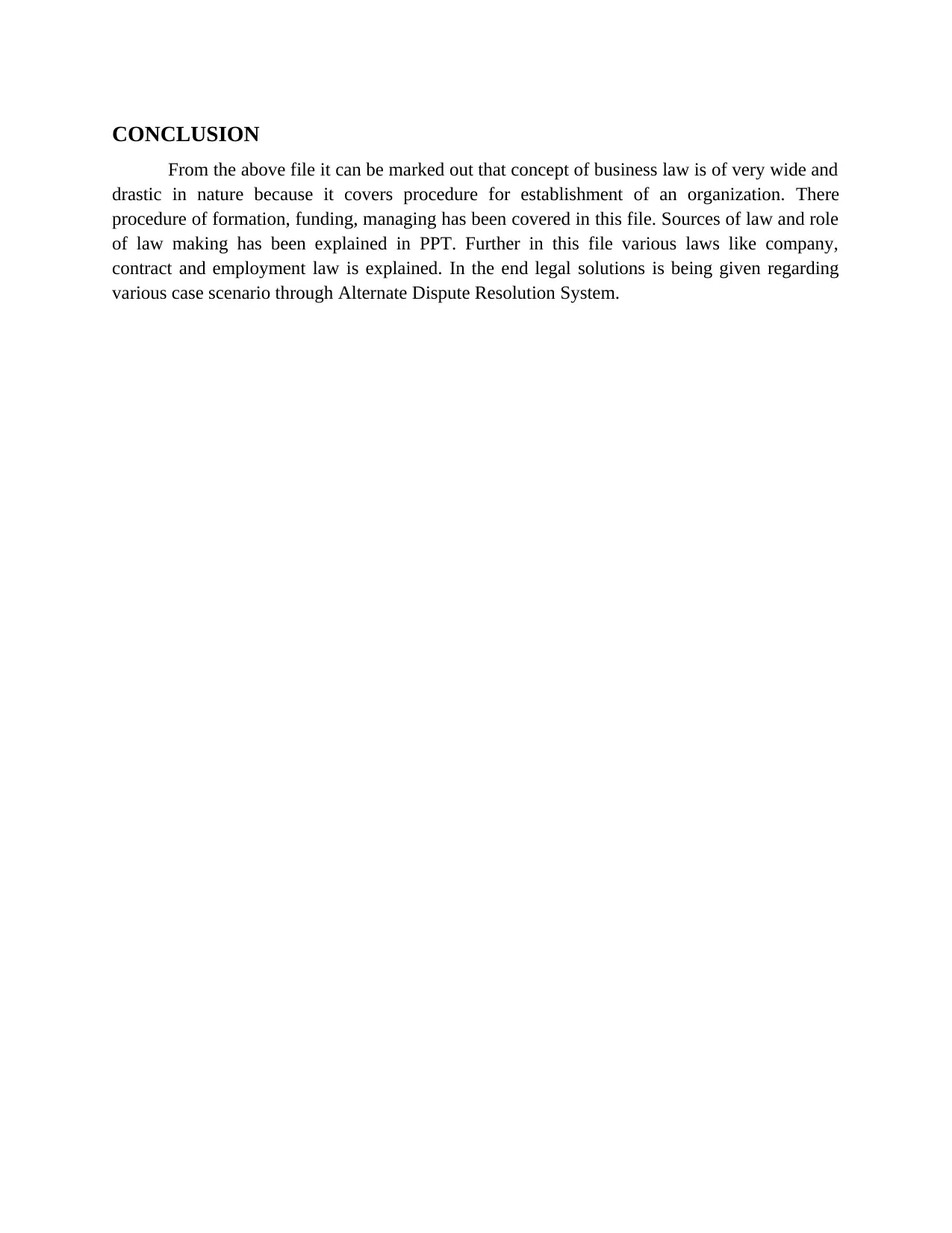
CONCLUSION
From the above file it can be marked out that concept of business law is of very wide and
drastic in nature because it covers procedure for establishment of an organization. There
procedure of formation, funding, managing has been covered in this file. Sources of law and role
of law making has been explained in PPT. Further in this file various laws like company,
contract and employment law is explained. In the end legal solutions is being given regarding
various case scenario through Alternate Dispute Resolution System.
From the above file it can be marked out that concept of business law is of very wide and
drastic in nature because it covers procedure for establishment of an organization. There
procedure of formation, funding, managing has been covered in this file. Sources of law and role
of law making has been explained in PPT. Further in this file various laws like company,
contract and employment law is explained. In the end legal solutions is being given regarding
various case scenario through Alternate Dispute Resolution System.
Paraphrase This Document
Need a fresh take? Get an instant paraphrase of this document with our AI Paraphraser
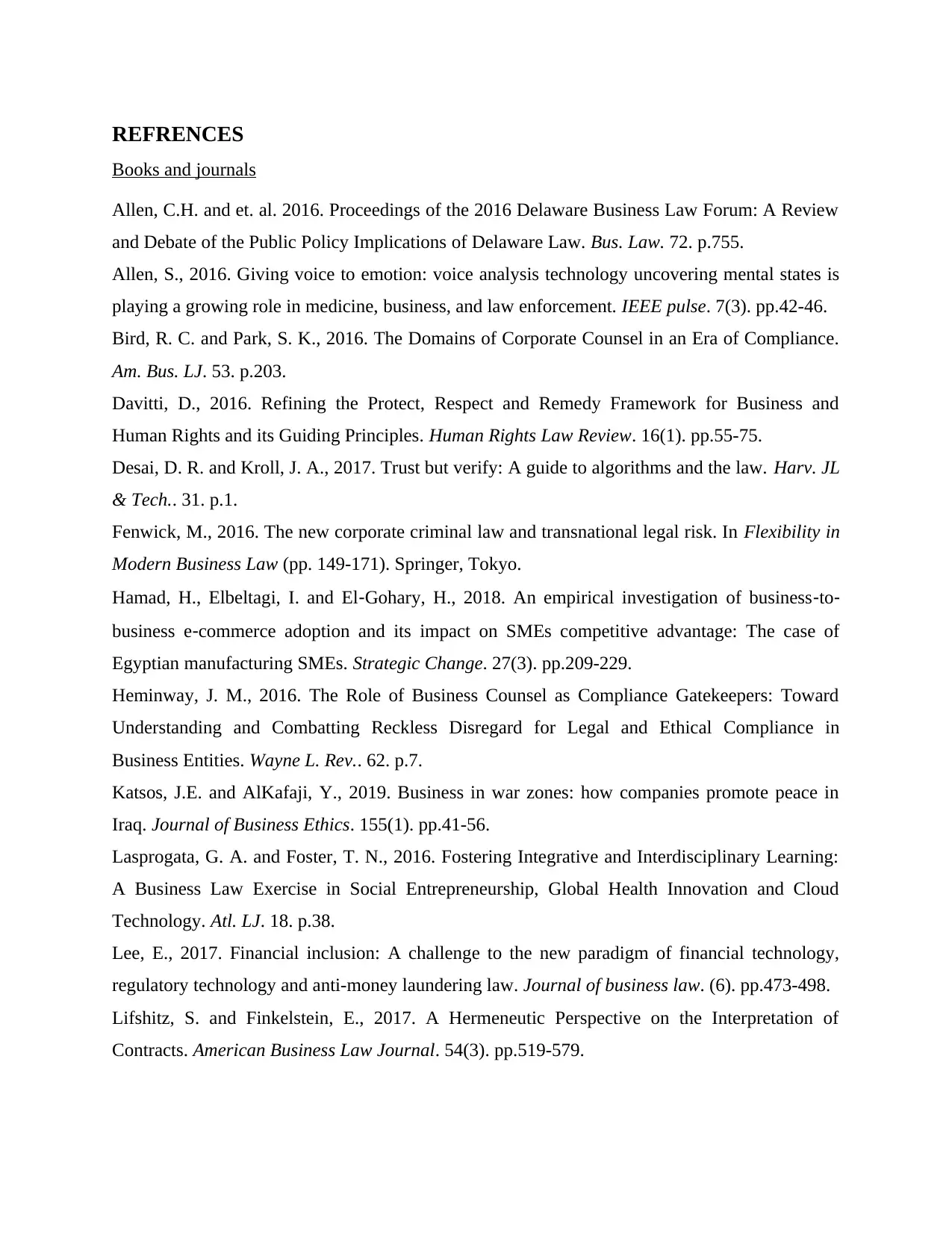
REFRENCES
Books and journals
Allen, C.H. and et. al. 2016. Proceedings of the 2016 Delaware Business Law Forum: A Review
and Debate of the Public Policy Implications of Delaware Law. Bus. Law. 72. p.755.
Allen, S., 2016. Giving voice to emotion: voice analysis technology uncovering mental states is
playing a growing role in medicine, business, and law enforcement. IEEE pulse. 7(3). pp.42-46.
Bird, R. C. and Park, S. K., 2016. The Domains of Corporate Counsel in an Era of Compliance.
Am. Bus. LJ. 53. p.203.
Davitti, D., 2016. Refining the Protect, Respect and Remedy Framework for Business and
Human Rights and its Guiding Principles. Human Rights Law Review. 16(1). pp.55-75.
Desai, D. R. and Kroll, J. A., 2017. Trust but verify: A guide to algorithms and the law. Harv. JL
& Tech.. 31. p.1.
Fenwick, M., 2016. The new corporate criminal law and transnational legal risk. In Flexibility in
Modern Business Law (pp. 149-171). Springer, Tokyo.
Hamad, H., Elbeltagi, I. and El‐Gohary, H., 2018. An empirical investigation of business‐to‐
business e‐commerce adoption and its impact on SMEs competitive advantage: The case of
Egyptian manufacturing SMEs. Strategic Change. 27(3). pp.209-229.
Heminway, J. M., 2016. The Role of Business Counsel as Compliance Gatekeepers: Toward
Understanding and Combatting Reckless Disregard for Legal and Ethical Compliance in
Business Entities. Wayne L. Rev.. 62. p.7.
Katsos, J.E. and AlKafaji, Y., 2019. Business in war zones: how companies promote peace in
Iraq. Journal of Business Ethics. 155(1). pp.41-56.
Lasprogata, G. A. and Foster, T. N., 2016. Fostering Integrative and Interdisciplinary Learning:
A Business Law Exercise in Social Entrepreneurship, Global Health Innovation and Cloud
Technology. Atl. LJ. 18. p.38.
Lee, E., 2017. Financial inclusion: A challenge to the new paradigm of financial technology,
regulatory technology and anti-money laundering law. Journal of business law. (6). pp.473-498.
Lifshitz, S. and Finkelstein, E., 2017. A Hermeneutic Perspective on the Interpretation of
Contracts. American Business Law Journal. 54(3). pp.519-579.
Books and journals
Allen, C.H. and et. al. 2016. Proceedings of the 2016 Delaware Business Law Forum: A Review
and Debate of the Public Policy Implications of Delaware Law. Bus. Law. 72. p.755.
Allen, S., 2016. Giving voice to emotion: voice analysis technology uncovering mental states is
playing a growing role in medicine, business, and law enforcement. IEEE pulse. 7(3). pp.42-46.
Bird, R. C. and Park, S. K., 2016. The Domains of Corporate Counsel in an Era of Compliance.
Am. Bus. LJ. 53. p.203.
Davitti, D., 2016. Refining the Protect, Respect and Remedy Framework for Business and
Human Rights and its Guiding Principles. Human Rights Law Review. 16(1). pp.55-75.
Desai, D. R. and Kroll, J. A., 2017. Trust but verify: A guide to algorithms and the law. Harv. JL
& Tech.. 31. p.1.
Fenwick, M., 2016. The new corporate criminal law and transnational legal risk. In Flexibility in
Modern Business Law (pp. 149-171). Springer, Tokyo.
Hamad, H., Elbeltagi, I. and El‐Gohary, H., 2018. An empirical investigation of business‐to‐
business e‐commerce adoption and its impact on SMEs competitive advantage: The case of
Egyptian manufacturing SMEs. Strategic Change. 27(3). pp.209-229.
Heminway, J. M., 2016. The Role of Business Counsel as Compliance Gatekeepers: Toward
Understanding and Combatting Reckless Disregard for Legal and Ethical Compliance in
Business Entities. Wayne L. Rev.. 62. p.7.
Katsos, J.E. and AlKafaji, Y., 2019. Business in war zones: how companies promote peace in
Iraq. Journal of Business Ethics. 155(1). pp.41-56.
Lasprogata, G. A. and Foster, T. N., 2016. Fostering Integrative and Interdisciplinary Learning:
A Business Law Exercise in Social Entrepreneurship, Global Health Innovation and Cloud
Technology. Atl. LJ. 18. p.38.
Lee, E., 2017. Financial inclusion: A challenge to the new paradigm of financial technology,
regulatory technology and anti-money laundering law. Journal of business law. (6). pp.473-498.
Lifshitz, S. and Finkelstein, E., 2017. A Hermeneutic Perspective on the Interpretation of
Contracts. American Business Law Journal. 54(3). pp.519-579.
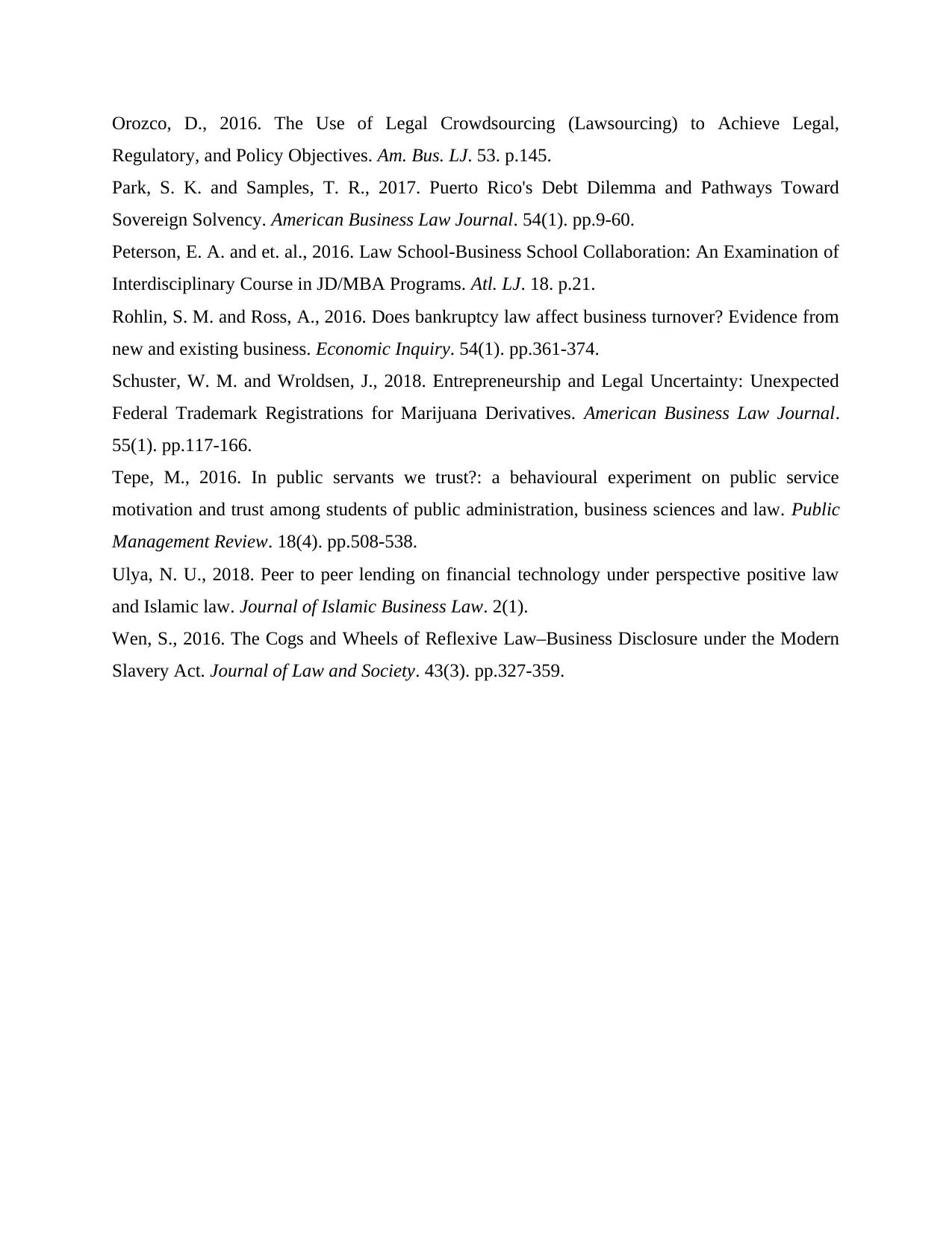
Orozco, D., 2016. The Use of Legal Crowdsourcing (Lawsourcing) to Achieve Legal,
Regulatory, and Policy Objectives. Am. Bus. LJ. 53. p.145.
Park, S. K. and Samples, T. R., 2017. Puerto Rico's Debt Dilemma and Pathways Toward
Sovereign Solvency. American Business Law Journal. 54(1). pp.9-60.
Peterson, E. A. and et. al., 2016. Law School-Business School Collaboration: An Examination of
Interdisciplinary Course in JD/MBA Programs. Atl. LJ. 18. p.21.
Rohlin, S. M. and Ross, A., 2016. Does bankruptcy law affect business turnover? Evidence from
new and existing business. Economic Inquiry. 54(1). pp.361-374.
Schuster, W. M. and Wroldsen, J., 2018. Entrepreneurship and Legal Uncertainty: Unexpected
Federal Trademark Registrations for Marijuana Derivatives. American Business Law Journal.
55(1). pp.117-166.
Tepe, M., 2016. In public servants we trust?: a behavioural experiment on public service
motivation and trust among students of public administration, business sciences and law. Public
Management Review. 18(4). pp.508-538.
Ulya, N. U., 2018. Peer to peer lending on financial technology under perspective positive law
and Islamic law. Journal of Islamic Business Law. 2(1).
Wen, S., 2016. The Cogs and Wheels of Reflexive Law–Business Disclosure under the Modern
Slavery Act. Journal of Law and Society. 43(3). pp.327-359.
Regulatory, and Policy Objectives. Am. Bus. LJ. 53. p.145.
Park, S. K. and Samples, T. R., 2017. Puerto Rico's Debt Dilemma and Pathways Toward
Sovereign Solvency. American Business Law Journal. 54(1). pp.9-60.
Peterson, E. A. and et. al., 2016. Law School-Business School Collaboration: An Examination of
Interdisciplinary Course in JD/MBA Programs. Atl. LJ. 18. p.21.
Rohlin, S. M. and Ross, A., 2016. Does bankruptcy law affect business turnover? Evidence from
new and existing business. Economic Inquiry. 54(1). pp.361-374.
Schuster, W. M. and Wroldsen, J., 2018. Entrepreneurship and Legal Uncertainty: Unexpected
Federal Trademark Registrations for Marijuana Derivatives. American Business Law Journal.
55(1). pp.117-166.
Tepe, M., 2016. In public servants we trust?: a behavioural experiment on public service
motivation and trust among students of public administration, business sciences and law. Public
Management Review. 18(4). pp.508-538.
Ulya, N. U., 2018. Peer to peer lending on financial technology under perspective positive law
and Islamic law. Journal of Islamic Business Law. 2(1).
Wen, S., 2016. The Cogs and Wheels of Reflexive Law–Business Disclosure under the Modern
Slavery Act. Journal of Law and Society. 43(3). pp.327-359.
⊘ This is a preview!⊘
Do you want full access?
Subscribe today to unlock all pages.
Trusted by 1+ million students worldwide

1 out of 12


Related Documents


Your All-in-One AI-Powered Toolkit for Academic Success.
+13062052269
info@desklib.com
Available 24*7 on WhatsApp / Email
![[object Object]](/_next/static/media/star-bottom.7253800d.svg)
Unlock your academic potential
Copyright © 2020–2026 A2Z Services. All Rights Reserved. Developed and managed by ZUCOL.