Analyzing Negligence: A Business Law Case Study Using the IRAC Method
VerifiedAdded on 2023/04/17
|5
|692
|317
Case Study
AI Summary
This case study addresses two distinct legal scenarios under business law, employing the IRAC (Issue, Rule, Application, Conclusion) method for analysis. The first case examines whether Joe can sue Krispy TitBits for negligence after discovering a cockroach in his cake, referencing Australian negligence and food safety laws, and the principle of neighbor love established in Donoghue V Stevenson. It concludes that Joe has grounds to sue due to the café's breach of duty. The second case explores whether the parents of Jack and Jill can sue Nursery Rhyme Farm after their children were injured despite warnings and safety measures. Applying the Civil Liability Act 2002 and the concept of 'proximity of relationship,' it concludes that the farm is unlikely to be found negligent as they took reasonable precautions. Desklib offers similar solved assignments and past papers for students.
Business law questions
Paraphrase This Document
Need a fresh take? Get an instant paraphrase of this document with our AI Paraphraser

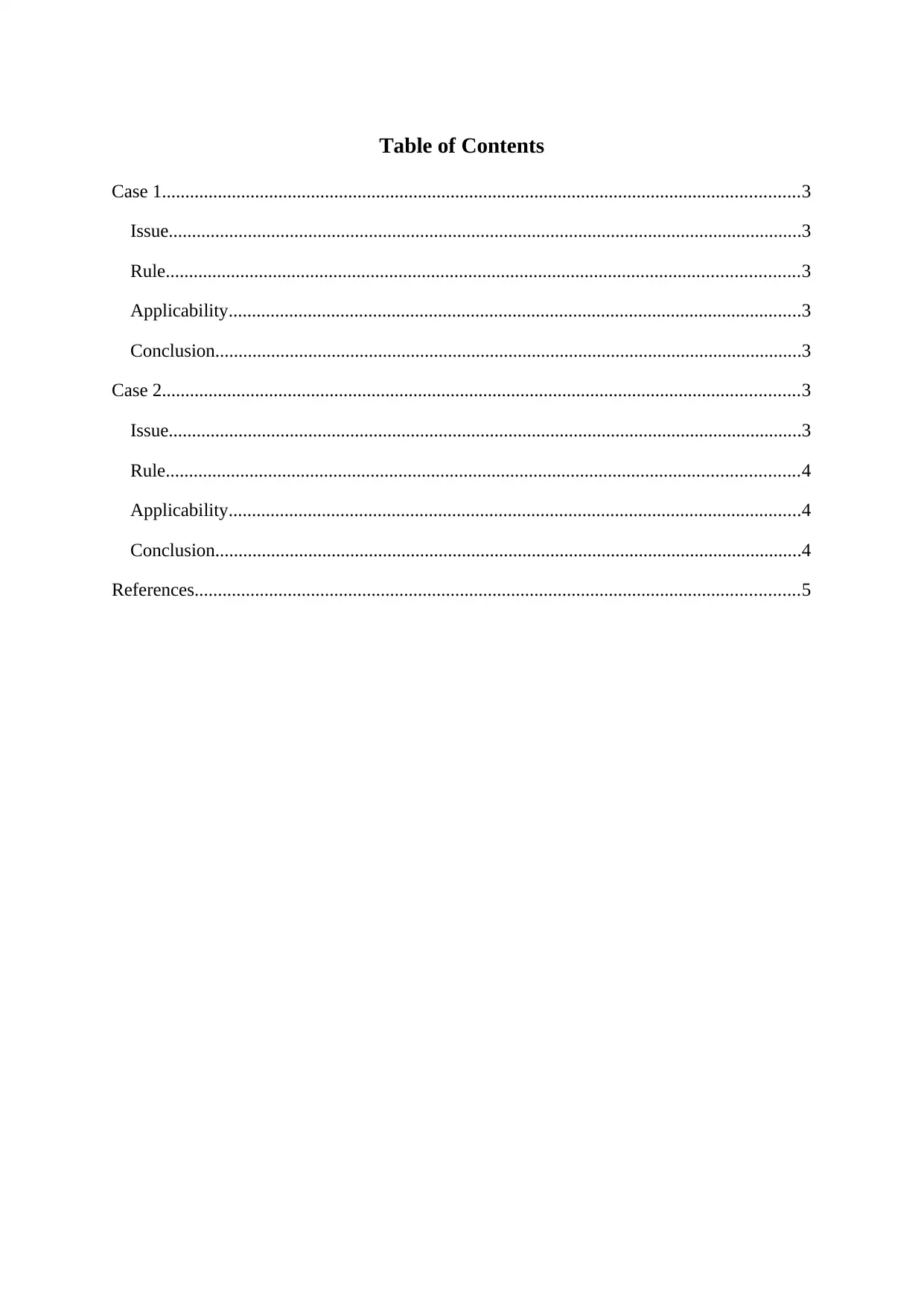
Table of Contents
Case 1.........................................................................................................................................3
Issue........................................................................................................................................3
Rule........................................................................................................................................3
Applicability...........................................................................................................................3
Conclusion..............................................................................................................................3
Case 2.........................................................................................................................................3
Issue........................................................................................................................................3
Rule........................................................................................................................................4
Applicability...........................................................................................................................4
Conclusion..............................................................................................................................4
References..................................................................................................................................5
Case 1.........................................................................................................................................3
Issue........................................................................................................................................3
Rule........................................................................................................................................3
Applicability...........................................................................................................................3
Conclusion..............................................................................................................................3
Case 2.........................................................................................................................................3
Issue........................................................................................................................................3
Rule........................................................................................................................................4
Applicability...........................................................................................................................4
Conclusion..............................................................................................................................4
References..................................................................................................................................5

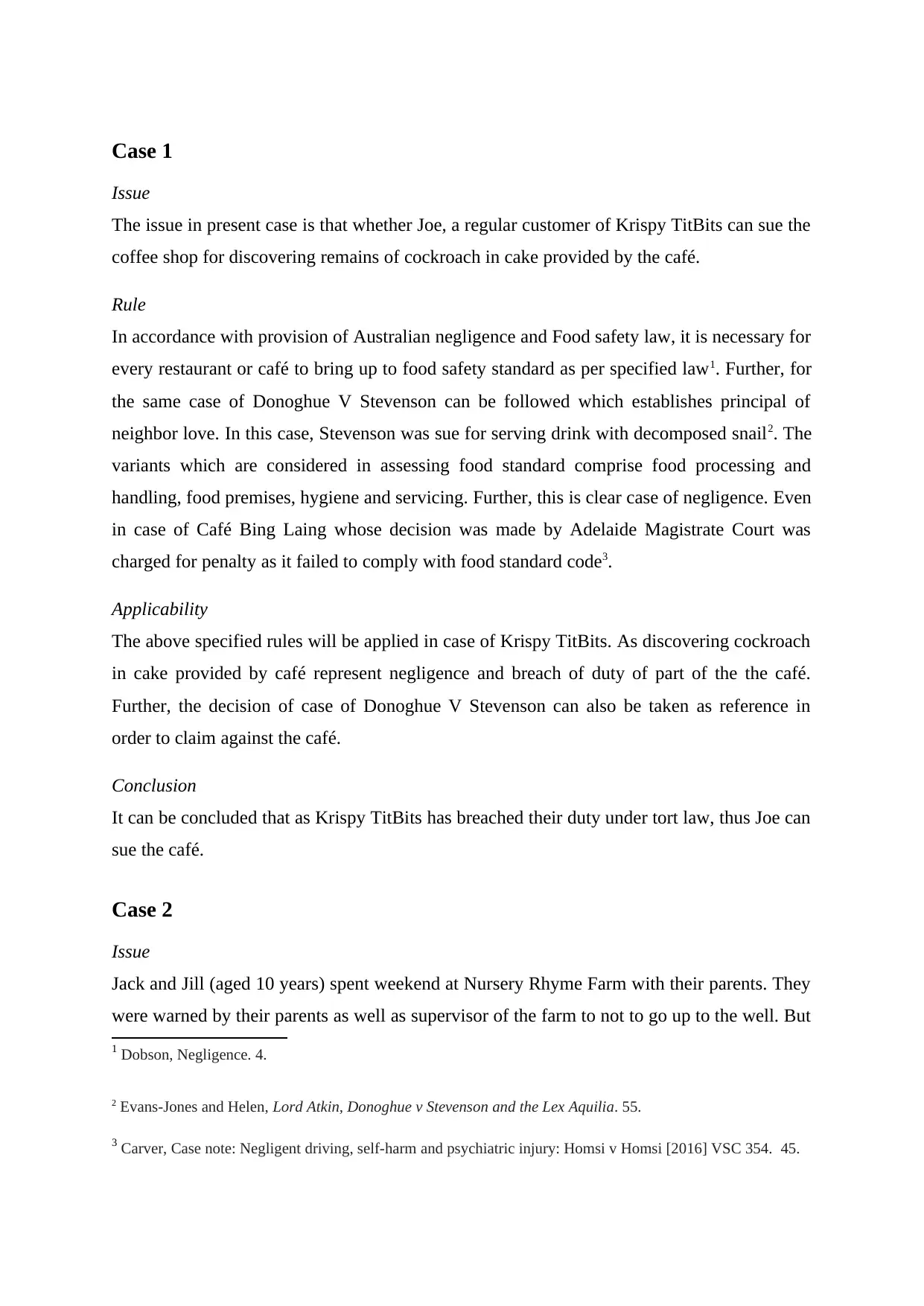
Case 1
Issue
The issue in present case is that whether Joe, a regular customer of Krispy TitBits can sue the
coffee shop for discovering remains of cockroach in cake provided by the café.
Rule
In accordance with provision of Australian negligence and Food safety law, it is necessary for
every restaurant or café to bring up to food safety standard as per specified law1. Further, for
the same case of Donoghue V Stevenson can be followed which establishes principal of
neighbor love. In this case, Stevenson was sue for serving drink with decomposed snail2. The
variants which are considered in assessing food standard comprise food processing and
handling, food premises, hygiene and servicing. Further, this is clear case of negligence. Even
in case of Café Bing Laing whose decision was made by Adelaide Magistrate Court was
charged for penalty as it failed to comply with food standard code3.
Applicability
The above specified rules will be applied in case of Krispy TitBits. As discovering cockroach
in cake provided by café represent negligence and breach of duty of part of the the café.
Further, the decision of case of Donoghue V Stevenson can also be taken as reference in
order to claim against the café.
Conclusion
It can be concluded that as Krispy TitBits has breached their duty under tort law, thus Joe can
sue the café.
Case 2
Issue
Jack and Jill (aged 10 years) spent weekend at Nursery Rhyme Farm with their parents. They
were warned by their parents as well as supervisor of the farm to not to go up to the well. But
1 Dobson, Negligence. 4.
2 Evans-Jones and Helen, Lord Atkin, Donoghue v Stevenson and the Lex Aquilia. 55.
3 Carver, Case note: Negligent driving, self-harm and psychiatric injury: Homsi v Homsi [2016] VSC 354. 45.
Issue
The issue in present case is that whether Joe, a regular customer of Krispy TitBits can sue the
coffee shop for discovering remains of cockroach in cake provided by the café.
Rule
In accordance with provision of Australian negligence and Food safety law, it is necessary for
every restaurant or café to bring up to food safety standard as per specified law1. Further, for
the same case of Donoghue V Stevenson can be followed which establishes principal of
neighbor love. In this case, Stevenson was sue for serving drink with decomposed snail2. The
variants which are considered in assessing food standard comprise food processing and
handling, food premises, hygiene and servicing. Further, this is clear case of negligence. Even
in case of Café Bing Laing whose decision was made by Adelaide Magistrate Court was
charged for penalty as it failed to comply with food standard code3.
Applicability
The above specified rules will be applied in case of Krispy TitBits. As discovering cockroach
in cake provided by café represent negligence and breach of duty of part of the the café.
Further, the decision of case of Donoghue V Stevenson can also be taken as reference in
order to claim against the café.
Conclusion
It can be concluded that as Krispy TitBits has breached their duty under tort law, thus Joe can
sue the café.
Case 2
Issue
Jack and Jill (aged 10 years) spent weekend at Nursery Rhyme Farm with their parents. They
were warned by their parents as well as supervisor of the farm to not to go up to the well. But
1 Dobson, Negligence. 4.
2 Evans-Jones and Helen, Lord Atkin, Donoghue v Stevenson and the Lex Aquilia. 55.
3 Carver, Case note: Negligent driving, self-harm and psychiatric injury: Homsi v Homsi [2016] VSC 354. 45.
⊘ This is a preview!⊘
Do you want full access?
Subscribe today to unlock all pages.

Trusted by 1+ million students worldwide

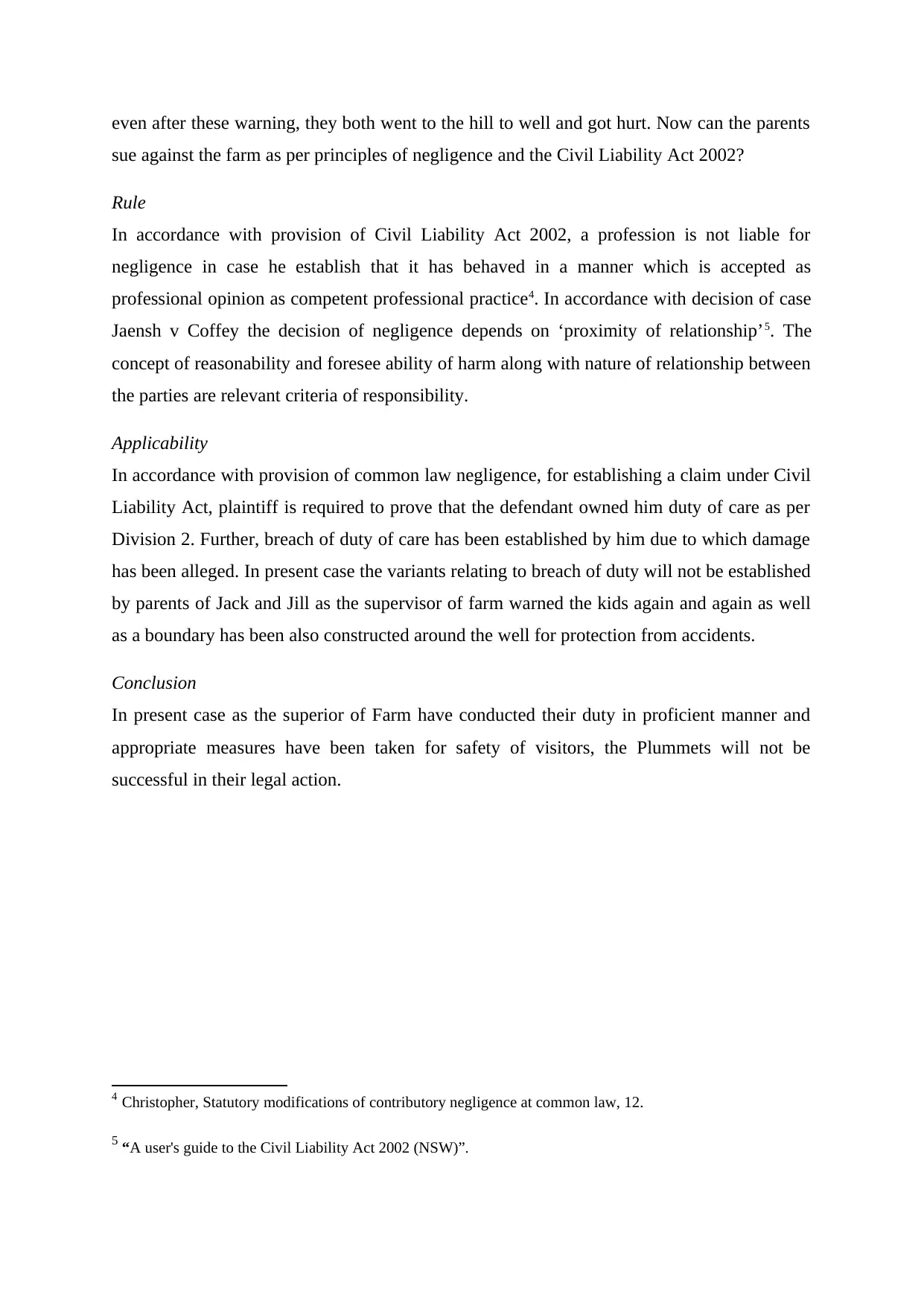
even after these warning, they both went to the hill to well and got hurt. Now can the parents
sue against the farm as per principles of negligence and the Civil Liability Act 2002?
Rule
In accordance with provision of Civil Liability Act 2002, a profession is not liable for
negligence in case he establish that it has behaved in a manner which is accepted as
professional opinion as competent professional practice4. In accordance with decision of case
Jaensh v Coffey the decision of negligence depends on ‘proximity of relationship’5. The
concept of reasonability and foresee ability of harm along with nature of relationship between
the parties are relevant criteria of responsibility.
Applicability
In accordance with provision of common law negligence, for establishing a claim under Civil
Liability Act, plaintiff is required to prove that the defendant owned him duty of care as per
Division 2. Further, breach of duty of care has been established by him due to which damage
has been alleged. In present case the variants relating to breach of duty will not be established
by parents of Jack and Jill as the supervisor of farm warned the kids again and again as well
as a boundary has been also constructed around the well for protection from accidents.
Conclusion
In present case as the superior of Farm have conducted their duty in proficient manner and
appropriate measures have been taken for safety of visitors, the Plummets will not be
successful in their legal action.
4 Christopher, Statutory modifications of contributory negligence at common law, 12.
5 “A user's guide to the Civil Liability Act 2002 (NSW)”.
sue against the farm as per principles of negligence and the Civil Liability Act 2002?
Rule
In accordance with provision of Civil Liability Act 2002, a profession is not liable for
negligence in case he establish that it has behaved in a manner which is accepted as
professional opinion as competent professional practice4. In accordance with decision of case
Jaensh v Coffey the decision of negligence depends on ‘proximity of relationship’5. The
concept of reasonability and foresee ability of harm along with nature of relationship between
the parties are relevant criteria of responsibility.
Applicability
In accordance with provision of common law negligence, for establishing a claim under Civil
Liability Act, plaintiff is required to prove that the defendant owned him duty of care as per
Division 2. Further, breach of duty of care has been established by him due to which damage
has been alleged. In present case the variants relating to breach of duty will not be established
by parents of Jack and Jill as the supervisor of farm warned the kids again and again as well
as a boundary has been also constructed around the well for protection from accidents.
Conclusion
In present case as the superior of Farm have conducted their duty in proficient manner and
appropriate measures have been taken for safety of visitors, the Plummets will not be
successful in their legal action.
4 Christopher, Statutory modifications of contributory negligence at common law, 12.
5 “A user's guide to the Civil Liability Act 2002 (NSW)”.
Paraphrase This Document
Need a fresh take? Get an instant paraphrase of this document with our AI Paraphraser

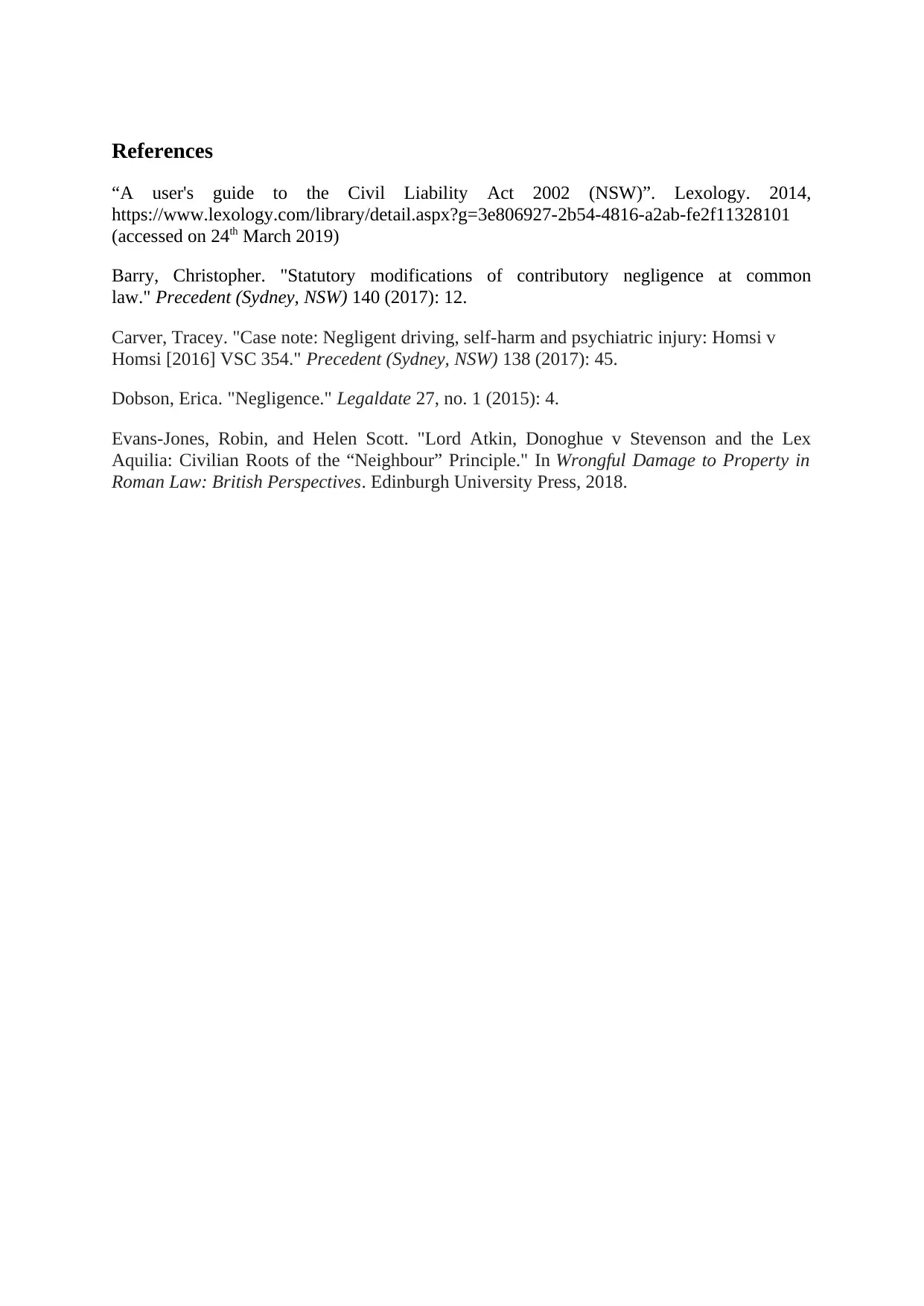
References
“A user's guide to the Civil Liability Act 2002 (NSW)”. Lexology. 2014,
https://www.lexology.com/library/detail.aspx?g=3e806927-2b54-4816-a2ab-fe2f11328101
(accessed on 24th March 2019)
Barry, Christopher. "Statutory modifications of contributory negligence at common
law." Precedent (Sydney, NSW) 140 (2017): 12.
Carver, Tracey. "Case note: Negligent driving, self-harm and psychiatric injury: Homsi v
Homsi [2016] VSC 354." Precedent (Sydney, NSW) 138 (2017): 45.
Dobson, Erica. "Negligence." Legaldate 27, no. 1 (2015): 4.
Evans-Jones, Robin, and Helen Scott. "Lord Atkin, Donoghue v Stevenson and the Lex
Aquilia: Civilian Roots of the “Neighbour” Principle." In Wrongful Damage to Property in
Roman Law: British Perspectives. Edinburgh University Press, 2018.
“A user's guide to the Civil Liability Act 2002 (NSW)”. Lexology. 2014,
https://www.lexology.com/library/detail.aspx?g=3e806927-2b54-4816-a2ab-fe2f11328101
(accessed on 24th March 2019)
Barry, Christopher. "Statutory modifications of contributory negligence at common
law." Precedent (Sydney, NSW) 140 (2017): 12.
Carver, Tracey. "Case note: Negligent driving, self-harm and psychiatric injury: Homsi v
Homsi [2016] VSC 354." Precedent (Sydney, NSW) 138 (2017): 45.
Dobson, Erica. "Negligence." Legaldate 27, no. 1 (2015): 4.
Evans-Jones, Robin, and Helen Scott. "Lord Atkin, Donoghue v Stevenson and the Lex
Aquilia: Civilian Roots of the “Neighbour” Principle." In Wrongful Damage to Property in
Roman Law: British Perspectives. Edinburgh University Press, 2018.
1 out of 5
Related Documents
Your All-in-One AI-Powered Toolkit for Academic Success.
+13062052269
info@desklib.com
Available 24*7 on WhatsApp / Email
Unlock your academic potential
Copyright © 2020–2025 A2Z Services. All Rights Reserved. Developed and managed by ZUCOL.