Business Law Case: Saunders and Watts Liability Analysis

Verified

Added on  2022/08/20

|5
|942
|13
Case Study
AI Summary
This case study analyzes a business law scenario involving Mrs. Rusholme, Saunders and Watts Ltd., and a gas explosion. The primary issue revolves around determining the basis of a lawsuit by the Rusholmes, specifically focusing on the potential for an unintentional tort, likely negligence. The analysis applies legal precedents such as Dominion Natural Gas v Collins and Perkins, Weller v Foot and Mouth Disease Research Institute, Bazley v. Curry, and Pierce Fisheries to evaluate the actions of Saunders and Watts. The case explores whether Saunders and Watts breached their duty of care by closing the windows and doors, contrary to Mrs. Rusholme's instructions, and whether their actions were a direct cause of the subsequent explosion and property damage. The conclusion suggests that negligence could form the foundation of the lawsuit if the Rusholmes can establish that Saunders and Watts failed to take adequate care, leading to the damage. The analysis emphasizes the importance of foreseeability, reasonable precautions, and the concept of vicarious liability in determining the outcome.
Document Page
Running head: BUSINESS LAW
BUSINESS LAW
Name of the Student
Name of the University
Author Note
tabler-icon-diamond-filled.svg

Paraphrase This Document

Need a fresh take? Get an instant paraphrase of this document with our AI Paraphraser
Document Page
1BUSINESS LAW
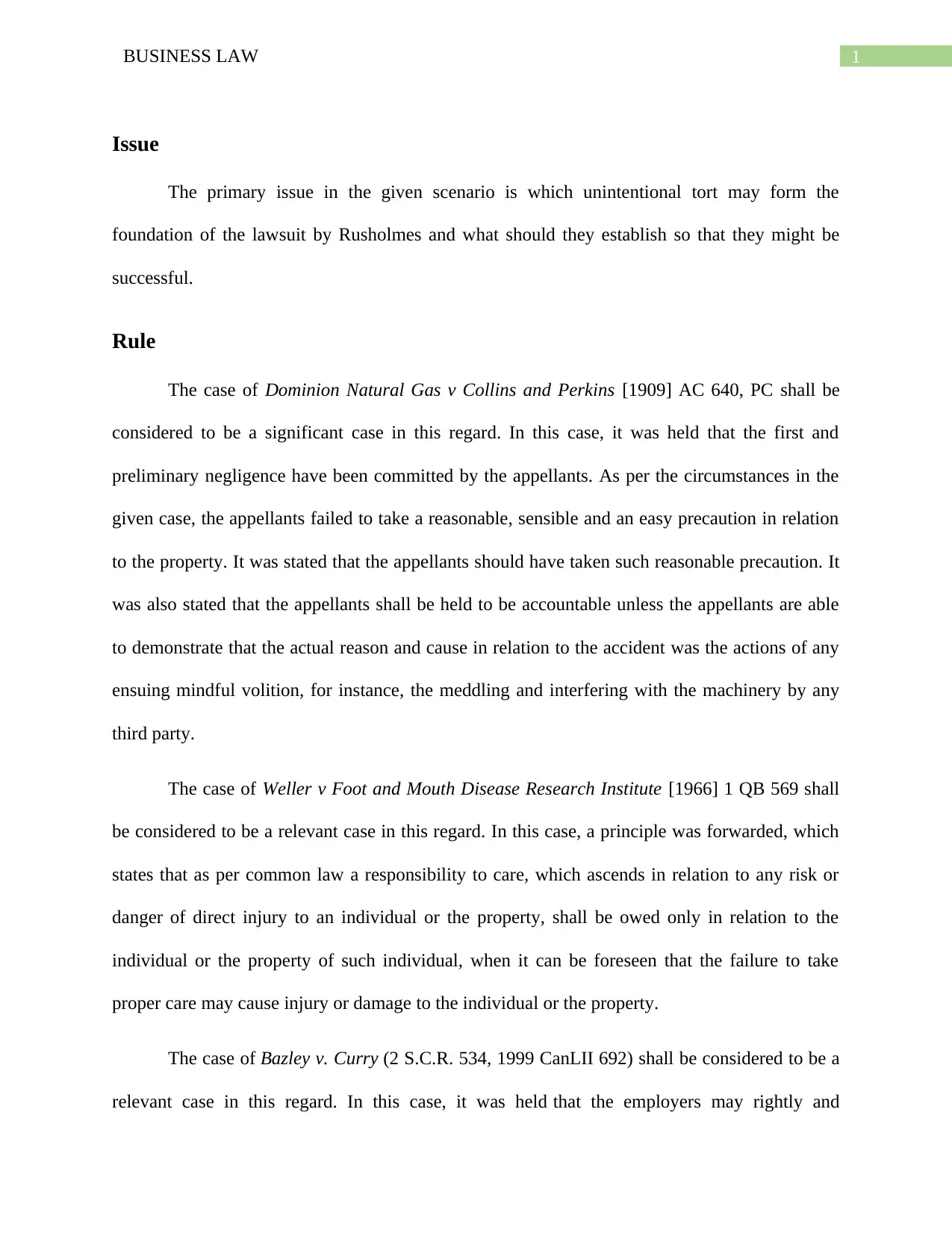
Issue
The primary issue in the given scenario is which unintentional tort may form the
foundation of the lawsuit by Rusholmes and what should they establish so that they might be
successful.
Rule
The case of Dominion Natural Gas v Collins and Perkins [1909] AC 640, PC shall be
considered to be a significant case in this regard. In this case, it was held that the first and
preliminary negligence have been committed by the appellants. As per the circumstances in the
given case, the appellants failed to take a reasonable, sensible and an easy precaution in relation
to the property. It was stated that the appellants should have taken such reasonable precaution. It
was also stated that the appellants shall be held to be accountable unless the appellants are able
to demonstrate that the actual reason and cause in relation to the accident was the actions of any
ensuing mindful volition, for instance, the meddling and interfering with the machinery by any
third party.
The case of Weller v Foot and Mouth Disease Research Institute [1966] 1 QB 569 shall
be considered to be a relevant case in this regard. In this case, a principle was forwarded, which
states that as per common law a responsibility to care, which ascends in relation to any risk or
danger of direct injury to an individual or the property, shall be owed only in relation to the
individual or the property of such individual, when it can be foreseen that the failure to take
proper care may cause injury or damage to the individual or the property.
The case of Bazley v. Curry (2 S.C.R. 534, 1999 CanLII 692) shall be considered to be a
relevant case in this regard. In this case, it was held that the employers may rightly and
Document Page
2BUSINESS LAW
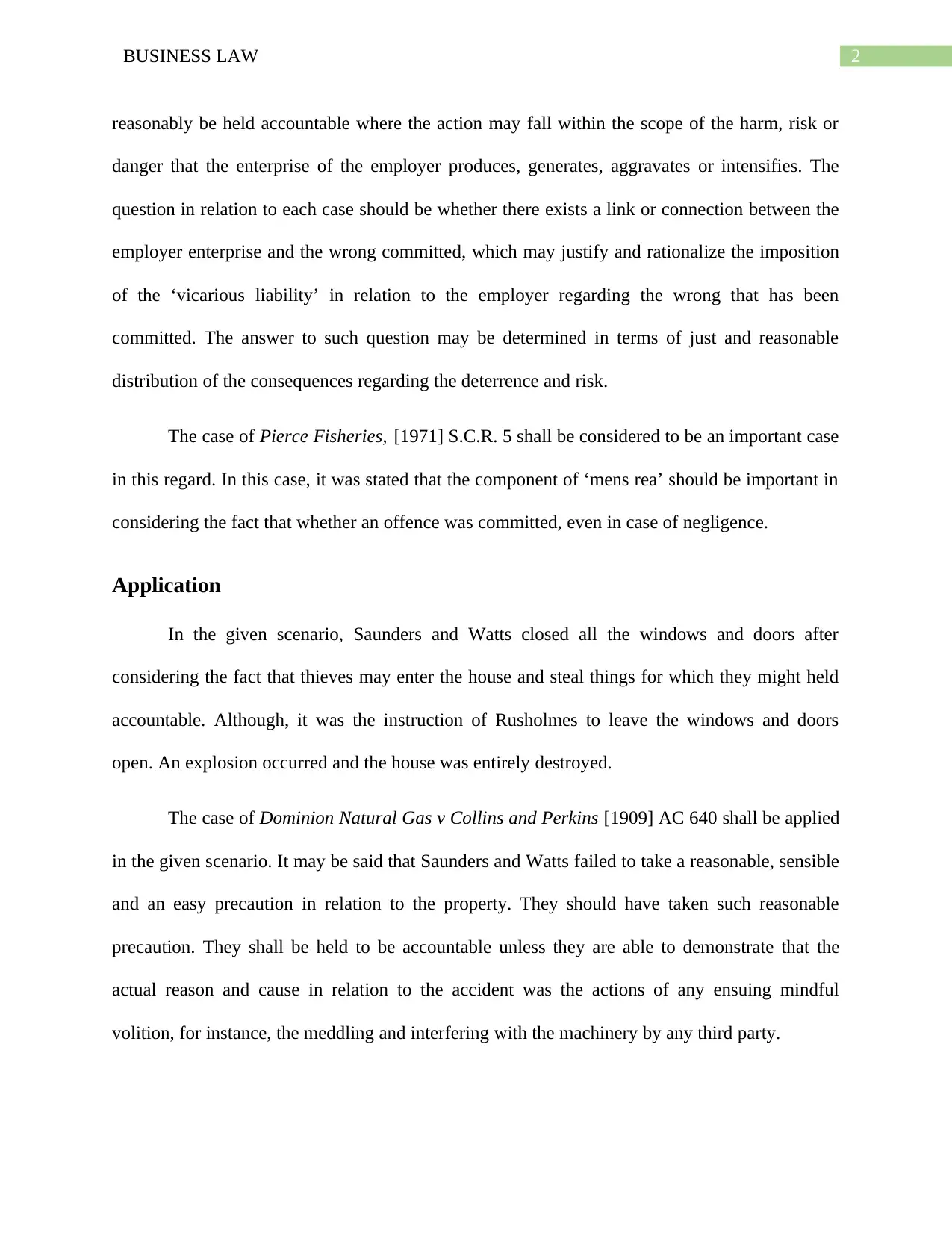
reasonably be held accountable where the action may fall within the scope of the harm, risk or
danger that the enterprise of the employer produces, generates, aggravates or intensifies. The
question in relation to each case should be whether there exists a link or connection between the
employer enterprise and the wrong committed, which may justify and rationalize the imposition
of the ‘vicarious liability’ in relation to the employer regarding the wrong that has been
committed. The answer to such question may be determined in terms of just and reasonable
distribution of the consequences regarding the deterrence and risk.
The case of Pierce Fisheries, [1971] S.C.R. 5 shall be considered to be an important case
in this regard. In this case, it was stated that the component of ‘mens rea’ should be important in
considering the fact that whether an offence was committed, even in case of negligence.
Application
In the given scenario, Saunders and Watts closed all the windows and doors after
considering the fact that thieves may enter the house and steal things for which they might held
accountable. Although, it was the instruction of Rusholmes to leave the windows and doors
open. An explosion occurred and the house was entirely destroyed.
The case of Dominion Natural Gas v Collins and Perkins [1909] AC 640 shall be applied
in the given scenario. It may be said that Saunders and Watts failed to take a reasonable, sensible
and an easy precaution in relation to the property. They should have taken such reasonable
precaution. They shall be held to be accountable unless they are able to demonstrate that the
actual reason and cause in relation to the accident was the actions of any ensuing mindful
volition, for instance, the meddling and interfering with the machinery by any third party.
Document Page
3BUSINESS LAW
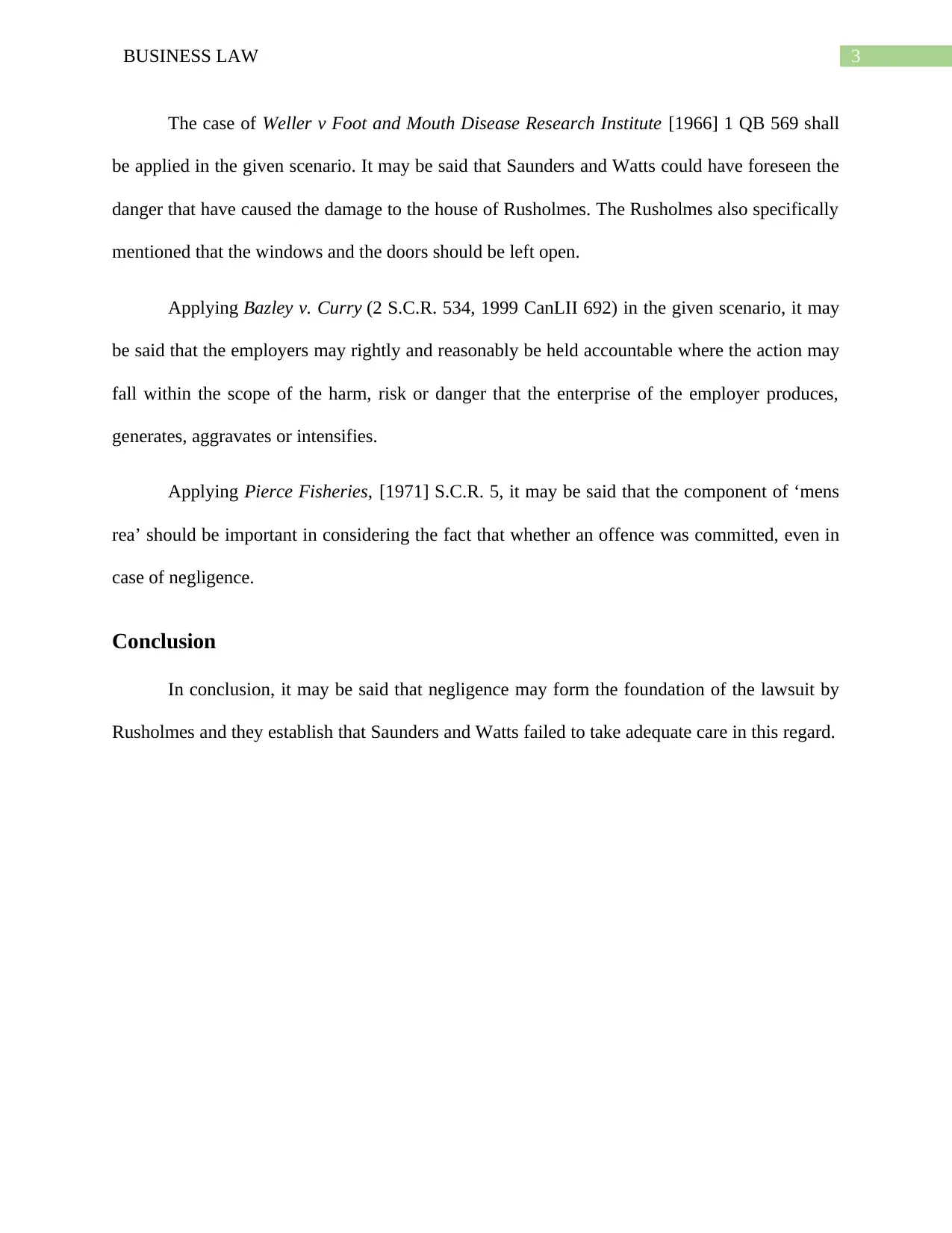
The case of Weller v Foot and Mouth Disease Research Institute [1966] 1 QB 569 shall
be applied in the given scenario. It may be said that Saunders and Watts could have foreseen the
danger that have caused the damage to the house of Rusholmes. The Rusholmes also specifically
mentioned that the windows and the doors should be left open.
Applying Bazley v. Curry (2 S.C.R. 534, 1999 CanLII 692) in the given scenario, it may
be said that the employers may rightly and reasonably be held accountable where the action may
fall within the scope of the harm, risk or danger that the enterprise of the employer produces,
generates, aggravates or intensifies.
Applying Pierce Fisheries, [1971] S.C.R. 5, it may be said that the component of ‘mens
rea’ should be important in considering the fact that whether an offence was committed, even in
case of negligence.
Conclusion
In conclusion, it may be said that negligence may form the foundation of the lawsuit by
Rusholmes and they establish that Saunders and Watts failed to take adequate care in this regard.
tabler-icon-diamond-filled.svg

Paraphrase This Document

Need a fresh take? Get an instant paraphrase of this document with our AI Paraphraser
Document Page
4BUSINESS LAW
References
Bazley v. Curry (2 S.C.R. 534, 1999 CanLII 692).
Dominion Natural Gas v Collins and Perkins [1909] AC 640.
Pierce Fisheries, [1971] S.C.R. 5.
Weller v Foot and Mouth Disease Research Institute [1966] 1 QB 569.
chevron_up_icon
1 out of 5
circle_padding
hide_on_mobile
zoom_out_icon
[object Object]