Business Law Assignment: Torts of Negligence and Its Elements
VerifiedAdded on 2021/02/19
|8
|2893
|277
Report
AI Summary
This report delves into the realm of business law, specifically examining the law of torts of negligence. It begins by defining business law and its significance in securing transactions and liabilities. The report then provides an in-depth analysis of negligence, outlining its four key elements: duty of care, breach of duty, causation, and remoteness of damages. Each element is explained with examples, including landmark cases such as Donoghue v Stevenson and Chester v Afshar. Furthermore, the report explores the importance of these principles in professional life, highlighting how they relate to skills, abilities, and the duty to care. It discusses the implications of breaching these duties, the identification of causes, and the potential for damages. The report concludes by emphasizing the role of business law in securing civil and criminal liabilities and the practical applications of negligence principles in various professional settings.
BUSINESS LAW

Paraphrase This Document
Need a fresh take? Get an instant paraphrase of this document with our AI Paraphraser
Table of Contents
INTRODUCTION...........................................................................................................................1
LAW OF TORTS ............................................................................................................................1
1) Elements of torts of negligence..............................................................................................1
2) Importance of Principles of Negligence in Professional life..................................................3
CONCLUSION................................................................................................................................4
REFERENCES................................................................................................................................5
INTRODUCTION...........................................................................................................................1
LAW OF TORTS ............................................................................................................................1
1) Elements of torts of negligence..............................................................................................1
2) Importance of Principles of Negligence in Professional life..................................................3
CONCLUSION................................................................................................................................4
REFERENCES................................................................................................................................5
INTRODUCTION
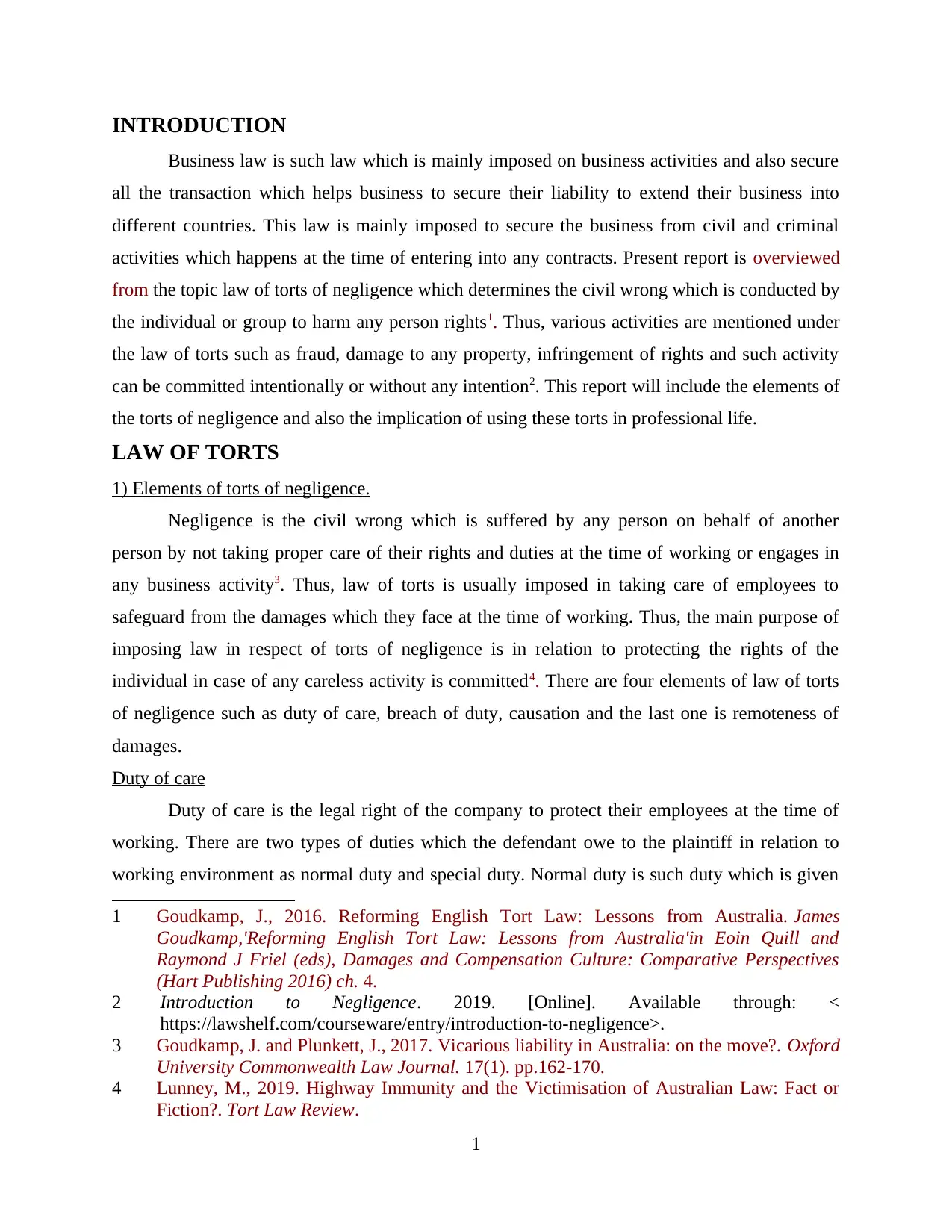
Business law is such law which is mainly imposed on business activities and also secure
all the transaction which helps business to secure their liability to extend their business into
different countries. This law is mainly imposed to secure the business from civil and criminal
activities which happens at the time of entering into any contracts. Present report is overviewed
from the topic law of torts of negligence which determines the civil wrong which is conducted by
the individual or group to harm any person rights1. Thus, various activities are mentioned under
the law of torts such as fraud, damage to any property, infringement of rights and such activity
can be committed intentionally or without any intention2. This report will include the elements of
the torts of negligence and also the implication of using these torts in professional life.
LAW OF TORTS
1) Elements of torts of negligence.
Negligence is the civil wrong which is suffered by any person on behalf of another
person by not taking proper care of their rights and duties at the time of working or engages in
any business activity3. Thus, law of torts is usually imposed in taking care of employees to
safeguard from the damages which they face at the time of working. Thus, the main purpose of
imposing law in respect of torts of negligence is in relation to protecting the rights of the
individual in case of any careless activity is committed4. There are four elements of law of torts
of negligence such as duty of care, breach of duty, causation and the last one is remoteness of
damages.
Duty of care
Duty of care is the legal right of the company to protect their employees at the time of
working. There are two types of duties which the defendant owe to the plaintiff in relation to
working environment as normal duty and special duty. Normal duty is such duty which is given
1 Goudkamp, J., 2016. Reforming English Tort Law: Lessons from Australia. James
Goudkamp,'Reforming English Tort Law: Lessons from Australia'in Eoin Quill and
Raymond J Friel (eds), Damages and Compensation Culture: Comparative Perspectives
(Hart Publishing 2016) ch. 4.
2 Introduction to Negligence. 2019. [Online]. Available through: <
https://lawshelf.com/courseware/entry/introduction-to-negligence>.
3 Goudkamp, J. and Plunkett, J., 2017. Vicarious liability in Australia: on the move?. Oxford
University Commonwealth Law Journal. 17(1). pp.162-170.
4 Lunney, M., 2019. Highway Immunity and the Victimisation of Australian Law: Fact or
Fiction?. Tort Law Review.
1
Business law is such law which is mainly imposed on business activities and also secure
all the transaction which helps business to secure their liability to extend their business into
different countries. This law is mainly imposed to secure the business from civil and criminal
activities which happens at the time of entering into any contracts. Present report is overviewed
from the topic law of torts of negligence which determines the civil wrong which is conducted by
the individual or group to harm any person rights1. Thus, various activities are mentioned under
the law of torts such as fraud, damage to any property, infringement of rights and such activity
can be committed intentionally or without any intention2. This report will include the elements of
the torts of negligence and also the implication of using these torts in professional life.
LAW OF TORTS
1) Elements of torts of negligence.
Negligence is the civil wrong which is suffered by any person on behalf of another
person by not taking proper care of their rights and duties at the time of working or engages in
any business activity3. Thus, law of torts is usually imposed in taking care of employees to
safeguard from the damages which they face at the time of working. Thus, the main purpose of
imposing law in respect of torts of negligence is in relation to protecting the rights of the
individual in case of any careless activity is committed4. There are four elements of law of torts
of negligence such as duty of care, breach of duty, causation and the last one is remoteness of
damages.
Duty of care
Duty of care is the legal right of the company to protect their employees at the time of
working. There are two types of duties which the defendant owe to the plaintiff in relation to
working environment as normal duty and special duty. Normal duty is such duty which is given
1 Goudkamp, J., 2016. Reforming English Tort Law: Lessons from Australia. James
Goudkamp,'Reforming English Tort Law: Lessons from Australia'in Eoin Quill and
Raymond J Friel (eds), Damages and Compensation Culture: Comparative Perspectives
(Hart Publishing 2016) ch. 4.
2 Introduction to Negligence. 2019. [Online]. Available through: <
https://lawshelf.com/courseware/entry/introduction-to-negligence>.
3 Goudkamp, J. and Plunkett, J., 2017. Vicarious liability in Australia: on the move?. Oxford
University Commonwealth Law Journal. 17(1). pp.162-170.
4 Lunney, M., 2019. Highway Immunity and the Victimisation of Australian Law: Fact or
Fiction?. Tort Law Review.
1
⊘ This is a preview!⊘
Do you want full access?
Subscribe today to unlock all pages.

Trusted by 1+ million students worldwide
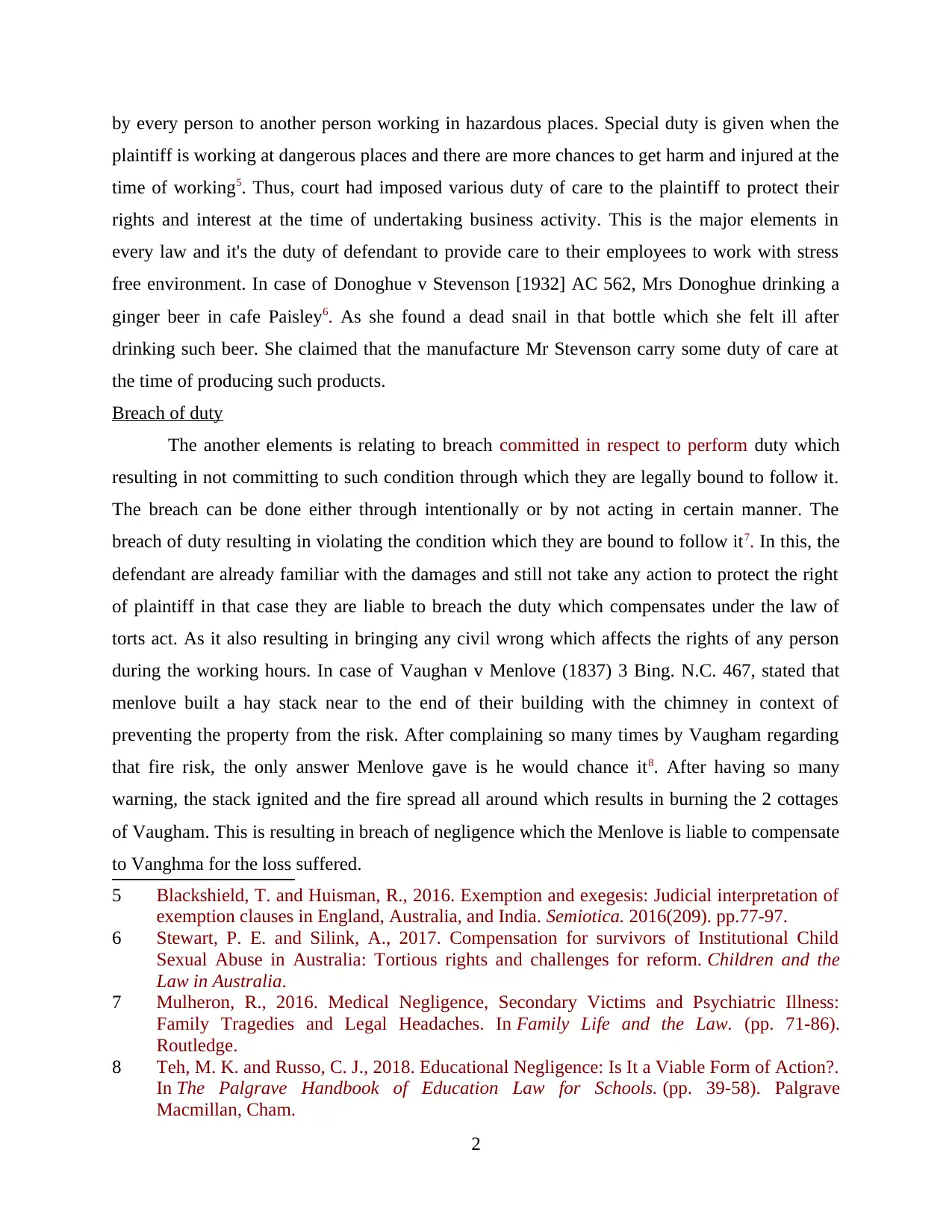
by every person to another person working in hazardous places. Special duty is given when the
plaintiff is working at dangerous places and there are more chances to get harm and injured at the
time of working5. Thus, court had imposed various duty of care to the plaintiff to protect their
rights and interest at the time of undertaking business activity. This is the major elements in
every law and it's the duty of defendant to provide care to their employees to work with stress
free environment. In case of Donoghue v Stevenson [1932] AC 562, Mrs Donoghue drinking a
ginger beer in cafe Paisley6. As she found a dead snail in that bottle which she felt ill after
drinking such beer. She claimed that the manufacture Mr Stevenson carry some duty of care at
the time of producing such products.
Breach of duty
The another elements is relating to breach committed in respect to perform duty which
resulting in not committing to such condition through which they are legally bound to follow it.
The breach can be done either through intentionally or by not acting in certain manner. The
breach of duty resulting in violating the condition which they are bound to follow it7. In this, the
defendant are already familiar with the damages and still not take any action to protect the right
of plaintiff in that case they are liable to breach the duty which compensates under the law of
torts act. As it also resulting in bringing any civil wrong which affects the rights of any person
during the working hours. In case of Vaughan v Menlove (1837) 3 Bing. N.C. 467, stated that
menlove built a hay stack near to the end of their building with the chimney in context of
preventing the property from the risk. After complaining so many times by Vaugham regarding
that fire risk, the only answer Menlove gave is he would chance it8. After having so many
warning, the stack ignited and the fire spread all around which results in burning the 2 cottages
of Vaugham. This is resulting in breach of negligence which the Menlove is liable to compensate
to Vanghma for the loss suffered.
5 Blackshield, T. and Huisman, R., 2016. Exemption and exegesis: Judicial interpretation of
exemption clauses in England, Australia, and India. Semiotica. 2016(209). pp.77-97.
6 Stewart, P. E. and Silink, A., 2017. Compensation for survivors of Institutional Child
Sexual Abuse in Australia: Tortious rights and challenges for reform. Children and the
Law in Australia.
7 Mulheron, R., 2016. Medical Negligence, Secondary Victims and Psychiatric Illness:
Family Tragedies and Legal Headaches. In Family Life and the Law. (pp. 71-86).
Routledge.
8 Teh, M. K. and Russo, C. J., 2018. Educational Negligence: Is It a Viable Form of Action?.
In The Palgrave Handbook of Education Law for Schools. (pp. 39-58). Palgrave
Macmillan, Cham.
2
plaintiff is working at dangerous places and there are more chances to get harm and injured at the
time of working5. Thus, court had imposed various duty of care to the plaintiff to protect their
rights and interest at the time of undertaking business activity. This is the major elements in
every law and it's the duty of defendant to provide care to their employees to work with stress
free environment. In case of Donoghue v Stevenson [1932] AC 562, Mrs Donoghue drinking a
ginger beer in cafe Paisley6. As she found a dead snail in that bottle which she felt ill after
drinking such beer. She claimed that the manufacture Mr Stevenson carry some duty of care at
the time of producing such products.
Breach of duty
The another elements is relating to breach committed in respect to perform duty which
resulting in not committing to such condition through which they are legally bound to follow it.
The breach can be done either through intentionally or by not acting in certain manner. The
breach of duty resulting in violating the condition which they are bound to follow it7. In this, the
defendant are already familiar with the damages and still not take any action to protect the right
of plaintiff in that case they are liable to breach the duty which compensates under the law of
torts act. As it also resulting in bringing any civil wrong which affects the rights of any person
during the working hours. In case of Vaughan v Menlove (1837) 3 Bing. N.C. 467, stated that
menlove built a hay stack near to the end of their building with the chimney in context of
preventing the property from the risk. After complaining so many times by Vaugham regarding
that fire risk, the only answer Menlove gave is he would chance it8. After having so many
warning, the stack ignited and the fire spread all around which results in burning the 2 cottages
of Vaugham. This is resulting in breach of negligence which the Menlove is liable to compensate
to Vanghma for the loss suffered.
5 Blackshield, T. and Huisman, R., 2016. Exemption and exegesis: Judicial interpretation of
exemption clauses in England, Australia, and India. Semiotica. 2016(209). pp.77-97.
6 Stewart, P. E. and Silink, A., 2017. Compensation for survivors of Institutional Child
Sexual Abuse in Australia: Tortious rights and challenges for reform. Children and the
Law in Australia.
7 Mulheron, R., 2016. Medical Negligence, Secondary Victims and Psychiatric Illness:
Family Tragedies and Legal Headaches. In Family Life and the Law. (pp. 71-86).
Routledge.
8 Teh, M. K. and Russo, C. J., 2018. Educational Negligence: Is It a Viable Form of Action?.
In The Palgrave Handbook of Education Law for Schools. (pp. 39-58). Palgrave
Macmillan, Cham.
2
Paraphrase This Document
Need a fresh take? Get an instant paraphrase of this document with our AI Paraphraser
Causation
The next elements is resulting to causation which means cause or reason of the breach
conducted. This is examined either the breach is conducted intentionally or without any
intention9. Mainly it results in bringing the civil wrong and the defendant is liable to be penalised
for such loss incurred. Thus, it resulting in examining the defendant action which resulting in
facing injury to the plaintiff for the activity undertaken. It determined the reason behind which
the injury is undertaken and the breach is conducted10. In case of Chester v Afshar[2004] 3 WLR
927 this case stated that Mrs. Chester approaches to Dr. Afshar a neurologist expert for her sever
back pain which she is suffering from years. Dr. suggested that she had to undergo a surgery and
also didn't tell the side effects of the operation as there is a risk of 1-2%. After having surgery
she suffered from cauda equina syndrome. In this the judge raise queries that Dr. had to told all
the consequence which is to be faced by Chester after having operation11. As if she knew the
negative aspects of the surgery, factors she can refer to another doctors regarding that diseases.
Damages or harm
The last elements is relating to remoteness of damages or harm which is caused by any
person regarding to breach of any duty. Thus, such harm or damages can be removed, or remote
from the wrongdoing which is not legally bound on plaintiff12. It is mainly relevant the claims
which is provided under the Occupiers Liability Acts and Nuisance claims as not every damages
are to be remote under this act. In case of Doughty v Turner Manufacturing Company [1964] 1
QB 518 stated that the factors worker is lighting a lid at the time of working and coincidently the
liquid raise from the lid which resulting in causing fire. It thus can be controlled by recovering
the damages for the losses suffered.
2) Importance of Principles of Negligences in Professional life
The professional life is related to the abilities and skill of the individual at the
professional level. It can be related to holding the company financial information and or any
9 Owen, J., 2018. Tearing Up the Patchwork Quilt: An Examination of How, Why and When
Liability for Psychiatric Injury in the Tort of Negligence.
10 Burns, K., 2018. ‘In this Day and Age’: Social Facts, Common Sense and Cognition in
Tort Law Judging in the United Kingdom. Journal of Law and Society. 45(2). pp.226-253.
11 Lamont, S., Stewart, C. and Chiarella, M., 2016. Decision-making capacity and its
relationship to a legally valid consent: ethical, legal and professional context. J Law
Med. 24. pp.371-386.
12 Peel, J., Osofsky, H. and Foerster, A., 2017. Shaping the Next Generation of Climate
Change Litigation in Australia. Melb. UL Rev. 41. p.793.
3
The next elements is resulting to causation which means cause or reason of the breach
conducted. This is examined either the breach is conducted intentionally or without any
intention9. Mainly it results in bringing the civil wrong and the defendant is liable to be penalised
for such loss incurred. Thus, it resulting in examining the defendant action which resulting in
facing injury to the plaintiff for the activity undertaken. It determined the reason behind which
the injury is undertaken and the breach is conducted10. In case of Chester v Afshar[2004] 3 WLR
927 this case stated that Mrs. Chester approaches to Dr. Afshar a neurologist expert for her sever
back pain which she is suffering from years. Dr. suggested that she had to undergo a surgery and
also didn't tell the side effects of the operation as there is a risk of 1-2%. After having surgery
she suffered from cauda equina syndrome. In this the judge raise queries that Dr. had to told all
the consequence which is to be faced by Chester after having operation11. As if she knew the
negative aspects of the surgery, factors she can refer to another doctors regarding that diseases.
Damages or harm
The last elements is relating to remoteness of damages or harm which is caused by any
person regarding to breach of any duty. Thus, such harm or damages can be removed, or remote
from the wrongdoing which is not legally bound on plaintiff12. It is mainly relevant the claims
which is provided under the Occupiers Liability Acts and Nuisance claims as not every damages
are to be remote under this act. In case of Doughty v Turner Manufacturing Company [1964] 1
QB 518 stated that the factors worker is lighting a lid at the time of working and coincidently the
liquid raise from the lid which resulting in causing fire. It thus can be controlled by recovering
the damages for the losses suffered.
2) Importance of Principles of Negligences in Professional life
The professional life is related to the abilities and skill of the individual at the
professional level. It can be related to holding the company financial information and or any
9 Owen, J., 2018. Tearing Up the Patchwork Quilt: An Examination of How, Why and When
Liability for Psychiatric Injury in the Tort of Negligence.
10 Burns, K., 2018. ‘In this Day and Age’: Social Facts, Common Sense and Cognition in
Tort Law Judging in the United Kingdom. Journal of Law and Society. 45(2). pp.226-253.
11 Lamont, S., Stewart, C. and Chiarella, M., 2016. Decision-making capacity and its
relationship to a legally valid consent: ethical, legal and professional context. J Law
Med. 24. pp.371-386.
12 Peel, J., Osofsky, H. and Foerster, A., 2017. Shaping the Next Generation of Climate
Change Litigation in Australia. Melb. UL Rev. 41. p.793.
3
other information which due to any negligences harm the company working at large scale13.
Thus, in respect of principles of torts of negligences, the first aspects are relating to the duty of
care which resulting in taking care of their skills, abilities and capabilities to avail such activity
in useful way. The care should be maintained in context of taking care of their capability
regarding their work allotted14. In case of person who are appointed as a post of accountant had
to taken proper care regarding maintaining the accounts and making entries which are true. Thus,
the first elements are to be appointed regarding the duty to care. The company had to carry
certain duty regarding providing the accurate details of the activity of the company.
The another importances are resulting to bringing the breach of duty. This is important in
profession life. As the individual whole liability and trust are depends on their working and if
they commit and breach in the transaction of the company regarding performing their skills and
ability in better way15. It resulting in facing many issues which is civil wrong and also liable to
be compensated for the losses incurred. Thus, by this breach of duty it helps the individual to
work within the norms and verify all the activity which they came across at the time of working
and which resulting in affecting their contract.
By identifying the causes or reason behind the breach of duty it helps in improving the
professional level of the individual and also providing chances to improve their mistakes. As law
of torts are the civil wrong which can be punished either through penalty or imprisonment which
is not more than 3 years16. Thus, this principle is useful in identifying the issue through which the
breach is committed. Thus, by committing the breach and identifying the reason behind such
breach, the damages are to be faced by the individual regarding the losses incurred. The
damagers can also to be recovered if they are to be claimed with less amount or the plaintiff
agree not to take any compensation for the losses incurred17. This is helpful in saving the life of
individual in professional scale.
13 Martin, K., 2016. Topical matters pertaining to the tort of negligence-the attribution of
blame. Brief. 43(7). p.38.
14 Fulbrook, J., 2017. Outdoor activities, negligence and the law. Routledge.
15 Davies, P. S., 2017. Interpretation and Rectification in Australia. The Cambridge Law
Journal. 76(3). pp.483-486.
16 Wiseman, L., Cockburn, T. and Sanderson, J., 2018. Legal consequences of autonomous
farming. Farm Policy Journal. 15(2). pp.37-46.
17 Carter, D. J., 2017. Responsibility for iatrogenic death in Australian criminal
law (Doctoral dissertation).
4
Thus, in respect of principles of torts of negligences, the first aspects are relating to the duty of
care which resulting in taking care of their skills, abilities and capabilities to avail such activity
in useful way. The care should be maintained in context of taking care of their capability
regarding their work allotted14. In case of person who are appointed as a post of accountant had
to taken proper care regarding maintaining the accounts and making entries which are true. Thus,
the first elements are to be appointed regarding the duty to care. The company had to carry
certain duty regarding providing the accurate details of the activity of the company.
The another importances are resulting to bringing the breach of duty. This is important in
profession life. As the individual whole liability and trust are depends on their working and if
they commit and breach in the transaction of the company regarding performing their skills and
ability in better way15. It resulting in facing many issues which is civil wrong and also liable to
be compensated for the losses incurred. Thus, by this breach of duty it helps the individual to
work within the norms and verify all the activity which they came across at the time of working
and which resulting in affecting their contract.
By identifying the causes or reason behind the breach of duty it helps in improving the
professional level of the individual and also providing chances to improve their mistakes. As law
of torts are the civil wrong which can be punished either through penalty or imprisonment which
is not more than 3 years16. Thus, this principle is useful in identifying the issue through which the
breach is committed. Thus, by committing the breach and identifying the reason behind such
breach, the damages are to be faced by the individual regarding the losses incurred. The
damagers can also to be recovered if they are to be claimed with less amount or the plaintiff
agree not to take any compensation for the losses incurred17. This is helpful in saving the life of
individual in professional scale.
13 Martin, K., 2016. Topical matters pertaining to the tort of negligence-the attribution of
blame. Brief. 43(7). p.38.
14 Fulbrook, J., 2017. Outdoor activities, negligence and the law. Routledge.
15 Davies, P. S., 2017. Interpretation and Rectification in Australia. The Cambridge Law
Journal. 76(3). pp.483-486.
16 Wiseman, L., Cockburn, T. and Sanderson, J., 2018. Legal consequences of autonomous
farming. Farm Policy Journal. 15(2). pp.37-46.
17 Carter, D. J., 2017. Responsibility for iatrogenic death in Australian criminal
law (Doctoral dissertation).
4
⊘ This is a preview!⊘
Do you want full access?
Subscribe today to unlock all pages.
Trusted by 1+ million students worldwide
CONCLUSION
In respective of above study it can be examined that business law helps companies to take
initiative action so to secure their civil and criminal liabilities of the individual. Law of torts are
usually imposed in respect of protecting the rights and also providing compensation to the loss
incurred. In this Act, various elements are to be incurred regarding the law of torts of
negligences. As law of torts are resulting to civil wrong and negligence reflect the act or things to
be committed intentionally or not. Thus, from the above discussion it reflects that law of torts of
negligence is useful in professional life and also the duty of care and breach of such duty reflect
the entire organisation working.
5
In respective of above study it can be examined that business law helps companies to take
initiative action so to secure their civil and criminal liabilities of the individual. Law of torts are
usually imposed in respect of protecting the rights and also providing compensation to the loss
incurred. In this Act, various elements are to be incurred regarding the law of torts of
negligences. As law of torts are resulting to civil wrong and negligence reflect the act or things to
be committed intentionally or not. Thus, from the above discussion it reflects that law of torts of
negligence is useful in professional life and also the duty of care and breach of such duty reflect
the entire organisation working.
5
Paraphrase This Document
Need a fresh take? Get an instant paraphrase of this document with our AI Paraphraser
REFERENCES
Books and Journals
Blackshield, T. and Huisman, R., 2016. Exemption and exegesis: Judicial interpretation of
exemption clauses in England, Australia, and India. Semiotica. 2016(209). pp.77-97.
Burns, K., 2018. ‘In this Day and Age’: Social Facts, Common Sense and Cognition in Tort Law
Judging in the United Kingdom. Journal of Law and Society. 45(2). pp.226-253.
Carter, D. J., 2017. Responsibility for iatrogenic death in Australian criminal law (Doctoral
dissertation).
Davies, P. S., 2017. Interpretation and Rectification in Australia. The Cambridge Law
Journal. 76(3). pp.483-486.
Fulbrook, J., 2017. Outdoor activities, negligence and the law. Routledge.
Goudkamp, J. and Plunkett, J., 2017. Vicarious liability in Australia: on the move?. Oxford
University Commonwealth Law Journal. 17(1). pp.162-170.
Goudkamp, J., 2016. Reforming English Tort Law: Lessons from Australia. James
Goudkamp,'Reforming English Tort Law: Lessons from Australia'in Eoin Quill and
Raymond J Friel (eds), Damages and Compensation Culture: Comparative Perspectives
(Hart Publishing 2016) ch. 4.
Lamont, S., Stewart, C. and Chiarella, M., 2016. Decision-making capacity and its relationship
to a legally valid consent: ethical, legal and professional context. J Law Med. 24. pp.371-
386.
Lunney, M., 2019. Highway Immunity and the Victimisation of Australian Law: Fact or
Fiction?. Tort Law Review.
Martin, K., 2016. Topical matters pertaining to the tort of negligence-the attribution of
blame. Brief. 43(7). p.38.
Mulheron, R., 2016. Medical Negligence, Secondary Victims and Psychiatric Illness: Family
Tragedies and Legal Headaches. In Family Life and the Law. (pp. 71-86). Routledge.
Owen, J., 2018. Tearing Up the Patchwork Quilt: An Examination of How, Why and When
Liability for Psychiatric Injury in the Tort of Negligence.
Peel, J., Osofsky, H. and Foerster, A., 2017. Shaping the Next Generation of Climate Change
Litigation in Australia. Melb. UL Rev. 41. p.793.
Stewart, P. E. and Silink, A., 2017. Compensation for survivors of Institutional Child Sexual
Abuse in Australia: Tortious rights and challenges for reform. Children and the Law in
Australia.
Teh, M. K. and Russo, C. J., 2018. Educational Negligence: Is It a Viable Form of Action?.
In The Palgrave Handbook of Education Law for Schools. (pp. 39-58). Palgrave
Macmillan, Cham.
Wiseman, L., Cockburn, T. and Sanderson, J., 2018. Legal consequences of autonomous
farming. Farm Policy Journal. 15(2). pp.37-46.
Online
Introduction to Negligence. 2019. [Online]. Available through: <
https://lawshelf.com/courseware/entry/introduction-to-negligence>.
6
Books and Journals
Blackshield, T. and Huisman, R., 2016. Exemption and exegesis: Judicial interpretation of
exemption clauses in England, Australia, and India. Semiotica. 2016(209). pp.77-97.
Burns, K., 2018. ‘In this Day and Age’: Social Facts, Common Sense and Cognition in Tort Law
Judging in the United Kingdom. Journal of Law and Society. 45(2). pp.226-253.
Carter, D. J., 2017. Responsibility for iatrogenic death in Australian criminal law (Doctoral
dissertation).
Davies, P. S., 2017. Interpretation and Rectification in Australia. The Cambridge Law
Journal. 76(3). pp.483-486.
Fulbrook, J., 2017. Outdoor activities, negligence and the law. Routledge.
Goudkamp, J. and Plunkett, J., 2017. Vicarious liability in Australia: on the move?. Oxford
University Commonwealth Law Journal. 17(1). pp.162-170.
Goudkamp, J., 2016. Reforming English Tort Law: Lessons from Australia. James
Goudkamp,'Reforming English Tort Law: Lessons from Australia'in Eoin Quill and
Raymond J Friel (eds), Damages and Compensation Culture: Comparative Perspectives
(Hart Publishing 2016) ch. 4.
Lamont, S., Stewart, C. and Chiarella, M., 2016. Decision-making capacity and its relationship
to a legally valid consent: ethical, legal and professional context. J Law Med. 24. pp.371-
386.
Lunney, M., 2019. Highway Immunity and the Victimisation of Australian Law: Fact or
Fiction?. Tort Law Review.
Martin, K., 2016. Topical matters pertaining to the tort of negligence-the attribution of
blame. Brief. 43(7). p.38.
Mulheron, R., 2016. Medical Negligence, Secondary Victims and Psychiatric Illness: Family
Tragedies and Legal Headaches. In Family Life and the Law. (pp. 71-86). Routledge.
Owen, J., 2018. Tearing Up the Patchwork Quilt: An Examination of How, Why and When
Liability for Psychiatric Injury in the Tort of Negligence.
Peel, J., Osofsky, H. and Foerster, A., 2017. Shaping the Next Generation of Climate Change
Litigation in Australia. Melb. UL Rev. 41. p.793.
Stewart, P. E. and Silink, A., 2017. Compensation for survivors of Institutional Child Sexual
Abuse in Australia: Tortious rights and challenges for reform. Children and the Law in
Australia.
Teh, M. K. and Russo, C. J., 2018. Educational Negligence: Is It a Viable Form of Action?.
In The Palgrave Handbook of Education Law for Schools. (pp. 39-58). Palgrave
Macmillan, Cham.
Wiseman, L., Cockburn, T. and Sanderson, J., 2018. Legal consequences of autonomous
farming. Farm Policy Journal. 15(2). pp.37-46.
Online
Introduction to Negligence. 2019. [Online]. Available through: <
https://lawshelf.com/courseware/entry/introduction-to-negligence>.
6

1 out of 8


Related Documents


Your All-in-One AI-Powered Toolkit for Academic Success.
+13062052269
info@desklib.com
Available 24*7 on WhatsApp / Email
![[object Object]](/_next/static/media/star-bottom.7253800d.svg)
Unlock your academic potential
Copyright © 2020–2026 A2Z Services. All Rights Reserved. Developed and managed by ZUCOL.