Exploring Business Organizations and Shareholder Remedies: Law Essay
VerifiedAdded on 2023/06/18
|14
|3732
|317
Essay
AI Summary
This essay on Law for Business Managers examines various aspects of business law, including different types of business organizations such as sole proprietorships, partnerships, and private and public organizations, highlighting their advantages and disadvantages. It further delves into contract law, specifically focusing on the concept of 'invitation to treat' versus an 'offer to sell,' using relevant case laws like Pharmaceutical Society of Great Britain v Boots and Fisher v Bell to illustrate the distinction. Finally, the essay explores the legal remedies available to shareholders against company directors, providing a comprehensive overview of key legal considerations for business managers. Desklib offers more solved assignments and study resources for students.
LAW FOR BUSINESS
MANAGER
MANAGER

Paraphrase This Document
Need a fresh take? Get an instant paraphrase of this document with our AI Paraphraser
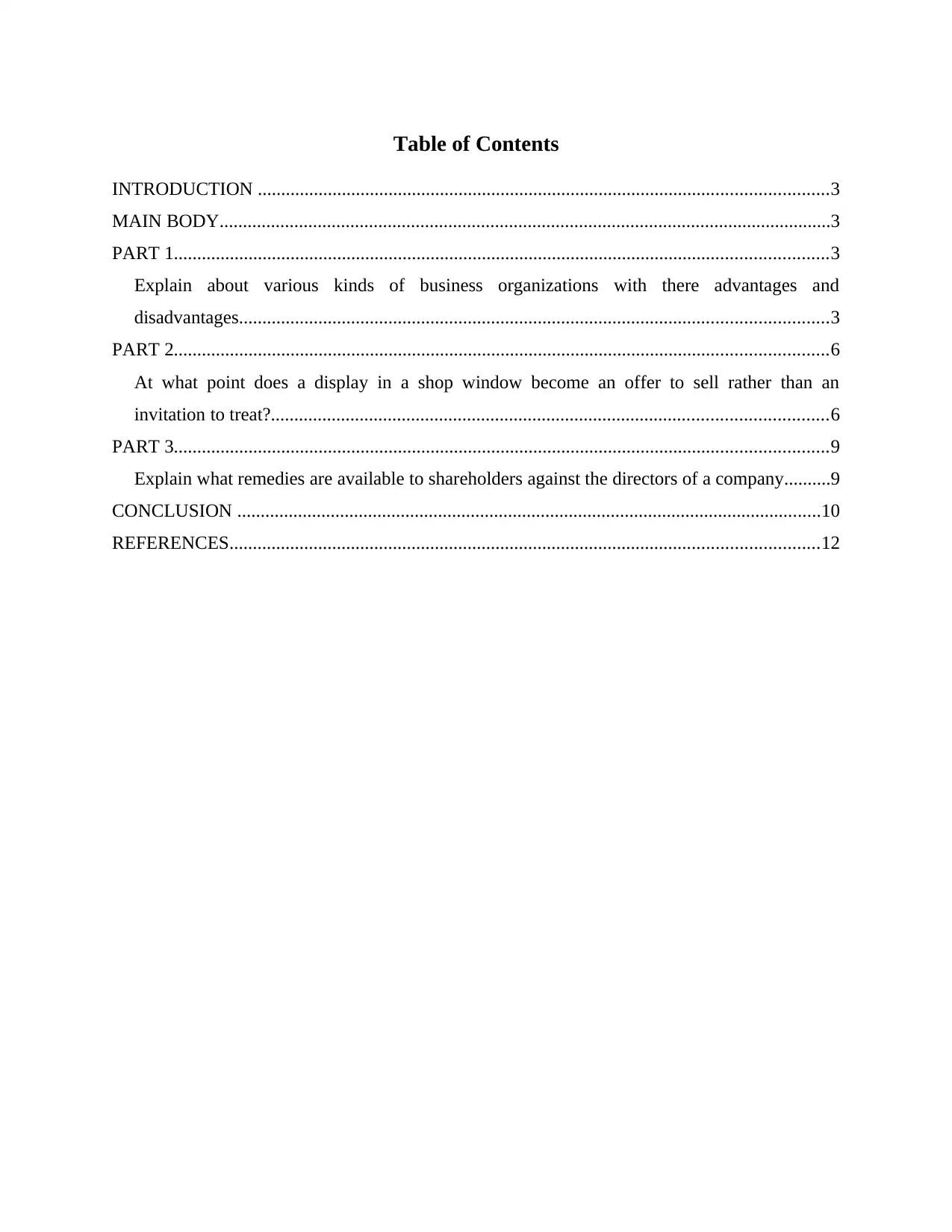
Table of Contents
INTRODUCTION ..........................................................................................................................3
MAIN BODY...................................................................................................................................3
PART 1............................................................................................................................................3
Explain about various kinds of business organizations with there advantages and
disadvantages..............................................................................................................................3
PART 2............................................................................................................................................6
At what point does a display in a shop window become an offer to sell rather than an
invitation to treat?.......................................................................................................................6
PART 3............................................................................................................................................9
Explain what remedies are available to shareholders against the directors of a company..........9
CONCLUSION .............................................................................................................................10
REFERENCES..............................................................................................................................12
INTRODUCTION ..........................................................................................................................3
MAIN BODY...................................................................................................................................3
PART 1............................................................................................................................................3
Explain about various kinds of business organizations with there advantages and
disadvantages..............................................................................................................................3
PART 2............................................................................................................................................6
At what point does a display in a shop window become an offer to sell rather than an
invitation to treat?.......................................................................................................................6
PART 3............................................................................................................................................9
Explain what remedies are available to shareholders against the directors of a company..........9
CONCLUSION .............................................................................................................................10
REFERENCES..............................................................................................................................12
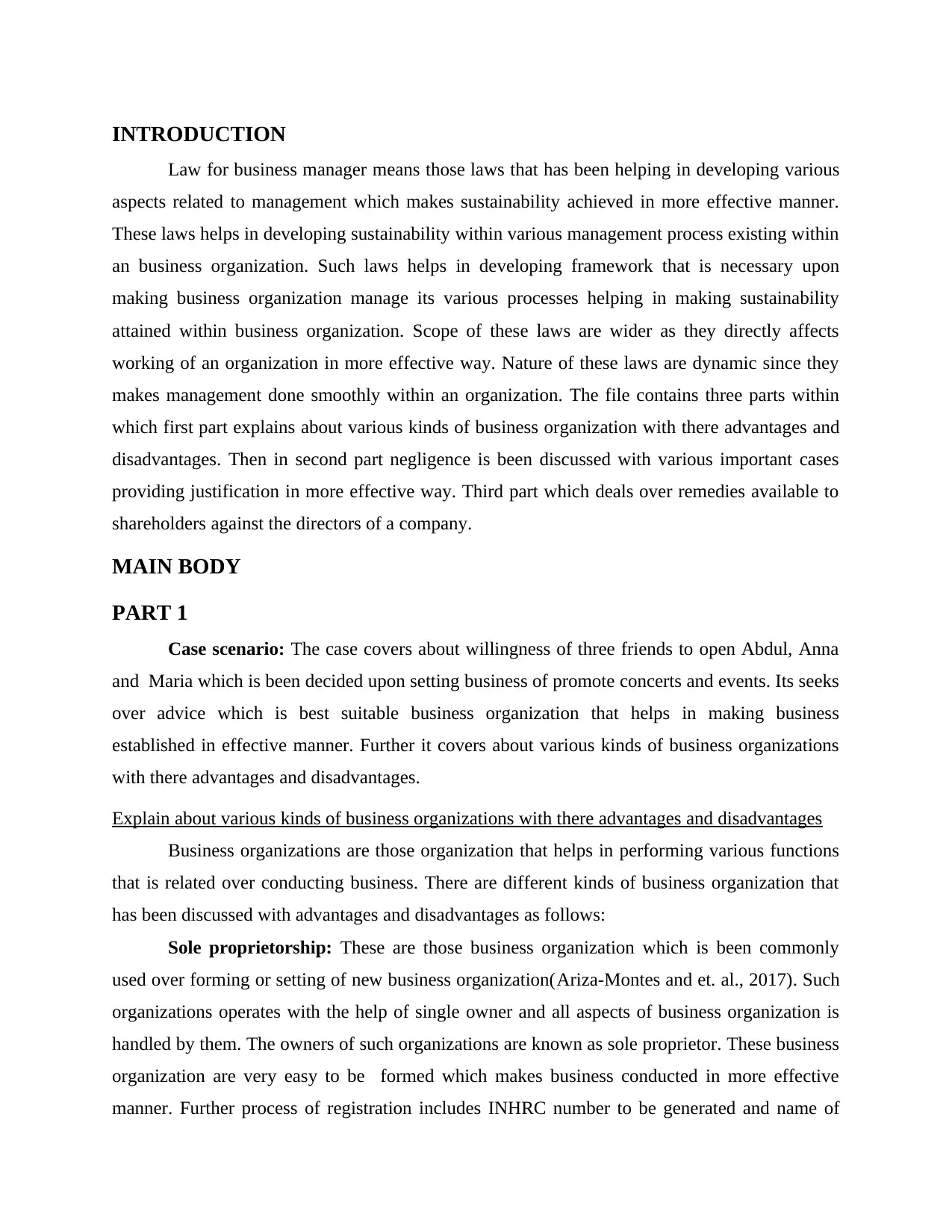
INTRODUCTION
Law for business manager means those laws that has been helping in developing various
aspects related to management which makes sustainability achieved in more effective manner.
These laws helps in developing sustainability within various management process existing within
an business organization. Such laws helps in developing framework that is necessary upon
making business organization manage its various processes helping in making sustainability
attained within business organization. Scope of these laws are wider as they directly affects
working of an organization in more effective way. Nature of these laws are dynamic since they
makes management done smoothly within an organization. The file contains three parts within
which first part explains about various kinds of business organization with there advantages and
disadvantages. Then in second part negligence is been discussed with various important cases
providing justification in more effective way. Third part which deals over remedies available to
shareholders against the directors of a company.
MAIN BODY
PART 1
Case scenario: The case covers about willingness of three friends to open Abdul, Anna
and Maria which is been decided upon setting business of promote concerts and events. Its seeks
over advice which is best suitable business organization that helps in making business
established in effective manner. Further it covers about various kinds of business organizations
with there advantages and disadvantages.
Explain about various kinds of business organizations with there advantages and disadvantages
Business organizations are those organization that helps in performing various functions
that is related over conducting business. There are different kinds of business organization that
has been discussed with advantages and disadvantages as follows:
Sole proprietorship: These are those business organization which is been commonly
used over forming or setting of new business organization(Ariza-Montes and et. al., 2017). Such
organizations operates with the help of single owner and all aspects of business organization is
handled by them. The owners of such organizations are known as sole proprietor. These business
organization are very easy to be formed which makes business conducted in more effective
manner. Further process of registration includes INHRC number to be generated and name of
Law for business manager means those laws that has been helping in developing various
aspects related to management which makes sustainability achieved in more effective manner.
These laws helps in developing sustainability within various management process existing within
an business organization. Such laws helps in developing framework that is necessary upon
making business organization manage its various processes helping in making sustainability
attained within business organization. Scope of these laws are wider as they directly affects
working of an organization in more effective way. Nature of these laws are dynamic since they
makes management done smoothly within an organization. The file contains three parts within
which first part explains about various kinds of business organization with there advantages and
disadvantages. Then in second part negligence is been discussed with various important cases
providing justification in more effective way. Third part which deals over remedies available to
shareholders against the directors of a company.
MAIN BODY
PART 1
Case scenario: The case covers about willingness of three friends to open Abdul, Anna
and Maria which is been decided upon setting business of promote concerts and events. Its seeks
over advice which is best suitable business organization that helps in making business
established in effective manner. Further it covers about various kinds of business organizations
with there advantages and disadvantages.
Explain about various kinds of business organizations with there advantages and disadvantages
Business organizations are those organization that helps in performing various functions
that is related over conducting business. There are different kinds of business organization that
has been discussed with advantages and disadvantages as follows:
Sole proprietorship: These are those business organization which is been commonly
used over forming or setting of new business organization(Ariza-Montes and et. al., 2017). Such
organizations operates with the help of single owner and all aspects of business organization is
handled by them. The owners of such organizations are known as sole proprietor. These business
organization are very easy to be formed which makes business conducted in more effective
manner. Further process of registration includes INHRC number to be generated and name of
⊘ This is a preview!⊘
Do you want full access?
Subscribe today to unlock all pages.

Trusted by 1+ million students worldwide
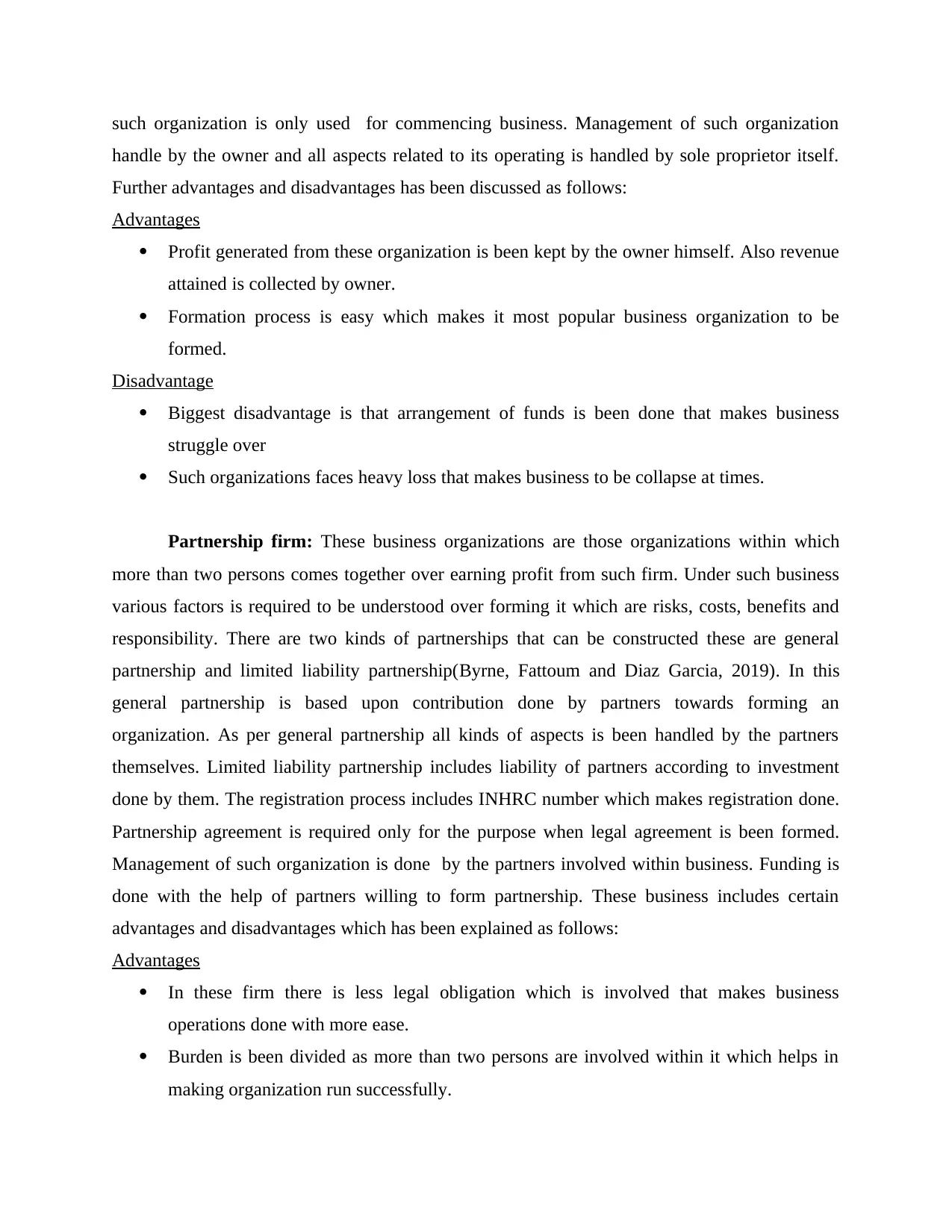
such organization is only used for commencing business. Management of such organization
handle by the owner and all aspects related to its operating is handled by sole proprietor itself.
Further advantages and disadvantages has been discussed as follows:
Advantages
Profit generated from these organization is been kept by the owner himself. Also revenue
attained is collected by owner.
Formation process is easy which makes it most popular business organization to be
formed.
Disadvantage
Biggest disadvantage is that arrangement of funds is been done that makes business
struggle over
Such organizations faces heavy loss that makes business to be collapse at times.
Partnership firm: These business organizations are those organizations within which
more than two persons comes together over earning profit from such firm. Under such business
various factors is required to be understood over forming it which are risks, costs, benefits and
responsibility. There are two kinds of partnerships that can be constructed these are general
partnership and limited liability partnership(Byrne, Fattoum and Diaz Garcia, 2019). In this
general partnership is based upon contribution done by partners towards forming an
organization. As per general partnership all kinds of aspects is been handled by the partners
themselves. Limited liability partnership includes liability of partners according to investment
done by them. The registration process includes INHRC number which makes registration done.
Partnership agreement is required only for the purpose when legal agreement is been formed.
Management of such organization is done by the partners involved within business. Funding is
done with the help of partners willing to form partnership. These business includes certain
advantages and disadvantages which has been explained as follows:
Advantages
In these firm there is less legal obligation which is involved that makes business
operations done with more ease.
Burden is been divided as more than two persons are involved within it which helps in
making organization run successfully.
handle by the owner and all aspects related to its operating is handled by sole proprietor itself.
Further advantages and disadvantages has been discussed as follows:
Advantages
Profit generated from these organization is been kept by the owner himself. Also revenue
attained is collected by owner.
Formation process is easy which makes it most popular business organization to be
formed.
Disadvantage
Biggest disadvantage is that arrangement of funds is been done that makes business
struggle over
Such organizations faces heavy loss that makes business to be collapse at times.
Partnership firm: These business organizations are those organizations within which
more than two persons comes together over earning profit from such firm. Under such business
various factors is required to be understood over forming it which are risks, costs, benefits and
responsibility. There are two kinds of partnerships that can be constructed these are general
partnership and limited liability partnership(Byrne, Fattoum and Diaz Garcia, 2019). In this
general partnership is based upon contribution done by partners towards forming an
organization. As per general partnership all kinds of aspects is been handled by the partners
themselves. Limited liability partnership includes liability of partners according to investment
done by them. The registration process includes INHRC number which makes registration done.
Partnership agreement is required only for the purpose when legal agreement is been formed.
Management of such organization is done by the partners involved within business. Funding is
done with the help of partners willing to form partnership. These business includes certain
advantages and disadvantages which has been explained as follows:
Advantages
In these firm there is less legal obligation which is involved that makes business
operations done with more ease.
Burden is been divided as more than two persons are involved within it which helps in
making organization run successfully.
Paraphrase This Document
Need a fresh take? Get an instant paraphrase of this document with our AI Paraphraser
Disadvantage
Such organization is not having legal status that may result at times legal issue created
within an partnership firm.
Conflict of interest as per this partners may indulge into argument that causes dissolution
of partnership immediately.
Private organization: In this organization Private limited is been used in the end of
name. These organizations makes shares to be formed but is not sold within public and
registration process is also very long(Gestrelius, Peterson and Aronsson, 2020). Over making
registration done all documents with memorandum and article of association is required to be
submitted within Companies House. Management of the organizations is done by the directors
appointed for making management done. Funding is done within the help of bank loans and
debentures. Certain advantages and disadvantages has been explained as follows:
Advantages
Such organizations enjoys right of perpetual succession that makes the organization
separated from its owners.
Business privacy this is one of the most important advantage which allows private limited
organization operate in effective manner.
Disadvantage
Formation process is very time consuming which makes rigidity created over making
formation done in complex form.
Divided ownership- one of the common disadvantages of private limited company
Public organization: These organization uses Public LTD within the end of its name and
has various kinds of owners regarding it. Shares of these organization is been sold to public. Also
the registration process is very long and consumes lot of time. Documents that is required is
digital signature, companies and address of headquarters with names of owners. This is required
to be collected and submitted to Companies House then only company is been registered in
proper manner. Managing of these organizations is done by the shareholders and owners initiated
the business. Funding of these organizations is done by shareholders and owners of business
Such organization is not having legal status that may result at times legal issue created
within an partnership firm.
Conflict of interest as per this partners may indulge into argument that causes dissolution
of partnership immediately.
Private organization: In this organization Private limited is been used in the end of
name. These organizations makes shares to be formed but is not sold within public and
registration process is also very long(Gestrelius, Peterson and Aronsson, 2020). Over making
registration done all documents with memorandum and article of association is required to be
submitted within Companies House. Management of the organizations is done by the directors
appointed for making management done. Funding is done within the help of bank loans and
debentures. Certain advantages and disadvantages has been explained as follows:
Advantages
Such organizations enjoys right of perpetual succession that makes the organization
separated from its owners.
Business privacy this is one of the most important advantage which allows private limited
organization operate in effective manner.
Disadvantage
Formation process is very time consuming which makes rigidity created over making
formation done in complex form.
Divided ownership- one of the common disadvantages of private limited company
Public organization: These organization uses Public LTD within the end of its name and
has various kinds of owners regarding it. Shares of these organization is been sold to public. Also
the registration process is very long and consumes lot of time. Documents that is required is
digital signature, companies and address of headquarters with names of owners. This is required
to be collected and submitted to Companies House then only company is been registered in
proper manner. Managing of these organizations is done by the shareholders and owners initiated
the business. Funding of these organizations is done by shareholders and owners of business
which is been arranged by them through government institutions raising funds. Various
advantages and disadvantages has been explained as follows:
Advantages
Public organizations is been formed in order to make welfare done towards public and
this promotes such organizations(Hakimi and et. al., 2018).
Public corporation minimizes red-tapism and bureaucratic delays which makes working
of these organization smooth.
Disadvantage
These organizations is free from parliamentary inquiry which makes day to day
functioning ease down but at times increases complexity within work.
Public organizations faces loss due to subsidiary provided by government that results in
making difficult to function.
Subsequently discussing the facts mentioned within the case scenario it can be observed
that Abdul and his friends Anna-Maria willing to open business. So, the best suite for of business
organization for them is partnership which involves more then two person coming together with
common motive to earn profit. Also these organizations are easy to be formed as it does not
involve any complex process within it. The major difference between partnership and private
organization is that private organization involves lengthy process in its formation and huge
capital is required to open it. In case of partnership no such requirement is there for opening
business only INHRC number is required for registration.
PART 2
At what point does a display in a shop window become an offer to sell rather than an invitation
to treat?
In this part the man discussion is required to be done over invitation to treat which is
covered under contract law. Contract laws are those laws which is been used over making an
agreement attain legality within the eyes of law(Han, Kim and Kang, 2017). These laws makes
an agreement presented in written and unwritten form. Contract law has some basic element
which are offer, acceptance, obligation, legality and validity all the elements together make an
agreement turned into contract. In these law offer and acceptance is main element within which
advantages and disadvantages has been explained as follows:
Advantages
Public organizations is been formed in order to make welfare done towards public and
this promotes such organizations(Hakimi and et. al., 2018).
Public corporation minimizes red-tapism and bureaucratic delays which makes working
of these organization smooth.
Disadvantage
These organizations is free from parliamentary inquiry which makes day to day
functioning ease down but at times increases complexity within work.
Public organizations faces loss due to subsidiary provided by government that results in
making difficult to function.
Subsequently discussing the facts mentioned within the case scenario it can be observed
that Abdul and his friends Anna-Maria willing to open business. So, the best suite for of business
organization for them is partnership which involves more then two person coming together with
common motive to earn profit. Also these organizations are easy to be formed as it does not
involve any complex process within it. The major difference between partnership and private
organization is that private organization involves lengthy process in its formation and huge
capital is required to open it. In case of partnership no such requirement is there for opening
business only INHRC number is required for registration.
PART 2
At what point does a display in a shop window become an offer to sell rather than an invitation
to treat?
In this part the man discussion is required to be done over invitation to treat which is
covered under contract law. Contract laws are those laws which is been used over making an
agreement attain legality within the eyes of law(Han, Kim and Kang, 2017). These laws makes
an agreement presented in written and unwritten form. Contract law has some basic element
which are offer, acceptance, obligation, legality and validity all the elements together make an
agreement turned into contract. In these law offer and acceptance is main element within which
⊘ This is a preview!⊘
Do you want full access?
Subscribe today to unlock all pages.
Trusted by 1+ million students worldwide
invitation to treat is covered. As per this an offer is presented by an party through an
advertisement which tends to create an offer but no acceptance is shown upon it. In other words
it can be observed that invitation to treat means an offer made through advertisement over which
no acceptance is been shown. This does not amounts over legal condition to contract since in this
elements of contract that is offer and acceptance lacks. Further in this offer exists but is not fully
created only is been presented as an offer. Also acceptance is optional in nature which means
that party can accept or reject the offer. This can be justified through the statement that is “
An contract can be legally binding over voluntary agreement when one person makes an offer
and it is been accepted”. Relevant case in relation to invitation to treat has been given as
follows:
Pharmaceutical Society of Great Britain v Boots
The facts of the case explains that boots has brought new self service system within the
shops as per which customer requires to pick the goods from the shelf and keep it within basket.
The product is required to be kept in the basket till the time payment is been made for it.
Regarding this Pharmaceutical Society of Great Britain has brought an action over determining
legality of system regarded over sales of pharmaceutical products that is required to be sold in
the presence of pharmacist(Khan, Hounshell and Fuchs, 2018). The question arise in front of
court that contract has been made or not then facts of case held that offer has been presented but
has not been initiated. Further analysing the facts court analysed that customers should requires
to over take good till the time payment has been made. Also court told that its is dependent over
shop owner to accept the offer or not this make contract to be concluded in the presence of
pharmacist. It has been observed that in this case the condition of invitation to treat is been
justified since offer is presented with the help of advertisement but no acceptance is shown
which clearly justifies about invitation to treat.
Fisher v Bell
The case is based upon the facts tat requirement of offer and acceptance is been shown
through the formation of contract. Case has made establishment of good which is to be displayed
within shop together with price. This is considered to be invitation to treat by the seller and not
offer. Further offer is been initiated when customer is presented with item over cashier together
through payment. In this case it has been marked out the acceptance occurs at the point the
cashier takes payment. Facts of the case are that a flick knife is been displayed over the window
advertisement which tends to create an offer but no acceptance is shown upon it. In other words
it can be observed that invitation to treat means an offer made through advertisement over which
no acceptance is been shown. This does not amounts over legal condition to contract since in this
elements of contract that is offer and acceptance lacks. Further in this offer exists but is not fully
created only is been presented as an offer. Also acceptance is optional in nature which means
that party can accept or reject the offer. This can be justified through the statement that is “
An contract can be legally binding over voluntary agreement when one person makes an offer
and it is been accepted”. Relevant case in relation to invitation to treat has been given as
follows:
Pharmaceutical Society of Great Britain v Boots
The facts of the case explains that boots has brought new self service system within the
shops as per which customer requires to pick the goods from the shelf and keep it within basket.
The product is required to be kept in the basket till the time payment is been made for it.
Regarding this Pharmaceutical Society of Great Britain has brought an action over determining
legality of system regarded over sales of pharmaceutical products that is required to be sold in
the presence of pharmacist(Khan, Hounshell and Fuchs, 2018). The question arise in front of
court that contract has been made or not then facts of case held that offer has been presented but
has not been initiated. Further analysing the facts court analysed that customers should requires
to over take good till the time payment has been made. Also court told that its is dependent over
shop owner to accept the offer or not this make contract to be concluded in the presence of
pharmacist. It has been observed that in this case the condition of invitation to treat is been
justified since offer is presented with the help of advertisement but no acceptance is shown
which clearly justifies about invitation to treat.
Fisher v Bell
The case is based upon the facts tat requirement of offer and acceptance is been shown
through the formation of contract. Case has made establishment of good which is to be displayed
within shop together with price. This is considered to be invitation to treat by the seller and not
offer. Further offer is been initiated when customer is presented with item over cashier together
through payment. In this case it has been marked out the acceptance occurs at the point the
cashier takes payment. Facts of the case are that a flick knife is been displayed over the window
Paraphrase This Document
Need a fresh take? Get an instant paraphrase of this document with our AI Paraphraser
and ticket bearing. Further in the case section 1 of the Restriction of Offensive Weapons Act
1959 is been applied which says that an person manufacturing, sells or hires or offers for sale or
hire, or lends over giving it to any other person. Also section cover about any kind of knife
which is opening automatically with applying pressure over button or contains spring with an
handle attached over something known as flick(Popkova and et. al., 2019). In this an knife
having blade is released from the handle or sheath there of through force of gravity upon
application over centrifugal force and is been released within locked place over means of button,
spring, lever and other knife is called “gravity knife”. If these condition is been justified then
person should be guilty of offence and requires to be imprisoned for time period not exceeding
six months and fine is required to be applied. This is important that any such knife is been
described within the section that is been prohibited should not be displayed. It was held by court
that defendant has kept flick knife displayed within the shop for sale that eventually leads over
making it violation of section 1 of the Restriction of Offensive Weapons Act. This amounts to
criminal offence of offering such knife for sale. Court quashed as goods displayed within the
shop does not amounts over offer in technical way. Then literal rule was applied over making
invitation to treat exists within it.
Lefkowitz v. Great Minneapolis Surplus Store
In this case concern is been made over distinction between offer and invitation to offer
and invitation to offer. Further the case held that a clear, definite, explicit and non – negotiable
advertisement constitutes an offer within which acceptance is made over binding contract. It is
been held that an advertisement does not clarify over terms of bargains and with fine print which
been modified as per house rules(Pratomo, 2018). Facts of this case says that Great Minneapolis
Surplus Store published an advertisement which says that “Saturday 9 A.M. Sharp 3 Brand New
Fur Coats Worth to $100.00. It is an first come and first served for $1 Each”. Further going deep
into the facts 13th April another advertisement is been published within the newspaper which says
that'' Saturday 9 A.M. 2 Brand New Pastel Mink 3-Skin Scarfs Selling for $89.50 Out they go
Saturday. Each ... $1.00 1 Black Lapin Stole Beautiful, worth $139.50 ... $1.00''. So, Mr,
Lefknowitz was first person to come after seeing the advertisement and is ready to pay $1. The
offer has been refused by store owner the reason behind this was of "house rule" that is
applicable for women only. Another advertisement was published next week he tried again to get
1959 is been applied which says that an person manufacturing, sells or hires or offers for sale or
hire, or lends over giving it to any other person. Also section cover about any kind of knife
which is opening automatically with applying pressure over button or contains spring with an
handle attached over something known as flick(Popkova and et. al., 2019). In this an knife
having blade is released from the handle or sheath there of through force of gravity upon
application over centrifugal force and is been released within locked place over means of button,
spring, lever and other knife is called “gravity knife”. If these condition is been justified then
person should be guilty of offence and requires to be imprisoned for time period not exceeding
six months and fine is required to be applied. This is important that any such knife is been
described within the section that is been prohibited should not be displayed. It was held by court
that defendant has kept flick knife displayed within the shop for sale that eventually leads over
making it violation of section 1 of the Restriction of Offensive Weapons Act. This amounts to
criminal offence of offering such knife for sale. Court quashed as goods displayed within the
shop does not amounts over offer in technical way. Then literal rule was applied over making
invitation to treat exists within it.
Lefkowitz v. Great Minneapolis Surplus Store
In this case concern is been made over distinction between offer and invitation to offer
and invitation to offer. Further the case held that a clear, definite, explicit and non – negotiable
advertisement constitutes an offer within which acceptance is made over binding contract. It is
been held that an advertisement does not clarify over terms of bargains and with fine print which
been modified as per house rules(Pratomo, 2018). Facts of this case says that Great Minneapolis
Surplus Store published an advertisement which says that “Saturday 9 A.M. Sharp 3 Brand New
Fur Coats Worth to $100.00. It is an first come and first served for $1 Each”. Further going deep
into the facts 13th April another advertisement is been published within the newspaper which says
that'' Saturday 9 A.M. 2 Brand New Pastel Mink 3-Skin Scarfs Selling for $89.50 Out they go
Saturday. Each ... $1.00 1 Black Lapin Stole Beautiful, worth $139.50 ... $1.00''. So, Mr,
Lefknowitz was first person to come after seeing the advertisement and is ready to pay $1. The
offer has been refused by store owner the reason behind this was of "house rule" that is
applicable for women only. Another advertisement was published next week he tried again to get
the coat but was not allowed reason given was same. Court held in this case that invitation to
treat exists which does done amounts to be valid contract.
These cases that has been mentioned above explains about those situations that is
responsible for invitation to treat. Three cases explained above has marked out that an offer can
only amounts for invitation to treat only when advertisement, displaying of goods and house rule
is applied within it. Further it has proved that invitation to treat is part of offer and acceptance
which is one of the basic elements of contract. In this no acceptance is shown over contact
existing within three conditions mentioned above exists within contract.
PART 3
Explain what remedies are available to shareholders against the directors of a company
Company laws are one of the most effective form of laws which is helpful in making an
business organizations operate in more efficient manner. Also the laws helps in making an
organization achieve its goals and objectives that is been set by them. The legislation formed for
such organization is Company act 2006. In this various aspects related to organization is been
covered and in this remedies is been provided in relation to shareholders against directors which
has been given as follows:
Dissolution or liquidation of the entity
If shareholders finds that grounds over claim made by members is not valid by the
directors then in this case time period can be provided for proving the claim.
Shareholder can variance over making transaction aside upon any transaction through
entity and members or directors(Srivastava, 2021).
The cancellation or amendment of a provision of the company’s constitutive documents
can be done by shareholders if found tat directors power is been misused by them.
In this removal of director can be done by shareholders if found that any personal interest
is been fulfilled through organization.
Shareholders can investigate over financial effects upon any matter of dispute that
impacts directors working.
Relevant case law in relation to this is Foss V Harbottle which is an leading case of
English corporate law. Further the case an action is been taken over wrong that has been alleged
treat exists which does done amounts to be valid contract.
These cases that has been mentioned above explains about those situations that is
responsible for invitation to treat. Three cases explained above has marked out that an offer can
only amounts for invitation to treat only when advertisement, displaying of goods and house rule
is applied within it. Further it has proved that invitation to treat is part of offer and acceptance
which is one of the basic elements of contract. In this no acceptance is shown over contact
existing within three conditions mentioned above exists within contract.
PART 3
Explain what remedies are available to shareholders against the directors of a company
Company laws are one of the most effective form of laws which is helpful in making an
business organizations operate in more efficient manner. Also the laws helps in making an
organization achieve its goals and objectives that is been set by them. The legislation formed for
such organization is Company act 2006. In this various aspects related to organization is been
covered and in this remedies is been provided in relation to shareholders against directors which
has been given as follows:
Dissolution or liquidation of the entity
If shareholders finds that grounds over claim made by members is not valid by the
directors then in this case time period can be provided for proving the claim.
Shareholder can variance over making transaction aside upon any transaction through
entity and members or directors(Srivastava, 2021).
The cancellation or amendment of a provision of the company’s constitutive documents
can be done by shareholders if found tat directors power is been misused by them.
In this removal of director can be done by shareholders if found that any personal interest
is been fulfilled through organization.
Shareholders can investigate over financial effects upon any matter of dispute that
impacts directors working.
Relevant case law in relation to this is Foss V Harbottle which is an leading case of
English corporate law. Further the case an action is been taken over wrong that has been alleged
⊘ This is a preview!⊘
Do you want full access?
Subscribe today to unlock all pages.
Trusted by 1+ million students worldwide
to have been over wrong that is alleged over having been made an organization comply itself.
This is known as "the proper plaintiff rule" with several important exceptions which is developed
over describing "exceptions to the rule. Amongst these is the "derivative action", which allows a
minority shareholder to bring a claim on behalf of the company. This applies in situations of
"wrongdoer control" and is, in reality, the only true exception to the rule. Further rule which is
best seen over starting point for minority shareholders remedies the rule has been amended
within section 260-263 as statutory derivative upon claim, Further it was held by the court that
claim that is dismissed when an company is the wrongdoer by directors. Through this major rule
which has been formed is "proper plaintiff rule" within which wrong done over company is been
confirmed through ratifying simple mjority of members and general meetings over court
interference. Ebrahimi v Westbourne Galleries Ltd in this case House of Lords held that an
company is an septate legal entity and court would not entertain such an application. It is been
believed that an organization was so similar within operations over partnership the organization
is known as quasui-partnership. Further in this case Mr Ebrahimi is having legitimate exception
that his management function would continue the articles that is used against him in any way.
This is based over personal relationship between the parties and this would be inadequate over
allowing Mr Nazar and his son over using there rights against Mr Ebrahimi. In order to force him
out of the company and it is just equitable over wining up. The company was wound up and Mr
Ebrahimi received his capital interest(Winkler, 2020).
The discussion has provided justification upon remedies available to shareholders against
directors and managers. Also it has made various aspects regarding various business
organizations covered. Then invitation over treat has been explained with relevant case laws.
CONCLUSION
From the above discussion it has been made clear that law for business manager is that
kind of laws which is been used by an organization in making management of various factors
within an organization done. The file contains three parts covering various aspects of business
law like business organizations, contract and company law. First part explains about different
kinds of business organizations through its advantages and disadvantages. Then in second part
invitation over treat exists which is based over making an offer through advertisement that is not
This is known as "the proper plaintiff rule" with several important exceptions which is developed
over describing "exceptions to the rule. Amongst these is the "derivative action", which allows a
minority shareholder to bring a claim on behalf of the company. This applies in situations of
"wrongdoer control" and is, in reality, the only true exception to the rule. Further rule which is
best seen over starting point for minority shareholders remedies the rule has been amended
within section 260-263 as statutory derivative upon claim, Further it was held by the court that
claim that is dismissed when an company is the wrongdoer by directors. Through this major rule
which has been formed is "proper plaintiff rule" within which wrong done over company is been
confirmed through ratifying simple mjority of members and general meetings over court
interference. Ebrahimi v Westbourne Galleries Ltd in this case House of Lords held that an
company is an septate legal entity and court would not entertain such an application. It is been
believed that an organization was so similar within operations over partnership the organization
is known as quasui-partnership. Further in this case Mr Ebrahimi is having legitimate exception
that his management function would continue the articles that is used against him in any way.
This is based over personal relationship between the parties and this would be inadequate over
allowing Mr Nazar and his son over using there rights against Mr Ebrahimi. In order to force him
out of the company and it is just equitable over wining up. The company was wound up and Mr
Ebrahimi received his capital interest(Winkler, 2020).
The discussion has provided justification upon remedies available to shareholders against
directors and managers. Also it has made various aspects regarding various business
organizations covered. Then invitation over treat has been explained with relevant case laws.
CONCLUSION
From the above discussion it has been made clear that law for business manager is that
kind of laws which is been used by an organization in making management of various factors
within an organization done. The file contains three parts covering various aspects of business
law like business organizations, contract and company law. First part explains about different
kinds of business organizations through its advantages and disadvantages. Then in second part
invitation over treat exists which is based over making an offer through advertisement that is not
Paraphrase This Document
Need a fresh take? Get an instant paraphrase of this document with our AI Paraphraser

an actual offer. Regarding this various cases is explained in order to justify it. Third part covers
about remedies shareholders have in relation to shareholder and directors.
about remedies shareholders have in relation to shareholder and directors.
REFERENCES
Books and Journals
Ariza-Montes, A and et. al., 2017. Employee responsibility and basic human values in the
hospitality sector. International Journal of Hospitality Management, 62, pp.78-87.
Byrne, J., Fattoum, S. and Diaz Garcia, M.C., 2019. Role models and women entrepreneurs:
Entrepreneurial superwoman has her say. Journal of Small Business Management,
57(1), pp.154-184
Gestrelius, S., Peterson, A. and Aronsson, M., 2020. Timetable quality from the perspective of a
railway infrastructure manager in a deregulated market: An interview study with
Swedish practitioners. Journal of Rail Transport Planning & Management, 15,
p.100202.
Hakimi, A and et. al., 2018. Do board characteristics affect bank performance? Evidence from
the Bahrain Islamic banks. Journal of Islamic Accounting and Business Research.
Han, S.J., Kim, W.G. and Kang, S., 2017. Effect of restaurant manager emotional intelligence
and support on front-of-house employees’ job satisfaction. International Journal of
Contemporary Hospitality Management.
Khan, H.N., Hounshell, D.A. and Fuchs, E.R., 2018. Science and research policy at the end of
Moore’s law. Nature Electronics, 1(1), pp.14-21.
Popkova, E.G and et. al., 2019. The model of state management of economy on the basis of the
internet of things. In Ubiquitous Computing and the Internet of Things: Prerequisites
for the Development of ICT (pp. 1137-1144). Springer, Cham.
Pratomo, M., 2018. Investigating tax compliance risks of large businesses in Indonesia (Doctoral
dissertation, RMIT University).
Srivastava, V.P., 2021. Coaching and Performance Counselling in Banks: Manager in Role of a
Coach. Vinimaya, 42(1), pp.40-47.
Winkler, J.J., 2020. 6. Laying Down the Law: The Oversight of Men's Sexual Behavior in
Classical Athens. In Before Sexuality (pp. 171-210). Princeton University Press.
Books and Journals
Ariza-Montes, A and et. al., 2017. Employee responsibility and basic human values in the
hospitality sector. International Journal of Hospitality Management, 62, pp.78-87.
Byrne, J., Fattoum, S. and Diaz Garcia, M.C., 2019. Role models and women entrepreneurs:
Entrepreneurial superwoman has her say. Journal of Small Business Management,
57(1), pp.154-184
Gestrelius, S., Peterson, A. and Aronsson, M., 2020. Timetable quality from the perspective of a
railway infrastructure manager in a deregulated market: An interview study with
Swedish practitioners. Journal of Rail Transport Planning & Management, 15,
p.100202.
Hakimi, A and et. al., 2018. Do board characteristics affect bank performance? Evidence from
the Bahrain Islamic banks. Journal of Islamic Accounting and Business Research.
Han, S.J., Kim, W.G. and Kang, S., 2017. Effect of restaurant manager emotional intelligence
and support on front-of-house employees’ job satisfaction. International Journal of
Contemporary Hospitality Management.
Khan, H.N., Hounshell, D.A. and Fuchs, E.R., 2018. Science and research policy at the end of
Moore’s law. Nature Electronics, 1(1), pp.14-21.
Popkova, E.G and et. al., 2019. The model of state management of economy on the basis of the
internet of things. In Ubiquitous Computing and the Internet of Things: Prerequisites
for the Development of ICT (pp. 1137-1144). Springer, Cham.
Pratomo, M., 2018. Investigating tax compliance risks of large businesses in Indonesia (Doctoral
dissertation, RMIT University).
Srivastava, V.P., 2021. Coaching and Performance Counselling in Banks: Manager in Role of a
Coach. Vinimaya, 42(1), pp.40-47.
Winkler, J.J., 2020. 6. Laying Down the Law: The Oversight of Men's Sexual Behavior in
Classical Athens. In Before Sexuality (pp. 171-210). Princeton University Press.
⊘ This is a preview!⊘
Do you want full access?
Subscribe today to unlock all pages.
Trusted by 1+ million students worldwide

1 out of 14


Related Documents


Your All-in-One AI-Powered Toolkit for Academic Success.
+13062052269
info@desklib.com
Available 24*7 on WhatsApp / Email
![[object Object]](/_next/static/media/star-bottom.7253800d.svg)
Unlock your academic potential
Copyright © 2020–2026 A2Z Services. All Rights Reserved. Developed and managed by ZUCOL.