Business Law Assignment: Contracts, Taxation, and Entities Overview
VerifiedAdded on 2021/09/18
|21
|10942
|100
Homework Assignment
AI Summary
This assignment provides an introduction to the legal environment of business, encompassing various topics such as the meaning and purpose of law, sources of law, and the Indian legal system. It delves into business contracts, explaining their legal elements, types, breach, and remedies, alongside special contracts like agency, lien, and letters of credit. The assignment also covers taxation in India, differentiating between direct and indirect taxes, and exploring the Indian Contract Act of 1872. Furthermore, it discusses non-corporate business entities, including sole proprietorships, partnerships, and limited liability partnerships (LLPs), along with their legal formalities and registration. The content includes detailed explanations, case studies, and examples to facilitate understanding of these crucial business law concepts. This assignment provides a comprehensive overview of legal aspects relevant to business operations and structures.
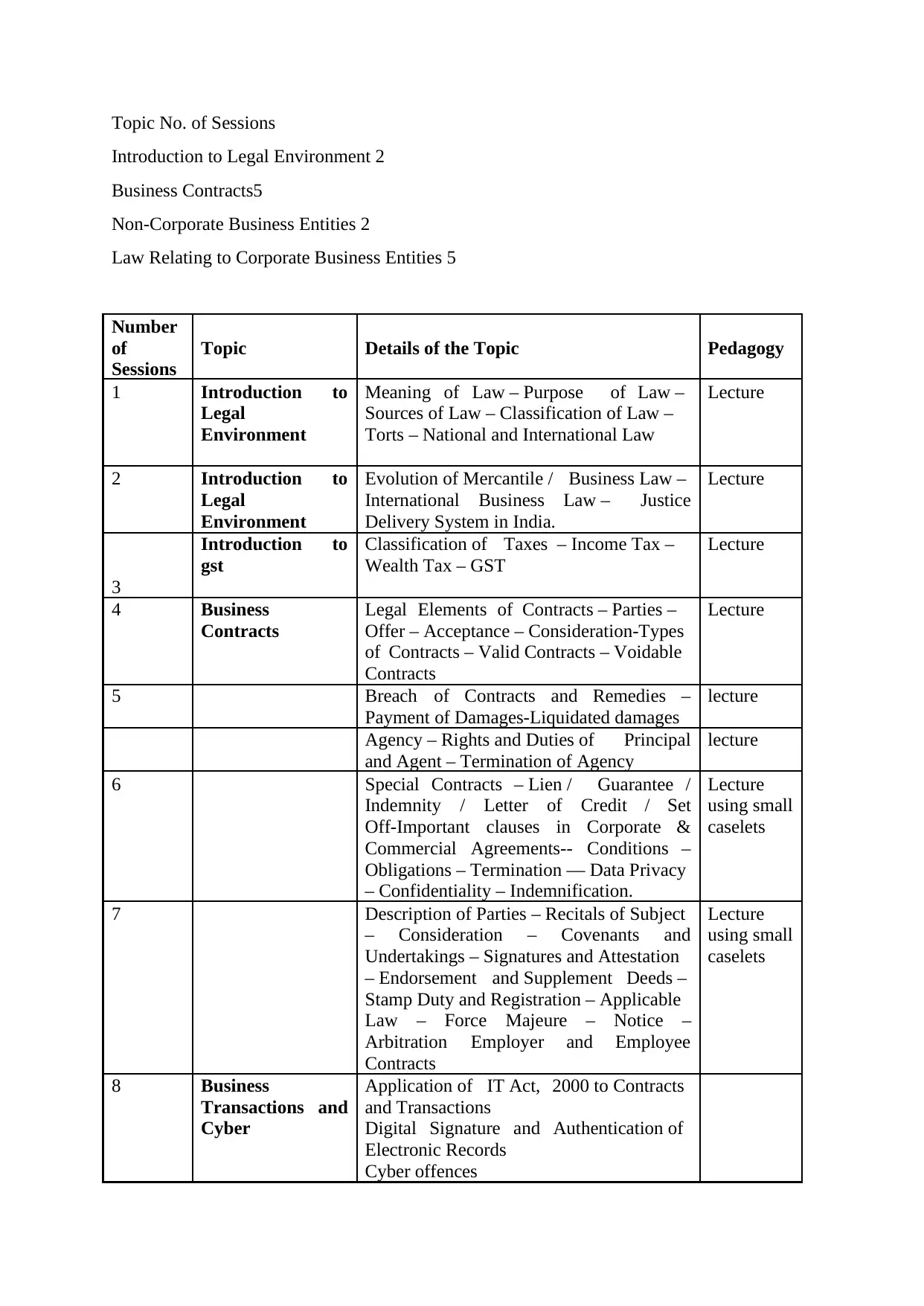
Topic No. of Sessions
Introduction to Legal Environment 2
Business Contracts5
Non-Corporate Business Entities 2
Law Relating to Corporate Business Entities 5
Number
of
Sessions
Topic Details of the Topic Pedagogy
1 Introduction to
Legal
Environment
Meaning of Law – Purpose of Law –
Sources of Law – Classification of Law –
Torts – National and International Law
Lecture
2 Introduction to
Legal
Environment
Evolution of Mercantile / Business Law –
International Business Law – Justice
Delivery System in India.
Lecture
3
Introduction to
gst
Classification of Taxes – Income Tax –
Wealth Tax – GST
Lecture
4 Business
Contracts
Legal Elements of Contracts – Parties –
Offer – Acceptance – Consideration-Types
of Contracts – Valid Contracts – Voidable
Contracts
Lecture
5 Breach of Contracts and Remedies –
Payment of Damages-Liquidated damages
lecture
Agency – Rights and Duties of Principal
and Agent – Termination of Agency
lecture
6 Special Contracts – Lien / Guarantee /
Indemnity / Letter of Credit / Set
Off-Important clauses in Corporate &
Commercial Agreements-- Conditions –
Obligations – Termination –– Data Privacy
– Confidentiality – Indemnification.
Lecture
using small
caselets
7 Description of Parties – Recitals of Subject
– Consideration – Covenants and
Undertakings – Signatures and Attestation
– Endorsement and Supplement Deeds –
Stamp Duty and Registration – Applicable
Law – Force Majeure – Notice –
Arbitration Employer and Employee
Contracts
Lecture
using small
caselets
8 Business
Transactions and
Cyber
Application of IT Act, 2000 to Contracts
and Transactions
Digital Signature and Authentication of
Electronic Records
Cyber offences
Introduction to Legal Environment 2
Business Contracts5
Non-Corporate Business Entities 2
Law Relating to Corporate Business Entities 5
Number
of
Sessions
Topic Details of the Topic Pedagogy
1 Introduction to
Legal
Environment
Meaning of Law – Purpose of Law –
Sources of Law – Classification of Law –
Torts – National and International Law
Lecture
2 Introduction to
Legal
Environment
Evolution of Mercantile / Business Law –
International Business Law – Justice
Delivery System in India.
Lecture
3
Introduction to
gst
Classification of Taxes – Income Tax –
Wealth Tax – GST
Lecture
4 Business
Contracts
Legal Elements of Contracts – Parties –
Offer – Acceptance – Consideration-Types
of Contracts – Valid Contracts – Voidable
Contracts
Lecture
5 Breach of Contracts and Remedies –
Payment of Damages-Liquidated damages
lecture
Agency – Rights and Duties of Principal
and Agent – Termination of Agency
lecture
6 Special Contracts – Lien / Guarantee /
Indemnity / Letter of Credit / Set
Off-Important clauses in Corporate &
Commercial Agreements-- Conditions –
Obligations – Termination –– Data Privacy
– Confidentiality – Indemnification.
Lecture
using small
caselets
7 Description of Parties – Recitals of Subject
– Consideration – Covenants and
Undertakings – Signatures and Attestation
– Endorsement and Supplement Deeds –
Stamp Duty and Registration – Applicable
Law – Force Majeure – Notice –
Arbitration Employer and Employee
Contracts
Lecture
using small
caselets
8 Business
Transactions and
Cyber
Application of IT Act, 2000 to Contracts
and Transactions
Digital Signature and Authentication of
Electronic Records
Cyber offences

Paraphrase This Document
Need a fresh take? Get an instant paraphrase of this document with our AI Paraphraser

9 Non-Corporate
Business Entities
Legal Formalities and Registration – Rights
and Liabilities of Members – Sole
Proprietorship – Partnership – society
Lecture
10 Limited Liability Partnership Firms (LLPs)
– Hindu Undivided Family (HUF).
Insolvency – Acts of Insolvency –
Consequences.
Lecture +
Case
Business Entities
Legal Formalities and Registration – Rights
and Liabilities of Members – Sole
Proprietorship – Partnership – society
Lecture
10 Limited Liability Partnership Firms (LLPs)
– Hindu Undivided Family (HUF).
Insolvency – Acts of Insolvency –
Consequences.
Lecture +
Case
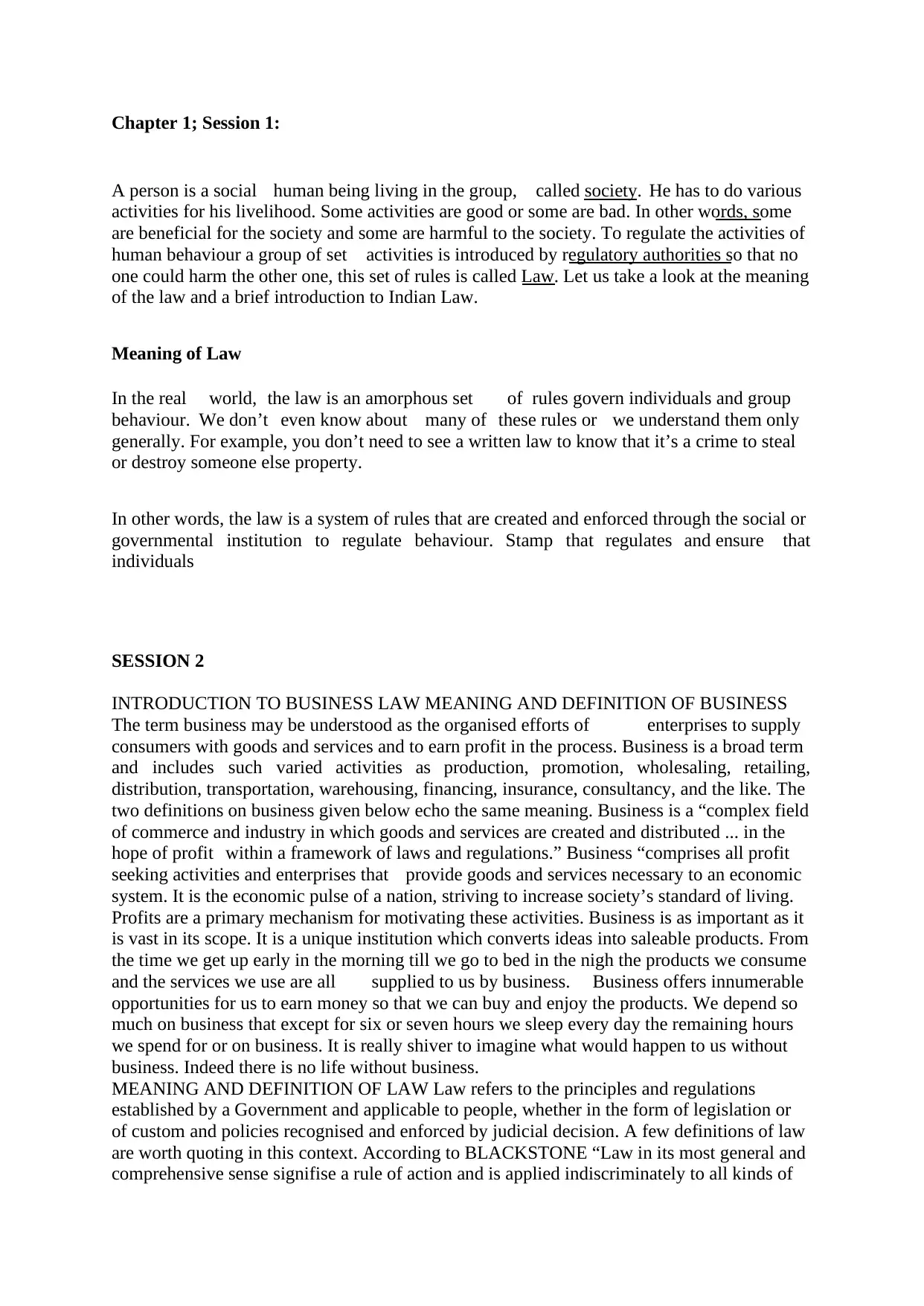
Chapter 1; Session 1:
A person is a social human being living in the group, called society. He has to do various
activities for his livelihood. Some activities are good or some are bad. In other words, some
are beneficial for the society and some are harmful to the society. To regulate the activities of
human behaviour a group of set activities is introduced by regulatory authorities so that no
one could harm the other one, this set of rules is called Law. Let us take a look at the meaning
of the law and a brief introduction to Indian Law.
Meaning of Law
In the real world, the law is an amorphous set of rules govern individuals and group
behaviour. We don’t even know about many of these rules or we understand them only
generally. For example, you don’t need to see a written law to know that it’s a crime to steal
or destroy someone else property.
In other words, the law is a system of rules that are created and enforced through the social or
governmental institution to regulate behaviour. Stamp that regulates and ensure that
individuals
SESSION 2
INTRODUCTION TO BUSINESS LAW MEANING AND DEFINITION OF BUSINESS
The term business may be understood as the organised efforts of enterprises to supply
consumers with goods and services and to earn profit in the process. Business is a broad term
and includes such varied activities as production, promotion, wholesaling, retailing,
distribution, transportation, warehousing, financing, insurance, consultancy, and the like. The
two definitions on business given below echo the same meaning. Business is a “complex field
of commerce and industry in which goods and services are created and distributed ... in the
hope of profit within a framework of laws and regulations.” Business “comprises all profit
seeking activities and enterprises that provide goods and services necessary to an economic
system. It is the economic pulse of a nation, striving to increase society’s standard of living.
Profits are a primary mechanism for motivating these activities. Business is as important as it
is vast in its scope. It is a unique institution which converts ideas into saleable products. From
the time we get up early in the morning till we go to bed in the nigh the products we consume
and the services we use are all supplied to us by business. Business offers innumerable
opportunities for us to earn money so that we can buy and enjoy the products. We depend so
much on business that except for six or seven hours we sleep every day the remaining hours
we spend for or on business. It is really shiver to imagine what would happen to us without
business. Indeed there is no life without business.
MEANING AND DEFINITION OF LAW Law refers to the principles and regulations
established by a Government and applicable to people, whether in the form of legislation or
of custom and policies recognised and enforced by judicial decision. A few definitions of law
are worth quoting in this context. According to BLACKSTONE “Law in its most general and
comprehensive sense signifise a rule of action and is applied indiscriminately to all kinds of
A person is a social human being living in the group, called society. He has to do various
activities for his livelihood. Some activities are good or some are bad. In other words, some
are beneficial for the society and some are harmful to the society. To regulate the activities of
human behaviour a group of set activities is introduced by regulatory authorities so that no
one could harm the other one, this set of rules is called Law. Let us take a look at the meaning
of the law and a brief introduction to Indian Law.
Meaning of Law
In the real world, the law is an amorphous set of rules govern individuals and group
behaviour. We don’t even know about many of these rules or we understand them only
generally. For example, you don’t need to see a written law to know that it’s a crime to steal
or destroy someone else property.
In other words, the law is a system of rules that are created and enforced through the social or
governmental institution to regulate behaviour. Stamp that regulates and ensure that
individuals
SESSION 2
INTRODUCTION TO BUSINESS LAW MEANING AND DEFINITION OF BUSINESS
The term business may be understood as the organised efforts of enterprises to supply
consumers with goods and services and to earn profit in the process. Business is a broad term
and includes such varied activities as production, promotion, wholesaling, retailing,
distribution, transportation, warehousing, financing, insurance, consultancy, and the like. The
two definitions on business given below echo the same meaning. Business is a “complex field
of commerce and industry in which goods and services are created and distributed ... in the
hope of profit within a framework of laws and regulations.” Business “comprises all profit
seeking activities and enterprises that provide goods and services necessary to an economic
system. It is the economic pulse of a nation, striving to increase society’s standard of living.
Profits are a primary mechanism for motivating these activities. Business is as important as it
is vast in its scope. It is a unique institution which converts ideas into saleable products. From
the time we get up early in the morning till we go to bed in the nigh the products we consume
and the services we use are all supplied to us by business. Business offers innumerable
opportunities for us to earn money so that we can buy and enjoy the products. We depend so
much on business that except for six or seven hours we sleep every day the remaining hours
we spend for or on business. It is really shiver to imagine what would happen to us without
business. Indeed there is no life without business.
MEANING AND DEFINITION OF LAW Law refers to the principles and regulations
established by a Government and applicable to people, whether in the form of legislation or
of custom and policies recognised and enforced by judicial decision. A few definitions of law
are worth quoting in this context. According to BLACKSTONE “Law in its most general and
comprehensive sense signifise a rule of action and is applied indiscriminately to all kinds of
⊘ This is a preview!⊘
Do you want full access?
Subscribe today to unlock all pages.

Trusted by 1+ million students worldwide
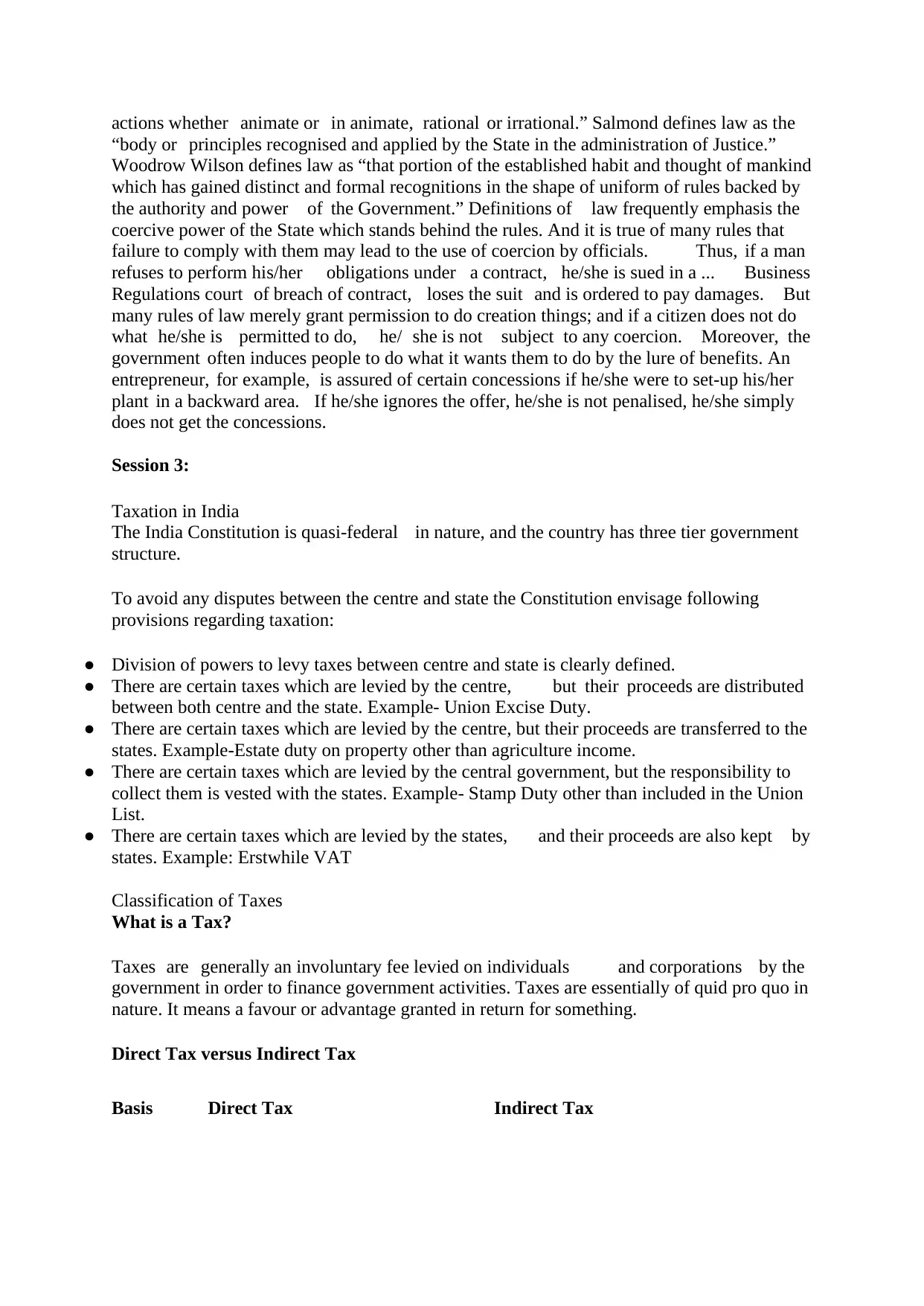
actions whether animate or in animate, rational or irrational.” Salmond defines law as the
“body or principles recognised and applied by the State in the administration of Justice.”
Woodrow Wilson defines law as “that portion of the established habit and thought of mankind
which has gained distinct and formal recognitions in the shape of uniform of rules backed by
the authority and power of the Government.” Definitions of law frequently emphasis the
coercive power of the State which stands behind the rules. And it is true of many rules that
failure to comply with them may lead to the use of coercion by officials. Thus, if a man
refuses to perform his/her obligations under a contract, he/she is sued in a ... Business
Regulations court of breach of contract, loses the suit and is ordered to pay damages. But
many rules of law merely grant permission to do creation things; and if a citizen does not do
what he/she is permitted to do, he/ she is not subject to any coercion. Moreover, the
government often induces people to do what it wants them to do by the lure of benefits. An
entrepreneur, for example, is assured of certain concessions if he/she were to set-up his/her
plant in a backward area. If he/she ignores the offer, he/she is not penalised, he/she simply
does not get the concessions.
Session 3:
Taxation in India
The India Constitution is quasi-federal in nature, and the country has three tier government
structure.
To avoid any disputes between the centre and state the Constitution envisage following
provisions regarding taxation:
● Division of powers to levy taxes between centre and state is clearly defined.
● There are certain taxes which are levied by the centre, but their proceeds are distributed
between both centre and the state. Example- Union Excise Duty.
● There are certain taxes which are levied by the centre, but their proceeds are transferred to the
states. Example-Estate duty on property other than agriculture income.
● There are certain taxes which are levied by the central government, but the responsibility to
collect them is vested with the states. Example- Stamp Duty other than included in the Union
List.
● There are certain taxes which are levied by the states, and their proceeds are also kept by
states. Example: Erstwhile VAT
Classification of Taxes
What is a Tax?
Taxes are generally an involuntary fee levied on individuals and corporations by the
government in order to finance government activities. Taxes are essentially of quid pro quo in
nature. It means a favour or advantage granted in return for something.
Direct Tax versus Indirect Tax
Basis Direct Tax Indirect Tax
“body or principles recognised and applied by the State in the administration of Justice.”
Woodrow Wilson defines law as “that portion of the established habit and thought of mankind
which has gained distinct and formal recognitions in the shape of uniform of rules backed by
the authority and power of the Government.” Definitions of law frequently emphasis the
coercive power of the State which stands behind the rules. And it is true of many rules that
failure to comply with them may lead to the use of coercion by officials. Thus, if a man
refuses to perform his/her obligations under a contract, he/she is sued in a ... Business
Regulations court of breach of contract, loses the suit and is ordered to pay damages. But
many rules of law merely grant permission to do creation things; and if a citizen does not do
what he/she is permitted to do, he/ she is not subject to any coercion. Moreover, the
government often induces people to do what it wants them to do by the lure of benefits. An
entrepreneur, for example, is assured of certain concessions if he/she were to set-up his/her
plant in a backward area. If he/she ignores the offer, he/she is not penalised, he/she simply
does not get the concessions.
Session 3:
Taxation in India
The India Constitution is quasi-federal in nature, and the country has three tier government
structure.
To avoid any disputes between the centre and state the Constitution envisage following
provisions regarding taxation:
● Division of powers to levy taxes between centre and state is clearly defined.
● There are certain taxes which are levied by the centre, but their proceeds are distributed
between both centre and the state. Example- Union Excise Duty.
● There are certain taxes which are levied by the centre, but their proceeds are transferred to the
states. Example-Estate duty on property other than agriculture income.
● There are certain taxes which are levied by the central government, but the responsibility to
collect them is vested with the states. Example- Stamp Duty other than included in the Union
List.
● There are certain taxes which are levied by the states, and their proceeds are also kept by
states. Example: Erstwhile VAT
Classification of Taxes
What is a Tax?
Taxes are generally an involuntary fee levied on individuals and corporations by the
government in order to finance government activities. Taxes are essentially of quid pro quo in
nature. It means a favour or advantage granted in return for something.
Direct Tax versus Indirect Tax
Basis Direct Tax Indirect Tax
Paraphrase This Document
Need a fresh take? Get an instant paraphrase of this document with our AI Paraphraser
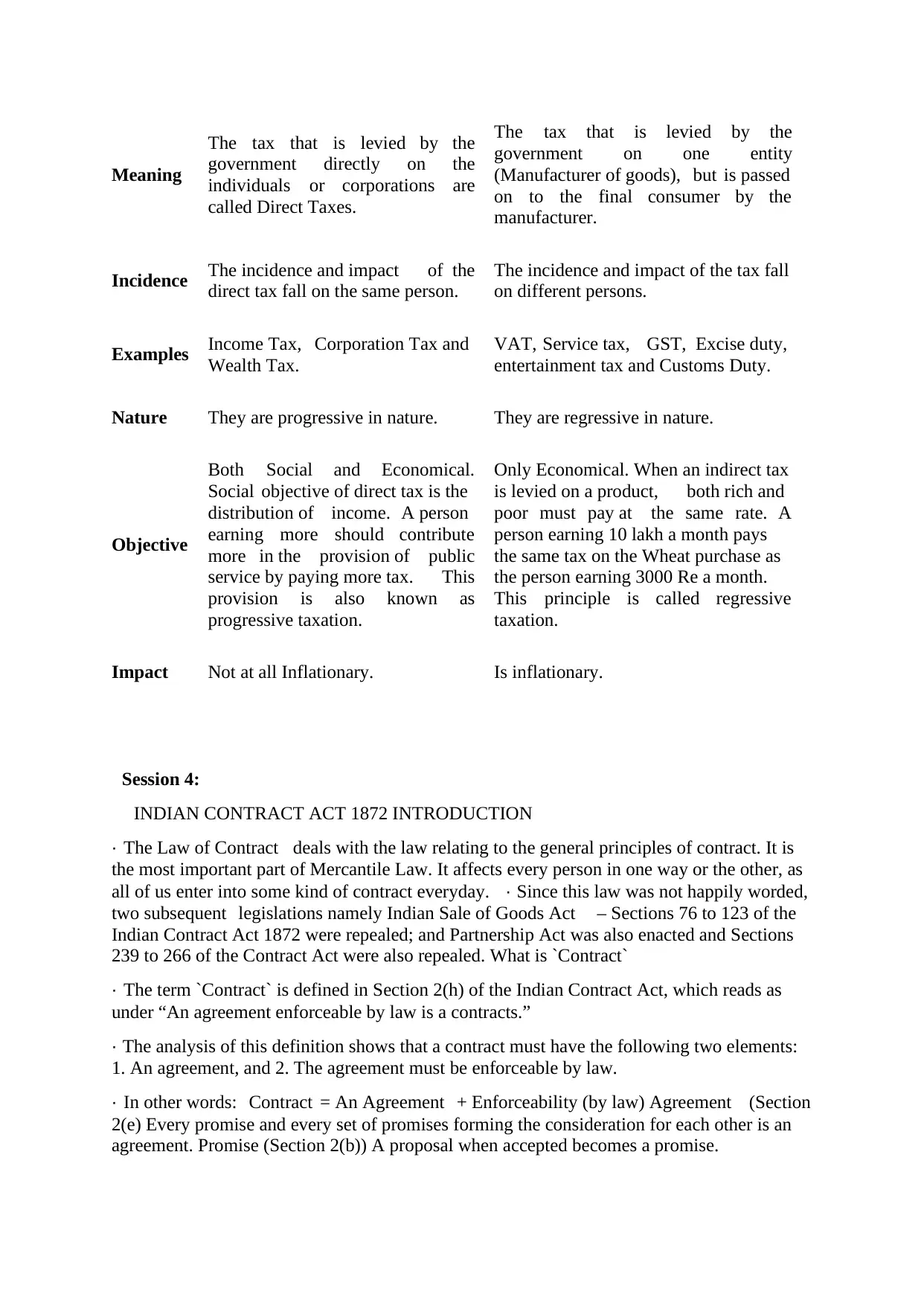
Meaning
The tax that is levied by the
government directly on the
individuals or corporations are
called Direct Taxes.
The tax that is levied by the
government on one entity
(Manufacturer of goods), but is passed
on to the final consumer by the
manufacturer.
Incidence The incidence and impact of the
direct tax fall on the same person.
The incidence and impact of the tax fall
on different persons.
Examples Income Tax, Corporation Tax and
Wealth Tax.
VAT, Service tax, GST, Excise duty,
entertainment tax and Customs Duty.
Nature They are progressive in nature. They are regressive in nature.
Objective
Both Social and Economical.
Social objective of direct tax is the
distribution of income. A person
earning more should contribute
more in the provision of public
service by paying more tax. This
provision is also known as
progressive taxation.
Only Economical. When an indirect tax
is levied on a product, both rich and
poor must pay at the same rate. A
person earning 10 lakh a month pays
the same tax on the Wheat purchase as
the person earning 3000 Re a month.
This principle is called regressive
taxation.
Impact Not at all Inflationary. Is inflationary.
Session 4:
INDIAN CONTRACT ACT 1872 INTRODUCTION
∙ The Law of Contract deals with the law relating to the general principles of contract. It is
the most important part of Mercantile Law. It affects every person in one way or the other, as
all of us enter into some kind of contract everyday. ∙ Since this law was not happily worded,
two subsequent legislations namely Indian Sale of Goods Act – Sections 76 to 123 of the
Indian Contract Act 1872 were repealed; and Partnership Act was also enacted and Sections
239 to 266 of the Contract Act were also repealed. What is `Contract`
∙ The term `Contract` is defined in Section 2(h) of the Indian Contract Act, which reads as
under “An agreement enforceable by law is a contracts.”
∙ The analysis of this definition shows that a contract must have the following two elements:
1. An agreement, and 2. The agreement must be enforceable by law.
∙ In other words: Contract = An Agreement + Enforceability (by law) Agreement (Section
2(e) Every promise and every set of promises forming the consideration for each other is an
agreement. Promise (Section 2(b)) A proposal when accepted becomes a promise.
The tax that is levied by the
government directly on the
individuals or corporations are
called Direct Taxes.
The tax that is levied by the
government on one entity
(Manufacturer of goods), but is passed
on to the final consumer by the
manufacturer.
Incidence The incidence and impact of the
direct tax fall on the same person.
The incidence and impact of the tax fall
on different persons.
Examples Income Tax, Corporation Tax and
Wealth Tax.
VAT, Service tax, GST, Excise duty,
entertainment tax and Customs Duty.
Nature They are progressive in nature. They are regressive in nature.
Objective
Both Social and Economical.
Social objective of direct tax is the
distribution of income. A person
earning more should contribute
more in the provision of public
service by paying more tax. This
provision is also known as
progressive taxation.
Only Economical. When an indirect tax
is levied on a product, both rich and
poor must pay at the same rate. A
person earning 10 lakh a month pays
the same tax on the Wheat purchase as
the person earning 3000 Re a month.
This principle is called regressive
taxation.
Impact Not at all Inflationary. Is inflationary.
Session 4:
INDIAN CONTRACT ACT 1872 INTRODUCTION
∙ The Law of Contract deals with the law relating to the general principles of contract. It is
the most important part of Mercantile Law. It affects every person in one way or the other, as
all of us enter into some kind of contract everyday. ∙ Since this law was not happily worded,
two subsequent legislations namely Indian Sale of Goods Act – Sections 76 to 123 of the
Indian Contract Act 1872 were repealed; and Partnership Act was also enacted and Sections
239 to 266 of the Contract Act were also repealed. What is `Contract`
∙ The term `Contract` is defined in Section 2(h) of the Indian Contract Act, which reads as
under “An agreement enforceable by law is a contracts.”
∙ The analysis of this definition shows that a contract must have the following two elements:
1. An agreement, and 2. The agreement must be enforceable by law.
∙ In other words: Contract = An Agreement + Enforceability (by law) Agreement (Section
2(e) Every promise and every set of promises forming the consideration for each other is an
agreement. Promise (Section 2(b)) A proposal when accepted becomes a promise.
∙ Every agreement is not a contract. When an agreement creates some legal obligations and is
enforceable by law, it is regarded as a contract.
2.1 ESSENTIAL ELEMENTS OF CONTRACT 1. Agreement 2. Intention to create legal
relationship 3. Free and genuine consent. 4. Parties competent to contract. 5. Lawful
consideration. 6. Lawful object. 7. Must be in writing. (Generally, oral contract is not
enforceable) 8. Agreement not declared void or illegal. 9. Certainty of meaning. 10.
Possibility of performance. 11. Necessary legal formalities.
Ex – Where 'A' who owns 2 cars x and y wishes to sell car 'x' for Rs. 30,000. 'B', an
acquaintance of 'A' does not know that' A' owns car 'x' also. He thinks that' A' owns only car
'y' and is offering to sell the same for the stated price. He gives his acceptance to buy the
same. There is no contract because the contracting parties have not agreed on the same thing
at the same time, 'A' offering to sell his car 'x' and 'B' agreeing to buy car or'. There is no
consensus-ad-idem.
LAW OF CONTRACT CREATES jus in personam ∙The term jus in personam means a “right
against or in respect of a specific person.” Thus, law of contract creates jus in personam and
not jus in rem. A jus in rem means a right against or a thing. CLASSIFICATION OF
CONTRACTS 1. Classification according to validity or enforceability. a) Valid b) Voidable c)
Void contracts or agreements d) Illegal. e) Unenforceable 2. Classification according to Mode
of formation (i) Express contract (ii) Implied contract 2. Classification according to
Performance
CONTRACT ACT (i) Executed contract (ii) Executory contract. (iii) Unilateral Contract (iv)
Bilateral Contract
2.2 OFFER AND ACCEPTANCE [Sections 3-9] OFFER What is `Offer/Proposal` ∙ A
Proposal is defined as quot;when one person signifies to another his willingness to do or to
abstain from doing anything, with a view to obtaining the assent of that other to such act or
abstinence, he is said to make a proposal.quot; [Section 2(a)]. How an Offer is made? ∙ An
offer can be made by (a) any act or (b) omission of the party proposing by which he intends
to communicate such proposal or which has the effect of communicating it to the other
(Section 3).
ESSENTIAL REQUIREMENTS OF A VALID OFFER ∙ An offer must have certain
essentials in order to constitute it a valid offer. These are: I. The offer must be made with a
view to obtain acceptance. 2. The offer must be made with the intention of creating legal
relations. [Balfour v. Balfour (1919) 2 K.B.57Il 2. The terms of offer must be definite,
unambiguous and certain or capable of being made certain. The terms of the offer must not
be loose, vague or ambiguous. 4. An offer must be distinguished from (a) a mere declaration
of intention or (b) an invitation to offer or to treat. An auctioneer, at the time of auction,
invites offers from the would-be-bidders. He is not making a proposal. A display of goods
with a price on them in a shop window is construed an invitation to offer and not an offer to
sell. Offer vis-a-vis Invitation to offer An offer must be distinguished from invitation to
offer. θ A prospectus issued by a company for subscription of its shares by the members of
the public, is an invitation θ to offer. The Letter of Offer issued by a company to its existing
shareholders is an offer. 5. The offer must be communicated to the offeree. An offer must be
communicated to the offeree before it can be accepted. This is true of specific as sell as
general offer. 6. The offer must not contain a term the non-compliance of which may be
assumed to amount to acceptance. Cross Offers ∙ Where two parties make identical offers to
each other, in ignorance of each other's offer, the offers are known as cross-offers and
enforceable by law, it is regarded as a contract.
2.1 ESSENTIAL ELEMENTS OF CONTRACT 1. Agreement 2. Intention to create legal
relationship 3. Free and genuine consent. 4. Parties competent to contract. 5. Lawful
consideration. 6. Lawful object. 7. Must be in writing. (Generally, oral contract is not
enforceable) 8. Agreement not declared void or illegal. 9. Certainty of meaning. 10.
Possibility of performance. 11. Necessary legal formalities.
Ex – Where 'A' who owns 2 cars x and y wishes to sell car 'x' for Rs. 30,000. 'B', an
acquaintance of 'A' does not know that' A' owns car 'x' also. He thinks that' A' owns only car
'y' and is offering to sell the same for the stated price. He gives his acceptance to buy the
same. There is no contract because the contracting parties have not agreed on the same thing
at the same time, 'A' offering to sell his car 'x' and 'B' agreeing to buy car or'. There is no
consensus-ad-idem.
LAW OF CONTRACT CREATES jus in personam ∙The term jus in personam means a “right
against or in respect of a specific person.” Thus, law of contract creates jus in personam and
not jus in rem. A jus in rem means a right against or a thing. CLASSIFICATION OF
CONTRACTS 1. Classification according to validity or enforceability. a) Valid b) Voidable c)
Void contracts or agreements d) Illegal. e) Unenforceable 2. Classification according to Mode
of formation (i) Express contract (ii) Implied contract 2. Classification according to
Performance
CONTRACT ACT (i) Executed contract (ii) Executory contract. (iii) Unilateral Contract (iv)
Bilateral Contract
2.2 OFFER AND ACCEPTANCE [Sections 3-9] OFFER What is `Offer/Proposal` ∙ A
Proposal is defined as quot;when one person signifies to another his willingness to do or to
abstain from doing anything, with a view to obtaining the assent of that other to such act or
abstinence, he is said to make a proposal.quot; [Section 2(a)]. How an Offer is made? ∙ An
offer can be made by (a) any act or (b) omission of the party proposing by which he intends
to communicate such proposal or which has the effect of communicating it to the other
(Section 3).
ESSENTIAL REQUIREMENTS OF A VALID OFFER ∙ An offer must have certain
essentials in order to constitute it a valid offer. These are: I. The offer must be made with a
view to obtain acceptance. 2. The offer must be made with the intention of creating legal
relations. [Balfour v. Balfour (1919) 2 K.B.57Il 2. The terms of offer must be definite,
unambiguous and certain or capable of being made certain. The terms of the offer must not
be loose, vague or ambiguous. 4. An offer must be distinguished from (a) a mere declaration
of intention or (b) an invitation to offer or to treat. An auctioneer, at the time of auction,
invites offers from the would-be-bidders. He is not making a proposal. A display of goods
with a price on them in a shop window is construed an invitation to offer and not an offer to
sell. Offer vis-a-vis Invitation to offer An offer must be distinguished from invitation to
offer. θ A prospectus issued by a company for subscription of its shares by the members of
the public, is an invitation θ to offer. The Letter of Offer issued by a company to its existing
shareholders is an offer. 5. The offer must be communicated to the offeree. An offer must be
communicated to the offeree before it can be accepted. This is true of specific as sell as
general offer. 6. The offer must not contain a term the non-compliance of which may be
assumed to amount to acceptance. Cross Offers ∙ Where two parties make identical offers to
each other, in ignorance of each other's offer, the offers are known as cross-offers and
⊘ This is a preview!⊘
Do you want full access?
Subscribe today to unlock all pages.
Trusted by 1+ million students worldwide
neither of the two can be called an acceptance of the other and, therefore, there is no
contract.
TERMINATION OR LAPSE OF AN OFFER ∙ An offer is made with a view to obtain
assent thereto. As soon as the offer is accepted it becomes a contract. But before it is
accepted, it may lapse, or may be revoked. Also, the offeree may reject the offer. In these
cases, the offer will come to an end. 1) The offer lapses after stipulated or reasonable time
2) An offer lapses by the death or insanity of the offeror or the offeree before acceptance. 3)
An offer terminates when rejected by the offeree. 4) An offer terminates when revoked by
the offeror before acceptance. 5) An offer terminates by not being accepted in the mode
prescribed, or if no mode is prescribed, in some usual and reasonable manner. 6) A
conditional offer terminates when the condition is not accepted by the offeree. (7) Counter
Offer
TERMINATION OF AN OFFER 1. An offer lapses after stipulated or reasonable time. 2.
An offer lapses by the death or insanity of the offeror or the offeree before acceptance. 2.
An offer.CONTRACT ACT rejection. 4. An offer terminates when revoked. 5. It terminates
by counter-offer. 6. It terminates by not being accepted in the mode prescribed or in usual
and reasonable manner. 7. A conditional offer terminates when condition is not accepted.
ACCEPTANCE ∙Acceptance has been defined as quot;When the person to whom the
proposal is made signifies his assent thereto, the proposal is said to be accepted”.
Acceptance how made ∙Theofferee is deemed to have given his acceptance when he gives
his assent to the proposal. The assent may be express or implied. It is express when the
acceptance has been signified either in writing, or by word of mouth, or by performance of
some required act. Ex- A enters into a bus for going to his destination and takes a seat. From
the very nature, of the circumstance, the law will imply acceptance on the part of A.] ∙ In the
case of a general offer, it can be accepted by anyone by complying with the terms of the
offer.
ESSENTIALS OF A VALID ACCEPTANCE 1) Acceptance must be absolute and
unqualified. 2) Acceptance must be communicated to the offeror. 3) Acceptance must be
according to the mode prescribed. Ex- A sends an offer to B through post in the usual
course. B should make the acceptance in the quot;usual and reasonable mannerquot; as no
mode of acceptance is prescribed. He may accept the offer by sending a letter, through post,
in the ordinary course, within a reasonable time.
COMMUNICATION OF OFFER, ACCEPTANCE AND REVOCATION ∙ As mentioned
earlier that in order to be a valid offer and acceptance. (i) the offer must be communicated to
the offeree, and (ii) the acceptance must be communicated to the offeror. The
communication of acceptance is complete: (i) as against the proposer, when it is put into a
course of transmission to him, so as to be out of the power of the acceptor; (ii) as against the
acceptor, when it comes to the knowledge of the proposer. Ex- A proposes, by letter, to sell
a house to B at a certain price. B accepts A's proposal by a letter sent by post. The
communication of acceptance is complete: (i) as against A, when the letter is posted by B;
(ii) as against B, when the letter is received by A. The communication of a revocation (of an
offer or an acceptance) is complete: (1) as against the person who makes it, when it is put
into a course of transmission to the person to whom it is made, so as to be out of the power
of the person who makes it. (2) as against the person to whom it is made when it comes to
his knowledge. Ex- A revokes his proposal by telegram. The revocation is complete as
against A, when the telegram is dispatched. It is complete as against B, when B receives it.
Revocation of proposal and acceptance: ∙ A proposal may be revoked at any time before the
contract.
TERMINATION OR LAPSE OF AN OFFER ∙ An offer is made with a view to obtain
assent thereto. As soon as the offer is accepted it becomes a contract. But before it is
accepted, it may lapse, or may be revoked. Also, the offeree may reject the offer. In these
cases, the offer will come to an end. 1) The offer lapses after stipulated or reasonable time
2) An offer lapses by the death or insanity of the offeror or the offeree before acceptance. 3)
An offer terminates when rejected by the offeree. 4) An offer terminates when revoked by
the offeror before acceptance. 5) An offer terminates by not being accepted in the mode
prescribed, or if no mode is prescribed, in some usual and reasonable manner. 6) A
conditional offer terminates when the condition is not accepted by the offeree. (7) Counter
Offer
TERMINATION OF AN OFFER 1. An offer lapses after stipulated or reasonable time. 2.
An offer lapses by the death or insanity of the offeror or the offeree before acceptance. 2.
An offer.CONTRACT ACT rejection. 4. An offer terminates when revoked. 5. It terminates
by counter-offer. 6. It terminates by not being accepted in the mode prescribed or in usual
and reasonable manner. 7. A conditional offer terminates when condition is not accepted.
ACCEPTANCE ∙Acceptance has been defined as quot;When the person to whom the
proposal is made signifies his assent thereto, the proposal is said to be accepted”.
Acceptance how made ∙Theofferee is deemed to have given his acceptance when he gives
his assent to the proposal. The assent may be express or implied. It is express when the
acceptance has been signified either in writing, or by word of mouth, or by performance of
some required act. Ex- A enters into a bus for going to his destination and takes a seat. From
the very nature, of the circumstance, the law will imply acceptance on the part of A.] ∙ In the
case of a general offer, it can be accepted by anyone by complying with the terms of the
offer.
ESSENTIALS OF A VALID ACCEPTANCE 1) Acceptance must be absolute and
unqualified. 2) Acceptance must be communicated to the offeror. 3) Acceptance must be
according to the mode prescribed. Ex- A sends an offer to B through post in the usual
course. B should make the acceptance in the quot;usual and reasonable mannerquot; as no
mode of acceptance is prescribed. He may accept the offer by sending a letter, through post,
in the ordinary course, within a reasonable time.
COMMUNICATION OF OFFER, ACCEPTANCE AND REVOCATION ∙ As mentioned
earlier that in order to be a valid offer and acceptance. (i) the offer must be communicated to
the offeree, and (ii) the acceptance must be communicated to the offeror. The
communication of acceptance is complete: (i) as against the proposer, when it is put into a
course of transmission to him, so as to be out of the power of the acceptor; (ii) as against the
acceptor, when it comes to the knowledge of the proposer. Ex- A proposes, by letter, to sell
a house to B at a certain price. B accepts A's proposal by a letter sent by post. The
communication of acceptance is complete: (i) as against A, when the letter is posted by B;
(ii) as against B, when the letter is received by A. The communication of a revocation (of an
offer or an acceptance) is complete: (1) as against the person who makes it, when it is put
into a course of transmission to the person to whom it is made, so as to be out of the power
of the person who makes it. (2) as against the person to whom it is made when it comes to
his knowledge. Ex- A revokes his proposal by telegram. The revocation is complete as
against A, when the telegram is dispatched. It is complete as against B, when B receives it.
Revocation of proposal and acceptance: ∙ A proposal may be revoked at any time before the
Paraphrase This Document
Need a fresh take? Get an instant paraphrase of this document with our AI Paraphraser
communication of its acceptance is complete as against the proposer, but not afterwards. Ex-
A proposes, by a letter sent by post, to sell his house to B. B accepts the proposal by a letter
sent by post. A may revoke his proposal at any time before or at the moment when B posts
his letter of acceptance, but not afterwards. B may revoke his acceptance at any time before
or at the moment when the letter communicating it reaches A, but not afterwards.
CAPACITY TO CONTRACT (Sections 10-12) WHO ARE NOT COMPETENT TO
CONTRACT ∙ The following are considered as incompetent to contract, in the eye of law: -
(1) Minor: - (i) A contract with or by a minor is void and a minor, therefore, cannot, bind
himself by a contract. (ii) A minor's agreement cannot be ratified by the minor on his
attaining majority.(iii) If a minor has received any benefit under a void contract, he cannot
be asked to refund the same. (iv) A minor cannot be a partner in a partnership firm. (v) A
minor's estate is liable to a person who supplies necessaries of life to a minor. CASE
EXAMPLE In 1903 the Privy Council in the leading case of MohiriBibi v.
DharmodasGhose (190,30 Ca. 539) held that in India minor's contracts are absolutely void
and not merely voidable. The facts of the case were: DharmodasGhose, a minor, entered
into a contract for borrowing a sum of Rs. 20,000 out of which the lender paid the minor a
sum of Rs. 8,000. The minor executed mortgage of property in favour of the lender.
Subsequently, the minor sued for setting aside the mortgage. The Privy Council had to
ascertain the validity of the mortgage. Under Section 7 of the Transfer of Property Act,
every person competent to contract is competent to mortgage. The Privy Council decided
that Sections 10 and 11 of the Indian Contract Act make the minor's contract void. The
mortgagee prayed for refund of Rs. 8,000 by the minor. The Privy Council further held that
as a minor's contract is void, any money advanced to a minor cannot be recovered. (2)
Mental Incompetence θA person is said to be of unsound mind for the purpose of making a
contract, if at the time when he makes it, he is incapable of understanding it, and of forming
a rational judgement as to its effect upon his interests. θ A person, who is usually of
unsound mind, but occasionally of sound mind, may make a contract when he is of sound
mind. Ex- A patient, in a lunatic asylum, who is at intervals, of sound mind; may contract
during those intervals. A sane man, who is delirious from fever or who is so drunk that he
cannot understand the terms of a contract or form a rational judgement as to its effect on his
interest, cannot contract whilst such delirium or drunkenness lasts. (3) Incompetence
through Status (i) Alien Enemy (Political Status) (ii) Foreign Sovereigns and Ambassadors
(iii) Company under the Companies Act or Statutory Corporation by passing Special Act of
Parliament (Corporate status) (iv) Insolvent Persons .
FREE CONSENT (Sections 10; 13-22) What is the meaning of `CONSENT` (SECTION
13) ∙ When two or more persons agree upon the same thing in the same sense, they are said
to consent. Ex- A agrees to sell his Fiat Car 1983 model for Rs. 80,000. B agrees to buy the
same. There is a valid contract since A and B have consented to the same subject matter.
What is meant by `Free Consent` ∙ Consent is said to be free when it is not caused by
Causes affecting contract Consequences 1. Coercion Contract voidable 2. Undue influence
Contract voidable 2. Fraud Contract voidable 4. Misrepresentation Contract voidable 5.
Mistake – (i) of fact (a) Bilateral Void (b) Unilateral Generally not invalid (ii) of Fact Void
Ex - (i) A railway company refuses to deliver certain goods to the consignee, except upon
the payment of an illegal charge for carriage. The consignee pays the sum charged in order
to obtain the goods. He is entitled to recover so much of the charge as was illegally
excessive. (ii) The directors of a Tramway Co. issued a prospectus stating that they had the
right to run tramcars with steam power instead of with horses as before. In fact, the Act
incorporating the company provided that such power might be used with the sanction of the
Board of Trade. But, the Board of Trade refused to give permission and the company had to
A proposes, by a letter sent by post, to sell his house to B. B accepts the proposal by a letter
sent by post. A may revoke his proposal at any time before or at the moment when B posts
his letter of acceptance, but not afterwards. B may revoke his acceptance at any time before
or at the moment when the letter communicating it reaches A, but not afterwards.
CAPACITY TO CONTRACT (Sections 10-12) WHO ARE NOT COMPETENT TO
CONTRACT ∙ The following are considered as incompetent to contract, in the eye of law: -
(1) Minor: - (i) A contract with or by a minor is void and a minor, therefore, cannot, bind
himself by a contract. (ii) A minor's agreement cannot be ratified by the minor on his
attaining majority.(iii) If a minor has received any benefit under a void contract, he cannot
be asked to refund the same. (iv) A minor cannot be a partner in a partnership firm. (v) A
minor's estate is liable to a person who supplies necessaries of life to a minor. CASE
EXAMPLE In 1903 the Privy Council in the leading case of MohiriBibi v.
DharmodasGhose (190,30 Ca. 539) held that in India minor's contracts are absolutely void
and not merely voidable. The facts of the case were: DharmodasGhose, a minor, entered
into a contract for borrowing a sum of Rs. 20,000 out of which the lender paid the minor a
sum of Rs. 8,000. The minor executed mortgage of property in favour of the lender.
Subsequently, the minor sued for setting aside the mortgage. The Privy Council had to
ascertain the validity of the mortgage. Under Section 7 of the Transfer of Property Act,
every person competent to contract is competent to mortgage. The Privy Council decided
that Sections 10 and 11 of the Indian Contract Act make the minor's contract void. The
mortgagee prayed for refund of Rs. 8,000 by the minor. The Privy Council further held that
as a minor's contract is void, any money advanced to a minor cannot be recovered. (2)
Mental Incompetence θA person is said to be of unsound mind for the purpose of making a
contract, if at the time when he makes it, he is incapable of understanding it, and of forming
a rational judgement as to its effect upon his interests. θ A person, who is usually of
unsound mind, but occasionally of sound mind, may make a contract when he is of sound
mind. Ex- A patient, in a lunatic asylum, who is at intervals, of sound mind; may contract
during those intervals. A sane man, who is delirious from fever or who is so drunk that he
cannot understand the terms of a contract or form a rational judgement as to its effect on his
interest, cannot contract whilst such delirium or drunkenness lasts. (3) Incompetence
through Status (i) Alien Enemy (Political Status) (ii) Foreign Sovereigns and Ambassadors
(iii) Company under the Companies Act or Statutory Corporation by passing Special Act of
Parliament (Corporate status) (iv) Insolvent Persons .
FREE CONSENT (Sections 10; 13-22) What is the meaning of `CONSENT` (SECTION
13) ∙ When two or more persons agree upon the same thing in the same sense, they are said
to consent. Ex- A agrees to sell his Fiat Car 1983 model for Rs. 80,000. B agrees to buy the
same. There is a valid contract since A and B have consented to the same subject matter.
What is meant by `Free Consent` ∙ Consent is said to be free when it is not caused by
Causes affecting contract Consequences 1. Coercion Contract voidable 2. Undue influence
Contract voidable 2. Fraud Contract voidable 4. Misrepresentation Contract voidable 5.
Mistake – (i) of fact (a) Bilateral Void (b) Unilateral Generally not invalid (ii) of Fact Void
Ex - (i) A railway company refuses to deliver certain goods to the consignee, except upon
the payment of an illegal charge for carriage. The consignee pays the sum charged in order
to obtain the goods. He is entitled to recover so much of the charge as was illegally
excessive. (ii) The directors of a Tramway Co. issued a prospectus stating that they had the
right to run tramcars with steam power instead of with horses as before. In fact, the Act
incorporating the company provided that such power might be used with the sanction of the
Board of Trade. But, the Board of Trade refused to give permission and the company had to
be wound up. P, a shareholder sued the directors for damages for fraud. The House of Lords
held that the directors were not liable in fraud because they honestly believed what they said
.
CONSIDERATION [Sections 2(d), 10,23-25, 148, 185] Definition ∙ Consideration is what a
promisor demands as the price for his promise. In simple words, it means 'something in
return.' ∙ Consideration has been defined as quot;When at the desire of the promisor, the
promisee or any other person has done or abstained from doing, or does or abstains from
doing, or promises to do or promises to abstain from doing something, such act or
abstinence or promise is called a consideration for the promise.quot;
IMPORTANCE OF CONSIDERATION ∙ A promise without consideration is purely
gratuitous and, however sacred and binding in honour it may be, cannot create a legal
obligation. ∙ A person who makes a promise to do or abstain from doing something usually
does so as a return or equivalent of some loss, damage, or inconvenience that may have
been occasioned to the other party in respect of the promise. The benefit so received and the
loss, damage or inconvenience so caused is regarded in law as the consideration for the
promise.
KINDS OF CONSIDERATION ∙ A consideration may be: 1. Executed or Present 2.
Executory or Future 2. Past 2.6 LEGALITY OF OBJECT (Sections 23, 24) ∙An agreement
will not be enforceable if its object or the consideration is unlawful. According to Section
23 of the Act, the consideration and the object of an agreement are unlawful in the
following cases: What consideration and objects are unlawful – agreement VOID 1. If it is
forbidden by law 2. If it is of such a nature that if permitted, it would defeat the provisions
of any law. 2. If it is fraudulent. An agreement with a view to defraud other is void. 4. If it
involves or implies injury to the person or property of another. If the object of an agreement
is to injure the person or property of another it is void. 5. If the Court regards it as immoral
or opposed to public policy. An agreement, whose object or consideration is immoral or is
opposed to the public policy, is void. Ex- A partnership entered into for the purpose of doing
business in arrack (local alcoholic drink) on a licence granted only to one of the partners, is
void ab-initio whether the partnership was entered into before the licence was granted or
afterwards as it involved a transfer of licence, which is forbidden and penalised by the
Akbari Act and the rules thereunder [VeluPayaychi v. Siva Sooriam, AIR (1950) Mad. 987].
2.7 VOID and VOIDABLE Agreements (Sections 26-30) Void agreement 1. The following
are the additional grounds declaring agreements as void: - (i) Agreements by person who are
not competent to contract. (ii) Agreements under a mutual mistake of fact material to the
agreement. (iii) Agreement with unlawful consideration. (iv) Agreement without
consideration. (Exception – if such an agreement is in writing and registered or for a past
consideration) (v) Agreement in restraint of marriage. (vi) Agreement in restraint of trade
(vii) Agreements in restrain of legal proceedings, (viii) Agreements void for uncertainty
(Agreements, the meaning of which is not certain, or capable of being made certain) (ix)
Agreements by way of wager (a promise to give money or money's worth upon the
determination or ascertainment of an uncertain event) (x) Agreements against Public Policy
.(xi) Agreements to do impossible act. Voidable agreements ∙An agreement, which has been
entered into by misrepresentation, fraud, coercion is voidable, at the option of the aggrieved
party.
2.8 CONTINGENT CONTRACTS (SECTIONS 31-36) ∙A contingent contract is a contract
to do or not to do something, if some event, collateral to such contract does or does not
happen. When a contingent contract may be enforced ∙ Contingent contracts may be
held that the directors were not liable in fraud because they honestly believed what they said
.
CONSIDERATION [Sections 2(d), 10,23-25, 148, 185] Definition ∙ Consideration is what a
promisor demands as the price for his promise. In simple words, it means 'something in
return.' ∙ Consideration has been defined as quot;When at the desire of the promisor, the
promisee or any other person has done or abstained from doing, or does or abstains from
doing, or promises to do or promises to abstain from doing something, such act or
abstinence or promise is called a consideration for the promise.quot;
IMPORTANCE OF CONSIDERATION ∙ A promise without consideration is purely
gratuitous and, however sacred and binding in honour it may be, cannot create a legal
obligation. ∙ A person who makes a promise to do or abstain from doing something usually
does so as a return or equivalent of some loss, damage, or inconvenience that may have
been occasioned to the other party in respect of the promise. The benefit so received and the
loss, damage or inconvenience so caused is regarded in law as the consideration for the
promise.
KINDS OF CONSIDERATION ∙ A consideration may be: 1. Executed or Present 2.
Executory or Future 2. Past 2.6 LEGALITY OF OBJECT (Sections 23, 24) ∙An agreement
will not be enforceable if its object or the consideration is unlawful. According to Section
23 of the Act, the consideration and the object of an agreement are unlawful in the
following cases: What consideration and objects are unlawful – agreement VOID 1. If it is
forbidden by law 2. If it is of such a nature that if permitted, it would defeat the provisions
of any law. 2. If it is fraudulent. An agreement with a view to defraud other is void. 4. If it
involves or implies injury to the person or property of another. If the object of an agreement
is to injure the person or property of another it is void. 5. If the Court regards it as immoral
or opposed to public policy. An agreement, whose object or consideration is immoral or is
opposed to the public policy, is void. Ex- A partnership entered into for the purpose of doing
business in arrack (local alcoholic drink) on a licence granted only to one of the partners, is
void ab-initio whether the partnership was entered into before the licence was granted or
afterwards as it involved a transfer of licence, which is forbidden and penalised by the
Akbari Act and the rules thereunder [VeluPayaychi v. Siva Sooriam, AIR (1950) Mad. 987].
2.7 VOID and VOIDABLE Agreements (Sections 26-30) Void agreement 1. The following
are the additional grounds declaring agreements as void: - (i) Agreements by person who are
not competent to contract. (ii) Agreements under a mutual mistake of fact material to the
agreement. (iii) Agreement with unlawful consideration. (iv) Agreement without
consideration. (Exception – if such an agreement is in writing and registered or for a past
consideration) (v) Agreement in restraint of marriage. (vi) Agreement in restraint of trade
(vii) Agreements in restrain of legal proceedings, (viii) Agreements void for uncertainty
(Agreements, the meaning of which is not certain, or capable of being made certain) (ix)
Agreements by way of wager (a promise to give money or money's worth upon the
determination or ascertainment of an uncertain event) (x) Agreements against Public Policy
.(xi) Agreements to do impossible act. Voidable agreements ∙An agreement, which has been
entered into by misrepresentation, fraud, coercion is voidable, at the option of the aggrieved
party.
2.8 CONTINGENT CONTRACTS (SECTIONS 31-36) ∙A contingent contract is a contract
to do or not to do something, if some event, collateral to such contract does or does not
happen. When a contingent contract may be enforced ∙ Contingent contracts may be
⊘ This is a preview!⊘
Do you want full access?
Subscribe today to unlock all pages.
Trusted by 1+ million students worldwide
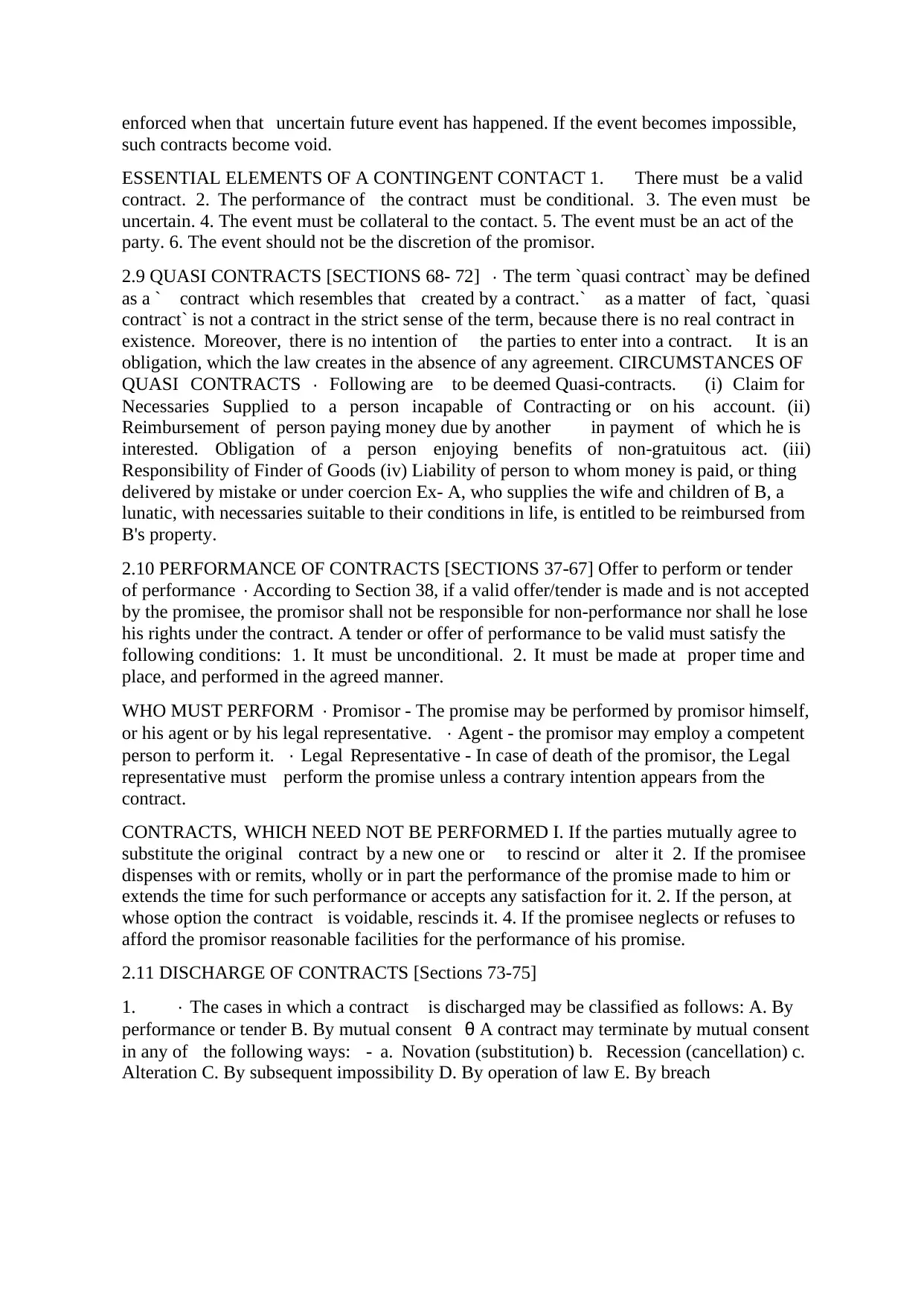
enforced when that uncertain future event has happened. If the event becomes impossible,
such contracts become void.
ESSENTIAL ELEMENTS OF A CONTINGENT CONTACT 1. There must be a valid
contract. 2. The performance of the contract must be conditional. 3. The even must be
uncertain. 4. The event must be collateral to the contact. 5. The event must be an act of the
party. 6. The event should not be the discretion of the promisor.
2.9 QUASI CONTRACTS [SECTIONS 68- 72] ∙ The term `quasi contract` may be defined
as a ` contract which resembles that created by a contract.` as a matter of fact, `quasi
contract` is not a contract in the strict sense of the term, because there is no real contract in
existence. Moreover, there is no intention of the parties to enter into a contract. It is an
obligation, which the law creates in the absence of any agreement. CIRCUMSTANCES OF
QUASI CONTRACTS ∙ Following are to be deemed Quasi-contracts. (i) Claim for
Necessaries Supplied to a person incapable of Contracting or on his account. (ii)
Reimbursement of person paying money due by another in payment of which he is
interested. Obligation of a person enjoying benefits of non-gratuitous act. (iii)
Responsibility of Finder of Goods (iv) Liability of person to whom money is paid, or thing
delivered by mistake or under coercion Ex- A, who supplies the wife and children of B, a
lunatic, with necessaries suitable to their conditions in life, is entitled to be reimbursed from
B's property.
2.10 PERFORMANCE OF CONTRACTS [SECTIONS 37-67] Offer to perform or tender
of performance ∙ According to Section 38, if a valid offer/tender is made and is not accepted
by the promisee, the promisor shall not be responsible for non-performance nor shall he lose
his rights under the contract. A tender or offer of performance to be valid must satisfy the
following conditions: 1. It must be unconditional. 2. It must be made at proper time and
place, and performed in the agreed manner.
WHO MUST PERFORM ∙ Promisor - The promise may be performed by promisor himself,
or his agent or by his legal representative. ∙ Agent - the promisor may employ a competent
person to perform it. ∙ Legal Representative - In case of death of the promisor, the Legal
representative must perform the promise unless a contrary intention appears from the
contract.
CONTRACTS, WHICH NEED NOT BE PERFORMED I. If the parties mutually agree to
substitute the original contract by a new one or to rescind or alter it 2. If the promisee
dispenses with or remits, wholly or in part the performance of the promise made to him or
extends the time for such performance or accepts any satisfaction for it. 2. If the person, at
whose option the contract is voidable, rescinds it. 4. If the promisee neglects or refuses to
afford the promisor reasonable facilities for the performance of his promise.
2.11 DISCHARGE OF CONTRACTS [Sections 73-75]
1. ∙ The cases in which a contract is discharged may be classified as follows: A. By
performance or tender B. By mutual consent θ A contract may terminate by mutual consent
in any of the following ways: - a. Novation (substitution) b. Recession (cancellation) c.
Alteration C. By subsequent impossibility D. By operation of law E. By breach
such contracts become void.
ESSENTIAL ELEMENTS OF A CONTINGENT CONTACT 1. There must be a valid
contract. 2. The performance of the contract must be conditional. 3. The even must be
uncertain. 4. The event must be collateral to the contact. 5. The event must be an act of the
party. 6. The event should not be the discretion of the promisor.
2.9 QUASI CONTRACTS [SECTIONS 68- 72] ∙ The term `quasi contract` may be defined
as a ` contract which resembles that created by a contract.` as a matter of fact, `quasi
contract` is not a contract in the strict sense of the term, because there is no real contract in
existence. Moreover, there is no intention of the parties to enter into a contract. It is an
obligation, which the law creates in the absence of any agreement. CIRCUMSTANCES OF
QUASI CONTRACTS ∙ Following are to be deemed Quasi-contracts. (i) Claim for
Necessaries Supplied to a person incapable of Contracting or on his account. (ii)
Reimbursement of person paying money due by another in payment of which he is
interested. Obligation of a person enjoying benefits of non-gratuitous act. (iii)
Responsibility of Finder of Goods (iv) Liability of person to whom money is paid, or thing
delivered by mistake or under coercion Ex- A, who supplies the wife and children of B, a
lunatic, with necessaries suitable to their conditions in life, is entitled to be reimbursed from
B's property.
2.10 PERFORMANCE OF CONTRACTS [SECTIONS 37-67] Offer to perform or tender
of performance ∙ According to Section 38, if a valid offer/tender is made and is not accepted
by the promisee, the promisor shall not be responsible for non-performance nor shall he lose
his rights under the contract. A tender or offer of performance to be valid must satisfy the
following conditions: 1. It must be unconditional. 2. It must be made at proper time and
place, and performed in the agreed manner.
WHO MUST PERFORM ∙ Promisor - The promise may be performed by promisor himself,
or his agent or by his legal representative. ∙ Agent - the promisor may employ a competent
person to perform it. ∙ Legal Representative - In case of death of the promisor, the Legal
representative must perform the promise unless a contrary intention appears from the
contract.
CONTRACTS, WHICH NEED NOT BE PERFORMED I. If the parties mutually agree to
substitute the original contract by a new one or to rescind or alter it 2. If the promisee
dispenses with or remits, wholly or in part the performance of the promise made to him or
extends the time for such performance or accepts any satisfaction for it. 2. If the person, at
whose option the contract is voidable, rescinds it. 4. If the promisee neglects or refuses to
afford the promisor reasonable facilities for the performance of his promise.
2.11 DISCHARGE OF CONTRACTS [Sections 73-75]
1. ∙ The cases in which a contract is discharged may be classified as follows: A. By
performance or tender B. By mutual consent θ A contract may terminate by mutual consent
in any of the following ways: - a. Novation (substitution) b. Recession (cancellation) c.
Alteration C. By subsequent impossibility D. By operation of law E. By breach
Paraphrase This Document
Need a fresh take? Get an instant paraphrase of this document with our AI Paraphraser
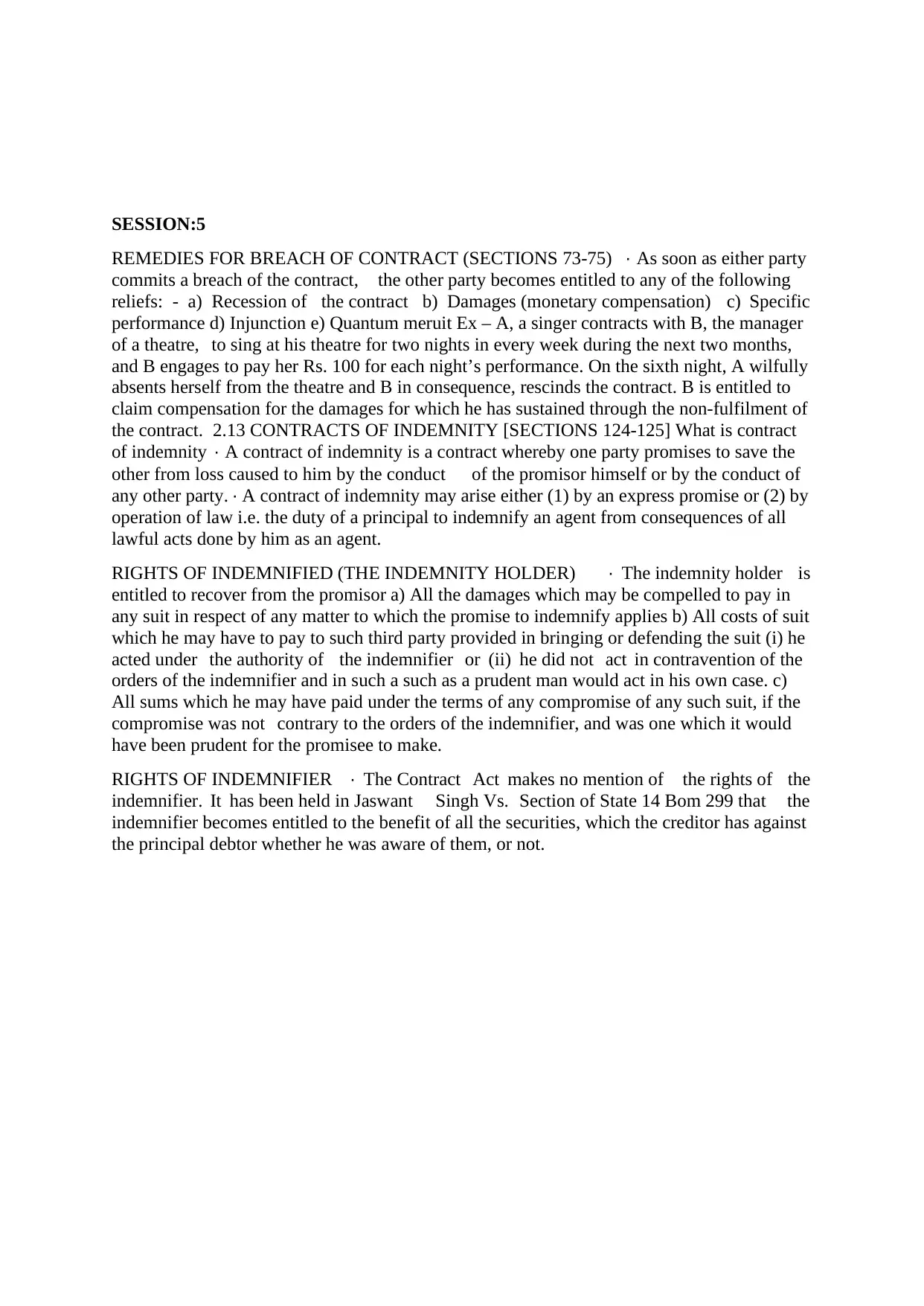
SESSION:5
REMEDIES FOR BREACH OF CONTRACT (SECTIONS 73-75) ∙ As soon as either party
commits a breach of the contract, the other party becomes entitled to any of the following
reliefs: - a) Recession of the contract b) Damages (monetary compensation) c) Specific
performance d) Injunction e) Quantum meruit Ex – A, a singer contracts with B, the manager
of a theatre, to sing at his theatre for two nights in every week during the next two months,
and B engages to pay her Rs. 100 for each night’s performance. On the sixth night, A wilfully
absents herself from the theatre and B in consequence, rescinds the contract. B is entitled to
claim compensation for the damages for which he has sustained through the non-fulfilment of
the contract. 2.13 CONTRACTS OF INDEMNITY [SECTIONS 124-125] What is contract
of indemnity ∙ A contract of indemnity is a contract whereby one party promises to save the
other from loss caused to him by the conduct of the promisor himself or by the conduct of
any other party. ∙ A contract of indemnity may arise either (1) by an express promise or (2) by
operation of law i.e. the duty of a principal to indemnify an agent from consequences of all
lawful acts done by him as an agent.
RIGHTS OF INDEMNIFIED (THE INDEMNITY HOLDER) ∙ The indemnity holder is
entitled to recover from the promisor a) All the damages which may be compelled to pay in
any suit in respect of any matter to which the promise to indemnify applies b) All costs of suit
which he may have to pay to such third party provided in bringing or defending the suit (i) he
acted under the authority of the indemnifier or (ii) he did not act in contravention of the
orders of the indemnifier and in such a such as a prudent man would act in his own case. c)
All sums which he may have paid under the terms of any compromise of any such suit, if the
compromise was not contrary to the orders of the indemnifier, and was one which it would
have been prudent for the promisee to make.
RIGHTS OF INDEMNIFIER ∙ The Contract Act makes no mention of the rights of the
indemnifier. It has been held in Jaswant Singh Vs. Section of State 14 Bom 299 that the
indemnifier becomes entitled to the benefit of all the securities, which the creditor has against
the principal debtor whether he was aware of them, or not.
REMEDIES FOR BREACH OF CONTRACT (SECTIONS 73-75) ∙ As soon as either party
commits a breach of the contract, the other party becomes entitled to any of the following
reliefs: - a) Recession of the contract b) Damages (monetary compensation) c) Specific
performance d) Injunction e) Quantum meruit Ex – A, a singer contracts with B, the manager
of a theatre, to sing at his theatre for two nights in every week during the next two months,
and B engages to pay her Rs. 100 for each night’s performance. On the sixth night, A wilfully
absents herself from the theatre and B in consequence, rescinds the contract. B is entitled to
claim compensation for the damages for which he has sustained through the non-fulfilment of
the contract. 2.13 CONTRACTS OF INDEMNITY [SECTIONS 124-125] What is contract
of indemnity ∙ A contract of indemnity is a contract whereby one party promises to save the
other from loss caused to him by the conduct of the promisor himself or by the conduct of
any other party. ∙ A contract of indemnity may arise either (1) by an express promise or (2) by
operation of law i.e. the duty of a principal to indemnify an agent from consequences of all
lawful acts done by him as an agent.
RIGHTS OF INDEMNIFIED (THE INDEMNITY HOLDER) ∙ The indemnity holder is
entitled to recover from the promisor a) All the damages which may be compelled to pay in
any suit in respect of any matter to which the promise to indemnify applies b) All costs of suit
which he may have to pay to such third party provided in bringing or defending the suit (i) he
acted under the authority of the indemnifier or (ii) he did not act in contravention of the
orders of the indemnifier and in such a such as a prudent man would act in his own case. c)
All sums which he may have paid under the terms of any compromise of any such suit, if the
compromise was not contrary to the orders of the indemnifier, and was one which it would
have been prudent for the promisee to make.
RIGHTS OF INDEMNIFIER ∙ The Contract Act makes no mention of the rights of the
indemnifier. It has been held in Jaswant Singh Vs. Section of State 14 Bom 299 that the
indemnifier becomes entitled to the benefit of all the securities, which the creditor has against
the principal debtor whether he was aware of them, or not.
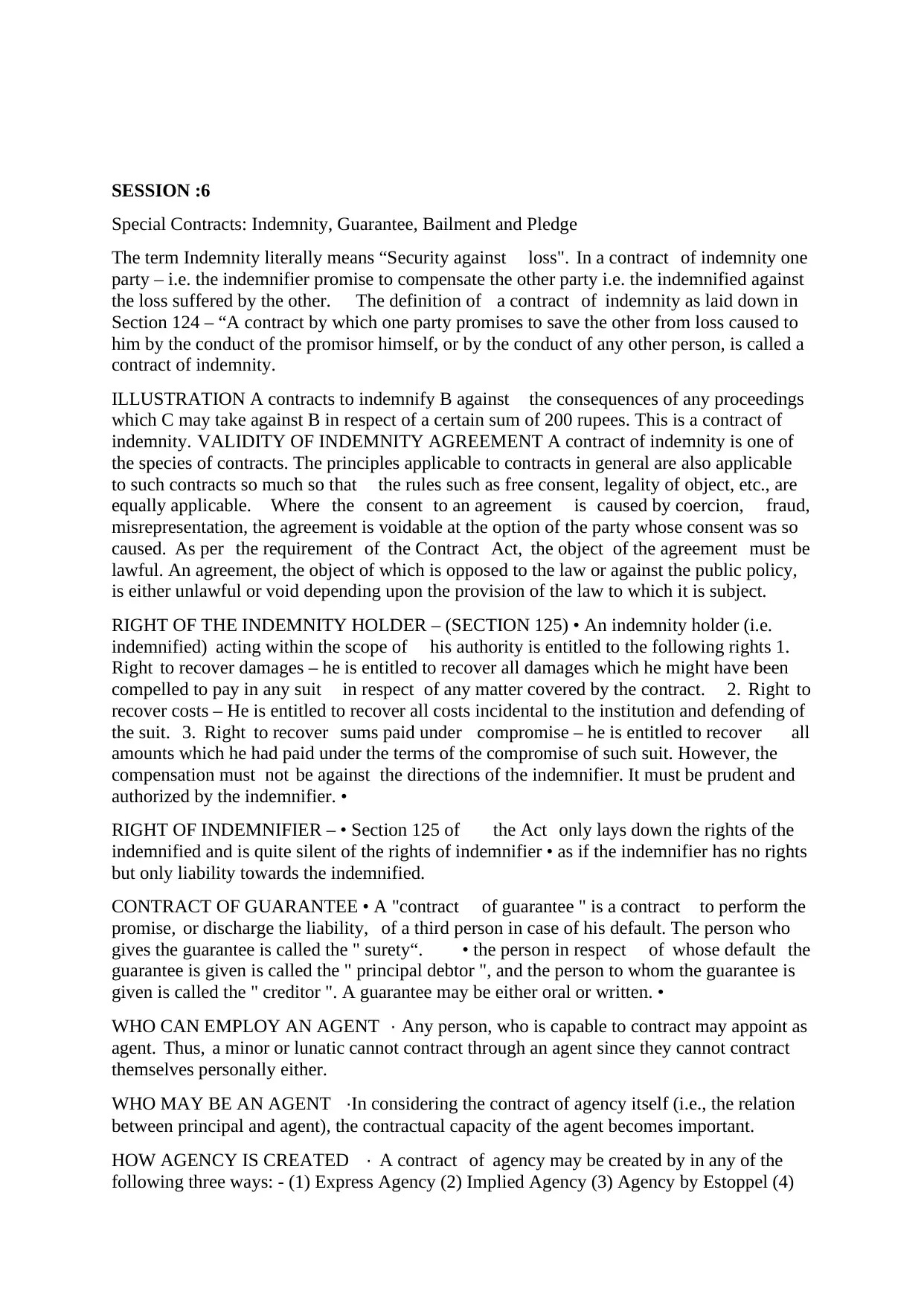
SESSION :6
Special Contracts: Indemnity, Guarantee, Bailment and Pledge
The term Indemnity literally means “Security against loss". In a contract of indemnity one
party – i.e. the indemnifier promise to compensate the other party i.e. the indemnified against
the loss suffered by the other. The definition of a contract of indemnity as laid down in
Section 124 – “A contract by which one party promises to save the other from loss caused to
him by the conduct of the promisor himself, or by the conduct of any other person, is called a
contract of indemnity.
ILLUSTRATION A contracts to indemnify B against the consequences of any proceedings
which C may take against B in respect of a certain sum of 200 rupees. This is a contract of
indemnity. VALIDITY OF INDEMNITY AGREEMENT A contract of indemnity is one of
the species of contracts. The principles applicable to contracts in general are also applicable
to such contracts so much so that the rules such as free consent, legality of object, etc., are
equally applicable. Where the consent to an agreement is caused by coercion, fraud,
misrepresentation, the agreement is voidable at the option of the party whose consent was so
caused. As per the requirement of the Contract Act, the object of the agreement must be
lawful. An agreement, the object of which is opposed to the law or against the public policy,
is either unlawful or void depending upon the provision of the law to which it is subject.
RIGHT OF THE INDEMNITY HOLDER – (SECTION 125) • An indemnity holder (i.e.
indemnified) acting within the scope of his authority is entitled to the following rights 1.
Right to recover damages – he is entitled to recover all damages which he might have been
compelled to pay in any suit in respect of any matter covered by the contract. 2. Right to
recover costs – He is entitled to recover all costs incidental to the institution and defending of
the suit. 3. Right to recover sums paid under compromise – he is entitled to recover all
amounts which he had paid under the terms of the compromise of such suit. However, the
compensation must not be against the directions of the indemnifier. It must be prudent and
authorized by the indemnifier. •
RIGHT OF INDEMNIFIER – • Section 125 of the Act only lays down the rights of the
indemnified and is quite silent of the rights of indemnifier • as if the indemnifier has no rights
but only liability towards the indemnified.
CONTRACT OF GUARANTEE • A "contract of guarantee " is a contract to perform the
promise, or discharge the liability, of a third person in case of his default. The person who
gives the guarantee is called the " surety“. • the person in respect of whose default the
guarantee is given is called the " principal debtor ", and the person to whom the guarantee is
given is called the " creditor ". A guarantee may be either oral or written. •
WHO CAN EMPLOY AN AGENT ∙ Any person, who is capable to contract may appoint as
agent. Thus, a minor or lunatic cannot contract through an agent since they cannot contract
themselves personally either.
WHO MAY BE AN AGENT ∙In considering the contract of agency itself (i.e., the relation
between principal and agent), the contractual capacity of the agent becomes important.
HOW AGENCY IS CREATED ∙ A contract of agency may be created by in any of the
following three ways: - (1) Express Agency (2) Implied Agency (3) Agency by Estoppel (4)
Special Contracts: Indemnity, Guarantee, Bailment and Pledge
The term Indemnity literally means “Security against loss". In a contract of indemnity one
party – i.e. the indemnifier promise to compensate the other party i.e. the indemnified against
the loss suffered by the other. The definition of a contract of indemnity as laid down in
Section 124 – “A contract by which one party promises to save the other from loss caused to
him by the conduct of the promisor himself, or by the conduct of any other person, is called a
contract of indemnity.
ILLUSTRATION A contracts to indemnify B against the consequences of any proceedings
which C may take against B in respect of a certain sum of 200 rupees. This is a contract of
indemnity. VALIDITY OF INDEMNITY AGREEMENT A contract of indemnity is one of
the species of contracts. The principles applicable to contracts in general are also applicable
to such contracts so much so that the rules such as free consent, legality of object, etc., are
equally applicable. Where the consent to an agreement is caused by coercion, fraud,
misrepresentation, the agreement is voidable at the option of the party whose consent was so
caused. As per the requirement of the Contract Act, the object of the agreement must be
lawful. An agreement, the object of which is opposed to the law or against the public policy,
is either unlawful or void depending upon the provision of the law to which it is subject.
RIGHT OF THE INDEMNITY HOLDER – (SECTION 125) • An indemnity holder (i.e.
indemnified) acting within the scope of his authority is entitled to the following rights 1.
Right to recover damages – he is entitled to recover all damages which he might have been
compelled to pay in any suit in respect of any matter covered by the contract. 2. Right to
recover costs – He is entitled to recover all costs incidental to the institution and defending of
the suit. 3. Right to recover sums paid under compromise – he is entitled to recover all
amounts which he had paid under the terms of the compromise of such suit. However, the
compensation must not be against the directions of the indemnifier. It must be prudent and
authorized by the indemnifier. •
RIGHT OF INDEMNIFIER – • Section 125 of the Act only lays down the rights of the
indemnified and is quite silent of the rights of indemnifier • as if the indemnifier has no rights
but only liability towards the indemnified.
CONTRACT OF GUARANTEE • A "contract of guarantee " is a contract to perform the
promise, or discharge the liability, of a third person in case of his default. The person who
gives the guarantee is called the " surety“. • the person in respect of whose default the
guarantee is given is called the " principal debtor ", and the person to whom the guarantee is
given is called the " creditor ". A guarantee may be either oral or written. •
WHO CAN EMPLOY AN AGENT ∙ Any person, who is capable to contract may appoint as
agent. Thus, a minor or lunatic cannot contract through an agent since they cannot contract
themselves personally either.
WHO MAY BE AN AGENT ∙In considering the contract of agency itself (i.e., the relation
between principal and agent), the contractual capacity of the agent becomes important.
HOW AGENCY IS CREATED ∙ A contract of agency may be created by in any of the
following three ways: - (1) Express Agency (2) Implied Agency (3) Agency by Estoppel (4)
⊘ This is a preview!⊘
Do you want full access?
Subscribe today to unlock all pages.
Trusted by 1+ million students worldwide

1 out of 21


Related Documents


Your All-in-One AI-Powered Toolkit for Academic Success.
+13062052269
info@desklib.com
Available 24*7 on WhatsApp / Email
![[object Object]](/_next/static/media/star-bottom.7253800d.svg)
Unlock your academic potential
Copyright © 2020–2026 A2Z Services. All Rights Reserved. Developed and managed by ZUCOL.