Business Law: Impact of UK Law on Business Operations (Coursework)
VerifiedAdded on 2021/02/20
|19
|6119
|171
Report
AI Summary
This report provides a comprehensive overview of the UK business law landscape. It begins by defining key concepts like parliament sovereignty and explores the different sources of UK law, including common law, constitution, and statutory law. The report then details the role of the government in the law-making process, outlining the stages a bill goes through to become an act. Furthermore, it examines the impact of employment, contract, and company law on business operations, highlighting the legal requirements and considerations for different types of businesses, including incorporated and unincorporated entities. The report also includes case studies to illustrate the application of legal principles. Finally, it offers a legal solution to business problems based on UK laws and common law principles.
Business law

Paraphrase This Document
Need a fresh take? Get an instant paraphrase of this document with our AI Paraphraser
Table of Contents
INTRODUCTION...........................................................................................................................1
TASK 1............................................................................................................................................2
Meaning of statement "parliament sovereignty" and different sources of UK law.....................2
Role of Government in the law making process..........................................................................4
Impact of employment law, contract law and company law over functioning and operations of
company ......................................................................................................................................6
TASK 2............................................................................................................................................9
Nature and Formation of different types of business...................................................................9
Difference between Unincorporated and Incorporated business...............................................11
How different businesses are funded and managed...................................................................11
CASE 1..........................................................................................................................................11
CASE 2..........................................................................................................................................13
CONCLUSION..............................................................................................................................15
REFERENCES..............................................................................................................................16
INTRODUCTION...........................................................................................................................1
TASK 1............................................................................................................................................2
Meaning of statement "parliament sovereignty" and different sources of UK law.....................2
Role of Government in the law making process..........................................................................4
Impact of employment law, contract law and company law over functioning and operations of
company ......................................................................................................................................6
TASK 2............................................................................................................................................9
Nature and Formation of different types of business...................................................................9
Difference between Unincorporated and Incorporated business...............................................11
How different businesses are funded and managed...................................................................11
CASE 1..........................................................................................................................................11
CASE 2..........................................................................................................................................13
CONCLUSION..............................................................................................................................15
REFERENCES..............................................................................................................................16
INTRODUCTION
A set of different rules, standards and regulations that are needed to be comply with by
each person of the country is known as law. In addition, English legal system contains a different
set of rules and regulations that is being formulated in order to govern various business
organisations working within the country (Horton and et.al., 2017). These laws contains rules
regarding each activity of the company. It helps in maintaining ethical values within the
business. Along with this, it also leads in preventing companies from fraud and other
uncertainties. Moreover, the aim of creating legislation for the businesses is to create a unified
and safe environment wherein the rights of the parties are protected and business activities takes
place in an organised manner. In United Kingdom, the power of making law lies in the hand of
British Parliament. It is the legislative body of the country. The acts passed by parliament is
called as statue which is also a source of English law. The government of the country plays a
major role in creation of a law. It is the government which prepares a draft bill which is then
presented in the lower and upper houses of parliament for attaining their approval. Once, a bill is
passed from the both the houses of the parliament, the royal assent for the same is taken which
afterwards takes the form of enacted legislation in the country.
Commercial law is broadly categorized into three parts such as employment law, contract
law and company law. Each of the legislation affects business functions in a significant way.
English contract law is a set of regulations which provides a framework relating to contract in
United Kingdom. The basic meaning of contract is an agreement which involves two or more
parties who have mutually consented to a specific terms and conditions and have a legal
obligation to perform their parts on a specific day. Such a contract is enforceable by law and is
presented as a conclusive proof in the event when parties gets involved in a dispute.
While company law in UK governs all the activities relating to company's formation,
operations and its liquidation. For instance, for starting a public company, there are some legal
requirements which are to be met by the people desiring of opening such class of company. A
public company must have at least 2 directors and a company secretary along with a paid up
capital 50,000 pounds. The company has to be listed on a recognised stock exchange in the
country. Another business law which is employment law is concerned with governance of
employee-employer relationship. It provides provisions relating to the duties, responsibilities,
liabilities and rights of a employee and an employer. Furthermore, it also lays out provisions that
1
A set of different rules, standards and regulations that are needed to be comply with by
each person of the country is known as law. In addition, English legal system contains a different
set of rules and regulations that is being formulated in order to govern various business
organisations working within the country (Horton and et.al., 2017). These laws contains rules
regarding each activity of the company. It helps in maintaining ethical values within the
business. Along with this, it also leads in preventing companies from fraud and other
uncertainties. Moreover, the aim of creating legislation for the businesses is to create a unified
and safe environment wherein the rights of the parties are protected and business activities takes
place in an organised manner. In United Kingdom, the power of making law lies in the hand of
British Parliament. It is the legislative body of the country. The acts passed by parliament is
called as statue which is also a source of English law. The government of the country plays a
major role in creation of a law. It is the government which prepares a draft bill which is then
presented in the lower and upper houses of parliament for attaining their approval. Once, a bill is
passed from the both the houses of the parliament, the royal assent for the same is taken which
afterwards takes the form of enacted legislation in the country.
Commercial law is broadly categorized into three parts such as employment law, contract
law and company law. Each of the legislation affects business functions in a significant way.
English contract law is a set of regulations which provides a framework relating to contract in
United Kingdom. The basic meaning of contract is an agreement which involves two or more
parties who have mutually consented to a specific terms and conditions and have a legal
obligation to perform their parts on a specific day. Such a contract is enforceable by law and is
presented as a conclusive proof in the event when parties gets involved in a dispute.
While company law in UK governs all the activities relating to company's formation,
operations and its liquidation. For instance, for starting a public company, there are some legal
requirements which are to be met by the people desiring of opening such class of company. A
public company must have at least 2 directors and a company secretary along with a paid up
capital 50,000 pounds. The company has to be listed on a recognised stock exchange in the
country. Another business law which is employment law is concerned with governance of
employee-employer relationship. It provides provisions relating to the duties, responsibilities,
liabilities and rights of a employee and an employer. Furthermore, it also lays out provisions that
1
⊘ This is a preview!⊘
Do you want full access?
Subscribe today to unlock all pages.

Trusted by 1+ million students worldwide
are related to discrimination at the workplace. Equality Act 2010, is the law which states
provisions that prohibits any kind of discrimination being practised against any person at the
workplace.
The present study shows a detailed description of overall English legal system along with
different sources of law and role of government in the law making procedure. It shows
sovereignty of parliament in overall legal system of UK. Further, it shows the impact of different
laws such as company, employment and contract law over functioning of different companies
along with describing difference between legislation, regulation and standards. The report will
also highlight the differences between incorporated and unincorporated businesses in relation to
how they are managed and funded. At the end of study, the report also provides legal solution for
some business problems on the basis of different rules and laws applicable on the case and
common laws of UK.
TASK 1
Meaning of statement "parliament sovereignty" and different sources of UK law
Parliament sovereignty
The term sovereignty can be defined as the superior position and dominating power of an
authority within the country. The queen is on top of the county but doesn’t have political power,
doesn’t have power over the parliament do the fact that the monarchy is inherited and transmitted
from generations to generations ,while the parliament in Uk is democratic elected by the people
at every 5 years ,unless the prim minister convene early elections. The constitution has provided
power to create as well as end any law within the country. Further, no one have right to override
any rule or regulation developed by the parliament. In this regard, it can be stated that the
statement “parliament sovereignty” is right in context to English legal system.
In Uk , the parliament and the judge makes the laws, named common laws. The judge has a
consultative role, can’t challenge the parliament rules, the parliament is above of
everything ,being democratic elected, empowered by the people to choose and decide for
them ,while the judge position is a job carrier.
In other words, the meaning of term parliament sovereignty is a description which lays
out the degree up to which UK's Parliament have absolute power of law making. It is basically a
principle of constitution of United Kingdom which reflects the supremacy of the authority of
Parliament that includes creation or ending of any law. The legislation created by parliament are
2
provisions that prohibits any kind of discrimination being practised against any person at the
workplace.
The present study shows a detailed description of overall English legal system along with
different sources of law and role of government in the law making procedure. It shows
sovereignty of parliament in overall legal system of UK. Further, it shows the impact of different
laws such as company, employment and contract law over functioning of different companies
along with describing difference between legislation, regulation and standards. The report will
also highlight the differences between incorporated and unincorporated businesses in relation to
how they are managed and funded. At the end of study, the report also provides legal solution for
some business problems on the basis of different rules and laws applicable on the case and
common laws of UK.
TASK 1
Meaning of statement "parliament sovereignty" and different sources of UK law
Parliament sovereignty
The term sovereignty can be defined as the superior position and dominating power of an
authority within the country. The queen is on top of the county but doesn’t have political power,
doesn’t have power over the parliament do the fact that the monarchy is inherited and transmitted
from generations to generations ,while the parliament in Uk is democratic elected by the people
at every 5 years ,unless the prim minister convene early elections. The constitution has provided
power to create as well as end any law within the country. Further, no one have right to override
any rule or regulation developed by the parliament. In this regard, it can be stated that the
statement “parliament sovereignty” is right in context to English legal system.
In Uk , the parliament and the judge makes the laws, named common laws. The judge has a
consultative role, can’t challenge the parliament rules, the parliament is above of
everything ,being democratic elected, empowered by the people to choose and decide for
them ,while the judge position is a job carrier.
In other words, the meaning of term parliament sovereignty is a description which lays
out the degree up to which UK's Parliament have absolute power of law making. It is basically a
principle of constitution of United Kingdom which reflects the supremacy of the authority of
Parliament that includes creation or ending of any law. The legislation created by parliament are
2
Paraphrase This Document
Need a fresh take? Get an instant paraphrase of this document with our AI Paraphraser
mandatory to be followed by the country. Further, parliament itself cannot pass any such law
which the upcoming parliament cannot variate. The term parliament sovereignty is a highly
specific doctrine as compared to UK's constitution. This signifies that parliament has no legal
boundary in relation to its powers which in turns reflects the unlimited legal competency of
British Parliament.
The doctrine of supremacy of British Parliament provides three basic points which
includes; that parliament of UK have the ultimate power of creating legislation regarding any
matter in the country, parliament cannot bound the future parliamentary acts and lastly, a
parliamentary act which is valid cannot be questioned by the judiciary. Because United Kingdom
is a member of European Union, the courts of the nation recognises EU supremacy over British
Parliament supremacy. The reason behind this is that EU legislation does not recognize the
concept of British parliament supremacy.
Sources of law:
Each legal system contains a range of sources on the basis of which each law in the
country is being formulated. These sources contain rules and regulations in context to ethical
values, cultural values and some binding rules of the country. Following are some major sources
of law of the English legal system:
Common law or the case law :are created by the judge but are not written,are the judicial
precedent decisions or case laws which takes a form of governing rule or legislation. Many
cases are provided decree on the basis of decisions that have taken in the past by similar or
higher judicial body or tribunal. These common laws act as a guide for the judges, and they
are bound to follow such common law when they are presented with similar kind of cases.
Thus, it can be said that common law is one of the source through which law comes into
existence.
Constitution: Constitution is considered as a fundamental law of a country. It provides the laws
and legislations which are fundamental in nature and are applicable to each and every citizen
of the nation. Second thing which makes it a source of law is that it segregates the power
between Legislative, executive and judicial level.
Statutory law:
The term statutory law can be defined as written laws which are enacted by the legislative
body of the nation. These laws are created deliberately by the elected representatives which are
3
which the upcoming parliament cannot variate. The term parliament sovereignty is a highly
specific doctrine as compared to UK's constitution. This signifies that parliament has no legal
boundary in relation to its powers which in turns reflects the unlimited legal competency of
British Parliament.
The doctrine of supremacy of British Parliament provides three basic points which
includes; that parliament of UK have the ultimate power of creating legislation regarding any
matter in the country, parliament cannot bound the future parliamentary acts and lastly, a
parliamentary act which is valid cannot be questioned by the judiciary. Because United Kingdom
is a member of European Union, the courts of the nation recognises EU supremacy over British
Parliament supremacy. The reason behind this is that EU legislation does not recognize the
concept of British parliament supremacy.
Sources of law:
Each legal system contains a range of sources on the basis of which each law in the
country is being formulated. These sources contain rules and regulations in context to ethical
values, cultural values and some binding rules of the country. Following are some major sources
of law of the English legal system:
Common law or the case law :are created by the judge but are not written,are the judicial
precedent decisions or case laws which takes a form of governing rule or legislation. Many
cases are provided decree on the basis of decisions that have taken in the past by similar or
higher judicial body or tribunal. These common laws act as a guide for the judges, and they
are bound to follow such common law when they are presented with similar kind of cases.
Thus, it can be said that common law is one of the source through which law comes into
existence.
Constitution: Constitution is considered as a fundamental law of a country. It provides the laws
and legislations which are fundamental in nature and are applicable to each and every citizen
of the nation. Second thing which makes it a source of law is that it segregates the power
between Legislative, executive and judicial level.
Statutory law:
The term statutory law can be defined as written laws which are enacted by the legislative
body of the nation. These laws are created deliberately by the elected representatives which are
3
applicable on whole of the country In the English legal system, the parliament contains the most
supreme legislation power (Medway, Roper and Gillooly, 2018).
Legislation: It includes acts of Parliament which are created by the legislature. Principal body of
making legislation in United Kingdom is British Parliament located in London. This body
holds the power of passing bills and enabling such bills to be termed as enacted laws.
European Union law: Being a member of European Union , English law has derived its base
from the rules, regulation and legislation of European Union. Also, Law of EU takes
precedence over the law of United Kingdom. For example, European Convention on Human
Rights have to be signed and duly followed by the UK legal system, since it was a member
of European Union.
Role of Government in the law making process
As per the constitution of UK, the overall law making process is needed to be performed
by authorised ministers of UK. The constitution provides information regarding rights and duties
of each governing authority of the government towards country. The elected representatives
collectively comprises Parliament which is responsible for making laws in the country. This
legislative body is also responsible for monitoring the activities of government.
Law making process in United Kingdom
4
supreme legislation power (Medway, Roper and Gillooly, 2018).
Legislation: It includes acts of Parliament which are created by the legislature. Principal body of
making legislation in United Kingdom is British Parliament located in London. This body
holds the power of passing bills and enabling such bills to be termed as enacted laws.
European Union law: Being a member of European Union , English law has derived its base
from the rules, regulation and legislation of European Union. Also, Law of EU takes
precedence over the law of United Kingdom. For example, European Convention on Human
Rights have to be signed and duly followed by the UK legal system, since it was a member
of European Union.
Role of Government in the law making process
As per the constitution of UK, the overall law making process is needed to be performed
by authorised ministers of UK. The constitution provides information regarding rights and duties
of each governing authority of the government towards country. The elected representatives
collectively comprises Parliament which is responsible for making laws in the country. This
legislative body is also responsible for monitoring the activities of government.
Law making process in United Kingdom
4
⊘ This is a preview!⊘
Do you want full access?
Subscribe today to unlock all pages.
Trusted by 1+ million students worldwide
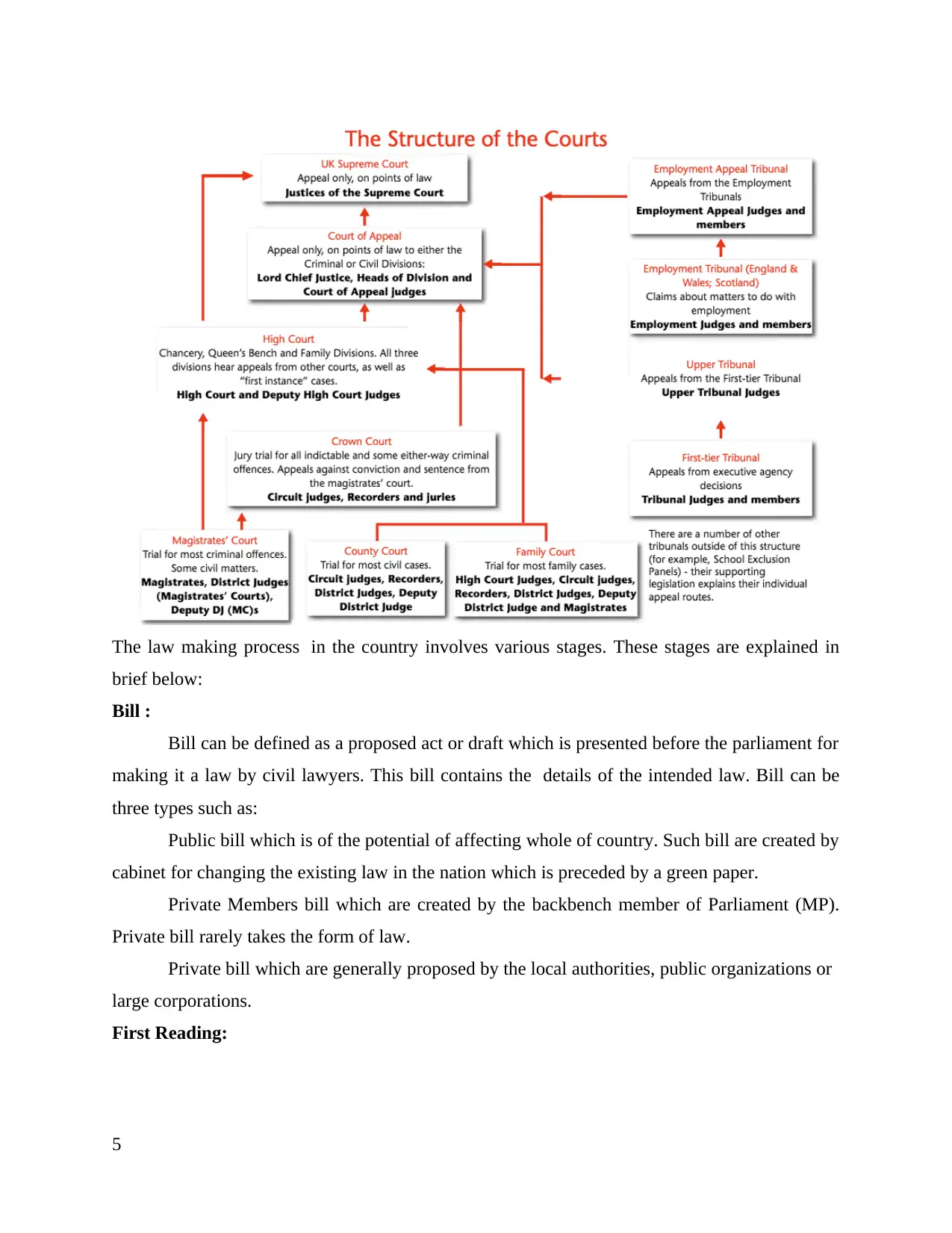
The law making process in the country involves various stages. These stages are explained in
brief below:
Bill :
Bill can be defined as a proposed act or draft which is presented before the parliament for
making it a law by civil lawyers. This bill contains the details of the intended law. Bill can be
three types such as:
Public bill which is of the potential of affecting whole of country. Such bill are created by
cabinet for changing the existing law in the nation which is preceded by a green paper.
Private Members bill which are created by the backbench member of Parliament (MP).
Private bill rarely takes the form of law.
Private bill which are generally proposed by the local authorities, public organizations or
large corporations.
First Reading:
5
brief below:
Bill :
Bill can be defined as a proposed act or draft which is presented before the parliament for
making it a law by civil lawyers. This bill contains the details of the intended law. Bill can be
three types such as:
Public bill which is of the potential of affecting whole of country. Such bill are created by
cabinet for changing the existing law in the nation which is preceded by a green paper.
Private Members bill which are created by the backbench member of Parliament (MP).
Private bill rarely takes the form of law.
Private bill which are generally proposed by the local authorities, public organizations or
large corporations.
First Reading:
5
Paraphrase This Document
Need a fresh take? Get an instant paraphrase of this document with our AI Paraphraser
This is the second stage in law making process in United Kingdom. In this phase, name
of the proposed bill and what are its components are read in the House of Commons. No action is
taken at this stage.
Second Reading:
In this reading, the elements of the proposed bill is debated and amendments in the bill
takes place. Member of Parliament after wards vote which is concerned with whether the
intended bill shall be further proceed or not(Stages of Law Making in the UK. 2018) .
Committee Stage:
At this stage in the law making process, the bill is presented before the committee of
House of Commons for the purpose of detailed examination and verification of the facts.
Committee is allowed to provide further suggestions or amendments n relation to the bill, if it is
required.
Report Stage:
Amendments and committee report is sent back to the House of Commons on which
further debate takes place. However, the duration of the debate could be short. Vote is taken
from the members of parliament for accepting or rejecting the amendments on the proposed bill
by the committee (Stages of Law Making in the UK, 2018.).
House of Lords:
This the upper house of British Parliament. After the bill has been passed from the report
stage, it is then presented in the House of Lords. Further amendments and changes are made if
needed in this house and is again in the House of Commons for considering the same. When the
bill comes back with approval from the lower house, House of Lords gives its green signal for
sending it for getting the royal assent on the proposed bill.
Royal Assent:
This is the last stage in the law making process, wherein the assent of Queen is taken for
approving the bill. A bill becomes an act only it obtains the assent of the Queen.
Impact of employment law, contract law and company law over functioning and operations of
company
Difference between legislation, standards and regulations
Legislations, standards and regulation, each are different from each other. Legislation of
the country provides detailed information regarding legal requirements of each law exists within
6
of the proposed bill and what are its components are read in the House of Commons. No action is
taken at this stage.
Second Reading:
In this reading, the elements of the proposed bill is debated and amendments in the bill
takes place. Member of Parliament after wards vote which is concerned with whether the
intended bill shall be further proceed or not(Stages of Law Making in the UK. 2018) .
Committee Stage:
At this stage in the law making process, the bill is presented before the committee of
House of Commons for the purpose of detailed examination and verification of the facts.
Committee is allowed to provide further suggestions or amendments n relation to the bill, if it is
required.
Report Stage:
Amendments and committee report is sent back to the House of Commons on which
further debate takes place. However, the duration of the debate could be short. Vote is taken
from the members of parliament for accepting or rejecting the amendments on the proposed bill
by the committee (Stages of Law Making in the UK, 2018.).
House of Lords:
This the upper house of British Parliament. After the bill has been passed from the report
stage, it is then presented in the House of Lords. Further amendments and changes are made if
needed in this house and is again in the House of Commons for considering the same. When the
bill comes back with approval from the lower house, House of Lords gives its green signal for
sending it for getting the royal assent on the proposed bill.
Royal Assent:
This is the last stage in the law making process, wherein the assent of Queen is taken for
approving the bill. A bill becomes an act only it obtains the assent of the Queen.
Impact of employment law, contract law and company law over functioning and operations of
company
Difference between legislation, standards and regulations
Legislations, standards and regulation, each are different from each other. Legislation of
the country provides detailed information regarding legal requirements of each law exists within
6
the legal system. legislations help in ensuring compliance of each rule applicable over any
person of the country (Laws vs. Regulations vs. Standards. 2018)
Where as , regulations of a legal system provides details regarding reason behind formulation
of each law of the country. It shows that how the law is to be enforced within the country. In this
regard, the regulations help in effective monitoring and control over the legal system of the
country.
On the other hand, standards are being developed in order to provide specifications and
minimum requirements regarding quality of product and services. Standards developed in the
country help in maintenance of quality, efficiency and maintaining safety standards among the
goods and services traded with in the organisation.
Impact of different laws on operations of business organisation
Business law contains a range of laws and rules with the compliance of which the
company can ensure effective working of overall business. Although, by complying with these
laws the various operations and functioning of the company get affected. Potential impact of
different laws over the company can be analysed as under:
Company law: It is one of the essential law of the country. Companies Act 2006 has
been formulated in the English legal system in order to maintain control and monitor over each
activity relating to business organisation of the country. The act contains guidelines and rules to
be followed by the company for performing each activity starting from the formulation
procedure of the firm till its dissolution. Therefore, the company law have a potential impact
over the functioning of a company (Ziegler, Wicks and Hodson, 2015).
For example, in case the company wants to acquire any another business organization
for expansion purpose, it can not complete the procedure just by purchasing the company and
paying consideration against it. Rather, due to rules mentioned in the companies Act 2006, It
requires passing special regulation by taking extraordinary general meeting of the shareholders.
Further, the act also makes the company to advertise into a local and an English newspaper
containing the acquisition of the company. In addition, the firm also needs to inform the registrar
of the state regarding the acquisition procedure held by the company.
Compliance of all these procedures increases the procedure of acquisition along with
increasing the cost to be incurred by the company for acquiring another business organisation. In
7
person of the country (Laws vs. Regulations vs. Standards. 2018)
Where as , regulations of a legal system provides details regarding reason behind formulation
of each law of the country. It shows that how the law is to be enforced within the country. In this
regard, the regulations help in effective monitoring and control over the legal system of the
country.
On the other hand, standards are being developed in order to provide specifications and
minimum requirements regarding quality of product and services. Standards developed in the
country help in maintenance of quality, efficiency and maintaining safety standards among the
goods and services traded with in the organisation.
Impact of different laws on operations of business organisation
Business law contains a range of laws and rules with the compliance of which the
company can ensure effective working of overall business. Although, by complying with these
laws the various operations and functioning of the company get affected. Potential impact of
different laws over the company can be analysed as under:
Company law: It is one of the essential law of the country. Companies Act 2006 has
been formulated in the English legal system in order to maintain control and monitor over each
activity relating to business organisation of the country. The act contains guidelines and rules to
be followed by the company for performing each activity starting from the formulation
procedure of the firm till its dissolution. Therefore, the company law have a potential impact
over the functioning of a company (Ziegler, Wicks and Hodson, 2015).
For example, in case the company wants to acquire any another business organization
for expansion purpose, it can not complete the procedure just by purchasing the company and
paying consideration against it. Rather, due to rules mentioned in the companies Act 2006, It
requires passing special regulation by taking extraordinary general meeting of the shareholders.
Further, the act also makes the company to advertise into a local and an English newspaper
containing the acquisition of the company. In addition, the firm also needs to inform the registrar
of the state regarding the acquisition procedure held by the company.
Compliance of all these procedures increases the procedure of acquisition along with
increasing the cost to be incurred by the company for acquiring another business organisation. In
7
⊘ This is a preview!⊘
Do you want full access?
Subscribe today to unlock all pages.
Trusted by 1+ million students worldwide
addition, requirements like conduction of extraordinary general meeting, advertisement in
newspaper, etc. leads in increasing the cost of operation of the company (Solomon, 2017)..
Employment law: It is the act that has been formulated in order to prevent each
employee of the country from fraudulent activities of their employers. Employment right Act
1996, Employment and labour law 2019, National minimum wages act 1996, ethical code of
conducts, etc. are some acts covered under the employment law in UK. These laws provides
several rights to the employees with the help of which employees can prevent themselves from
fraudulent activities of their employers.
As per the constitution of UK, at the time of employing any candidate on any vacant
position of the company, the business needs to comply with each rule mentioned in these acts of
employment law. It has direct impact over the workings of business. For example, at the time of
employing any candidate at any vacant position, it needs to enter into an employment contract
with them. Furthermore, both employer and employee would need to perform each activity
relating to the employment as per employment contract made by them. It creates legal
boundation over both employer and employee (Watts, 2017). Further, compliance of these laws
also results in increasing the cost of company as it may lead in making the firm to pay at least
minimum amount of wages as mentioned in the national minimum wages as mentioned in the
national minimum wages act 1996. In addition, due to implication of employment right act, the
company needs to provide maternity leave to its women employees. It may have direct impact
over performance, operation and management of overall business.
Contract law: it is the legal binding agreement between people ,between people and
company,etc. When we build a contract we have 2 or more parts ,an agreement between offerer
and offree,agreement between offerer and offeree.
The elements of the contract are :privacy of the contract ,offer, acceptance,
communication, consideration. This law contains a range of rules, regulations and laws that are
needed to be comply with by each person each time whenever they enters into any contract. In
the English legal system, Contract act 1999 contains different rules to be comply at the time
entering into a contract and performing their task in the contract (Rivera, and et.al., 2016). The
core activity of each business organisation is to buy or sale various goods and services and
generate profit in the form of consideration for the products and services provided to them. This
law also have a potential impact over the business of a company. For Example, In case, the
8
newspaper, etc. leads in increasing the cost of operation of the company (Solomon, 2017)..
Employment law: It is the act that has been formulated in order to prevent each
employee of the country from fraudulent activities of their employers. Employment right Act
1996, Employment and labour law 2019, National minimum wages act 1996, ethical code of
conducts, etc. are some acts covered under the employment law in UK. These laws provides
several rights to the employees with the help of which employees can prevent themselves from
fraudulent activities of their employers.
As per the constitution of UK, at the time of employing any candidate on any vacant
position of the company, the business needs to comply with each rule mentioned in these acts of
employment law. It has direct impact over the workings of business. For example, at the time of
employing any candidate at any vacant position, it needs to enter into an employment contract
with them. Furthermore, both employer and employee would need to perform each activity
relating to the employment as per employment contract made by them. It creates legal
boundation over both employer and employee (Watts, 2017). Further, compliance of these laws
also results in increasing the cost of company as it may lead in making the firm to pay at least
minimum amount of wages as mentioned in the national minimum wages as mentioned in the
national minimum wages act 1996. In addition, due to implication of employment right act, the
company needs to provide maternity leave to its women employees. It may have direct impact
over performance, operation and management of overall business.
Contract law: it is the legal binding agreement between people ,between people and
company,etc. When we build a contract we have 2 or more parts ,an agreement between offerer
and offree,agreement between offerer and offeree.
The elements of the contract are :privacy of the contract ,offer, acceptance,
communication, consideration. This law contains a range of rules, regulations and laws that are
needed to be comply with by each person each time whenever they enters into any contract. In
the English legal system, Contract act 1999 contains different rules to be comply at the time
entering into a contract and performing their task in the contract (Rivera, and et.al., 2016). The
core activity of each business organisation is to buy or sale various goods and services and
generate profit in the form of consideration for the products and services provided to them. This
law also have a potential impact over the business of a company. For Example, In case, the
8
Paraphrase This Document
Need a fresh take? Get an instant paraphrase of this document with our AI Paraphraser
company enters into any agreement regarding sale or purchase of any goods or services, due to
compliance of contract law, the agreement would be treated as a business contract. In this regard,
the company would be needed to comply with each rule mentioned in the contract of the
company. Non compliance of any law may lead in increasing financial uncertainties of the
company.
From analysis of the above study on different laws it can be said that business law
contains different acts that have a major impact over the business operations of a company.
TASK 2
Nature and Formation of different types of business
Various forms of business exists which are different in size, nature or purpose. Below is
the description of various forms of business:
Sole proprietorship:
This is one of the business wherein the business is owned by a single person. The profits
or loss incurred in a business is solely the responsibility of the sole trader. It is characterized by
unlimited liability of the sole trader. The nature of the business is such that it does not have any
separate legal identity from its owner. They are bound by extreme legal boundations like in the
cases of partnerships and limited liability company.
Partnerships:
It is a form of business in which two or more people come together for sharing the profits
and losses of the business, having common interests (Endicott, 2016). There are different kinds
of partnerships which exists such as ordinary partnerships, limited and limited liability
partnerships. Some of the characteristics of partnerships are as follows:
Two or more person is required for forming a partnership.
A partner can be engaged in another business such as member of limited company or any
other partnership.
Agreement between the partners
Profits and loss are shared equally.
Limited Liability companies:
Limited liability companies are of various types such as private limited, private limited
by guarantee, public limited company.
9
compliance of contract law, the agreement would be treated as a business contract. In this regard,
the company would be needed to comply with each rule mentioned in the contract of the
company. Non compliance of any law may lead in increasing financial uncertainties of the
company.
From analysis of the above study on different laws it can be said that business law
contains different acts that have a major impact over the business operations of a company.
TASK 2
Nature and Formation of different types of business
Various forms of business exists which are different in size, nature or purpose. Below is
the description of various forms of business:
Sole proprietorship:
This is one of the business wherein the business is owned by a single person. The profits
or loss incurred in a business is solely the responsibility of the sole trader. It is characterized by
unlimited liability of the sole trader. The nature of the business is such that it does not have any
separate legal identity from its owner. They are bound by extreme legal boundations like in the
cases of partnerships and limited liability company.
Partnerships:
It is a form of business in which two or more people come together for sharing the profits
and losses of the business, having common interests (Endicott, 2016). There are different kinds
of partnerships which exists such as ordinary partnerships, limited and limited liability
partnerships. Some of the characteristics of partnerships are as follows:
Two or more person is required for forming a partnership.
A partner can be engaged in another business such as member of limited company or any
other partnership.
Agreement between the partners
Profits and loss are shared equally.
Limited Liability companies:
Limited liability companies are of various types such as private limited, private limited
by guarantee, public limited company.
9
Company limited by share refers to the association of people that has separate legal
existence from its owners. The liability of shareholders in such company is limited to the unpaid
amount on their shares in the company (Guerin and Barreiro, 2016). No company can call for
extra amount than this. A public company is that company which is listed on a stock exchange
and whose shares are publicly traded by the public. While private company is that company
whose share are not traded on the stock exchange and raise its capital through private placements
of share, loans etc.
An important characteristics of a company is that it is perpetual, meaning of which is
that, it does not get affected by the death of member, rather it continues to exists. This is because
it is created by law and can be shut down through a law procedure only.
Advantages of Partnership :
Partnerships are easier to form since no long legal procedures are required.
Cost of setting up a partnership is lower than the company.
Losses of the company are divided among the partners.
Lesser legal compliance as compared to company form of organization Not required to publish their books of account.
Disadvantages of Partnership
The liability of the partners is unlimited. This makes its as a riskier form of business
organization.
Higher risk of conflict among the partner exists which could lead to dissolution of
partnership. When any partner join or leaves the partner, the business have to be valued which makes
it as a costly affair.
Advantages of a Company:
Shareholders liability is limited in this form of business organization.
Transfer of shares is easier in the company as against the partnership wherein the
procedure of leaving the partnership is complex.
Larger capital can be acquired by forming a company.
Perpetual existence, that is, it does not get affected by the members’ mortality. Professional management of the business.
Disadvantages of Company:
The company needs to publish its books of accounts that hinders it privacy and secrecy.
10
existence from its owners. The liability of shareholders in such company is limited to the unpaid
amount on their shares in the company (Guerin and Barreiro, 2016). No company can call for
extra amount than this. A public company is that company which is listed on a stock exchange
and whose shares are publicly traded by the public. While private company is that company
whose share are not traded on the stock exchange and raise its capital through private placements
of share, loans etc.
An important characteristics of a company is that it is perpetual, meaning of which is
that, it does not get affected by the death of member, rather it continues to exists. This is because
it is created by law and can be shut down through a law procedure only.
Advantages of Partnership :
Partnerships are easier to form since no long legal procedures are required.
Cost of setting up a partnership is lower than the company.
Losses of the company are divided among the partners.
Lesser legal compliance as compared to company form of organization Not required to publish their books of account.
Disadvantages of Partnership
The liability of the partners is unlimited. This makes its as a riskier form of business
organization.
Higher risk of conflict among the partner exists which could lead to dissolution of
partnership. When any partner join or leaves the partner, the business have to be valued which makes
it as a costly affair.
Advantages of a Company:
Shareholders liability is limited in this form of business organization.
Transfer of shares is easier in the company as against the partnership wherein the
procedure of leaving the partnership is complex.
Larger capital can be acquired by forming a company.
Perpetual existence, that is, it does not get affected by the members’ mortality. Professional management of the business.
Disadvantages of Company:
The company needs to publish its books of accounts that hinders it privacy and secrecy.
10
⊘ This is a preview!⊘
Do you want full access?
Subscribe today to unlock all pages.
Trusted by 1+ million students worldwide

1 out of 19


Related Documents


Your All-in-One AI-Powered Toolkit for Academic Success.
+13062052269
info@desklib.com
Available 24*7 on WhatsApp / Email
![[object Object]](/_next/static/media/star-bottom.7253800d.svg)
Unlock your academic potential
Copyright © 2020–2026 A2Z Services. All Rights Reserved. Developed and managed by ZUCOL.