Business Law Quiz: Multiple Choice Questions for Law Students

Verified

Added on  2023/06/16

|6
|1716
|395
Quiz and Exam
AI Summary
This document presents a business law quiz comprising multiple-choice questions designed to assess understanding of key legal concepts. The questions cover various aspects of business law, including the sale of goods, ascertained and unascertained goods, the nemo dat rule, Australian Consumer Law (ACL), implied terms and conditions in contracts, misleading or deceptive conduct, and remedies for breaches of the ACL. Specific cases such as Ashington Piggeries Ltd v Christopher Hill Ltd and Miller v Fiona's Clothes Horse of Centrepoint Pty Ltd are referenced, testing knowledge of legal precedents. The quiz also addresses the definition of 'goods' under the Sale of Goods Act and the implications of caveat emptor. It is intended for students studying business law to test their comprehension and prepare for exams. Desklib provides more resources for students, including past papers and solved assignments.

Document Page
Business Law Quiz
tabler-icon-diamond-filled.svg

Paraphrase This Document

Need a fresh take? Get an instant paraphrase of this document with our AI Paraphraser
Document Page
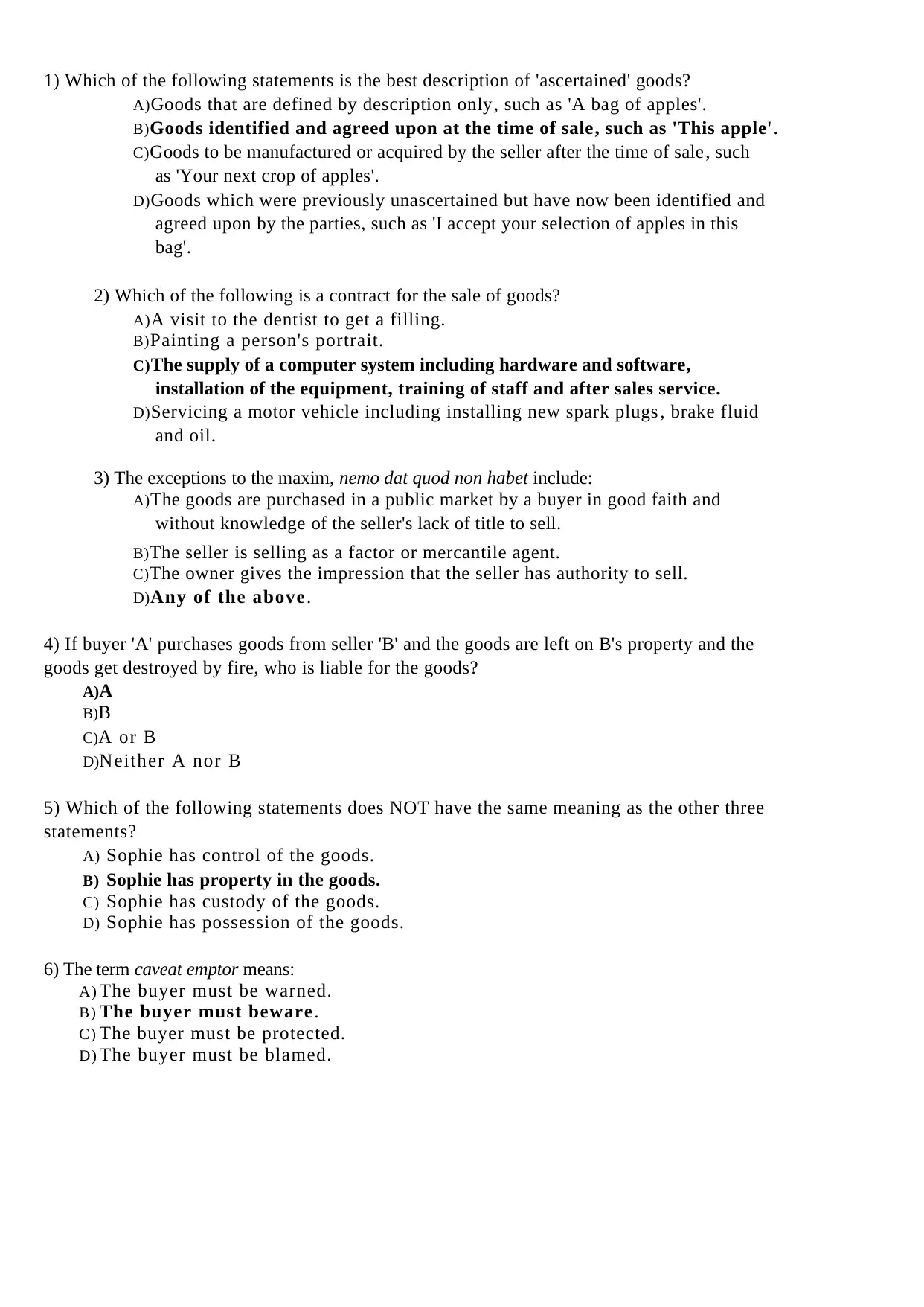
1) Which of the following statements is the best description of 'ascertained' goods?
A)Goods that are defined by description only, such as 'A bag of apples'.
B)Goods identified and agreed upon at the time of sale, such as 'This apple'.
C)Goods to be manufactured or acquired by the seller after the time of sale, such
as 'Your next crop of apples'.
D)Goods which were previously unascertained but have now been identified and
agreed upon by the parties, such as 'I accept your selection of apples in this
bag'.
2) Which of the following is a contract for the sale of goods?
A)A visit to the dentist to get a filling.
B)Painting a person's portrait.
C)The supply of a computer system including hardware and software,
installation of the equipment, training of staff and after sales service.
D)Servicing a motor vehicle including installing new spark plugs , brake fluid
and oil.
3) The exceptions to the maxim, nemo dat quod non habet include:
A)The goods are purchased in a public market by a buyer in good faith and
without knowledge of the seller's lack of title to sell.
B)The seller is selling as a factor or mercantile agent.
C)The owner gives the impression that the seller has authority to sell.
D)Any of the above.
4) If buyer 'A' purchases goods from seller 'B' and the goods are left on B's property and the
goods get destroyed by fire, who is liable for the goods?
A)A
B)B
C)A or B
D)Neither A nor B
5) Which of the following statements does NOT have the same meaning as the other three
statements?
A) Sophie has control of the goods.
B) Sophie has property in the goods.
C) Sophie has custody of the goods.
D) Sophie has possession of the goods.
6) The term caveat emptor means:
A) The buyer must be warned.
B) The buyer must beware.
C) The buyer must be protected.
D) The buyer must be blamed.
Document Page
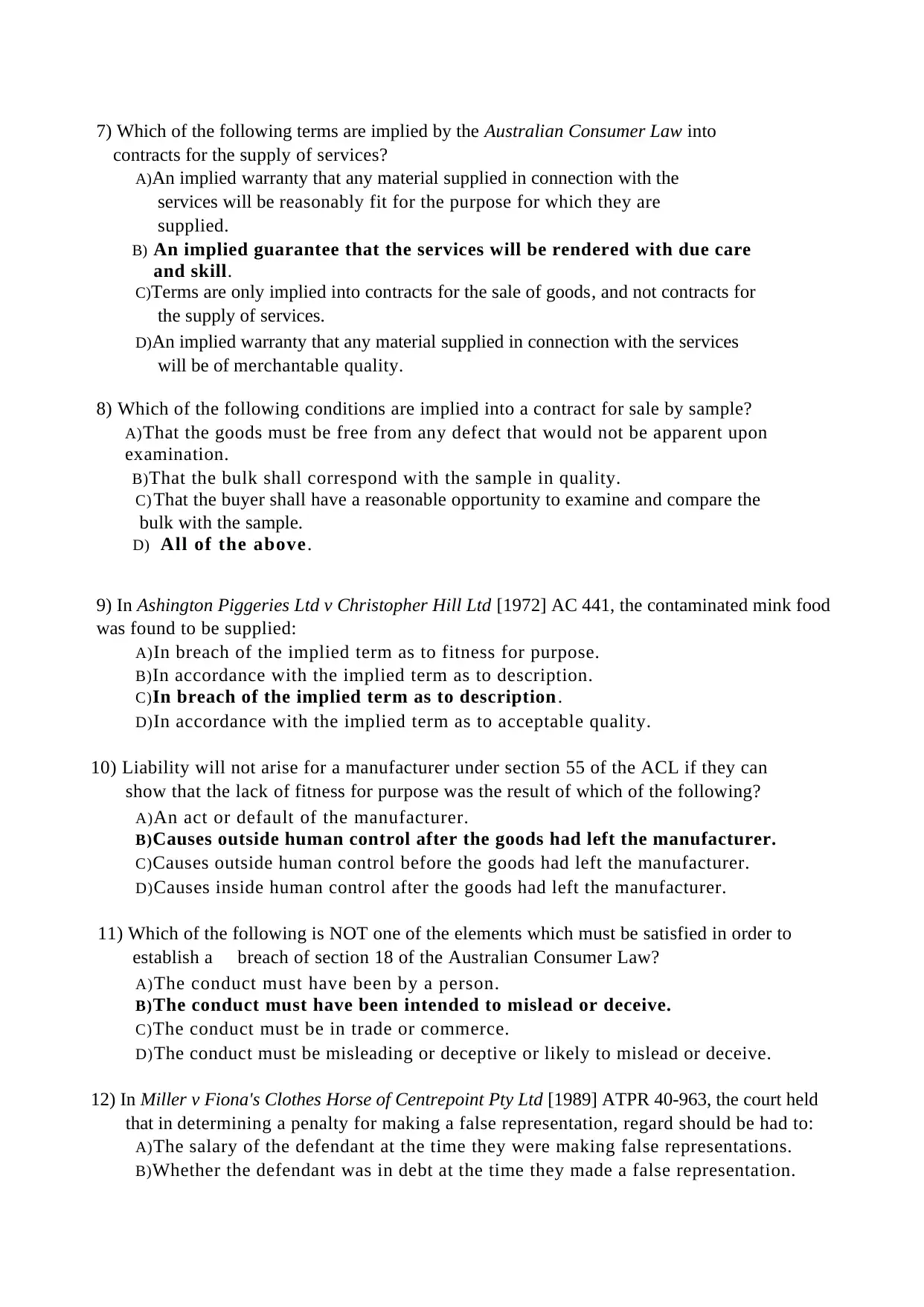
7) Which of the following terms are implied by the Australian Consumer Law into
contracts for the supply of services?
A)An implied warranty that any material supplied in connection with the
services will be reasonably fit for the purpose for which they are
supplied.
B) An implied guarantee that the services will be rendered with due care
and skill.
C)Terms are only implied into contracts for the sale of goods, and not contracts for
the supply of services.
D)An implied warranty that any material supplied in connection with the services
will be of merchantable quality.
8) Which of the following conditions are implied into a contract for sale by sample?
A)That the goods must be free from any defect that would not be apparent upon
examination.
B)That the bulk shall correspond with the sample in quality.
C) That the buyer shall have a reasonable opportunity to examine and compare the
bulk with the sample.
D) All of the above.
9) In Ashington Piggeries Ltd v Christopher Hill Ltd [1972] AC 441, the contaminated mink food
was found to be supplied:
A)In breach of the implied term as to fitness for purpose.
B)In accordance with the implied term as to description.
C)In breach of the implied term as to description.
D)In accordance with the implied term as to acceptable quality.
10) Liability will not arise for a manufacturer under section 55 of the ACL if they can
show that the lack of fitness for purpose was the result of which of the following?
A)An act or default of the manufacturer.
B)Causes outside human control after the goods had left the manufacturer.
C)Causes outside human control before the goods had left the manufacturer.
D)Causes inside human control after the goods had left the manufacturer.
11) Which of the following is NOT one of the elements which must be satisfied in order to
establish a breach of section 18 of the Australian Consumer Law?
A)The conduct must have been by a person.
B)The conduct must have been intended to mislead or deceive.
C)The conduct must be in trade or commerce.
D)The conduct must be misleading or deceptive or likely to mislead or deceive.
12) In Miller v Fiona's Clothes Horse of Centrepoint Pty Ltd [1989] ATPR 40-963, the court held
that in determining a penalty for making a false representation, regard should be had to:
A)The salary of the defendant at the time they were making false representations.
B)Whether the defendant was in debt at the time they made a false representation.
Document Page
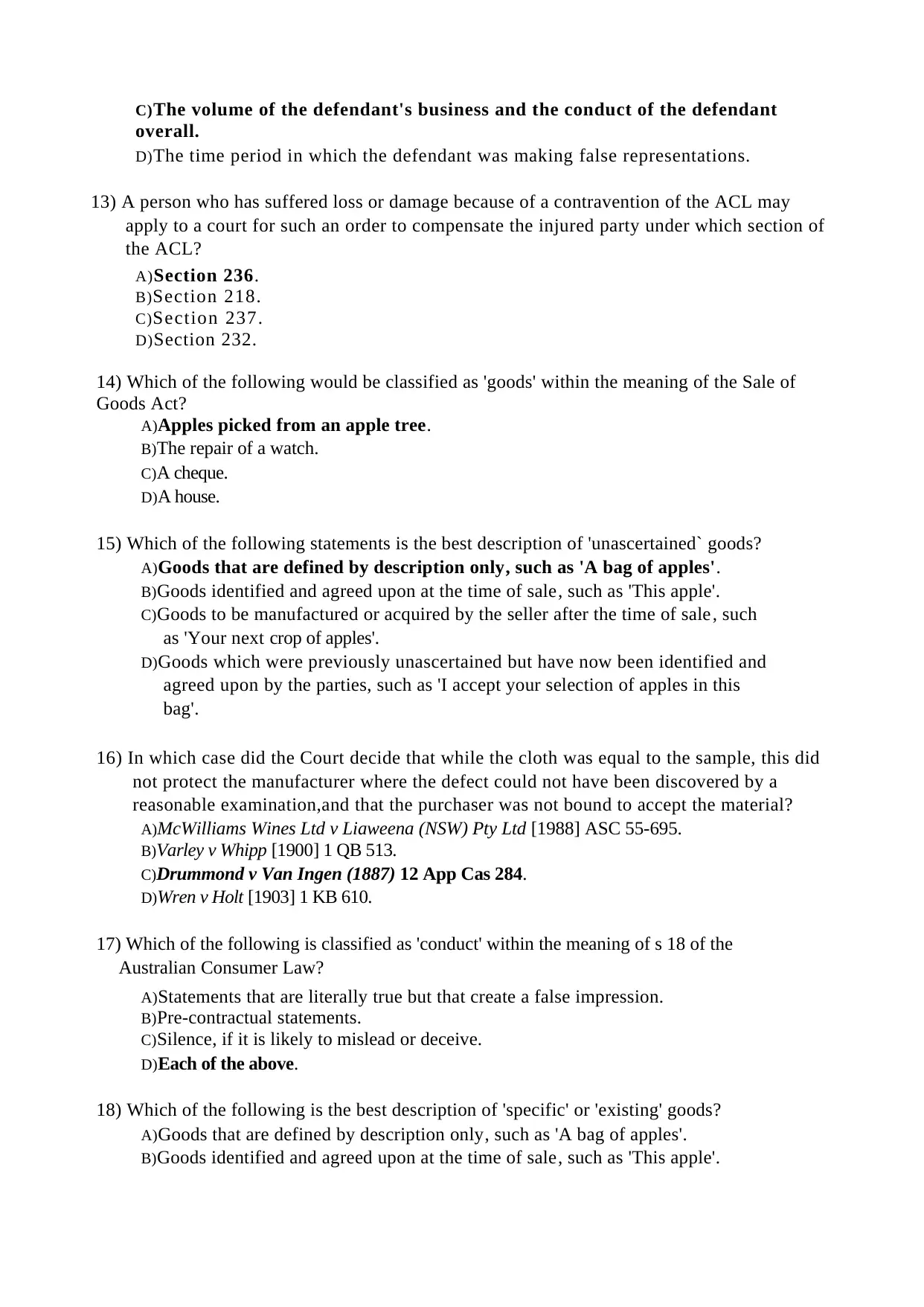
C)The volume of the defendant's business and the conduct of the defendant
overall.
D)The time period in which the defendant was making false representations.
13) A person who has suffered loss or damage because of a contravention of the ACL may
apply to a court for such an order to compensate the injured party under which section of
the ACL?
A)Section 236.
B)Section 218.
C)Section 237.
D)Section 232.
14) Which of the following would be classified as 'goods' within the meaning of the Sale of
Goods Act?
A)Apples picked from an apple tree.
B)The repair of a watch.
C)A cheque.
D)A house.
15) Which of the following statements is the best description of 'unascertained` goods?
A)Goods that are defined by description only, such as 'A bag of apples'.
B)Goods identified and agreed upon at the time of sale, such as 'This apple'.
C)Goods to be manufactured or acquired by the seller after the time of sale, such
as 'Your next crop of apples'.
D)Goods which were previously unascertained but have now been identified and
agreed upon by the parties, such as 'I accept your selection of apples in this
bag'.
16) In which case did the Court decide that while the cloth was equal to the sample, this did
not protect the manufacturer where the defect could not have been discovered by a
reasonable examination,and that the purchaser was not bound to accept the material?
A)McWilliams Wines Ltd v Liaweena (NSW) Pty Ltd [1988] ASC 55-695.
B)Varley v Whipp [1900] 1 QB 513.
C)Drummond v Van Ingen (1887) 12 App Cas 284.
D)Wren v Holt [1903] 1 KB 610.
17) Which of the following is classified as 'conduct' within the meaning of s 18 of the
Australian Consumer Law?
A)Statements that are literally true but that create a false impression.
B)Pre-contractual statements.
C)Silence, if it is likely to mislead or deceive.
D)Each of the above.
18) Which of the following is the best description of 'specific' or 'existing' goods?
A)Goods that are defined by description only, such as 'A bag of apples'.
B)Goods identified and agreed upon at the time of sale, such as 'This apple'.
tabler-icon-diamond-filled.svg

Paraphrase This Document

Need a fresh take? Get an instant paraphrase of this document with our AI Paraphraser
Document Page
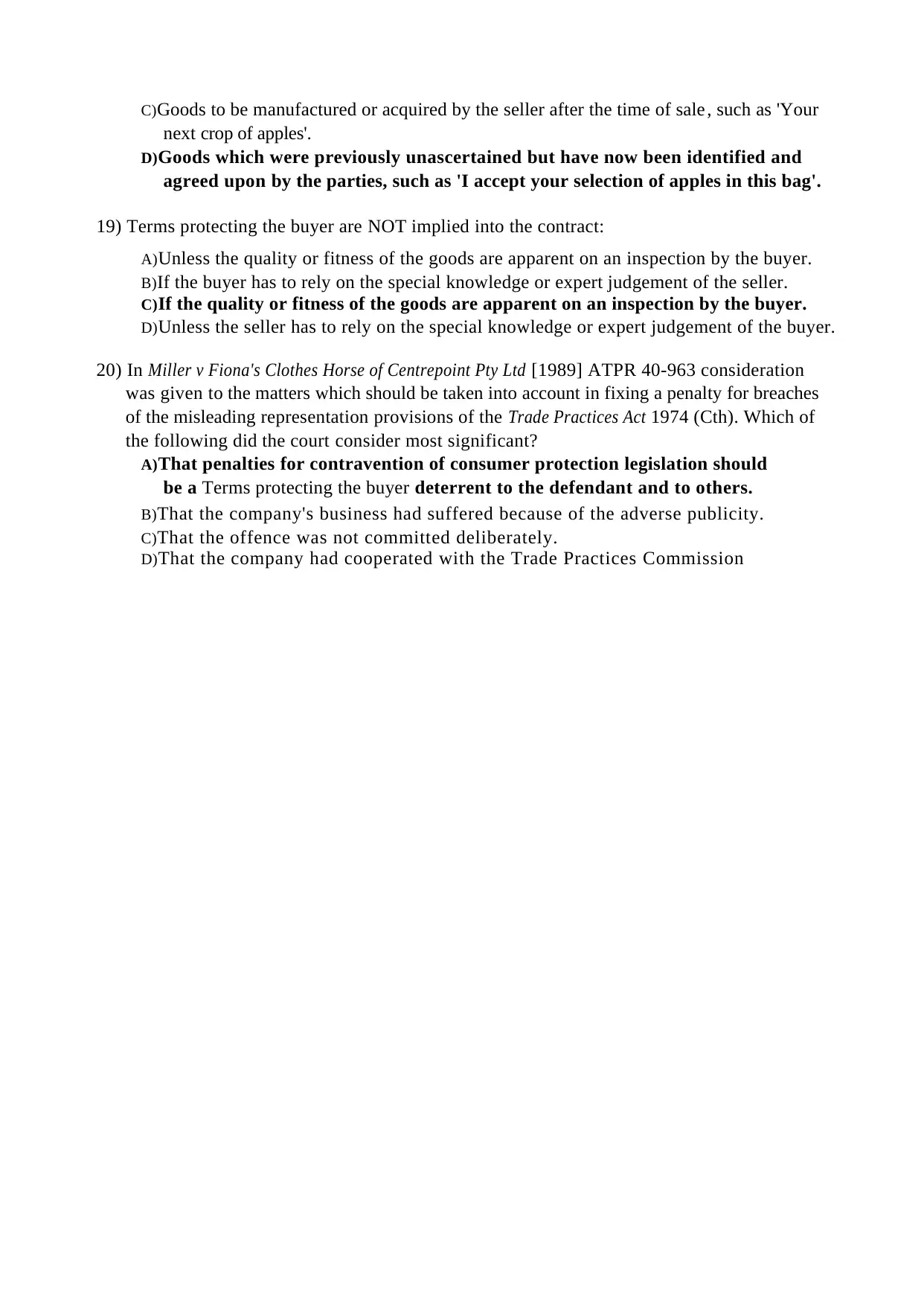
C)Goods to be manufactured or acquired by the seller after the time of sale , such as 'Your
next crop of apples'.
D)Goods which were previously unascertained but have now been identified and
agreed upon by the parties, such as 'I accept your selection of apples in this bag'.
19) Terms protecting the buyer are NOT implied into the contract:
A)Unless the quality or fitness of the goods are apparent on an inspection by the buyer.
B)If the buyer has to rely on the special knowledge or expert judgement of the seller.
C)If the quality or fitness of the goods are apparent on an inspection by the buyer.
D)Unless the seller has to rely on the special knowledge or expert judgement of the buyer.
20) In Miller v Fiona's Clothes Horse of Centrepoint Pty Ltd [1989] ATPR 40-963 consideration
was given to the matters which should be taken into account in fixing a penalty for breaches
of the misleading representation provisions of the Trade Practices Act 1974 (Cth). Which of
the following did the court consider most significant?
A)That penalties for contravention of consumer protection legislation should
be a Terms protecting the buyer deterrent to the defendant and to others.
B)That the company's business had suffered because of the adverse publicity.
C)That the offence was not committed deliberately.
D)That the company had cooperated with the Trade Practices Commission
Document Page
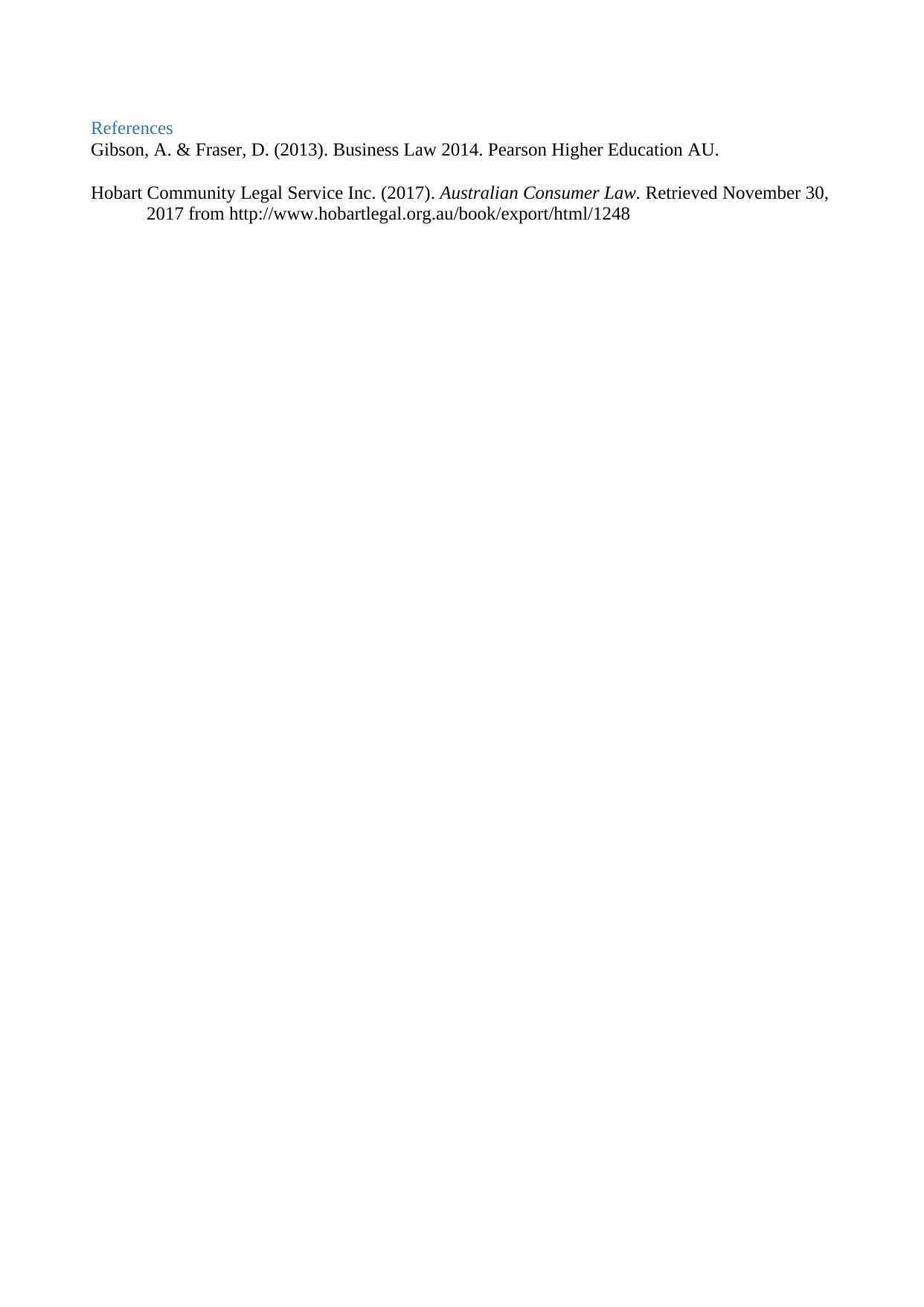
References
Gibson, A. & Fraser, D. (2013). Business Law 2014. Pearson Higher Education AU.
Hobart Community Legal Service Inc. (2017). Australian Consumer Law. Retrieved November 30,
2017 from http://www.hobartlegal.org.au/book/export/html/1248
chevron_up_icon
1 out of 6
circle_padding
hide_on_mobile
zoom_out_icon
[object Object]