Albena Yordanova: Business Law Report - Sources and Impact
VerifiedAdded on 2021/03/03
|25
|5121
|432
Report
AI Summary
This report, authored by Albena Yordanova, LBBA00804, delves into the realm of business law, examining its sources, the role of government in law-making, and its impact on various aspects of business operations. The report begins by defining law and exploring the sources of English law, including judicial precedent, statutory law, and European law. It then elucidates the government's role in law-making, outlining the process of how a bill becomes a law, and differentiates between how statutory and common law are applied in justice courts. The second part of the report illustrates, with specific examples, how company, employment, and contract law have a potential impact upon businesses. Company law, employment law, and contract law are explored in detail with an analysis of their key components and their impact on business practices. The report concludes by emphasizing the importance of understanding and adhering to these laws for the successful operation of businesses within the United Kingdom.
1 ALBENA YORDANOVA
LBBA00804
LG78294
Unit 7: Business Law
LBBA00804
LG78294
Unit 7: Business Law

Paraphrase This Document
Need a fresh take? Get an instant paraphrase of this document with our AI Paraphraser
2 ALBENA YORDANOVA
LBBA00804
LG78294
LBBA00804
LG78294
3 ALBENA YORDANOVA
LBBA00804
LG78294
Introduction
Crimes are very common in modern-day society, in both personal and
corporate spaces. For this reason, laws and regulations had to be formed to
keep everyone in check. In the scenario where these regulatory systems do
not exist, only chaos would be seen throughout the world(Abbott, Pendlebury
and Wardman, 2013). The social balance depends on the effective
application of laws and regulations. In the most basic sense, laws protect
people’s rights and serve justice to criminals and victims. Similarly, business
organisations must also follow their own set of rules and regulations specially
designed for them(Allison and Prentice, 2009). This report takes a closer look
into these laws, their sources, how they work and other details, in order to
identify how they impact society.
LBBA00804
LG78294
Introduction
Crimes are very common in modern-day society, in both personal and
corporate spaces. For this reason, laws and regulations had to be formed to
keep everyone in check. In the scenario where these regulatory systems do
not exist, only chaos would be seen throughout the world(Abbott, Pendlebury
and Wardman, 2013). The social balance depends on the effective
application of laws and regulations. In the most basic sense, laws protect
people’s rights and serve justice to criminals and victims. Similarly, business
organisations must also follow their own set of rules and regulations specially
designed for them(Allison and Prentice, 2009). This report takes a closer look
into these laws, their sources, how they work and other details, in order to
identify how they impact society.
⊘ This is a preview!⊘
Do you want full access?
Subscribe today to unlock all pages.

Trusted by 1+ million students worldwide
4 ALBENA YORDANOVA
LBBA00804
LG78294
Task 1
(I) “Explain different sources of law”
Definition of Law
The law is essentially a system of rules recognised by any country or
community as being the means by which citizens of the country or members
of the community can be regulated, and when necessary, enforced with
penalties. A society cannot function without some rules and regulations in
place(Allison and Prentice, 2009). Even amongst ancient people, there were
laws for what one could do and could not do. In that sense, the idea of law is
not unique to modern society. However, the extent to which laws have been
used or can be used is a certain result of the current society and the people
living in them.
English Law
This system of law has become the foundation for the legal system of many
other countries, especially Commonwealth countries. This has made it
fundamental to the overall legal systems of the world. The legal system can
be approached from different perspectives, and this allows the perceiving
eyes to form different interpretations of the same laws and
regulations(Holdsworth, 2016). The basic understanding is simple, a law tells
us what can be done and what cannot be done. This allows the society to live
under a sense of harmony, that crime against one another will not go
unjustified. The “Union Act of 1707” divides the British Legal System into
three sections. They are:
1. England and Wales following the English Law.
2. Northern Ireland following the Northern Ireland Law.
3. Scotland following the Scottish Law(Holdsworth, 2016).
LBBA00804
LG78294
Task 1
(I) “Explain different sources of law”
Definition of Law
The law is essentially a system of rules recognised by any country or
community as being the means by which citizens of the country or members
of the community can be regulated, and when necessary, enforced with
penalties. A society cannot function without some rules and regulations in
place(Allison and Prentice, 2009). Even amongst ancient people, there were
laws for what one could do and could not do. In that sense, the idea of law is
not unique to modern society. However, the extent to which laws have been
used or can be used is a certain result of the current society and the people
living in them.
English Law
This system of law has become the foundation for the legal system of many
other countries, especially Commonwealth countries. This has made it
fundamental to the overall legal systems of the world. The legal system can
be approached from different perspectives, and this allows the perceiving
eyes to form different interpretations of the same laws and
regulations(Holdsworth, 2016). The basic understanding is simple, a law tells
us what can be done and what cannot be done. This allows the society to live
under a sense of harmony, that crime against one another will not go
unjustified. The “Union Act of 1707” divides the British Legal System into
three sections. They are:
1. England and Wales following the English Law.
2. Northern Ireland following the Northern Ireland Law.
3. Scotland following the Scottish Law(Holdsworth, 2016).
Paraphrase This Document
Need a fresh take? Get an instant paraphrase of this document with our AI Paraphraser
5 ALBENA YORDANOVA
LBBA00804
LG78294
Sources of English Law
Several different sources are responsible for the uniformity that is known as
English Law. These are explained here:
1. Judicial Precedent:Common Law and Equity come together to form a
judicial precedent. It basically refers to previous instances of a legal
case which can serve as an example of law for future cases with similar
facts or issues. Legal systems based on the common law prioritise the
establishment of consistent rules so that the outcomes can be
consistent and predictable as well. The more predictable the outcome,
the better the law.For this reason, judges are bound to rulings of
previous legal cases. This bondage is known as stare decisis, which a
Latin phrase meaning “Let the decision stand.” This is one of the
crucial sources of English law and is on equal footing with both
Statutory Law and European Law(Arnheim, 2014).
2. Statutory Law:The most significant source for English Law is without
a doubt the Statutory Laws. These are formed by the different agencies
of the government and various legislative bodies. These laws are
generally codified as well, i.e. they are written down on a codebook.
There are two kinds of Statutory Law depending on the body that is
making them. They can be either legislation or delegated legislation.
Delegated legislation refers to legal bodies that have been entrusted to
make laws(Scalia and Garner, 2012).
3. European Law:Upon joining the European Economic Corporation in
1973, European Law has gained significant importance in English Law.
The corporation became what is known today to be the European
Union in 1993. It is actually due to the “European Communities Act of
1972” that these laws are considered to be a part of English Law. The
Parliament of Europe, its Court of Justice, as well as the Council of
LBBA00804
LG78294
Sources of English Law
Several different sources are responsible for the uniformity that is known as
English Law. These are explained here:
1. Judicial Precedent:Common Law and Equity come together to form a
judicial precedent. It basically refers to previous instances of a legal
case which can serve as an example of law for future cases with similar
facts or issues. Legal systems based on the common law prioritise the
establishment of consistent rules so that the outcomes can be
consistent and predictable as well. The more predictable the outcome,
the better the law.For this reason, judges are bound to rulings of
previous legal cases. This bondage is known as stare decisis, which a
Latin phrase meaning “Let the decision stand.” This is one of the
crucial sources of English law and is on equal footing with both
Statutory Law and European Law(Arnheim, 2014).
2. Statutory Law:The most significant source for English Law is without
a doubt the Statutory Laws. These are formed by the different agencies
of the government and various legislative bodies. These laws are
generally codified as well, i.e. they are written down on a codebook.
There are two kinds of Statutory Law depending on the body that is
making them. They can be either legislation or delegated legislation.
Delegated legislation refers to legal bodies that have been entrusted to
make laws(Scalia and Garner, 2012).
3. European Law:Upon joining the European Economic Corporation in
1973, European Law has gained significant importance in English Law.
The corporation became what is known today to be the European
Union in 1993. It is actually due to the “European Communities Act of
1972” that these laws are considered to be a part of English Law. The
Parliament of Europe, its Court of Justice, as well as the Council of
6 ALBENA YORDANOVA
LBBA00804
LG78294
Ministers are the ones responsible for the enactment and formulation
of these laws(Kennedy, Cahill and Power, 2011).
(II) “Explain the role of government in law-making and
how statutory and common law is applied in the justice
courts”
Role of Government in Law-Making
A crucial role is played by the government in making laws, and this can be
understood by the fact that the government participates as a member of the
parliament in the making of such laws(Holdsworth, 2016). Of course, like any
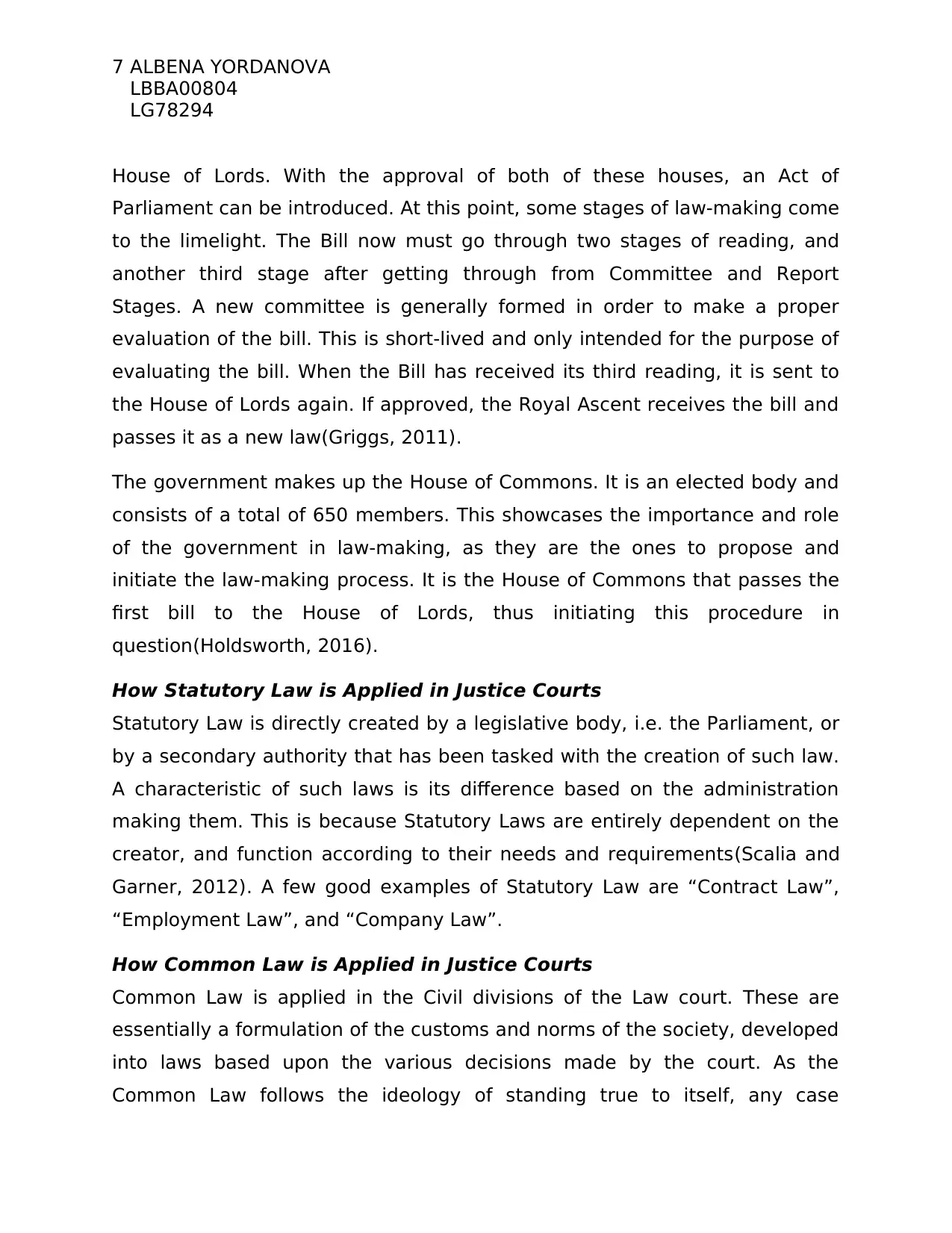
legal process, even law-making has a certain procedure. Below is a figure
that demonstrates this procedure.
Figure 1: Process of Law-Making(Griggs, 2011).
The figure provided above avoid attempts to provide an understanding of the
procedure of the passing of a bill into law. The very first stages to the
procedure involve a getting through both the House of Commons and theProcedures to
Law-Making
Procedures to
Law-MakingThe House of
Commons
The House of
CommonsThe House of
Lords
The House of
LordsIntroducing an
Act of
Parliament
Introducing an
Act of
ParliamentStages in Law-
Making
Stages in Law-
MakingBill
BillFirst Reading First ReadingSecond
Reading Second
ReadingCommitte
Stage
Committe
StageReport Stage Report StageThird Reading
Third ReadingHouse of
Lords House of
LordsRoyal Ascent Royal Ascent
LBBA00804
LG78294
Ministers are the ones responsible for the enactment and formulation
of these laws(Kennedy, Cahill and Power, 2011).
(II) “Explain the role of government in law-making and
how statutory and common law is applied in the justice
courts”
Role of Government in Law-Making
A crucial role is played by the government in making laws, and this can be
understood by the fact that the government participates as a member of the
parliament in the making of such laws(Holdsworth, 2016). Of course, like any
legal process, even law-making has a certain procedure. Below is a figure
that demonstrates this procedure.
Figure 1: Process of Law-Making(Griggs, 2011).
The figure provided above avoid attempts to provide an understanding of the
procedure of the passing of a bill into law. The very first stages to the
procedure involve a getting through both the House of Commons and theProcedures to
Law-Making
Procedures to
Law-MakingThe House of
Commons
The House of
CommonsThe House of
Lords
The House of
LordsIntroducing an
Act of
Parliament
Introducing an
Act of
ParliamentStages in Law-
Making
Stages in Law-
MakingBill
BillFirst Reading First ReadingSecond
Reading Second
ReadingCommitte
Stage
Committe
StageReport Stage Report StageThird Reading
Third ReadingHouse of
Lords House of
LordsRoyal Ascent Royal Ascent
⊘ This is a preview!⊘
Do you want full access?
Subscribe today to unlock all pages.
Trusted by 1+ million students worldwide
7 ALBENA YORDANOVA
LBBA00804
LG78294
House of Lords. With the approval of both of these houses, an Act of
Parliament can be introduced. At this point, some stages of law-making come
to the limelight. The Bill now must go through two stages of reading, and
another third stage after getting through from Committee and Report
Stages. A new committee is generally formed in order to make a proper
evaluation of the bill. This is short-lived and only intended for the purpose of
evaluating the bill. When the Bill has received its third reading, it is sent to
the House of Lords again. If approved, the Royal Ascent receives the bill and
passes it as a new law(Griggs, 2011).
The government makes up the House of Commons. It is an elected body and
consists of a total of 650 members. This showcases the importance and role
of the government in law-making, as they are the ones to propose and
initiate the law-making process. It is the House of Commons that passes the
first bill to the House of Lords, thus initiating this procedure in
question(Holdsworth, 2016).
How Statutory Law is Applied in Justice Courts
Statutory Law is directly created by a legislative body, i.e. the Parliament, or
by a secondary authority that has been tasked with the creation of such law.
A characteristic of such laws is its difference based on the administration
making them. This is because Statutory Laws are entirely dependent on the
creator, and function according to their needs and requirements(Scalia and
Garner, 2012). A few good examples of Statutory Law are “Contract Law”,
“Employment Law”, and “Company Law”.
How Common Law is Applied in Justice Courts
Common Law is applied in the Civil divisions of the Law court. These are
essentially a formulation of the customs and norms of the society, developed
into laws based upon the various decisions made by the court. As the
Common Law follows the ideology of standing true to itself, any case
LBBA00804
LG78294
House of Lords. With the approval of both of these houses, an Act of
Parliament can be introduced. At this point, some stages of law-making come
to the limelight. The Bill now must go through two stages of reading, and
another third stage after getting through from Committee and Report
Stages. A new committee is generally formed in order to make a proper
evaluation of the bill. This is short-lived and only intended for the purpose of
evaluating the bill. When the Bill has received its third reading, it is sent to
the House of Lords again. If approved, the Royal Ascent receives the bill and
passes it as a new law(Griggs, 2011).
The government makes up the House of Commons. It is an elected body and
consists of a total of 650 members. This showcases the importance and role
of the government in law-making, as they are the ones to propose and
initiate the law-making process. It is the House of Commons that passes the
first bill to the House of Lords, thus initiating this procedure in
question(Holdsworth, 2016).
How Statutory Law is Applied in Justice Courts
Statutory Law is directly created by a legislative body, i.e. the Parliament, or
by a secondary authority that has been tasked with the creation of such law.
A characteristic of such laws is its difference based on the administration
making them. This is because Statutory Laws are entirely dependent on the
creator, and function according to their needs and requirements(Scalia and
Garner, 2012). A few good examples of Statutory Law are “Contract Law”,
“Employment Law”, and “Company Law”.
How Common Law is Applied in Justice Courts
Common Law is applied in the Civil divisions of the Law court. These are
essentially a formulation of the customs and norms of the society, developed
into laws based upon the various decisions made by the court. As the
Common Law follows the ideology of standing true to itself, any case
Paraphrase This Document
Need a fresh take? Get an instant paraphrase of this document with our AI Paraphraser
8 ALBENA YORDANOVA
LBBA00804
LG78294
resolution may become an example for future cases, and these examples
can be used in cases featuring similar of same facts or issues. Proper
documentation takes place in order to ascertain the authority of such
law(Arnheim, 2014). It is entirely the decision of the judge when a new
scenario arrives. But whatever decision is taken, would then become part of
the Common Law.
LBBA00804
LG78294
resolution may become an example for future cases, and these examples
can be used in cases featuring similar of same facts or issues. Proper
documentation takes place in order to ascertain the authority of such
law(Arnheim, 2014). It is entirely the decision of the judge when a new
scenario arrives. But whatever decision is taken, would then become part of
the Common Law.
9 ALBENA YORDANOVA
LBBA00804
LG78294
Task 2
(I) “Illustrate, using specific examples, how company,
employment and contract law has a potential impact upon
business”
Company Law and Its Impact on Business
The various activities of a company are governed by some set of rules and
regulations, and these are known as Company Law. Most countries have
their own company law, and that is also the case for the United Kingdom.
Setting an example for the Commonwealth countries, the company law of
the United Kingdom has also been adopted by many of them(Pennington,
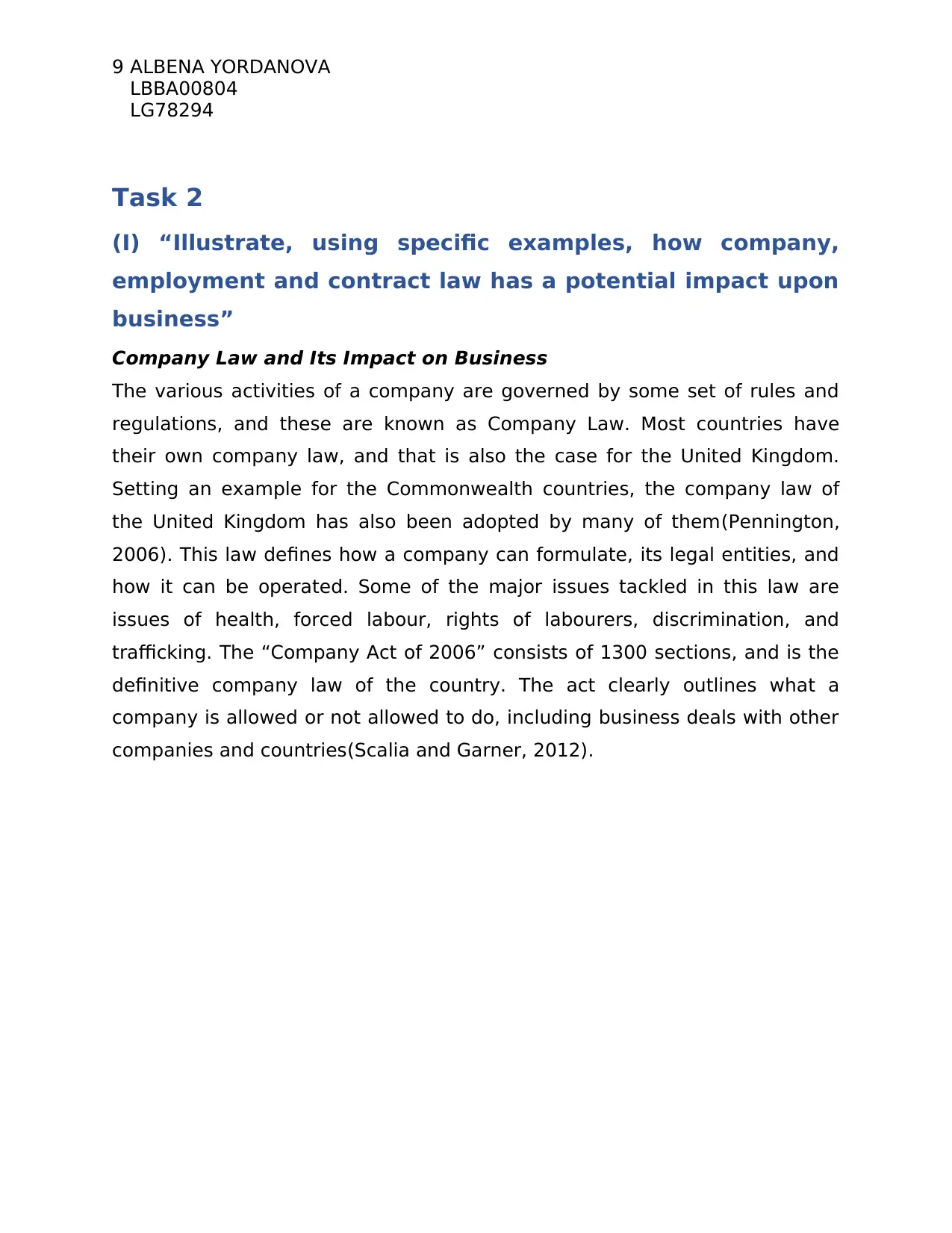
2006). This law defines how a company can formulate, its legal entities, and
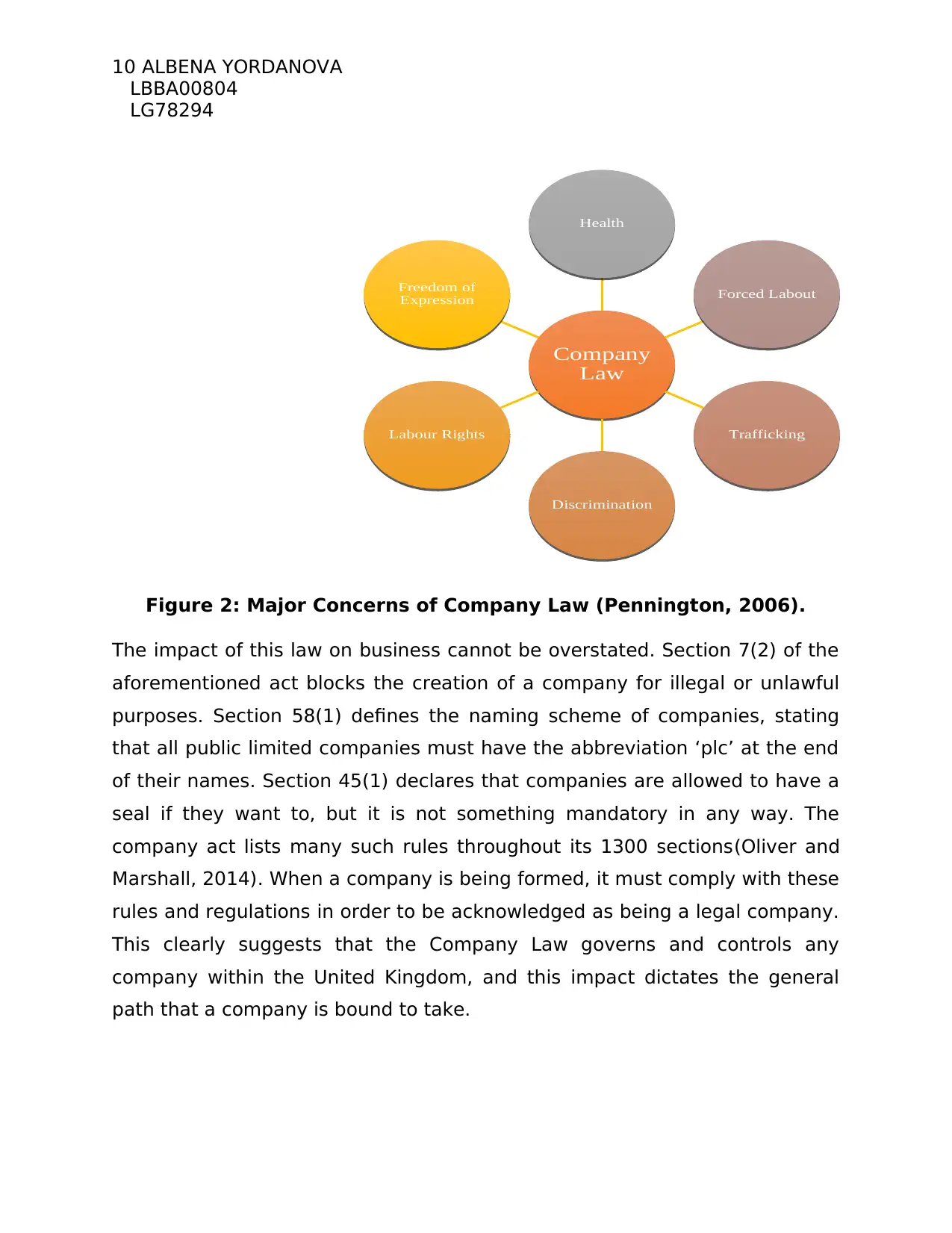
how it can be operated. Some of the major issues tackled in this law are
issues of health, forced labour, rights of labourers, discrimination, and
trafficking. The “Company Act of 2006” consists of 1300 sections, and is the
definitive company law of the country. The act clearly outlines what a
company is allowed or not allowed to do, including business deals with other
companies and countries(Scalia and Garner, 2012).
LBBA00804
LG78294
Task 2
(I) “Illustrate, using specific examples, how company,
employment and contract law has a potential impact upon
business”
Company Law and Its Impact on Business
The various activities of a company are governed by some set of rules and
regulations, and these are known as Company Law. Most countries have
their own company law, and that is also the case for the United Kingdom.
Setting an example for the Commonwealth countries, the company law of
the United Kingdom has also been adopted by many of them(Pennington,
2006). This law defines how a company can formulate, its legal entities, and
how it can be operated. Some of the major issues tackled in this law are
issues of health, forced labour, rights of labourers, discrimination, and
trafficking. The “Company Act of 2006” consists of 1300 sections, and is the
definitive company law of the country. The act clearly outlines what a
company is allowed or not allowed to do, including business deals with other
companies and countries(Scalia and Garner, 2012).
⊘ This is a preview!⊘
Do you want full access?
Subscribe today to unlock all pages.
Trusted by 1+ million students worldwide
10 ALBENA YORDANOVA
LBBA00804
LG78294
Figure 2: Major Concerns of Company Law (Pennington, 2006).
The impact of this law on business cannot be overstated. Section 7(2) of the
aforementioned act blocks the creation of a company for illegal or unlawful
purposes. Section 58(1) defines the naming scheme of companies, stating
that all public limited companies must have the abbreviation ‘plc’ at the end
of their names. Section 45(1) declares that companies are allowed to have a
seal if they want to, but it is not something mandatory in any way. The
company act lists many such rules throughout its 1300 sections(Oliver and
Marshall, 2014). When a company is being formed, it must comply with these
rules and regulations in order to be acknowledged as being a legal company.
This clearly suggests that the Company Law governs and controls any
company within the United Kingdom, and this impact dictates the general
path that a company is bound to take.Company
Law
Company
LawHealth
HealthForced Labout
Forced LaboutTrafficking
TraffickingDiscrimination
DiscriminationLabour Rights
Labour RightsFreedom of
Expression
Freedom of
Expression
LBBA00804
LG78294
Figure 2: Major Concerns of Company Law (Pennington, 2006).
The impact of this law on business cannot be overstated. Section 7(2) of the
aforementioned act blocks the creation of a company for illegal or unlawful
purposes. Section 58(1) defines the naming scheme of companies, stating
that all public limited companies must have the abbreviation ‘plc’ at the end
of their names. Section 45(1) declares that companies are allowed to have a
seal if they want to, but it is not something mandatory in any way. The
company act lists many such rules throughout its 1300 sections(Oliver and
Marshall, 2014). When a company is being formed, it must comply with these
rules and regulations in order to be acknowledged as being a legal company.
This clearly suggests that the Company Law governs and controls any
company within the United Kingdom, and this impact dictates the general
path that a company is bound to take.Company
Law
Company
LawHealth
HealthForced Labout
Forced LaboutTrafficking
TraffickingDiscrimination
DiscriminationLabour Rights
Labour RightsFreedom of
Expression
Freedom of
Expression
Paraphrase This Document
Need a fresh take? Get an instant paraphrase of this document with our AI Paraphraser
11 ALBENA YORDANOVA
LBBA00804
LG78294
Employment Law and Its Impact on Business
Employment is one of the most important sectors of the economy. It allows
people to join existing companies and organisations, as well as making new
ones, in order to perform within the economy. But the Employment Law is
not concerned with self-employment, and rather governs employment within
existing companies(Scalia and Garner, 2012). The rules and regulations that
make up the Employment Law dwell with employers, employees, the
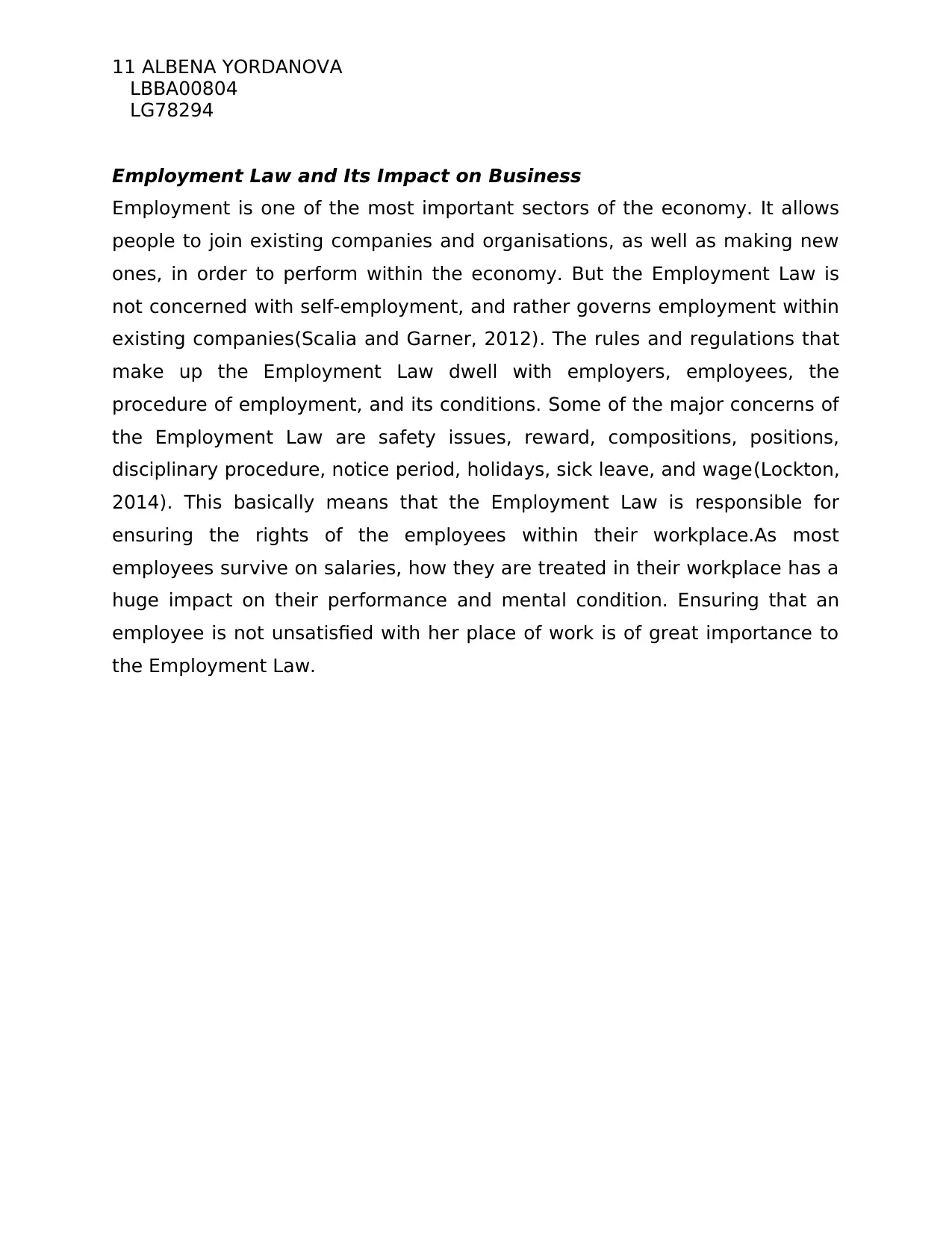
procedure of employment, and its conditions. Some of the major concerns of
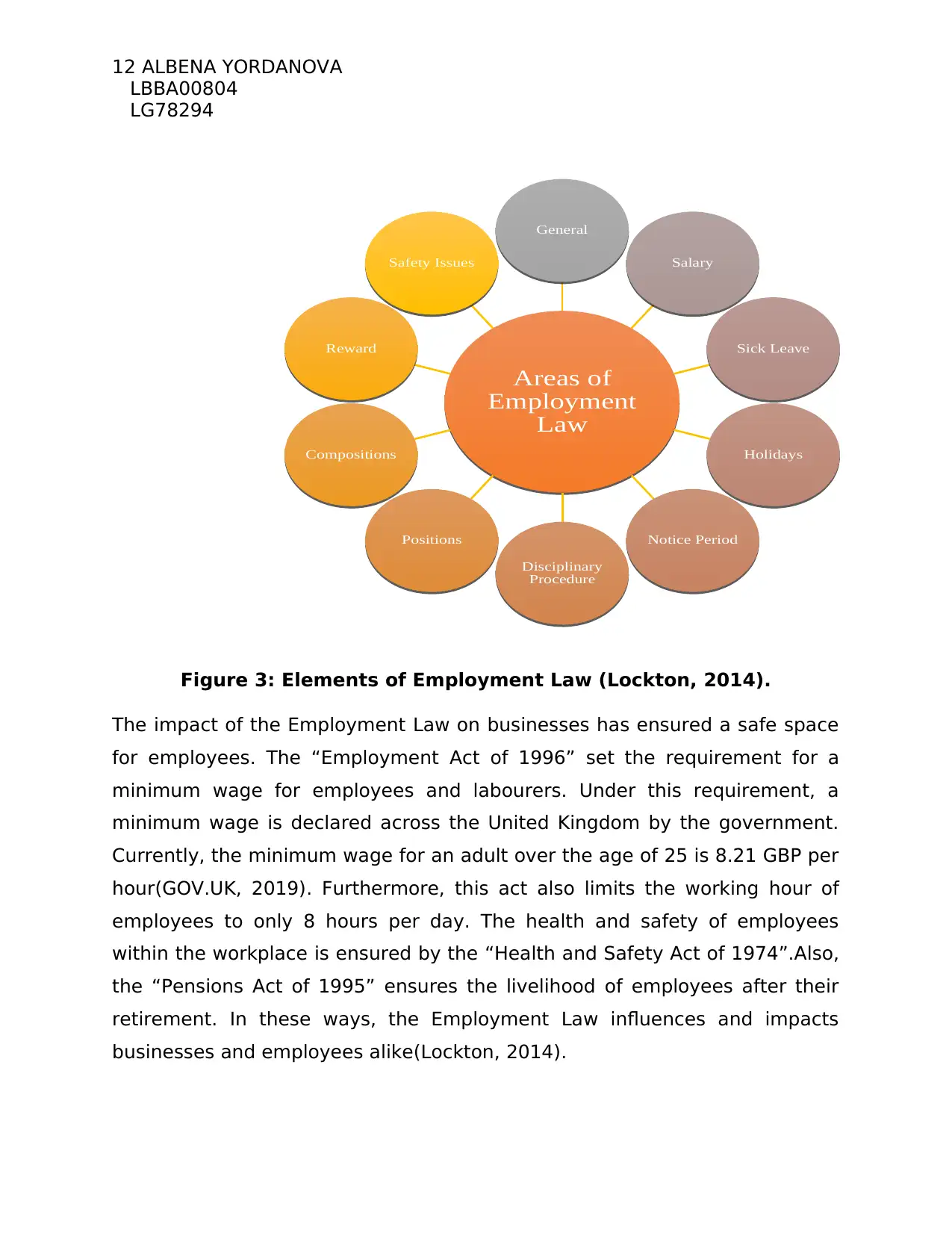
the Employment Law are safety issues, reward, compositions, positions,
disciplinary procedure, notice period, holidays, sick leave, and wage(Lockton,
2014). This basically means that the Employment Law is responsible for
ensuring the rights of the employees within their workplace.As most
employees survive on salaries, how they are treated in their workplace has a
huge impact on their performance and mental condition. Ensuring that an
employee is not unsatisfied with her place of work is of great importance to
the Employment Law.
LBBA00804
LG78294
Employment Law and Its Impact on Business
Employment is one of the most important sectors of the economy. It allows
people to join existing companies and organisations, as well as making new
ones, in order to perform within the economy. But the Employment Law is
not concerned with self-employment, and rather governs employment within
existing companies(Scalia and Garner, 2012). The rules and regulations that
make up the Employment Law dwell with employers, employees, the
procedure of employment, and its conditions. Some of the major concerns of
the Employment Law are safety issues, reward, compositions, positions,
disciplinary procedure, notice period, holidays, sick leave, and wage(Lockton,
2014). This basically means that the Employment Law is responsible for
ensuring the rights of the employees within their workplace.As most
employees survive on salaries, how they are treated in their workplace has a
huge impact on their performance and mental condition. Ensuring that an
employee is not unsatisfied with her place of work is of great importance to
the Employment Law.
12 ALBENA YORDANOVA
LBBA00804
LG78294
Figure 3: Elements of Employment Law (Lockton, 2014).
The impact of the Employment Law on businesses has ensured a safe space
for employees. The “Employment Act of 1996” set the requirement for a
minimum wage for employees and labourers. Under this requirement, a
minimum wage is declared across the United Kingdom by the government.
Currently, the minimum wage for an adult over the age of 25 is 8.21 GBP per
hour(GOV.UK, 2019). Furthermore, this act also limits the working hour of
employees to only 8 hours per day. The health and safety of employees
within the workplace is ensured by the “Health and Safety Act of 1974”.Also,
the “Pensions Act of 1995” ensures the livelihood of employees after their
retirement. In these ways, the Employment Law influences and impacts
businesses and employees alike(Lockton, 2014).Areas of
Employment
Law
Areas of
Employment
LawGeneral
GeneralSalary
SalarySick Leave
Sick LeaveHolidays
HolidaysNotice Period
Notice PeriodDisciplinary
Procedure
Disciplinary
ProcedurePositions
PositionsCompositions
CompositionsReward
RewardSafety Issues
Safety Issues
LBBA00804
LG78294
Figure 3: Elements of Employment Law (Lockton, 2014).
The impact of the Employment Law on businesses has ensured a safe space
for employees. The “Employment Act of 1996” set the requirement for a
minimum wage for employees and labourers. Under this requirement, a
minimum wage is declared across the United Kingdom by the government.
Currently, the minimum wage for an adult over the age of 25 is 8.21 GBP per
hour(GOV.UK, 2019). Furthermore, this act also limits the working hour of
employees to only 8 hours per day. The health and safety of employees
within the workplace is ensured by the “Health and Safety Act of 1974”.Also,
the “Pensions Act of 1995” ensures the livelihood of employees after their
retirement. In these ways, the Employment Law influences and impacts
businesses and employees alike(Lockton, 2014).Areas of
Employment
Law
Areas of
Employment
LawGeneral
GeneralSalary
SalarySick Leave
Sick LeaveHolidays
HolidaysNotice Period
Notice PeriodDisciplinary
Procedure
Disciplinary
ProcedurePositions
PositionsCompositions
CompositionsReward
RewardSafety Issues
Safety Issues
⊘ This is a preview!⊘
Do you want full access?
Subscribe today to unlock all pages.
Trusted by 1+ million students worldwide

1 out of 25


Related Documents


Your All-in-One AI-Powered Toolkit for Academic Success.
+13062052269
info@desklib.com
Available 24*7 on WhatsApp / Email
![[object Object]](/_next/static/media/star-bottom.7253800d.svg)
Unlock your academic potential
Copyright © 2020–2026 A2Z Services. All Rights Reserved. Developed and managed by ZUCOL.