Business Law Report
VerifiedAdded on 2020/01/28
|13
|3710
|92
Report
AI Summary
This report examines the legal considerations involved in converting a partnership into a limited liability company under UK law. It discusses the approval process for transferring partnership assets, the liabilities of directors in case of insolvency, and the necessary permissions and formalities for issuing ordinary and preference shares. The report emphasizes the importance of compliance with the Companies Act 2006 and the need for unanimous consent among partners for asset transfers. Additionally, it outlines the fiduciary duties of directors and the implications of failing to meet these obligations.

Law

Paraphrase This Document
Need a fresh take? Get an instant paraphrase of this document with our AI Paraphraser
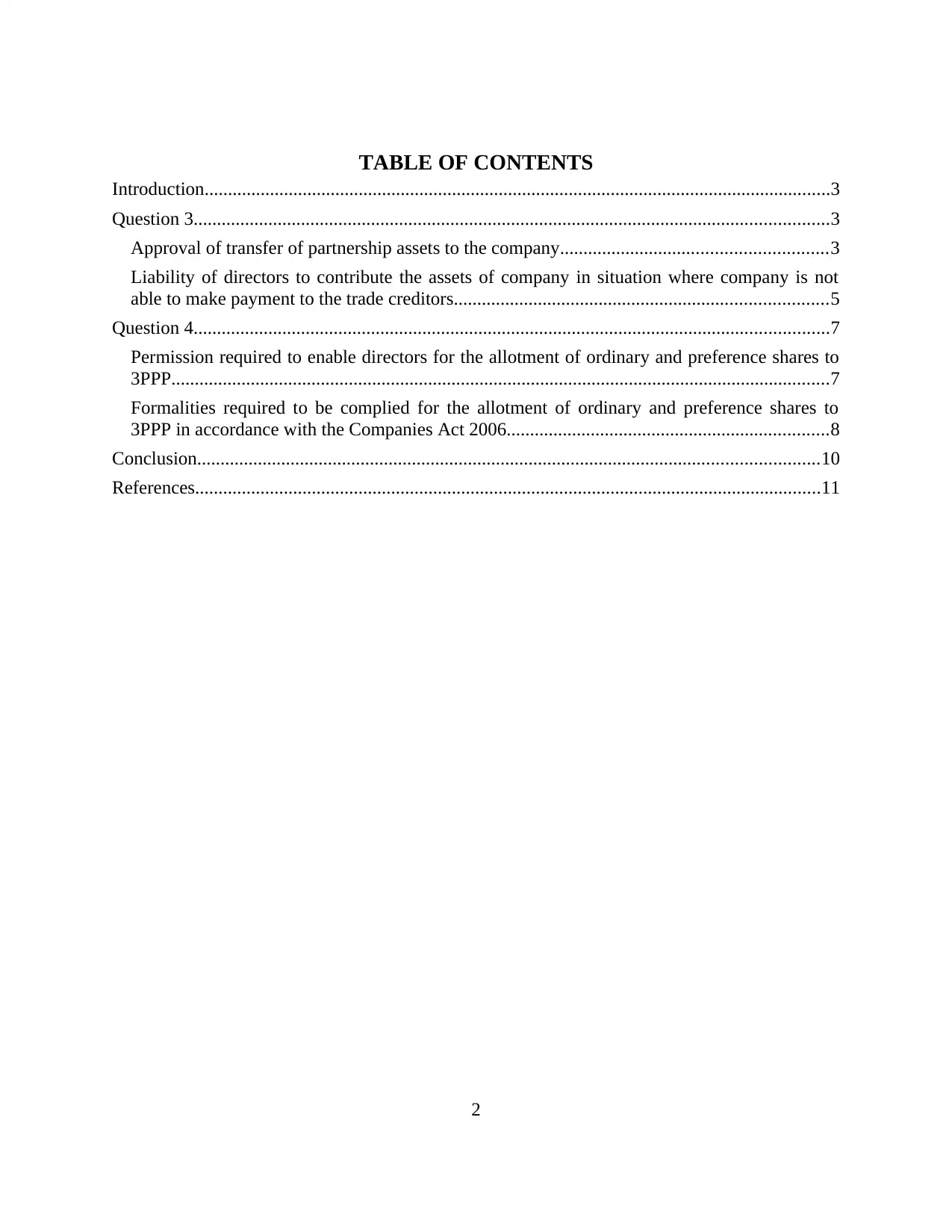
TABLE OF CONTENTS
Introduction......................................................................................................................................3
Question 3........................................................................................................................................3
Approval of transfer of partnership assets to the company.........................................................3
Liability of directors to contribute the assets of company in situation where company is not
able to make payment to the trade creditors................................................................................5
Question 4........................................................................................................................................7
Permission required to enable directors for the allotment of ordinary and preference shares to
3PPP.............................................................................................................................................7
Formalities required to be complied for the allotment of ordinary and preference shares to
3PPP in accordance with the Companies Act 2006.....................................................................8
Conclusion.....................................................................................................................................10
References......................................................................................................................................11
2
Introduction......................................................................................................................................3
Question 3........................................................................................................................................3
Approval of transfer of partnership assets to the company.........................................................3
Liability of directors to contribute the assets of company in situation where company is not
able to make payment to the trade creditors................................................................................5
Question 4........................................................................................................................................7
Permission required to enable directors for the allotment of ordinary and preference shares to
3PPP.............................................................................................................................................7
Formalities required to be complied for the allotment of ordinary and preference shares to
3PPP in accordance with the Companies Act 2006.....................................................................8
Conclusion.....................................................................................................................................10
References......................................................................................................................................11
2
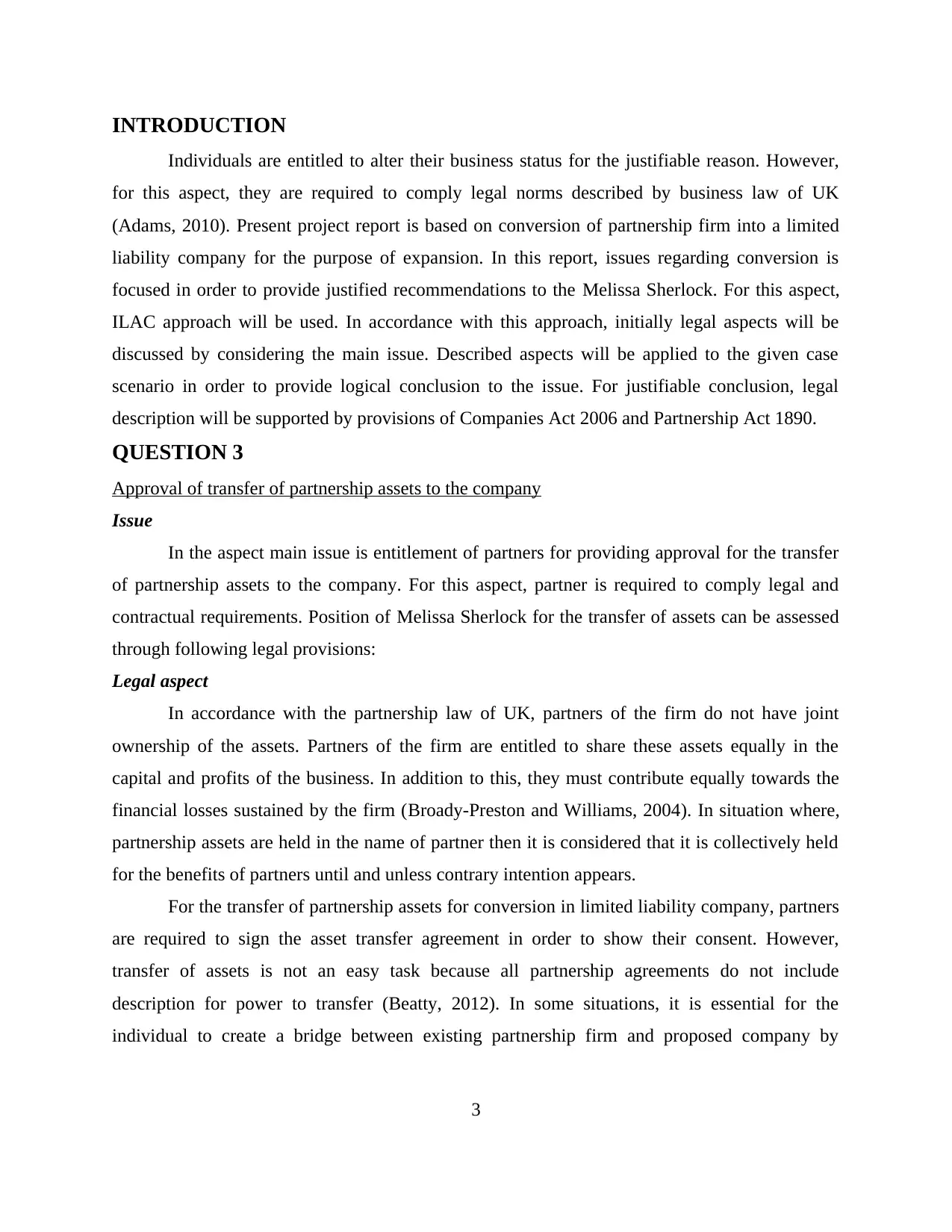
INTRODUCTION
Individuals are entitled to alter their business status for the justifiable reason. However,
for this aspect, they are required to comply legal norms described by business law of UK
(Adams, 2010). Present project report is based on conversion of partnership firm into a limited
liability company for the purpose of expansion. In this report, issues regarding conversion is
focused in order to provide justified recommendations to the Melissa Sherlock. For this aspect,
ILAC approach will be used. In accordance with this approach, initially legal aspects will be
discussed by considering the main issue. Described aspects will be applied to the given case
scenario in order to provide logical conclusion to the issue. For justifiable conclusion, legal
description will be supported by provisions of Companies Act 2006 and Partnership Act 1890.
QUESTION 3
Approval of transfer of partnership assets to the company
Issue
In the aspect main issue is entitlement of partners for providing approval for the transfer
of partnership assets to the company. For this aspect, partner is required to comply legal and
contractual requirements. Position of Melissa Sherlock for the transfer of assets can be assessed
through following legal provisions:
Legal aspect
In accordance with the partnership law of UK, partners of the firm do not have joint
ownership of the assets. Partners of the firm are entitled to share these assets equally in the
capital and profits of the business. In addition to this, they must contribute equally towards the
financial losses sustained by the firm (Broady-Preston and Williams, 2004). In situation where,
partnership assets are held in the name of partner then it is considered that it is collectively held
for the benefits of partners until and unless contrary intention appears.
For the transfer of partnership assets for conversion in limited liability company, partners
are required to sign the asset transfer agreement in order to show their consent. However,
transfer of assets is not an easy task because all partnership agreements do not include
description for power to transfer (Beatty, 2012). In some situations, it is essential for the
individual to create a bridge between existing partnership firm and proposed company by
3
Individuals are entitled to alter their business status for the justifiable reason. However,
for this aspect, they are required to comply legal norms described by business law of UK
(Adams, 2010). Present project report is based on conversion of partnership firm into a limited
liability company for the purpose of expansion. In this report, issues regarding conversion is
focused in order to provide justified recommendations to the Melissa Sherlock. For this aspect,
ILAC approach will be used. In accordance with this approach, initially legal aspects will be
discussed by considering the main issue. Described aspects will be applied to the given case
scenario in order to provide logical conclusion to the issue. For justifiable conclusion, legal
description will be supported by provisions of Companies Act 2006 and Partnership Act 1890.
QUESTION 3
Approval of transfer of partnership assets to the company
Issue
In the aspect main issue is entitlement of partners for providing approval for the transfer
of partnership assets to the company. For this aspect, partner is required to comply legal and
contractual requirements. Position of Melissa Sherlock for the transfer of assets can be assessed
through following legal provisions:
Legal aspect
In accordance with the partnership law of UK, partners of the firm do not have joint
ownership of the assets. Partners of the firm are entitled to share these assets equally in the
capital and profits of the business. In addition to this, they must contribute equally towards the
financial losses sustained by the firm (Broady-Preston and Williams, 2004). In situation where,
partnership assets are held in the name of partner then it is considered that it is collectively held
for the benefits of partners until and unless contrary intention appears.
For the transfer of partnership assets for conversion in limited liability company, partners
are required to sign the asset transfer agreement in order to show their consent. However,
transfer of assets is not an easy task because all partnership agreements do not include
description for power to transfer (Beatty, 2012). In some situations, it is essential for the
individual to create a bridge between existing partnership firm and proposed company by
3
⊘ This is a preview!⊘
Do you want full access?
Subscribe today to unlock all pages.

Trusted by 1+ million students worldwide
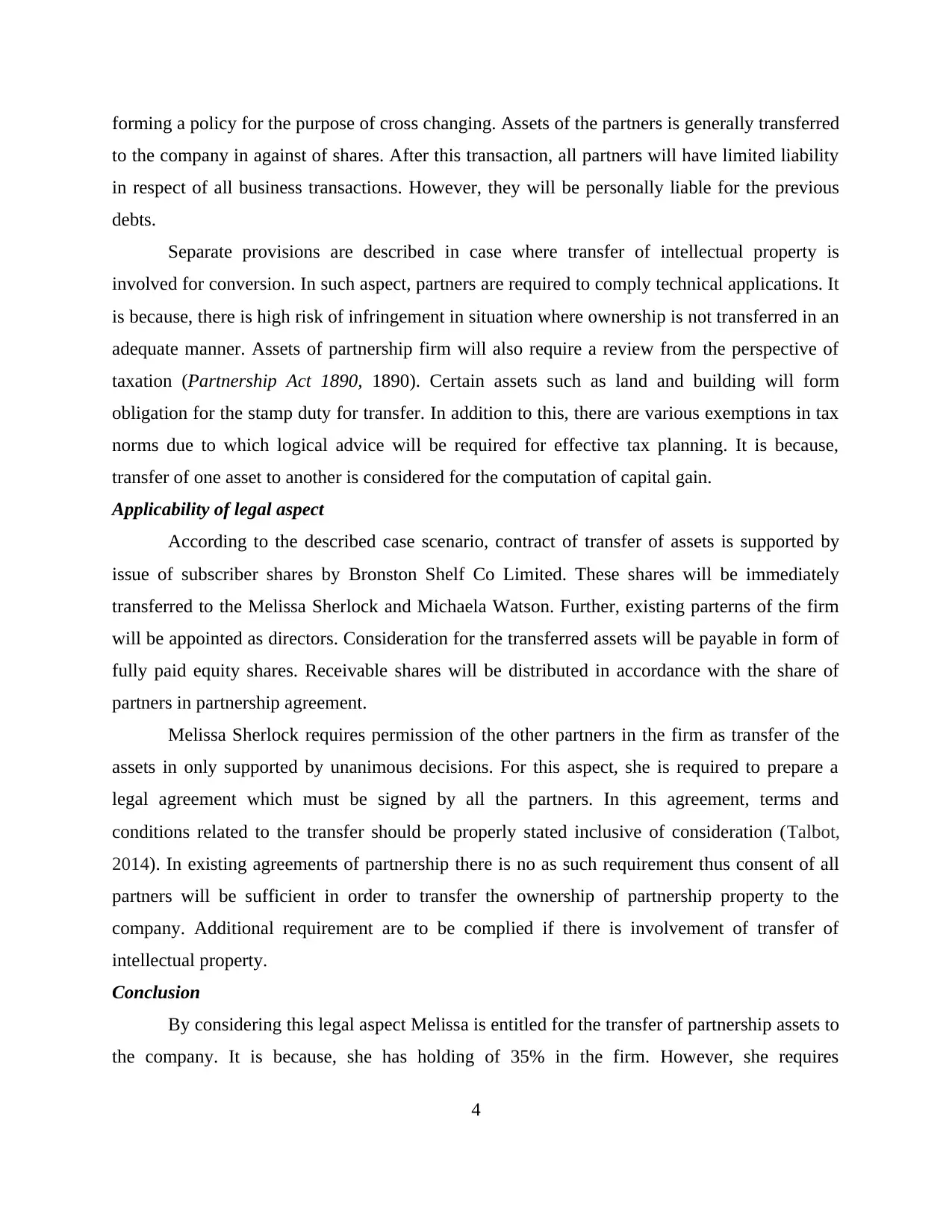
forming a policy for the purpose of cross changing. Assets of the partners is generally transferred
to the company in against of shares. After this transaction, all partners will have limited liability
in respect of all business transactions. However, they will be personally liable for the previous
debts.
Separate provisions are described in case where transfer of intellectual property is
involved for conversion. In such aspect, partners are required to comply technical applications. It
is because, there is high risk of infringement in situation where ownership is not transferred in an
adequate manner. Assets of partnership firm will also require a review from the perspective of
taxation (Partnership Act 1890, 1890). Certain assets such as land and building will form
obligation for the stamp duty for transfer. In addition to this, there are various exemptions in tax
norms due to which logical advice will be required for effective tax planning. It is because,
transfer of one asset to another is considered for the computation of capital gain.
Applicability of legal aspect
According to the described case scenario, contract of transfer of assets is supported by
issue of subscriber shares by Bronston Shelf Co Limited. These shares will be immediately
transferred to the Melissa Sherlock and Michaela Watson. Further, existing parterns of the firm
will be appointed as directors. Consideration for the transferred assets will be payable in form of
fully paid equity shares. Receivable shares will be distributed in accordance with the share of
partners in partnership agreement.
Melissa Sherlock requires permission of the other partners in the firm as transfer of the
assets in only supported by unanimous decisions. For this aspect, she is required to prepare a
legal agreement which must be signed by all the partners. In this agreement, terms and
conditions related to the transfer should be properly stated inclusive of consideration (Talbot,
2014). In existing agreements of partnership there is no as such requirement thus consent of all
partners will be sufficient in order to transfer the ownership of partnership property to the
company. Additional requirement are to be complied if there is involvement of transfer of
intellectual property.
Conclusion
By considering this legal aspect Melissa is entitled for the transfer of partnership assets to
the company. It is because, she has holding of 35% in the firm. However, she requires
4
to the company in against of shares. After this transaction, all partners will have limited liability
in respect of all business transactions. However, they will be personally liable for the previous
debts.
Separate provisions are described in case where transfer of intellectual property is
involved for conversion. In such aspect, partners are required to comply technical applications. It
is because, there is high risk of infringement in situation where ownership is not transferred in an
adequate manner. Assets of partnership firm will also require a review from the perspective of
taxation (Partnership Act 1890, 1890). Certain assets such as land and building will form
obligation for the stamp duty for transfer. In addition to this, there are various exemptions in tax
norms due to which logical advice will be required for effective tax planning. It is because,
transfer of one asset to another is considered for the computation of capital gain.
Applicability of legal aspect
According to the described case scenario, contract of transfer of assets is supported by
issue of subscriber shares by Bronston Shelf Co Limited. These shares will be immediately
transferred to the Melissa Sherlock and Michaela Watson. Further, existing parterns of the firm
will be appointed as directors. Consideration for the transferred assets will be payable in form of
fully paid equity shares. Receivable shares will be distributed in accordance with the share of
partners in partnership agreement.
Melissa Sherlock requires permission of the other partners in the firm as transfer of the
assets in only supported by unanimous decisions. For this aspect, she is required to prepare a
legal agreement which must be signed by all the partners. In this agreement, terms and
conditions related to the transfer should be properly stated inclusive of consideration (Talbot,
2014). In existing agreements of partnership there is no as such requirement thus consent of all
partners will be sufficient in order to transfer the ownership of partnership property to the
company. Additional requirement are to be complied if there is involvement of transfer of
intellectual property.
Conclusion
By considering this legal aspect Melissa is entitled for the transfer of partnership assets to
the company. It is because, she has holding of 35% in the firm. However, she requires
4
Paraphrase This Document
Need a fresh take? Get an instant paraphrase of this document with our AI Paraphraser
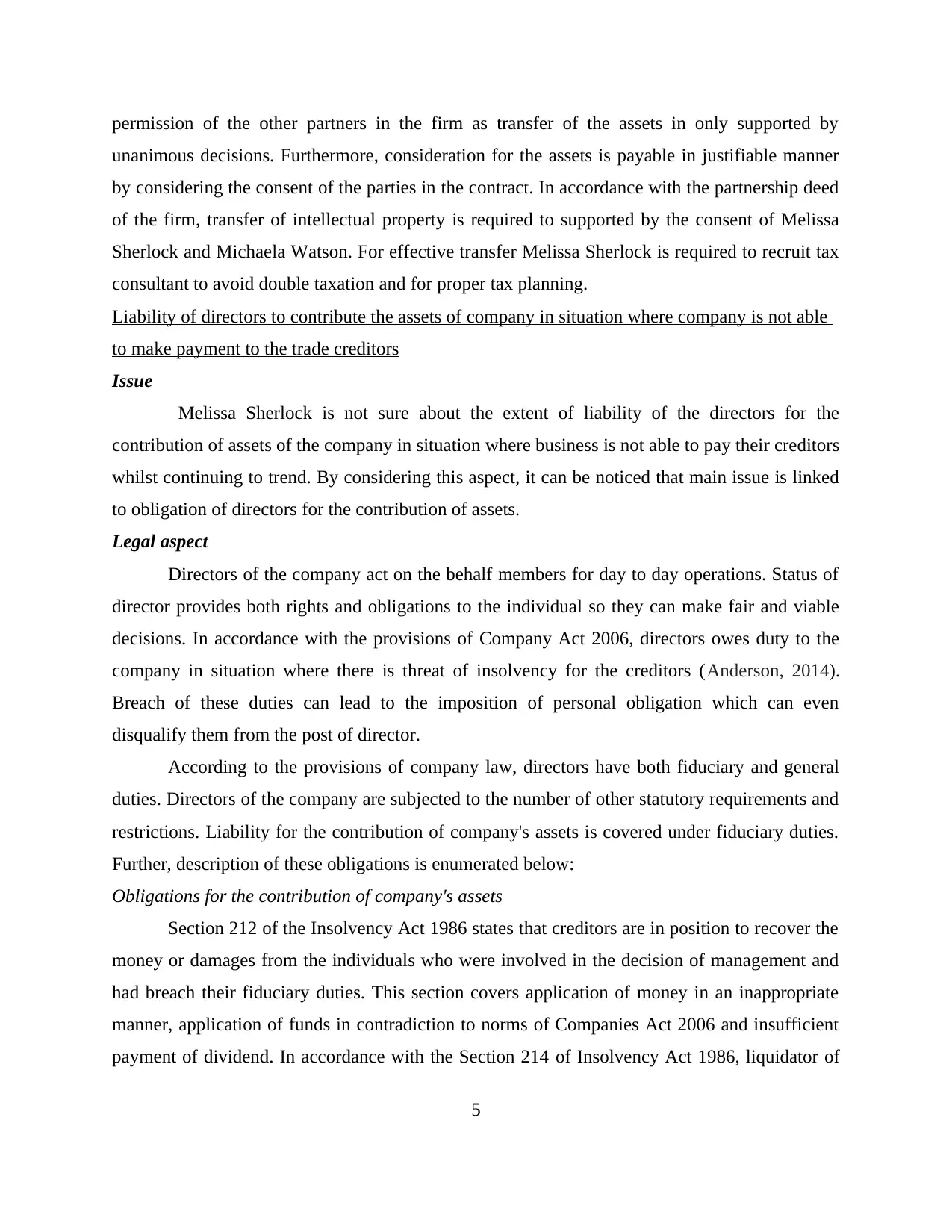
permission of the other partners in the firm as transfer of the assets in only supported by
unanimous decisions. Furthermore, consideration for the assets is payable in justifiable manner
by considering the consent of the parties in the contract. In accordance with the partnership deed
of the firm, transfer of intellectual property is required to supported by the consent of Melissa
Sherlock and Michaela Watson. For effective transfer Melissa Sherlock is required to recruit tax
consultant to avoid double taxation and for proper tax planning.
Liability of directors to contribute the assets of company in situation where company is not able
to make payment to the trade creditors
Issue
Melissa Sherlock is not sure about the extent of liability of the directors for the
contribution of assets of the company in situation where business is not able to pay their creditors
whilst continuing to trend. By considering this aspect, it can be noticed that main issue is linked
to obligation of directors for the contribution of assets.
Legal aspect
Directors of the company act on the behalf members for day to day operations. Status of
director provides both rights and obligations to the individual so they can make fair and viable
decisions. In accordance with the provisions of Company Act 2006, directors owes duty to the
company in situation where there is threat of insolvency for the creditors (Anderson, 2014).
Breach of these duties can lead to the imposition of personal obligation which can even
disqualify them from the post of director.
According to the provisions of company law, directors have both fiduciary and general
duties. Directors of the company are subjected to the number of other statutory requirements and
restrictions. Liability for the contribution of company's assets is covered under fiduciary duties.
Further, description of these obligations is enumerated below:
Obligations for the contribution of company's assets
Section 212 of the Insolvency Act 1986 states that creditors are in position to recover the
money or damages from the individuals who were involved in the decision of management and
had breach their fiduciary duties. This section covers application of money in an inappropriate
manner, application of funds in contradiction to norms of Companies Act 2006 and insufficient
payment of dividend. In accordance with the Section 214 of Insolvency Act 1986, liquidator of
5
unanimous decisions. Furthermore, consideration for the assets is payable in justifiable manner
by considering the consent of the parties in the contract. In accordance with the partnership deed
of the firm, transfer of intellectual property is required to supported by the consent of Melissa
Sherlock and Michaela Watson. For effective transfer Melissa Sherlock is required to recruit tax
consultant to avoid double taxation and for proper tax planning.
Liability of directors to contribute the assets of company in situation where company is not able
to make payment to the trade creditors
Issue
Melissa Sherlock is not sure about the extent of liability of the directors for the
contribution of assets of the company in situation where business is not able to pay their creditors
whilst continuing to trend. By considering this aspect, it can be noticed that main issue is linked
to obligation of directors for the contribution of assets.
Legal aspect
Directors of the company act on the behalf members for day to day operations. Status of
director provides both rights and obligations to the individual so they can make fair and viable
decisions. In accordance with the provisions of Company Act 2006, directors owes duty to the
company in situation where there is threat of insolvency for the creditors (Anderson, 2014).
Breach of these duties can lead to the imposition of personal obligation which can even
disqualify them from the post of director.
According to the provisions of company law, directors have both fiduciary and general
duties. Directors of the company are subjected to the number of other statutory requirements and
restrictions. Liability for the contribution of company's assets is covered under fiduciary duties.
Further, description of these obligations is enumerated below:
Obligations for the contribution of company's assets
Section 212 of the Insolvency Act 1986 states that creditors are in position to recover the
money or damages from the individuals who were involved in the decision of management and
had breach their fiduciary duties. This section covers application of money in an inappropriate
manner, application of funds in contradiction to norms of Companies Act 2006 and insufficient
payment of dividend. In accordance with the Section 214 of Insolvency Act 1986, liquidator of
5
company is in position to the make directors personally liable for the contribution of company
assets for the debts (Directors and insolvency, 2015). However, this liability will be raised in
situation where directors was aware of the fact there is no reasonable prospect of insolvency and
they were in position to minimize the potential losses. Further, Section 213 of this Act states that
any individual having intention to defraud the creditor for any fraudulent objective will be
personally liable for the contribution of company's assets. According to the Section 238
(Transactions at an undervalue) and 239 (Preferences) this obligation also arise in case company
had disposed their assets at significant lower value in comparison to its worth.
Disqualification
In situation of such obligation directors faces disqualification minimum of five years for
the act of persistent default in their duties. Due to the disqualification remark they will not be
able to participate in management decisions, promotion and formation activities of company
(Donohoe, 2011).
Relief from liability, indemnity and insurance
Court is in position to relieve a particular director from the liability of negligence in
situation where there act is supported by the justified action. However, this provision will not be
applied in situation where director is involved in wrongful trading activities (Shehzad, 2009). A
company is also in position to indemnify their directors in civil proceedings in case where
decision is in favour of director or director is considered to be acquitted.
Applicability of legal aspect
In accordance with the provided case study, Melissa Sherlock, Michaela Watson and
Jason Hudson have been appointed directors of the Company after the completion of conversion
process. By the virtue of the position of the director they are required to comply their fiduciary
and general duties. They are obliged to act fairly in order to attain aims and objectives of the
company in an effective manner. They should not get involved in unfair trading activities and
manipulated financial transactions which are prejudice to the interest of company. However, in
situation where they failed to do so they will be held liable for the contribution of company's
assets.
Conclusion
6
assets for the debts (Directors and insolvency, 2015). However, this liability will be raised in
situation where directors was aware of the fact there is no reasonable prospect of insolvency and
they were in position to minimize the potential losses. Further, Section 213 of this Act states that
any individual having intention to defraud the creditor for any fraudulent objective will be
personally liable for the contribution of company's assets. According to the Section 238
(Transactions at an undervalue) and 239 (Preferences) this obligation also arise in case company
had disposed their assets at significant lower value in comparison to its worth.
Disqualification
In situation of such obligation directors faces disqualification minimum of five years for
the act of persistent default in their duties. Due to the disqualification remark they will not be
able to participate in management decisions, promotion and formation activities of company
(Donohoe, 2011).
Relief from liability, indemnity and insurance
Court is in position to relieve a particular director from the liability of negligence in
situation where there act is supported by the justified action. However, this provision will not be
applied in situation where director is involved in wrongful trading activities (Shehzad, 2009). A
company is also in position to indemnify their directors in civil proceedings in case where
decision is in favour of director or director is considered to be acquitted.
Applicability of legal aspect
In accordance with the provided case study, Melissa Sherlock, Michaela Watson and
Jason Hudson have been appointed directors of the Company after the completion of conversion
process. By the virtue of the position of the director they are required to comply their fiduciary
and general duties. They are obliged to act fairly in order to attain aims and objectives of the
company in an effective manner. They should not get involved in unfair trading activities and
manipulated financial transactions which are prejudice to the interest of company. However, in
situation where they failed to do so they will be held liable for the contribution of company's
assets.
Conclusion
6
⊘ This is a preview!⊘
Do you want full access?
Subscribe today to unlock all pages.
Trusted by 1+ million students worldwide
By considering the above described legal aspects it can be said that directors (Melissa
Sherlock, Michaela Watson and Jason Hudson) of the S&W Toys Limited will be held obliged
for the contribution of assets of the company if they are involved in following faulty actions:
Breach of fiduciary duties
Involvement in wrongful trading activities
Act of misfeasance
Undervalued transactions
QUESTION 4
Permission required to enable directors for the allotment of ordinary and preference shares to
3PPP
Issue
Directors are not the owners of the company thus they are required to comply certain
norms to avail permission for the allotment of ordinary and preference shares to the third party.
This part of the project is focused on the description of permission required for the allotment of
the share capital of company.
Legal aspect
Mainly there is two type of share capital i.e. authorised and issued. Authorised capital is
maximum amount that can be issue by a company. On the other hand, issued capital is number of
shares issued and held by the directors (Rush and Ottley, 2006). Corporate entities are entitled to
issue new shares in order to generate financial sources for the attainment of objectives of
business. Company can issue shares to an individual as well as an organization.
According to the legal provisions of the Companies Act 2006, directors of the company
require permission of the existing shareholders in case where they have only one class of shares.
However, if company is incorporated prior to 1st October 2009 then directors have existing
authority for the allotment of shares in accordance with its articles (Companies Act 2006, 2006).
Provisions of articles may also contain restrictions for the issue of shares in such case directors
are required to pass ordinary resolutions.
Directors are restricted for the issue of new shares due to Section 549 of the Companies
Act 2006. In accordance with the provisions of this Section directors are not entitled for the issue
of new shares if it is not authorised by the articles of the company. In such situations, they are
7
Sherlock, Michaela Watson and Jason Hudson) of the S&W Toys Limited will be held obliged
for the contribution of assets of the company if they are involved in following faulty actions:
Breach of fiduciary duties
Involvement in wrongful trading activities
Act of misfeasance
Undervalued transactions
QUESTION 4
Permission required to enable directors for the allotment of ordinary and preference shares to
3PPP
Issue
Directors are not the owners of the company thus they are required to comply certain
norms to avail permission for the allotment of ordinary and preference shares to the third party.
This part of the project is focused on the description of permission required for the allotment of
the share capital of company.
Legal aspect
Mainly there is two type of share capital i.e. authorised and issued. Authorised capital is
maximum amount that can be issue by a company. On the other hand, issued capital is number of
shares issued and held by the directors (Rush and Ottley, 2006). Corporate entities are entitled to
issue new shares in order to generate financial sources for the attainment of objectives of
business. Company can issue shares to an individual as well as an organization.
According to the legal provisions of the Companies Act 2006, directors of the company
require permission of the existing shareholders in case where they have only one class of shares.
However, if company is incorporated prior to 1st October 2009 then directors have existing
authority for the allotment of shares in accordance with its articles (Companies Act 2006, 2006).
Provisions of articles may also contain restrictions for the issue of shares in such case directors
are required to pass ordinary resolutions.
Directors are restricted for the issue of new shares due to Section 549 of the Companies
Act 2006. In accordance with the provisions of this Section directors are not entitled for the issue
of new shares if it is not authorised by the articles of the company. In such situations, they are
7
Paraphrase This Document
Need a fresh take? Get an instant paraphrase of this document with our AI Paraphraser
required to pass ordinary resolution in the general meeting (Padhi, 2012). Further, Section of 561
of the CA2006 states that new shares are required to be issued to the existing shareholder in the
ratio of existing holding.
Provisions of the Companies Act 2006 does not impose legal restrictions on the number
of shares that can be issued by private company after its incorporation. However, it is possible to
include restriction in the article of association of the company (Gill, 2005). Further, articles
adopted by any private company formed after 1st October 2009 provides permission to director
for the issue of equity share capital (not preference shares) more than permitted by the directors.
Applicability of legal aspect
In accordance with the above described aspects, Melissa is required to pass ordinary
resolution to attain the permission for the issue of new equity and preference shares. For this
aspect, meeting is required to be called up in which all directors and shareholders are present. By
considering the article of association there is no restriction on the issue of equity shares thus
directors are only required to take permission from the existing shareholders (Introduction to
articles, 2015). Resolution should be in written mode and it must have consent of more than fifty
percent shareholders. By considering the present case situation, Melissa requires consent of at
least one director for this equity issue. It is because, she has 35% shareholding and for the issue
of equity she requires further consent of minimum 16% shareholding.
Conclusion
After taking permission from the existing shareholders, directors of the company will be
entitled to allot the additional ordinary and preference shares to 3PPP for the generation of funds
for the company. For the issue of equity and preference she is required to comply statutory
formalities in an appropriable manner.
Formalities required to be complied for the allotment of ordinary and preference shares to 3PPP
in accordance with the Companies Act 2006
Issue
Melissa is not aware of the formalities required to be satisfied for the allotment of
ordinary and preference shares to 3PPP in accordance with the Companies Act 2006. By
considering this aspect, this part of the project is focused on the description of formalities to be
satisfied for the issue of share capital to the third party.
8
of the CA2006 states that new shares are required to be issued to the existing shareholder in the
ratio of existing holding.
Provisions of the Companies Act 2006 does not impose legal restrictions on the number
of shares that can be issued by private company after its incorporation. However, it is possible to
include restriction in the article of association of the company (Gill, 2005). Further, articles
adopted by any private company formed after 1st October 2009 provides permission to director
for the issue of equity share capital (not preference shares) more than permitted by the directors.
Applicability of legal aspect
In accordance with the above described aspects, Melissa is required to pass ordinary
resolution to attain the permission for the issue of new equity and preference shares. For this
aspect, meeting is required to be called up in which all directors and shareholders are present. By
considering the article of association there is no restriction on the issue of equity shares thus
directors are only required to take permission from the existing shareholders (Introduction to
articles, 2015). Resolution should be in written mode and it must have consent of more than fifty
percent shareholders. By considering the present case situation, Melissa requires consent of at
least one director for this equity issue. It is because, she has 35% shareholding and for the issue
of equity she requires further consent of minimum 16% shareholding.
Conclusion
After taking permission from the existing shareholders, directors of the company will be
entitled to allot the additional ordinary and preference shares to 3PPP for the generation of funds
for the company. For the issue of equity and preference she is required to comply statutory
formalities in an appropriable manner.
Formalities required to be complied for the allotment of ordinary and preference shares to 3PPP
in accordance with the Companies Act 2006
Issue
Melissa is not aware of the formalities required to be satisfied for the allotment of
ordinary and preference shares to 3PPP in accordance with the Companies Act 2006. By
considering this aspect, this part of the project is focused on the description of formalities to be
satisfied for the issue of share capital to the third party.
8
Legal aspect
Formalities for the issue of equity and preference share capital
Offer letter: An offer is required to be made to Private Placement Offer Letter to the
particular group not more than 200 people. This offer letter is required to be in
appropriate form. It can be either in writing or oral mode.
◦ Content of offer letter: Offer letter issued by company must contain information
related to business carried out by the company and its subsidiaries. Further, it should
include purpose and object of the offer and its justification (Emerson, 2009). In
addition to this, details regarding related party transactions, litigation pending,
contribution by directors and promoters and management perception for risk factors
should also be inserted (Allotment and issue of share capital and pre-emption right,
2015). Company is required to provide information regarding their dividend and
voting rights.
◦ Financial disclosure: Directors of the company are required to provide financial
disclosure to the potential shareholders. This disclosure must contain following
information:
▪ Capital structure of company of both before and after issue of security.
▪ Information related to previous profits and dividends.
▪ Summary of financial position.
▪ Declaration of compliance by the directors.
Allotment of shares in accordance with the board resolution: In this step, directors of the
company are required to approve the applications for shares received. Further, allotment
of shares is authorised and details are stated of potential shareholders. These forms are
submitted to the Company House. After the completion of this process, share certificates
are issued to the new share holders in respect of their shareholdings. Information of this
allotment is stated in register of members and allotments.
Completion of allotment through submission of From SH01 to Companies House: Within
the duration of 1 month of allotment, directors are required to deliver form SH01 to the
Companies House. This form is consists of statement of capital of the company. With this
formation information regarding overall capital structure can be attained (Allotment and
9
Formalities for the issue of equity and preference share capital
Offer letter: An offer is required to be made to Private Placement Offer Letter to the
particular group not more than 200 people. This offer letter is required to be in
appropriate form. It can be either in writing or oral mode.
◦ Content of offer letter: Offer letter issued by company must contain information
related to business carried out by the company and its subsidiaries. Further, it should
include purpose and object of the offer and its justification (Emerson, 2009). In
addition to this, details regarding related party transactions, litigation pending,
contribution by directors and promoters and management perception for risk factors
should also be inserted (Allotment and issue of share capital and pre-emption right,
2015). Company is required to provide information regarding their dividend and
voting rights.
◦ Financial disclosure: Directors of the company are required to provide financial
disclosure to the potential shareholders. This disclosure must contain following
information:
▪ Capital structure of company of both before and after issue of security.
▪ Information related to previous profits and dividends.
▪ Summary of financial position.
▪ Declaration of compliance by the directors.
Allotment of shares in accordance with the board resolution: In this step, directors of the
company are required to approve the applications for shares received. Further, allotment
of shares is authorised and details are stated of potential shareholders. These forms are
submitted to the Company House. After the completion of this process, share certificates
are issued to the new share holders in respect of their shareholdings. Information of this
allotment is stated in register of members and allotments.
Completion of allotment through submission of From SH01 to Companies House: Within
the duration of 1 month of allotment, directors are required to deliver form SH01 to the
Companies House. This form is consists of statement of capital of the company. With this
formation information regarding overall capital structure can be attained (Allotment and
9
⊘ This is a preview!⊘
Do you want full access?
Subscribe today to unlock all pages.
Trusted by 1+ million students worldwide
issue of share capital and pre-emption right, 2015). However, in this form directors are
not required to provide details of shareholders but they can include their shareholding in
next annual return. Record of allotment transaction in Company's account: Directors of the company are
required to ensure that allotments are reflected in books of accounts in proper manner.
This issue will increase amount of cash and cash equivalent along with the share capital
of company.
Applicability of legal aspect
Melissa is required to form an offer letter in order for the allotment of ordinary and
preference shares to 3PPP. In this offer letter, she is required to state complete information
regarding equity and preference issue such as rate of dividend and their voting rights. On this
offer letter consent will be provided by managing director of 3PPP. After their consent, equity
and preference shares will be issued to the party with the described terms and conditions in offer
letter. After the issue, she is required to submit the for SH01 to the Companies House with the
required information. Further, information of this allotment is also required to be reflected in
next annual return and books of accounts in appropriate manner.
Conclusion
Melissa can issue share to the 3PPP by complying formalities in described legal aspects.
After the completion of these formalities, 3PPP will be considered as shareholder of the
company and they will be able to participate in management decision through their voting rights.
In addition to this, return of provided funds by 3PPP will be paid in form of dividend.
CONCLUSION
In accordance with the present study conclusion can be drawn that business entities are
required to comply legal norms for the conversion of business. In addition to this, commercial
transactions are required to be supported by consent of all parties in order to avoid conflicts and
legal complications. Present study depicts that assets of partnership firm can be transferred in
favour of company is situation where it is supported by proper consent of partners and statutory
requirements. Further, directors of the company are required to satisfy their fiduciary and general
duties in proper manner else they will be held liable for the contribution of company's assets. In
order to issue equity and preference share capital, directors are required to take permission from
10
not required to provide details of shareholders but they can include their shareholding in
next annual return. Record of allotment transaction in Company's account: Directors of the company are
required to ensure that allotments are reflected in books of accounts in proper manner.
This issue will increase amount of cash and cash equivalent along with the share capital
of company.
Applicability of legal aspect
Melissa is required to form an offer letter in order for the allotment of ordinary and
preference shares to 3PPP. In this offer letter, she is required to state complete information
regarding equity and preference issue such as rate of dividend and their voting rights. On this
offer letter consent will be provided by managing director of 3PPP. After their consent, equity
and preference shares will be issued to the party with the described terms and conditions in offer
letter. After the issue, she is required to submit the for SH01 to the Companies House with the
required information. Further, information of this allotment is also required to be reflected in
next annual return and books of accounts in appropriate manner.
Conclusion
Melissa can issue share to the 3PPP by complying formalities in described legal aspects.
After the completion of these formalities, 3PPP will be considered as shareholder of the
company and they will be able to participate in management decision through their voting rights.
In addition to this, return of provided funds by 3PPP will be paid in form of dividend.
CONCLUSION
In accordance with the present study conclusion can be drawn that business entities are
required to comply legal norms for the conversion of business. In addition to this, commercial
transactions are required to be supported by consent of all parties in order to avoid conflicts and
legal complications. Present study depicts that assets of partnership firm can be transferred in
favour of company is situation where it is supported by proper consent of partners and statutory
requirements. Further, directors of the company are required to satisfy their fiduciary and general
duties in proper manner else they will be held liable for the contribution of company's assets. In
order to issue equity and preference share capital, directors are required to take permission from
10
Paraphrase This Document
Need a fresh take? Get an instant paraphrase of this document with our AI Paraphraser

the existing shareholders. Further, they are required to comply statutory formalities in order to
make investor their shareholder.
11
make investor their shareholder.
11
REFERENCES
Books and journals
Adams, A., 2010. Law For Business Students. 6th ed. Pearson Education Lt.
Anderson, H., 2014. Directors' Liability for Fraudulent Phoenix Activity—A Comparison of the
Australian and UK Approaches. Journal of Corporate Law Studies. 14(1). pp.139-173.
Beatty, J. F., 2012. Legal Environment. Cengage learning.
Broady-Preston, J., and Williams, T., 2004. Using information to create business value: City of
London legal firms, a case study. Performance Measurement and Metrics. 5 (1). pp.5 –
10.
Donohoe, S., 2011. The WW Gear case. conditions precedent and construction contracts",
Structural Survey. 29 (2) pp.99 – 105.
Emerson, W. R., 2009. Business Law. Barron's Educational Series.
Gill, J., 2005. Business Law for the Entrepreneur. Arima Publishing.
Padhi, K., P., 2012. Legal Aspects of Business. PHI Learning Pvt. Ltd.
Rush, J. and Ottley, M., 2006. Business Law. Cengage learning.
Shehzad, N., 2009. Business Law: A Guide for Entrepreneurs (1st edition). International Journal
of Law and Management. 51(1). pp.53 – 54.
Talbot, L. E., 2014. Operationalizing Sustainability in Company Law Reform Through a Labour-
Centred Approach: A UK Perspective. European Company Law. 11(2).
Online
Allotment and issue of share capital and pre-emption right. 2015. [Online] Available through:
<https://www.lexisnexis.com/uk/lexispsl/corporate/document/391387/55KB-9K81-
F186-H08N-00000-00/Allotment+and+issue+of+share+capital+and+pre-
emption+rights>. [Accessed on 1st February 2016].
Companies Act 2006. 2006. [Online] Available through:
<http://www.legislation.gov.uk/ukpga/2006/46/contents>. [Accessed on 1st February
2016].
Directors and insolvency. 2015. [Online] Available through: <http://united-
kingdom.taylorwessing.com/synapse/duties_directors_insolvency.html>. [Accessed on
1st February 2016].
12
Books and journals
Adams, A., 2010. Law For Business Students. 6th ed. Pearson Education Lt.
Anderson, H., 2014. Directors' Liability for Fraudulent Phoenix Activity—A Comparison of the
Australian and UK Approaches. Journal of Corporate Law Studies. 14(1). pp.139-173.
Beatty, J. F., 2012. Legal Environment. Cengage learning.
Broady-Preston, J., and Williams, T., 2004. Using information to create business value: City of
London legal firms, a case study. Performance Measurement and Metrics. 5 (1). pp.5 –
10.
Donohoe, S., 2011. The WW Gear case. conditions precedent and construction contracts",
Structural Survey. 29 (2) pp.99 – 105.
Emerson, W. R., 2009. Business Law. Barron's Educational Series.
Gill, J., 2005. Business Law for the Entrepreneur. Arima Publishing.
Padhi, K., P., 2012. Legal Aspects of Business. PHI Learning Pvt. Ltd.
Rush, J. and Ottley, M., 2006. Business Law. Cengage learning.
Shehzad, N., 2009. Business Law: A Guide for Entrepreneurs (1st edition). International Journal
of Law and Management. 51(1). pp.53 – 54.
Talbot, L. E., 2014. Operationalizing Sustainability in Company Law Reform Through a Labour-
Centred Approach: A UK Perspective. European Company Law. 11(2).
Online
Allotment and issue of share capital and pre-emption right. 2015. [Online] Available through:
<https://www.lexisnexis.com/uk/lexispsl/corporate/document/391387/55KB-9K81-
F186-H08N-00000-00/Allotment+and+issue+of+share+capital+and+pre-
emption+rights>. [Accessed on 1st February 2016].
Companies Act 2006. 2006. [Online] Available through:
<http://www.legislation.gov.uk/ukpga/2006/46/contents>. [Accessed on 1st February
2016].
Directors and insolvency. 2015. [Online] Available through: <http://united-
kingdom.taylorwessing.com/synapse/duties_directors_insolvency.html>. [Accessed on
1st February 2016].
12
⊘ This is a preview!⊘
Do you want full access?
Subscribe today to unlock all pages.
Trusted by 1+ million students worldwide

1 out of 13


Related Documents


Your All-in-One AI-Powered Toolkit for Academic Success.
+13062052269
info@desklib.com
Available 24*7 on WhatsApp / Email
![[object Object]](/_next/static/media/star-bottom.7253800d.svg)
Unlock your academic potential
Copyright © 2020–2026 A2Z Services. All Rights Reserved. Developed and managed by ZUCOL.