Tort Law in Business & Corporation Law: A Detailed Analysis
VerifiedAdded on 2023/06/08
|9
|3394
|327
Essay
AI Summary
This essay provides an analysis of Tort Law, focusing on key elements such as duty of care, breach of duty, and negligence. It discusses how courts evaluate these elements, emphasizing the importance of circumstances surrounding a case. The essay explores the concept of contributory negligence and various defenses available under Tort Law. It also highlights the significance of factors like foreseeability of risk, likelihood of harm, and social utility in determining liability and damages. The document concludes by underscoring the necessity for courts to consider the specific circumstances of each case to ensure fair and just outcomes. Desklib offers a wide range of such solved assignments.
Running Head: BUSINESS AND CORPORATION LAW 0
TORT Law
Student’s Name
8/1/2018
TORT Law
Student’s Name
8/1/2018

Paraphrase This Document
Need a fresh take? Get an instant paraphrase of this document with our AI Paraphraser
Tort Law
1
Assignment on Tort Law
In general, some relationships do exist in the society where a person owns a liability of care
towards the other person. These relationships are those where fiduciary factors exist in the nature
of a relationship, for instance, Doctor-Patients, Solicitors- Clients, and so on. Wherever a person
fails to discharge such duty of care, and due to this reason other parties suffer from a loss then
such a situation termed as “Tort.” Here the meaning of tort is “Civil Wrong1.” Negligence is an
important kind of tort. When due to negligence or any other kind of tort of a person, another
party comes out with loss, then, the suffered party can ask for the damages Under Tort Law.
Some of the elements are mentioned under Tort Law that is necessary to exist in a case tort.
These factors are as follow:
1. The existence of Duty of care
2. Breach of such duty
3. Defendant’s act must be the actual cause of harm/loss
4. Cause of loss should be proximate
5. The plaintiff must be suffered from an identified harm.
If all the aforesaid conditions get satisfied then a case of tort will be proved.
It was seen in the case of Read v Lyons Co Ltd2 that while considering the cases of
negligence/tort, Judges does not consider the condition and characteristic of the defendant of the
case. It means the court considers the existence of the aforementioned requirements. Further, it
has also been noted in the said case that the court looks after the circumstance of the case in
which a loss is accrued to the plaintiff.
As mentioned earlier that loss should be directly related to the negligence act of the defendant.
This is to mention that the cases where the reason of loss is not the negligence of the defendant,
the court does consider the case as “Case of Negligence.” Here, this is significant to know that
for reasons, the court does not consider the characteristics of the individual defendant.
Negligence is a part of Tort Law that comes under Common Law. Common Law works on the
basis of natural justice and legal precedents. In every case, providing justice to the victim party is
the main target of judges, this is the reason that they do not consider the situation of an
individual defendant. Characteristics of an individual can be anything. He/she can be poor or
1 Margaret Kerr and JoAnn Kurtz, Make it Legal: What Every Canadian Entrepreneur Needs to Know About the
Law (John Wiley & Sons 2012), 281.
2 [1947] AC 156
1
Assignment on Tort Law
In general, some relationships do exist in the society where a person owns a liability of care
towards the other person. These relationships are those where fiduciary factors exist in the nature
of a relationship, for instance, Doctor-Patients, Solicitors- Clients, and so on. Wherever a person
fails to discharge such duty of care, and due to this reason other parties suffer from a loss then
such a situation termed as “Tort.” Here the meaning of tort is “Civil Wrong1.” Negligence is an
important kind of tort. When due to negligence or any other kind of tort of a person, another
party comes out with loss, then, the suffered party can ask for the damages Under Tort Law.
Some of the elements are mentioned under Tort Law that is necessary to exist in a case tort.
These factors are as follow:
1. The existence of Duty of care
2. Breach of such duty
3. Defendant’s act must be the actual cause of harm/loss
4. Cause of loss should be proximate
5. The plaintiff must be suffered from an identified harm.
If all the aforesaid conditions get satisfied then a case of tort will be proved.
It was seen in the case of Read v Lyons Co Ltd2 that while considering the cases of
negligence/tort, Judges does not consider the condition and characteristic of the defendant of the
case. It means the court considers the existence of the aforementioned requirements. Further, it
has also been noted in the said case that the court looks after the circumstance of the case in
which a loss is accrued to the plaintiff.
As mentioned earlier that loss should be directly related to the negligence act of the defendant.
This is to mention that the cases where the reason of loss is not the negligence of the defendant,
the court does consider the case as “Case of Negligence.” Here, this is significant to know that
for reasons, the court does not consider the characteristics of the individual defendant.
Negligence is a part of Tort Law that comes under Common Law. Common Law works on the
basis of natural justice and legal precedents. In every case, providing justice to the victim party is
the main target of judges, this is the reason that they do not consider the situation of an
individual defendant. Characteristics of an individual can be anything. He/she can be poor or
1 Margaret Kerr and JoAnn Kurtz, Make it Legal: What Every Canadian Entrepreneur Needs to Know About the
Law (John Wiley & Sons 2012), 281.
2 [1947] AC 156
Tort Law
2
unaware of the law. However, this will not be fair to consider the characteristics of them. The
lead task of judges is to provide the justice to the victim party; hence, the need is to focus on the
condition of the plaintiff rather than the defendant. This is also expected that if once courts will
start considering situations of individual defendants, then all the defendants will start making
excuses and no one will let the judges held them liable.
However, this is not that, a judge never considers the situation of a defendant. In many of the
cases, where the defendant himself/herself is not able to perform his/her duty of care due to the
physical conditions, the courts consider the issues in such cases. The reason of the same is that
an ill person cannot be held liable to perform the duty of care as similar to a healthy person in the
cases where the said duty involves the personal assistance of defendant. Mostly, courts consider
the physical capacity of the defendant but not the mental one. A person cannot be held free from
the standard of care just because of the reason that the same is mentally unstable or is lacking in
memory, judgment, or emotional stability. This cannot be stated that courts never consider the
personal characteristics of the individual defendant, but it does not happen in general.
It was held in the case of Blyth V Birmingham Waterworks3 that negligence is an omission of the
duty that a reasonable person was expected to fulfill. In the interpretation of this, it can be stated
that the defendant must be a reasonable person. If a person is not able to take reasonable
decisions and steps then, the same cannot be held liable for Negligence or another kind of tort
under Tort Law. Here the meaning of reasonable person is a person that is expected to be a
skilled, mature, competent, and experienced one. Further as per the decision of the case of
wilsher V Essex Area Health Authority4 inexperience of a defendant (where defendant is a
professional) cannot reduce the standard of care5. Providing justice to the weaker party to the
case is the lead reason for not considering the defendant’s situation is a particular case. If the
court would start considering defendant’s characteristics then probably no defendant will be left
there. Hence, court although listen to both the parties yet not consider characteristics of the
defendant.
As discussed above that the court does not consider characteristics of the individual defendant,
this is also significant to discuss that courts take into account and consider the circumstances of
the case in which loss occurred. The decision in every case depends on it is circumstances. As
tort is a situation where a person fails to perform the standard of care, therefore the reason for
that it has happen needs to review. Such reasons are a part of the circumstances of the case. In
many of the cases, it has observed that the defendant failed due to the situation of the moment.
Sometimes, at a particular time, it does not remain possible for the defendant to perform the duty
of care, and then in such cases, the court needs to know the exact circumstances. Contributory
negligence is an important aspect under Tort Law. This is a situation where along with the
defendant, the claimant also fails to take care of him/her or do an act that is proved as an
3 (1856) 11 Exch
4 [1987] QB 730
5 Kirsty Horsey and Erika Rackley, Tort Law (Oxford university Press 2015), 222.
2
unaware of the law. However, this will not be fair to consider the characteristics of them. The
lead task of judges is to provide the justice to the victim party; hence, the need is to focus on the
condition of the plaintiff rather than the defendant. This is also expected that if once courts will
start considering situations of individual defendants, then all the defendants will start making
excuses and no one will let the judges held them liable.
However, this is not that, a judge never considers the situation of a defendant. In many of the
cases, where the defendant himself/herself is not able to perform his/her duty of care due to the
physical conditions, the courts consider the issues in such cases. The reason of the same is that
an ill person cannot be held liable to perform the duty of care as similar to a healthy person in the
cases where the said duty involves the personal assistance of defendant. Mostly, courts consider
the physical capacity of the defendant but not the mental one. A person cannot be held free from
the standard of care just because of the reason that the same is mentally unstable or is lacking in
memory, judgment, or emotional stability. This cannot be stated that courts never consider the
personal characteristics of the individual defendant, but it does not happen in general.
It was held in the case of Blyth V Birmingham Waterworks3 that negligence is an omission of the
duty that a reasonable person was expected to fulfill. In the interpretation of this, it can be stated
that the defendant must be a reasonable person. If a person is not able to take reasonable
decisions and steps then, the same cannot be held liable for Negligence or another kind of tort
under Tort Law. Here the meaning of reasonable person is a person that is expected to be a
skilled, mature, competent, and experienced one. Further as per the decision of the case of
wilsher V Essex Area Health Authority4 inexperience of a defendant (where defendant is a
professional) cannot reduce the standard of care5. Providing justice to the weaker party to the
case is the lead reason for not considering the defendant’s situation is a particular case. If the
court would start considering defendant’s characteristics then probably no defendant will be left
there. Hence, court although listen to both the parties yet not consider characteristics of the
defendant.
As discussed above that the court does not consider characteristics of the individual defendant,
this is also significant to discuss that courts take into account and consider the circumstances of
the case in which loss occurred. The decision in every case depends on it is circumstances. As
tort is a situation where a person fails to perform the standard of care, therefore the reason for
that it has happen needs to review. Such reasons are a part of the circumstances of the case. In
many of the cases, it has observed that the defendant failed due to the situation of the moment.
Sometimes, at a particular time, it does not remain possible for the defendant to perform the duty
of care, and then in such cases, the court needs to know the exact circumstances. Contributory
negligence is an important aspect under Tort Law. This is a situation where along with the
defendant, the claimant also fails to take care of him/her or do an act that is proved as an
3 (1856) 11 Exch
4 [1987] QB 730
5 Kirsty Horsey and Erika Rackley, Tort Law (Oxford university Press 2015), 222.
⊘ This is a preview!⊘
Do you want full access?
Subscribe today to unlock all pages.

Trusted by 1+ million students worldwide
Tort Law
3
additional reason for the loss accrued6. In case of contributory negligence, damages are reduced
up to a certain level and the plaintiff can only claim for the partial damages. The defendant can
use this factor as defense in against of plaintiff. To check out the existence of contributory
negligence, courts consider the circumstances of the loss. Further, while entertaining a case,
judges are required to review the entire circumstances of the case in order to decide the
applicability of rules and precedents, such review helps the court in a grant of the decision. In
addition to contributory negligence, there are many concepts and factors exist in Tort Law.
Similarly, Negligence, factors such as nuisance and defamation can be the causes of breach of
duty. To find the answers to some of the queries, considerations of circumstances are necessary
for the courts. Following are the queries that need to be reviewed:-
1. Breach of Duty: - In the Tort Law, breach of duty is a situation, where the reasonable person
fails to show the standard of care7. Whether there was any duty of care existed that the defendant
owned and whether the defendant did not perform such a duty, this can only be check by looking
into the circumstances of the case.
2. The reason for such Breach: - Reason of breach of duty is also an important element. Such a
reason can be a nuisance, negligence, or defamation. Cause of breach of duty is important
because it plays a significant role in the judgment.
3. Quantum and kind of Loss: - Loss can be in the form of economic loss, physical injury, or
psychiatric harm. A loss is the only factor cause of that plaintiff brings the case to the court.
Similarly, kind of loss and quantity is also important as on the basis of these, damages are
calculated.
4. Quantum of Damages: - As mentioned earlier that the quantity of damages does depend on
the calculated loss, therefore, both these aspects are important to review. To decide the damages,
courts are required to check the circumstance in which loss occurred.
5. The existence of defenses: - Under tort law, some defenses are mentioned. These defenses
are mainly of four type such as Volenti non fit injuria, Ex turpi Causa, Contributory Negligence
and exclusion of Liability8. Whenever a defendant asks for defenses, it is the liability of the court
to check the applicability of the same before providing the same to the defendant. To check such
applicability, courts consider the circumstances.
Without knowing the aforesaid elements, courts cannot reach up to a defined and correct
decision. Many of the times, even a reasonable person gets fail to show the standard of care due
6 LegalMatch, ‘What Is Contributory Negligence in a Personal Injury Lawsuit?’ (2018) <
https://www.legalmatch.com/law-library/article/defenses-to-tort-liability-contributory-negligence.html> accessed 04
August 2018
7 Find Law, ‘Elements of a Negligence Case’ (2018) < https://injury.findlaw.com/accident-injury-law/elements-of-a-
negligence-case.html> accessed 04 August 2018
8 E-law resources, ‘Tort Law’ (2018) < http://e-lawresources.co.uk/Tort-law.php> accessed 04 August 2018
3
additional reason for the loss accrued6. In case of contributory negligence, damages are reduced
up to a certain level and the plaintiff can only claim for the partial damages. The defendant can
use this factor as defense in against of plaintiff. To check out the existence of contributory
negligence, courts consider the circumstances of the loss. Further, while entertaining a case,
judges are required to review the entire circumstances of the case in order to decide the
applicability of rules and precedents, such review helps the court in a grant of the decision. In
addition to contributory negligence, there are many concepts and factors exist in Tort Law.
Similarly, Negligence, factors such as nuisance and defamation can be the causes of breach of
duty. To find the answers to some of the queries, considerations of circumstances are necessary
for the courts. Following are the queries that need to be reviewed:-
1. Breach of Duty: - In the Tort Law, breach of duty is a situation, where the reasonable person
fails to show the standard of care7. Whether there was any duty of care existed that the defendant
owned and whether the defendant did not perform such a duty, this can only be check by looking
into the circumstances of the case.
2. The reason for such Breach: - Reason of breach of duty is also an important element. Such a
reason can be a nuisance, negligence, or defamation. Cause of breach of duty is important
because it plays a significant role in the judgment.
3. Quantum and kind of Loss: - Loss can be in the form of economic loss, physical injury, or
psychiatric harm. A loss is the only factor cause of that plaintiff brings the case to the court.
Similarly, kind of loss and quantity is also important as on the basis of these, damages are
calculated.
4. Quantum of Damages: - As mentioned earlier that the quantity of damages does depend on
the calculated loss, therefore, both these aspects are important to review. To decide the damages,
courts are required to check the circumstance in which loss occurred.
5. The existence of defenses: - Under tort law, some defenses are mentioned. These defenses
are mainly of four type such as Volenti non fit injuria, Ex turpi Causa, Contributory Negligence
and exclusion of Liability8. Whenever a defendant asks for defenses, it is the liability of the court
to check the applicability of the same before providing the same to the defendant. To check such
applicability, courts consider the circumstances.
Without knowing the aforesaid elements, courts cannot reach up to a defined and correct
decision. Many of the times, even a reasonable person gets fail to show the standard of care due
6 LegalMatch, ‘What Is Contributory Negligence in a Personal Injury Lawsuit?’ (2018) <
https://www.legalmatch.com/law-library/article/defenses-to-tort-liability-contributory-negligence.html> accessed 04
August 2018
7 Find Law, ‘Elements of a Negligence Case’ (2018) < https://injury.findlaw.com/accident-injury-law/elements-of-a-
negligence-case.html> accessed 04 August 2018
8 E-law resources, ‘Tort Law’ (2018) < http://e-lawresources.co.uk/Tort-law.php> accessed 04 August 2018
Paraphrase This Document
Need a fresh take? Get an instant paraphrase of this document with our AI Paraphraser
Tort Law
4
to some emergency. In this situation, courts need to review that whether the reasonable person
behaved reasonably in the emergency or not9. Under the starting section of this discussion, five
conditions have been mentioned that are necessary to be there in the cases of Tort. To check that
whether all the five conditions are getting satisfied or not, courts look after the circumstances. It
can be mentioned that circumstances of loss are one of the most important topics to review in a
case, based on that courts provide justice. Judges are not present at the time of incidents; they
review the circumstances, apply the rules of law, and then provide their decision. Without
considering circumstances in that loss occurred, courts will not be able to reach up to the
decision.
In the aforesaid section, reason and significance of considering the circumstances of a case have
discussed. However, in conjunction with this is also necessary to know that what kind of
circumstances, that court considers usually. While calculating the damages and giving the
decision, the court usually looks after some of the factors such as foreseeability of risk, the
likelihood of harm, social utility, the seriousness of harm and so on. These elements have huge
significance and the same effect the order and decision of the courts. In Foreseeability of risk,
courts check that whether the risk was foreseeable or not? It means Courts need to check that
whether the defendant could be aware of the existence of risk or not10. . In a situation where the
defendant could not get any idea about the involved risk, the same cannot be held liable. Further,
the following are also the important circumstance that courts consider in their actions:
Likelihood of Harm: - It is very common that while considering the circumstances of the case,
the court reviews the entire scenario of the case. Likelihood of harm defines the nature of risk
and standard of care on the part of defendant accordingly. The less likely harm exists, the less
standard of duty will arise. In general, meaning, the likelihood of harm can be termed as a
possibility of harm. In the case of Bolton V Stone 11 the defendant owned a cricket club that had a
protective fence of five meters. There were a very few chances to hit a ball out from there and
until the date of the case, no case of injury have been reported. At the claim of the plaintiff, the
court held that there was almost no possibility of risk and therefore the defendant had no
standard of care in this case12. Frequency of incidents also evaluates the likelihood of harm.
In the case of Miller V Jackson13 , although defendant had the five meters high wall in his cricket
club, yet despite this, Plaintiff house received balls several times from the cricket club of the
9The Free Dictionary, ‘Negligence’ (2018) <https://legal dictionary.thefreedictionary.com/Proof+of+Negligence>
accessed 04 August 2018
10 Amit Tikriti, ‘Foreseeability and Proximate Cause in an Injury Case’ (Allaw, 2018)
<http://www.alllaw.com/articles/nolo/personal-injury/foreseeability-proximate-cause.html> accessed 04 August
2018
11 [1951] ac 850
12 Bits of Law, ‘Breach of Duty: Standard of Care’ (2018)
<http://www.bitsoflaw.org/tort/negligence/study-note/degree/breach-of-duty-standard-reasonable-care> accessed 04
August 2018
13 [1977] QB 966
4
to some emergency. In this situation, courts need to review that whether the reasonable person
behaved reasonably in the emergency or not9. Under the starting section of this discussion, five
conditions have been mentioned that are necessary to be there in the cases of Tort. To check that
whether all the five conditions are getting satisfied or not, courts look after the circumstances. It
can be mentioned that circumstances of loss are one of the most important topics to review in a
case, based on that courts provide justice. Judges are not present at the time of incidents; they
review the circumstances, apply the rules of law, and then provide their decision. Without
considering circumstances in that loss occurred, courts will not be able to reach up to the
decision.
In the aforesaid section, reason and significance of considering the circumstances of a case have
discussed. However, in conjunction with this is also necessary to know that what kind of
circumstances, that court considers usually. While calculating the damages and giving the
decision, the court usually looks after some of the factors such as foreseeability of risk, the
likelihood of harm, social utility, the seriousness of harm and so on. These elements have huge
significance and the same effect the order and decision of the courts. In Foreseeability of risk,
courts check that whether the risk was foreseeable or not? It means Courts need to check that
whether the defendant could be aware of the existence of risk or not10. . In a situation where the
defendant could not get any idea about the involved risk, the same cannot be held liable. Further,
the following are also the important circumstance that courts consider in their actions:
Likelihood of Harm: - It is very common that while considering the circumstances of the case,
the court reviews the entire scenario of the case. Likelihood of harm defines the nature of risk
and standard of care on the part of defendant accordingly. The less likely harm exists, the less
standard of duty will arise. In general, meaning, the likelihood of harm can be termed as a
possibility of harm. In the case of Bolton V Stone 11 the defendant owned a cricket club that had a
protective fence of five meters. There were a very few chances to hit a ball out from there and
until the date of the case, no case of injury have been reported. At the claim of the plaintiff, the
court held that there was almost no possibility of risk and therefore the defendant had no
standard of care in this case12. Frequency of incidents also evaluates the likelihood of harm.
In the case of Miller V Jackson13 , although defendant had the five meters high wall in his cricket
club, yet despite this, Plaintiff house received balls several times from the cricket club of the
9The Free Dictionary, ‘Negligence’ (2018) <https://legal dictionary.thefreedictionary.com/Proof+of+Negligence>
accessed 04 August 2018
10 Amit Tikriti, ‘Foreseeability and Proximate Cause in an Injury Case’ (Allaw, 2018)
<http://www.alllaw.com/articles/nolo/personal-injury/foreseeability-proximate-cause.html> accessed 04 August
2018
11 [1951] ac 850
12 Bits of Law, ‘Breach of Duty: Standard of Care’ (2018)
<http://www.bitsoflaw.org/tort/negligence/study-note/degree/breach-of-duty-standard-reasonable-care> accessed 04
August 2018
13 [1977] QB 966
Tort Law
5
defendant, and for this reason, his house was damaged. In the decision, it was held that no matter
how practical it was or not but incidents were happening on a regular interval and cause of that
there was a high likelihood of harm14. The defendant in such a situation owned a duty of care
towards the plaintiff. Courts consider the likelihood of harm to check that whether the defendant
had a duty of care or not. In the decision of the case Haley V London Electricity Board15, it was
decided that not every small risk can be ignored and this cannot be established as the absence of
likelihood of harm.
Seriousness of Harm: - As the likelihood of harm defines the possibility of an injury, similarly
seriousness of harm define the consequences of possible injury16. The more dangerous impact of
injury/harm exists, the higher standard of care will be there on the part of the plaintiff. Further
where in addition of seriousness of the injury, the defendant also been aware of such seriousness
of harm, then his/her liability increases more. Irrelevant to the possibility of injury and number
of incidents, if the nature of the possible injury is a serious one then the defendant will have a
standard of care if he/she is aware with the same. In the case of Paris V Stepney Borough
Council17, defendant was aware that the plaintiff lost his sight in one eye, yet he did not take any
reasonable steps to prevent the risk and therefore, plaintiff has suffered from the same issue with
his another eye. It was held by House of Lords that although the possibility of risk was very
minimal the result was dangerous and in the knowledge of the defendant. Hence, the defendant
held liable18.
Some other elements such as the defendant’s purpose, caution taken by defendants are part of
circumstances that the court usually considers.
After the aforementioned discussion, in the course of conclusion, this is to state that Tort is a part
of Common Law and the same has it is of great significance. For every case of under Tort Law,
this is necessary that there must be a reasonable person that owns a duty of care towards another
person. Further, such a reasonable person must fail to perform his/her said duty. While hearing
and proceedings of a case, courts usually do not consider the characteristics of an individual
defendant except in some of the cases. Further, as circumstances of a case define the other
factors such as presence and absence of breach of duty, type of loss, liabilities, expected behavior
of the parties of the case, the quantity of loss and for this reason study of circumstance is an
important thing to do by the courts. Further, the seriousness of harm and likelihood of harm are
the two lead type of circumstance that court review and consider during in the course of granting
justice. In addition to the said two factors, some other factors such as social utility, and
14 Arunabha Sengupta, ‘Miller vs Jackson: A verdict for cricket’ (cricketcountry, 29 May 2017) <
http://www.cricketcountry.com/articles/miller-vs-jackson-a-verdict-for-cricket-611388> accessed 04 August 2018
15 [1965] AC 778
16 Jane Wright, Tort Law and Human Rights (Bloomsbury Publishing 2017), 249.
17 [1951] AC 367
18Swarb.Co.Uk, ‘PARIS V STEPNEY BOROUGH COUNCIL: HL 13 DEC 1950’ (2018)
<https://swarb.co.uk/paris-v-stepney-borough-council-hl-13-dec-1950/> accessed 04 August 2018
5
defendant, and for this reason, his house was damaged. In the decision, it was held that no matter
how practical it was or not but incidents were happening on a regular interval and cause of that
there was a high likelihood of harm14. The defendant in such a situation owned a duty of care
towards the plaintiff. Courts consider the likelihood of harm to check that whether the defendant
had a duty of care or not. In the decision of the case Haley V London Electricity Board15, it was
decided that not every small risk can be ignored and this cannot be established as the absence of
likelihood of harm.
Seriousness of Harm: - As the likelihood of harm defines the possibility of an injury, similarly
seriousness of harm define the consequences of possible injury16. The more dangerous impact of
injury/harm exists, the higher standard of care will be there on the part of the plaintiff. Further
where in addition of seriousness of the injury, the defendant also been aware of such seriousness
of harm, then his/her liability increases more. Irrelevant to the possibility of injury and number
of incidents, if the nature of the possible injury is a serious one then the defendant will have a
standard of care if he/she is aware with the same. In the case of Paris V Stepney Borough
Council17, defendant was aware that the plaintiff lost his sight in one eye, yet he did not take any
reasonable steps to prevent the risk and therefore, plaintiff has suffered from the same issue with
his another eye. It was held by House of Lords that although the possibility of risk was very
minimal the result was dangerous and in the knowledge of the defendant. Hence, the defendant
held liable18.
Some other elements such as the defendant’s purpose, caution taken by defendants are part of
circumstances that the court usually considers.
After the aforementioned discussion, in the course of conclusion, this is to state that Tort is a part
of Common Law and the same has it is of great significance. For every case of under Tort Law,
this is necessary that there must be a reasonable person that owns a duty of care towards another
person. Further, such a reasonable person must fail to perform his/her said duty. While hearing
and proceedings of a case, courts usually do not consider the characteristics of an individual
defendant except in some of the cases. Further, as circumstances of a case define the other
factors such as presence and absence of breach of duty, type of loss, liabilities, expected behavior
of the parties of the case, the quantity of loss and for this reason study of circumstance is an
important thing to do by the courts. Further, the seriousness of harm and likelihood of harm are
the two lead type of circumstance that court review and consider during in the course of granting
justice. In addition to the said two factors, some other factors such as social utility, and
14 Arunabha Sengupta, ‘Miller vs Jackson: A verdict for cricket’ (cricketcountry, 29 May 2017) <
http://www.cricketcountry.com/articles/miller-vs-jackson-a-verdict-for-cricket-611388> accessed 04 August 2018
15 [1965] AC 778
16 Jane Wright, Tort Law and Human Rights (Bloomsbury Publishing 2017), 249.
17 [1951] AC 367
18Swarb.Co.Uk, ‘PARIS V STEPNEY BOROUGH COUNCIL: HL 13 DEC 1950’ (2018)
<https://swarb.co.uk/paris-v-stepney-borough-council-hl-13-dec-1950/> accessed 04 August 2018
⊘ This is a preview!⊘
Do you want full access?
Subscribe today to unlock all pages.
Trusted by 1+ million students worldwide
Tort Law
6
foreseeability of risk are also there that are required to be reviewed by courts. Tort attracts a
Civil Liability, a proper legal remedy and justices are expected from the courts in the matters
thereto.
6
foreseeability of risk are also there that are required to be reviewed by courts. Tort attracts a
Civil Liability, a proper legal remedy and justices are expected from the courts in the matters
thereto.
Paraphrase This Document
Need a fresh take? Get an instant paraphrase of this document with our AI Paraphraser
Tort Law
7
Bibliography
Cases
Blyth V Birmingham Waterworks (1856) 11 Exch
Bolton V Stone [1951] ac 850
Haley V London Electricity Board [1965] AC 778
Miller V Jackson[1977] QB 966
Paris V Stepney Borough Council [1951] AC 367
Read v Lyons Co Ltd [1947] AC 156
wilsher V Essex Area Health Authority [1987] QB 730
Books/Journals
Jane Wright, Tort Law and Human Rights (Bloomsbury Publishing 2017)
Kirsty Horsey and Erika Rackley, Tort Law (Oxford university Press 2015)
Margaret Kerr and JoAnn Kurtz, Make it Legal: What Every Canadian Entrepreneur Needs to
Know About the Law (John Wiley & Sons 2012)
Other Sources
Amit Tikriti, ‘Foreseeability and Proximate Cause in an Injury Case’ (Allaw, 2018)
<http://www.alllaw.com/articles/nolo/personal-injury/foreseeability-proximate-cause.html>
accessed 04 August 2018
7
Bibliography
Cases
Blyth V Birmingham Waterworks (1856) 11 Exch
Bolton V Stone [1951] ac 850
Haley V London Electricity Board [1965] AC 778
Miller V Jackson[1977] QB 966
Paris V Stepney Borough Council [1951] AC 367
Read v Lyons Co Ltd [1947] AC 156
wilsher V Essex Area Health Authority [1987] QB 730
Books/Journals
Jane Wright, Tort Law and Human Rights (Bloomsbury Publishing 2017)
Kirsty Horsey and Erika Rackley, Tort Law (Oxford university Press 2015)
Margaret Kerr and JoAnn Kurtz, Make it Legal: What Every Canadian Entrepreneur Needs to
Know About the Law (John Wiley & Sons 2012)
Other Sources
Amit Tikriti, ‘Foreseeability and Proximate Cause in an Injury Case’ (Allaw, 2018)
<http://www.alllaw.com/articles/nolo/personal-injury/foreseeability-proximate-cause.html>
accessed 04 August 2018
Tort Law
8
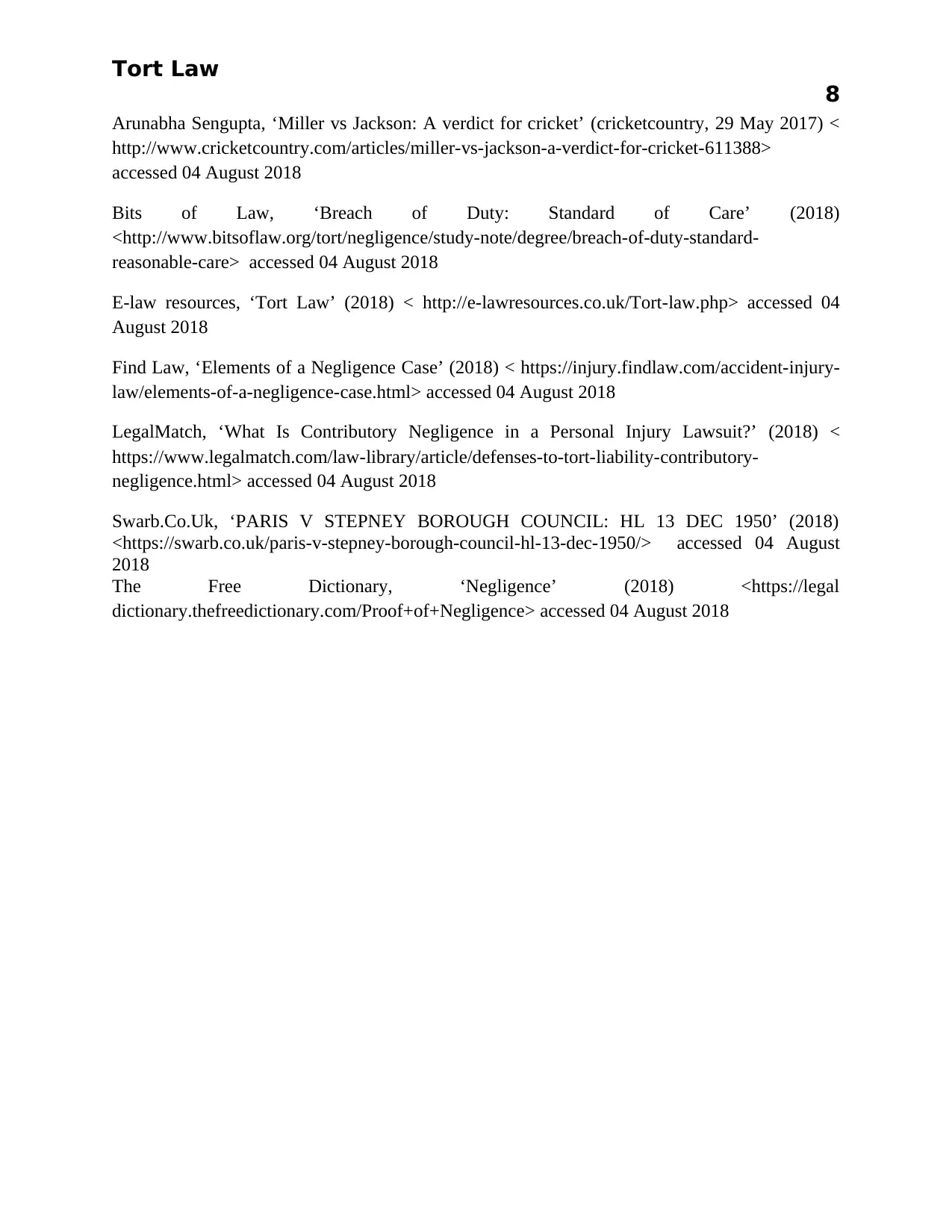
Arunabha Sengupta, ‘Miller vs Jackson: A verdict for cricket’ (cricketcountry, 29 May 2017) <
http://www.cricketcountry.com/articles/miller-vs-jackson-a-verdict-for-cricket-611388>
accessed 04 August 2018
Bits of Law, ‘Breach of Duty: Standard of Care’ (2018)
<http://www.bitsoflaw.org/tort/negligence/study-note/degree/breach-of-duty-standard-
reasonable-care> accessed 04 August 2018
E-law resources, ‘Tort Law’ (2018) < http://e-lawresources.co.uk/Tort-law.php> accessed 04
August 2018
Find Law, ‘Elements of a Negligence Case’ (2018) < https://injury.findlaw.com/accident-injury-
law/elements-of-a-negligence-case.html> accessed 04 August 2018
LegalMatch, ‘What Is Contributory Negligence in a Personal Injury Lawsuit?’ (2018) <
https://www.legalmatch.com/law-library/article/defenses-to-tort-liability-contributory-
negligence.html> accessed 04 August 2018
Swarb.Co.Uk, ‘PARIS V STEPNEY BOROUGH COUNCIL: HL 13 DEC 1950’ (2018)
<https://swarb.co.uk/paris-v-stepney-borough-council-hl-13-dec-1950/> accessed 04 August
2018
The Free Dictionary, ‘Negligence’ (2018) <https://legal
dictionary.thefreedictionary.com/Proof+of+Negligence> accessed 04 August 2018
8
Arunabha Sengupta, ‘Miller vs Jackson: A verdict for cricket’ (cricketcountry, 29 May 2017) <
http://www.cricketcountry.com/articles/miller-vs-jackson-a-verdict-for-cricket-611388>
accessed 04 August 2018
Bits of Law, ‘Breach of Duty: Standard of Care’ (2018)
<http://www.bitsoflaw.org/tort/negligence/study-note/degree/breach-of-duty-standard-
reasonable-care> accessed 04 August 2018
E-law resources, ‘Tort Law’ (2018) < http://e-lawresources.co.uk/Tort-law.php> accessed 04
August 2018
Find Law, ‘Elements of a Negligence Case’ (2018) < https://injury.findlaw.com/accident-injury-
law/elements-of-a-negligence-case.html> accessed 04 August 2018
LegalMatch, ‘What Is Contributory Negligence in a Personal Injury Lawsuit?’ (2018) <
https://www.legalmatch.com/law-library/article/defenses-to-tort-liability-contributory-
negligence.html> accessed 04 August 2018
Swarb.Co.Uk, ‘PARIS V STEPNEY BOROUGH COUNCIL: HL 13 DEC 1950’ (2018)
<https://swarb.co.uk/paris-v-stepney-borough-council-hl-13-dec-1950/> accessed 04 August
2018
The Free Dictionary, ‘Negligence’ (2018) <https://legal
dictionary.thefreedictionary.com/Proof+of+Negligence> accessed 04 August 2018
⊘ This is a preview!⊘
Do you want full access?
Subscribe today to unlock all pages.
Trusted by 1+ million students worldwide

1 out of 9


Related Documents


Your All-in-One AI-Powered Toolkit for Academic Success.
+13062052269
info@desklib.com
Available 24*7 on WhatsApp / Email
![[object Object]](/_next/static/media/star-bottom.7253800d.svg)
Unlock your academic potential
Copyright © 2020–2026 A2Z Services. All Rights Reserved. Developed and managed by ZUCOL.