BUSI 2301 Business Law: Case Analysis of UCC and Dress Code Policy

Verified

Added on  2023/04/20

|4
|725
|422
Case Study
AI Summary
This assignment presents a business law case study involving two distinct scenarios. The first case examines a dispute over a holiday package contract and the application of the Uniform Commercial Code (UCC) Statute of Frauds, arguing that the unwritten agreement exceeding $500 is not enforceable. The second case analyzes a dress code policy at Dress for Success, Inc., where female salespersons were required to wear smocks, arguing that this policy was not discriminatory as it served a legitimate business purpose of easy identification by clients, referencing a similar court decision. The analysis provides legal reasoning and references relevant legal precedents to support each conclusion.
Document Page
Running head: BUSINESS LAW ASSIGNMENT
Business Law Assignment
Name of the Student
Name of the University
Author Note
tabler-icon-diamond-filled.svg

Paraphrase This Document

Need a fresh take? Get an instant paraphrase of this document with our AI Paraphraser
Document Page
1BUSINESS LAW ASSIGNMENT
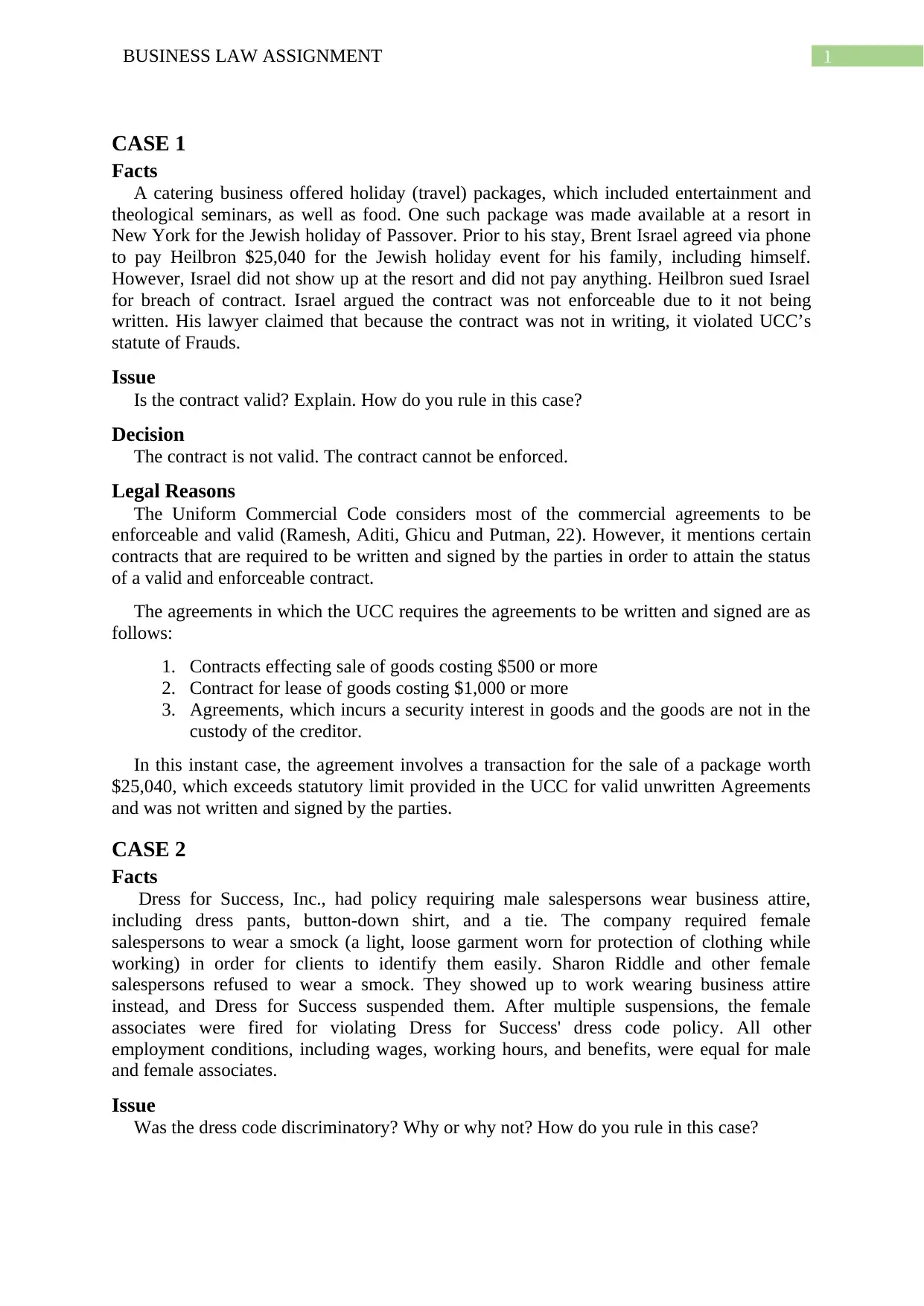
CASE 1
Facts
A catering business offered holiday (travel) packages, which included entertainment and
theological seminars, as well as food. One such package was made available at a resort in
New York for the Jewish holiday of Passover. Prior to his stay, Brent Israel agreed via phone
to pay Heilbron $25,040 for the Jewish holiday event for his family, including himself.
However, Israel did not show up at the resort and did not pay anything. Heilbron sued Israel
for breach of contract. Israel argued the contract was not enforceable due to it not being
written. His lawyer claimed that because the contract was not in writing, it violated UCC’s
statute of Frauds.
Issue
Is the contract valid? Explain. How do you rule in this case?
Decision
The contract is not valid. The contract cannot be enforced.
Legal Reasons
The Uniform Commercial Code considers most of the commercial agreements to be
enforceable and valid (Ramesh, Aditi, Ghicu and Putman, 22). However, it mentions certain
contracts that are required to be written and signed by the parties in order to attain the status
of a valid and enforceable contract.
The agreements in which the UCC requires the agreements to be written and signed are as
follows:
1. Contracts effecting sale of goods costing $500 or more
2. Contract for lease of goods costing $1,000 or more
3. Agreements, which incurs a security interest in goods and the goods are not in the
custody of the creditor.
In this instant case, the agreement involves a transaction for the sale of a package worth
$25,040, which exceeds statutory limit provided in the UCC for valid unwritten Agreements
and was not written and signed by the parties.
CASE 2
Facts
Dress for Success, Inc., had policy requiring male salespersons wear business attire,
including dress pants, button-down shirt, and a tie. The company required female
salespersons to wear a smock (a light, loose garment worn for protection of clothing while
working) in order for clients to identify them easily. Sharon Riddle and other female
salespersons refused to wear a smock. They showed up to work wearing business attire
instead, and Dress for Success suspended them. After multiple suspensions, the female
associates were fired for violating Dress for Success' dress code policy. All other
employment conditions, including wages, working hours, and benefits, were equal for male
and female associates.
Issue
Was the dress code discriminatory? Why or why not? How do you rule in this case?
Document Page
2BUSINESS LAW ASSIGNMENT
Decision
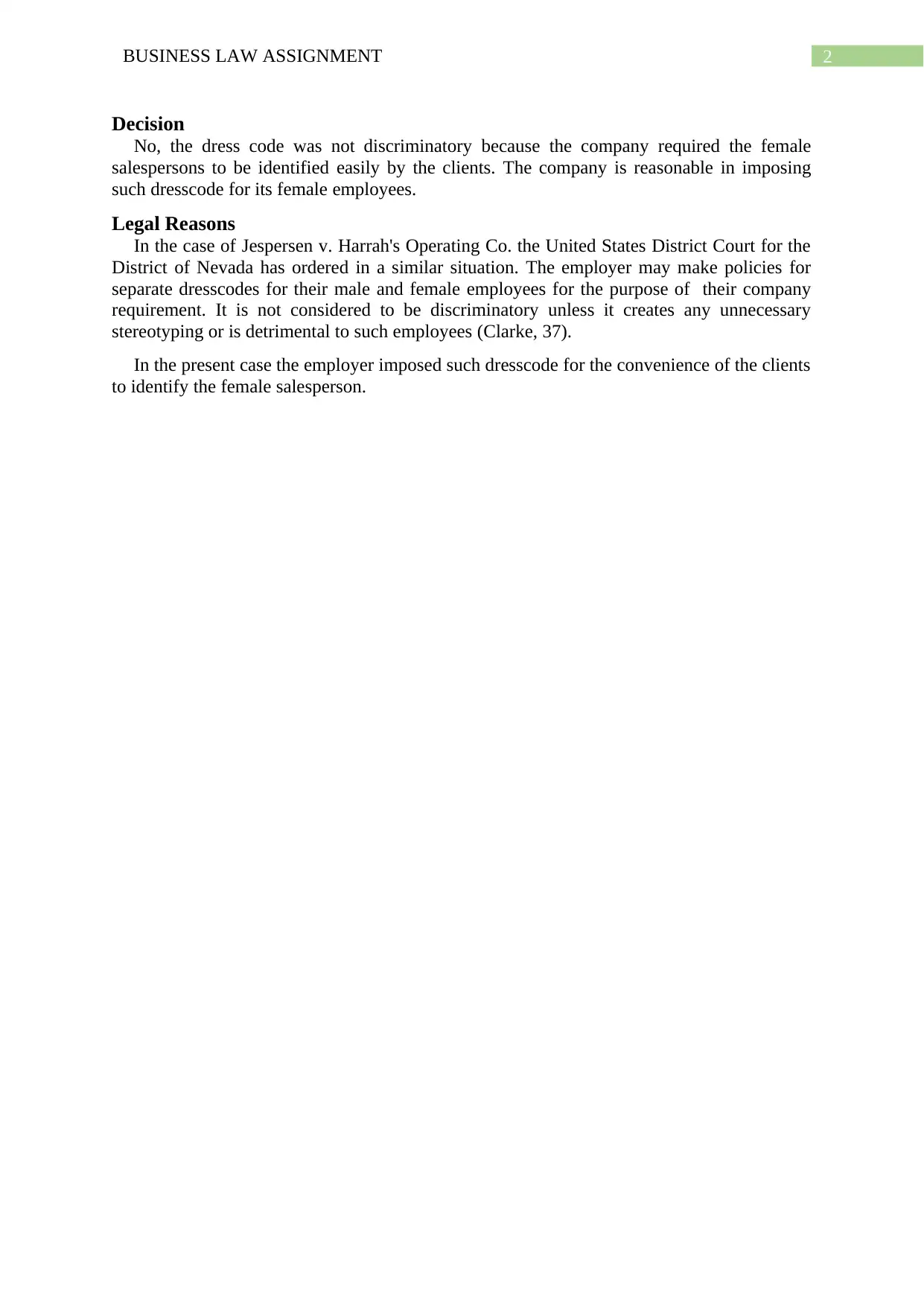
No, the dress code was not discriminatory because the company required the female
salespersons to be identified easily by the clients. The company is reasonable in imposing
such dresscode for its female employees.
Legal Reasons
In the case of Jespersen v. Harrah's Operating Co. the United States District Court for the
District of Nevada has ordered in a similar situation. The employer may make policies for
separate dresscodes for their male and female employees for the purpose of their company
requirement. It is not considered to be discriminatory unless it creates any unnecessary
stereotyping or is detrimental to such employees (Clarke, 37).
In the present case the employer imposed such dresscode for the convenience of the clients
to identify the female salesperson.
Document Page
3BUSINESS LAW ASSIGNMENT
Reference:
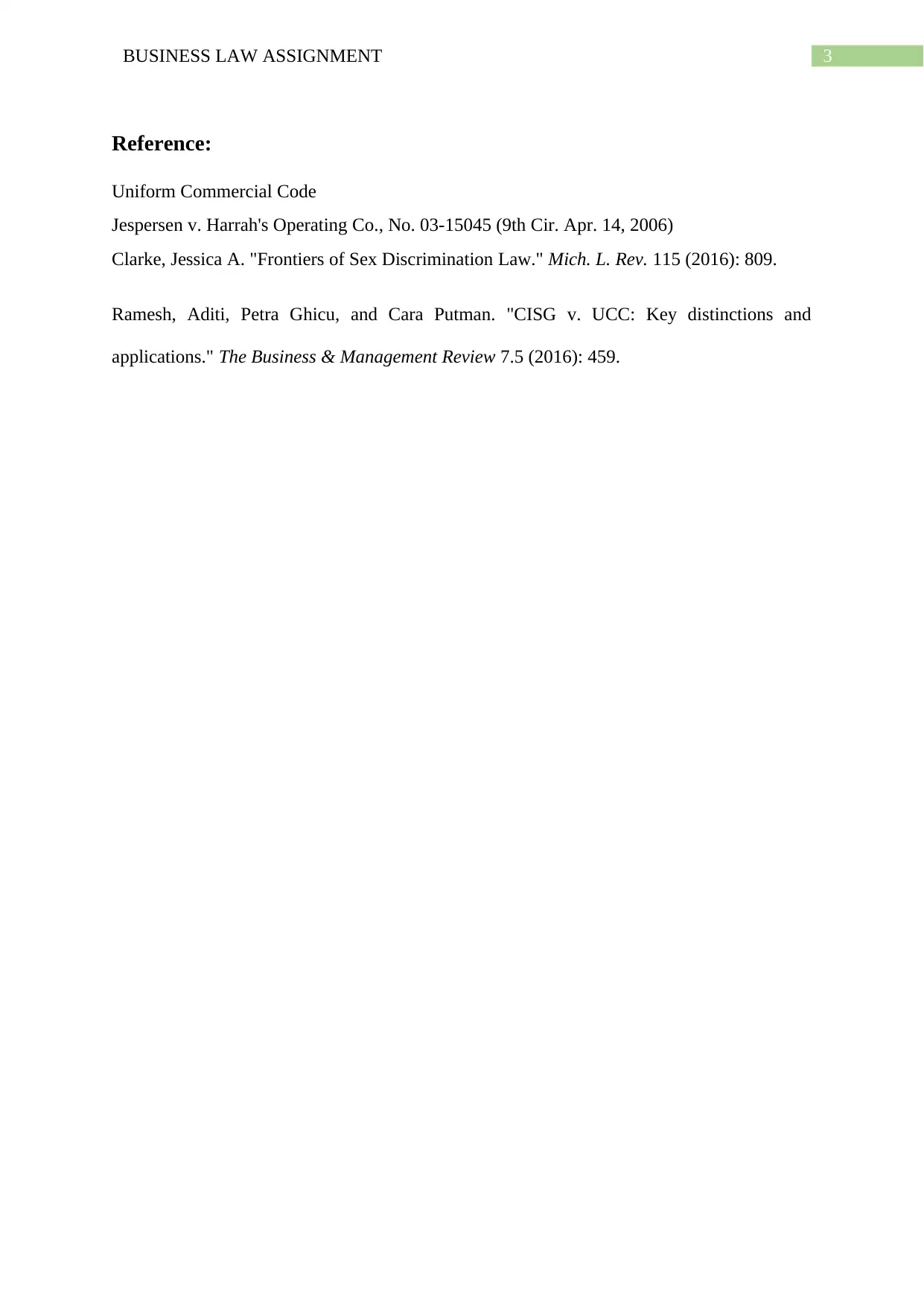
Uniform Commercial Code
Jespersen v. Harrah's Operating Co., No. 03-15045 (9th Cir. Apr. 14, 2006)
Clarke, Jessica A. "Frontiers of Sex Discrimination Law." Mich. L. Rev. 115 (2016): 809.
Ramesh, Aditi, Petra Ghicu, and Cara Putman. "CISG v. UCC: Key distinctions and
applications." The Business & Management Review 7.5 (2016): 459.
chevron_up_icon
1 out of 4
circle_padding
hide_on_mobile
zoom_out_icon
[object Object]