MGT536: Leadership in Business - Analysis of Leadership Styles
VerifiedAdded on 2022/10/07
|13
|3394
|26
Essay
AI Summary
This essay delves into the multifaceted realm of leadership within the business landscape, examining the leadership approaches of prominent figures such as Bill Gates, Jeff Weiner, and Reed Hastings. It critically analyzes their leadership styles, including transformational leadership, and their application in managing organizations, fostering innovation, and navigating competitive environments. The essay explores the significance of both financial and non-financial metrics, including ESG factors, in evaluating leadership effectiveness and organizational success. It further discusses the challenges leaders face in balancing these metrics and the importance of adapting to changing market dynamics. The analysis provides insights into how these leaders have shaped their respective industries and offers a comprehensive understanding of effective leadership in the modern business world, emphasizing the importance of compassion, innovation, and adaptability.
Leadership in Business 0
Title: Leadership in Business
Assignment Name:
Student Name:
Course Name and Number:
Professor:
Date:
Title: Leadership in Business
Assignment Name:
Student Name:
Course Name and Number:
Professor:
Date:

Paraphrase This Document
Need a fresh take? Get an instant paraphrase of this document with our AI Paraphraser
Leadership in Business 1
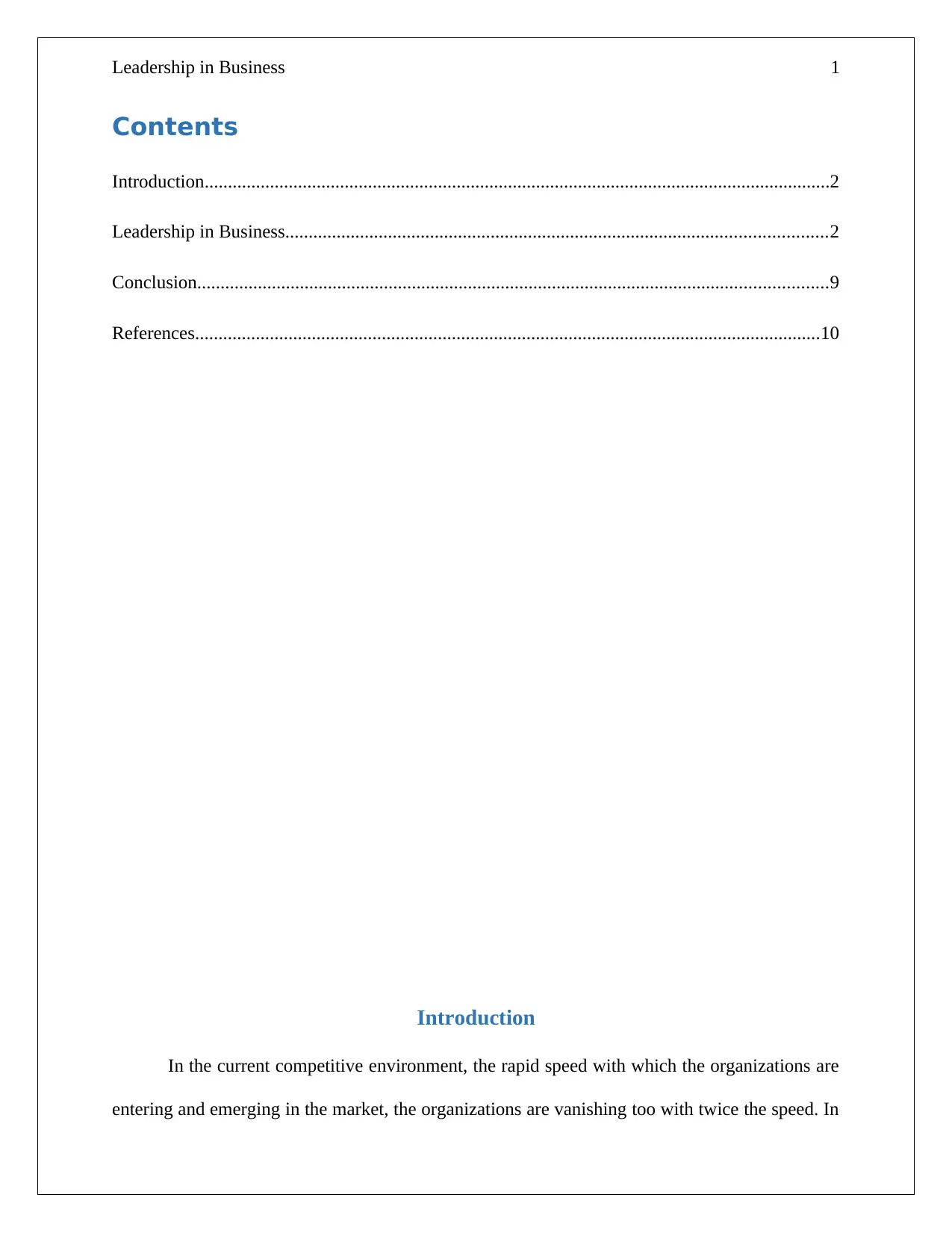
Contents
Introduction......................................................................................................................................2
Leadership in Business....................................................................................................................2
Conclusion.......................................................................................................................................9
References......................................................................................................................................10
Introduction
In the current competitive environment, the rapid speed with which the organizations are
entering and emerging in the market, the organizations are vanishing too with twice the speed. In
Contents
Introduction......................................................................................................................................2
Leadership in Business....................................................................................................................2
Conclusion.......................................................................................................................................9
References......................................................................................................................................10
Introduction
In the current competitive environment, the rapid speed with which the organizations are
entering and emerging in the market, the organizations are vanishing too with twice the speed. In
Leadership in Business 2
the past few many of the most prominent organizations have sunk due to various reason, the
most crucial amongst them is lack of appropriate leadership. The main secret behind the success
of top organizations that has been functioning from ages is effective leadership. Some of the
most important attributes of a good leader are motivating and encouraging the employees,
sharing the same vision with the employees, increasing the level of innovation in the
organization, and many more. A leader needs to support their employees, in order to get bigger
support from them, in fulfilling the organization’s objectives. For being a good leader, every
leader needs to possess some important skills, which have to be utilized at the right time and at
the right place. In addition to this, it should also be noted that the leadership approaches of every
leader may vary from each other. In this assignment, the leadership approaches of different
business leaders have been analyzed, so as to understand the main reason behind the success of
their organizations. The application of different leadership approaches in times of emergency and
in managing the workforce. The three leaders, who're leadership styles have been analyzed in
this essay are Bill Gates, Jeff Weiner, and Reed Hastings.
Leadership in Business
A leader can make or break an organization. The success of an organization depends on
the roles, which a leader plays in different circumstances. In the current turbulent world, the
success of a leader can be determined through various different factors, which include the vision
of a leader and their skills to share it with their employees, managing the human resource
appropriately, providing proper financial and non-financial resources to the organization,
developing a culture that is in sync with the vision, mission, goals, and principles of an
organization, have abilities and power of strong decision-making, learning from their mistakes
and improving their performance accordingly (Anthony & Schwartz, 2017).
the past few many of the most prominent organizations have sunk due to various reason, the
most crucial amongst them is lack of appropriate leadership. The main secret behind the success
of top organizations that has been functioning from ages is effective leadership. Some of the
most important attributes of a good leader are motivating and encouraging the employees,
sharing the same vision with the employees, increasing the level of innovation in the
organization, and many more. A leader needs to support their employees, in order to get bigger
support from them, in fulfilling the organization’s objectives. For being a good leader, every
leader needs to possess some important skills, which have to be utilized at the right time and at
the right place. In addition to this, it should also be noted that the leadership approaches of every
leader may vary from each other. In this assignment, the leadership approaches of different
business leaders have been analyzed, so as to understand the main reason behind the success of
their organizations. The application of different leadership approaches in times of emergency and
in managing the workforce. The three leaders, who're leadership styles have been analyzed in
this essay are Bill Gates, Jeff Weiner, and Reed Hastings.
Leadership in Business
A leader can make or break an organization. The success of an organization depends on
the roles, which a leader plays in different circumstances. In the current turbulent world, the
success of a leader can be determined through various different factors, which include the vision
of a leader and their skills to share it with their employees, managing the human resource
appropriately, providing proper financial and non-financial resources to the organization,
developing a culture that is in sync with the vision, mission, goals, and principles of an
organization, have abilities and power of strong decision-making, learning from their mistakes
and improving their performance accordingly (Anthony & Schwartz, 2017).
⊘ This is a preview!⊘
Do you want full access?
Subscribe today to unlock all pages.

Trusted by 1+ million students worldwide
Leadership in Business 3
For instance, Bill Gates is one of the most prominent and influential leaders of the world.
He is responsible for bringing a revolution in the field of personal computers and since then,
have maintained his dominance in the computer industry. The leadership style practiced by Bill
Gates is transformational leadership (Ghasabeh & Provitera, 2017). This leadership approach
comes naturally to him as he believes in innovation, knowledge, and taking risks. In addition to
this, he also switches to another leadership style, if there is a need. In managing an organization
especially in the current competitive world, it is paramount that a leader should encourage
innovation. Through, Bill Gates transformational leadership approach, his main intention is to
improve personal creativity, along with the creativity of his teammates. For ensuring that every
teammate's creativity increases, the resources are utilized individually. It is due to this
continuous approach of increasing creativity in the teammates that have helped the organization
in offering the customers with the best product (Ali, Jangga, Ismail, Kamal & Ali, 2015). Also,
the type of dominance which Microsoft has in the market, no other organization is able to
achieve it. Though these approaches, Bill Gates has developed an innovative environment, where
knowledge and creativity are the key factors, which has helped him in maintaining its position in
the competitive environment. In addition to this, these different approaches have also helped him
in sharing his vision with his employees. Therefore, as a leader Bill Gates has performed
extremely well in the current turbulent world. But, as a leader who utilizes transformational
leadership, there were times, when the leader is extremely focused towards result-driven
approaches. Bill Gates has at times have been too focused towards the end result that at times, he
ignored logical progression (Kim, 2018).
One other leader, who utilized transformation leadership is the CEO and the co-founder
of Netflix, that is, Reed Hastings. As a transformational leader, the two qualities of Reed Hasting
For instance, Bill Gates is one of the most prominent and influential leaders of the world.
He is responsible for bringing a revolution in the field of personal computers and since then,
have maintained his dominance in the computer industry. The leadership style practiced by Bill
Gates is transformational leadership (Ghasabeh & Provitera, 2017). This leadership approach
comes naturally to him as he believes in innovation, knowledge, and taking risks. In addition to
this, he also switches to another leadership style, if there is a need. In managing an organization
especially in the current competitive world, it is paramount that a leader should encourage
innovation. Through, Bill Gates transformational leadership approach, his main intention is to
improve personal creativity, along with the creativity of his teammates. For ensuring that every
teammate's creativity increases, the resources are utilized individually. It is due to this
continuous approach of increasing creativity in the teammates that have helped the organization
in offering the customers with the best product (Ali, Jangga, Ismail, Kamal & Ali, 2015). Also,
the type of dominance which Microsoft has in the market, no other organization is able to
achieve it. Though these approaches, Bill Gates has developed an innovative environment, where
knowledge and creativity are the key factors, which has helped him in maintaining its position in
the competitive environment. In addition to this, these different approaches have also helped him
in sharing his vision with his employees. Therefore, as a leader Bill Gates has performed
extremely well in the current turbulent world. But, as a leader who utilizes transformational
leadership, there were times, when the leader is extremely focused towards result-driven
approaches. Bill Gates has at times have been too focused towards the end result that at times, he
ignored logical progression (Kim, 2018).
One other leader, who utilized transformation leadership is the CEO and the co-founder
of Netflix, that is, Reed Hastings. As a transformational leader, the two qualities of Reed Hasting
Paraphrase This Document
Need a fresh take? Get an instant paraphrase of this document with our AI Paraphraser
Leadership in Business 4
abides by are reciprocity and creative intelligence. In addition to this, his approaches for
managing his human resource are extremely efficient. Some of his approaches include travel
policies, compensation packages, personal time off, and formal reviews, has helped him in
improving the productivity of its employees and in retaining them in the organization. All these
different leadership approaches have helped him in improving the performance of his employees
and also, for helped him in making effective decisions (Martins Marques de Lima Rua & Costa
Araújo, 2013). Therefore, as a leader, Reed Hasting has performed brilliantly and the success of
Netflix perfectly exhibits it. Netflix is responsible for bringing a revolution in the media field as
it is due to it that the trend of web series and web applications is prevailing in the market, with
Netflix having dominance.
As transformational leaders, both Bill Gates and Reed Hasting have exhibited qualities
that have helped them in becoming a strong leader. Both of them has been dominating their
individual fields in the current turbulent world and this dominance and the increasing growth of
the organization display their efficiency in running the organization effectively. Therefore, as a
successful leader both of them are offering the organization with financial and non-financial
resources, managing the human resources, increasing innovation in the organization, and have
made effective decisions (Hu, Gu & Chen, 2013).
For becoming an influential and powerful leader, it is important for them to ensure that
they focus on various different metrics, which include both financial and non-financial metrics.
Earlier, the main focus of the leaders was only on financial metrics. But with the changing times,
the leaders were forced to give equal importance to non-financial metrics too, as earning profits
for the organization is not the only objective of the current organizations to survive in the
market. Some of the financial and non-financial metrics that have to be considered by the leaders
abides by are reciprocity and creative intelligence. In addition to this, his approaches for
managing his human resource are extremely efficient. Some of his approaches include travel
policies, compensation packages, personal time off, and formal reviews, has helped him in
improving the productivity of its employees and in retaining them in the organization. All these
different leadership approaches have helped him in improving the performance of his employees
and also, for helped him in making effective decisions (Martins Marques de Lima Rua & Costa
Araújo, 2013). Therefore, as a leader, Reed Hasting has performed brilliantly and the success of
Netflix perfectly exhibits it. Netflix is responsible for bringing a revolution in the media field as
it is due to it that the trend of web series and web applications is prevailing in the market, with
Netflix having dominance.
As transformational leaders, both Bill Gates and Reed Hasting have exhibited qualities
that have helped them in becoming a strong leader. Both of them has been dominating their
individual fields in the current turbulent world and this dominance and the increasing growth of
the organization display their efficiency in running the organization effectively. Therefore, as a
successful leader both of them are offering the organization with financial and non-financial
resources, managing the human resources, increasing innovation in the organization, and have
made effective decisions (Hu, Gu & Chen, 2013).
For becoming an influential and powerful leader, it is important for them to ensure that
they focus on various different metrics, which include both financial and non-financial metrics.
Earlier, the main focus of the leaders was only on financial metrics. But with the changing times,
the leaders were forced to give equal importance to non-financial metrics too, as earning profits
for the organization is not the only objective of the current organizations to survive in the
market. Some of the financial and non-financial metrics that have to be considered by the leaders
Leadership in Business 5
are sales revenue metric, customer loyalty, and retention metric, cost of customer acquisition
metric, operating productivity metric, gross margin metric, employees hour work metric, profit
metric, cost overhead metric, marketing metric, brand image metric, stakeholder relationship
metric, customer relationship metric, corporate social responsibility metric, and many more. All
these different metrics are crucial for developing a successful organization. Also, in case of
ignoring any one of the metrics, the organization can suffer huge loss.
If a leader will only focus on the financial metric, then he will have to face many
different problems and issues, which will impact the overall growth of the organization. Some of
the issues that will emerge due to ignoring customer relationship with the organization,
stakeholder’s relationship with the organization, job satisfaction to employees, the innovation
level in the organization, and the brand image in the market (Seppälä, 2015). In the current
competitive and unstable environment all these various factors will be impacted as the leader is
focusing only on the financial metrics.
For instance, Reed Hastings through Netflix is offering the customers with a product that
is a great source of entertainment. He also uses transformational leadership and one of the
qualities of this leadership style is result-driven approaches. Now, if the leader keeps an
approach of financial success as their biggest priority, then he will focus only on the end result,
which is an increase in financial resources. In an attempt to attain the end result, the chances of
Reed Hastings to ignore non-financial metrics are very high, as, under transformational
leadership, the leaders tend to ignore the progression aspects and is too focused towards the end
result. In such circumstances, the organization may fail to look after the changing demands or
needs of the customers, which will impact the organization adversely in the long-run. It is due to
this reason that both financial and non-financial resources should be given equal importance
are sales revenue metric, customer loyalty, and retention metric, cost of customer acquisition
metric, operating productivity metric, gross margin metric, employees hour work metric, profit
metric, cost overhead metric, marketing metric, brand image metric, stakeholder relationship
metric, customer relationship metric, corporate social responsibility metric, and many more. All
these different metrics are crucial for developing a successful organization. Also, in case of
ignoring any one of the metrics, the organization can suffer huge loss.
If a leader will only focus on the financial metric, then he will have to face many
different problems and issues, which will impact the overall growth of the organization. Some of
the issues that will emerge due to ignoring customer relationship with the organization,
stakeholder’s relationship with the organization, job satisfaction to employees, the innovation
level in the organization, and the brand image in the market (Seppälä, 2015). In the current
competitive and unstable environment all these various factors will be impacted as the leader is
focusing only on the financial metrics.
For instance, Reed Hastings through Netflix is offering the customers with a product that
is a great source of entertainment. He also uses transformational leadership and one of the
qualities of this leadership style is result-driven approaches. Now, if the leader keeps an
approach of financial success as their biggest priority, then he will focus only on the end result,
which is an increase in financial resources. In an attempt to attain the end result, the chances of
Reed Hastings to ignore non-financial metrics are very high, as, under transformational
leadership, the leaders tend to ignore the progression aspects and is too focused towards the end
result. In such circumstances, the organization may fail to look after the changing demands or
needs of the customers, which will impact the organization adversely in the long-run. It is due to
this reason that both financial and non-financial resources should be given equal importance
⊘ This is a preview!⊘
Do you want full access?
Subscribe today to unlock all pages.
Trusted by 1+ million students worldwide
Leadership in Business 6
(Stevens, 2010). Reed Hastings understands that the competition amongst various media service
providers is intense and aggressive. It is due to this competition that he continuously makes
effective decisions for increasing the innovation level in the organization. Therefore, he focuses
on both financial and non-financial services. One of the non-financial services he focuses on is
job satisfaction to employees. Reed Hastings approach of stepping back and providing its
employees with the power to make a crucial decision in the organization has helped in
empowering the employees of Netflix. It is due to this reason that in the year 2017, Netflix was
rewarded one of the top organizations in offering immense customer satisfaction (Kateb & Prof.
K., 2019).
On the other hand, Jeff Weiner, who is the CEO of one of the most popular social
networking sites that are associated with business, LinkedIn. His leadership approaches have
been popular from his Yahoo days and the dominance which LinkedIn has created is due to the
compassionate leadership style he utilizes for all his business approaches. Jeff Weiner has been
functioning as the CEO of LinkedIn for almost a decade and under his leadership, the
organization has grown from 338 employees to more than 10,000 employees. In addition to this,
the company’s annual revenue is more than $3 billion. It is due to his focus on both the financial
and non-financial metrics that has helped LinkedIn is becoming one of the most trustworthy
organizations to conduct business. Compassion is a wish, willingness, and feeling to be kind and
respectful to others (Hougaard, Carter & Beck, 2018). Now, both the aspects that are compassion
and leadership, when combined together, push a leader to become considerate of other people
feelings and opinions, along with enhancing their mindfulness regularly. In the current
environment of increasing instabilities and the global competition, the need for compassionate
leadership has increased as it helps in developing a harmonious environment in an organization
(Stevens, 2010). Reed Hastings understands that the competition amongst various media service
providers is intense and aggressive. It is due to this competition that he continuously makes
effective decisions for increasing the innovation level in the organization. Therefore, he focuses
on both financial and non-financial services. One of the non-financial services he focuses on is
job satisfaction to employees. Reed Hastings approach of stepping back and providing its
employees with the power to make a crucial decision in the organization has helped in
empowering the employees of Netflix. It is due to this reason that in the year 2017, Netflix was
rewarded one of the top organizations in offering immense customer satisfaction (Kateb & Prof.
K., 2019).
On the other hand, Jeff Weiner, who is the CEO of one of the most popular social
networking sites that are associated with business, LinkedIn. His leadership approaches have
been popular from his Yahoo days and the dominance which LinkedIn has created is due to the
compassionate leadership style he utilizes for all his business approaches. Jeff Weiner has been
functioning as the CEO of LinkedIn for almost a decade and under his leadership, the
organization has grown from 338 employees to more than 10,000 employees. In addition to this,
the company’s annual revenue is more than $3 billion. It is due to his focus on both the financial
and non-financial metrics that has helped LinkedIn is becoming one of the most trustworthy
organizations to conduct business. Compassion is a wish, willingness, and feeling to be kind and
respectful to others (Hougaard, Carter & Beck, 2018). Now, both the aspects that are compassion
and leadership, when combined together, push a leader to become considerate of other people
feelings and opinions, along with enhancing their mindfulness regularly. In the current
environment of increasing instabilities and the global competition, the need for compassionate
leadership has increased as it helps in developing a harmonious environment in an organization
Paraphrase This Document
Need a fresh take? Get an instant paraphrase of this document with our AI Paraphraser
Leadership in Business 7
(Hougaard, 2019). With the compassionate leadership approach, Jeff Weiner has successfully
managed the turbulent environment in the market, and the different attributes of making the
decision after considering different opinions and experiences of the employees, customers, and
stakeholders, has helped him in increasing the growth of the organization massively (Hougaard
& Carter, 2018). All these different aspects highlight the fact that Jeff Weiner offers equal
importance to both financial and non-financial aspects.
In the current environment, both the leader, Jeff Weiner and Reed Hastings, understand
the importance of customers, employees, stakeholders, marketing, and many other non-financial
aspects. They know that if the organization will only focus on financial aspects then it will not be
beneficial for the long-run, as the approach is not sustainable. In addition to this, the organization
will experience a loss in many non-financial metrics, which is the backbone of the financial
metrics (Hougaard, Carter & Chester, 2018).
For the leader, it is extremely difficult to balance the two metrics, which are financial and
ESG. The leader faces many issues in an attempt to balance both these different metrics. For
instance, corporate social responsibility is a crucial aspect, which all the organizations should
work on. With the increasing instabilities in the market and low customer retention rate of
different organizations, the majority of the organizations does not adequate funds for
implementing a corporate social responsibility plan (White, 2018). In addition to this, the
pressure on the leaders to develop products that are fulfilling the various principles of ESG is
extremely important. Now in the act of balancing and ensuring that both the aspects are
addressed the different principles of ESG, along with fulfilling the organization’s vision,
mission, principles, and goals, the leader face various different challenges. For instance, if
LinkedIn CEO Jeff Weiner implements a simple guideline that all the employees should be
(Hougaard, 2019). With the compassionate leadership approach, Jeff Weiner has successfully
managed the turbulent environment in the market, and the different attributes of making the
decision after considering different opinions and experiences of the employees, customers, and
stakeholders, has helped him in increasing the growth of the organization massively (Hougaard
& Carter, 2018). All these different aspects highlight the fact that Jeff Weiner offers equal
importance to both financial and non-financial aspects.
In the current environment, both the leader, Jeff Weiner and Reed Hastings, understand
the importance of customers, employees, stakeholders, marketing, and many other non-financial
aspects. They know that if the organization will only focus on financial aspects then it will not be
beneficial for the long-run, as the approach is not sustainable. In addition to this, the organization
will experience a loss in many non-financial metrics, which is the backbone of the financial
metrics (Hougaard, Carter & Chester, 2018).
For the leader, it is extremely difficult to balance the two metrics, which are financial and
ESG. The leader faces many issues in an attempt to balance both these different metrics. For
instance, corporate social responsibility is a crucial aspect, which all the organizations should
work on. With the increasing instabilities in the market and low customer retention rate of
different organizations, the majority of the organizations does not adequate funds for
implementing a corporate social responsibility plan (White, 2018). In addition to this, the
pressure on the leaders to develop products that are fulfilling the various principles of ESG is
extremely important. Now in the act of balancing and ensuring that both the aspects are
addressed the different principles of ESG, along with fulfilling the organization’s vision,
mission, principles, and goals, the leader face various different challenges. For instance, if
LinkedIn CEO Jeff Weiner implements a simple guideline that all the employees should be
Leadership in Business 8
offered with additional human rights, then the instabilities in the organization will increase. Also,
many of the employees will take advantage of the different ESG approach appropriately, which
will affect both the financial and non-financial resources of the organization (Hougaard & Carter,
2017).
Some of the organizations keep very high financial goals. This increases the pressure on
the employees immensely. In addition to this, the leaders tend to curb innovation and opinions of
the employees as they are too focused on achieving their goals. In such a situation, the
organization will experience low employee retention rate, as it fails to fulfill one of the core
principles of ESG, which is talent management (Yasir, Imran, Irshad, Mohamad & Khan, 2016).
Along with this, many times the employees may file a case against the leader of the organization
under different acts. Due to this, the organization performance on different metrics is reduced
immensely.
The loss of stakeholders is the most common challenge which the leaders face due to
balancing the financial and ESG metrics. In an organization, there are different kinds of
stakeholders with different opinions, needs, and ambition. In such a circumstance, many of the
people may agree to a financial approach but disagree with an ESG approach or vice versa. In
such a circumstance, the organization loses some of the most prominent stakeholders, as they do
not share the same vision as the leaders. Even if the leaders utilize effective negotiation skills,
still they will suffer the loss of stakeholders, which can be a huge loss for an organization too
(DeSteno, 2018).
For instance, Jeff Weiner proposes the approach of cutting a small profit margin from all
the stakeholders for fulfilling the ESG approaches. In such circumstance, if the profit cut is very
minimal, many of the stakeholders might not agree with this approach and this can result in loss
offered with additional human rights, then the instabilities in the organization will increase. Also,
many of the employees will take advantage of the different ESG approach appropriately, which
will affect both the financial and non-financial resources of the organization (Hougaard & Carter,
2017).
Some of the organizations keep very high financial goals. This increases the pressure on
the employees immensely. In addition to this, the leaders tend to curb innovation and opinions of
the employees as they are too focused on achieving their goals. In such a situation, the
organization will experience low employee retention rate, as it fails to fulfill one of the core
principles of ESG, which is talent management (Yasir, Imran, Irshad, Mohamad & Khan, 2016).
Along with this, many times the employees may file a case against the leader of the organization
under different acts. Due to this, the organization performance on different metrics is reduced
immensely.
The loss of stakeholders is the most common challenge which the leaders face due to
balancing the financial and ESG metrics. In an organization, there are different kinds of
stakeholders with different opinions, needs, and ambition. In such a circumstance, many of the
people may agree to a financial approach but disagree with an ESG approach or vice versa. In
such a circumstance, the organization loses some of the most prominent stakeholders, as they do
not share the same vision as the leaders. Even if the leaders utilize effective negotiation skills,
still they will suffer the loss of stakeholders, which can be a huge loss for an organization too
(DeSteno, 2018).
For instance, Jeff Weiner proposes the approach of cutting a small profit margin from all
the stakeholders for fulfilling the ESG approaches. In such circumstance, if the profit cut is very
minimal, many of the stakeholders might not agree with this approach and this can result in loss
⊘ This is a preview!⊘
Do you want full access?
Subscribe today to unlock all pages.
Trusted by 1+ million students worldwide
Leadership in Business 9
of stakeholders (Alwahaibi, 2019). In such a circumstance, the best approach to managing these
issues and instabilities is by utilizing the principle-based leadership approach. This will help in
managing the different issues that will emerge while balancing financial and ESG performance
metrics.
Conclusion
With this, it can be concluded that a leader has to ensure that he effectively performs
different roles by utilizing leadership styles, which is best suitable for that situation. In addition
to this, a leader should not focus on only one attribute. They have diverse responsibilities, which
requires paying equal attention to different aspects. Therefore, for managing the employees,
customers, stakeholders, financial aspects, and other non-financial aspects, a leader needs to
devote equal attention. Along with this, he needs to develop an environment and culture in the
organization which facilitates improvement and learning. This will help in managing the impact
of the current turbulent environment on the organization in an effective way.
of stakeholders (Alwahaibi, 2019). In such a circumstance, the best approach to managing these
issues and instabilities is by utilizing the principle-based leadership approach. This will help in
managing the different issues that will emerge while balancing financial and ESG performance
metrics.
Conclusion
With this, it can be concluded that a leader has to ensure that he effectively performs
different roles by utilizing leadership styles, which is best suitable for that situation. In addition
to this, a leader should not focus on only one attribute. They have diverse responsibilities, which
requires paying equal attention to different aspects. Therefore, for managing the employees,
customers, stakeholders, financial aspects, and other non-financial aspects, a leader needs to
devote equal attention. Along with this, he needs to develop an environment and culture in the
organization which facilitates improvement and learning. This will help in managing the impact
of the current turbulent environment on the organization in an effective way.
Paraphrase This Document
Need a fresh take? Get an instant paraphrase of this document with our AI Paraphraser
Leadership in Business 10
References
Ali, N., Jangga, R., Ismail, M., Kamal, S., & Ali, M. (2015). Influence of Leadership Styles in
Creating Quality Work Culture. Procedia Economics And Finance, 31(1), 161-169.
Alwahaibi, u. (2019). Transformational Leadership: A Review on Contemporary
Issues. International Journal Of Academic Research In Business And Social Sciences, 9(3),
1-8.
Anthony, S., & Schwartz, E. (2017). What the Best Transformational Leaders Do. Retrieved 28
September 2019, from https://hbr.org/2017/05/what-the-best-transformational-leaders-do
DeSteno, D. (2018). How to Cultivate Gratitude, Compassion, and Pride on Your Team.
Retrieved 28 September 2019, from https://hbr.org/2018/02/how-to-cultivate-gratitude-
compassion-and-pride-on-your-team
Ghasabeh, M., & Provitera, M. (2017). Transformational Leadership: Building an Effective
Culture to Manage Organisational Knowledge. The Journal Of Values-Based Leadership, 10(2),
1-8.
Hougaard, R. (2019). The Dalai Lama on Why Leaders Should Be Mindful, Selfless, and
Compassionate. Retrieved 28 September 2019, from https://hbr.org/2019/02/the-dalai-lama-
on-why-leaders-should-be-mindful-selfless-and-compassionate
Hougaard, R., & Carter, J. (2018). Leading with Less Ego. Retrieved 28 September 2019, from
https://hbr.org/ideacast/2018/03/leading-with-less-ego.html
Hougaard, R., & Carter, J. (2017). If You Aspire to Be a Great Leader, Be Present. Retrieved 28
September 2019, from https://hbr.org/2017/12/if-you-aspire-to-be-a-great-leader-be-present
References
Ali, N., Jangga, R., Ismail, M., Kamal, S., & Ali, M. (2015). Influence of Leadership Styles in
Creating Quality Work Culture. Procedia Economics And Finance, 31(1), 161-169.
Alwahaibi, u. (2019). Transformational Leadership: A Review on Contemporary
Issues. International Journal Of Academic Research In Business And Social Sciences, 9(3),
1-8.
Anthony, S., & Schwartz, E. (2017). What the Best Transformational Leaders Do. Retrieved 28
September 2019, from https://hbr.org/2017/05/what-the-best-transformational-leaders-do
DeSteno, D. (2018). How to Cultivate Gratitude, Compassion, and Pride on Your Team.
Retrieved 28 September 2019, from https://hbr.org/2018/02/how-to-cultivate-gratitude-
compassion-and-pride-on-your-team
Ghasabeh, M., & Provitera, M. (2017). Transformational Leadership: Building an Effective
Culture to Manage Organisational Knowledge. The Journal Of Values-Based Leadership, 10(2),
1-8.
Hougaard, R. (2019). The Dalai Lama on Why Leaders Should Be Mindful, Selfless, and
Compassionate. Retrieved 28 September 2019, from https://hbr.org/2019/02/the-dalai-lama-
on-why-leaders-should-be-mindful-selfless-and-compassionate
Hougaard, R., & Carter, J. (2018). Leading with Less Ego. Retrieved 28 September 2019, from
https://hbr.org/ideacast/2018/03/leading-with-less-ego.html
Hougaard, R., & Carter, J. (2017). If You Aspire to Be a Great Leader, Be Present. Retrieved 28
September 2019, from https://hbr.org/2017/12/if-you-aspire-to-be-a-great-leader-be-present
Leadership in Business 11
Hougaard, R., Carter, J., & Beck, J. (2018). Assessment: Are You a Compassionate Leader?.
Retrieved 28 September 2019, from https://hbr.org/2018/05/assessment-are-you-a-
compassionate-leader
Hougaard, R., Carter, J., & Chester, L. (2018). Power Can Corrupt Leaders. Compassion Can
Save Them. Retrieved 28 September 2019, from https://hbr.org/2018/02/power-can-corrupt-
leaders-compassion-can-save-them
Hu, H., Gu, Q., & Chen, J. (2013). How and when does transformational leadership affect
organizational creativity and innovation?. Nankai Business Review International, 4(2), 147-
166.
Kateb, M., & Prof. K., R. (2019). The Effect of Transformational Leadership Style on
Employees` Job Satisfaction of Syrian Private Universities. IARJSET, 6(8), 8-13.
Kim, G. (2018). Transformational Leadership: A Quick Start Guide. Retrieved 28 September
2019, from https://static1.squarespace.com/static/571faf00c2ea510eafddb70b/t/
5c1f087121c67c0d67c426a8/1545537650781/2018-Forum-Transformational-
Leadership.pdf
Martins Marques de Lima Rua, O., & Costa Araújo, J. (2013). The influence of the
transformational leadership in the organizational trust. Harvard Deusto Business
Research, 2(1), 1-4.
Seppälä, E. (2015). Why Compassion Is a Better Managerial Tactic than Toughness. Retrieved
28 September 2019, from https://hbr.org/2015/05/why-compassion-is-a-better-managerial-
tactic-than-toughness
Hougaard, R., Carter, J., & Beck, J. (2018). Assessment: Are You a Compassionate Leader?.
Retrieved 28 September 2019, from https://hbr.org/2018/05/assessment-are-you-a-
compassionate-leader
Hougaard, R., Carter, J., & Chester, L. (2018). Power Can Corrupt Leaders. Compassion Can
Save Them. Retrieved 28 September 2019, from https://hbr.org/2018/02/power-can-corrupt-
leaders-compassion-can-save-them
Hu, H., Gu, Q., & Chen, J. (2013). How and when does transformational leadership affect
organizational creativity and innovation?. Nankai Business Review International, 4(2), 147-
166.
Kateb, M., & Prof. K., R. (2019). The Effect of Transformational Leadership Style on
Employees` Job Satisfaction of Syrian Private Universities. IARJSET, 6(8), 8-13.
Kim, G. (2018). Transformational Leadership: A Quick Start Guide. Retrieved 28 September
2019, from https://static1.squarespace.com/static/571faf00c2ea510eafddb70b/t/
5c1f087121c67c0d67c426a8/1545537650781/2018-Forum-Transformational-
Leadership.pdf
Martins Marques de Lima Rua, O., & Costa Araújo, J. (2013). The influence of the
transformational leadership in the organizational trust. Harvard Deusto Business
Research, 2(1), 1-4.
Seppälä, E. (2015). Why Compassion Is a Better Managerial Tactic than Toughness. Retrieved
28 September 2019, from https://hbr.org/2015/05/why-compassion-is-a-better-managerial-
tactic-than-toughness
⊘ This is a preview!⊘
Do you want full access?
Subscribe today to unlock all pages.
Trusted by 1+ million students worldwide

1 out of 13


Related Documents


Your All-in-One AI-Powered Toolkit for Academic Success.
+13062052269
info@desklib.com
Available 24*7 on WhatsApp / Email
![[object Object]](/_next/static/media/star-bottom.7253800d.svg)
Unlock your academic potential
Copyright © 2020–2026 A2Z Services. All Rights Reserved. Developed and managed by ZUCOL.