Essay: Evaluating Current Business Management Trends (MGMT11109)
VerifiedAdded on 2022/12/22
|9
|2324
|27
Essay
AI Summary
This essay critically analyzes four key management trends impacting businesses in 2019: business model innovation, the use of technology for communication, organizational culture evolution, and adaptive management innovation. The essay draws on academic research to explore how globalization and technological advancements have reshaped the business landscape, emphasizing the importance of these trends for achieving competitive advantage. It examines how businesses are adopting new models, leveraging technology for communication, fostering evolving organizational cultures, and implementing adaptive management approaches. The essay highlights examples like Amazon and Apple to illustrate these trends and concludes that embracing these changes is crucial for business success in a dynamic environment.
As opined by Li, Qiao and Wang (2017), globalization coupled with the
extensive usage of different innovative technologies had completely changed the
dynamics of the present business world in comparison to that of the earlier times.
Dobbs, Manyika and Woetzel (2015) are of the viewpoint that mere reliance on the
attributes of the services or products or their value proposition had failed to help the
business corporations to gain competitive advantage. Furthermore, it had been seen
that the effective usage of different innovations had become the most important factor
for gaining competitive advantage. Thus, the business corporations in order to gain
success or competitive advantage need to not only embrace the recent innovations but
also take into account the recent business trends. Business model innovation, usage of
innovative technologies for communicating rather than actually undertaking the process
of travelling, organizational culture evolution and adoptive management innovation are
the four most important management trends that the business corporations need to take
into account for the purpose of gaining the desired level of success. This essay
undertakes an analysis of the four above mentioned management trends and the
factors which had created this environment of change in 2019.
Visnjic, Wiengarten and Neely (2016) are of the viewpoint that the change that
had taken place within the cauldron of the modern business landscape becomes
perceptible not only in terms of the services or the products which are being offered by
them but also in respect to the business models that are being used by the business
corporations as well. For instance, as discussed by Friedrich von den Eichen, Freiling
and Matzler (2015), the business corporations rather than merely relying on the
traditional “brick and mortar model” of business are presently using innovative
extensive usage of different innovative technologies had completely changed the
dynamics of the present business world in comparison to that of the earlier times.
Dobbs, Manyika and Woetzel (2015) are of the viewpoint that mere reliance on the
attributes of the services or products or their value proposition had failed to help the
business corporations to gain competitive advantage. Furthermore, it had been seen
that the effective usage of different innovations had become the most important factor
for gaining competitive advantage. Thus, the business corporations in order to gain
success or competitive advantage need to not only embrace the recent innovations but
also take into account the recent business trends. Business model innovation, usage of
innovative technologies for communicating rather than actually undertaking the process
of travelling, organizational culture evolution and adoptive management innovation are
the four most important management trends that the business corporations need to take
into account for the purpose of gaining the desired level of success. This essay
undertakes an analysis of the four above mentioned management trends and the
factors which had created this environment of change in 2019.
Visnjic, Wiengarten and Neely (2016) are of the viewpoint that the change that
had taken place within the cauldron of the modern business landscape becomes
perceptible not only in terms of the services or the products which are being offered by
them but also in respect to the business models that are being used by the business
corporations as well. For instance, as discussed by Friedrich von den Eichen, Freiling
and Matzler (2015), the business corporations rather than merely relying on the
traditional “brick and mortar model” of business are presently using innovative

Paraphrase This Document
Need a fresh take? Get an instant paraphrase of this document with our AI Paraphraser
business models which are in conjunction with the nature of the services or products
offered by them. Adding to this, Chahal, Dangwal and Raina (2016) have noted that the
major objective of the business corporations behind the usage of the process of
business model innovation is to create as well as capture value for their customers. An
important factor which had directly contributed towards the process of business model
innovation or transformation used by the business corporations can be attributed to the
fact that in the face of globalization the choices related to the services or products which
are available to the customers had increased substantially (Friedrich von den Eichen,
Freiling & Matzler, 2015). Thus, the customers not only take into perspective the value
proposition of the services or the products which are being offered to them by the
business corporations but also the manner in which these corporations are being able to
create or capture value for them. An important case in this regard is that of Amazon
which had been able to create value for its customers through the usage of the e-
commerce business model rather than relying on the “brick and mortar model” of
business which the majority of the retail firms are following even in 2019 (Arifusalam
Shaikh & Rafiq, 2018). This in turn had not only helped the concerned corporation to
attain a substantial amount of success within the retail industry but also to attain
competitive advantage as well. Thus, it would not too far-fetched to say that the
effective usage of the business trend of business model innovation had become
important for the different business corporations.
As discussed by Douglas, Lubbe and Fabris-Rotelli (2013), technology had
substantially changed the manner in which business is being conducted by the business
corporations or for that matter information is being conveyed to the relevant
offered by them. Adding to this, Chahal, Dangwal and Raina (2016) have noted that the
major objective of the business corporations behind the usage of the process of
business model innovation is to create as well as capture value for their customers. An
important factor which had directly contributed towards the process of business model
innovation or transformation used by the business corporations can be attributed to the
fact that in the face of globalization the choices related to the services or products which
are available to the customers had increased substantially (Friedrich von den Eichen,
Freiling & Matzler, 2015). Thus, the customers not only take into perspective the value
proposition of the services or the products which are being offered to them by the
business corporations but also the manner in which these corporations are being able to
create or capture value for them. An important case in this regard is that of Amazon
which had been able to create value for its customers through the usage of the e-
commerce business model rather than relying on the “brick and mortar model” of
business which the majority of the retail firms are following even in 2019 (Arifusalam
Shaikh & Rafiq, 2018). This in turn had not only helped the concerned corporation to
attain a substantial amount of success within the retail industry but also to attain
competitive advantage as well. Thus, it would not too far-fetched to say that the
effective usage of the business trend of business model innovation had become
important for the different business corporations.
As discussed by Douglas, Lubbe and Fabris-Rotelli (2013), technology had
substantially changed the manner in which business is being conducted by the business
corporations or for that matter information is being conveyed to the relevant
stakeholders within the corporations. For instance, earlier the business corporations
used to organize yearly or for that matter quarterly meetings or conferences for the
purpose of communicating or cascading the progress made by it, the strategic directions
that it had been followed and other relevant information which were important from the
perspective of the stakeholders (Agrawal, 2017). However, as stated by Li, Qiao and
Wang (2017), this process followed by the business corporations had undergone a
significant change in the present in pace with the dynamicity of the modern business
environment and also the need to cascade information at a much faster rate. More
importantly, presently it had been seen that the business corporations are using
different disruptive technologies like internet, social media, emails and others for
the purpose of undertaking the desired communication with their key stakeholders
(Dobbs, Manyika & Woetzel, 2015). Moreover, the publication of annual reports, video
conference calls, emails and others had completely obliterated the need to undertake
actual travel for the purpose of cascading the required information to the stakeholders
(Arifusalam Shaikh & Rafiq, 2018). This in turn had helped the business corporations to
not only save a substantial amount of their financial resources which in the earlier times
they spent on their travelling needs and others and also enhanced the quality as well as
the timeliness of the communication process used by them as well (Douglas, Lubbe &
Fabris-Rotelli, 2013).
According to Chahal, Dangwal and Raina (2016), the organizational culture or for
that matter the workplace culture which was used by the business corporations in the
earlier times merely focused on the enhancement of the organizational productivity or
the employee performance. However, as discussed by Agrawal (2017), the business
used to organize yearly or for that matter quarterly meetings or conferences for the
purpose of communicating or cascading the progress made by it, the strategic directions
that it had been followed and other relevant information which were important from the
perspective of the stakeholders (Agrawal, 2017). However, as stated by Li, Qiao and
Wang (2017), this process followed by the business corporations had undergone a
significant change in the present in pace with the dynamicity of the modern business
environment and also the need to cascade information at a much faster rate. More
importantly, presently it had been seen that the business corporations are using
different disruptive technologies like internet, social media, emails and others for
the purpose of undertaking the desired communication with their key stakeholders
(Dobbs, Manyika & Woetzel, 2015). Moreover, the publication of annual reports, video
conference calls, emails and others had completely obliterated the need to undertake
actual travel for the purpose of cascading the required information to the stakeholders
(Arifusalam Shaikh & Rafiq, 2018). This in turn had helped the business corporations to
not only save a substantial amount of their financial resources which in the earlier times
they spent on their travelling needs and others and also enhanced the quality as well as
the timeliness of the communication process used by them as well (Douglas, Lubbe &
Fabris-Rotelli, 2013).
According to Chahal, Dangwal and Raina (2016), the organizational culture or for
that matter the workplace culture which was used by the business corporations in the
earlier times merely focused on the enhancement of the organizational productivity or
the employee performance. However, as discussed by Agrawal (2017), the business
⊘ This is a preview!⊘
Do you want full access?
Subscribe today to unlock all pages.

Trusted by 1+ million students worldwide
corporations are trying to take the help of the kind of organizational or workplace
cultures which are likely to help the workers to improve the quality as well as the
timeliness of the work which is being performed by them. Adding to this, Yin, Lu, Yang
and Jing (2014) have noted that the business corporations are trying to synchronize the
workplace culture that they are using with the nature or for that matter the kind of work
that the workers are required to perform within the spectrum of the concerned
corporation. It is precisely here that the concept of organizational culture evolution
becomes important from the perspective of the different business corporations. For
instance, Apple through the usage of the concept of organizational culture evolution
had been able to develop an innovative continuous learning culture within its
workplace so as to support the innovative services and products that it offers (Visnjic,
Wiengarten & Neely, 2016). Furthermore, the adequate usage of this particular
organizational culture had enabled the concerned corporation to encourage the workers
to use the entities of creativity, design thinking, innovation and others for the completion
of the job roles which they are required to perform within the corporation so as to
enhance both the quality and the quantity of the work which is being performed by them.
In this relation, Li, Qiao and Wang (2017) have noted that an important factor that had
motivated the business corporations to use the construct of organizational culture
evolution is the ever-increasing focus of the customers on the aspect of quality rather
than price and other attributes of the services or products offered by the business
corporations. More importantly, as discussed by Yin, Lu, Yang and Jing (2014), the
needs of the workers and also the work that they are required to perform within the
business corporations had also changed substantially and these in turn had
cultures which are likely to help the workers to improve the quality as well as the
timeliness of the work which is being performed by them. Adding to this, Yin, Lu, Yang
and Jing (2014) have noted that the business corporations are trying to synchronize the
workplace culture that they are using with the nature or for that matter the kind of work
that the workers are required to perform within the spectrum of the concerned
corporation. It is precisely here that the concept of organizational culture evolution
becomes important from the perspective of the different business corporations. For
instance, Apple through the usage of the concept of organizational culture evolution
had been able to develop an innovative continuous learning culture within its
workplace so as to support the innovative services and products that it offers (Visnjic,
Wiengarten & Neely, 2016). Furthermore, the adequate usage of this particular
organizational culture had enabled the concerned corporation to encourage the workers
to use the entities of creativity, design thinking, innovation and others for the completion
of the job roles which they are required to perform within the corporation so as to
enhance both the quality and the quantity of the work which is being performed by them.
In this relation, Li, Qiao and Wang (2017) have noted that an important factor that had
motivated the business corporations to use the construct of organizational culture
evolution is the ever-increasing focus of the customers on the aspect of quality rather
than price and other attributes of the services or products offered by the business
corporations. More importantly, as discussed by Yin, Lu, Yang and Jing (2014), the
needs of the workers and also the work that they are required to perform within the
business corporations had also changed substantially and these in turn had
Paraphrase This Document
Need a fresh take? Get an instant paraphrase of this document with our AI Paraphraser
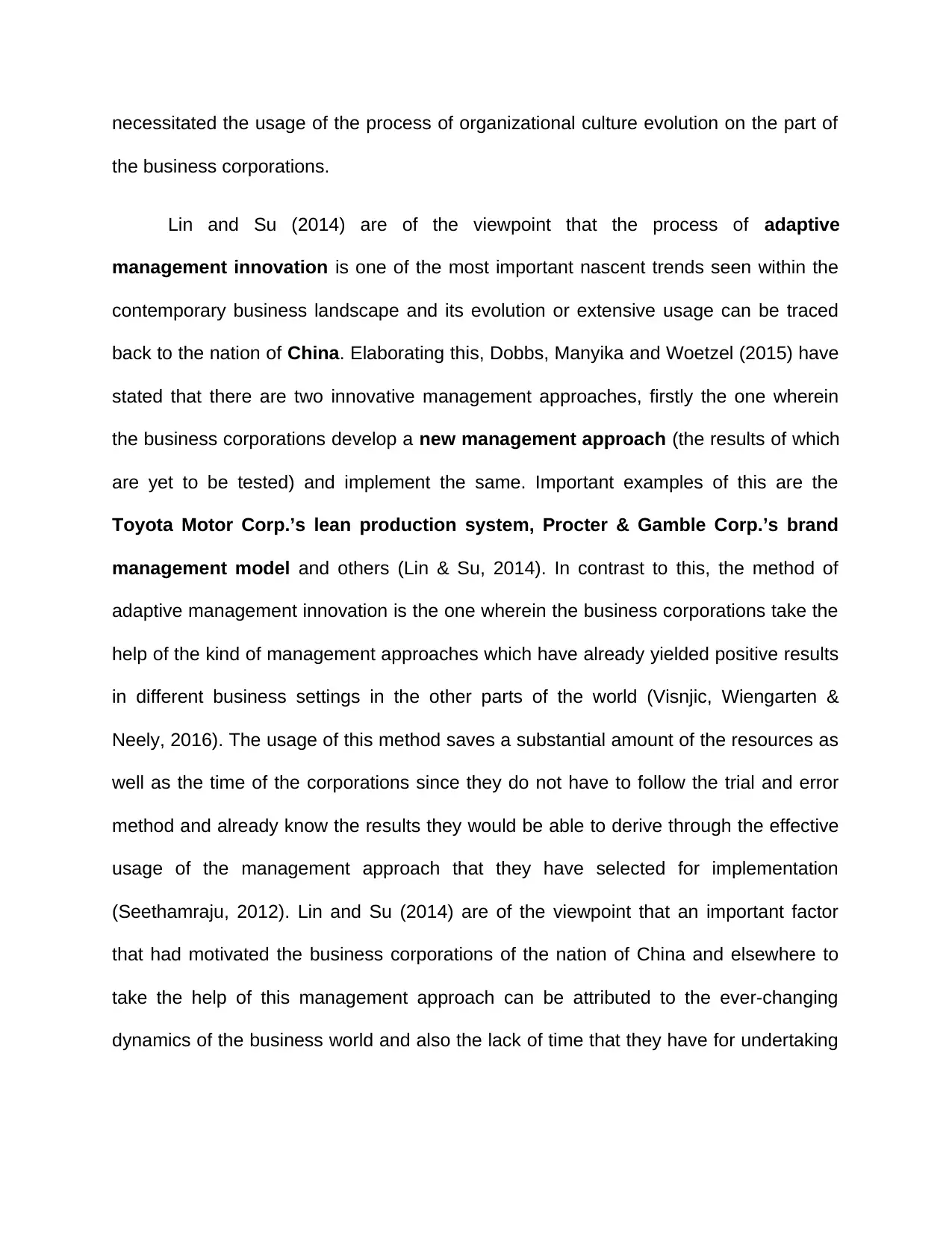
necessitated the usage of the process of organizational culture evolution on the part of
the business corporations.
Lin and Su (2014) are of the viewpoint that the process of adaptive
management innovation is one of the most important nascent trends seen within the
contemporary business landscape and its evolution or extensive usage can be traced
back to the nation of China. Elaborating this, Dobbs, Manyika and Woetzel (2015) have
stated that there are two innovative management approaches, firstly the one wherein
the business corporations develop a new management approach (the results of which
are yet to be tested) and implement the same. Important examples of this are the
Toyota Motor Corp.’s lean production system, Procter & Gamble Corp.’s brand
management model and others (Lin & Su, 2014). In contrast to this, the method of
adaptive management innovation is the one wherein the business corporations take the
help of the kind of management approaches which have already yielded positive results
in different business settings in the other parts of the world (Visnjic, Wiengarten &
Neely, 2016). The usage of this method saves a substantial amount of the resources as
well as the time of the corporations since they do not have to follow the trial and error
method and already know the results they would be able to derive through the effective
usage of the management approach that they have selected for implementation
(Seethamraju, 2012). Lin and Su (2014) are of the viewpoint that an important factor
that had motivated the business corporations of the nation of China and elsewhere to
take the help of this management approach can be attributed to the ever-changing
dynamics of the business world and also the lack of time that they have for undertaking
the business corporations.
Lin and Su (2014) are of the viewpoint that the process of adaptive
management innovation is one of the most important nascent trends seen within the
contemporary business landscape and its evolution or extensive usage can be traced
back to the nation of China. Elaborating this, Dobbs, Manyika and Woetzel (2015) have
stated that there are two innovative management approaches, firstly the one wherein
the business corporations develop a new management approach (the results of which
are yet to be tested) and implement the same. Important examples of this are the
Toyota Motor Corp.’s lean production system, Procter & Gamble Corp.’s brand
management model and others (Lin & Su, 2014). In contrast to this, the method of
adaptive management innovation is the one wherein the business corporations take the
help of the kind of management approaches which have already yielded positive results
in different business settings in the other parts of the world (Visnjic, Wiengarten &
Neely, 2016). The usage of this method saves a substantial amount of the resources as
well as the time of the corporations since they do not have to follow the trial and error
method and already know the results they would be able to derive through the effective
usage of the management approach that they have selected for implementation
(Seethamraju, 2012). Lin and Su (2014) are of the viewpoint that an important factor
that had motivated the business corporations of the nation of China and elsewhere to
take the help of this management approach can be attributed to the ever-changing
dynamics of the business world and also the lack of time that they have for undertaking
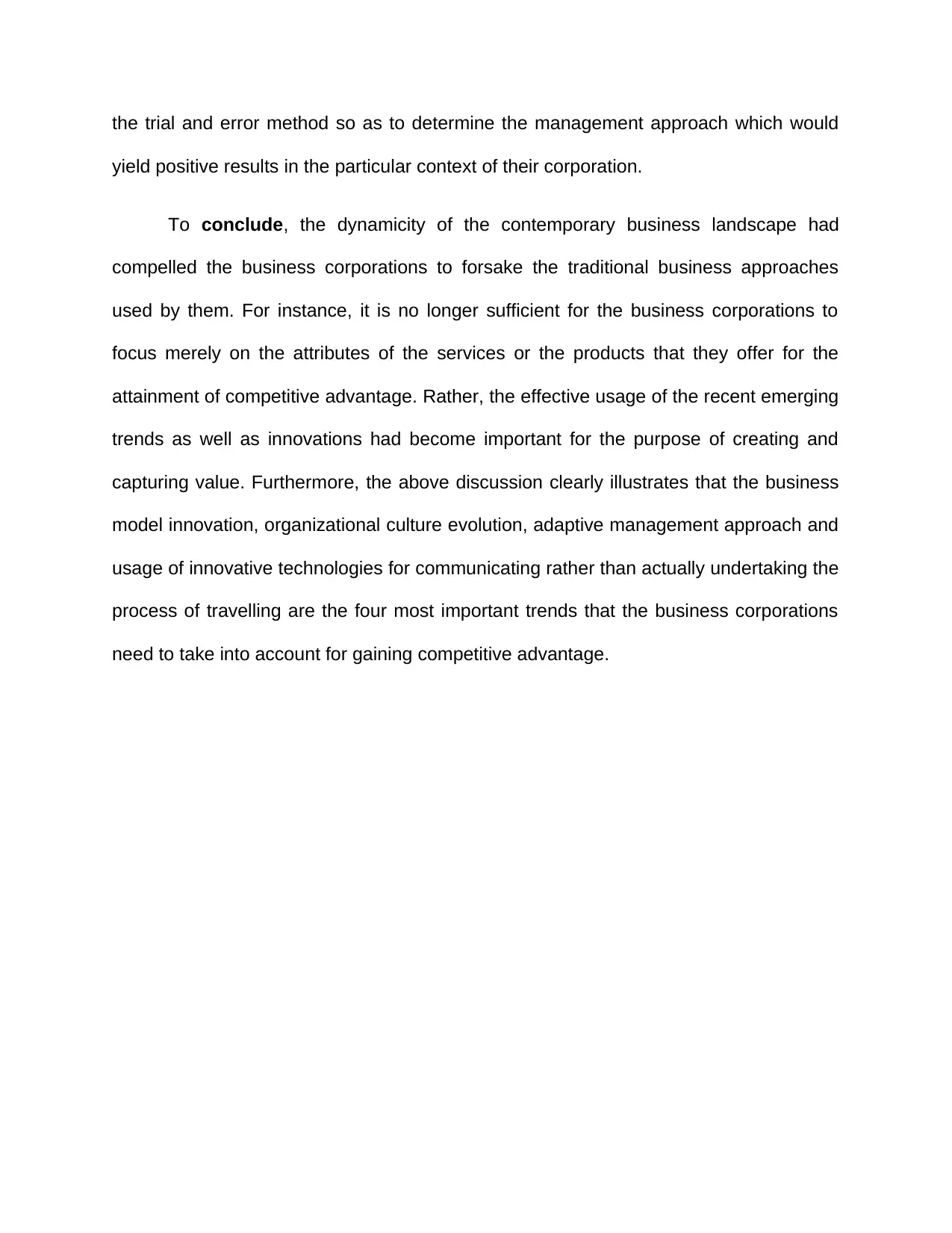
the trial and error method so as to determine the management approach which would
yield positive results in the particular context of their corporation.
To conclude, the dynamicity of the contemporary business landscape had
compelled the business corporations to forsake the traditional business approaches
used by them. For instance, it is no longer sufficient for the business corporations to
focus merely on the attributes of the services or the products that they offer for the
attainment of competitive advantage. Rather, the effective usage of the recent emerging
trends as well as innovations had become important for the purpose of creating and
capturing value. Furthermore, the above discussion clearly illustrates that the business
model innovation, organizational culture evolution, adaptive management approach and
usage of innovative technologies for communicating rather than actually undertaking the
process of travelling are the four most important trends that the business corporations
need to take into account for gaining competitive advantage.
yield positive results in the particular context of their corporation.
To conclude, the dynamicity of the contemporary business landscape had
compelled the business corporations to forsake the traditional business approaches
used by them. For instance, it is no longer sufficient for the business corporations to
focus merely on the attributes of the services or the products that they offer for the
attainment of competitive advantage. Rather, the effective usage of the recent emerging
trends as well as innovations had become important for the purpose of creating and
capturing value. Furthermore, the above discussion clearly illustrates that the business
model innovation, organizational culture evolution, adaptive management approach and
usage of innovative technologies for communicating rather than actually undertaking the
process of travelling are the four most important trends that the business corporations
need to take into account for gaining competitive advantage.
⊘ This is a preview!⊘
Do you want full access?
Subscribe today to unlock all pages.
Trusted by 1+ million students worldwide
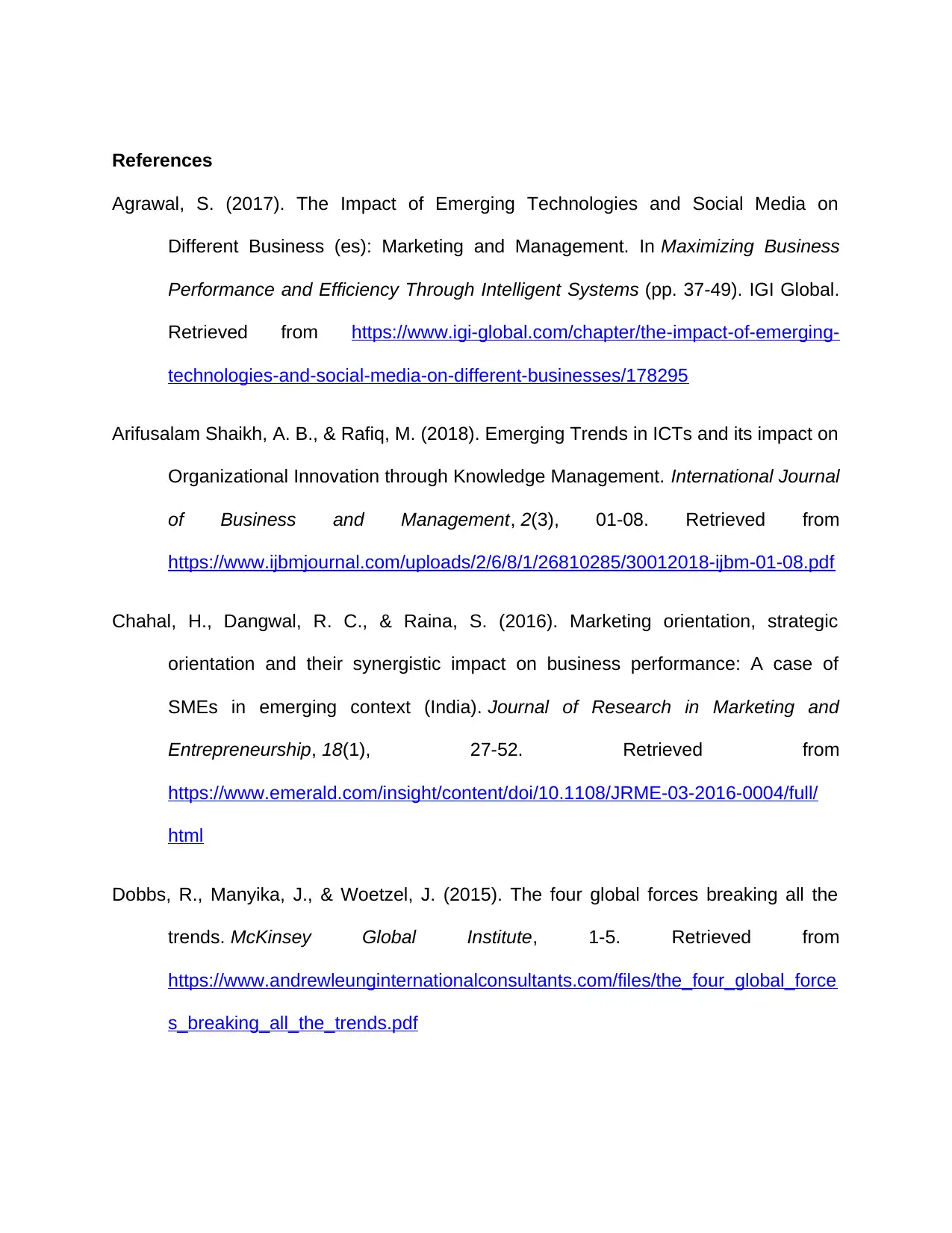
References
Agrawal, S. (2017). The Impact of Emerging Technologies and Social Media on
Different Business (es): Marketing and Management. In Maximizing Business
Performance and Efficiency Through Intelligent Systems (pp. 37-49). IGI Global.
Retrieved from https://www.igi-global.com/chapter/the-impact-of-emerging-
technologies-and-social-media-on-different-businesses/178295
Arifusalam Shaikh, A. B., & Rafiq, M. (2018). Emerging Trends in ICTs and its impact on
Organizational Innovation through Knowledge Management. International Journal
of Business and Management, 2(3), 01-08. Retrieved from
https://www.ijbmjournal.com/uploads/2/6/8/1/26810285/30012018-ijbm-01-08.pdf
Chahal, H., Dangwal, R. C., & Raina, S. (2016). Marketing orientation, strategic
orientation and their synergistic impact on business performance: A case of
SMEs in emerging context (India). Journal of Research in Marketing and
Entrepreneurship, 18(1), 27-52. Retrieved from
https://www.emerald.com/insight/content/doi/10.1108/JRME-03-2016-0004/full/
html
Dobbs, R., Manyika, J., & Woetzel, J. (2015). The four global forces breaking all the
trends. McKinsey Global Institute, 1-5. Retrieved from
https://www.andrewleunginternationalconsultants.com/files/the_four_global_force
s_breaking_all_the_trends.pdf
Agrawal, S. (2017). The Impact of Emerging Technologies and Social Media on
Different Business (es): Marketing and Management. In Maximizing Business
Performance and Efficiency Through Intelligent Systems (pp. 37-49). IGI Global.
Retrieved from https://www.igi-global.com/chapter/the-impact-of-emerging-
technologies-and-social-media-on-different-businesses/178295
Arifusalam Shaikh, A. B., & Rafiq, M. (2018). Emerging Trends in ICTs and its impact on
Organizational Innovation through Knowledge Management. International Journal
of Business and Management, 2(3), 01-08. Retrieved from
https://www.ijbmjournal.com/uploads/2/6/8/1/26810285/30012018-ijbm-01-08.pdf
Chahal, H., Dangwal, R. C., & Raina, S. (2016). Marketing orientation, strategic
orientation and their synergistic impact on business performance: A case of
SMEs in emerging context (India). Journal of Research in Marketing and
Entrepreneurship, 18(1), 27-52. Retrieved from
https://www.emerald.com/insight/content/doi/10.1108/JRME-03-2016-0004/full/
html
Dobbs, R., Manyika, J., & Woetzel, J. (2015). The four global forces breaking all the
trends. McKinsey Global Institute, 1-5. Retrieved from
https://www.andrewleunginternationalconsultants.com/files/the_four_global_force
s_breaking_all_the_trends.pdf
Paraphrase This Document
Need a fresh take? Get an instant paraphrase of this document with our AI Paraphraser
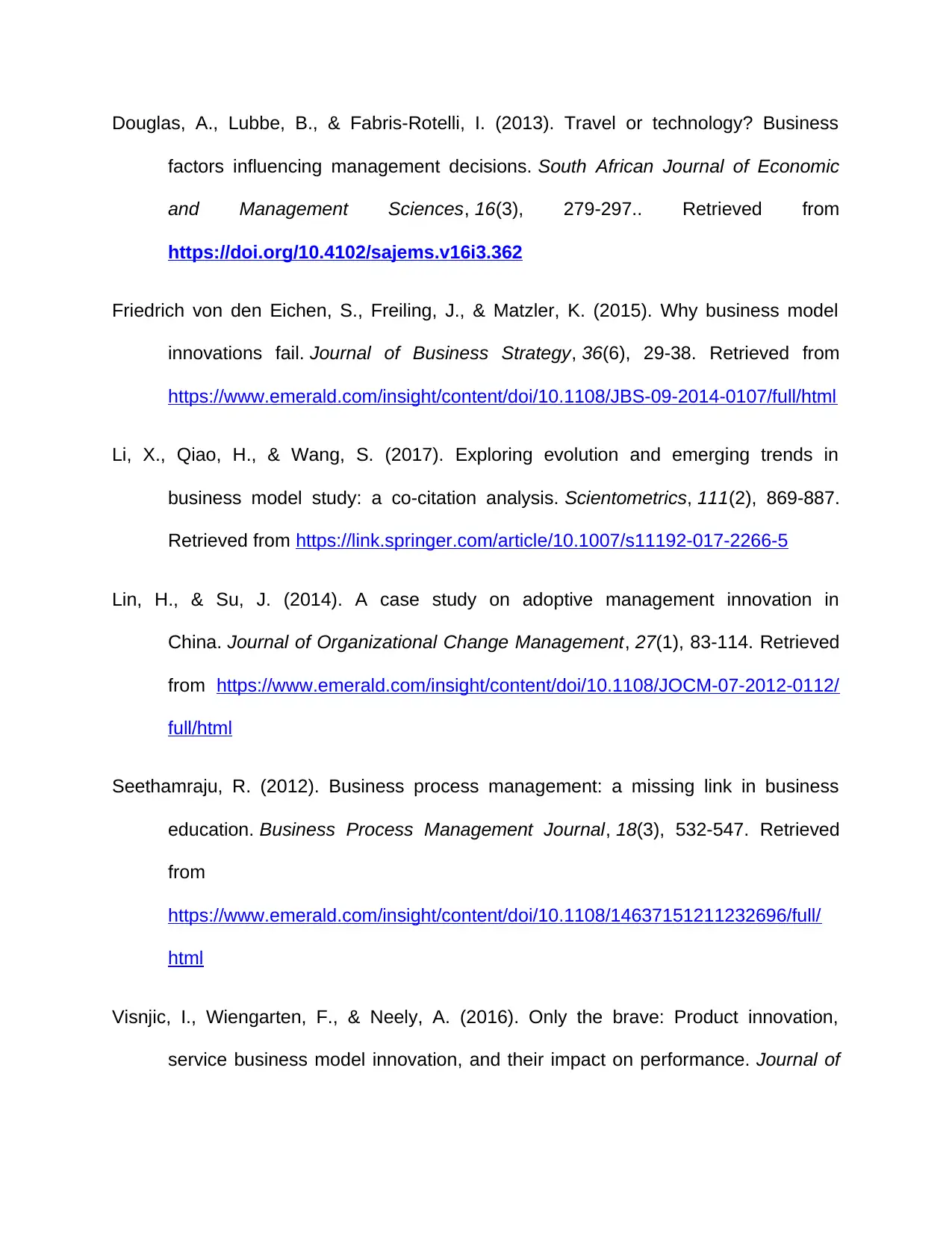
Douglas, A., Lubbe, B., & Fabris-Rotelli, I. (2013). Travel or technology? Business
factors influencing management decisions. South African Journal of Economic
and Management Sciences, 16(3), 279-297.. Retrieved from
https://doi.org/10.4102/sajems.v16i3.362
Friedrich von den Eichen, S., Freiling, J., & Matzler, K. (2015). Why business model
innovations fail. Journal of Business Strategy, 36(6), 29-38. Retrieved from
https://www.emerald.com/insight/content/doi/10.1108/JBS-09-2014-0107/full/html
Li, X., Qiao, H., & Wang, S. (2017). Exploring evolution and emerging trends in
business model study: a co-citation analysis. Scientometrics, 111(2), 869-887.
Retrieved from https://link.springer.com/article/10.1007/s11192-017-2266-5
Lin, H., & Su, J. (2014). A case study on adoptive management innovation in
China. Journal of Organizational Change Management, 27(1), 83-114. Retrieved
from https://www.emerald.com/insight/content/doi/10.1108/JOCM-07-2012-0112/
full/html
Seethamraju, R. (2012). Business process management: a missing link in business
education. Business Process Management Journal, 18(3), 532-547. Retrieved
from
https://www.emerald.com/insight/content/doi/10.1108/14637151211232696/full/
html
Visnjic, I., Wiengarten, F., & Neely, A. (2016). Only the brave: Product innovation,
service business model innovation, and their impact on performance. Journal of
factors influencing management decisions. South African Journal of Economic
and Management Sciences, 16(3), 279-297.. Retrieved from
https://doi.org/10.4102/sajems.v16i3.362
Friedrich von den Eichen, S., Freiling, J., & Matzler, K. (2015). Why business model
innovations fail. Journal of Business Strategy, 36(6), 29-38. Retrieved from
https://www.emerald.com/insight/content/doi/10.1108/JBS-09-2014-0107/full/html
Li, X., Qiao, H., & Wang, S. (2017). Exploring evolution and emerging trends in
business model study: a co-citation analysis. Scientometrics, 111(2), 869-887.
Retrieved from https://link.springer.com/article/10.1007/s11192-017-2266-5
Lin, H., & Su, J. (2014). A case study on adoptive management innovation in
China. Journal of Organizational Change Management, 27(1), 83-114. Retrieved
from https://www.emerald.com/insight/content/doi/10.1108/JOCM-07-2012-0112/
full/html
Seethamraju, R. (2012). Business process management: a missing link in business
education. Business Process Management Journal, 18(3), 532-547. Retrieved
from
https://www.emerald.com/insight/content/doi/10.1108/14637151211232696/full/
html
Visnjic, I., Wiengarten, F., & Neely, A. (2016). Only the brave: Product innovation,
service business model innovation, and their impact on performance. Journal of
Product Innovation Management, 33(1), 36-52. Retrieved from
https://onlinelibrary.wiley.com/doi/abs/10.1111/jpim.12254
Yin, S., Lu, F., Yang, Y., & Jing, R. (2014). Organizational culture evolution: An
imprinting perspective. Journal of Organizational Change Management, 27(6),
973-994. Retrieved from
https://www.emerald.com/insight/content/doi/10.1108/JOCM-05-2013-0080/full/
html?mobileUi=0&fullSc=1&mbSc=1
https://onlinelibrary.wiley.com/doi/abs/10.1111/jpim.12254
Yin, S., Lu, F., Yang, Y., & Jing, R. (2014). Organizational culture evolution: An
imprinting perspective. Journal of Organizational Change Management, 27(6),
973-994. Retrieved from
https://www.emerald.com/insight/content/doi/10.1108/JOCM-05-2013-0080/full/
html?mobileUi=0&fullSc=1&mbSc=1
⊘ This is a preview!⊘
Do you want full access?
Subscribe today to unlock all pages.
Trusted by 1+ million students worldwide

1 out of 9


Related Documents


Your All-in-One AI-Powered Toolkit for Academic Success.
+13062052269
info@desklib.com
Available 24*7 on WhatsApp / Email
![[object Object]](/_next/static/media/star-bottom.7253800d.svg)
Unlock your academic potential
Copyright © 2020–2026 A2Z Services. All Rights Reserved. Developed and managed by ZUCOL.