Developing Intercultural Competence in Global Business Management
VerifiedAdded on 2023/06/18
|9
|2027
|403
Report
AI Summary
This report explores the concept of intercultural competence in business, focusing on a case study involving an American manager in India facing cross-cultural challenges. It identifies potential problems in communication, work styles, motivation, and information gaps. The report applies Hofstede's Cultural Dimension Theory to understand cultural differences and provides recommendations for improving cross-cultural communication, including clear communication, cultural learning, and diversity training. The goal is to enhance teamwork, performance, and productivity by fostering a healthy workplace environment that values diverse cultural backgrounds. The report concludes by emphasizing the importance of understanding cultural values and adapting communication styles to resolve cross-cultural issues effectively, supported by training and development strategies.
INTERCULTURAL
COMPETENCE IN
BUSINESS
COMPETENCE IN
BUSINESS

Paraphrase This Document
Need a fresh take? Get an instant paraphrase of this document with our AI Paraphraser
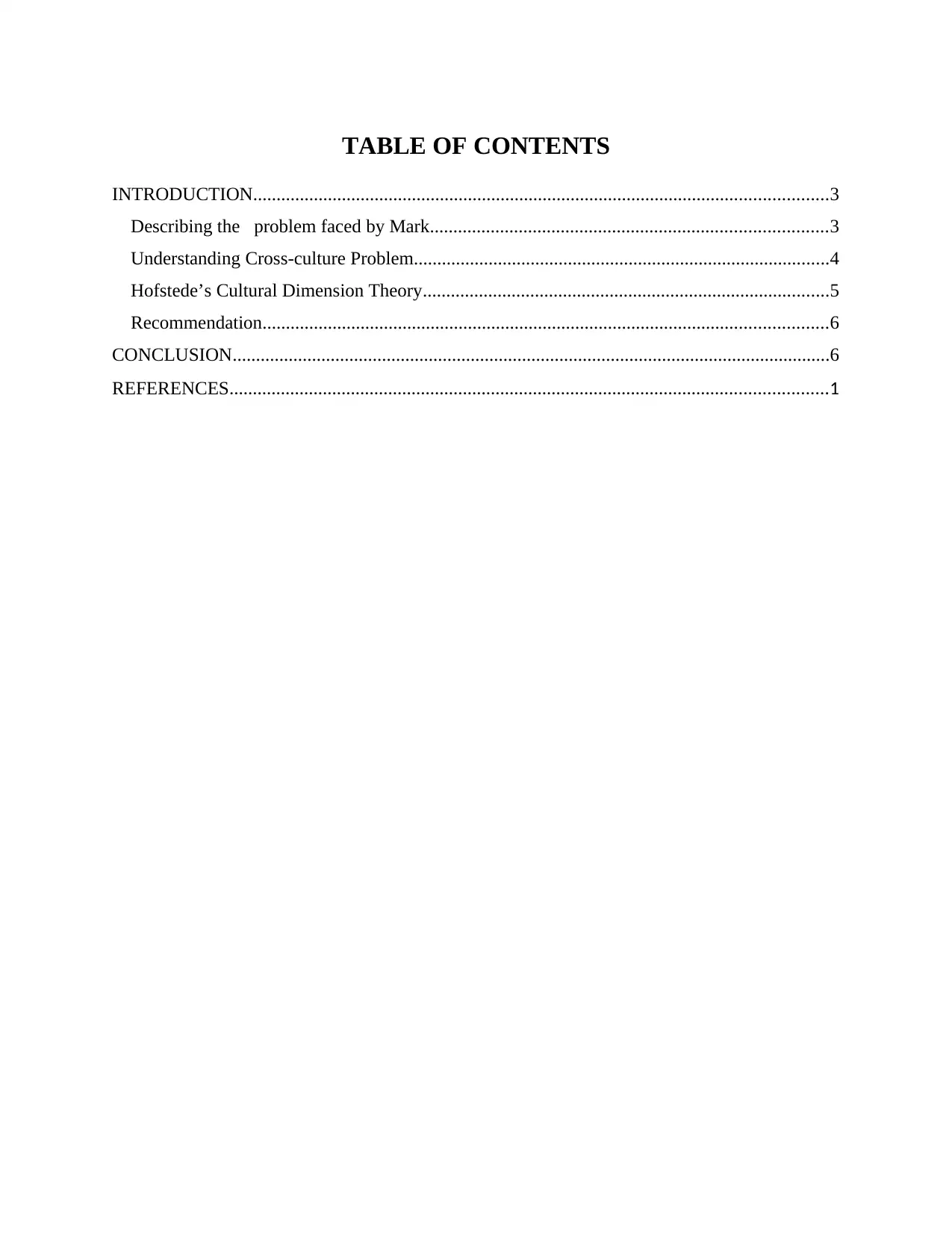
TABLE OF CONTENTS
INTRODUCTION...........................................................................................................................3
Describing the problem faced by Mark.....................................................................................3
Understanding Cross-culture Problem.........................................................................................4
Hofstede’s Cultural Dimension Theory.......................................................................................5
Recommendation.........................................................................................................................6
CONCLUSION................................................................................................................................6
REFERENCES................................................................................................................................1
INTRODUCTION...........................................................................................................................3
Describing the problem faced by Mark.....................................................................................3
Understanding Cross-culture Problem.........................................................................................4
Hofstede’s Cultural Dimension Theory.......................................................................................5
Recommendation.........................................................................................................................6
CONCLUSION................................................................................................................................6
REFERENCES................................................................................................................................1
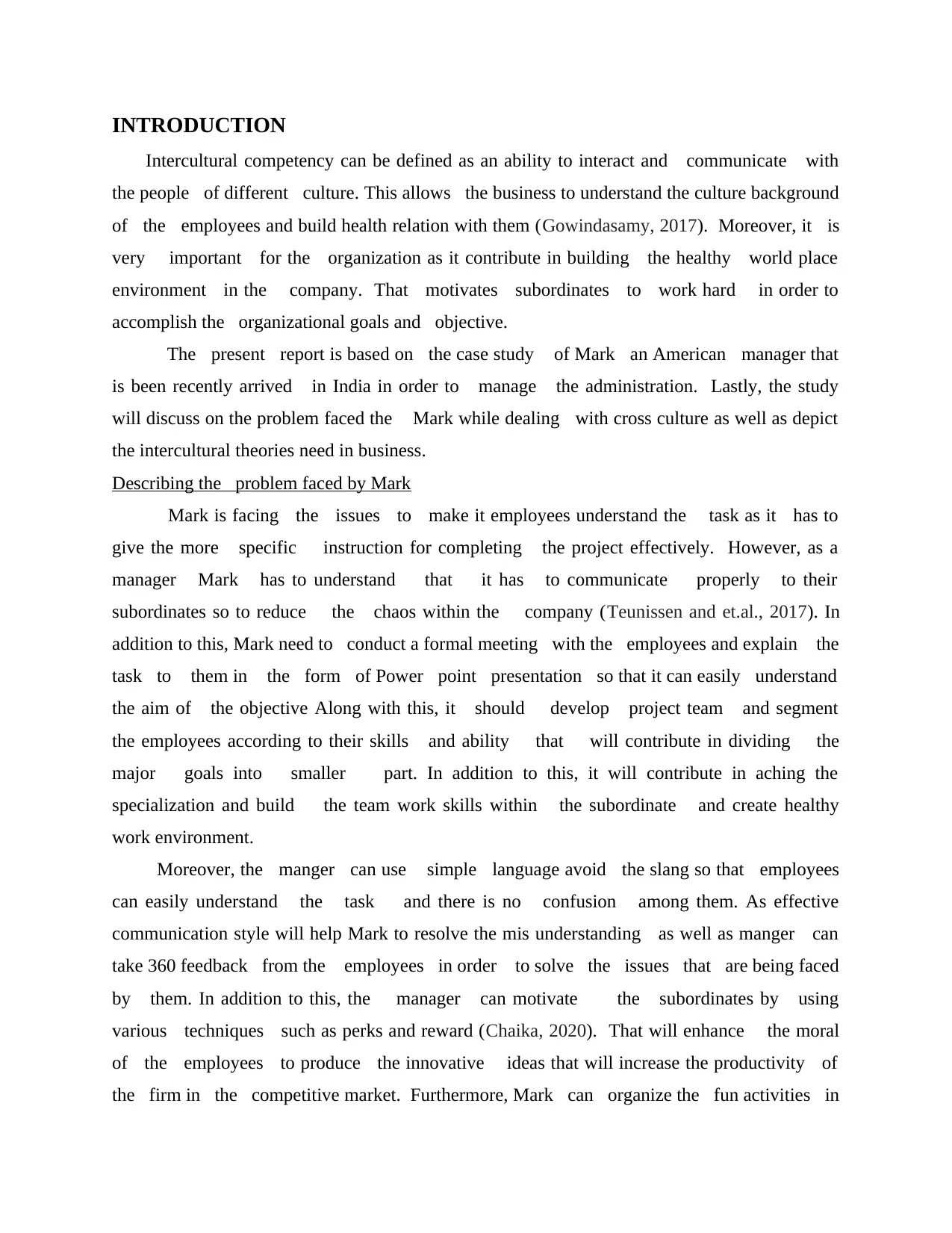
INTRODUCTION
Intercultural competency can be defined as an ability to interact and communicate with
the people of different culture. This allows the business to understand the culture background
of the employees and build health relation with them (Gowindasamy, 2017). Moreover, it is
very important for the organization as it contribute in building the healthy world place
environment in the company. That motivates subordinates to work hard in order to
accomplish the organizational goals and objective.
The present report is based on the case study of Mark an American manager that
is been recently arrived in India in order to manage the administration. Lastly, the study
will discuss on the problem faced the Mark while dealing with cross culture as well as depict
the intercultural theories need in business.
Describing the problem faced by Mark
Mark is facing the issues to make it employees understand the task as it has to
give the more specific instruction for completing the project effectively. However, as a
manager Mark has to understand that it has to communicate properly to their
subordinates so to reduce the chaos within the company (Teunissen and et.al., 2017). In
addition to this, Mark need to conduct a formal meeting with the employees and explain the
task to them in the form of Power point presentation so that it can easily understand
the aim of the objective Along with this, it should develop project team and segment
the employees according to their skills and ability that will contribute in dividing the
major goals into smaller part. In addition to this, it will contribute in aching the
specialization and build the team work skills within the subordinate and create healthy
work environment.
Moreover, the manger can use simple language avoid the slang so that employees
can easily understand the task and there is no confusion among them. As effective
communication style will help Mark to resolve the mis understanding as well as manger can
take 360 feedback from the employees in order to solve the issues that are being faced
by them. In addition to this, the manager can motivate the subordinates by using
various techniques such as perks and reward (Chaika, 2020). That will enhance the moral
of the employees to produce the innovative ideas that will increase the productivity of
the firm in the competitive market. Furthermore, Mark can organize the fun activities in
Intercultural competency can be defined as an ability to interact and communicate with
the people of different culture. This allows the business to understand the culture background
of the employees and build health relation with them (Gowindasamy, 2017). Moreover, it is
very important for the organization as it contribute in building the healthy world place
environment in the company. That motivates subordinates to work hard in order to
accomplish the organizational goals and objective.
The present report is based on the case study of Mark an American manager that
is been recently arrived in India in order to manage the administration. Lastly, the study
will discuss on the problem faced the Mark while dealing with cross culture as well as depict
the intercultural theories need in business.
Describing the problem faced by Mark
Mark is facing the issues to make it employees understand the task as it has to
give the more specific instruction for completing the project effectively. However, as a
manager Mark has to understand that it has to communicate properly to their
subordinates so to reduce the chaos within the company (Teunissen and et.al., 2017). In
addition to this, Mark need to conduct a formal meeting with the employees and explain the
task to them in the form of Power point presentation so that it can easily understand
the aim of the objective Along with this, it should develop project team and segment
the employees according to their skills and ability that will contribute in dividing the
major goals into smaller part. In addition to this, it will contribute in aching the
specialization and build the team work skills within the subordinate and create healthy
work environment.
Moreover, the manger can use simple language avoid the slang so that employees
can easily understand the task and there is no confusion among them. As effective
communication style will help Mark to resolve the mis understanding as well as manger can
take 360 feedback from the employees in order to solve the issues that are being faced
by them. In addition to this, the manager can motivate the subordinates by using
various techniques such as perks and reward (Chaika, 2020). That will enhance the moral
of the employees to produce the innovative ideas that will increase the productivity of
the firm in the competitive market. Furthermore, Mark can organize the fun activities in
⊘ This is a preview!⊘
Do you want full access?
Subscribe today to unlock all pages.

Trusted by 1+ million students worldwide
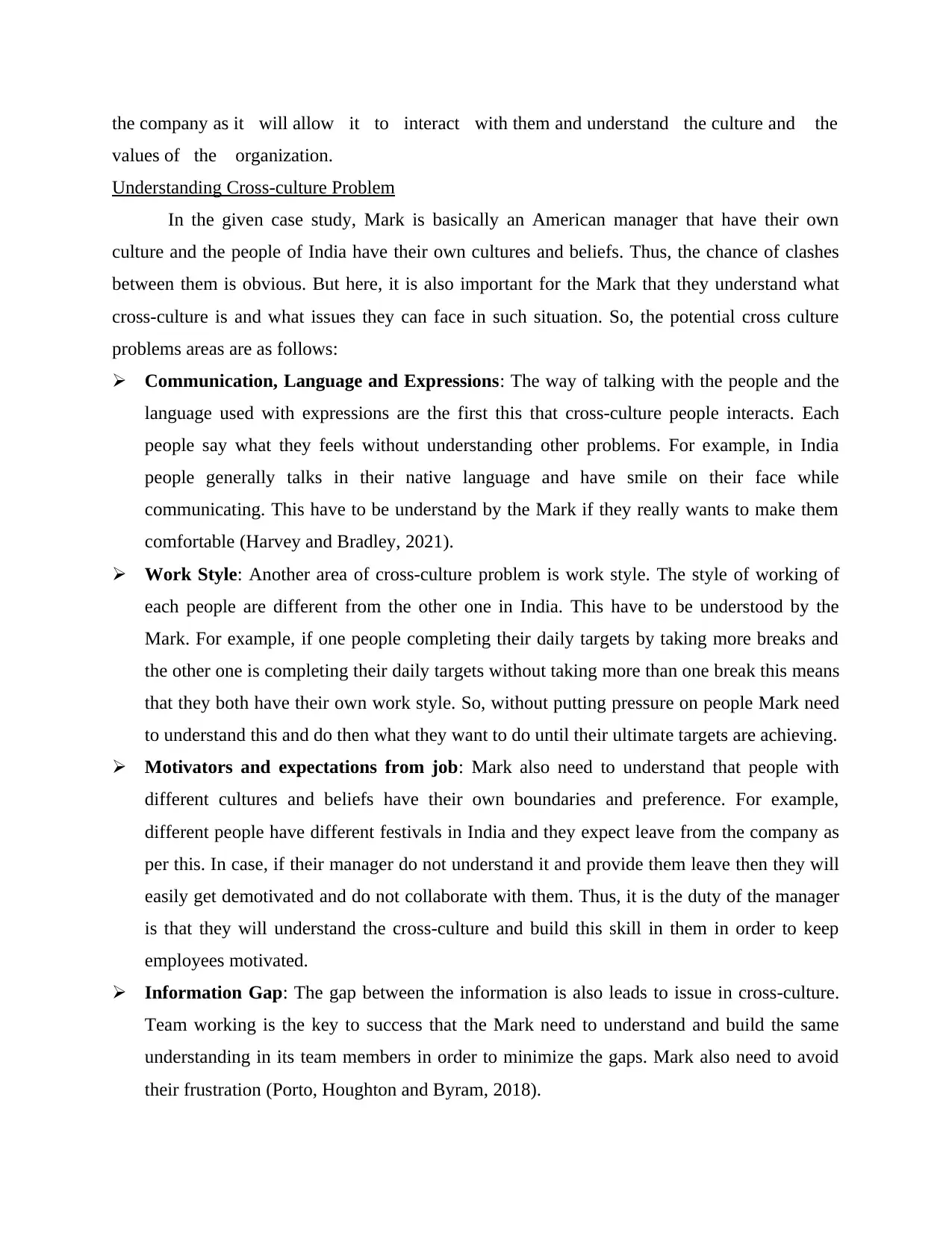
the company as it will allow it to interact with them and understand the culture and the
values of the organization.
Understanding Cross-culture Problem
In the given case study, Mark is basically an American manager that have their own
culture and the people of India have their own cultures and beliefs. Thus, the chance of clashes
between them is obvious. But here, it is also important for the Mark that they understand what
cross-culture is and what issues they can face in such situation. So, the potential cross culture
problems areas are as follows:
Communication, Language and Expressions: The way of talking with the people and the
language used with expressions are the first this that cross-culture people interacts. Each
people say what they feels without understanding other problems. For example, in India
people generally talks in their native language and have smile on their face while
communicating. This have to be understand by the Mark if they really wants to make them
comfortable (Harvey and Bradley, 2021).
Work Style: Another area of cross-culture problem is work style. The style of working of
each people are different from the other one in India. This have to be understood by the
Mark. For example, if one people completing their daily targets by taking more breaks and
the other one is completing their daily targets without taking more than one break this means
that they both have their own work style. So, without putting pressure on people Mark need
to understand this and do then what they want to do until their ultimate targets are achieving.
Motivators and expectations from job: Mark also need to understand that people with
different cultures and beliefs have their own boundaries and preference. For example,
different people have different festivals in India and they expect leave from the company as
per this. In case, if their manager do not understand it and provide them leave then they will
easily get demotivated and do not collaborate with them. Thus, it is the duty of the manager
is that they will understand the cross-culture and build this skill in them in order to keep
employees motivated.
Information Gap: The gap between the information is also leads to issue in cross-culture.
Team working is the key to success that the Mark need to understand and build the same
understanding in its team members in order to minimize the gaps. Mark also need to avoid
their frustration (Porto, Houghton and Byram, 2018).
values of the organization.
Understanding Cross-culture Problem
In the given case study, Mark is basically an American manager that have their own
culture and the people of India have their own cultures and beliefs. Thus, the chance of clashes
between them is obvious. But here, it is also important for the Mark that they understand what
cross-culture is and what issues they can face in such situation. So, the potential cross culture
problems areas are as follows:
Communication, Language and Expressions: The way of talking with the people and the
language used with expressions are the first this that cross-culture people interacts. Each
people say what they feels without understanding other problems. For example, in India
people generally talks in their native language and have smile on their face while
communicating. This have to be understand by the Mark if they really wants to make them
comfortable (Harvey and Bradley, 2021).
Work Style: Another area of cross-culture problem is work style. The style of working of
each people are different from the other one in India. This have to be understood by the
Mark. For example, if one people completing their daily targets by taking more breaks and
the other one is completing their daily targets without taking more than one break this means
that they both have their own work style. So, without putting pressure on people Mark need
to understand this and do then what they want to do until their ultimate targets are achieving.
Motivators and expectations from job: Mark also need to understand that people with
different cultures and beliefs have their own boundaries and preference. For example,
different people have different festivals in India and they expect leave from the company as
per this. In case, if their manager do not understand it and provide them leave then they will
easily get demotivated and do not collaborate with them. Thus, it is the duty of the manager
is that they will understand the cross-culture and build this skill in them in order to keep
employees motivated.
Information Gap: The gap between the information is also leads to issue in cross-culture.
Team working is the key to success that the Mark need to understand and build the same
understanding in its team members in order to minimize the gaps. Mark also need to avoid
their frustration (Porto, Houghton and Byram, 2018).
Paraphrase This Document
Need a fresh take? Get an instant paraphrase of this document with our AI Paraphraser
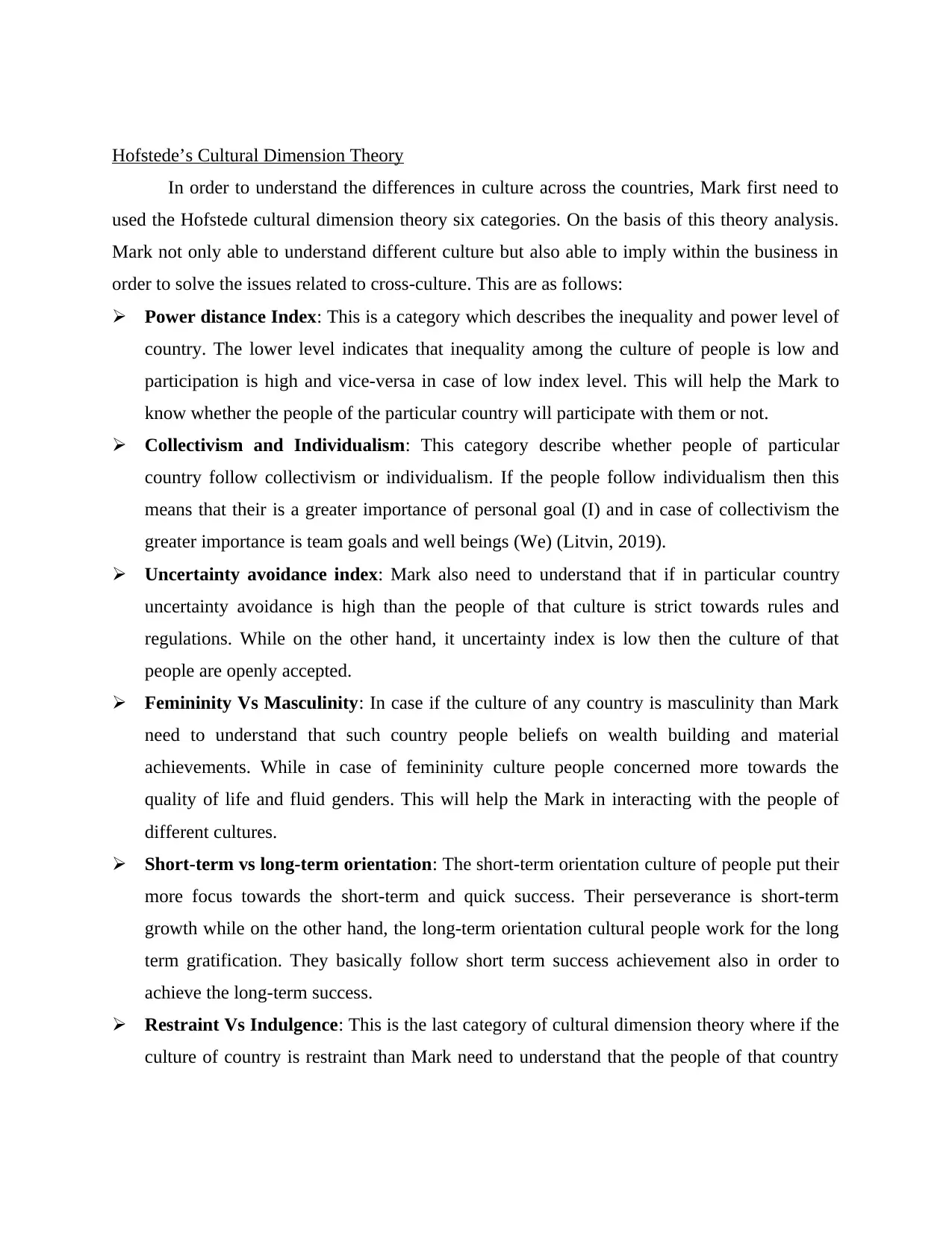
Hofstede’s Cultural Dimension Theory
In order to understand the differences in culture across the countries, Mark first need to
used the Hofstede cultural dimension theory six categories. On the basis of this theory analysis.
Mark not only able to understand different culture but also able to imply within the business in
order to solve the issues related to cross-culture. This are as follows:
Power distance Index: This is a category which describes the inequality and power level of
country. The lower level indicates that inequality among the culture of people is low and
participation is high and vice-versa in case of low index level. This will help the Mark to
know whether the people of the particular country will participate with them or not.
Collectivism and Individualism: This category describe whether people of particular
country follow collectivism or individualism. If the people follow individualism then this
means that their is a greater importance of personal goal (I) and in case of collectivism the
greater importance is team goals and well beings (We) (Litvin, 2019).
Uncertainty avoidance index: Mark also need to understand that if in particular country
uncertainty avoidance is high than the people of that culture is strict towards rules and
regulations. While on the other hand, it uncertainty index is low then the culture of that
people are openly accepted.
Femininity Vs Masculinity: In case if the culture of any country is masculinity than Mark
need to understand that such country people beliefs on wealth building and material
achievements. While in case of femininity culture people concerned more towards the
quality of life and fluid genders. This will help the Mark in interacting with the people of
different cultures.
Short-term vs long-term orientation: The short-term orientation culture of people put their
more focus towards the short-term and quick success. Their perseverance is short-term
growth while on the other hand, the long-term orientation cultural people work for the long
term gratification. They basically follow short term success achievement also in order to
achieve the long-term success.
Restraint Vs Indulgence: This is the last category of cultural dimension theory where if the
culture of country is restraint than Mark need to understand that the people of that country
In order to understand the differences in culture across the countries, Mark first need to
used the Hofstede cultural dimension theory six categories. On the basis of this theory analysis.
Mark not only able to understand different culture but also able to imply within the business in
order to solve the issues related to cross-culture. This are as follows:
Power distance Index: This is a category which describes the inequality and power level of
country. The lower level indicates that inequality among the culture of people is low and
participation is high and vice-versa in case of low index level. This will help the Mark to
know whether the people of the particular country will participate with them or not.
Collectivism and Individualism: This category describe whether people of particular
country follow collectivism or individualism. If the people follow individualism then this
means that their is a greater importance of personal goal (I) and in case of collectivism the
greater importance is team goals and well beings (We) (Litvin, 2019).
Uncertainty avoidance index: Mark also need to understand that if in particular country
uncertainty avoidance is high than the people of that culture is strict towards rules and
regulations. While on the other hand, it uncertainty index is low then the culture of that
people are openly accepted.
Femininity Vs Masculinity: In case if the culture of any country is masculinity than Mark
need to understand that such country people beliefs on wealth building and material
achievements. While in case of femininity culture people concerned more towards the
quality of life and fluid genders. This will help the Mark in interacting with the people of
different cultures.
Short-term vs long-term orientation: The short-term orientation culture of people put their
more focus towards the short-term and quick success. Their perseverance is short-term
growth while on the other hand, the long-term orientation cultural people work for the long
term gratification. They basically follow short term success achievement also in order to
achieve the long-term success.
Restraint Vs Indulgence: This is the last category of cultural dimension theory where if the
culture of country is restraint than Mark need to understand that the people of that country
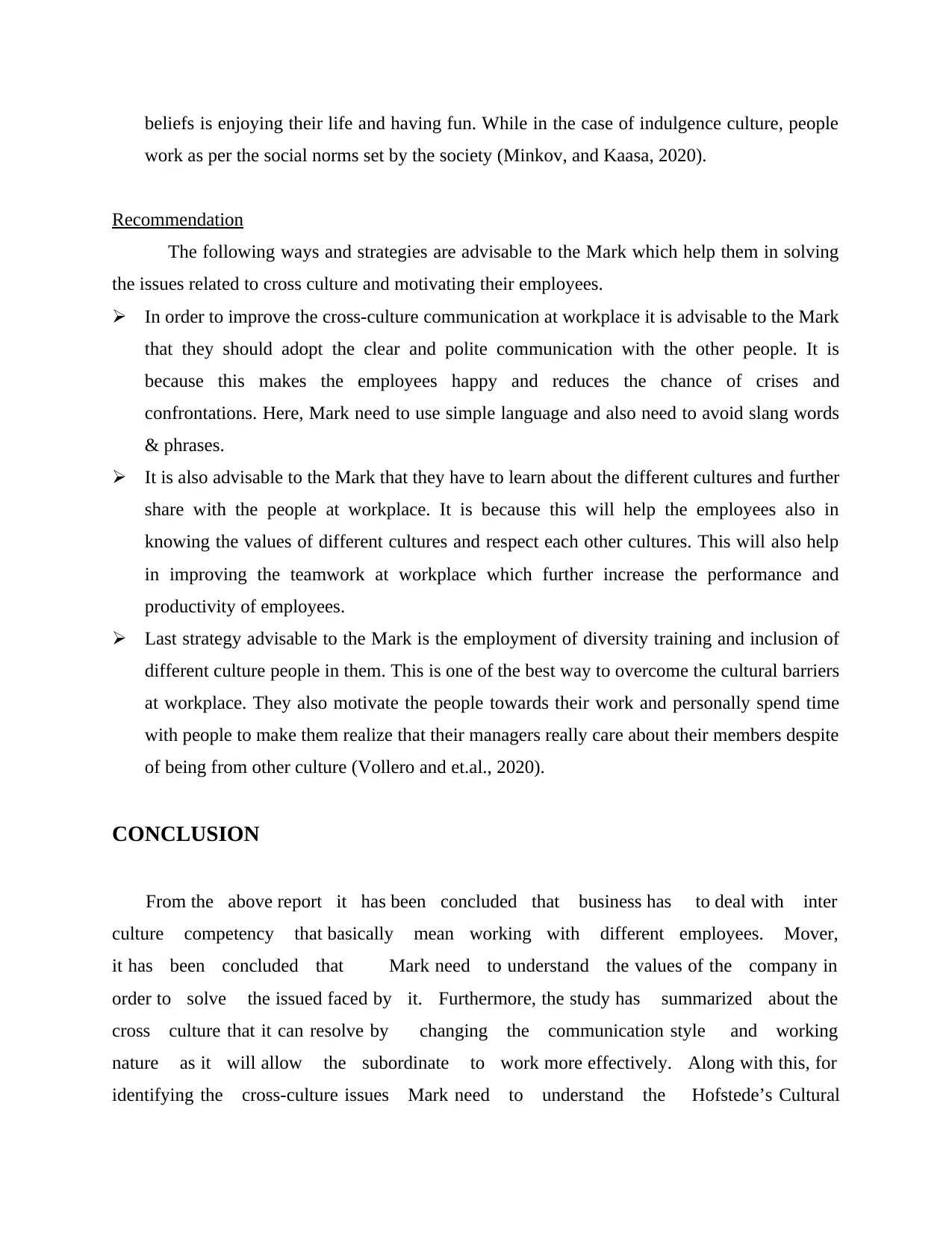
beliefs is enjoying their life and having fun. While in the case of indulgence culture, people
work as per the social norms set by the society (Minkov, and Kaasa, 2020).
Recommendation
The following ways and strategies are advisable to the Mark which help them in solving
the issues related to cross culture and motivating their employees.
In order to improve the cross-culture communication at workplace it is advisable to the Mark
that they should adopt the clear and polite communication with the other people. It is
because this makes the employees happy and reduces the chance of crises and
confrontations. Here, Mark need to use simple language and also need to avoid slang words
& phrases.
It is also advisable to the Mark that they have to learn about the different cultures and further
share with the people at workplace. It is because this will help the employees also in
knowing the values of different cultures and respect each other cultures. This will also help
in improving the teamwork at workplace which further increase the performance and
productivity of employees.
Last strategy advisable to the Mark is the employment of diversity training and inclusion of
different culture people in them. This is one of the best way to overcome the cultural barriers
at workplace. They also motivate the people towards their work and personally spend time
with people to make them realize that their managers really care about their members despite
of being from other culture (Vollero and et.al., 2020).
CONCLUSION
From the above report it has been concluded that business has to deal with inter
culture competency that basically mean working with different employees. Mover,
it has been concluded that Mark need to understand the values of the company in
order to solve the issued faced by it. Furthermore, the study has summarized about the
cross culture that it can resolve by changing the communication style and working
nature as it will allow the subordinate to work more effectively. Along with this, for
identifying the cross-culture issues Mark need to understand the Hofstede’s Cultural
work as per the social norms set by the society (Minkov, and Kaasa, 2020).
Recommendation
The following ways and strategies are advisable to the Mark which help them in solving
the issues related to cross culture and motivating their employees.
In order to improve the cross-culture communication at workplace it is advisable to the Mark
that they should adopt the clear and polite communication with the other people. It is
because this makes the employees happy and reduces the chance of crises and
confrontations. Here, Mark need to use simple language and also need to avoid slang words
& phrases.
It is also advisable to the Mark that they have to learn about the different cultures and further
share with the people at workplace. It is because this will help the employees also in
knowing the values of different cultures and respect each other cultures. This will also help
in improving the teamwork at workplace which further increase the performance and
productivity of employees.
Last strategy advisable to the Mark is the employment of diversity training and inclusion of
different culture people in them. This is one of the best way to overcome the cultural barriers
at workplace. They also motivate the people towards their work and personally spend time
with people to make them realize that their managers really care about their members despite
of being from other culture (Vollero and et.al., 2020).
CONCLUSION
From the above report it has been concluded that business has to deal with inter
culture competency that basically mean working with different employees. Mover,
it has been concluded that Mark need to understand the values of the company in
order to solve the issued faced by it. Furthermore, the study has summarized about the
cross culture that it can resolve by changing the communication style and working
nature as it will allow the subordinate to work more effectively. Along with this, for
identifying the cross-culture issues Mark need to understand the Hofstede’s Cultural
⊘ This is a preview!⊘
Do you want full access?
Subscribe today to unlock all pages.
Trusted by 1+ million students worldwide
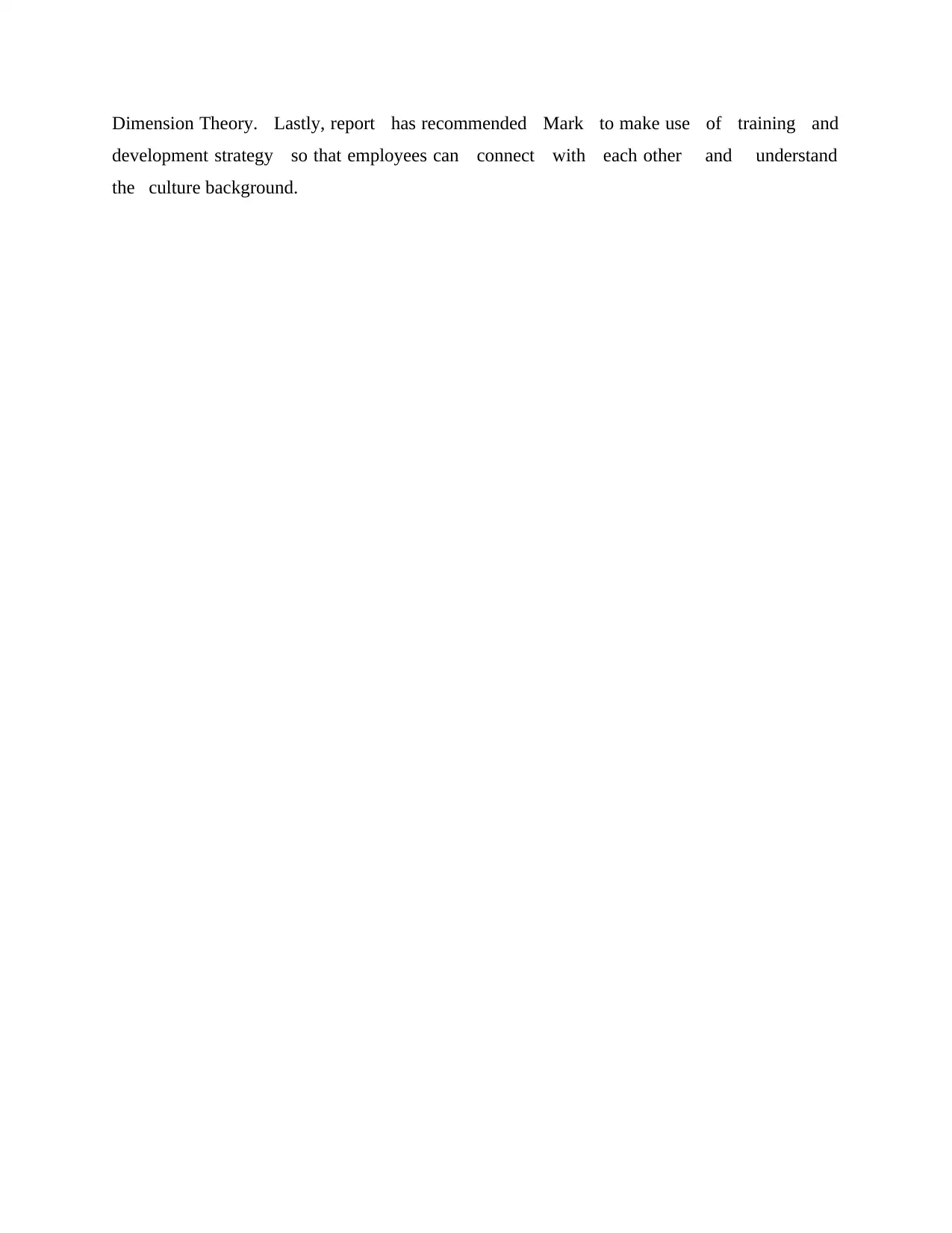
Dimension Theory. Lastly, report has recommended Mark to make use of training and
development strategy so that employees can connect with each other and understand
the culture background.
development strategy so that employees can connect with each other and understand
the culture background.
Paraphrase This Document
Need a fresh take? Get an instant paraphrase of this document with our AI Paraphraser
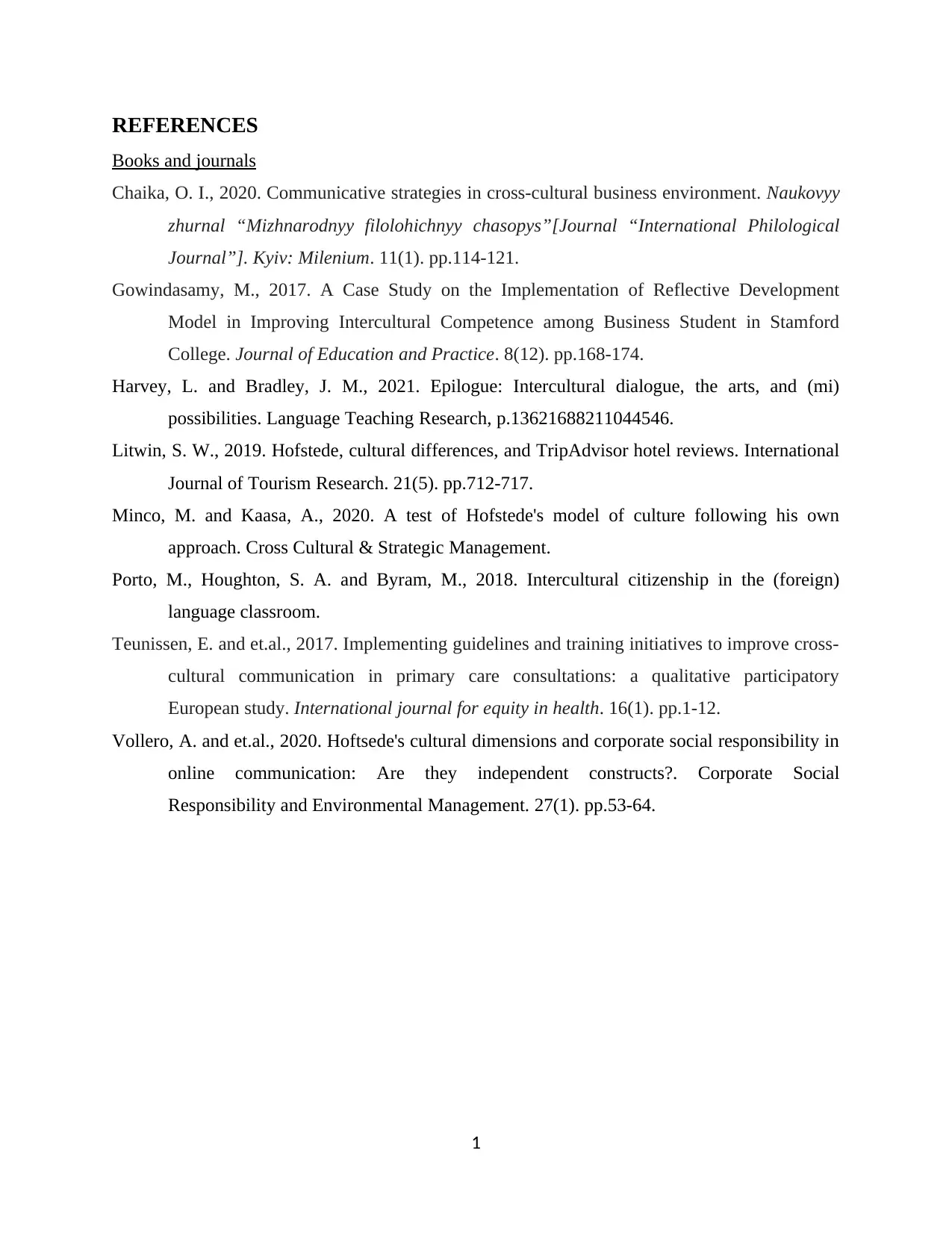
REFERENCES
Books and journals
Chaika, O. I., 2020. Communicative strategies in cross-cultural business environment. Naukovyy
zhurnal “Mizhnarodnyy filolohichnyy chasopys”[Journal “International Philological
Journal”]. Kyiv: Milenium. 11(1). pp.114-121.
Gowindasamy, M., 2017. A Case Study on the Implementation of Reflective Development
Model in Improving Intercultural Competence among Business Student in Stamford
College. Journal of Education and Practice. 8(12). pp.168-174.
Harvey, L. and Bradley, J. M., 2021. Epilogue: Intercultural dialogue, the arts, and (mi)
possibilities. Language Teaching Research, p.13621688211044546.
Litwin, S. W., 2019. Hofstede, cultural differences, and TripAdvisor hotel reviews. International
Journal of Tourism Research. 21(5). pp.712-717.
Minco, M. and Kaasa, A., 2020. A test of Hofstede's model of culture following his own
approach. Cross Cultural & Strategic Management.
Porto, M., Houghton, S. A. and Byram, M., 2018. Intercultural citizenship in the (foreign)
language classroom.
Teunissen, E. and et.al., 2017. Implementing guidelines and training initiatives to improve cross-
cultural communication in primary care consultations: a qualitative participatory
European study. International journal for equity in health. 16(1). pp.1-12.
Vollero, A. and et.al., 2020. Hoftsede's cultural dimensions and corporate social responsibility in
online communication: Are they independent constructs?. Corporate Social
Responsibility and Environmental Management. 27(1). pp.53-64.
1
Books and journals
Chaika, O. I., 2020. Communicative strategies in cross-cultural business environment. Naukovyy
zhurnal “Mizhnarodnyy filolohichnyy chasopys”[Journal “International Philological
Journal”]. Kyiv: Milenium. 11(1). pp.114-121.
Gowindasamy, M., 2017. A Case Study on the Implementation of Reflective Development
Model in Improving Intercultural Competence among Business Student in Stamford
College. Journal of Education and Practice. 8(12). pp.168-174.
Harvey, L. and Bradley, J. M., 2021. Epilogue: Intercultural dialogue, the arts, and (mi)
possibilities. Language Teaching Research, p.13621688211044546.
Litwin, S. W., 2019. Hofstede, cultural differences, and TripAdvisor hotel reviews. International
Journal of Tourism Research. 21(5). pp.712-717.
Minco, M. and Kaasa, A., 2020. A test of Hofstede's model of culture following his own
approach. Cross Cultural & Strategic Management.
Porto, M., Houghton, S. A. and Byram, M., 2018. Intercultural citizenship in the (foreign)
language classroom.
Teunissen, E. and et.al., 2017. Implementing guidelines and training initiatives to improve cross-
cultural communication in primary care consultations: a qualitative participatory
European study. International journal for equity in health. 16(1). pp.1-12.
Vollero, A. and et.al., 2020. Hoftsede's cultural dimensions and corporate social responsibility in
online communication: Are they independent constructs?. Corporate Social
Responsibility and Environmental Management. 27(1). pp.53-64.
1

2
⊘ This is a preview!⊘
Do you want full access?
Subscribe today to unlock all pages.
Trusted by 1+ million students worldwide

1 out of 9


Related Documents


Your All-in-One AI-Powered Toolkit for Academic Success.
+13062052269
info@desklib.com
Available 24*7 on WhatsApp / Email
![[object Object]](/_next/static/media/star-bottom.7253800d.svg)
Unlock your academic potential
Copyright © 2020–2026 A2Z Services. All Rights Reserved. Developed and managed by ZUCOL.