Analysis of Strategic Business Management and Planning for ISS World
VerifiedAdded on 2023/01/19
|19
|5615
|69
Report
AI Summary
This report provides a comprehensive analysis of strategic business management and planning, focusing on the ISS World Company. It begins with an introduction to strategic business management and its importance, outlining ISS World's goals, values, and strategic planning processes. The report then delves into specific models, including the balance scorecard and gap planning, illustrating how these tools are used to assess financial performance and identify market gaps. Furthermore, it examines both internal and external factors influencing organizational management and planning strategies, utilizing PESTEL and SWOT analyses. The report also addresses corporate governance, risk factors, competitive advantages, and supply chain management. Finally, it explores stakeholder considerations, providing a complete overview of strategic business management principles and their application within the context of ISS World Company.
Strategic Business
Management
and
Planning
Management
and
Planning

Paraphrase This Document
Need a fresh take? Get an instant paraphrase of this document with our AI Paraphraser
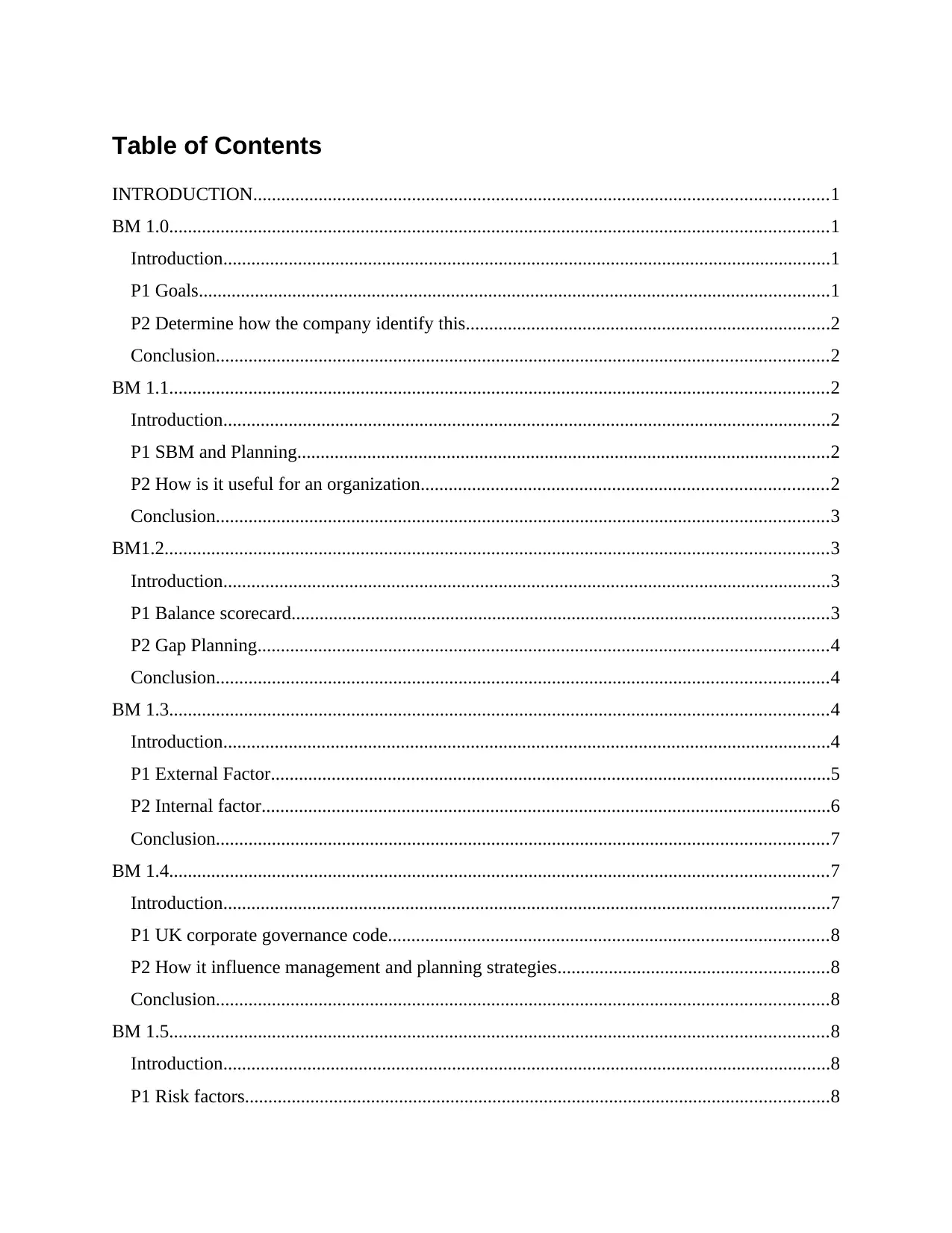
Table of Contents
INTRODUCTION...........................................................................................................................1
BM 1.0.............................................................................................................................................1
Introduction..................................................................................................................................1
P1 Goals.......................................................................................................................................1
P2 Determine how the company identify this..............................................................................2
Conclusion...................................................................................................................................2
BM 1.1.............................................................................................................................................2
Introduction..................................................................................................................................2
P1 SBM and Planning..................................................................................................................2
P2 How is it useful for an organization.......................................................................................2
Conclusion...................................................................................................................................3
BM1.2..............................................................................................................................................3
Introduction..................................................................................................................................3
P1 Balance scorecard...................................................................................................................3
P2 Gap Planning..........................................................................................................................4
Conclusion...................................................................................................................................4
BM 1.3.............................................................................................................................................4
Introduction..................................................................................................................................4
P1 External Factor........................................................................................................................5
P2 Internal factor..........................................................................................................................6
Conclusion...................................................................................................................................7
BM 1.4.............................................................................................................................................7
Introduction..................................................................................................................................7
P1 UK corporate governance code..............................................................................................8
P2 How it influence management and planning strategies..........................................................8
Conclusion...................................................................................................................................8
BM 1.5.............................................................................................................................................8
Introduction..................................................................................................................................8
P1 Risk factors.............................................................................................................................8
INTRODUCTION...........................................................................................................................1
BM 1.0.............................................................................................................................................1
Introduction..................................................................................................................................1
P1 Goals.......................................................................................................................................1
P2 Determine how the company identify this..............................................................................2
Conclusion...................................................................................................................................2
BM 1.1.............................................................................................................................................2
Introduction..................................................................................................................................2
P1 SBM and Planning..................................................................................................................2
P2 How is it useful for an organization.......................................................................................2
Conclusion...................................................................................................................................3
BM1.2..............................................................................................................................................3
Introduction..................................................................................................................................3
P1 Balance scorecard...................................................................................................................3
P2 Gap Planning..........................................................................................................................4
Conclusion...................................................................................................................................4
BM 1.3.............................................................................................................................................4
Introduction..................................................................................................................................4
P1 External Factor........................................................................................................................5
P2 Internal factor..........................................................................................................................6
Conclusion...................................................................................................................................7
BM 1.4.............................................................................................................................................7
Introduction..................................................................................................................................7
P1 UK corporate governance code..............................................................................................8
P2 How it influence management and planning strategies..........................................................8
Conclusion...................................................................................................................................8
BM 1.5.............................................................................................................................................8
Introduction..................................................................................................................................8
P1 Risk factors.............................................................................................................................8
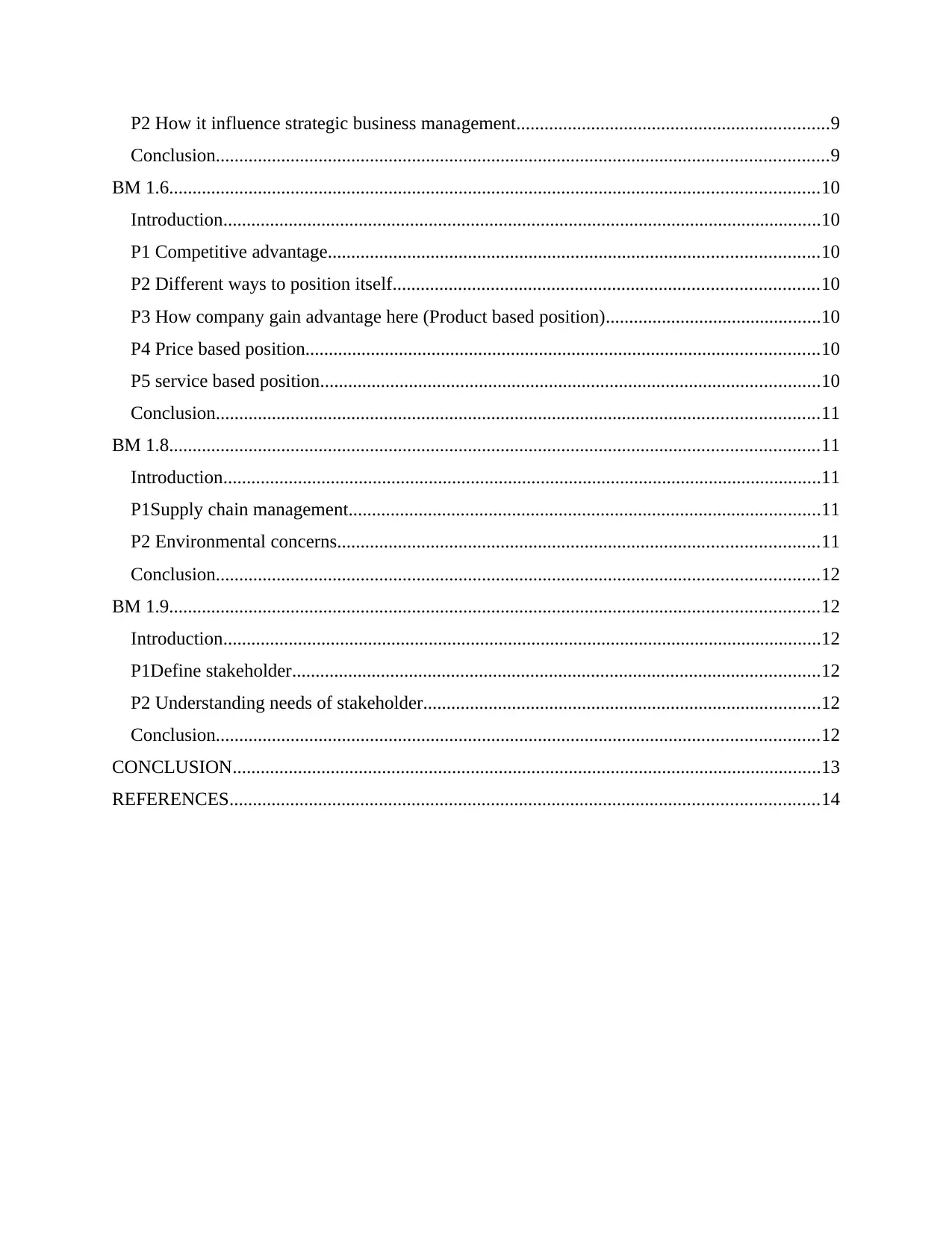
P2 How it influence strategic business management...................................................................9
Conclusion...................................................................................................................................9
BM 1.6...........................................................................................................................................10
Introduction................................................................................................................................10
P1 Competitive advantage.........................................................................................................10
P2 Different ways to position itself...........................................................................................10
P3 How company gain advantage here (Product based position)..............................................10
P4 Price based position..............................................................................................................10
P5 service based position...........................................................................................................10
Conclusion.................................................................................................................................11
BM 1.8...........................................................................................................................................11
Introduction................................................................................................................................11
P1Supply chain management.....................................................................................................11
P2 Environmental concerns.......................................................................................................11
Conclusion.................................................................................................................................12
BM 1.9...........................................................................................................................................12
Introduction................................................................................................................................12
P1Define stakeholder.................................................................................................................12
P2 Understanding needs of stakeholder.....................................................................................12
Conclusion.................................................................................................................................12
CONCLUSION..............................................................................................................................13
REFERENCES..............................................................................................................................14
Conclusion...................................................................................................................................9
BM 1.6...........................................................................................................................................10
Introduction................................................................................................................................10
P1 Competitive advantage.........................................................................................................10
P2 Different ways to position itself...........................................................................................10
P3 How company gain advantage here (Product based position)..............................................10
P4 Price based position..............................................................................................................10
P5 service based position...........................................................................................................10
Conclusion.................................................................................................................................11
BM 1.8...........................................................................................................................................11
Introduction................................................................................................................................11
P1Supply chain management.....................................................................................................11
P2 Environmental concerns.......................................................................................................11
Conclusion.................................................................................................................................12
BM 1.9...........................................................................................................................................12
Introduction................................................................................................................................12
P1Define stakeholder.................................................................................................................12
P2 Understanding needs of stakeholder.....................................................................................12
Conclusion.................................................................................................................................12
CONCLUSION..............................................................................................................................13
REFERENCES..............................................................................................................................14
⊘ This is a preview!⊘
Do you want full access?
Subscribe today to unlock all pages.

Trusted by 1+ million students worldwide
INTRODUCTION
Strategic business management and planning is important planning for business and its
effectiveness in business. This help to business in order to understand the requirement of
planning. The present report will based on the “ISS world company” which is provide various
services to customers like catering, security facilities. The report will shows a goals and
objectives of business and importance of SBM. This evaluate the classic and contemporary
models in developing business. This will analysis the internal and external factors which
influence to business, corporate governance code affect to business management. This will
define the risk factors and its impact or advantages of product, price and services based position.
BM 1.0
Introduction
The section present the goals and values of the company in which report describe the set
of beliefs and principles and further describe how ISS develop strategies to attain these
objectives/goals.
P1 Goals
Company goal is to focus how the firm meet the customer need by providing best
services so that it will help to provide unique position by integrate the best facilities at local and
global level. For that the business offer different products in reasonable rates with discount in
order to quantify the objectives.
Difference between:
Strategic: It is that planning in which the ISS define the strategy, direction and also helps to
make decision by allocating the resource to pursue the strategy. Basically the strategic planning
deals with whole business with some milestones. (Van Deursen, Helsper and Eynon, 2016). for
ISS, the strategies are implement by the business when there is a need to take a business into
further level of success and also regularly monitor the day to day planning as well.
Tactical: It is the short range planning that emphasize the current operations of various parts and
Manager of ISS use tactical planning in order to attain defined aim and objectives of an
organization.
Operational: It is a process of linking all the strategic goals as well as objectives to tactical
goals and objectives that clearly describe milestone and condition for success. Therefore, the
manager of ISS uses operational plan in order to keep all the information with them. To fulfil the
1
Strategic business management and planning is important planning for business and its
effectiveness in business. This help to business in order to understand the requirement of
planning. The present report will based on the “ISS world company” which is provide various
services to customers like catering, security facilities. The report will shows a goals and
objectives of business and importance of SBM. This evaluate the classic and contemporary
models in developing business. This will analysis the internal and external factors which
influence to business, corporate governance code affect to business management. This will
define the risk factors and its impact or advantages of product, price and services based position.
BM 1.0
Introduction
The section present the goals and values of the company in which report describe the set
of beliefs and principles and further describe how ISS develop strategies to attain these
objectives/goals.
P1 Goals
Company goal is to focus how the firm meet the customer need by providing best
services so that it will help to provide unique position by integrate the best facilities at local and
global level. For that the business offer different products in reasonable rates with discount in
order to quantify the objectives.
Difference between:
Strategic: It is that planning in which the ISS define the strategy, direction and also helps to
make decision by allocating the resource to pursue the strategy. Basically the strategic planning
deals with whole business with some milestones. (Van Deursen, Helsper and Eynon, 2016). for
ISS, the strategies are implement by the business when there is a need to take a business into
further level of success and also regularly monitor the day to day planning as well.
Tactical: It is the short range planning that emphasize the current operations of various parts and
Manager of ISS use tactical planning in order to attain defined aim and objectives of an
organization.
Operational: It is a process of linking all the strategic goals as well as objectives to tactical
goals and objectives that clearly describe milestone and condition for success. Therefore, the
manager of ISS uses operational plan in order to keep all the information with them. To fulfil the
1
Paraphrase This Document
Need a fresh take? Get an instant paraphrase of this document with our AI Paraphraser
operational goals, company should also make sure that the there should be a daily process of
monitoring so that it will help to determine the daily progress.
Values: ISS follows the values such as:
Honesty: Firm respect their customers, colleagues and its honesty is not negotiable.
Quality: It deliver the good quality of product and firm have the professional with passion
for quality.
Responsibility: it empower everyone to determine the new ways to improve the service.
The workers working under this, also take responsibility for their decision to make sure
that actions are correct.
P2 Determine how the company identify this
ISS includes different members to attain the goals and objectives and describe their view
point in order to attain the same such as the Founder/owner approved the strategies develop by
manager and leader. On the other side, Primary decision-makers of the firm are different for
every department and thus, they make decision at primary level, so that the company achieve the
goals. Further, ISS also provide nominal group technique which is a group brainstorming activity
that encourages every member in order to provide their problem and solution (Nickols, 2016).
Moreover, ISS also uses Expert judgement in which the firm provides input to planning and also
estimating their opinion in group Consensus. Lastly, in order to achieve the defined aim, straw
man is used in which the arguments that is based upon the giving the impression of refuting on
opponents.
On the other side, it is also analysed that other companies also uses different strategies in
order to determine the goals. Such that Tesco uses effective strategies like promotional tools and
it also its departments who have its own roles and responsibilities and also help the firmt o take
better decision for the company as well.
Conclusion
From the above, it has been concluded that ISS goals and objectives are mainly based
upon to fulfil the customer need and it can be attain with the support of their owner/ founder and
their primary decision-makers.
2
monitoring so that it will help to determine the daily progress.
Values: ISS follows the values such as:
Honesty: Firm respect their customers, colleagues and its honesty is not negotiable.
Quality: It deliver the good quality of product and firm have the professional with passion
for quality.
Responsibility: it empower everyone to determine the new ways to improve the service.
The workers working under this, also take responsibility for their decision to make sure
that actions are correct.
P2 Determine how the company identify this
ISS includes different members to attain the goals and objectives and describe their view
point in order to attain the same such as the Founder/owner approved the strategies develop by
manager and leader. On the other side, Primary decision-makers of the firm are different for
every department and thus, they make decision at primary level, so that the company achieve the
goals. Further, ISS also provide nominal group technique which is a group brainstorming activity
that encourages every member in order to provide their problem and solution (Nickols, 2016).
Moreover, ISS also uses Expert judgement in which the firm provides input to planning and also
estimating their opinion in group Consensus. Lastly, in order to achieve the defined aim, straw
man is used in which the arguments that is based upon the giving the impression of refuting on
opponents.
On the other side, it is also analysed that other companies also uses different strategies in
order to determine the goals. Such that Tesco uses effective strategies like promotional tools and
it also its departments who have its own roles and responsibilities and also help the firmt o take
better decision for the company as well.
Conclusion
From the above, it has been concluded that ISS goals and objectives are mainly based
upon to fulfil the customer need and it can be attain with the support of their owner/ founder and
their primary decision-makers.
2
BM 1.1
Introduction
This section is presents the importance of strategic business management and planning.
This will shows a usefulness to their organisation.
P1 SBM and Planning
Strategic business management is the effective ongoing planning, monitoring, analysis
and assessment of all that is important for organisation in order to meets goals and objectives of
ISS world company (Ansoff and et.al., 2018). On the other side planning is effective tool and
blueprint of work timelines and resources which are used in work. Both are help to achieve goals
and objectives of firms in effective manner.
P2 How is it useful for an organization
Strategic business management and planning tools are most important and effective for
business and its growth factor. This is useful for ISS world company in order to meets their goals
and objectives of company. There are different benefits for ISS world which are as follows: Proper allocation of resources: with the help of effective and best strategic business
management planning, company manager is able to find the requirements of resources
and its proper allocation in work. Identifying potential time constraints: planning is useful and helpful for business and its
growth. With the help of this, manager is able to understand the time constraints
(Vishnevskiy, Karasev and Meissner, 2016). Measuring achievable outcomes: with the help of proper and strategic business
management and planning, manager of ISS world is easily measures their outcomes
before work and through planning.
Allocation of budget to project and department: this is very important part which is help
to ISS manager to allocate budget for paying expenses and fulfil the needs of department.
This help to manage department expenses.
Conclusion
From the above discussion it had been concluded that the strategic business management
and planning has important and useful for company in order to meets their goals and objectives
of company in effective manner. With the help of this, company has able to find the effective use
of resources in work. On the other side, it had been concluded that if company has not made
3
Introduction
This section is presents the importance of strategic business management and planning.
This will shows a usefulness to their organisation.
P1 SBM and Planning
Strategic business management is the effective ongoing planning, monitoring, analysis
and assessment of all that is important for organisation in order to meets goals and objectives of
ISS world company (Ansoff and et.al., 2018). On the other side planning is effective tool and
blueprint of work timelines and resources which are used in work. Both are help to achieve goals
and objectives of firms in effective manner.
P2 How is it useful for an organization
Strategic business management and planning tools are most important and effective for
business and its growth factor. This is useful for ISS world company in order to meets their goals
and objectives of company. There are different benefits for ISS world which are as follows: Proper allocation of resources: with the help of effective and best strategic business
management planning, company manager is able to find the requirements of resources
and its proper allocation in work. Identifying potential time constraints: planning is useful and helpful for business and its
growth. With the help of this, manager is able to understand the time constraints
(Vishnevskiy, Karasev and Meissner, 2016). Measuring achievable outcomes: with the help of proper and strategic business
management and planning, manager of ISS world is easily measures their outcomes
before work and through planning.
Allocation of budget to project and department: this is very important part which is help
to ISS manager to allocate budget for paying expenses and fulfil the needs of department.
This help to manage department expenses.
Conclusion
From the above discussion it had been concluded that the strategic business management
and planning has important and useful for company in order to meets their goals and objectives
of company in effective manner. With the help of this, company has able to find the effective use
of resources in work. On the other side, it had been concluded that if company has not made
3
⊘ This is a preview!⊘
Do you want full access?
Subscribe today to unlock all pages.
Trusted by 1+ million students worldwide
effective planning and management then it can affect to company because lack of schedule of
work.
BM1.2
Introduction
The section is present a strategic planning models like balance scorecard and analysis of
gap planning. This model is help to ISS in order to analysis gap in organisation and set strategic
direction for business.
P1 Balance scorecard
Balanced scorecard is refers the BSC is a the framework in order to implement and
manage strategy in effective manner. This links with strategic objectives, measurements, target
and initiatives (Cassidy, 2016). This model is help to measures and calculate the financial
performance of ISS. It is the performance metric used in the strategic management to identify or
improve various internal functions of a business and result external outcomes. This model have a
four perspectives such as financial, customers, learning & growth and business process. Financial perspective is includes return on investment, growth, fixed costs profits. Here,
manager is set objectives is to increase margin of profits. Learning and growth is help to measures requirement of loans to customer. Internal business process has objective to increase leading by measuring quality of
money required for business and its growth.
Customer, here is ISS world manager sets objectives to decrease in loan interest rate or
know interest of customers with company.
This process is help to ISS world manager for their strategic planning of company.
P2 Gap Planning
Gap planning is help to identify the gap in market. Thus, comparing forecast profit to
desired profits reveals the planning gap. There are different types of gap which can be happens in
ISS company such as product, profit, manpower and performance gaps. This model is help to
develop business by analysing the performance gap in ISS. With the help of this model, company
is able to analysis market gap and make strategic planning for future growth and business
development (Channon and Jalland, 2016). This is very important model when company
manager is made strategic planning for business because gap analysis is help to turn their
weakness into strength. The stages of gap planning to completion are as follows:
4
work.
BM1.2
Introduction
The section is present a strategic planning models like balance scorecard and analysis of
gap planning. This model is help to ISS in order to analysis gap in organisation and set strategic
direction for business.
P1 Balance scorecard
Balanced scorecard is refers the BSC is a the framework in order to implement and
manage strategy in effective manner. This links with strategic objectives, measurements, target
and initiatives (Cassidy, 2016). This model is help to measures and calculate the financial
performance of ISS. It is the performance metric used in the strategic management to identify or
improve various internal functions of a business and result external outcomes. This model have a
four perspectives such as financial, customers, learning & growth and business process. Financial perspective is includes return on investment, growth, fixed costs profits. Here,
manager is set objectives is to increase margin of profits. Learning and growth is help to measures requirement of loans to customer. Internal business process has objective to increase leading by measuring quality of
money required for business and its growth.
Customer, here is ISS world manager sets objectives to decrease in loan interest rate or
know interest of customers with company.
This process is help to ISS world manager for their strategic planning of company.
P2 Gap Planning
Gap planning is help to identify the gap in market. Thus, comparing forecast profit to
desired profits reveals the planning gap. There are different types of gap which can be happens in
ISS company such as product, profit, manpower and performance gaps. This model is help to
develop business by analysing the performance gap in ISS. With the help of this model, company
is able to analysis market gap and make strategic planning for future growth and business
development (Channon and Jalland, 2016). This is very important model when company
manager is made strategic planning for business because gap analysis is help to turn their
weakness into strength. The stages of gap planning to completion are as follows:
4
Paraphrase This Document
Need a fresh take? Get an instant paraphrase of this document with our AI Paraphraser
Identify the current state, here is identify the company's present location at market place.
Through, this company found exact state of product and its demand in market. Identify where you want to be, this stage refers a specific performance of company and
what is the future goal of product as per customers needs with company. Identify the gaps in their particular department, here is company found the problem and
gap in their internal related to product and services as per future goals.
Devise improvement to close the gap, here is made the final improvement for company
growth by analysing current performance, market and company needs.
SWOT planning tool:
The SWOT model is help to overcome the weakness of company by using opportunities
which are mentioned at marketplace in effective manner. SWOT analysis model is provide
opportunities to company.
PESTLE planning tool:
This model is helpful for manage work by considering all the factors and legal
requirements.
Conclusion
From the above discussion it had been concluded that the balance scorecard helpful tools
for measures financial performance and made balance between growth of company. The gap
planning model has effective for strategic planning in the company.
BM 1.3
Introduction
This section is shows a internal and external factors influence organisational management
and planning strategies. This section will shows a PESTEL and SWOT analysis model.
P1 External Factor
In order to analysis, external factor which can affect to company, here is select the
PESTEL analysis framework. With the help of this company is easily understand that what factor
affect to company which is underneath:
Political factors:
The environmental low can affect to ISS strategic planning because company is provide
cleaning, catering and other services. For example: in the catering services, manager have to take
care of clean environment because as per environment low company cannot harm to environment
5
Through, this company found exact state of product and its demand in market. Identify where you want to be, this stage refers a specific performance of company and
what is the future goal of product as per customers needs with company. Identify the gaps in their particular department, here is company found the problem and
gap in their internal related to product and services as per future goals.
Devise improvement to close the gap, here is made the final improvement for company
growth by analysing current performance, market and company needs.
SWOT planning tool:
The SWOT model is help to overcome the weakness of company by using opportunities
which are mentioned at marketplace in effective manner. SWOT analysis model is provide
opportunities to company.
PESTLE planning tool:
This model is helpful for manage work by considering all the factors and legal
requirements.
Conclusion
From the above discussion it had been concluded that the balance scorecard helpful tools
for measures financial performance and made balance between growth of company. The gap
planning model has effective for strategic planning in the company.
BM 1.3
Introduction
This section is shows a internal and external factors influence organisational management
and planning strategies. This section will shows a PESTEL and SWOT analysis model.
P1 External Factor
In order to analysis, external factor which can affect to company, here is select the
PESTEL analysis framework. With the help of this company is easily understand that what factor
affect to company which is underneath:
Political factors:
The environmental low can affect to ISS strategic planning because company is provide
cleaning, catering and other services. For example: in the catering services, manager have to take
care of clean environment because as per environment low company cannot harm to environment
5
for their personal uses (He, 2015). Like in the forest they cannot cut woods. The contingency
planning is keep wood fire with them.
Economic factors:
Economic factors is concerns with unemployment low. For example: if unemployment
low is high in this case company is not able to hire desired candidates for their staff. This can
impact on the strategic plan for company and this is the challenge. In this, contingency plan is
hire best and talented candidates for work and provide best training to them.
Social factors:
Social factor includes culture and lifestyle of customers. This can affect to company and
its strategic plan in negative manner. For example: some changes in customers taste and
preference customers are move towards other which can affect to ISS company. This can be
control by company with the help of contingency plan. The contingency plan is first analysis a
needs and preference of customers with their product and services then made some changes.
Technological factors:
Now days technology is more advanced in the market place. This refers to technology
incentives, the level of innovation, automation, research and development activity. For example:
new technologies can affect to company. There are more competitors of company at marketplace
and they are use more technologies for work in order to attract customers towards business
(Kerzner, 2017). This can be control by company with contingency plan is to invest on R&D
department for analysis market needs.
Legal factors:
The legal factor refers with lows and regulations which are implemented with
government. For example: if government introduce new low in that case this can affect to
company structure and strategic planning of work. In that case company manager have to apply
all the low related lows in their structure.
Environmental factors:
The Climate changes can affect to business and its growth. For example: in the rainy
season, catering is affected by cool food. In that case, contingency plan is keep food at warm
place in order to keep it hot.
Those are the external factor which affects ISS Company by making some changes and
policies, taste and other factor in negative manner.
6
planning is keep wood fire with them.
Economic factors:
Economic factors is concerns with unemployment low. For example: if unemployment
low is high in this case company is not able to hire desired candidates for their staff. This can
impact on the strategic plan for company and this is the challenge. In this, contingency plan is
hire best and talented candidates for work and provide best training to them.
Social factors:
Social factor includes culture and lifestyle of customers. This can affect to company and
its strategic plan in negative manner. For example: some changes in customers taste and
preference customers are move towards other which can affect to ISS company. This can be
control by company with the help of contingency plan. The contingency plan is first analysis a
needs and preference of customers with their product and services then made some changes.
Technological factors:
Now days technology is more advanced in the market place. This refers to technology
incentives, the level of innovation, automation, research and development activity. For example:
new technologies can affect to company. There are more competitors of company at marketplace
and they are use more technologies for work in order to attract customers towards business
(Kerzner, 2017). This can be control by company with contingency plan is to invest on R&D
department for analysis market needs.
Legal factors:
The legal factor refers with lows and regulations which are implemented with
government. For example: if government introduce new low in that case this can affect to
company structure and strategic planning of work. In that case company manager have to apply
all the low related lows in their structure.
Environmental factors:
The Climate changes can affect to business and its growth. For example: in the rainy
season, catering is affected by cool food. In that case, contingency plan is keep food at warm
place in order to keep it hot.
Those are the external factor which affects ISS Company by making some changes and
policies, taste and other factor in negative manner.
6
⊘ This is a preview!⊘
Do you want full access?
Subscribe today to unlock all pages.
Trusted by 1+ million students worldwide

P2 Internal factor
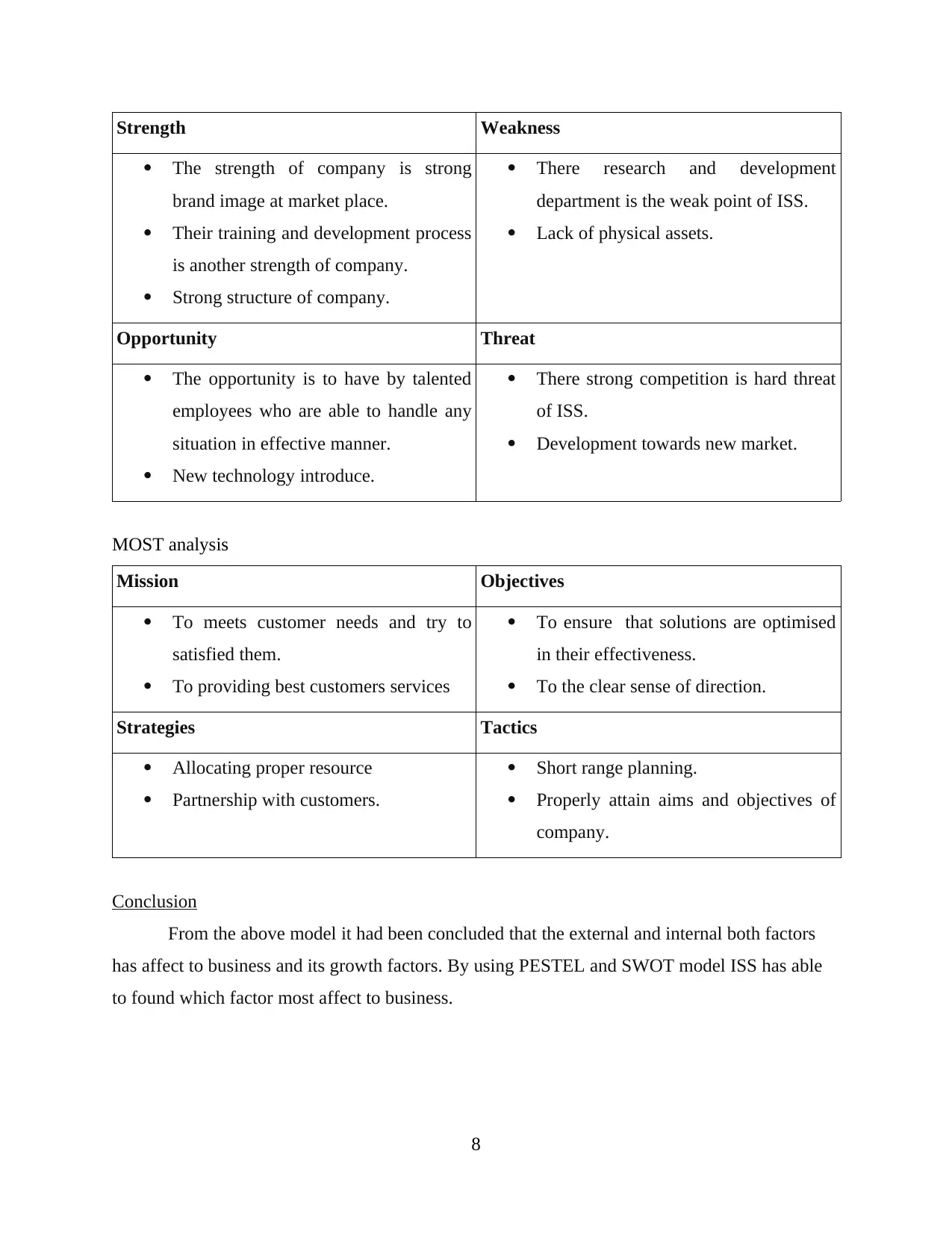
In order to analysis the influence of internal factors in ISS here is uses SWOT analysis
model.
7
In order to analysis the influence of internal factors in ISS here is uses SWOT analysis
model.
7
Paraphrase This Document
Need a fresh take? Get an instant paraphrase of this document with our AI Paraphraser
Strength Weakness
The strength of company is strong
brand image at market place.
Their training and development process
is another strength of company.
Strong structure of company.
There research and development
department is the weak point of ISS.
Lack of physical assets.
Opportunity Threat
The opportunity is to have by talented
employees who are able to handle any
situation in effective manner.
New technology introduce.
There strong competition is hard threat
of ISS.
Development towards new market.
MOST analysis
Mission Objectives
To meets customer needs and try to
satisfied them.
To providing best customers services
To ensure that solutions are optimised
in their effectiveness.
To the clear sense of direction.
Strategies Tactics
Allocating proper resource
Partnership with customers.
Short range planning.
Properly attain aims and objectives of
company.
Conclusion
From the above model it had been concluded that the external and internal both factors
has affect to business and its growth factors. By using PESTEL and SWOT model ISS has able
to found which factor most affect to business.
8
The strength of company is strong
brand image at market place.
Their training and development process
is another strength of company.
Strong structure of company.
There research and development
department is the weak point of ISS.
Lack of physical assets.
Opportunity Threat
The opportunity is to have by talented
employees who are able to handle any
situation in effective manner.
New technology introduce.
There strong competition is hard threat
of ISS.
Development towards new market.
MOST analysis
Mission Objectives
To meets customer needs and try to
satisfied them.
To providing best customers services
To ensure that solutions are optimised
in their effectiveness.
To the clear sense of direction.
Strategies Tactics
Allocating proper resource
Partnership with customers.
Short range planning.
Properly attain aims and objectives of
company.
Conclusion
From the above model it had been concluded that the external and internal both factors
has affect to business and its growth factors. By using PESTEL and SWOT model ISS has able
to found which factor most affect to business.
8
BM 1.4
Introduction
This section is discuss the influence of organisational governance requirements on
management and planning strategies (Kincic and et.al., 2016). This will covers the UK corporate
governance code and its influences on management and planning.
P1 UK corporate governance code
The UK corporate governance code sets the out standards of good practice for listed
companies in London stock exchange rate. This help to sets of principle of good corporate for
ISS with specific aim is to add and register their name in stock exchange.
P2 How it influence management and planning strategies
Corporate governance code and government policy is influence the business and its
growth factors. This design relationship between companies, stakeholders and shareholders for
long term sustainable growth of the UK economy. This can give impact to business and its
growth factors in negative manner.
Business leadership:
ISS world company have their own leadership style to work and perform their task at
market place in effective manner. But, corporate governance code says role of leadership and
directors have to divide proper role and responsibility of company in effective manner. This can
influence personal leadership style of company.
Establishing policies and procedures:
Corporate governance code can affect to ISS policies and procedure of work in complex
manner. This code is developed at national level not on personal level and company decide their
work and objectives as per their own profit which is not refers in code (McDONALD, 2016). So,
by this corporate governance code influences ISS policies and procedures.
Role of board:
The role of board is make and building rules and policies by analysing conditions and
situations within the company. They are highly ensured about the work and its factors by
managing proper works. The relationship between director and stakeholders is very strong and
they had to be made an effective role in the company in an effective manner for manage good
works.
9
Introduction
This section is discuss the influence of organisational governance requirements on
management and planning strategies (Kincic and et.al., 2016). This will covers the UK corporate
governance code and its influences on management and planning.
P1 UK corporate governance code
The UK corporate governance code sets the out standards of good practice for listed
companies in London stock exchange rate. This help to sets of principle of good corporate for
ISS with specific aim is to add and register their name in stock exchange.
P2 How it influence management and planning strategies
Corporate governance code and government policy is influence the business and its
growth factors. This design relationship between companies, stakeholders and shareholders for
long term sustainable growth of the UK economy. This can give impact to business and its
growth factors in negative manner.
Business leadership:
ISS world company have their own leadership style to work and perform their task at
market place in effective manner. But, corporate governance code says role of leadership and
directors have to divide proper role and responsibility of company in effective manner. This can
influence personal leadership style of company.
Establishing policies and procedures:
Corporate governance code can affect to ISS policies and procedure of work in complex
manner. This code is developed at national level not on personal level and company decide their
work and objectives as per their own profit which is not refers in code (McDONALD, 2016). So,
by this corporate governance code influences ISS policies and procedures.
Role of board:
The role of board is make and building rules and policies by analysing conditions and
situations within the company. They are highly ensured about the work and its factors by
managing proper works. The relationship between director and stakeholders is very strong and
they had to be made an effective role in the company in an effective manner for manage good
works.
9
⊘ This is a preview!⊘
Do you want full access?
Subscribe today to unlock all pages.
Trusted by 1+ million students worldwide

1 out of 19


Related Documents


Your All-in-One AI-Powered Toolkit for Academic Success.
+13062052269
info@desklib.com
Available 24*7 on WhatsApp / Email
![[object Object]](/_next/static/media/star-bottom.7253800d.svg)
Unlock your academic potential
Copyright © 2020–2026 A2Z Services. All Rights Reserved. Developed and managed by ZUCOL.