BA Leadership: Motivation Issues at Woolworths Ghana - A Case Study
VerifiedAdded on 2023/04/20
|8
|1733
|461
Report
AI Summary
This report investigates the motivational issues faced by Woolworths, a retail company in Ghana, focusing on the impact of monetary and non-monetary rewards. It addresses the management problem of declining employee motivation and its effects on performance and turnover. The research aims to determine the key motivational issues, assess the role of rewards, and suggest effective strategies for improvement. The study employs various motivational theories, including Maslow's hierarchy of needs and Herzberg's two-factor theory, and utilizes a mixed-methods approach with both qualitative and quantitative data collection through surveys and secondary sources. Data analysis involves thematic and statistical methods, while ethical considerations are addressed to ensure data privacy and prevent plagiarism. The report includes a detailed work plan and timetable, concluding with recommendations for Woolworths to enhance employee motivation. Desklib provides access to similar reports and study tools for students.
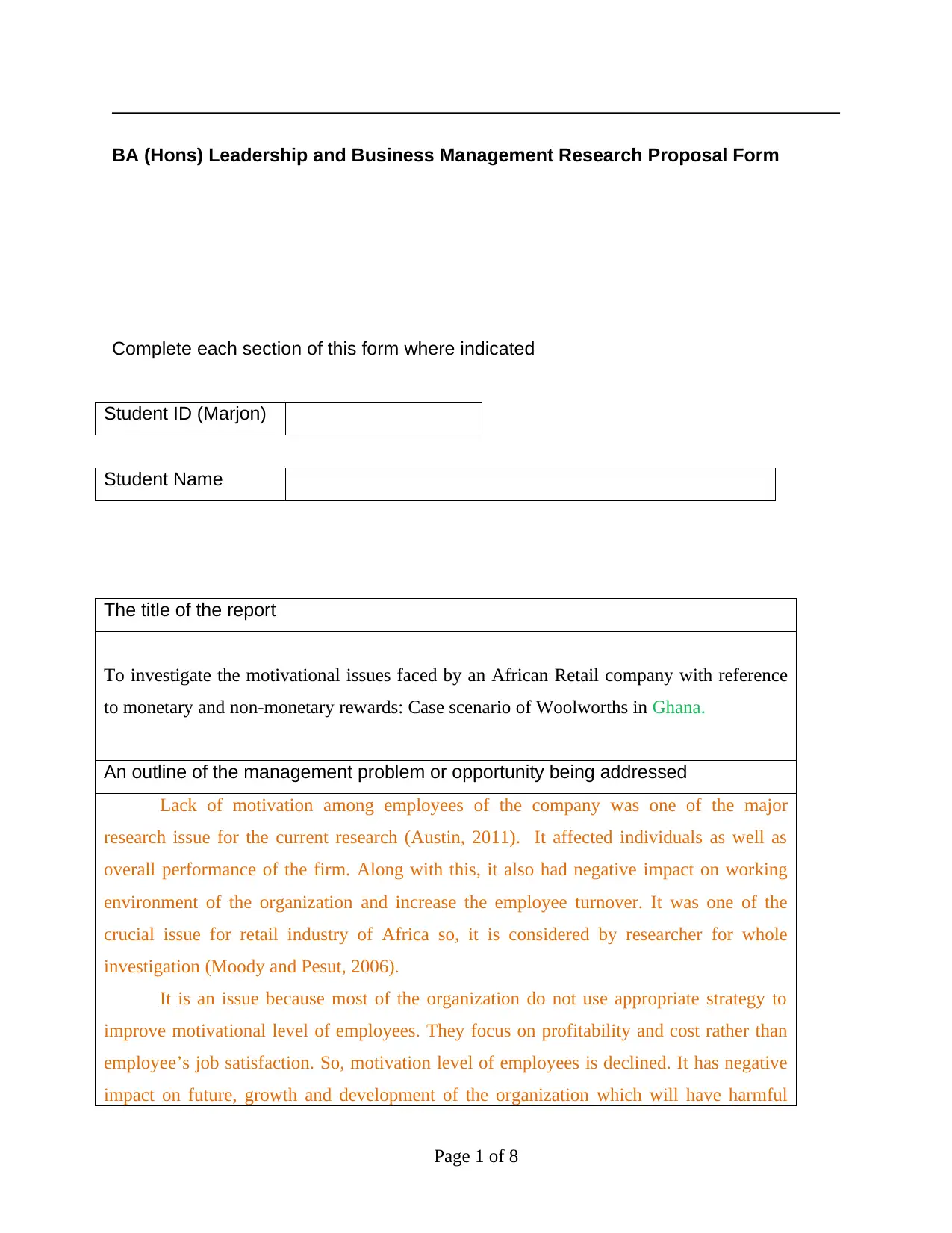
BA (Hons) Leadership and Business Management Research Proposal Form
Complete each section of this form where indicated
Student ID (Marjon)
Student Name
The title of the report
To investigate the motivational issues faced by an African Retail company with reference
to monetary and non-monetary rewards: Case scenario of Woolworths in Ghana.
An outline of the management problem or opportunity being addressed
Lack of motivation among employees of the company was one of the major
research issue for the current research (Austin, 2011). It affected individuals as well as
overall performance of the firm. Along with this, it also had negative impact on working
environment of the organization and increase the employee turnover. It was one of the
crucial issue for retail industry of Africa so, it is considered by researcher for whole
investigation (Moody and Pesut, 2006).
It is an issue because most of the organization do not use appropriate strategy to
improve motivational level of employees. They focus on profitability and cost rather than
employee’s job satisfaction. So, motivation level of employees is declined. It has negative
impact on future, growth and development of the organization which will have harmful
Page 1 of 8
Complete each section of this form where indicated
Student ID (Marjon)
Student Name
The title of the report
To investigate the motivational issues faced by an African Retail company with reference
to monetary and non-monetary rewards: Case scenario of Woolworths in Ghana.
An outline of the management problem or opportunity being addressed
Lack of motivation among employees of the company was one of the major
research issue for the current research (Austin, 2011). It affected individuals as well as
overall performance of the firm. Along with this, it also had negative impact on working
environment of the organization and increase the employee turnover. It was one of the
crucial issue for retail industry of Africa so, it is considered by researcher for whole
investigation (Moody and Pesut, 2006).
It is an issue because most of the organization do not use appropriate strategy to
improve motivational level of employees. They focus on profitability and cost rather than
employee’s job satisfaction. So, motivation level of employees is declined. It has negative
impact on future, growth and development of the organization which will have harmful
Page 1 of 8
Paraphrase This Document
Need a fresh take? Get an instant paraphrase of this document with our AI Paraphraser

influence on whole retail industry (Denzin and Lincoln, 2005).
It is an issue now because Woolworths which was one of the leading organization
of retail industry of Ghana. It applied reward strategy for improving motivational level of
employees (Baah, 2003). Along with this, it has invested huge amount of money in
providing monetary and non-monetary rewards to all staff members. But there were no
clearance about that whether these rewards were effective for resolving motivational issue
or not (Dörnyei, 2001). So, author has decide to conduct study on this subject.
For resolving this issue author will shed light on different reasons behind the lack
of motivational level of employees of Woolworths. Along with this, focus will also be
given on importance of rewards in improving motivation. Afterwards for attaining aim and
objectives of the research author will determine different strategies for overcoming
motivational issues in Woolworths (Daniel and Sam, 2011).
The aims, research questions and objectives of the report
Aim:
“To determine the motivational issues faced by an African Retail company with reference
to monetary and non-monetary rewards: Case scenario of Woolworths, Ghana”.
Research question
1. What are the major issues affecting motivation of employees of Woolworths?
2. What is the major role of monetary and non-monetary rewards in employee
motivation of Woolworths?
3. How could Woolworths resolve motivational issues in an effective manner?
Objectives:
To identify the major motivational issues of Woolworths.
To understand the role of monetary and non-monetary rewards in employee
motivation of Woolworths.
To suggest appropriate strategies to resolve motivational issues from Woolworths.
Management literature and theories underpinning the report
There are number of motivational theories which will help in understanding the issues
associated with the current research and these include motivational theory on needs of
Page 2 of 8
It is an issue now because Woolworths which was one of the leading organization
of retail industry of Ghana. It applied reward strategy for improving motivational level of
employees (Baah, 2003). Along with this, it has invested huge amount of money in
providing monetary and non-monetary rewards to all staff members. But there were no
clearance about that whether these rewards were effective for resolving motivational issue
or not (Dörnyei, 2001). So, author has decide to conduct study on this subject.
For resolving this issue author will shed light on different reasons behind the lack
of motivational level of employees of Woolworths. Along with this, focus will also be
given on importance of rewards in improving motivation. Afterwards for attaining aim and
objectives of the research author will determine different strategies for overcoming
motivational issues in Woolworths (Daniel and Sam, 2011).
The aims, research questions and objectives of the report
Aim:
“To determine the motivational issues faced by an African Retail company with reference
to monetary and non-monetary rewards: Case scenario of Woolworths, Ghana”.
Research question
1. What are the major issues affecting motivation of employees of Woolworths?
2. What is the major role of monetary and non-monetary rewards in employee
motivation of Woolworths?
3. How could Woolworths resolve motivational issues in an effective manner?
Objectives:
To identify the major motivational issues of Woolworths.
To understand the role of monetary and non-monetary rewards in employee
motivation of Woolworths.
To suggest appropriate strategies to resolve motivational issues from Woolworths.
Management literature and theories underpinning the report
There are number of motivational theories which will help in understanding the issues
associated with the current research and these include motivational theory on needs of
Page 2 of 8

hierarchy, two factor theory, Hawthorne Effect, Expectancy Theory and Three-
Dimensional Theory of Attribution. These theories will help in understanding the
importance of employee motivation for organization. Further, researcher will also comprise
historical research papers on major motivational issues for organizations of African retail
industry. Along with this, author will include literature on role of monetary and non-
monetary rewards in employee motivation and different strategies which can be applied by
an organization for increasing motivation level of employees.
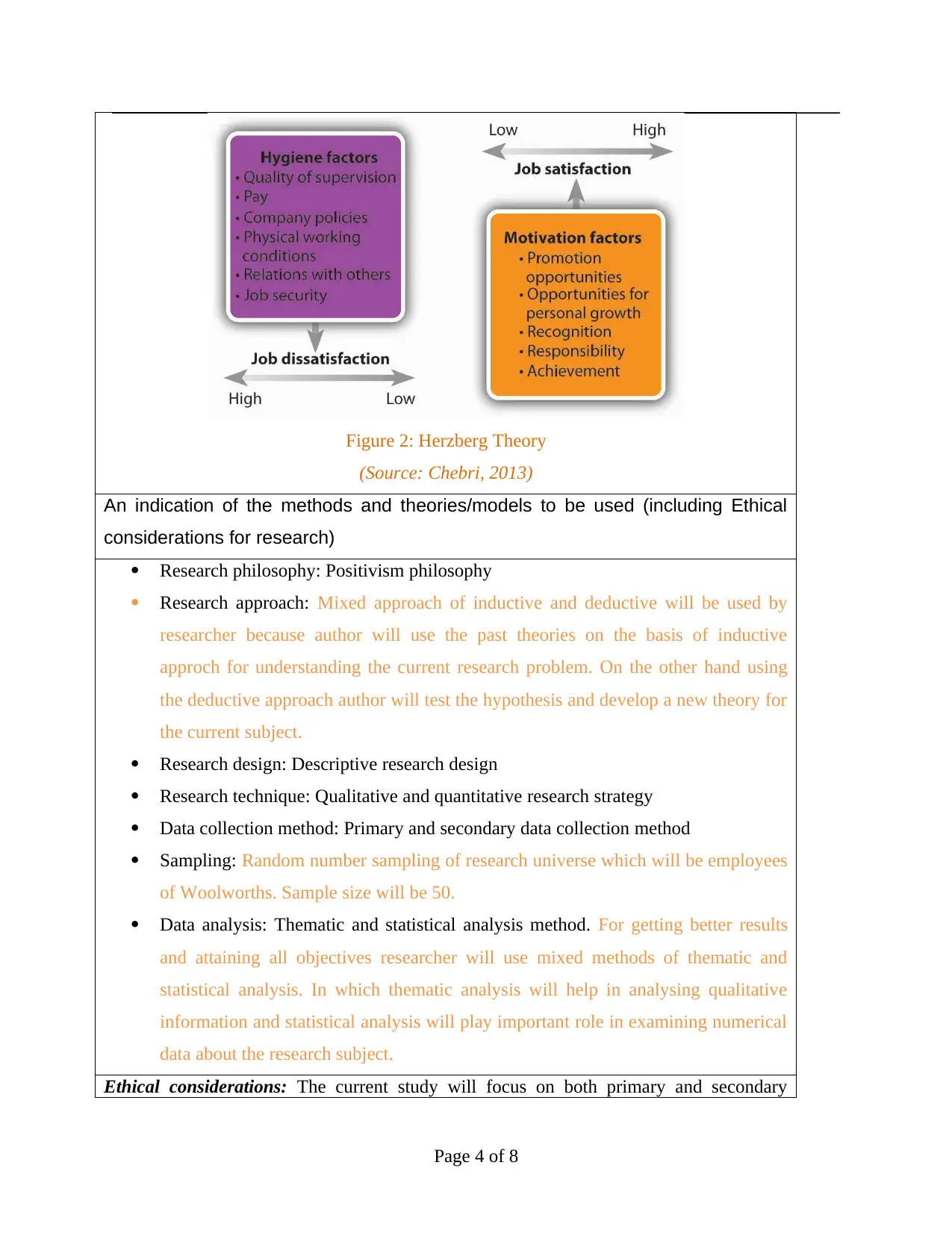
In this context, Maslow theory can be underpinned to gain the idea related to employee
motivation. This theory states that need of employee follows in a series which acts as a
motivation for them. This need includes physiological, security, social, esteem and self-
actualisation.
Figure 1: Maslow Need Hierarchy Theory
(Source: McLeod, 2007)
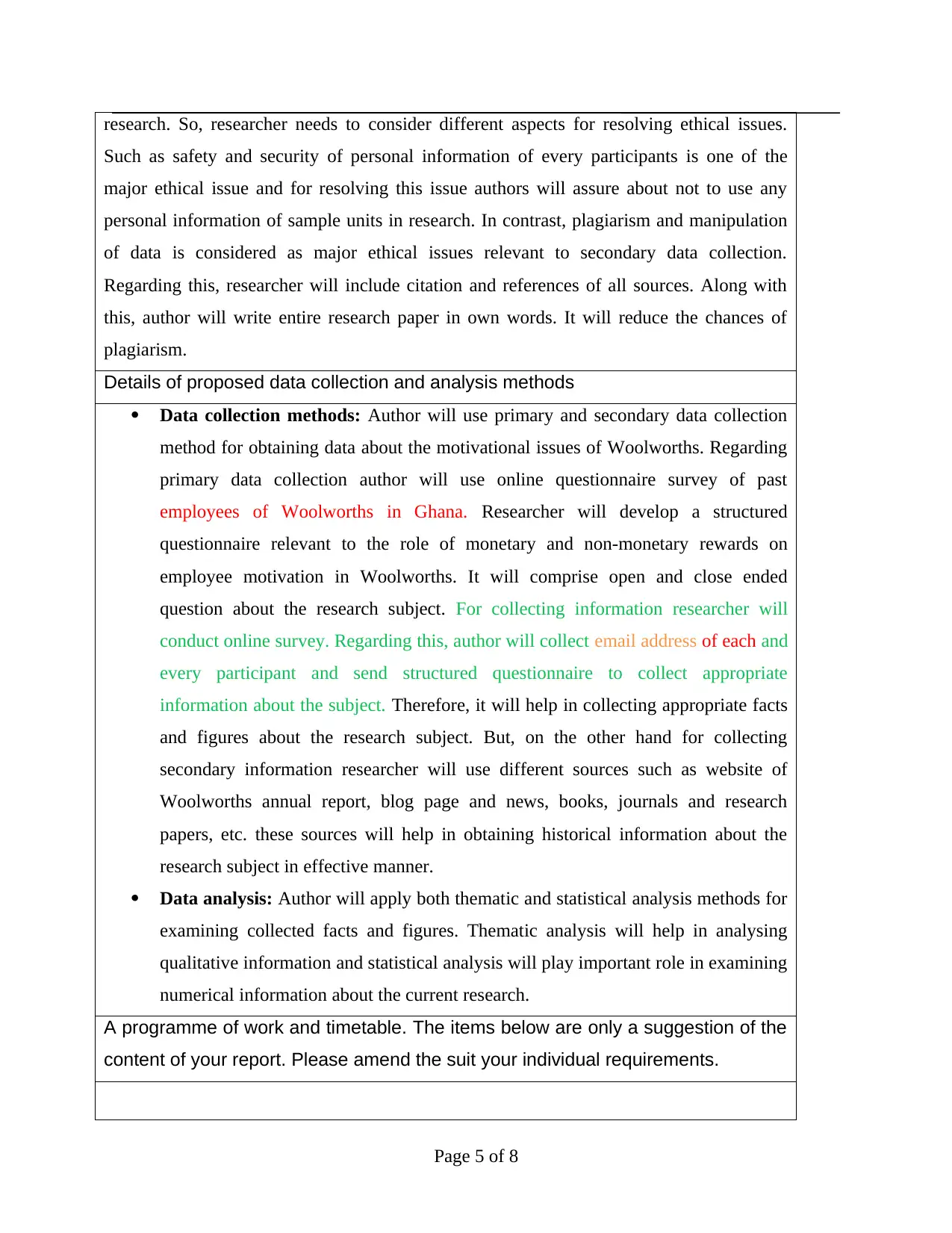
In addition to it, Herzberg defined two factors of motivation i.e. hygiene and motivator
factor. Absence of hygiene factor leads to demotivation whereas presence of motivator
factors boost the motivation among employees.
Page 3 of 8
Dimensional Theory of Attribution. These theories will help in understanding the
importance of employee motivation for organization. Further, researcher will also comprise
historical research papers on major motivational issues for organizations of African retail
industry. Along with this, author will include literature on role of monetary and non-
monetary rewards in employee motivation and different strategies which can be applied by
an organization for increasing motivation level of employees.
In this context, Maslow theory can be underpinned to gain the idea related to employee
motivation. This theory states that need of employee follows in a series which acts as a
motivation for them. This need includes physiological, security, social, esteem and self-
actualisation.
Figure 1: Maslow Need Hierarchy Theory
(Source: McLeod, 2007)
In addition to it, Herzberg defined two factors of motivation i.e. hygiene and motivator
factor. Absence of hygiene factor leads to demotivation whereas presence of motivator
factors boost the motivation among employees.
Page 3 of 8
⊘ This is a preview!⊘
Do you want full access?
Subscribe today to unlock all pages.

Trusted by 1+ million students worldwide

Figure 2: Herzberg Theory
(Source: Chebri, 2013)
An indication of the methods and theories/models to be used (including Ethical
considerations for research)
Research philosophy: Positivism philosophy
Research approach: Mixed approach of inductive and deductive will be used by
researcher because author will use the past theories on the basis of inductive
approch for understanding the current research problem. On the other hand using
the deductive approach author will test the hypothesis and develop a new theory for
the current subject.
Research design: Descriptive research design
Research technique: Qualitative and quantitative research strategy
Data collection method: Primary and secondary data collection method
Sampling: Random number sampling of research universe which will be employees
of Woolworths. Sample size will be 50.
Data analysis: Thematic and statistical analysis method. For getting better results
and attaining all objectives researcher will use mixed methods of thematic and
statistical analysis. In which thematic analysis will help in analysing qualitative
information and statistical analysis will play important role in examining numerical
data about the research subject.
Ethical considerations: The current study will focus on both primary and secondary
Page 4 of 8
(Source: Chebri, 2013)
An indication of the methods and theories/models to be used (including Ethical
considerations for research)
Research philosophy: Positivism philosophy
Research approach: Mixed approach of inductive and deductive will be used by
researcher because author will use the past theories on the basis of inductive
approch for understanding the current research problem. On the other hand using
the deductive approach author will test the hypothesis and develop a new theory for
the current subject.
Research design: Descriptive research design
Research technique: Qualitative and quantitative research strategy
Data collection method: Primary and secondary data collection method
Sampling: Random number sampling of research universe which will be employees
of Woolworths. Sample size will be 50.
Data analysis: Thematic and statistical analysis method. For getting better results
and attaining all objectives researcher will use mixed methods of thematic and
statistical analysis. In which thematic analysis will help in analysing qualitative
information and statistical analysis will play important role in examining numerical
data about the research subject.
Ethical considerations: The current study will focus on both primary and secondary
Page 4 of 8
Paraphrase This Document
Need a fresh take? Get an instant paraphrase of this document with our AI Paraphraser

research. So, researcher needs to consider different aspects for resolving ethical issues.
Such as safety and security of personal information of every participants is one of the
major ethical issue and for resolving this issue authors will assure about not to use any
personal information of sample units in research. In contrast, plagiarism and manipulation
of data is considered as major ethical issues relevant to secondary data collection.
Regarding this, researcher will include citation and references of all sources. Along with
this, author will write entire research paper in own words. It will reduce the chances of
plagiarism.
Details of proposed data collection and analysis methods
Data collection methods: Author will use primary and secondary data collection
method for obtaining data about the motivational issues of Woolworths. Regarding
primary data collection author will use online questionnaire survey of past
employees of Woolworths in Ghana. Researcher will develop a structured
questionnaire relevant to the role of monetary and non-monetary rewards on
employee motivation in Woolworths. It will comprise open and close ended
question about the research subject. For collecting information researcher will
conduct online survey. Regarding this, author will collect email address of each and
every participant and send structured questionnaire to collect appropriate
information about the subject. Therefore, it will help in collecting appropriate facts
and figures about the research subject. But, on the other hand for collecting
secondary information researcher will use different sources such as website of
Woolworths annual report, blog page and news, books, journals and research
papers, etc. these sources will help in obtaining historical information about the
research subject in effective manner.
Data analysis: Author will apply both thematic and statistical analysis methods for
examining collected facts and figures. Thematic analysis will help in analysing
qualitative information and statistical analysis will play important role in examining
numerical information about the current research.
A programme of work and timetable. The items below are only a suggestion of the
content of your report. Please amend the suit your individual requirements.
Page 5 of 8
Such as safety and security of personal information of every participants is one of the
major ethical issue and for resolving this issue authors will assure about not to use any
personal information of sample units in research. In contrast, plagiarism and manipulation
of data is considered as major ethical issues relevant to secondary data collection.
Regarding this, researcher will include citation and references of all sources. Along with
this, author will write entire research paper in own words. It will reduce the chances of
plagiarism.
Details of proposed data collection and analysis methods
Data collection methods: Author will use primary and secondary data collection
method for obtaining data about the motivational issues of Woolworths. Regarding
primary data collection author will use online questionnaire survey of past
employees of Woolworths in Ghana. Researcher will develop a structured
questionnaire relevant to the role of monetary and non-monetary rewards on
employee motivation in Woolworths. It will comprise open and close ended
question about the research subject. For collecting information researcher will
conduct online survey. Regarding this, author will collect email address of each and
every participant and send structured questionnaire to collect appropriate
information about the subject. Therefore, it will help in collecting appropriate facts
and figures about the research subject. But, on the other hand for collecting
secondary information researcher will use different sources such as website of
Woolworths annual report, blog page and news, books, journals and research
papers, etc. these sources will help in obtaining historical information about the
research subject in effective manner.
Data analysis: Author will apply both thematic and statistical analysis methods for
examining collected facts and figures. Thematic analysis will help in analysing
qualitative information and statistical analysis will play important role in examining
numerical information about the current research.
A programme of work and timetable. The items below are only a suggestion of the
content of your report. Please amend the suit your individual requirements.
Page 5 of 8

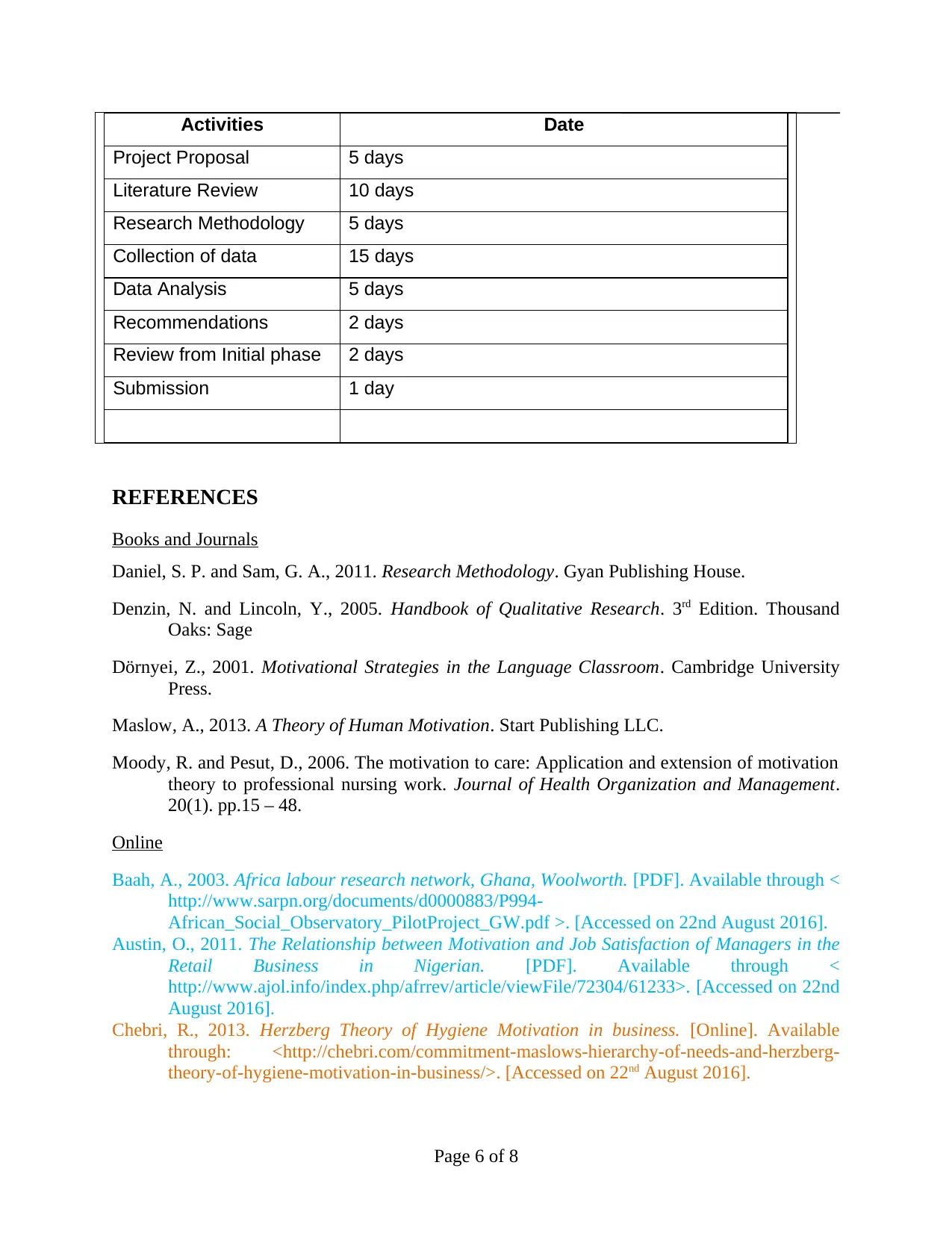
Activities Date
Project Proposal 5 days
Literature Review 10 days
Research Methodology 5 days
Collection of data 15 days
Data Analysis 5 days
Recommendations 2 days
Review from Initial phase 2 days
Submission 1 day
REFERENCES
Books and Journals
Daniel, S. P. and Sam, G. A., 2011. Research Methodology. Gyan Publishing House.
Denzin, N. and Lincoln, Y., 2005. Handbook of Qualitative Research. 3rd Edition. Thousand
Oaks: Sage
Dörnyei, Z., 2001. Motivational Strategies in the Language Classroom. Cambridge University
Press.
Maslow, A., 2013. A Theory of Human Motivation. Start Publishing LLC.
Moody, R. and Pesut, D., 2006. The motivation to care: Application and extension of motivation
theory to professional nursing work. Journal of Health Organization and Management.
20(1). pp.15 – 48.
Online
Baah, A., 2003. Africa labour research network, Ghana, Woolworth. [PDF]. Available through <
http://www.sarpn.org/documents/d0000883/P994-
African_Social_Observatory_PilotProject_GW.pdf >. [Accessed on 22nd August 2016].
Austin, O., 2011. The Relationship between Motivation and Job Satisfaction of Managers in the
Retail Business in Nigerian. [PDF]. Available through <
http://www.ajol.info/index.php/afrrev/article/viewFile/72304/61233>. [Accessed on 22nd
August 2016].
Chebri, R., 2013. Herzberg Theory of Hygiene Motivation in business. [Online]. Available
through: <http://chebri.com/commitment-maslows-hierarchy-of-needs-and-herzberg-
theory-of-hygiene-motivation-in-business/>. [Accessed on 22nd August 2016].
Page 6 of 8
Project Proposal 5 days
Literature Review 10 days
Research Methodology 5 days
Collection of data 15 days
Data Analysis 5 days
Recommendations 2 days
Review from Initial phase 2 days
Submission 1 day
REFERENCES
Books and Journals
Daniel, S. P. and Sam, G. A., 2011. Research Methodology. Gyan Publishing House.
Denzin, N. and Lincoln, Y., 2005. Handbook of Qualitative Research. 3rd Edition. Thousand
Oaks: Sage
Dörnyei, Z., 2001. Motivational Strategies in the Language Classroom. Cambridge University
Press.
Maslow, A., 2013. A Theory of Human Motivation. Start Publishing LLC.
Moody, R. and Pesut, D., 2006. The motivation to care: Application and extension of motivation
theory to professional nursing work. Journal of Health Organization and Management.
20(1). pp.15 – 48.
Online
Baah, A., 2003. Africa labour research network, Ghana, Woolworth. [PDF]. Available through <
http://www.sarpn.org/documents/d0000883/P994-
African_Social_Observatory_PilotProject_GW.pdf >. [Accessed on 22nd August 2016].
Austin, O., 2011. The Relationship between Motivation and Job Satisfaction of Managers in the
Retail Business in Nigerian. [PDF]. Available through <
http://www.ajol.info/index.php/afrrev/article/viewFile/72304/61233>. [Accessed on 22nd
August 2016].
Chebri, R., 2013. Herzberg Theory of Hygiene Motivation in business. [Online]. Available
through: <http://chebri.com/commitment-maslows-hierarchy-of-needs-and-herzberg-
theory-of-hygiene-motivation-in-business/>. [Accessed on 22nd August 2016].
Page 6 of 8
⊘ This is a preview!⊘
Do you want full access?
Subscribe today to unlock all pages.

Trusted by 1+ million students worldwide

McLeod, S., 2007. Maslow's Hierarchy of Needs. [Online]. Available through:
<http://www.simplypsychology.org/maslow.html>. [Accessed on 22nd August 2016].
Students – do not write below this line
---------------------------------------------------------------------------------------------------------------------
ABI Admin only
Proposal considered by:
Signature: Date:
Proposal accepted: Yes No
Supervisor Name:
Page 7 of 8
<http://www.simplypsychology.org/maslow.html>. [Accessed on 22nd August 2016].
Students – do not write below this line
---------------------------------------------------------------------------------------------------------------------
ABI Admin only
Proposal considered by:
Signature: Date:
Proposal accepted: Yes No
Supervisor Name:
Page 7 of 8
Paraphrase This Document
Need a fresh take? Get an instant paraphrase of this document with our AI Paraphraser

Page 8 of 8
1 out of 8
Related Documents
Your All-in-One AI-Powered Toolkit for Academic Success.
+13062052269
info@desklib.com
Available 24*7 on WhatsApp / Email
Unlock your academic potential
Copyright © 2020–2025 A2Z Services. All Rights Reserved. Developed and managed by ZUCOL.


![[Course Name] Coursework: Employee Motivation and HR Technology](/_next/image/?url=https%3A%2F%2Fdesklib.com%2Fmedia%2Fimages%2Fma%2F2ba519af49b147e5b2dd5f7233c67895.jpg&w=256&q=75)