BUS356 Business Negotiation Report: Strategies, Ethics, and Conflicts
VerifiedAdded on 2022/08/18
|12
|3047
|12
Report
AI Summary
This report, prepared for the BUS356 Business Negotiation course, analyzes various aspects of negotiation, starting with the importance of trust and its role in cross-cultural scenarios, particularly referencing negotiations between Intel and stakeholders in China and the US. It delves into ethical reasoning, contrasting American and Chinese perspectives, and examines the impact of these differences on negotiation tactics, especially concerning intellectual property rights. The report further explores the crucial role of communication in multi-party negotiations, highlighting its contribution to resolving conflicts and building relationships, alongside the use of non-verbal communication and active listening. It also discusses hardball tactics used in distributive bargaining and how cultural differences, using Hofstede's model, affect international negotiations. Finally, the report concludes by outlining ten best practices for negotiation strategy, providing examples for practical application, and offering insights for effective negotiation in various business contexts.

Management 1
BUS356
BUS356

Paraphrase This Document
Need a fresh take? Get an instant paraphrase of this document with our AI Paraphraser
Management 2
Q1. A. Importance of trust in negotiations and analysis of cross-cultural negotiations
Trust is essential in the process of negotiation. Building trust is essential for maintaining a
long-term relationship and the trust is responsible to solve several conflicts among the
organization. Trust in negotiations develop naturally over time but negotiators cannot come up
with the overall process (Lewicki and Polin, 2013). The concept of trust creating risk in
negotiation is important to reduce these risks properly. For avoiding the risk, the managing of
trust is a critical skill for managers.
The main step to inspiring trust in negotiation is to determine the trustworthiness. The
negotiation has occurred among China and America related to the Intel company. As the trust
plays an effective role in managing this process of negotiation. The deal in the negotiation needs
proper trust then only one can succeed in managing the negotiation (Liu, et al., 2012). The
important thing in the process of negotiation is that any negotiator does not enter in the process
with someone you don’t trust. This shows the lack of trust among negotiators.
The cross-cultural negotiation is affected by American negotiators and Chinese
negotiators. This affects the trust level among the Intel organization that works in the U.S. as
well as China also. The cross-cultural negotiation also affects cross-cultural communication
among the proper areas. The organization Intel involved in the cross-cultural negotiation to
preserve the relationships with the Chinese stakeholders (Levitt, et al., 2015). This negotiation
maintains the overall communication among the organization and improves the growth of the
business. The negotiators of both counties need a proper understanding of negotiation.
B. Difference between American and Chinese as per the ethical reasoning
There is a difference between the views of American and Chinese views on ethical
reasoning. Ethical reasoning includes the rights and wrong of human conduct. Each person has
standards as per their values which affect several decisions. The Chinese and Americans views
related to ethics are different aspects. The ethical thought of Chinese is different from a
worthwhile life and the process of weighing duties towards family versus toward strangers. The
ethical traits in America are focused on honesty and trustworthiness. The moral decision of
American relates to superiority and moral tribalism (Hollingworth and Valentine, 2015).
Q1. A. Importance of trust in negotiations and analysis of cross-cultural negotiations
Trust is essential in the process of negotiation. Building trust is essential for maintaining a
long-term relationship and the trust is responsible to solve several conflicts among the
organization. Trust in negotiations develop naturally over time but negotiators cannot come up
with the overall process (Lewicki and Polin, 2013). The concept of trust creating risk in
negotiation is important to reduce these risks properly. For avoiding the risk, the managing of
trust is a critical skill for managers.
The main step to inspiring trust in negotiation is to determine the trustworthiness. The
negotiation has occurred among China and America related to the Intel company. As the trust
plays an effective role in managing this process of negotiation. The deal in the negotiation needs
proper trust then only one can succeed in managing the negotiation (Liu, et al., 2012). The
important thing in the process of negotiation is that any negotiator does not enter in the process
with someone you don’t trust. This shows the lack of trust among negotiators.
The cross-cultural negotiation is affected by American negotiators and Chinese
negotiators. This affects the trust level among the Intel organization that works in the U.S. as
well as China also. The cross-cultural negotiation also affects cross-cultural communication
among the proper areas. The organization Intel involved in the cross-cultural negotiation to
preserve the relationships with the Chinese stakeholders (Levitt, et al., 2015). This negotiation
maintains the overall communication among the organization and improves the growth of the
business. The negotiators of both counties need a proper understanding of negotiation.
B. Difference between American and Chinese as per the ethical reasoning
There is a difference between the views of American and Chinese views on ethical
reasoning. Ethical reasoning includes the rights and wrong of human conduct. Each person has
standards as per their values which affect several decisions. The Chinese and Americans views
related to ethics are different aspects. The ethical thought of Chinese is different from a
worthwhile life and the process of weighing duties towards family versus toward strangers. The
ethical traits in America are focused on honesty and trustworthiness. The moral decision of
American relates to superiority and moral tribalism (Hollingworth and Valentine, 2015).
Management 3
The American and Chinese adopt ethical negotiating tactics in the overall process of
negotiation. There are different concerns of America and China in the business of Intel
organization. The main concern of China includes the protection of the intellectual rights of
property of Intel. The intellectual property in Intel is treated as a communal right in China. The
intel's first litigation suit in China occurred by sharing the concept with the Dalian State
government official negotiation team. The understanding of the approach related to each party
related to ethical reasoning as the negotiation is done by the Chinese negotiators and the Dalian
state government officials negotiation team. The social contract ethics is included in this process
which involved Intel's negotiation in china. Intel used a small company in China for the process
of infringement (Okoro, 2012). The negotiators in China, as well as the negotiation team of
Dalian, faces several challenges in this overall process of multiple licenses of Intel. The
intellectual property right information is involved in this overall process. But as per the issue
related to the protection, the intellectual property right gets affected by the defined process of
Intel negotiation.
The American and Chinese adopt ethical negotiating tactics in the overall process of
negotiation. There are different concerns of America and China in the business of Intel
organization. The main concern of China includes the protection of the intellectual rights of
property of Intel. The intellectual property in Intel is treated as a communal right in China. The
intel's first litigation suit in China occurred by sharing the concept with the Dalian State
government official negotiation team. The understanding of the approach related to each party
related to ethical reasoning as the negotiation is done by the Chinese negotiators and the Dalian
state government officials negotiation team. The social contract ethics is included in this process
which involved Intel's negotiation in china. Intel used a small company in China for the process
of infringement (Okoro, 2012). The negotiators in China, as well as the negotiation team of
Dalian, faces several challenges in this overall process of multiple licenses of Intel. The
intellectual property right information is involved in this overall process. But as per the issue
related to the protection, the intellectual property right gets affected by the defined process of
Intel negotiation.
⊘ This is a preview!⊘
Do you want full access?
Subscribe today to unlock all pages.

Trusted by 1+ million students worldwide
Management 4
Q2. A. Importance of communication process in multi-partite negotiations
The communication is too effective and important in the process of negotiations. This helps
to make the proper goal and helps to understand the position. The communication is too
important for the multi-party negotiations as it creates the value-creating process among
negotiation. The multi-party negotiation includes the resolving of an issue among two or more
parties. So, their communication create friendly relations and helps in resolving the issues.
In the American and Chinese negotiations, several rounds of communication need to be
developed for managing the negotiation. By the process of the communication, overall
negotiation can be reduced and improve the relationships and trust among the American and
Chinese negotiators. The communication plays an effective role in the overall process and helps
in resolving the is occurred among the American negotiators and Chinese negotiators. The
cooperative behaviour during negotiations gets improved by the overall communication (Robbins
and Judge, 2012). The concern amongst others addressed by the communications. The Intel
company also gets developed in China by communication among negotiators.
The two reasons for managing the communication in the multi-partite negotiations are
discussed below-
The communication makes the proper process of resolving an issue by improving the
listening process.
The trust has been developed among negotiators to improve the overall process of the
negotiation.
B. Conflicts of the case and the management of conflicts
The several conflicts occur in the case during the negotiation arise among Chinese
negotiators and American negotiators. The opening of the Intel company creates several conflicts
among China and America. The heated tussles arise the intra-group conflict among China
offices. Conflicts arise when the negotiations become complex and the stakes are high in the
company. Conflicts management is one of the important parts that need to manage conflicts and
resolving conflicts. The conflict management is the employment of strategies to correct the
Q2. A. Importance of communication process in multi-partite negotiations
The communication is too effective and important in the process of negotiations. This helps
to make the proper goal and helps to understand the position. The communication is too
important for the multi-party negotiations as it creates the value-creating process among
negotiation. The multi-party negotiation includes the resolving of an issue among two or more
parties. So, their communication create friendly relations and helps in resolving the issues.
In the American and Chinese negotiations, several rounds of communication need to be
developed for managing the negotiation. By the process of the communication, overall
negotiation can be reduced and improve the relationships and trust among the American and
Chinese negotiators. The communication plays an effective role in the overall process and helps
in resolving the is occurred among the American negotiators and Chinese negotiators. The
cooperative behaviour during negotiations gets improved by the overall communication (Robbins
and Judge, 2012). The concern amongst others addressed by the communications. The Intel
company also gets developed in China by communication among negotiators.
The two reasons for managing the communication in the multi-partite negotiations are
discussed below-
The communication makes the proper process of resolving an issue by improving the
listening process.
The trust has been developed among negotiators to improve the overall process of the
negotiation.
B. Conflicts of the case and the management of conflicts
The several conflicts occur in the case during the negotiation arise among Chinese
negotiators and American negotiators. The opening of the Intel company creates several conflicts
among China and America. The heated tussles arise the intra-group conflict among China
offices. Conflicts arise when the negotiations become complex and the stakes are high in the
company. Conflicts management is one of the important parts that need to manage conflicts and
resolving conflicts. The conflict management is the employment of strategies to correct the
Paraphrase This Document
Need a fresh take? Get an instant paraphrase of this document with our AI Paraphraser
Management 5
differences (Field, et al., 2014). The conflict of this case is related to the Intel company that
opens in China itself and the Chinese negotiators and American negotiators affect the activities
and functions of the company.
There are several strategies used for conflict resolution. The main three strategies are discussed
below-
The value-creating strategies need not to be abandoned. These strategies create a proper
process in managing the conflicts.
Use the time for achieving the advantage. This is one of the process used in resolutions of
conflicts.
The emotional response needs to be avoided, as emotional response affects the overall
process in a large manner. The negotiation takes place under the surface.
C. Characteristics of language and use of non-verbal communications.
Language has different characteristics that manage the communication process in the overall
process of negotiation. The different characteristics of language include:
Language is social: Language possesses social group, the combination of an
indispensable set of rules which helps to interact with the humans. The set of signals used
for communication among humans by the language.
Language is systematic: The system of arrangements is included in the language so the
language is called systematic.
Language is symbolic: Language includes a combination of symbols and used to denote
the objects
Use of non-verbal communication and active listening
The non-verbal communication is more effective as it helps the people to reinforce and
modify the words. The non-verbal communication includes the facial expression, tone of voice
and body language. This also improves the negotiation and manage interactions among the
people by the proper process (Robbins, et al., 2014). The negotiator's relationship becomes
differences (Field, et al., 2014). The conflict of this case is related to the Intel company that
opens in China itself and the Chinese negotiators and American negotiators affect the activities
and functions of the company.
There are several strategies used for conflict resolution. The main three strategies are discussed
below-
The value-creating strategies need not to be abandoned. These strategies create a proper
process in managing the conflicts.
Use the time for achieving the advantage. This is one of the process used in resolutions of
conflicts.
The emotional response needs to be avoided, as emotional response affects the overall
process in a large manner. The negotiation takes place under the surface.
C. Characteristics of language and use of non-verbal communications.
Language has different characteristics that manage the communication process in the overall
process of negotiation. The different characteristics of language include:
Language is social: Language possesses social group, the combination of an
indispensable set of rules which helps to interact with the humans. The set of signals used
for communication among humans by the language.
Language is systematic: The system of arrangements is included in the language so the
language is called systematic.
Language is symbolic: Language includes a combination of symbols and used to denote
the objects
Use of non-verbal communication and active listening
The non-verbal communication is more effective as it helps the people to reinforce and
modify the words. The non-verbal communication includes the facial expression, tone of voice
and body language. This also improves the negotiation and manage interactions among the
people by the proper process (Robbins, et al., 2014). The negotiator's relationship becomes
Management 6
proper by using non-verbal communication. The Intel China management team and Chinese state
government officials need non-verbal communication to becomes a proper process.
Active listening is used to manage the counselling, training and solving disputes in the
process. The Intel China and America affect the overall process and active listening creates the
proper management and manages the overall conflicts occurred due to negotiation. The
negotiation creates conflicts and this can be managed proper active listening.
.
proper by using non-verbal communication. The Intel China management team and Chinese state
government officials need non-verbal communication to becomes a proper process.
Active listening is used to manage the counselling, training and solving disputes in the
process. The Intel China and America affect the overall process and active listening creates the
proper management and manages the overall conflicts occurred due to negotiation. The
negotiation creates conflicts and this can be managed proper active listening.
.
⊘ This is a preview!⊘
Do you want full access?
Subscribe today to unlock all pages.
Trusted by 1+ million students worldwide
Management 7
Q3.A. Hardball tactics in the distributive bargaining process
The hardball tactics are important in the distributive bargaining process. The hardball tactics
need to show your style in every business deal. Hardball negotiations are thought of as
distributive negotiations. The negotiation occurred between buyer and seller and this is used to
hardball tactics. The hardball tactics are used as the key to success. The hardball tactics are used
to get rid of the negotiation and these tactics are used as a treatment for the differences occurred
between buyer and seller due to negotiation (Gallois and Giles, 2015). There are several hardball
tactics used in the distributive bargaining process. The two main hardball tactics are described
below-
Extreme demands that followed up by small, slow concessions
This tactic is most common hardball tactics that help to protect the dealmakers form
making concessions quickly. This tactic helps the parties in managing the type of
negotiation. The buyer can achieve all the goals and objectives b using this tactic in the
process of bargaining. They don’t be rattled by an aggressive opponent.
Commitment tactics
This is also another important tactic that manages the conflicts occurred in the buyer ad
seller due to the process of bargaining. In this opponent says that he has some restrictions
to negotiate with you and he can only manage limited discretion. These commitment
tactics are real and genuine. By using these tactics, one can deal with the person who
required to do business with you. For example, these tactics manage the negotiations
occurred between buyer and seller in any type of business.
B. Cultural differences from different nationalities of the property seller
The cultural difference occurred in the international trade as the culture of both the business
are different and they cannot understand each other perspectives. This can mainly affect the
property seller and potential buyer. This is all occurred due to the property negotiation. The
buyer and seller are much more affected due to the cultural differences occurred among business
trade. The cultural differences highly impacted the negotiations like the negotiation occurred
Q3.A. Hardball tactics in the distributive bargaining process
The hardball tactics are important in the distributive bargaining process. The hardball tactics
need to show your style in every business deal. Hardball negotiations are thought of as
distributive negotiations. The negotiation occurred between buyer and seller and this is used to
hardball tactics. The hardball tactics are used as the key to success. The hardball tactics are used
to get rid of the negotiation and these tactics are used as a treatment for the differences occurred
between buyer and seller due to negotiation (Gallois and Giles, 2015). There are several hardball
tactics used in the distributive bargaining process. The two main hardball tactics are described
below-
Extreme demands that followed up by small, slow concessions
This tactic is most common hardball tactics that help to protect the dealmakers form
making concessions quickly. This tactic helps the parties in managing the type of
negotiation. The buyer can achieve all the goals and objectives b using this tactic in the
process of bargaining. They don’t be rattled by an aggressive opponent.
Commitment tactics
This is also another important tactic that manages the conflicts occurred in the buyer ad
seller due to the process of bargaining. In this opponent says that he has some restrictions
to negotiate with you and he can only manage limited discretion. These commitment
tactics are real and genuine. By using these tactics, one can deal with the person who
required to do business with you. For example, these tactics manage the negotiations
occurred between buyer and seller in any type of business.
B. Cultural differences from different nationalities of the property seller
The cultural difference occurred in the international trade as the culture of both the business
are different and they cannot understand each other perspectives. This can mainly affect the
property seller and potential buyer. This is all occurred due to the property negotiation. The
buyer and seller are much more affected due to the cultural differences occurred among business
trade. The cultural differences highly impacted the negotiations like the negotiation occurred
Paraphrase This Document
Need a fresh take? Get an instant paraphrase of this document with our AI Paraphraser
Management 8
among China and America (Wertheim, 2016). The international business affects the buyer and
seller negotiations as per the cultural differences. In the Hofstede model of culture, the several
dimensions need to consider in the international negotiations.
Power distance
Some of the countries have different levels of power and these powers are only analyzed
internally and not be analyzed by outsiders. For example, in Russia, power tends to be
concentrated on top.
Individualism/collectivism
The people in a culture think ourselves as an individual or a collected group. For
example, in the United States people achieves a high score in individualism and people in
China achieves high score in collectivism (Mazei, et al., 2015).
Masculinity/Femininity
Society endorses the elements that affect the characteristics of Masculine and Feminine.
For example, aggressiveness and competition are considered as male characteristics while
the focus in relationships and cooperation considered as female characteristics.
Uncertainty Avoidance
This described that someone os comfortable with uncertainty situations. Some cultures
are different from ambiguity. As it also impacts the negotiation due to the cultural
differences.
among China and America (Wertheim, 2016). The international business affects the buyer and
seller negotiations as per the cultural differences. In the Hofstede model of culture, the several
dimensions need to consider in the international negotiations.
Power distance
Some of the countries have different levels of power and these powers are only analyzed
internally and not be analyzed by outsiders. For example, in Russia, power tends to be
concentrated on top.
Individualism/collectivism
The people in a culture think ourselves as an individual or a collected group. For
example, in the United States people achieves a high score in individualism and people in
China achieves high score in collectivism (Mazei, et al., 2015).
Masculinity/Femininity
Society endorses the elements that affect the characteristics of Masculine and Feminine.
For example, aggressiveness and competition are considered as male characteristics while
the focus in relationships and cooperation considered as female characteristics.
Uncertainty Avoidance
This described that someone os comfortable with uncertainty situations. Some cultures
are different from ambiguity. As it also impacts the negotiation due to the cultural
differences.
Management 9
Q4. Ten best practices of negotiation strategy and example of these practices
I need to attend an interview for the job of the IT manager. So, I need to understand the
negotiation strategies that help me in conducting a successful negotiation with the employer. As
an It project director, I need to analyse the best strategies of negotiation (Elfenbein, 2015). For
managing proper negotiation, the strategies need to understand which are discussed below-
Firstly, it is important to listen and understand the point of view of other parties
I need to understand the listening process and understand the point of view of other
parties. For negotiating the employer, the listening is important. So, I need to understand
the point of view of the employer. It is essential to listen to me. The point of view of
parties needs to understand the proper employment.
Be Prepared
It is important to prepare before using the negotiation in employment. The preparation of
negotiation is more important as it affects the overall process of the negotiation. I need to
prepare before understanding the strategy of negotiation in the overall process. Review
the small deals that need to be completed by the other side and it affects the agreements
(Brett, 2017). The proper understanding of offerings and pricing from the party
competitors.
Understand the deal dynamics
Deal dynamics is important for negotiations and it is more crucial in negotiation. The
deal dynamics need to understand the overall process of the timing constraints. The
leverage negotiation is affected by the deal dynamics.
Always draft the version of the agreement
The version of the agreement is also included in the negotiation. I need to manage the
agreement for the proper analysis of the draft (Ozmec, et al., 2015). This is one of the
most important negotiation strategies used to manage relations with the employer.
Q4. Ten best practices of negotiation strategy and example of these practices
I need to attend an interview for the job of the IT manager. So, I need to understand the
negotiation strategies that help me in conducting a successful negotiation with the employer. As
an It project director, I need to analyse the best strategies of negotiation (Elfenbein, 2015). For
managing proper negotiation, the strategies need to understand which are discussed below-
Firstly, it is important to listen and understand the point of view of other parties
I need to understand the listening process and understand the point of view of other
parties. For negotiating the employer, the listening is important. So, I need to understand
the point of view of the employer. It is essential to listen to me. The point of view of
parties needs to understand the proper employment.
Be Prepared
It is important to prepare before using the negotiation in employment. The preparation of
negotiation is more important as it affects the overall process of the negotiation. I need to
prepare before understanding the strategy of negotiation in the overall process. Review
the small deals that need to be completed by the other side and it affects the agreements
(Brett, 2017). The proper understanding of offerings and pricing from the party
competitors.
Understand the deal dynamics
Deal dynamics is important for negotiations and it is more crucial in negotiation. The
deal dynamics need to understand the overall process of the timing constraints. The
leverage negotiation is affected by the deal dynamics.
Always draft the version of the agreement
The version of the agreement is also included in the negotiation. I need to manage the
agreement for the proper analysis of the draft (Ozmec, et al., 2015). This is one of the
most important negotiation strategies used to manage relations with the employer.
⊘ This is a preview!⊘
Do you want full access?
Subscribe today to unlock all pages.
Trusted by 1+ million students worldwide
Management 10
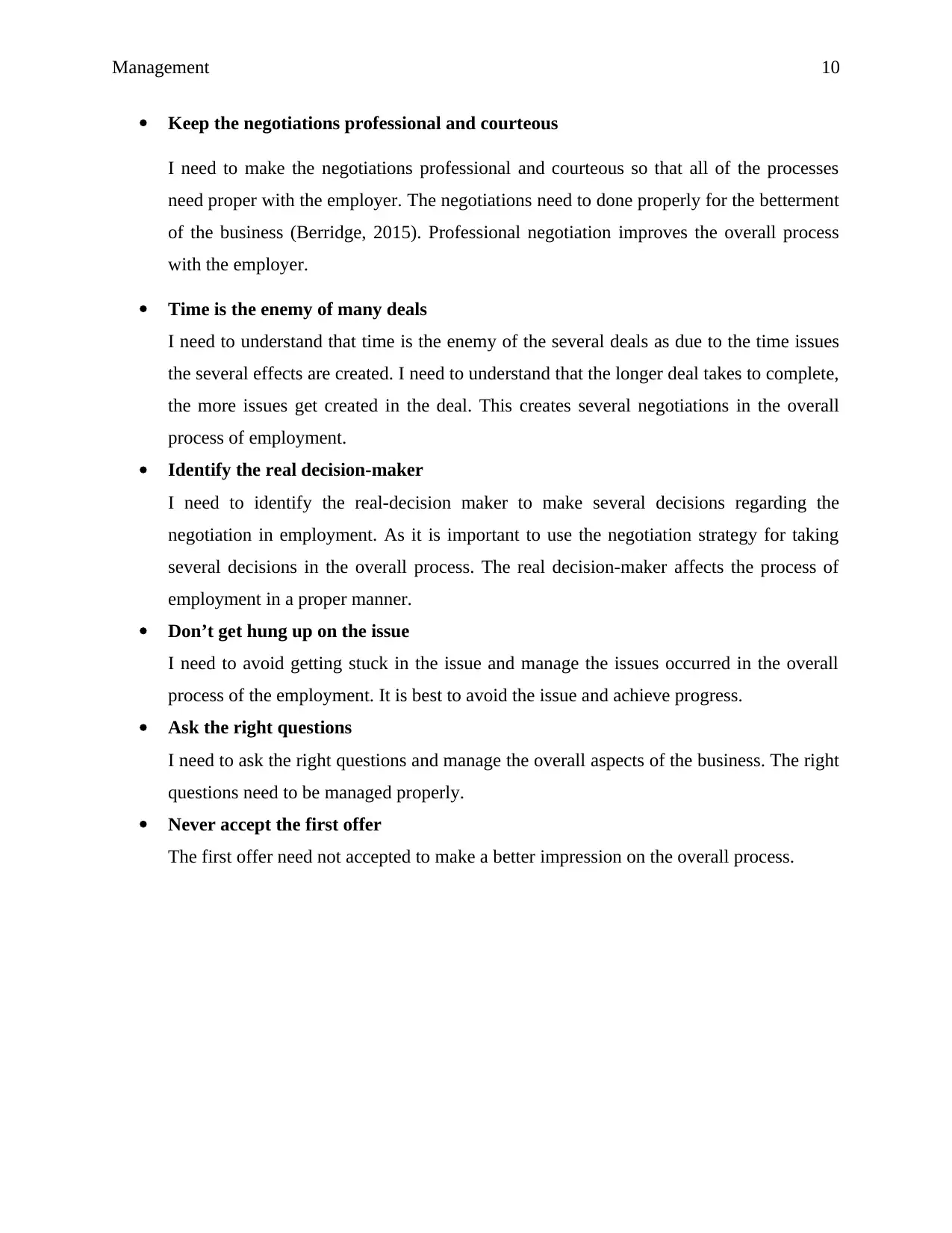
Keep the negotiations professional and courteous
I need to make the negotiations professional and courteous so that all of the processes
need proper with the employer. The negotiations need to done properly for the betterment
of the business (Berridge, 2015). Professional negotiation improves the overall process
with the employer.
Time is the enemy of many deals
I need to understand that time is the enemy of the several deals as due to the time issues
the several effects are created. I need to understand that the longer deal takes to complete,
the more issues get created in the deal. This creates several negotiations in the overall
process of employment.
Identify the real decision-maker
I need to identify the real-decision maker to make several decisions regarding the
negotiation in employment. As it is important to use the negotiation strategy for taking
several decisions in the overall process. The real decision-maker affects the process of
employment in a proper manner.
Don’t get hung up on the issue
I need to avoid getting stuck in the issue and manage the issues occurred in the overall
process of the employment. It is best to avoid the issue and achieve progress.
Ask the right questions
I need to ask the right questions and manage the overall aspects of the business. The right
questions need to be managed properly.
Never accept the first offer
The first offer need not accepted to make a better impression on the overall process.
Keep the negotiations professional and courteous
I need to make the negotiations professional and courteous so that all of the processes
need proper with the employer. The negotiations need to done properly for the betterment
of the business (Berridge, 2015). Professional negotiation improves the overall process
with the employer.
Time is the enemy of many deals
I need to understand that time is the enemy of the several deals as due to the time issues
the several effects are created. I need to understand that the longer deal takes to complete,
the more issues get created in the deal. This creates several negotiations in the overall
process of employment.
Identify the real decision-maker
I need to identify the real-decision maker to make several decisions regarding the
negotiation in employment. As it is important to use the negotiation strategy for taking
several decisions in the overall process. The real decision-maker affects the process of
employment in a proper manner.
Don’t get hung up on the issue
I need to avoid getting stuck in the issue and manage the issues occurred in the overall
process of the employment. It is best to avoid the issue and achieve progress.
Ask the right questions
I need to ask the right questions and manage the overall aspects of the business. The right
questions need to be managed properly.
Never accept the first offer
The first offer need not accepted to make a better impression on the overall process.
Paraphrase This Document
Need a fresh take? Get an instant paraphrase of this document with our AI Paraphraser
Management 11
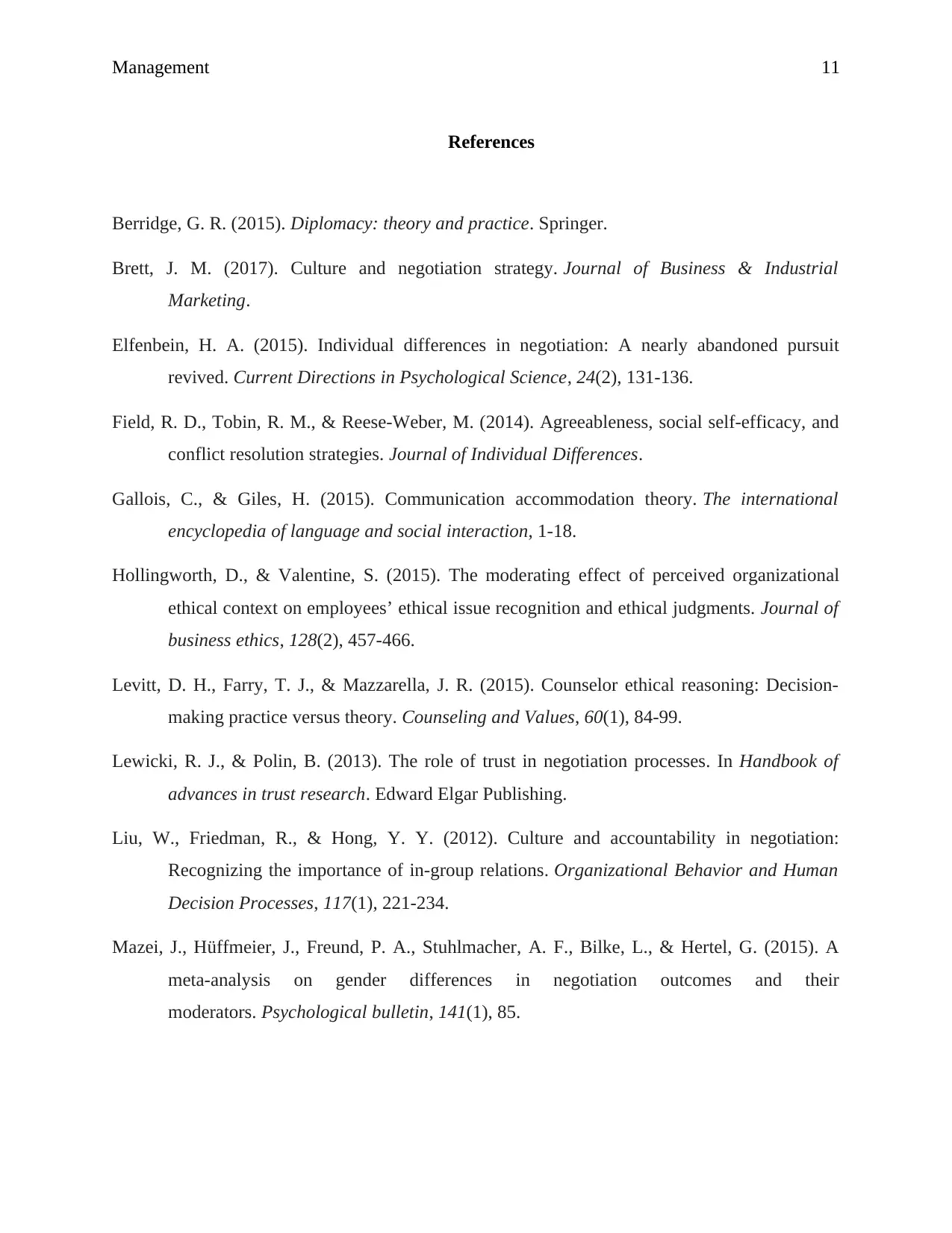
References
Berridge, G. R. (2015). Diplomacy: theory and practice. Springer.
Brett, J. M. (2017). Culture and negotiation strategy. Journal of Business & Industrial
Marketing.
Elfenbein, H. A. (2015). Individual differences in negotiation: A nearly abandoned pursuit
revived. Current Directions in Psychological Science, 24(2), 131-136.
Field, R. D., Tobin, R. M., & Reese-Weber, M. (2014). Agreeableness, social self-efficacy, and
conflict resolution strategies. Journal of Individual Differences.
Gallois, C., & Giles, H. (2015). Communication accommodation theory. The international
encyclopedia of language and social interaction, 1-18.
Hollingworth, D., & Valentine, S. (2015). The moderating effect of perceived organizational
ethical context on employees’ ethical issue recognition and ethical judgments. Journal of
business ethics, 128(2), 457-466.
Levitt, D. H., Farry, T. J., & Mazzarella, J. R. (2015). Counselor ethical reasoning: Decision‐
making practice versus theory. Counseling and Values, 60(1), 84-99.
Lewicki, R. J., & Polin, B. (2013). The role of trust in negotiation processes. In Handbook of
advances in trust research. Edward Elgar Publishing.
Liu, W., Friedman, R., & Hong, Y. Y. (2012). Culture and accountability in negotiation:
Recognizing the importance of in-group relations. Organizational Behavior and Human
Decision Processes, 117(1), 221-234.
Mazei, J., Hüffmeier, J., Freund, P. A., Stuhlmacher, A. F., Bilke, L., & Hertel, G. (2015). A
meta-analysis on gender differences in negotiation outcomes and their
moderators. Psychological bulletin, 141(1), 85.
References
Berridge, G. R. (2015). Diplomacy: theory and practice. Springer.
Brett, J. M. (2017). Culture and negotiation strategy. Journal of Business & Industrial
Marketing.
Elfenbein, H. A. (2015). Individual differences in negotiation: A nearly abandoned pursuit
revived. Current Directions in Psychological Science, 24(2), 131-136.
Field, R. D., Tobin, R. M., & Reese-Weber, M. (2014). Agreeableness, social self-efficacy, and
conflict resolution strategies. Journal of Individual Differences.
Gallois, C., & Giles, H. (2015). Communication accommodation theory. The international
encyclopedia of language and social interaction, 1-18.
Hollingworth, D., & Valentine, S. (2015). The moderating effect of perceived organizational
ethical context on employees’ ethical issue recognition and ethical judgments. Journal of
business ethics, 128(2), 457-466.
Levitt, D. H., Farry, T. J., & Mazzarella, J. R. (2015). Counselor ethical reasoning: Decision‐
making practice versus theory. Counseling and Values, 60(1), 84-99.
Lewicki, R. J., & Polin, B. (2013). The role of trust in negotiation processes. In Handbook of
advances in trust research. Edward Elgar Publishing.
Liu, W., Friedman, R., & Hong, Y. Y. (2012). Culture and accountability in negotiation:
Recognizing the importance of in-group relations. Organizational Behavior and Human
Decision Processes, 117(1), 221-234.
Mazei, J., Hüffmeier, J., Freund, P. A., Stuhlmacher, A. F., Bilke, L., & Hertel, G. (2015). A
meta-analysis on gender differences in negotiation outcomes and their
moderators. Psychological bulletin, 141(1), 85.
Management 12
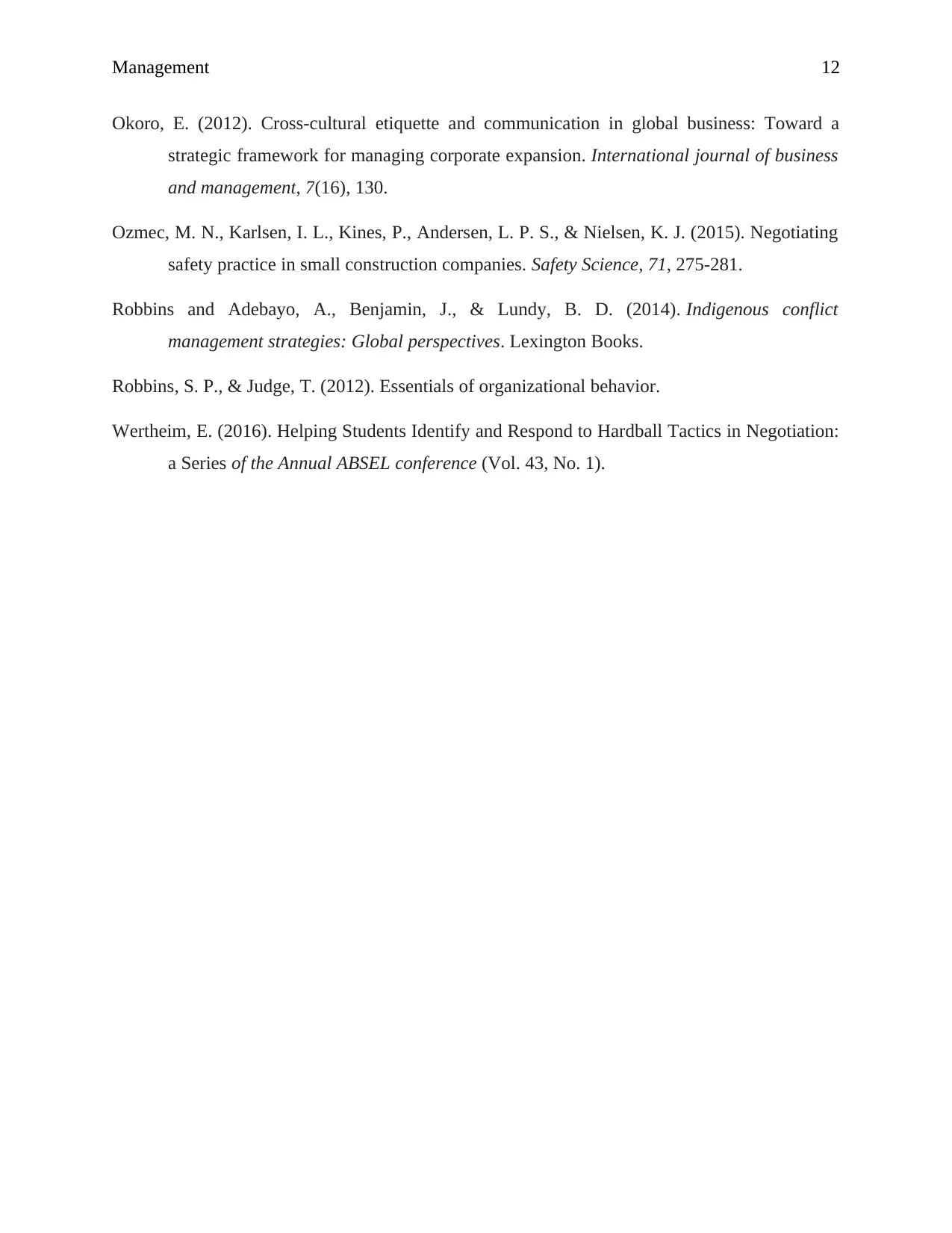
Okoro, E. (2012). Cross-cultural etiquette and communication in global business: Toward a
strategic framework for managing corporate expansion. International journal of business
and management, 7(16), 130.
Ozmec, M. N., Karlsen, I. L., Kines, P., Andersen, L. P. S., & Nielsen, K. J. (2015). Negotiating
safety practice in small construction companies. Safety Science, 71, 275-281.
Robbins and Adebayo, A., Benjamin, J., & Lundy, B. D. (2014). Indigenous conflict
management strategies: Global perspectives. Lexington Books.
Robbins, S. P., & Judge, T. (2012). Essentials of organizational behavior.
Wertheim, E. (2016). Helping Students Identify and Respond to Hardball Tactics in Negotiation:
a Series of the Annual ABSEL conference (Vol. 43, No. 1).
Okoro, E. (2012). Cross-cultural etiquette and communication in global business: Toward a
strategic framework for managing corporate expansion. International journal of business
and management, 7(16), 130.
Ozmec, M. N., Karlsen, I. L., Kines, P., Andersen, L. P. S., & Nielsen, K. J. (2015). Negotiating
safety practice in small construction companies. Safety Science, 71, 275-281.
Robbins and Adebayo, A., Benjamin, J., & Lundy, B. D. (2014). Indigenous conflict
management strategies: Global perspectives. Lexington Books.
Robbins, S. P., & Judge, T. (2012). Essentials of organizational behavior.
Wertheim, E. (2016). Helping Students Identify and Respond to Hardball Tactics in Negotiation:
a Series of the Annual ABSEL conference (Vol. 43, No. 1).
⊘ This is a preview!⊘
Do you want full access?
Subscribe today to unlock all pages.
Trusted by 1+ million students worldwide

1 out of 12


Your All-in-One AI-Powered Toolkit for Academic Success.
+13062052269
info@desklib.com
Available 24*7 on WhatsApp / Email
![[object Object]](/_next/static/media/star-bottom.7253800d.svg)
Unlock your academic potential
Copyright © 2020–2026 A2Z Services. All Rights Reserved. Developed and managed by ZUCOL.