Business Operations: Analysis, Strategies, and Reporting
VerifiedAdded on 2022/12/15
|13
|3303
|76
Report
AI Summary
This report provides a comprehensive overview of business operations, encompassing various aspects crucial for organizational success. It begins by differentiating between public and private sector organizations and explores different organizational structures. A PESTEL analysis is conducted, examining the political, economic, social, technological, legal, and environmental factors impacting businesses, using Tesco as a case study. The report delves into the importance of accounting, different functions of Human Resources (HR), and employment legislation. It further analyzes the stages of team development, organizational charts, and the roles and responsibilities within a team. Motivation theories and leadership styles are discussed to understand employee behavior and management strategies. Finally, the report assesses the impact of customer service and the benefits of customer profiling. The document, contributed by a student, offers valuable insights into business operations, providing a holistic understanding of the key elements that drive business performance and customer satisfaction.
How Business operate

Paraphrase This Document
Need a fresh take? Get an instant paraphrase of this document with our AI Paraphraser
Table of Contents
Introduction .........................................................................................................................................3
Task 1 .................................................................................................................................................3
1.1 Different types of organisation of public and private ..........................................................3
1.2 Different Structures...............................................................................................................4
1.3 PESTEL ANAYSIS .............................................................................................................4
TASK 2.................................................................................................................................................5
2.1 Importance of Accounting....................................................................................................5
2.2 Different functions of HR ...................................................................................................6
2.3 Employment Legislation.......................................................................................................6
TASK 3.................................................................................................................................................7
TASK 4 ...............................................................................................................................................7
4.1 Stages of Team Development...............................................................................................7
4.2 Organisation Chart of TESCO.............................................................................................9
Role and Responsibilities ..........................................................................................................9
4.3 Motivation Theories .............................................................................................................9
4.4 Leadership styles ................................................................................................................11
TASK 5 ..............................................................................................................................................11
5.1 Impact of customer service.................................................................................................11
5.2 Benefits of customer profiling............................................................................................11
Conclusion .........................................................................................................................................12
References:.........................................................................................................................................13
Introduction .........................................................................................................................................3
Task 1 .................................................................................................................................................3
1.1 Different types of organisation of public and private ..........................................................3
1.2 Different Structures...............................................................................................................4
1.3 PESTEL ANAYSIS .............................................................................................................4
TASK 2.................................................................................................................................................5
2.1 Importance of Accounting....................................................................................................5
2.2 Different functions of HR ...................................................................................................6
2.3 Employment Legislation.......................................................................................................6
TASK 3.................................................................................................................................................7
TASK 4 ...............................................................................................................................................7
4.1 Stages of Team Development...............................................................................................7
4.2 Organisation Chart of TESCO.............................................................................................9
Role and Responsibilities ..........................................................................................................9
4.3 Motivation Theories .............................................................................................................9
4.4 Leadership styles ................................................................................................................11
TASK 5 ..............................................................................................................................................11
5.1 Impact of customer service.................................................................................................11
5.2 Benefits of customer profiling............................................................................................11
Conclusion .........................................................................................................................................12
References:.........................................................................................................................................13
INTRODUCTION
Business operations is the activity of managing the daily activities which is carried out by the
business with the consideration of attaining the profitability within the organisation. There are
different types of business which vary on the basis of business type, different sector in the industry
and the profit and non profit organisation (Rezaee, 2017).There is significance role of the
business which helps in evaluation of the performance, generate revenue to cover the operating cost.
In order to perform the business operation that are generally includes retail, manufacturing,
technology and service industry. This report will cover the customer service, business environment
and team development.
Task 1
1.1 Different types of organisation of public and private
Public sectors: It refers to the the organisation that is run by the government body with the
consideration of benefit of the society by providing the goods and services on the reasonable price.
Different type of republic sector are-departmental undertaking, statutory corporations and
government companies.
Departmental undertaking is operated by the government in the direction of of their
ministers for example technology strategy board and medical research council.
Statutory corporation It is the operation which is run by the parliament of the special act
which includes the rules and regulation. For example ground state and four television
corporation.
Government companies These are the doors in establishment under the Indian companies act
which is is operating their business with not less than 51% of paid capital to the state and
Central Government. For example highways England and British business Bank.
Private sectors These are the organisation which is run by the individual with the
consideration of generating the higher revenue and profitability that is not controlled by the
government bodies and the different type of business includes are sole proprietorship and
partnership.
Sole Proprietor ship It is the type of business which is owned and controlled by the
individual who is responsible for all the profit and losses with the enterprises. Example –
HM Tech, VASSITANT
Business operations is the activity of managing the daily activities which is carried out by the
business with the consideration of attaining the profitability within the organisation. There are
different types of business which vary on the basis of business type, different sector in the industry
and the profit and non profit organisation (Rezaee, 2017).There is significance role of the
business which helps in evaluation of the performance, generate revenue to cover the operating cost.
In order to perform the business operation that are generally includes retail, manufacturing,
technology and service industry. This report will cover the customer service, business environment
and team development.
Task 1
1.1 Different types of organisation of public and private
Public sectors: It refers to the the organisation that is run by the government body with the
consideration of benefit of the society by providing the goods and services on the reasonable price.
Different type of republic sector are-departmental undertaking, statutory corporations and
government companies.
Departmental undertaking is operated by the government in the direction of of their
ministers for example technology strategy board and medical research council.
Statutory corporation It is the operation which is run by the parliament of the special act
which includes the rules and regulation. For example ground state and four television
corporation.
Government companies These are the doors in establishment under the Indian companies act
which is is operating their business with not less than 51% of paid capital to the state and
Central Government. For example highways England and British business Bank.
Private sectors These are the organisation which is run by the individual with the
consideration of generating the higher revenue and profitability that is not controlled by the
government bodies and the different type of business includes are sole proprietorship and
partnership.
Sole Proprietor ship It is the type of business which is owned and controlled by the
individual who is responsible for all the profit and losses with the enterprises. Example –
HM Tech, VASSITANT
⊘ This is a preview!⊘
Do you want full access?
Subscribe today to unlock all pages.

Trusted by 1+ million students worldwide
Partnership it is a type of business in which the two or more person work on a agreed basis
under the partnership Act 1890 which include the ordinary and limited partnership of the
individuals. Example – Yoomoo, Mumsnet.
1.2 Different Structures
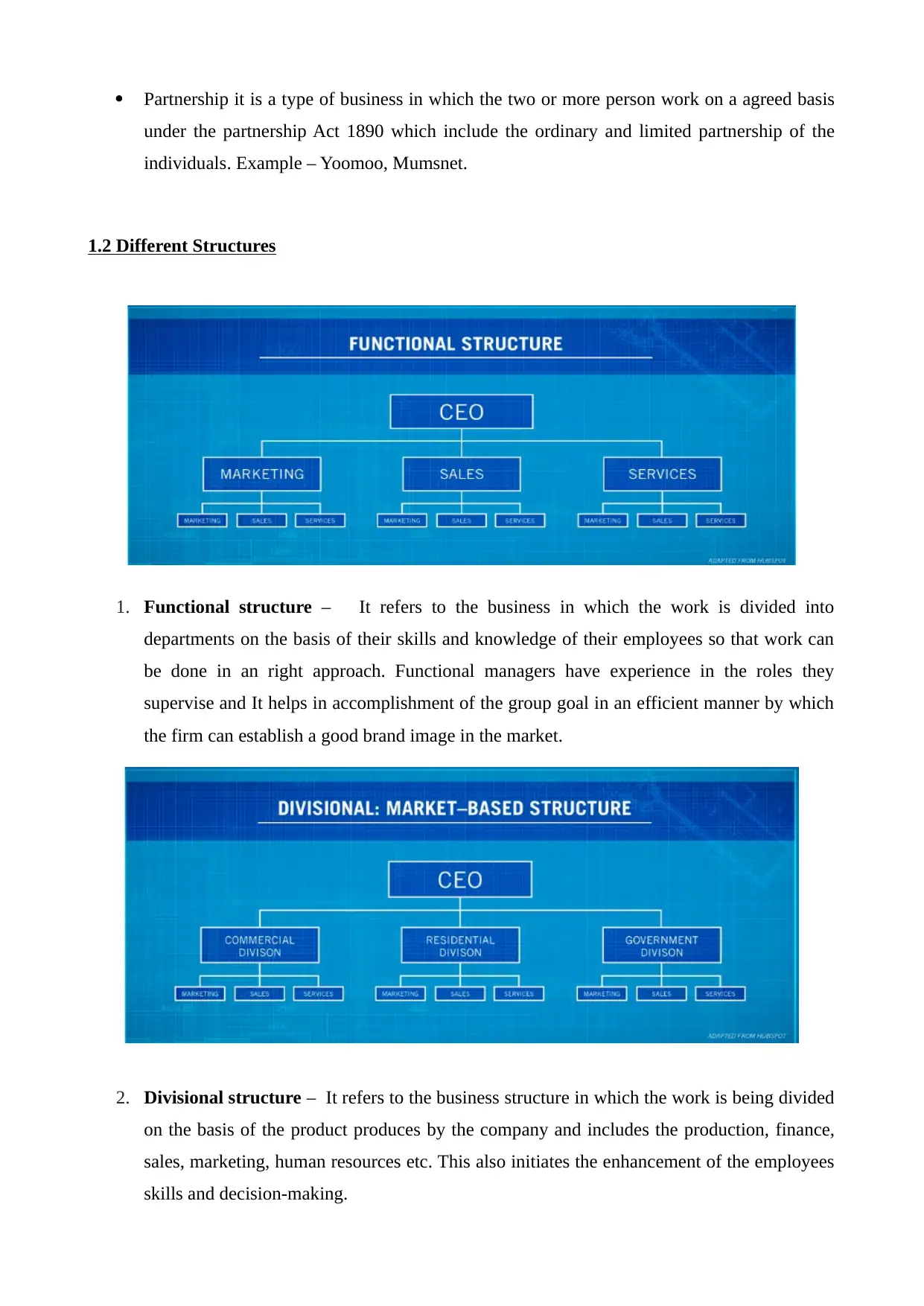
1. Functional structure – It refers to the business in which the work is divided into
departments on the basis of their skills and knowledge of their employees so that work can
be done in an right approach. Functional managers have experience in the roles they
supervise and It helps in accomplishment of the group goal in an efficient manner by which
the firm can establish a good brand image in the market.
2. Divisional structure – It refers to the business structure in which the work is being divided
on the basis of the product produces by the company and includes the production, finance,
sales, marketing, human resources etc. This also initiates the enhancement of the employees
skills and decision-making.
under the partnership Act 1890 which include the ordinary and limited partnership of the
individuals. Example – Yoomoo, Mumsnet.
1.2 Different Structures
1. Functional structure – It refers to the business in which the work is divided into
departments on the basis of their skills and knowledge of their employees so that work can
be done in an right approach. Functional managers have experience in the roles they
supervise and It helps in accomplishment of the group goal in an efficient manner by which
the firm can establish a good brand image in the market.
2. Divisional structure – It refers to the business structure in which the work is being divided
on the basis of the product produces by the company and includes the production, finance,
sales, marketing, human resources etc. This also initiates the enhancement of the employees
skills and decision-making.
Paraphrase This Document
Need a fresh take? Get an instant paraphrase of this document with our AI Paraphraser
1.3 PESTEL ANAYSIS
PESTLE analysis is the framework of analysing the external environment of
the business by understanding the different aspect used in the environmental
scanning. In context of Tesco, It will evaluate the political, economical, social,
technological, legal and environmental factors which is enlist as follows:
Political factor: There are various factors which influenced the performance of
the company like tax rate, foreign trade, government policy and legalisation.
There are various employment opportunities which is given by the TESCO
which increase the demand of products and services.
Economic factor: It is the factor which includes the inflation rate, exchange
rate, interest rate and economic growth. Tesco is focusing on creating the good
brand image in the market by copping up with the polices but change in the
policies affects the performance of the company by using the appropriate
methods of advertising.(Diaz-Briquets, 2019).
Social factor: These are the factors which includes the demographics
characteristics, customs, norms and large population in the market. The people
in the UK is moving towards the bulk buying that increase the sale of the Tesco
by providing the wide range of products as the demand of the prospective
customers is based on their attitudes and shared beliefs.
Technological factor: These are the factors which includes the change in the
technology and the advancement in the existing products. It determines the
new ways of manufacturing and distributing the goods and services by
emphasising the research and development so that they can get the innovative
products and services in the company.
Legal factor: These are the factors which includes the consumer rights, product
labelling and safety of the products. The UK government affects the
functionality of the business by making change in the polices and laws. Tesco
is reducing the customer price of fuel.
Environmental factor: It refers to the ecological aspect of the business by
which includes the weather, air, pollution an change in the climate etc. Tesco is
PESTLE analysis is the framework of analysing the external environment of
the business by understanding the different aspect used in the environmental
scanning. In context of Tesco, It will evaluate the political, economical, social,
technological, legal and environmental factors which is enlist as follows:
Political factor: There are various factors which influenced the performance of
the company like tax rate, foreign trade, government policy and legalisation.
There are various employment opportunities which is given by the TESCO
which increase the demand of products and services.
Economic factor: It is the factor which includes the inflation rate, exchange
rate, interest rate and economic growth. Tesco is focusing on creating the good
brand image in the market by copping up with the polices but change in the
policies affects the performance of the company by using the appropriate
methods of advertising.(Diaz-Briquets, 2019).
Social factor: These are the factors which includes the demographics
characteristics, customs, norms and large population in the market. The people
in the UK is moving towards the bulk buying that increase the sale of the Tesco
by providing the wide range of products as the demand of the prospective
customers is based on their attitudes and shared beliefs.
Technological factor: These are the factors which includes the change in the
technology and the advancement in the existing products. It determines the
new ways of manufacturing and distributing the goods and services by
emphasising the research and development so that they can get the innovative
products and services in the company.
Legal factor: These are the factors which includes the consumer rights, product
labelling and safety of the products. The UK government affects the
functionality of the business by making change in the polices and laws. Tesco
is reducing the customer price of fuel.
Environmental factor: It refers to the ecological aspect of the business by
which includes the weather, air, pollution an change in the climate etc. Tesco is
working on the consideration of reducing the sue of carbon footprints and
minimized the wastage of raw maternal in the stores due to increase in the
environmental issues.
TASK 2
2.1 Importance of Accounting
Accounting is the process of his recording the financial transaction in the business that involves
the analysing, summarising, reporting and interpretation of the financial transaction s.
1. Record of transactions- Accounting is the aspect which keypad systematic record of all the
business transaction that help in comparisoning of the financial data in the past year.
2. Decision making- As the accounting helps I keeping records and data by which the manager
of the company analyse the final situation and take the corrective actions on the basis of the
final results.
3. Planning – On the bass is of accounting information and data the organisation can do the
proper planning that includes the cash, sales, procurement, stock quantity planning etc.
2.2 Different functions of HR
1. Human resource planning- The main functions of the HR department is to determine the
Needs of the workforce within the organisation so that the respective owprations can be run
in an appropriate manner and this also determine what type of skills and knowledge would
be require for the organisation.
2. Recruitment and selection- It is the process of selecting the deserving candidate by
analysing there verbal and non verbal behavior of the employees so that they can get the
potential employee this organisation who can run their busienss in an efficient
manner. (Moratis and Cochius, 2017).
3. Training and development- it is the next function of the human resource to give the traning
and development to the employees so that they can enhance the capabilities of the
employees worth the aim of acheiving higher productivity and profitability.
2.3 Employment Legislation
It refers to the rights of the Workers and applicable law that is related to the emplyment and
safety issues like working hours, employment status, pay and entitlement on holidays, health and
safety.
1. Individual Employment relations- This is the contractual relationship between the
minimized the wastage of raw maternal in the stores due to increase in the
environmental issues.
TASK 2
2.1 Importance of Accounting
Accounting is the process of his recording the financial transaction in the business that involves
the analysing, summarising, reporting and interpretation of the financial transaction s.
1. Record of transactions- Accounting is the aspect which keypad systematic record of all the
business transaction that help in comparisoning of the financial data in the past year.
2. Decision making- As the accounting helps I keeping records and data by which the manager
of the company analyse the final situation and take the corrective actions on the basis of the
final results.
3. Planning – On the bass is of accounting information and data the organisation can do the
proper planning that includes the cash, sales, procurement, stock quantity planning etc.
2.2 Different functions of HR
1. Human resource planning- The main functions of the HR department is to determine the
Needs of the workforce within the organisation so that the respective owprations can be run
in an appropriate manner and this also determine what type of skills and knowledge would
be require for the organisation.
2. Recruitment and selection- It is the process of selecting the deserving candidate by
analysing there verbal and non verbal behavior of the employees so that they can get the
potential employee this organisation who can run their busienss in an efficient
manner. (Moratis and Cochius, 2017).
3. Training and development- it is the next function of the human resource to give the traning
and development to the employees so that they can enhance the capabilities of the
employees worth the aim of acheiving higher productivity and profitability.
2.3 Employment Legislation
It refers to the rights of the Workers and applicable law that is related to the emplyment and
safety issues like working hours, employment status, pay and entitlement on holidays, health and
safety.
1. Individual Employment relations- This is the contractual relationship between the
⊘ This is a preview!⊘
Do you want full access?
Subscribe today to unlock all pages.
Trusted by 1+ million students worldwide
parties where one party is in tthe control of other and this is bound which they have to execute to
work. It also includes the minimum wages, workings aspect s and social security, transfer,
promotion, dismissal procedures and compensations
2. Wages and remuneration- It involves the aspect in which is it stated that the fair
remuneration must be given to each employee so that they can contribute with their best practices in
order to get the good command in their living standard and well being.
TASK 3
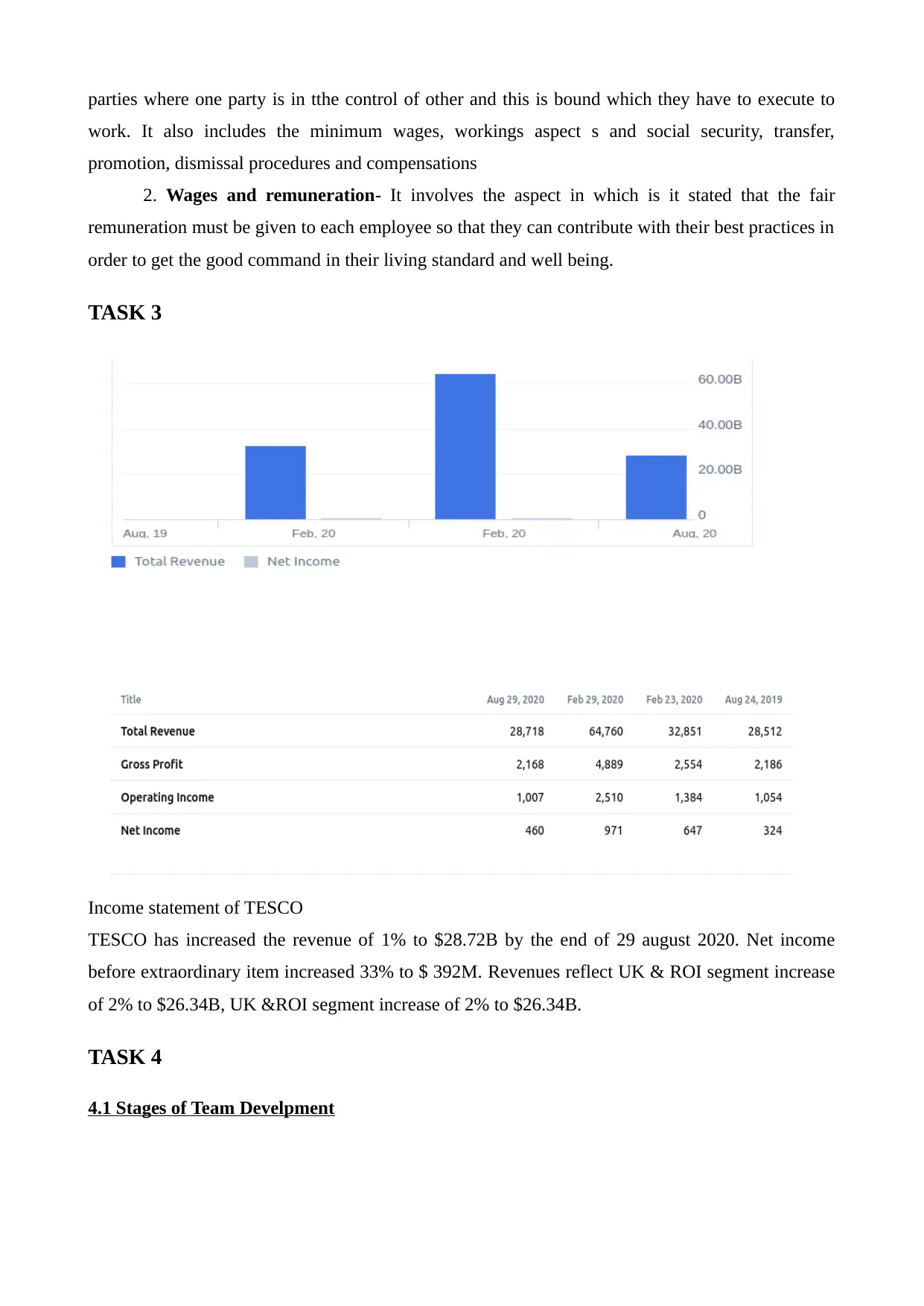
Income statement of TESCO
TESCO has increased the revenue of 1% to $28.72B by the end of 29 august 2020. Net income
before extraordinary item increased 33% to $ 392M. Revenues reflect UK & ROI segment increase
of 2% to $26.34B, UK &ROI segment increase of 2% to $26.34B.
TASK 4
4.1 Stages of Team Develpment
work. It also includes the minimum wages, workings aspect s and social security, transfer,
promotion, dismissal procedures and compensations
2. Wages and remuneration- It involves the aspect in which is it stated that the fair
remuneration must be given to each employee so that they can contribute with their best practices in
order to get the good command in their living standard and well being.
TASK 3
Income statement of TESCO
TESCO has increased the revenue of 1% to $28.72B by the end of 29 august 2020. Net income
before extraordinary item increased 33% to $ 392M. Revenues reflect UK & ROI segment increase
of 2% to $26.34B, UK &ROI segment increase of 2% to $26.34B.
TASK 4
4.1 Stages of Team Develpment
Paraphrase This Document
Need a fresh take? Get an instant paraphrase of this document with our AI Paraphraser
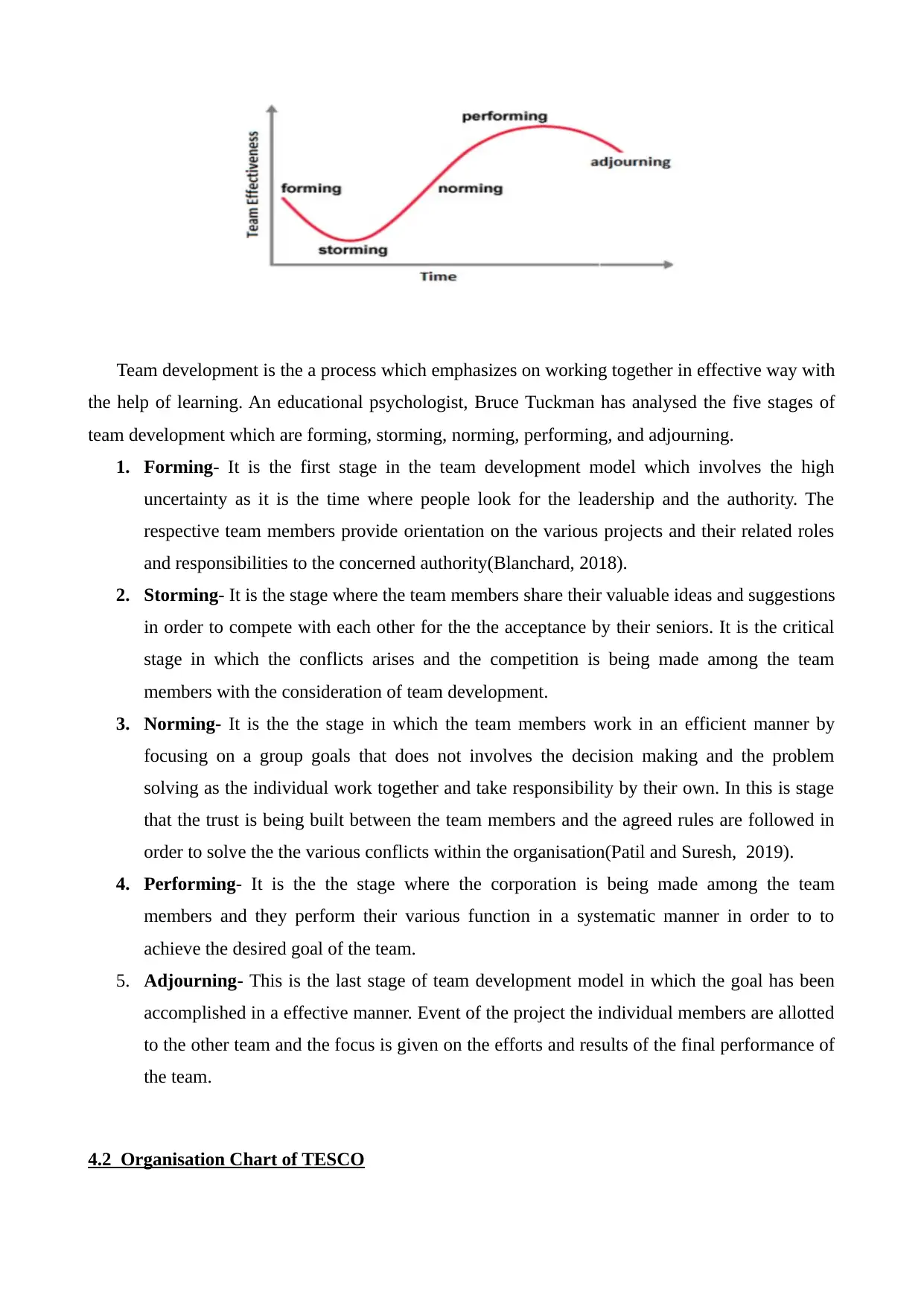
Team development is the a process which emphasizes on working together in effective way with
the help of learning. An educational psychologist, Bruce Tuckman has analysed the five stages of
team development which are forming, storming, norming, performing, and adjourning.
1. Forming- It is the first stage in the team development model which involves the high
uncertainty as it is the time where people look for the leadership and the authority. The
respective team members provide orientation on the various projects and their related roles
and responsibilities to the concerned authority(Blanchard, 2018).
2. Storming- It is the stage where the team members share their valuable ideas and suggestions
in order to compete with each other for the the acceptance by their seniors. It is the critical
stage in which the conflicts arises and the competition is being made among the team
members with the consideration of team development.
3. Norming- It is the the stage in which the team members work in an efficient manner by
focusing on a group goals that does not involves the decision making and the problem
solving as the individual work together and take responsibility by their own. In this is stage
that the trust is being built between the team members and the agreed rules are followed in
order to solve the the various conflicts within the organisation(Patil and Suresh, 2019).
4. Performing- It is the the stage where the corporation is being made among the team
members and they perform their various function in a systematic manner in order to to
achieve the desired goal of the team.
5. Adjourning- This is the last stage of team development model in which the goal has been
accomplished in a effective manner. Event of the project the individual members are allotted
to the other team and the focus is given on the efforts and results of the final performance of
the team.
4.2 Organisation Chart of TESCO
the help of learning. An educational psychologist, Bruce Tuckman has analysed the five stages of
team development which are forming, storming, norming, performing, and adjourning.
1. Forming- It is the first stage in the team development model which involves the high
uncertainty as it is the time where people look for the leadership and the authority. The
respective team members provide orientation on the various projects and their related roles
and responsibilities to the concerned authority(Blanchard, 2018).
2. Storming- It is the stage where the team members share their valuable ideas and suggestions
in order to compete with each other for the the acceptance by their seniors. It is the critical
stage in which the conflicts arises and the competition is being made among the team
members with the consideration of team development.
3. Norming- It is the the stage in which the team members work in an efficient manner by
focusing on a group goals that does not involves the decision making and the problem
solving as the individual work together and take responsibility by their own. In this is stage
that the trust is being built between the team members and the agreed rules are followed in
order to solve the the various conflicts within the organisation(Patil and Suresh, 2019).
4. Performing- It is the the stage where the corporation is being made among the team
members and they perform their various function in a systematic manner in order to to
achieve the desired goal of the team.
5. Adjourning- This is the last stage of team development model in which the goal has been
accomplished in a effective manner. Event of the project the individual members are allotted
to the other team and the focus is given on the efforts and results of the final performance of
the team.
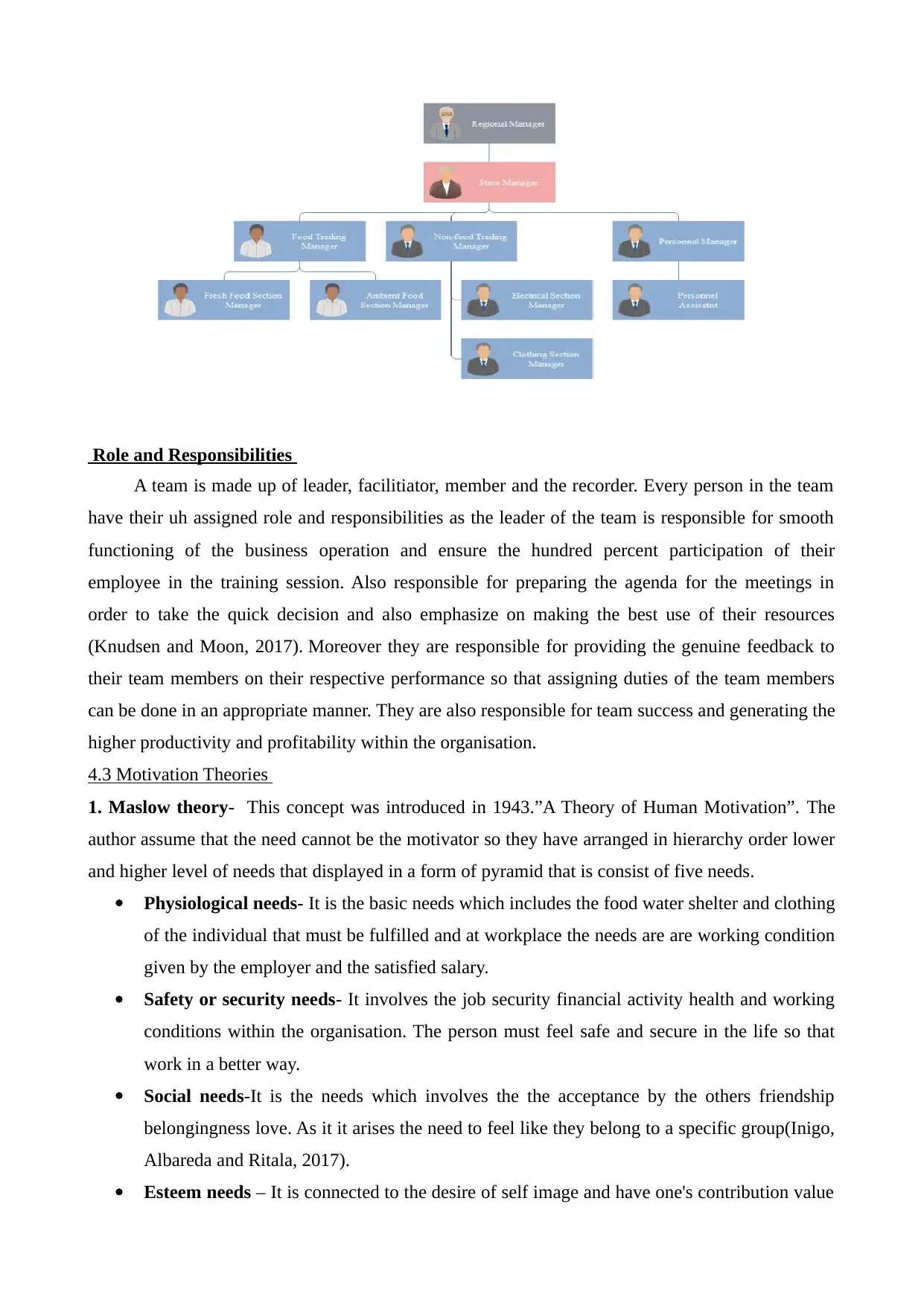
4.2 Organisation Chart of TESCO
Role and Responsibilities
A team is made up of leader, facilitiator, member and the recorder. Every person in the team
have their uh assigned role and responsibilities as the leader of the team is responsible for smooth
functioning of the business operation and ensure the hundred percent participation of their
employee in the training session. Also responsible for preparing the agenda for the meetings in
order to take the quick decision and also emphasize on making the best use of their resources
(Knudsen and Moon, 2017). Moreover they are responsible for providing the genuine feedback to
their team members on their respective performance so that assigning duties of the team members
can be done in an appropriate manner. They are also responsible for team success and generating the
higher productivity and profitability within the organisation.
4.3 Motivation Theories
1. Maslow theory- This concept was introduced in 1943.”A Theory of Human Motivation”. The
author assume that the need cannot be the motivator so they have arranged in hierarchy order lower
and higher level of needs that displayed in a form of pyramid that is consist of five needs.
Physiological needs- It is the basic needs which includes the food water shelter and clothing
of the individual that must be fulfilled and at workplace the needs are are working condition
given by the employer and the satisfied salary.
Safety or security needs- It involves the job security financial activity health and working
conditions within the organisation. The person must feel safe and secure in the life so that
work in a better way.
Social needs-It is the needs which involves the the acceptance by the others friendship
belongingness love. As it it arises the need to feel like they belong to a specific group(Inigo,
Albareda and Ritala, 2017).
Esteem needs – It is connected to the desire of self image and have one's contribution value
A team is made up of leader, facilitiator, member and the recorder. Every person in the team
have their uh assigned role and responsibilities as the leader of the team is responsible for smooth
functioning of the business operation and ensure the hundred percent participation of their
employee in the training session. Also responsible for preparing the agenda for the meetings in
order to take the quick decision and also emphasize on making the best use of their resources
(Knudsen and Moon, 2017). Moreover they are responsible for providing the genuine feedback to
their team members on their respective performance so that assigning duties of the team members
can be done in an appropriate manner. They are also responsible for team success and generating the
higher productivity and profitability within the organisation.
4.3 Motivation Theories
1. Maslow theory- This concept was introduced in 1943.”A Theory of Human Motivation”. The
author assume that the need cannot be the motivator so they have arranged in hierarchy order lower
and higher level of needs that displayed in a form of pyramid that is consist of five needs.
Physiological needs- It is the basic needs which includes the food water shelter and clothing
of the individual that must be fulfilled and at workplace the needs are are working condition
given by the employer and the satisfied salary.
Safety or security needs- It involves the job security financial activity health and working
conditions within the organisation. The person must feel safe and secure in the life so that
work in a better way.
Social needs-It is the needs which involves the the acceptance by the others friendship
belongingness love. As it it arises the need to feel like they belong to a specific group(Inigo,
Albareda and Ritala, 2017).
Esteem needs – It is connected to the desire of self image and have one's contribution value
⊘ This is a preview!⊘
Do you want full access?
Subscribe today to unlock all pages.
Trusted by 1+ million students worldwide
and appreciated by others. It includes the need of prestige attention rack organisation status
and getting respect from others.
Self actualization needs- This is the last need that pretend the requirement of developing
the probabilities and receiving the full potential that is called self actualization. It determines
the desire of the person to accomplish something in order to to get the personal growth.
2. Mayo theory- This theory was established on Hawthorne experiments which developed a matrix
to illustrate the team success. The theory consist of four combinations-
Groups with low cohesiveness and low norms- this is combination the productivity of the
group is infected that does not last for a longer period of time as nobody's influenced in the
protective way.
Groups with high cohesiveness and low norms- In this combination the negative behavior
is being influenced for example gangs.
Groups with high norms and but low cohesiveness- In this combination, there is a less
positive impact on the team as the team members is working for their own goal ratehr than
for group goals (Sousa-Zomer And et. al., 2018).
Groups with high norms and high cohesiveness- there is positive impact on this
combination as the people tends to work for the individual as well for acheiving the group
goals.
3. McClelland theory- This theory is based on the three dimensions as it does not depends upon
age or gender. It is associated to learning as needs are evaluated by they experience in the culture
and the environment.
Achievement- The personnel perform better for the acheivment of their certain goals as they
are directly linked to the competition. High need acheivers assumes personal responsibility to
perform a specific task.
Power- It is the need in the an individual control the work or others and perform by themselves
as this power influence the other put control on others.
Affiliation- It is the factors which includes the needs of love, belonging and acceptance in
order to maintain the friendly and warm relationship with their employees in the organisation.
4.4 Leadership styles
Autocratic style – It is also known as centered leadership style in which all the decision are
being made by the leader only and only person who deligate their duties and responsibilities
to their subordinates in order to complete the specific work. In this, there is less power given
and getting respect from others.
Self actualization needs- This is the last need that pretend the requirement of developing
the probabilities and receiving the full potential that is called self actualization. It determines
the desire of the person to accomplish something in order to to get the personal growth.
2. Mayo theory- This theory was established on Hawthorne experiments which developed a matrix
to illustrate the team success. The theory consist of four combinations-
Groups with low cohesiveness and low norms- this is combination the productivity of the
group is infected that does not last for a longer period of time as nobody's influenced in the
protective way.
Groups with high cohesiveness and low norms- In this combination the negative behavior
is being influenced for example gangs.
Groups with high norms and but low cohesiveness- In this combination, there is a less
positive impact on the team as the team members is working for their own goal ratehr than
for group goals (Sousa-Zomer And et. al., 2018).
Groups with high norms and high cohesiveness- there is positive impact on this
combination as the people tends to work for the individual as well for acheiving the group
goals.
3. McClelland theory- This theory is based on the three dimensions as it does not depends upon
age or gender. It is associated to learning as needs are evaluated by they experience in the culture
and the environment.
Achievement- The personnel perform better for the acheivment of their certain goals as they
are directly linked to the competition. High need acheivers assumes personal responsibility to
perform a specific task.
Power- It is the need in the an individual control the work or others and perform by themselves
as this power influence the other put control on others.
Affiliation- It is the factors which includes the needs of love, belonging and acceptance in
order to maintain the friendly and warm relationship with their employees in the organisation.
4.4 Leadership styles
Autocratic style – It is also known as centered leadership style in which all the decision are
being made by the leader only and only person who deligate their duties and responsibilities
to their subordinates in order to complete the specific work. In this, there is less power given
Paraphrase This Document
Need a fresh take? Get an instant paraphrase of this document with our AI Paraphraser
to employees, they just have to follow the actions of their leader (Reis and et. al., 2018).
Democratic style- It Is also known as the participative eladership style in which employees
are free to give their valuable feedbacks and suggestions and leader listen to them before
making the final decision.this also helps in getting the innovation and advancement within in
the organisation as employees are more free to do experiment and research.
TASK 5
5.1 Impact of customer service
Customer service is the providing the assestence to theeir customers by sloving their queries
and problems and represents the company by giving services before and after purchase of product
by the customers.
The main consideration of the customer service is that it helps in establishing thhe strong
brand image in the market by buidling good relationship with the customers. Training and learning
to the employees so that they can maintain the customer service by which they can retain their loyal
customer within the organisation.
5.2 Benefits of customer profiling
Customer profiling helps in keeping the record of the cutokers by which it helps in market
penetration by evaluating the market opportunities. By conducting the campaigns, the response rate
can be enhance which leads to increase in trhe sale by connecting to the right people at the right
time (Deva and Bilchitz, 2017).
Democratic style- It Is also known as the participative eladership style in which employees
are free to give their valuable feedbacks and suggestions and leader listen to them before
making the final decision.this also helps in getting the innovation and advancement within in
the organisation as employees are more free to do experiment and research.
TASK 5
5.1 Impact of customer service
Customer service is the providing the assestence to theeir customers by sloving their queries
and problems and represents the company by giving services before and after purchase of product
by the customers.
The main consideration of the customer service is that it helps in establishing thhe strong
brand image in the market by buidling good relationship with the customers. Training and learning
to the employees so that they can maintain the customer service by which they can retain their loyal
customer within the organisation.
5.2 Benefits of customer profiling
Customer profiling helps in keeping the record of the cutokers by which it helps in market
penetration by evaluating the market opportunities. By conducting the campaigns, the response rate
can be enhance which leads to increase in trhe sale by connecting to the right people at the right
time (Deva and Bilchitz, 2017).
Conclusion
It is concluded from the above report that there must be a systematic business plan and the
resources by which an organisation run their business in a successful way and human resource
manager play and significant role in hiring the the deserving candidate and make them efficient for
a specific job role. Accounting also helps in operating the various business transactions and
customer services let the business to build the stong relationship with the customers by solving their
problems.
It is concluded from the above report that there must be a systematic business plan and the
resources by which an organisation run their business in a successful way and human resource
manager play and significant role in hiring the the deserving candidate and make them efficient for
a specific job role. Accounting also helps in operating the various business transactions and
customer services let the business to build the stong relationship with the customers by solving their
problems.
⊘ This is a preview!⊘
Do you want full access?
Subscribe today to unlock all pages.
Trusted by 1+ million students worldwide

1 out of 13


Related Documents


Your All-in-One AI-Powered Toolkit for Academic Success.
+13062052269
info@desklib.com
Available 24*7 on WhatsApp / Email
![[object Object]](/_next/static/media/star-bottom.7253800d.svg)
Unlock your academic potential
Copyright © 2020–2026 A2Z Services. All Rights Reserved. Developed and managed by ZUCOL.