Comparison of Managerial and Leadership Roles in Business Operations
VerifiedAdded on 2023/01/12
|13
|3400
|52
Report
AI Summary
This report provides a comprehensive analysis of the roles and characteristics of managers and leaders within a business context, using Innocent Drinks as a case study. It differentiates between managerial and leadership roles, exploring how leaders motivate employees, develop visions, and plan for organizational success, while managers monitor, handle resources, and supervise operations. The report examines the roles of leaders and managers in various situational contexts such as technological changes, labor turnover, and conflict resolution, emphasizing the importance of adapting leadership styles to specific challenges. It also explores leadership theories like situational, system, and contingency leadership, and discusses key approaches to operational management, including Total Quality Management, JIT inventory, Kaizen, Six Sigma, Lean production, and Queuing theory. Furthermore, the report highlights the importance of operational management in achieving organizational objectives and identifies factors within the business environment that impact operational management and decision-making by leaders and managers, providing a holistic view of leadership and management in driving organizational efficiency and success.
MANAGE KNOWLEDGE AND
INFORMATION
INFORMATION

Paraphrase This Document
Need a fresh take? Get an instant paraphrase of this document with our AI Paraphraser
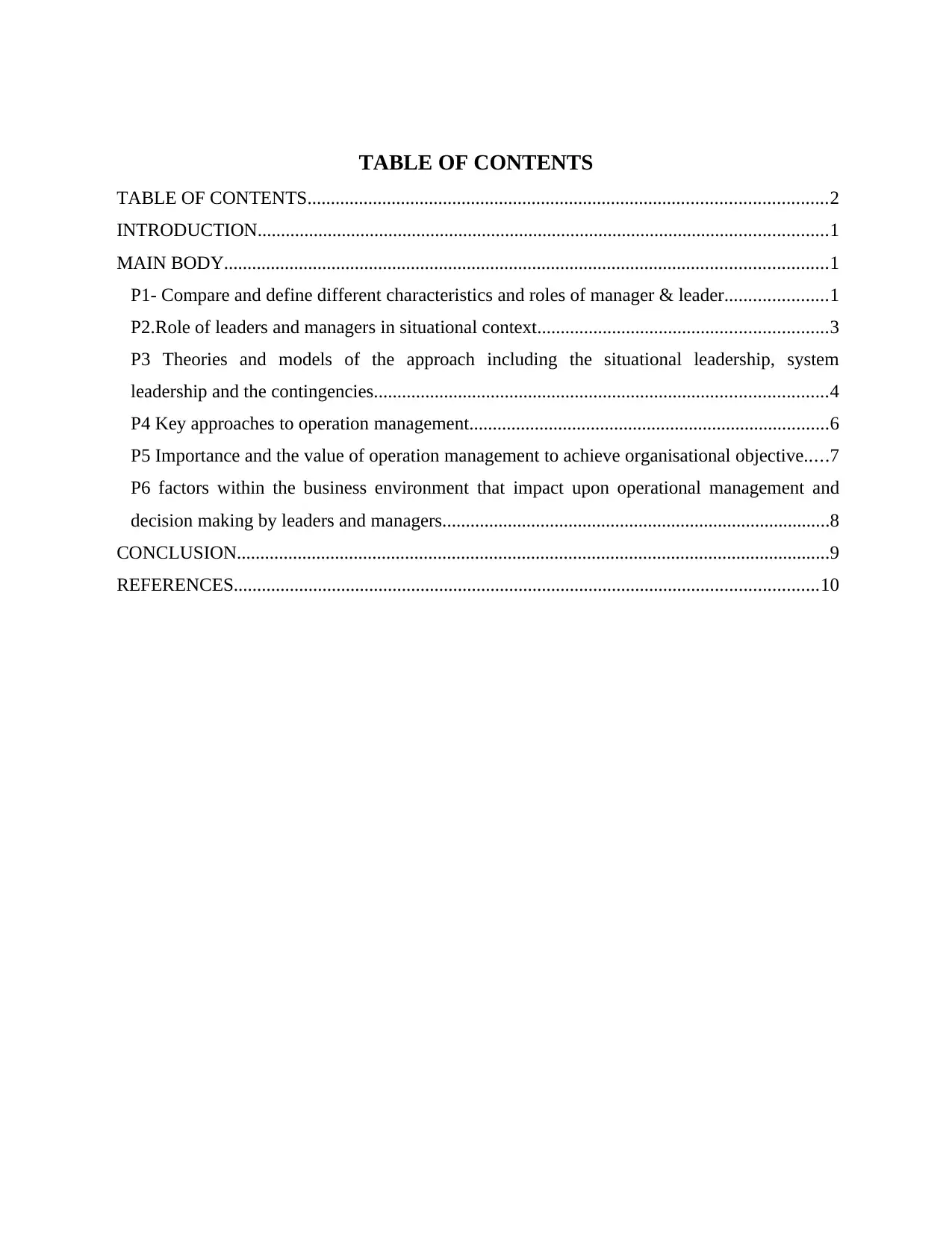
TABLE OF CONTENTS
TABLE OF CONTENTS...............................................................................................................2
INTRODUCTION..........................................................................................................................1
MAIN BODY.................................................................................................................................1
P1- Compare and define different characteristics and roles of manager & leader......................1
P2.Role of leaders and managers in situational context..............................................................3
P3 Theories and models of the approach including the situational leadership, system
leadership and the contingencies.................................................................................................4
P4 Key approaches to operation management.............................................................................6
P5 Importance and the value of operation management to achieve organisational objective.....7
P6 factors within the business environment that impact upon operational management and
decision making by leaders and managers...................................................................................8
CONCLUSION...............................................................................................................................9
REFERENCES.............................................................................................................................10
TABLE OF CONTENTS...............................................................................................................2
INTRODUCTION..........................................................................................................................1
MAIN BODY.................................................................................................................................1
P1- Compare and define different characteristics and roles of manager & leader......................1
P2.Role of leaders and managers in situational context..............................................................3
P3 Theories and models of the approach including the situational leadership, system
leadership and the contingencies.................................................................................................4
P4 Key approaches to operation management.............................................................................6
P5 Importance and the value of operation management to achieve organisational objective.....7
P6 factors within the business environment that impact upon operational management and
decision making by leaders and managers...................................................................................8
CONCLUSION...............................................................................................................................9
REFERENCES.............................................................................................................................10
INTRODUCTION
Operation management refer to administration of the business practices for creating the
highest level of the efficiencies in the organisation. It is concerned with converting the material
and labour in goods or services in the most efficient manner for maximising the profits of the
organisation. It is one of the strategic function of the organisation that is concerned with the
management of the operations. Present report is based on the Innocent Drinks which is a fruit
juice company. Study will cover the understanding of the role of leaders and managers in the
management of business operations, their roles in different organisation situations. It will also
cover the function of the leaders and managers in the organisation for the growth and success of
the organisation. It will also provide the importance of operations management in the
achievement of the business objectives.
MAIN BODY
P1- Compare and define different characteristics and roles of manager & leader
Leader is a person who sees how things can be improved in workplace and who rallies
individual to move towards that better mission or vision.
Roles of leader-
Employee’s motivator-
Within small or large companies the role of leader is to inspire and motivate labour which
is quite beneficial for businesses as it help to retain skilled applicants for longer term.
Develop vision-
Leader role is to create and develop a clear vision for firms as well as convey the same in
front of organizations.
Planner-
Along with above roles leader play another role that is a planner. They plan for achieving
aims & objectives of businesses. Individual identify a purpose and then communicate it with
team.
Characteristics-
Communication-
It is one of the best traits among leader that they can use to inspire people working in
workplace for achieving businesses aims and objectives.
1
Operation management refer to administration of the business practices for creating the
highest level of the efficiencies in the organisation. It is concerned with converting the material
and labour in goods or services in the most efficient manner for maximising the profits of the
organisation. It is one of the strategic function of the organisation that is concerned with the
management of the operations. Present report is based on the Innocent Drinks which is a fruit
juice company. Study will cover the understanding of the role of leaders and managers in the
management of business operations, their roles in different organisation situations. It will also
cover the function of the leaders and managers in the organisation for the growth and success of
the organisation. It will also provide the importance of operations management in the
achievement of the business objectives.
MAIN BODY
P1- Compare and define different characteristics and roles of manager & leader
Leader is a person who sees how things can be improved in workplace and who rallies
individual to move towards that better mission or vision.
Roles of leader-
Employee’s motivator-
Within small or large companies the role of leader is to inspire and motivate labour which
is quite beneficial for businesses as it help to retain skilled applicants for longer term.
Develop vision-
Leader role is to create and develop a clear vision for firms as well as convey the same in
front of organizations.
Planner-
Along with above roles leader play another role that is a planner. They plan for achieving
aims & objectives of businesses. Individual identify a purpose and then communicate it with
team.
Characteristics-
Communication-
It is one of the best traits among leader that they can use to inspire people working in
workplace for achieving businesses aims and objectives.
1
⊘ This is a preview!⊘
Do you want full access?
Subscribe today to unlock all pages.

Trusted by 1+ million students worldwide
Influence-
By connecting with employees emotionally, making others feels valuable and asking for
input & recommendations, leader influences their team in effective manner.
Humility-
Leader has this characteristic, because they more concerned about the well being of their
group and other team members.
A manager is a specialist who is in charge or manages of something; they can control
different departments in organizations or direct staff who work for them.
Roles of manager-
Monitor-
The role of manager is to monitor and examine workplace as well as businesses practices
in systematic manner that is really very important to assure success.
Resource handler-
Another role of manager is to handle every asset within business structure and allocate to
people according to demand or needs.
Supervisor-
Manager role is to cater right directions as they able to provide supervision clearly and give
feedback to people and to team.
Traits of manager-
Continual learning-
Manager always tries to learn from their senior as well as junior; they prefer to continually
learn different things that increase productivity level rather than before.
Time management-
Another characteristic of a manager is time management, they able to manage time and
complete day to day tasks without making delay.
Experience-
Manager is an experience person, capable to lead a team or other people while working it
big or small companies in efficient manner.
Comparison between roles and traits of leader & manager
Basis Manager Leader
Characteristics Above characteristics of On the other hand, traits of
2
By connecting with employees emotionally, making others feels valuable and asking for
input & recommendations, leader influences their team in effective manner.
Humility-
Leader has this characteristic, because they more concerned about the well being of their
group and other team members.
A manager is a specialist who is in charge or manages of something; they can control
different departments in organizations or direct staff who work for them.
Roles of manager-
Monitor-
The role of manager is to monitor and examine workplace as well as businesses practices
in systematic manner that is really very important to assure success.
Resource handler-
Another role of manager is to handle every asset within business structure and allocate to
people according to demand or needs.
Supervisor-
Manager role is to cater right directions as they able to provide supervision clearly and give
feedback to people and to team.
Traits of manager-
Continual learning-
Manager always tries to learn from their senior as well as junior; they prefer to continually
learn different things that increase productivity level rather than before.
Time management-
Another characteristic of a manager is time management, they able to manage time and
complete day to day tasks without making delay.
Experience-
Manager is an experience person, capable to lead a team or other people while working it
big or small companies in efficient manner.
Comparison between roles and traits of leader & manager
Basis Manager Leader
Characteristics Above characteristics of On the other hand, traits of
2
Paraphrase This Document
Need a fresh take? Get an instant paraphrase of this document with our AI Paraphraser
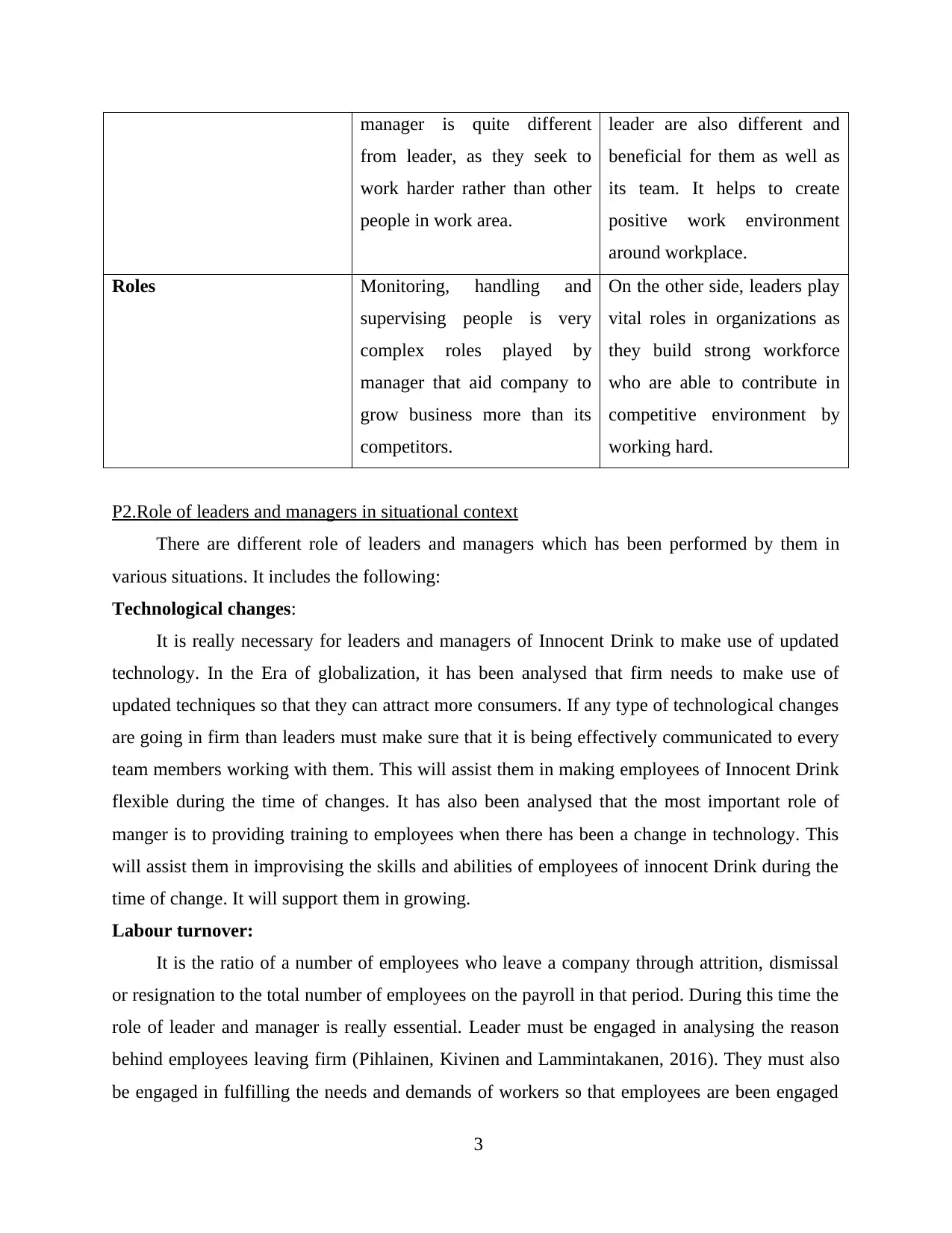
manager is quite different
from leader, as they seek to
work harder rather than other
people in work area.
leader are also different and
beneficial for them as well as
its team. It helps to create
positive work environment
around workplace.
Roles Monitoring, handling and
supervising people is very
complex roles played by
manager that aid company to
grow business more than its
competitors.
On the other side, leaders play
vital roles in organizations as
they build strong workforce
who are able to contribute in
competitive environment by
working hard.
P2.Role of leaders and managers in situational context
There are different role of leaders and managers which has been performed by them in
various situations. It includes the following:
Technological changes:
It is really necessary for leaders and managers of Innocent Drink to make use of updated
technology. In the Era of globalization, it has been analysed that firm needs to make use of
updated techniques so that they can attract more consumers. If any type of technological changes
are going in firm than leaders must make sure that it is being effectively communicated to every
team members working with them. This will assist them in making employees of Innocent Drink
flexible during the time of changes. It has also been analysed that the most important role of
manger is to providing training to employees when there has been a change in technology. This
will assist them in improvising the skills and abilities of employees of innocent Drink during the
time of change. It will support them in growing.
Labour turnover:
It is the ratio of a number of employees who leave a company through attrition, dismissal
or resignation to the total number of employees on the payroll in that period. During this time the
role of leader and manager is really essential. Leader must be engaged in analysing the reason
behind employees leaving firm (Pihlainen, Kivinen and Lammintakanen, 2016). They must also
be engaged in fulfilling the needs and demands of workers so that employees are been engaged
3
from leader, as they seek to
work harder rather than other
people in work area.
leader are also different and
beneficial for them as well as
its team. It helps to create
positive work environment
around workplace.
Roles Monitoring, handling and
supervising people is very
complex roles played by
manager that aid company to
grow business more than its
competitors.
On the other side, leaders play
vital roles in organizations as
they build strong workforce
who are able to contribute in
competitive environment by
working hard.
P2.Role of leaders and managers in situational context
There are different role of leaders and managers which has been performed by them in
various situations. It includes the following:
Technological changes:
It is really necessary for leaders and managers of Innocent Drink to make use of updated
technology. In the Era of globalization, it has been analysed that firm needs to make use of
updated techniques so that they can attract more consumers. If any type of technological changes
are going in firm than leaders must make sure that it is being effectively communicated to every
team members working with them. This will assist them in making employees of Innocent Drink
flexible during the time of changes. It has also been analysed that the most important role of
manger is to providing training to employees when there has been a change in technology. This
will assist them in improvising the skills and abilities of employees of innocent Drink during the
time of change. It will support them in growing.
Labour turnover:
It is the ratio of a number of employees who leave a company through attrition, dismissal
or resignation to the total number of employees on the payroll in that period. During this time the
role of leader and manager is really essential. Leader must be engaged in analysing the reason
behind employees leaving firm (Pihlainen, Kivinen and Lammintakanen, 2016). They must also
be engaged in fulfilling the needs and demands of workers so that employees are been engaged
3
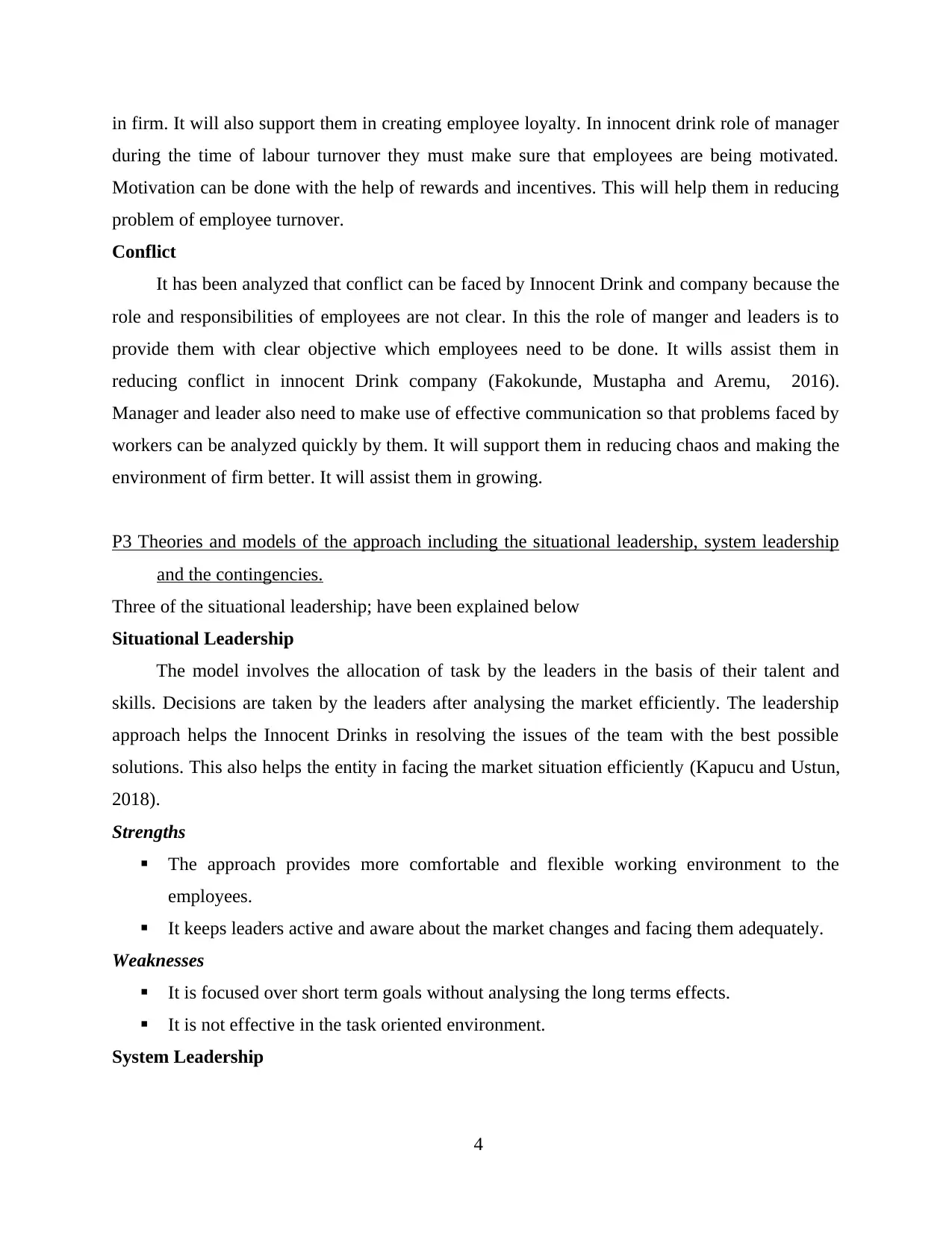
in firm. It will also support them in creating employee loyalty. In innocent drink role of manager
during the time of labour turnover they must make sure that employees are being motivated.
Motivation can be done with the help of rewards and incentives. This will help them in reducing
problem of employee turnover.
Conflict
It has been analyzed that conflict can be faced by Innocent Drink and company because the
role and responsibilities of employees are not clear. In this the role of manger and leaders is to
provide them with clear objective which employees need to be done. It wills assist them in
reducing conflict in innocent Drink company (Fakokunde, Mustapha and Aremu, 2016).
Manager and leader also need to make use of effective communication so that problems faced by
workers can be analyzed quickly by them. It will support them in reducing chaos and making the
environment of firm better. It will assist them in growing.
P3 Theories and models of the approach including the situational leadership, system leadership
and the contingencies.
Three of the situational leadership; have been explained below
Situational Leadership
The model involves the allocation of task by the leaders in the basis of their talent and
skills. Decisions are taken by the leaders after analysing the market efficiently. The leadership
approach helps the Innocent Drinks in resolving the issues of the team with the best possible
solutions. This also helps the entity in facing the market situation efficiently (Kapucu and Ustun,
2018).
Strengths
The approach provides more comfortable and flexible working environment to the
employees.
It keeps leaders active and aware about the market changes and facing them adequately.
Weaknesses
It is focused over short term goals without analysing the long terms effects.
It is not effective in the task oriented environment.
System Leadership
4
during the time of labour turnover they must make sure that employees are being motivated.
Motivation can be done with the help of rewards and incentives. This will help them in reducing
problem of employee turnover.
Conflict
It has been analyzed that conflict can be faced by Innocent Drink and company because the
role and responsibilities of employees are not clear. In this the role of manger and leaders is to
provide them with clear objective which employees need to be done. It wills assist them in
reducing conflict in innocent Drink company (Fakokunde, Mustapha and Aremu, 2016).
Manager and leader also need to make use of effective communication so that problems faced by
workers can be analyzed quickly by them. It will support them in reducing chaos and making the
environment of firm better. It will assist them in growing.
P3 Theories and models of the approach including the situational leadership, system leadership
and the contingencies.
Three of the situational leadership; have been explained below
Situational Leadership
The model involves the allocation of task by the leaders in the basis of their talent and
skills. Decisions are taken by the leaders after analysing the market efficiently. The leadership
approach helps the Innocent Drinks in resolving the issues of the team with the best possible
solutions. This also helps the entity in facing the market situation efficiently (Kapucu and Ustun,
2018).
Strengths
The approach provides more comfortable and flexible working environment to the
employees.
It keeps leaders active and aware about the market changes and facing them adequately.
Weaknesses
It is focused over short term goals without analysing the long terms effects.
It is not effective in the task oriented environment.
System Leadership
4
⊘ This is a preview!⊘
Do you want full access?
Subscribe today to unlock all pages.
Trusted by 1+ million students worldwide
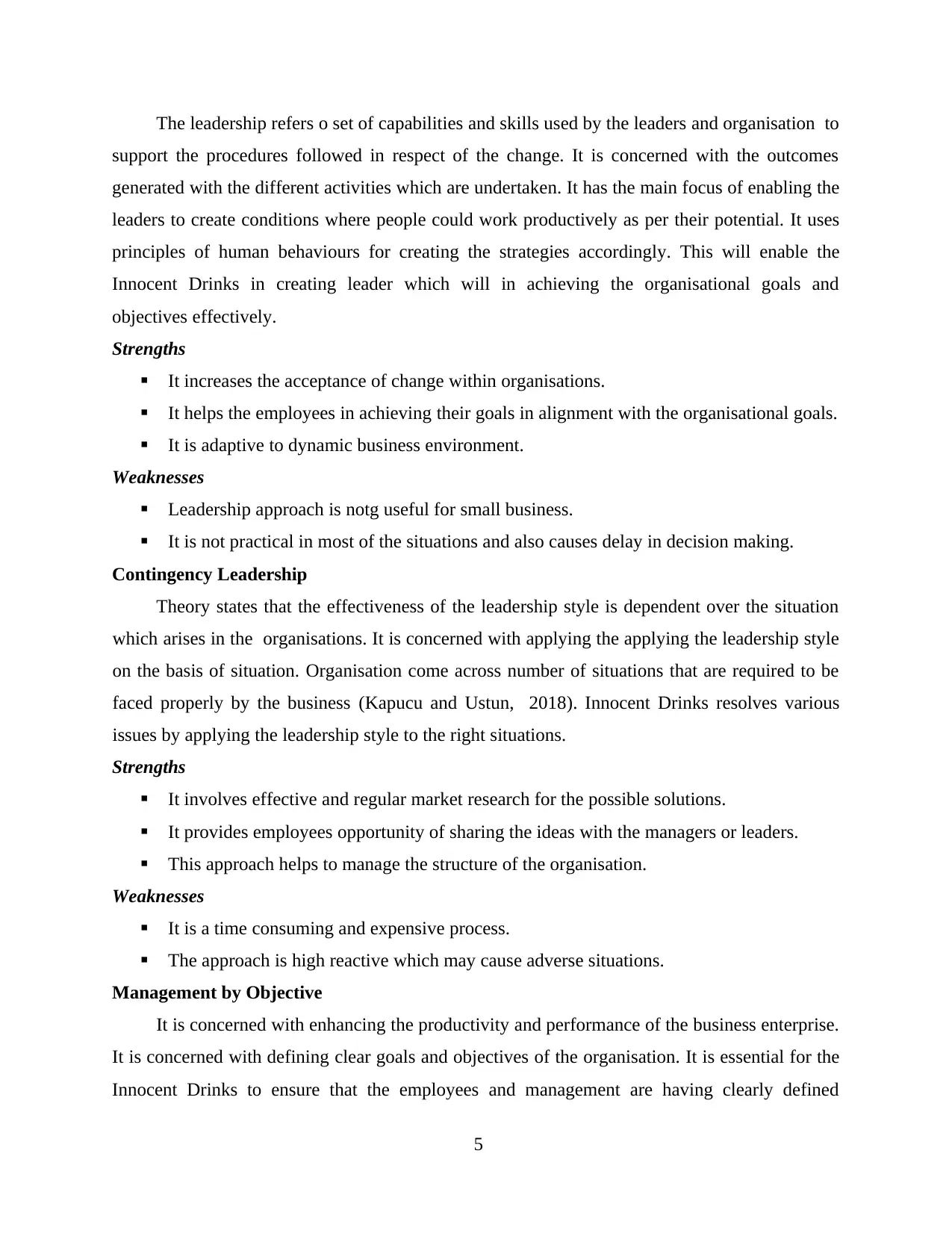
The leadership refers o set of capabilities and skills used by the leaders and organisation to
support the procedures followed in respect of the change. It is concerned with the outcomes
generated with the different activities which are undertaken. It has the main focus of enabling the
leaders to create conditions where people could work productively as per their potential. It uses
principles of human behaviours for creating the strategies accordingly. This will enable the
Innocent Drinks in creating leader which will in achieving the organisational goals and
objectives effectively.
Strengths
It increases the acceptance of change within organisations.
It helps the employees in achieving their goals in alignment with the organisational goals.
It is adaptive to dynamic business environment.
Weaknesses
Leadership approach is notg useful for small business.
It is not practical in most of the situations and also causes delay in decision making.
Contingency Leadership
Theory states that the effectiveness of the leadership style is dependent over the situation
which arises in the organisations. It is concerned with applying the applying the leadership style
on the basis of situation. Organisation come across number of situations that are required to be
faced properly by the business (Kapucu and Ustun, 2018). Innocent Drinks resolves various
issues by applying the leadership style to the right situations.
Strengths
It involves effective and regular market research for the possible solutions.
It provides employees opportunity of sharing the ideas with the managers or leaders.
This approach helps to manage the structure of the organisation.
Weaknesses
It is a time consuming and expensive process.
The approach is high reactive which may cause adverse situations.
Management by Objective
It is concerned with enhancing the productivity and performance of the business enterprise.
It is concerned with defining clear goals and objectives of the organisation. It is essential for the
Innocent Drinks to ensure that the employees and management are having clearly defined
5
support the procedures followed in respect of the change. It is concerned with the outcomes
generated with the different activities which are undertaken. It has the main focus of enabling the
leaders to create conditions where people could work productively as per their potential. It uses
principles of human behaviours for creating the strategies accordingly. This will enable the
Innocent Drinks in creating leader which will in achieving the organisational goals and
objectives effectively.
Strengths
It increases the acceptance of change within organisations.
It helps the employees in achieving their goals in alignment with the organisational goals.
It is adaptive to dynamic business environment.
Weaknesses
Leadership approach is notg useful for small business.
It is not practical in most of the situations and also causes delay in decision making.
Contingency Leadership
Theory states that the effectiveness of the leadership style is dependent over the situation
which arises in the organisations. It is concerned with applying the applying the leadership style
on the basis of situation. Organisation come across number of situations that are required to be
faced properly by the business (Kapucu and Ustun, 2018). Innocent Drinks resolves various
issues by applying the leadership style to the right situations.
Strengths
It involves effective and regular market research for the possible solutions.
It provides employees opportunity of sharing the ideas with the managers or leaders.
This approach helps to manage the structure of the organisation.
Weaknesses
It is a time consuming and expensive process.
The approach is high reactive which may cause adverse situations.
Management by Objective
It is concerned with enhancing the productivity and performance of the business enterprise.
It is concerned with defining clear goals and objectives of the organisation. It is essential for the
Innocent Drinks to ensure that the employees and management are having clearly defined
5
Paraphrase This Document
Need a fresh take? Get an instant paraphrase of this document with our AI Paraphraser
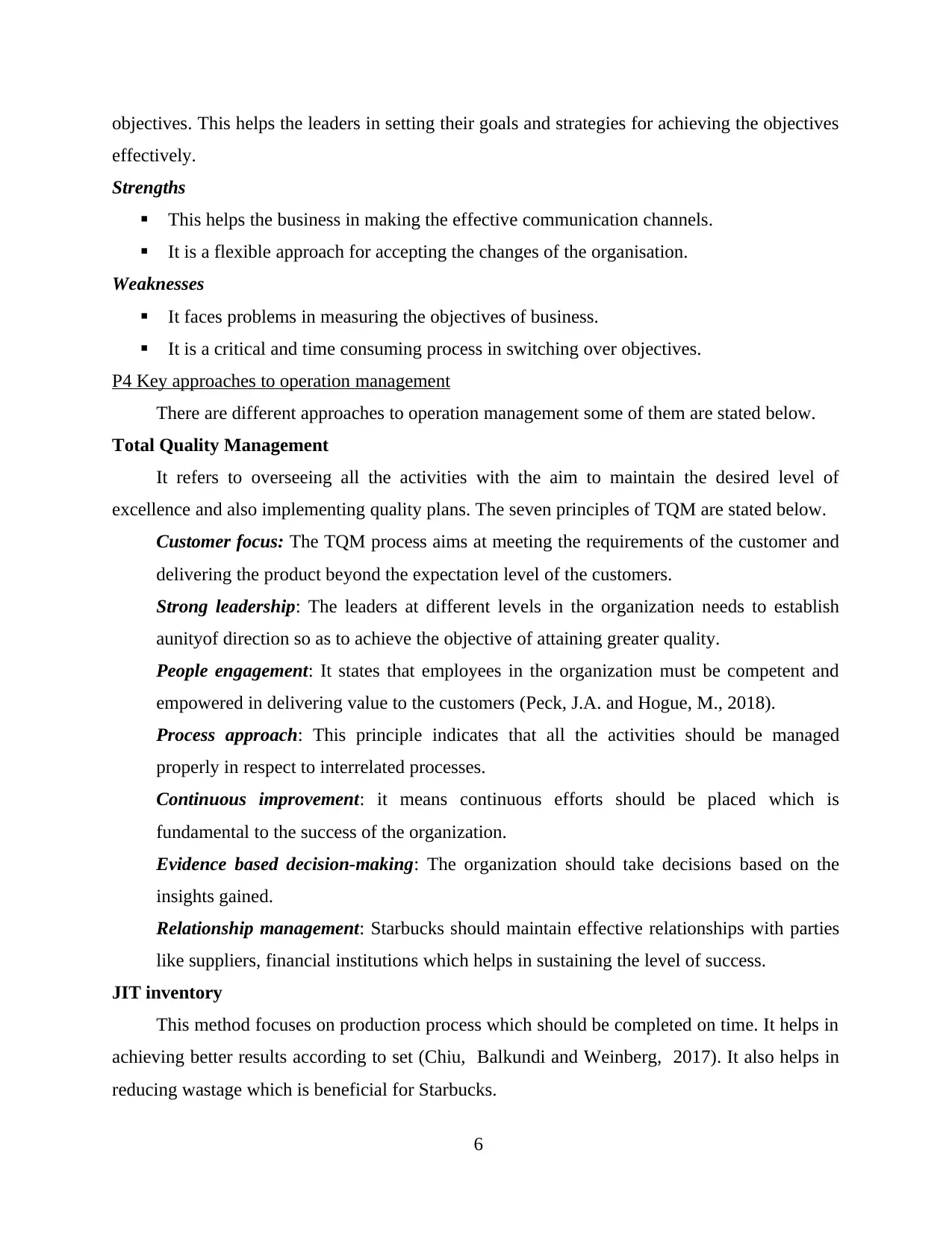
objectives. This helps the leaders in setting their goals and strategies for achieving the objectives
effectively.
Strengths
This helps the business in making the effective communication channels.
It is a flexible approach for accepting the changes of the organisation.
Weaknesses
It faces problems in measuring the objectives of business.
It is a critical and time consuming process in switching over objectives.
P4 Key approaches to operation management
There are different approaches to operation management some of them are stated below.
Total Quality Management
It refers to overseeing all the activities with the aim to maintain the desired level of
excellence and also implementing quality plans. The seven principles of TQM are stated below.
Customer focus: The TQM process aims at meeting the requirements of the customer and
delivering the product beyond the expectation level of the customers.
Strong leadership: The leaders at different levels in the organization needs to establish
aunityof direction so as to achieve the objective of attaining greater quality.
People engagement: It states that employees in the organization must be competent and
empowered in delivering value to the customers (Peck, J.A. and Hogue, M., 2018).
Process approach: This principle indicates that all the activities should be managed
properly in respect to interrelated processes.
Continuous improvement: it means continuous efforts should be placed which is
fundamental to the success of the organization.
Evidence based decision-making: The organization should take decisions based on the
insights gained.
Relationship management: Starbucks should maintain effective relationships with parties
like suppliers, financial institutions which helps in sustaining the level of success.
JIT inventory
This method focuses on production process which should be completed on time. It helps in
achieving better results according to set (Chiu, Balkundi and Weinberg, 2017). It also helps in
reducing wastage which is beneficial for Starbucks.
6
effectively.
Strengths
This helps the business in making the effective communication channels.
It is a flexible approach for accepting the changes of the organisation.
Weaknesses
It faces problems in measuring the objectives of business.
It is a critical and time consuming process in switching over objectives.
P4 Key approaches to operation management
There are different approaches to operation management some of them are stated below.
Total Quality Management
It refers to overseeing all the activities with the aim to maintain the desired level of
excellence and also implementing quality plans. The seven principles of TQM are stated below.
Customer focus: The TQM process aims at meeting the requirements of the customer and
delivering the product beyond the expectation level of the customers.
Strong leadership: The leaders at different levels in the organization needs to establish
aunityof direction so as to achieve the objective of attaining greater quality.
People engagement: It states that employees in the organization must be competent and
empowered in delivering value to the customers (Peck, J.A. and Hogue, M., 2018).
Process approach: This principle indicates that all the activities should be managed
properly in respect to interrelated processes.
Continuous improvement: it means continuous efforts should be placed which is
fundamental to the success of the organization.
Evidence based decision-making: The organization should take decisions based on the
insights gained.
Relationship management: Starbucks should maintain effective relationships with parties
like suppliers, financial institutions which helps in sustaining the level of success.
JIT inventory
This method focuses on production process which should be completed on time. It helps in
achieving better results according to set (Chiu, Balkundi and Weinberg, 2017). It also helps in
reducing wastage which is beneficial for Starbucks.
6
Kaizen approach
It is the continuous improvement approach in which works on continuous development of
the product and methods of production which is based on cooperation and.
Six sigma
Under this approach, Starbucks will be able to achieve maximum customer satisfaction by
minimizing the defects and improving the production system. It is mainly known for eliminating
defects.
Lean production
This theory tells about the best method to achieve the. It is affected by the desired to
reduce the resource wastage which makes employees more efficient in managing resources.
Queuing theory
It is based on the study of waiting lines model. The application of this theory will help the
organization in solving the problems in the optimal manner (Pihlainen, Kivinen and
Lammintakanen, 2016.. Also, it helps in predicting the arrival of customers for whom products
are to be serviced.
Role of leader
Analysing the need and desire of the workers and motivating them.
To provide direction to the employees to achieve outcomes.
To increase the productivity of the employees.
Role of manager
To hire the required skill to put them on work.
Managing the resources according to the skills and potential.
Supervising all the activities n timely basis for achieving desired results.
P5 Importance and the value of operation management to achieve organisational objective.
Operation management enable the company to achieve its business objectives. Importance
of the operation management are as follows.
Reducing cost of sales
Innocent Drinks by identifying the activities that are unproductive could reduce their extra
costs. The non adding value activities reduce the profit margins of company. By reducing the
value adding activities it could focus more efficiently over the productive activities
7
It is the continuous improvement approach in which works on continuous development of
the product and methods of production which is based on cooperation and.
Six sigma
Under this approach, Starbucks will be able to achieve maximum customer satisfaction by
minimizing the defects and improving the production system. It is mainly known for eliminating
defects.
Lean production
This theory tells about the best method to achieve the. It is affected by the desired to
reduce the resource wastage which makes employees more efficient in managing resources.
Queuing theory
It is based on the study of waiting lines model. The application of this theory will help the
organization in solving the problems in the optimal manner (Pihlainen, Kivinen and
Lammintakanen, 2016.. Also, it helps in predicting the arrival of customers for whom products
are to be serviced.
Role of leader
Analysing the need and desire of the workers and motivating them.
To provide direction to the employees to achieve outcomes.
To increase the productivity of the employees.
Role of manager
To hire the required skill to put them on work.
Managing the resources according to the skills and potential.
Supervising all the activities n timely basis for achieving desired results.
P5 Importance and the value of operation management to achieve organisational objective.
Operation management enable the company to achieve its business objectives. Importance
of the operation management are as follows.
Reducing cost of sales
Innocent Drinks by identifying the activities that are unproductive could reduce their extra
costs. The non adding value activities reduce the profit margins of company. By reducing the
value adding activities it could focus more efficiently over the productive activities
7
⊘ This is a preview!⊘
Do you want full access?
Subscribe today to unlock all pages.
Trusted by 1+ million students worldwide
Increasing the business revenues
Business by managing their operations could focus over increasing their profit ratios.
Operations management by efficiently managing their process can reduce the process of the
products which will help the company to gain new market share by delivering quality products.
Efficient utilisation of resources
Using operation management organisation strive for making the best utilisation of the
available resources (Eriksson and et.al., 2017). By applying the operation management
approaches organisations could reduce the wastage of resources within the organisation. With the
efficient use of available resources company is achieving the desired results.
Trends in market
Business operates in a dynamic business environment that helps the business enterprise in
adapting the market changes positively. Operation management helps the business enterprise in
managing the workforce top accept the market changes effectively and helping the organisation
to achieve their goals and objectives.
P6 factors within the business environment that impact upon operational management and
decision making by leaders and managers.
There are various factors within the business environment that has laid impact on decision
making of business managers and leaders working in Innocent drink. The factors includes the
following:
Corporate social responsibility: Innocent drink needs to be engaged in doing corporate
social responsibility. In this one of the most important role of leaders and managers of firm.
Leaders must make sure that equal opportunities are being provided to all the employees working
in firm. This will support them in creating employee loyalty (Bratton, 2020). Leaders and
managers also need to be engaged in making sure that no type of discrimination exists in firm.
This will support firm in increasing the satisfaction level of workers.
Culture: Innocent Drink also is engaged in making the culture of their firm better. In this
role of leaders and managers is to understand the needs of consumers by engaging effective
interaction. This will assist them in making culture of firm better. It has also been analysed that
when the culture of firm will be satisfactory, this will support them in retaining employees. It
will also help them in growing and achieving objectives.
8
Business by managing their operations could focus over increasing their profit ratios.
Operations management by efficiently managing their process can reduce the process of the
products which will help the company to gain new market share by delivering quality products.
Efficient utilisation of resources
Using operation management organisation strive for making the best utilisation of the
available resources (Eriksson and et.al., 2017). By applying the operation management
approaches organisations could reduce the wastage of resources within the organisation. With the
efficient use of available resources company is achieving the desired results.
Trends in market
Business operates in a dynamic business environment that helps the business enterprise in
adapting the market changes positively. Operation management helps the business enterprise in
managing the workforce top accept the market changes effectively and helping the organisation
to achieve their goals and objectives.
P6 factors within the business environment that impact upon operational management and
decision making by leaders and managers.
There are various factors within the business environment that has laid impact on decision
making of business managers and leaders working in Innocent drink. The factors includes the
following:
Corporate social responsibility: Innocent drink needs to be engaged in doing corporate
social responsibility. In this one of the most important role of leaders and managers of firm.
Leaders must make sure that equal opportunities are being provided to all the employees working
in firm. This will support them in creating employee loyalty (Bratton, 2020). Leaders and
managers also need to be engaged in making sure that no type of discrimination exists in firm.
This will support firm in increasing the satisfaction level of workers.
Culture: Innocent Drink also is engaged in making the culture of their firm better. In this
role of leaders and managers is to understand the needs of consumers by engaging effective
interaction. This will assist them in making culture of firm better. It has also been analysed that
when the culture of firm will be satisfactory, this will support them in retaining employees. It
will also help them in growing and achieving objectives.
8
Paraphrase This Document
Need a fresh take? Get an instant paraphrase of this document with our AI Paraphraser
Value: Value can be created by leaders and managers of innocent Drink by not engaging in
hampering the belief, value and thought process of workers who are been working with them.
Leader must make sure that they are engaged in following proper code of conduct so that
employee loyalty can be created. This can assist them in growing and also they will be able to
create value for employees as well as consumers (Rich, Singleton and Wadhwa, 2018).
Ethics: In this leaders and managers decision making process will be affected by making
sure that they are not been engaged in doing any type of unethical activities. This will assist
Innocent Drink in increasing the satisfaction level of workers. This will also help them in
engaging employees towards them. It will increase the satisfaction level of employees and will
also reduce the employee turnover. They need to follow ethical code of conduct.
Sustainability: It has also been analysed that leaders and managers of Innocent Drink needs
to be engaged in making effective utilization of resources. They must make sure that there has
been no wastage of resources.
CONCLUSION
From the above study it has been summarised that there are various roles and responsibilities
of leaders and managers. They have been engaged in providing training to employees when there
has been a change in technology. It has also been analysed from the report that leaders and
managers have also been making effective use of resources so that waste can be minimised and
sustainability has been created by it. It has also supported the firm in achieving goals and
objectives. Effective communication has also Assist Company in enhancing the motivation level
of workers and making them more productive.
9
hampering the belief, value and thought process of workers who are been working with them.
Leader must make sure that they are engaged in following proper code of conduct so that
employee loyalty can be created. This can assist them in growing and also they will be able to
create value for employees as well as consumers (Rich, Singleton and Wadhwa, 2018).
Ethics: In this leaders and managers decision making process will be affected by making
sure that they are not been engaged in doing any type of unethical activities. This will assist
Innocent Drink in increasing the satisfaction level of workers. This will also help them in
engaging employees towards them. It will increase the satisfaction level of employees and will
also reduce the employee turnover. They need to follow ethical code of conduct.
Sustainability: It has also been analysed that leaders and managers of Innocent Drink needs
to be engaged in making effective utilization of resources. They must make sure that there has
been no wastage of resources.
CONCLUSION
From the above study it has been summarised that there are various roles and responsibilities
of leaders and managers. They have been engaged in providing training to employees when there
has been a change in technology. It has also been analysed from the report that leaders and
managers have also been making effective use of resources so that waste can be minimised and
sustainability has been created by it. It has also supported the firm in achieving goals and
objectives. Effective communication has also Assist Company in enhancing the motivation level
of workers and making them more productive.
9
REFERENCES
Books and Journals
Alas, R. and et.al., 2018. Management and leadership development needs: The case of Estonia.
In Business and Society (pp. 47-66). Springer, Cham.
Boylan, M., 2016. Deepening system leadership: Teachers leading from below. Educational
Management Administration & Leadership. 44(1). pp.57-72.
Bratton, J., 2020. TRAIT, BEHAVIOUR AND CONTINGENCY THEORIES OF
LEADERSHIP. Organizational Leadership. p.125.
Chiu, C.Y.C., Balkundi, P. and Weinberg, F.J., 2017. When managers become leaders: The role
of manager network centralities, social power, and followers' perception of leadership. The
Leadership Quarterly. 28(2). pp.334-348.
Eriksson, A., . and et.al., 2017. Management and leadership approaches to health promotion and
sustainable workplaces: A scoping review. Societies, 7(2), p.14.
Fakokunde, T.O., Mustapha, A.M. and Aremu, M., 2016. Understanding the queuing theory for
improved service delivery: an entrepreneurial-mindset approach. Ethiopian Journal of
Business and Economics (The). 6(1). pp.33-47.
Kapucu, N. and Ustun, Y., 2018. Collaborative crisis management and leadership in the public
sector. International Journal of Public Administration.41(7). pp.548-561.
Peck, J.A. and Hogue, M., 2018. Acting with the best of intentions… or not: A typology and
model of impression management in leadership. The Leadership Quarterly, 29(1), pp.123-
134.
Pihlainen, V., Kivinen, T. and Lammintakanen, J., 2016. Management and leadership
competence in hospitals: a systematic literature review. Leadership in Health Services.
Rich, C.R., Singleton, J.K. and Wadhwa, S.S., 2018. Sustainability for healthcare management:
a leadership imperative. Routledge.
10
Books and Journals
Alas, R. and et.al., 2018. Management and leadership development needs: The case of Estonia.
In Business and Society (pp. 47-66). Springer, Cham.
Boylan, M., 2016. Deepening system leadership: Teachers leading from below. Educational
Management Administration & Leadership. 44(1). pp.57-72.
Bratton, J., 2020. TRAIT, BEHAVIOUR AND CONTINGENCY THEORIES OF
LEADERSHIP. Organizational Leadership. p.125.
Chiu, C.Y.C., Balkundi, P. and Weinberg, F.J., 2017. When managers become leaders: The role
of manager network centralities, social power, and followers' perception of leadership. The
Leadership Quarterly. 28(2). pp.334-348.
Eriksson, A., . and et.al., 2017. Management and leadership approaches to health promotion and
sustainable workplaces: A scoping review. Societies, 7(2), p.14.
Fakokunde, T.O., Mustapha, A.M. and Aremu, M., 2016. Understanding the queuing theory for
improved service delivery: an entrepreneurial-mindset approach. Ethiopian Journal of
Business and Economics (The). 6(1). pp.33-47.
Kapucu, N. and Ustun, Y., 2018. Collaborative crisis management and leadership in the public
sector. International Journal of Public Administration.41(7). pp.548-561.
Peck, J.A. and Hogue, M., 2018. Acting with the best of intentions… or not: A typology and
model of impression management in leadership. The Leadership Quarterly, 29(1), pp.123-
134.
Pihlainen, V., Kivinen, T. and Lammintakanen, J., 2016. Management and leadership
competence in hospitals: a systematic literature review. Leadership in Health Services.
Rich, C.R., Singleton, J.K. and Wadhwa, S.S., 2018. Sustainability for healthcare management:
a leadership imperative. Routledge.
10
⊘ This is a preview!⊘
Do you want full access?
Subscribe today to unlock all pages.
Trusted by 1+ million students worldwide

1 out of 13


Related Documents


Your All-in-One AI-Powered Toolkit for Academic Success.
+13062052269
info@desklib.com
Available 24*7 on WhatsApp / Email
![[object Object]](/_next/static/media/star-bottom.7253800d.svg)
Unlock your academic potential
Copyright © 2020–2026 A2Z Services. All Rights Reserved. Developed and managed by ZUCOL.