Business Environment Analysis: For-Profit, Non-Profit, and M&S Report
VerifiedAdded on 2023/01/18
|15
|3792
|39
Report
AI Summary
This report provides a comprehensive analysis of the business environment, exploring various organizational types including private, public, and voluntary sectors, and differentiating between for-profit, not-for-profit, and non-government organizations. The report delves into the distinctions between micro, small, and medium-sized organizations. It examines the interrelationship between organizational functions such as marketing, human resources, finance, and production, highlighting their impact on business objectives. The report uses Marks & Spencer as a case study to analyze the positive and negative effects of the macro environment, utilizing PESTEL analysis to assess political, economic, social, technological, environmental, and legal factors. The report covers different aspects of the business environment in order to provide a holistic view of the business operations.
BUSINESS AND THE
BUSINESS
ENVIRONMENT
BUSINESS
ENVIRONMENT

Paraphrase This Document
Need a fresh take? Get an instant paraphrase of this document with our AI Paraphraser

⊘ This is a preview!⊘
Do you want full access?
Subscribe today to unlock all pages.

Trusted by 1+ million students worldwide
INTRODUCTION
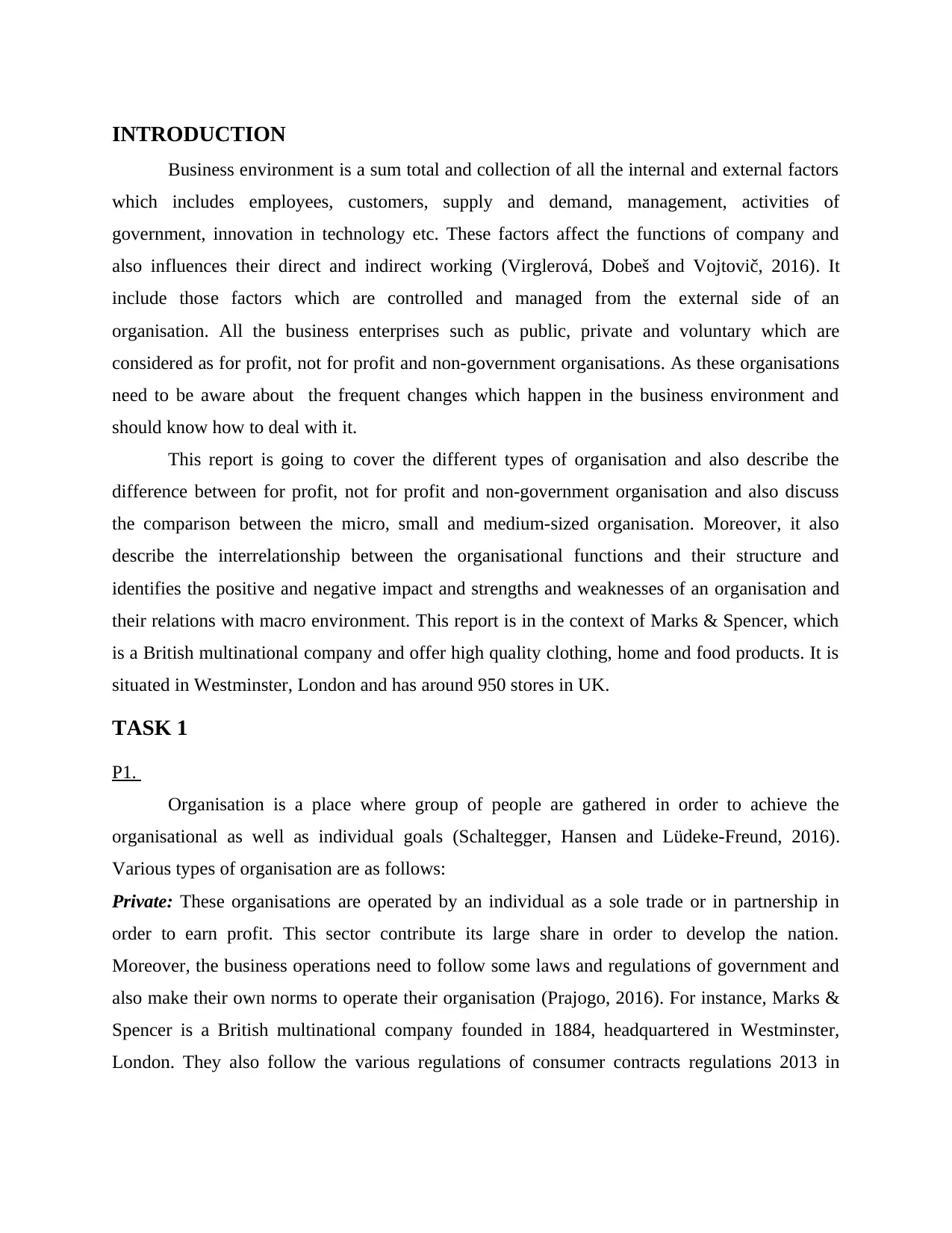
Business environment is a sum total and collection of all the internal and external factors
which includes employees, customers, supply and demand, management, activities of
government, innovation in technology etc. These factors affect the functions of company and
also influences their direct and indirect working (Virglerová, Dobeš and Vojtovič, 2016). It
include those factors which are controlled and managed from the external side of an
organisation. All the business enterprises such as public, private and voluntary which are
considered as for profit, not for profit and non-government organisations. As these organisations
need to be aware about the frequent changes which happen in the business environment and
should know how to deal with it.
This report is going to cover the different types of organisation and also describe the
difference between for profit, not for profit and non-government organisation and also discuss
the comparison between the micro, small and medium-sized organisation. Moreover, it also
describe the interrelationship between the organisational functions and their structure and
identifies the positive and negative impact and strengths and weaknesses of an organisation and
their relations with macro environment. This report is in the context of Marks & Spencer, which
is a British multinational company and offer high quality clothing, home and food products. It is
situated in Westminster, London and has around 950 stores in UK.
TASK 1
P1.
Organisation is a place where group of people are gathered in order to achieve the
organisational as well as individual goals (Schaltegger, Hansen and Lüdeke-Freund, 2016).
Various types of organisation are as follows:
Private: These organisations are operated by an individual as a sole trade or in partnership in
order to earn profit. This sector contribute its large share in order to develop the nation.
Moreover, the business operations need to follow some laws and regulations of government and
also make their own norms to operate their organisation (Prajogo, 2016). For instance, Marks &
Spencer is a British multinational company founded in 1884, headquartered in Westminster,
London. They also follow the various regulations of consumer contracts regulations 2013 in
Business environment is a sum total and collection of all the internal and external factors
which includes employees, customers, supply and demand, management, activities of
government, innovation in technology etc. These factors affect the functions of company and
also influences their direct and indirect working (Virglerová, Dobeš and Vojtovič, 2016). It
include those factors which are controlled and managed from the external side of an
organisation. All the business enterprises such as public, private and voluntary which are
considered as for profit, not for profit and non-government organisations. As these organisations
need to be aware about the frequent changes which happen in the business environment and
should know how to deal with it.
This report is going to cover the different types of organisation and also describe the
difference between for profit, not for profit and non-government organisation and also discuss
the comparison between the micro, small and medium-sized organisation. Moreover, it also
describe the interrelationship between the organisational functions and their structure and
identifies the positive and negative impact and strengths and weaknesses of an organisation and
their relations with macro environment. This report is in the context of Marks & Spencer, which
is a British multinational company and offer high quality clothing, home and food products. It is
situated in Westminster, London and has around 950 stores in UK.
TASK 1
P1.
Organisation is a place where group of people are gathered in order to achieve the
organisational as well as individual goals (Schaltegger, Hansen and Lüdeke-Freund, 2016).
Various types of organisation are as follows:
Private: These organisations are operated by an individual as a sole trade or in partnership in
order to earn profit. This sector contribute its large share in order to develop the nation.
Moreover, the business operations need to follow some laws and regulations of government and
also make their own norms to operate their organisation (Prajogo, 2016). For instance, Marks &
Spencer is a British multinational company founded in 1884, headquartered in Westminster,
London. They also follow the various regulations of consumer contracts regulations 2013 in
Paraphrase This Document
Need a fresh take? Get an instant paraphrase of this document with our AI Paraphraser
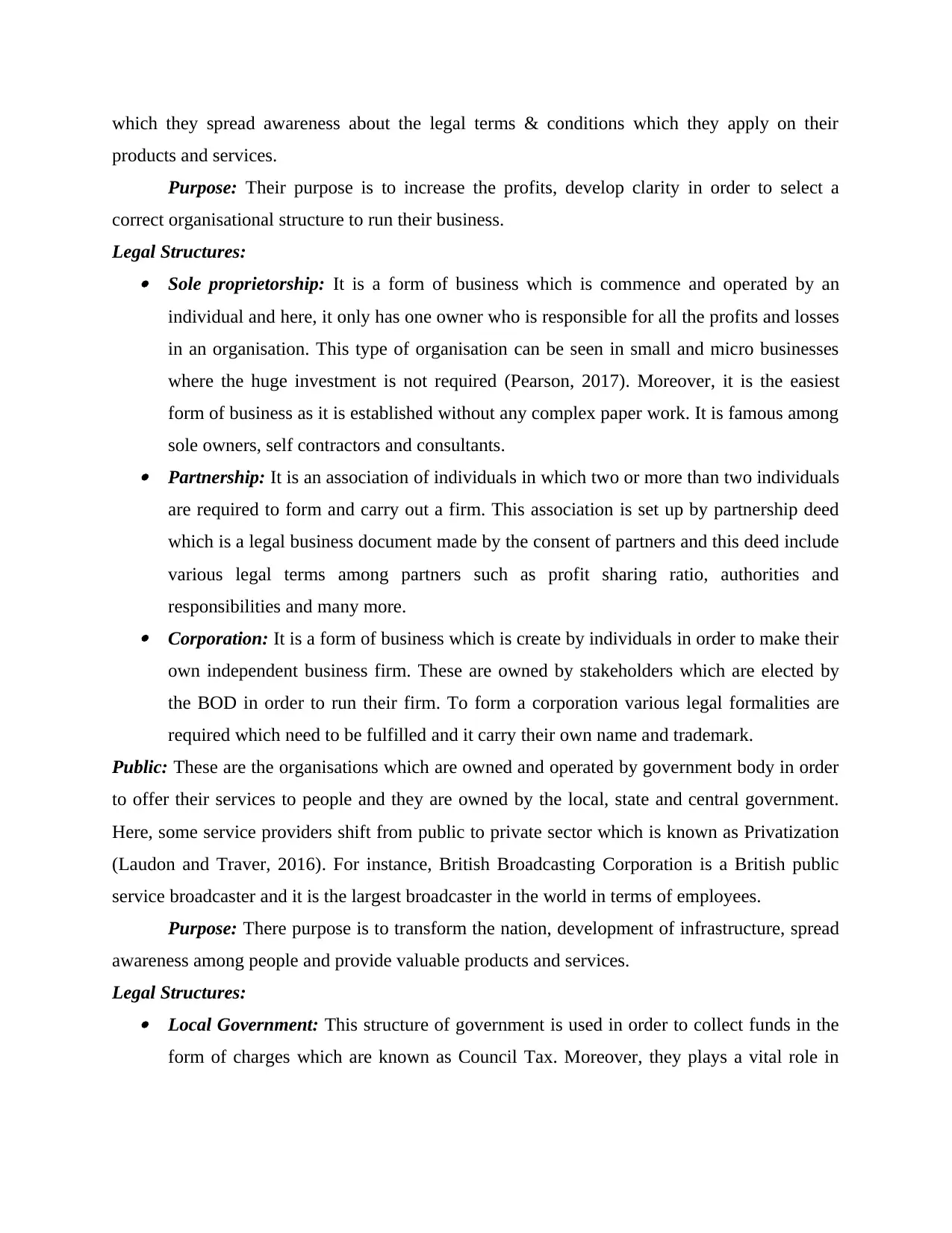
which they spread awareness about the legal terms & conditions which they apply on their
products and services.
Purpose: Their purpose is to increase the profits, develop clarity in order to select a
correct organisational structure to run their business.
Legal Structures: Sole proprietorship: It is a form of business which is commence and operated by an
individual and here, it only has one owner who is responsible for all the profits and losses
in an organisation. This type of organisation can be seen in small and micro businesses
where the huge investment is not required (Pearson, 2017). Moreover, it is the easiest
form of business as it is established without any complex paper work. It is famous among
sole owners, self contractors and consultants. Partnership: It is an association of individuals in which two or more than two individuals
are required to form and carry out a firm. This association is set up by partnership deed
which is a legal business document made by the consent of partners and this deed include
various legal terms among partners such as profit sharing ratio, authorities and
responsibilities and many more. Corporation: It is a form of business which is create by individuals in order to make their
own independent business firm. These are owned by stakeholders which are elected by
the BOD in order to run their firm. To form a corporation various legal formalities are
required which need to be fulfilled and it carry their own name and trademark.
Public: These are the organisations which are owned and operated by government body in order
to offer their services to people and they are owned by the local, state and central government.
Here, some service providers shift from public to private sector which is known as Privatization
(Laudon and Traver, 2016). For instance, British Broadcasting Corporation is a British public
service broadcaster and it is the largest broadcaster in the world in terms of employees.
Purpose: There purpose is to transform the nation, development of infrastructure, spread
awareness among people and provide valuable products and services.
Legal Structures: Local Government: This structure of government is used in order to collect funds in the
form of charges which are known as Council Tax. Moreover, they plays a vital role in
products and services.
Purpose: Their purpose is to increase the profits, develop clarity in order to select a
correct organisational structure to run their business.
Legal Structures: Sole proprietorship: It is a form of business which is commence and operated by an
individual and here, it only has one owner who is responsible for all the profits and losses
in an organisation. This type of organisation can be seen in small and micro businesses
where the huge investment is not required (Pearson, 2017). Moreover, it is the easiest
form of business as it is established without any complex paper work. It is famous among
sole owners, self contractors and consultants. Partnership: It is an association of individuals in which two or more than two individuals
are required to form and carry out a firm. This association is set up by partnership deed
which is a legal business document made by the consent of partners and this deed include
various legal terms among partners such as profit sharing ratio, authorities and
responsibilities and many more. Corporation: It is a form of business which is create by individuals in order to make their
own independent business firm. These are owned by stakeholders which are elected by
the BOD in order to run their firm. To form a corporation various legal formalities are
required which need to be fulfilled and it carry their own name and trademark.
Public: These are the organisations which are owned and operated by government body in order
to offer their services to people and they are owned by the local, state and central government.
Here, some service providers shift from public to private sector which is known as Privatization
(Laudon and Traver, 2016). For instance, British Broadcasting Corporation is a British public
service broadcaster and it is the largest broadcaster in the world in terms of employees.
Purpose: There purpose is to transform the nation, development of infrastructure, spread
awareness among people and provide valuable products and services.
Legal Structures: Local Government: This structure of government is used in order to collect funds in the
form of charges which are known as Council Tax. Moreover, they plays a vital role in
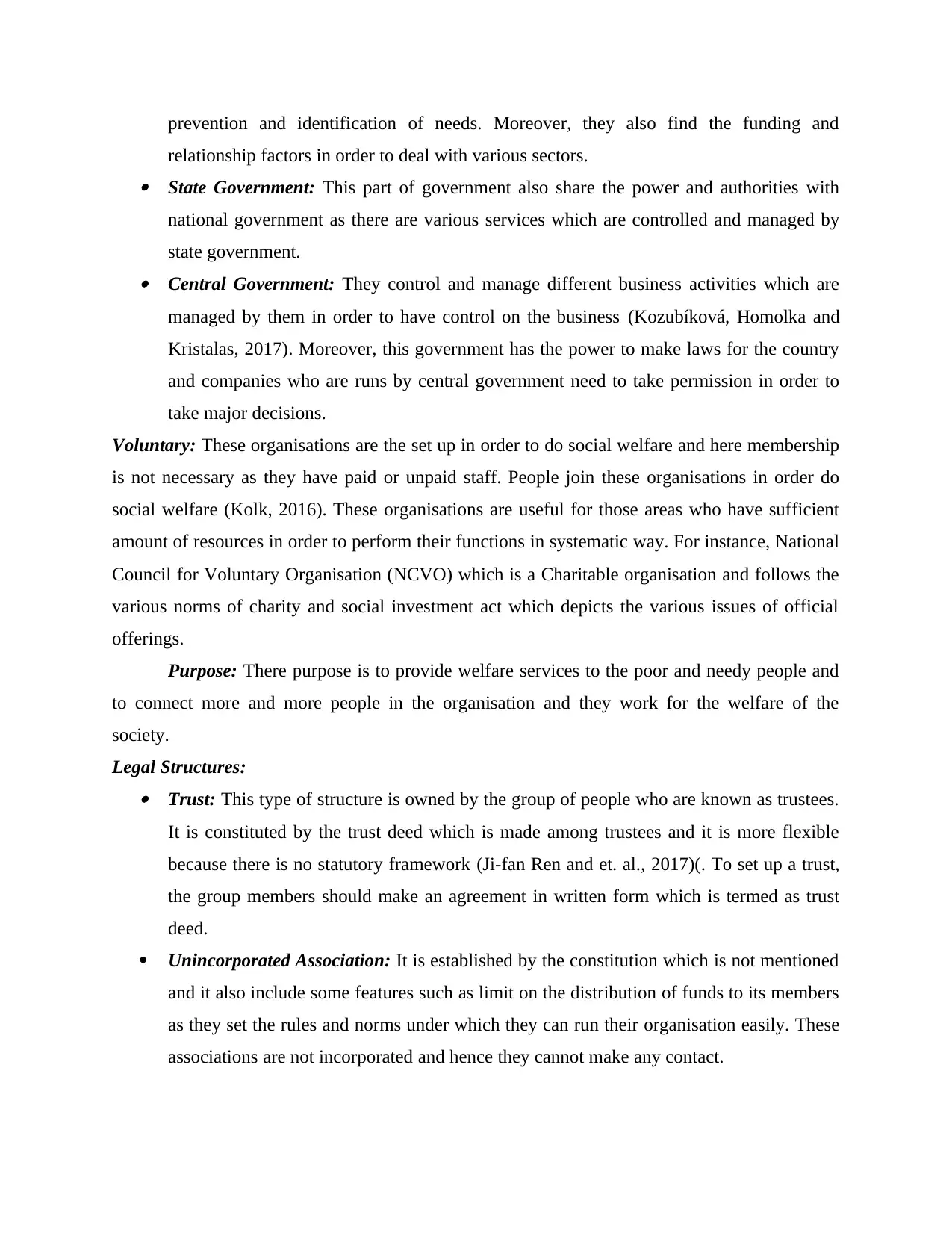
prevention and identification of needs. Moreover, they also find the funding and
relationship factors in order to deal with various sectors. State Government: This part of government also share the power and authorities with
national government as there are various services which are controlled and managed by
state government. Central Government: They control and manage different business activities which are
managed by them in order to have control on the business (Kozubíková, Homolka and
Kristalas, 2017). Moreover, this government has the power to make laws for the country
and companies who are runs by central government need to take permission in order to
take major decisions.
Voluntary: These organisations are the set up in order to do social welfare and here membership
is not necessary as they have paid or unpaid staff. People join these organisations in order do
social welfare (Kolk, 2016). These organisations are useful for those areas who have sufficient
amount of resources in order to perform their functions in systematic way. For instance, National
Council for Voluntary Organisation (NCVO) which is a Charitable organisation and follows the
various norms of charity and social investment act which depicts the various issues of official
offerings.
Purpose: There purpose is to provide welfare services to the poor and needy people and
to connect more and more people in the organisation and they work for the welfare of the
society.
Legal Structures: Trust: This type of structure is owned by the group of people who are known as trustees.
It is constituted by the trust deed which is made among trustees and it is more flexible
because there is no statutory framework (Ji-fan Ren and et. al., 2017)(. To set up a trust,
the group members should make an agreement in written form which is termed as trust
deed.
Unincorporated Association: It is established by the constitution which is not mentioned
and it also include some features such as limit on the distribution of funds to its members
as they set the rules and norms under which they can run their organisation easily. These
associations are not incorporated and hence they cannot make any contact.
relationship factors in order to deal with various sectors. State Government: This part of government also share the power and authorities with
national government as there are various services which are controlled and managed by
state government. Central Government: They control and manage different business activities which are
managed by them in order to have control on the business (Kozubíková, Homolka and
Kristalas, 2017). Moreover, this government has the power to make laws for the country
and companies who are runs by central government need to take permission in order to
take major decisions.
Voluntary: These organisations are the set up in order to do social welfare and here membership
is not necessary as they have paid or unpaid staff. People join these organisations in order do
social welfare (Kolk, 2016). These organisations are useful for those areas who have sufficient
amount of resources in order to perform their functions in systematic way. For instance, National
Council for Voluntary Organisation (NCVO) which is a Charitable organisation and follows the
various norms of charity and social investment act which depicts the various issues of official
offerings.
Purpose: There purpose is to provide welfare services to the poor and needy people and
to connect more and more people in the organisation and they work for the welfare of the
society.
Legal Structures: Trust: This type of structure is owned by the group of people who are known as trustees.
It is constituted by the trust deed which is made among trustees and it is more flexible
because there is no statutory framework (Ji-fan Ren and et. al., 2017)(. To set up a trust,
the group members should make an agreement in written form which is termed as trust
deed.
Unincorporated Association: It is established by the constitution which is not mentioned
and it also include some features such as limit on the distribution of funds to its members
as they set the rules and norms under which they can run their organisation easily. These
associations are not incorporated and hence they cannot make any contact.
⊘ This is a preview!⊘
Do you want full access?
Subscribe today to unlock all pages.
Trusted by 1+ million students worldwide
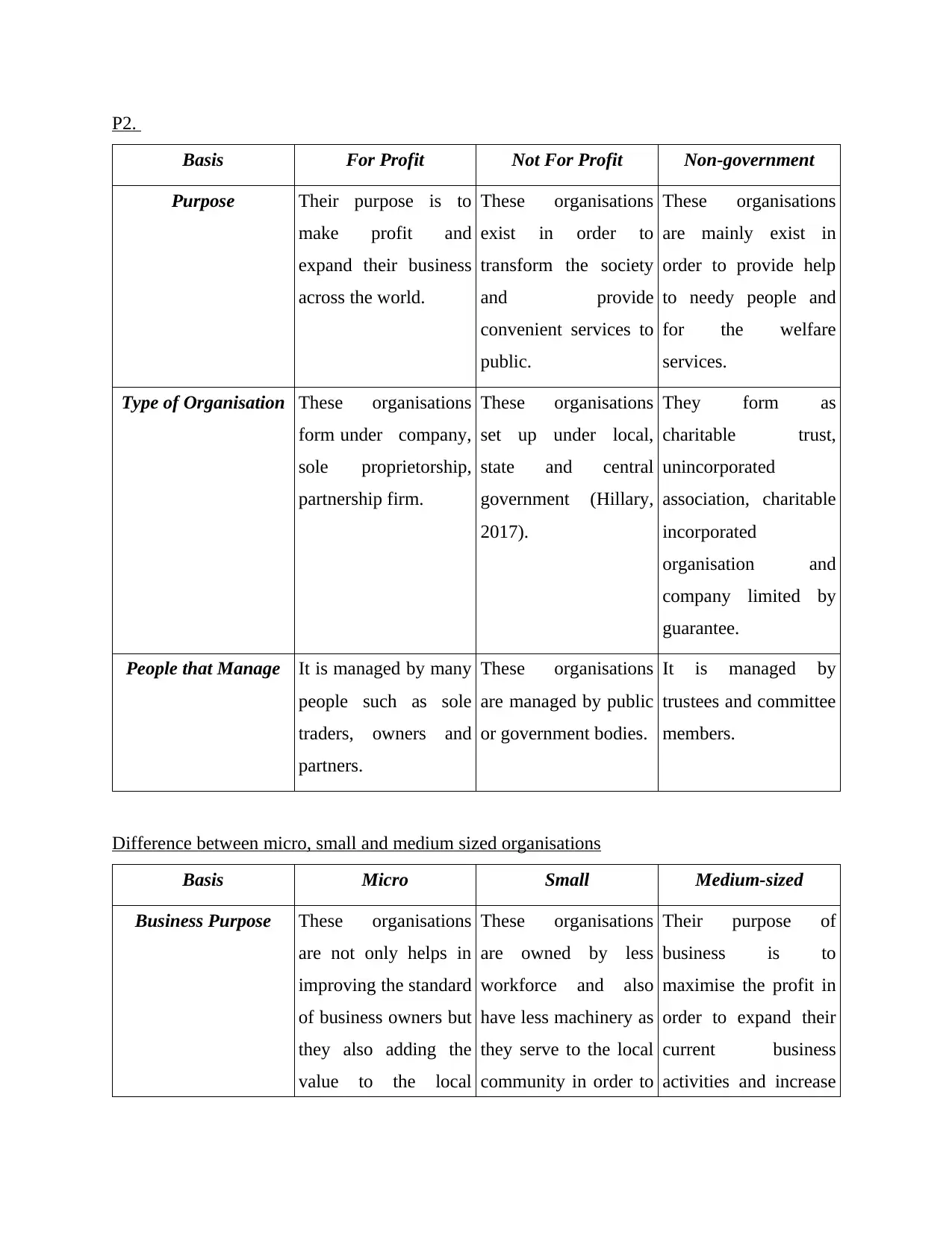
P2.
Basis For Profit Not For Profit Non-government
Purpose Their purpose is to
make profit and
expand their business
across the world.
These organisations
exist in order to
transform the society
and provide
convenient services to
public.
These organisations
are mainly exist in
order to provide help
to needy people and
for the welfare
services.
Type of Organisation These organisations
form under company,
sole proprietorship,
partnership firm.
These organisations
set up under local,
state and central
government (Hillary,
2017).
They form as
charitable trust,
unincorporated
association, charitable
incorporated
organisation and
company limited by
guarantee.
People that Manage It is managed by many
people such as sole
traders, owners and
partners.
These organisations
are managed by public
or government bodies.
It is managed by
trustees and committee
members.
Difference between micro, small and medium sized organisations
Basis Micro Small Medium-sized
Business Purpose These organisations
are not only helps in
improving the standard
of business owners but
they also adding the
value to the local
These organisations
are owned by less
workforce and also
have less machinery as
they serve to the local
community in order to
Their purpose of
business is to
maximise the profit in
order to expand their
current business
activities and increase
Basis For Profit Not For Profit Non-government
Purpose Their purpose is to
make profit and
expand their business
across the world.
These organisations
exist in order to
transform the society
and provide
convenient services to
public.
These organisations
are mainly exist in
order to provide help
to needy people and
for the welfare
services.
Type of Organisation These organisations
form under company,
sole proprietorship,
partnership firm.
These organisations
set up under local,
state and central
government (Hillary,
2017).
They form as
charitable trust,
unincorporated
association, charitable
incorporated
organisation and
company limited by
guarantee.
People that Manage It is managed by many
people such as sole
traders, owners and
partners.
These organisations
are managed by public
or government bodies.
It is managed by
trustees and committee
members.
Difference between micro, small and medium sized organisations
Basis Micro Small Medium-sized
Business Purpose These organisations
are not only helps in
improving the standard
of business owners but
they also adding the
value to the local
These organisations
are owned by less
workforce and also
have less machinery as
they serve to the local
community in order to
Their purpose of
business is to
maximise the profit in
order to expand their
current business
activities and increase
Paraphrase This Document
Need a fresh take? Get an instant paraphrase of this document with our AI Paraphraser
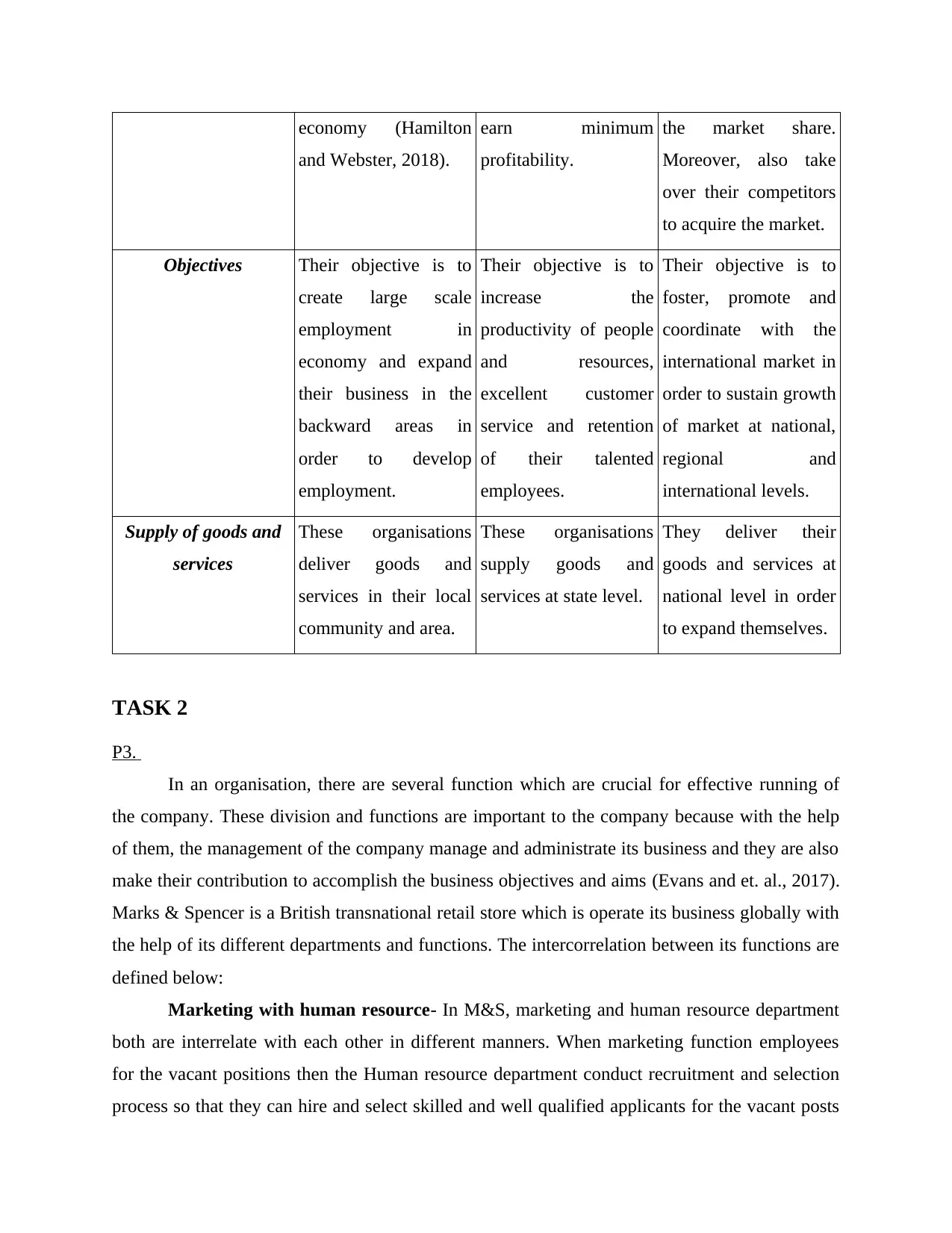
economy (Hamilton
and Webster, 2018).
earn minimum
profitability.
the market share.
Moreover, also take
over their competitors
to acquire the market.
Objectives Their objective is to
create large scale
employment in
economy and expand
their business in the
backward areas in
order to develop
employment.
Their objective is to
increase the
productivity of people
and resources,
excellent customer
service and retention
of their talented
employees.
Their objective is to
foster, promote and
coordinate with the
international market in
order to sustain growth
of market at national,
regional and
international levels.
Supply of goods and
services
These organisations
deliver goods and
services in their local
community and area.
These organisations
supply goods and
services at state level.
They deliver their
goods and services at
national level in order
to expand themselves.
TASK 2
P3.
In an organisation, there are several function which are crucial for effective running of
the company. These division and functions are important to the company because with the help
of them, the management of the company manage and administrate its business and they are also
make their contribution to accomplish the business objectives and aims (Evans and et. al., 2017).
Marks & Spencer is a British transnational retail store which is operate its business globally with
the help of its different departments and functions. The intercorrelation between its functions are
defined below:
Marketing with human resource- In M&S, marketing and human resource department
both are interrelate with each other in different manners. When marketing function employees
for the vacant positions then the Human resource department conduct recruitment and selection
process so that they can hire and select skilled and well qualified applicants for the vacant posts
and Webster, 2018).
earn minimum
profitability.
the market share.
Moreover, also take
over their competitors
to acquire the market.
Objectives Their objective is to
create large scale
employment in
economy and expand
their business in the
backward areas in
order to develop
employment.
Their objective is to
increase the
productivity of people
and resources,
excellent customer
service and retention
of their talented
employees.
Their objective is to
foster, promote and
coordinate with the
international market in
order to sustain growth
of market at national,
regional and
international levels.
Supply of goods and
services
These organisations
deliver goods and
services in their local
community and area.
These organisations
supply goods and
services at state level.
They deliver their
goods and services at
national level in order
to expand themselves.
TASK 2
P3.
In an organisation, there are several function which are crucial for effective running of
the company. These division and functions are important to the company because with the help
of them, the management of the company manage and administrate its business and they are also
make their contribution to accomplish the business objectives and aims (Evans and et. al., 2017).
Marks & Spencer is a British transnational retail store which is operate its business globally with
the help of its different departments and functions. The intercorrelation between its functions are
defined below:
Marketing with human resource- In M&S, marketing and human resource department
both are interrelate with each other in different manners. When marketing function employees
for the vacant positions then the Human resource department conduct recruitment and selection
process so that they can hire and select skilled and well qualified applicants for the vacant posts
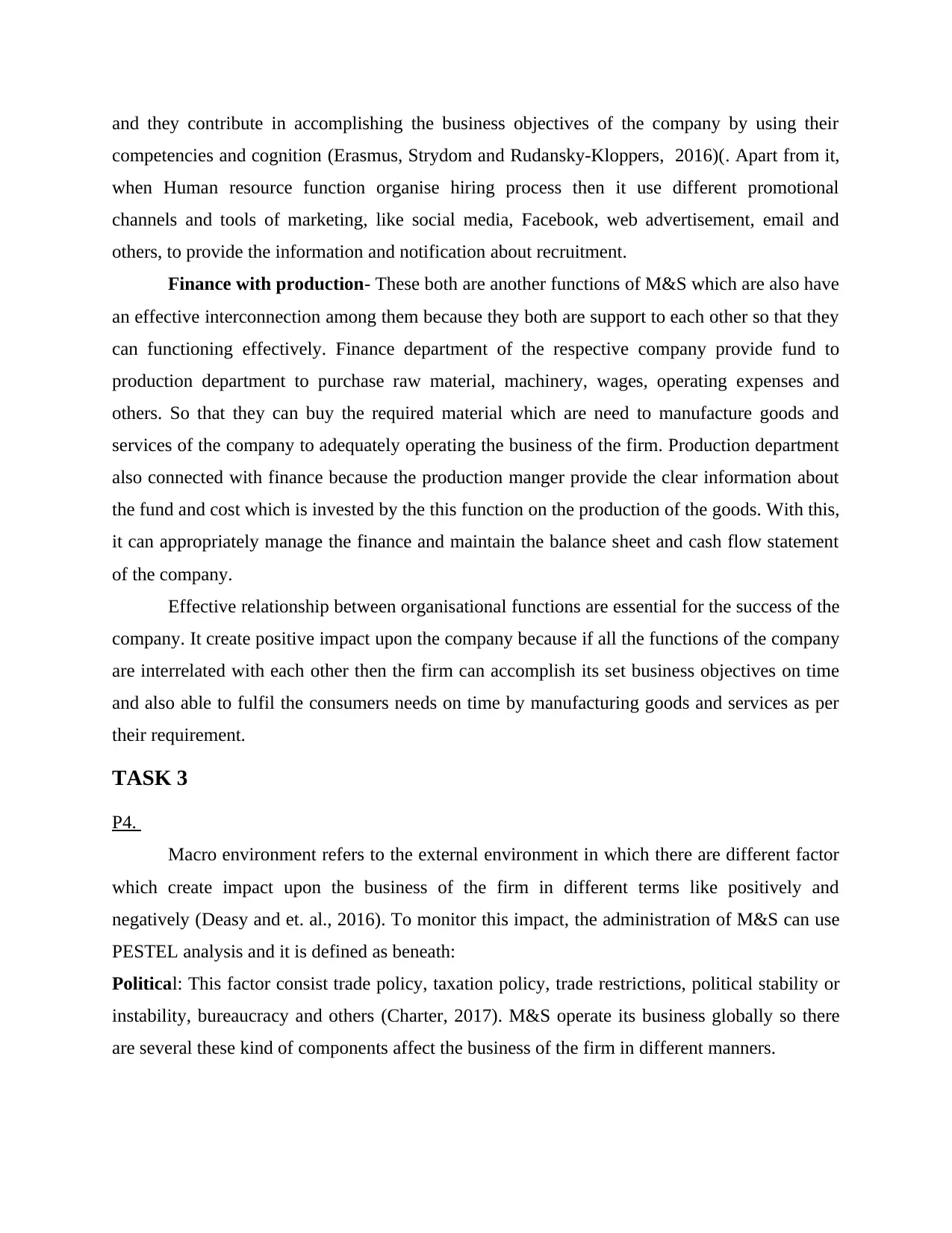
and they contribute in accomplishing the business objectives of the company by using their
competencies and cognition (Erasmus, Strydom and Rudansky-Kloppers, 2016)(. Apart from it,
when Human resource function organise hiring process then it use different promotional
channels and tools of marketing, like social media, Facebook, web advertisement, email and
others, to provide the information and notification about recruitment.
Finance with production- These both are another functions of M&S which are also have
an effective interconnection among them because they both are support to each other so that they
can functioning effectively. Finance department of the respective company provide fund to
production department to purchase raw material, machinery, wages, operating expenses and
others. So that they can buy the required material which are need to manufacture goods and
services of the company to adequately operating the business of the firm. Production department
also connected with finance because the production manger provide the clear information about
the fund and cost which is invested by the this function on the production of the goods. With this,
it can appropriately manage the finance and maintain the balance sheet and cash flow statement
of the company.
Effective relationship between organisational functions are essential for the success of the
company. It create positive impact upon the company because if all the functions of the company
are interrelated with each other then the firm can accomplish its set business objectives on time
and also able to fulfil the consumers needs on time by manufacturing goods and services as per
their requirement.
TASK 3
P4.
Macro environment refers to the external environment in which there are different factor
which create impact upon the business of the firm in different terms like positively and
negatively (Deasy and et. al., 2016). To monitor this impact, the administration of M&S can use
PESTEL analysis and it is defined as beneath:
Political: This factor consist trade policy, taxation policy, trade restrictions, political stability or
instability, bureaucracy and others (Charter, 2017). M&S operate its business globally so there
are several these kind of components affect the business of the firm in different manners.
competencies and cognition (Erasmus, Strydom and Rudansky-Kloppers, 2016)(. Apart from it,
when Human resource function organise hiring process then it use different promotional
channels and tools of marketing, like social media, Facebook, web advertisement, email and
others, to provide the information and notification about recruitment.
Finance with production- These both are another functions of M&S which are also have
an effective interconnection among them because they both are support to each other so that they
can functioning effectively. Finance department of the respective company provide fund to
production department to purchase raw material, machinery, wages, operating expenses and
others. So that they can buy the required material which are need to manufacture goods and
services of the company to adequately operating the business of the firm. Production department
also connected with finance because the production manger provide the clear information about
the fund and cost which is invested by the this function on the production of the goods. With this,
it can appropriately manage the finance and maintain the balance sheet and cash flow statement
of the company.
Effective relationship between organisational functions are essential for the success of the
company. It create positive impact upon the company because if all the functions of the company
are interrelated with each other then the firm can accomplish its set business objectives on time
and also able to fulfil the consumers needs on time by manufacturing goods and services as per
their requirement.
TASK 3
P4.
Macro environment refers to the external environment in which there are different factor
which create impact upon the business of the firm in different terms like positively and
negatively (Deasy and et. al., 2016). To monitor this impact, the administration of M&S can use
PESTEL analysis and it is defined as beneath:
Political: This factor consist trade policy, taxation policy, trade restrictions, political stability or
instability, bureaucracy and others (Charter, 2017). M&S operate its business globally so there
are several these kind of components affect the business of the firm in different manners.
⊘ This is a preview!⊘
Do you want full access?
Subscribe today to unlock all pages.
Trusted by 1+ million students worldwide
Positive: Free trade policies have been a monolithic political welfare for M&S and its
almost 1500 overseas retail store. The respective company favoured by EC's free trade concord
so have led to reduced beginning expenditure (Marks and Spencer PESTLE Analysis, 2019).
Negative: As Brexit put negative impact on the operations of company in order to import
and export its products especially in terms of trade regulations.
Economical: This factor overlook the performance of economy which include the economic
growth, exchange rates, inflation, interest and many more. Currently, the economic condition of
company is uncertain and affect its sales (Chang, 2016).
Positive: The premium pricing strategy of the company helps in improving its growth and
success in the competitive market which defines its quality which is offered by company.
Negative: Prices have always become the biggest factor in the retail industry but the
competitors of M&S start providing discounts on their products which influences the sales of the
M&S (Marks and Spencer PESTLE Analysis, 2019).
Social: It is the environment which represents the demographic norms, values, trends and
customs in which the organisation operates (Virglerová, Dobeš and Vojtovič, 2016). Marks &
Spencer appeal to different markets in terms of social class which majorly influences the
company and its current issues.
Positive: M&S provide various services to their respective customers and after this, they
are now ready to serve themselves in the food sector in which they provide hygienic and healthy
food products in order to attract large amount of customers.
Negative: The reputation become less trendy for their younger consumers because of the
designs and trends which is followed by company. Their motive is to provide quality instead of
being trendy.
Technological: These factors affect the technological terms which include operations, level of
innovation, automation, R&D and many more. This factor plays an important role in terms of
retail market as it helps in managing their brands and also useful for promoting and advertising
the creation of brand awareness among people.
Positive: Self-checkout service which is provided by the company to their food stores as
it is in trend which is designed to save money which people spent on cashiers and helpful for
customers in order to provide faster experience (Marks and Spencer PESTLE Analysis, 2019).
almost 1500 overseas retail store. The respective company favoured by EC's free trade concord
so have led to reduced beginning expenditure (Marks and Spencer PESTLE Analysis, 2019).
Negative: As Brexit put negative impact on the operations of company in order to import
and export its products especially in terms of trade regulations.
Economical: This factor overlook the performance of economy which include the economic
growth, exchange rates, inflation, interest and many more. Currently, the economic condition of
company is uncertain and affect its sales (Chang, 2016).
Positive: The premium pricing strategy of the company helps in improving its growth and
success in the competitive market which defines its quality which is offered by company.
Negative: Prices have always become the biggest factor in the retail industry but the
competitors of M&S start providing discounts on their products which influences the sales of the
M&S (Marks and Spencer PESTLE Analysis, 2019).
Social: It is the environment which represents the demographic norms, values, trends and
customs in which the organisation operates (Virglerová, Dobeš and Vojtovič, 2016). Marks &
Spencer appeal to different markets in terms of social class which majorly influences the
company and its current issues.
Positive: M&S provide various services to their respective customers and after this, they
are now ready to serve themselves in the food sector in which they provide hygienic and healthy
food products in order to attract large amount of customers.
Negative: The reputation become less trendy for their younger consumers because of the
designs and trends which is followed by company. Their motive is to provide quality instead of
being trendy.
Technological: These factors affect the technological terms which include operations, level of
innovation, automation, R&D and many more. This factor plays an important role in terms of
retail market as it helps in managing their brands and also useful for promoting and advertising
the creation of brand awareness among people.
Positive: Self-checkout service which is provided by the company to their food stores as
it is in trend which is designed to save money which people spent on cashiers and helpful for
customers in order to provide faster experience (Marks and Spencer PESTLE Analysis, 2019).
Paraphrase This Document
Need a fresh take? Get an instant paraphrase of this document with our AI Paraphraser
Negative: The online services which are provided by company put negative impact in
terms of food as they does not deliver the food products just like other food stores.
Environmental: This factor become important in terms of increasing the scarcity of raw
materials, carbon footprints, environmental offsets and many more.
Positive: The green policy which is adopted by the company in order to protect the
market and its conditions and they named it “Plan A” which is useful for the carbon emission
and become a zero waste to landfill.
Negative: In the context to M&S, they does not conduct market research before entering
into new market which can become risky for them in order to launch their products.
Legal: This factor describes the various laws and legislations which needs to follow by company
in order to achieve sustainability. Retailers should follow various resources in order to meet
various legislation which can abide them during their regulation (Schaltegger, Hansen and
Lüdeke-Freund, 2016). It becomes tricky when company expand its business and start online
trading.
Positive: Company adopt fair packaging and labelling act which helps their respective
customers in order to provide general information of the product such as what the package
contains, who made it and how much it contains (Marks and Spencer PESTLE Analysis, 2019).
Negative: It is found that Company exploit their workers and induces them to work 7
days which is violation of Labour act and because of this company breaches its legal policies.
TASK 4
P5.
SWOT Analysis of Marks & Spencer
Strengths Weaknesses
Expansion of business at global level
strengthen the UK market.
Company is achieving success in order
to implement new projects which helps
in earning valuable returns (Prajogo,
2016).
Company is not capable enough to
accept its challenges because its
competitors occupy its marketplace.
The price factor is its weakness as they
charge high prices which cannot be
afford by the middle class customers.
Opportunities Threats
terms of food as they does not deliver the food products just like other food stores.
Environmental: This factor become important in terms of increasing the scarcity of raw
materials, carbon footprints, environmental offsets and many more.
Positive: The green policy which is adopted by the company in order to protect the
market and its conditions and they named it “Plan A” which is useful for the carbon emission
and become a zero waste to landfill.
Negative: In the context to M&S, they does not conduct market research before entering
into new market which can become risky for them in order to launch their products.
Legal: This factor describes the various laws and legislations which needs to follow by company
in order to achieve sustainability. Retailers should follow various resources in order to meet
various legislation which can abide them during their regulation (Schaltegger, Hansen and
Lüdeke-Freund, 2016). It becomes tricky when company expand its business and start online
trading.
Positive: Company adopt fair packaging and labelling act which helps their respective
customers in order to provide general information of the product such as what the package
contains, who made it and how much it contains (Marks and Spencer PESTLE Analysis, 2019).
Negative: It is found that Company exploit their workers and induces them to work 7
days which is violation of Labour act and because of this company breaches its legal policies.
TASK 4
P5.
SWOT Analysis of Marks & Spencer
Strengths Weaknesses
Expansion of business at global level
strengthen the UK market.
Company is achieving success in order
to implement new projects which helps
in earning valuable returns (Prajogo,
2016).
Company is not capable enough to
accept its challenges because its
competitors occupy its marketplace.
The price factor is its weakness as they
charge high prices which cannot be
afford by the middle class customers.
Opportunities Threats
Company has an opportunity in order to
merge with more suppliers which is
helpful in terms of saving its
manufacturing cost and helps in
acquiring new market segment.
Moreover, the brand reputation of
company helps in its expansion and
premium pricing policy (Pearson,
2017).
Company faces law suits in many
countries in which they exploit the
political climate by changing its
policies frequently.
M&S has threat from its competitors
such as Amazon, TESCO and many
more.
Porter's Five Forces Model Threat of New Entrants: This factor describes the threat of new entry which is moderate
in terms of low level changes and high variable capital cost in order to establish a new
business. Therefore, in terms of M&S they have strong brand reputation which helps in
making their products success in the market. Threat of Substitute: It describes the alternate factors which can become threat for the
company and its products (Laudon and Traver, 2016). In this context, substitute products
can become threat for the company which can affect the brand and its production. This
force is high as in the diversified business environment the customers can easily switch
from one product to another. Bargaining power of Suppliers: In the context of M&S, the negotiation power of
suppliers is low because in clothing and food industry there are lot of suppliers present in
the market. Hence, company can easily switch from one to another. Bargaining power of Buyers: In terms of M&S, the bargaining power of customers is
high because customers can easily switch from one brand to another one (Kolk, 2016).
Therefore, in order to retain them M&S offer various Discounts, offers and vouchers in
order to retain their customers.
Competitive Rivalry: In this industry the intensity of competitors in retail sector is high
because the services which they provide are also provided by their competitors including,
TESCO, Asda, local market and many more. As each sector is spending on advertising in
order tom open new franchise which helps in developing their customer base.
merge with more suppliers which is
helpful in terms of saving its
manufacturing cost and helps in
acquiring new market segment.
Moreover, the brand reputation of
company helps in its expansion and
premium pricing policy (Pearson,
2017).
Company faces law suits in many
countries in which they exploit the
political climate by changing its
policies frequently.
M&S has threat from its competitors
such as Amazon, TESCO and many
more.
Porter's Five Forces Model Threat of New Entrants: This factor describes the threat of new entry which is moderate
in terms of low level changes and high variable capital cost in order to establish a new
business. Therefore, in terms of M&S they have strong brand reputation which helps in
making their products success in the market. Threat of Substitute: It describes the alternate factors which can become threat for the
company and its products (Laudon and Traver, 2016). In this context, substitute products
can become threat for the company which can affect the brand and its production. This
force is high as in the diversified business environment the customers can easily switch
from one product to another. Bargaining power of Suppliers: In the context of M&S, the negotiation power of
suppliers is low because in clothing and food industry there are lot of suppliers present in
the market. Hence, company can easily switch from one to another. Bargaining power of Buyers: In terms of M&S, the bargaining power of customers is
high because customers can easily switch from one brand to another one (Kolk, 2016).
Therefore, in order to retain them M&S offer various Discounts, offers and vouchers in
order to retain their customers.
Competitive Rivalry: In this industry the intensity of competitors in retail sector is high
because the services which they provide are also provided by their competitors including,
TESCO, Asda, local market and many more. As each sector is spending on advertising in
order tom open new franchise which helps in developing their customer base.
⊘ This is a preview!⊘
Do you want full access?
Subscribe today to unlock all pages.
Trusted by 1+ million students worldwide

1 out of 15


Related Documents


Your All-in-One AI-Powered Toolkit for Academic Success.
+13062052269
info@desklib.com
Available 24*7 on WhatsApp / Email
![[object Object]](/_next/static/media/star-bottom.7253800d.svg)
Unlock your academic potential
Copyright © 2020–2026 A2Z Services. All Rights Reserved. Developed and managed by ZUCOL.