Analysis of Business Management and Marketing Orientation Approaches
VerifiedAdded on 2023/06/10
|13
|2614
|58
Report
AI Summary
This report provides a comprehensive overview of business management and marketing, focusing on the contrasting approaches of marketing orientation and product orientation. It defines and differentiates these two orientations, explaining how marketing orientation prioritizes understanding and meeting customer needs through the product mix, while product orientation emphasizes efficient production and quality product development. The report details the advantages and disadvantages of each orientation, such as increased customer focus and brand loyalty versus the risk of market underestimation and challenges in adapting to quick market changes. It analyzes which approach is more suitable for long-term business success, arguing in favor of marketing orientation due to its customer-centric approach. The report also outlines the steps a business must take to adjust its orientation, including focusing on customer satisfaction, fostering interdepartmental communication, and utilizing tools like the Ansoff Matrix for growth strategies such as market penetration, market development, product development, and diversification. The report concludes by reiterating the importance of understanding customer desires in shaping successful marketing strategies.
Running head: BUSINESS MANAGEMENT AND MARKETING
Business Management and Marketing
Name of the Student:
Name of the University:
Author Note:
Business Management and Marketing
Name of the Student:
Name of the University:
Author Note:

Paraphrase This Document
Need a fresh take? Get an instant paraphrase of this document with our AI Paraphraser
1BUSINESS MANAGEMENT AND MARKETING
Executive Summary:
The report is a discussion on business management and marketing in terms of marketing
orientation and product orientation. The report discusses about the advantages and disadvantages
of the marketing orientation and production and puts up a section on which approach is the most
suitable for long-term business. The report also discusses about the steps that a business
undertakes in adapting to its orientation along with the challenges faced ahead.
Executive Summary:
The report is a discussion on business management and marketing in terms of marketing
orientation and product orientation. The report discusses about the advantages and disadvantages
of the marketing orientation and production and puts up a section on which approach is the most
suitable for long-term business. The report also discusses about the steps that a business
undertakes in adapting to its orientation along with the challenges faced ahead.
2BUSINESS MANAGEMENT AND MARKETING
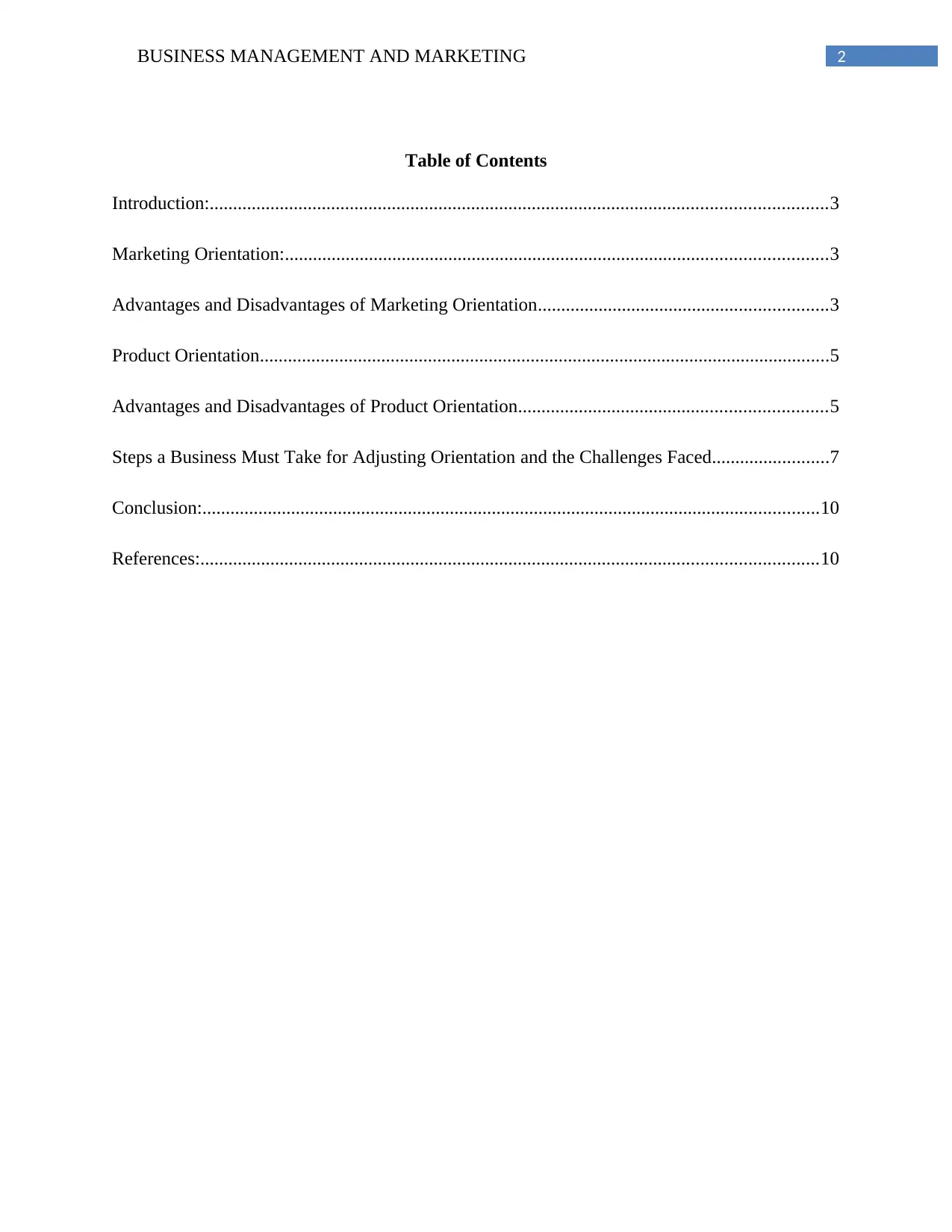
Table of Contents
Introduction:....................................................................................................................................3
Marketing Orientation:....................................................................................................................3
Advantages and Disadvantages of Marketing Orientation..............................................................3
Product Orientation..........................................................................................................................5
Advantages and Disadvantages of Product Orientation..................................................................5
Steps a Business Must Take for Adjusting Orientation and the Challenges Faced.........................7
Conclusion:....................................................................................................................................10
References:....................................................................................................................................10
Table of Contents
Introduction:....................................................................................................................................3
Marketing Orientation:....................................................................................................................3
Advantages and Disadvantages of Marketing Orientation..............................................................3
Product Orientation..........................................................................................................................5
Advantages and Disadvantages of Product Orientation..................................................................5
Steps a Business Must Take for Adjusting Orientation and the Challenges Faced.........................7
Conclusion:....................................................................................................................................10
References:....................................................................................................................................10
⊘ This is a preview!⊘
Do you want full access?
Subscribe today to unlock all pages.

Trusted by 1+ million students worldwide
3BUSINESS MANAGEMENT AND MARKETING
Introduction:
The report gives an overview of business management and marketing in the context of
two conflicting ends of the customer orientation spectrum that includes the marketing orientation
and product orientation. Market orientation defined as the philosophy of the company on meeting
and discovering the desires and the needs of the customers through the product mix. Product
orientation takes place when a company tries to ignore the needs of the customers and focus on
efficient building of the quality products. The report also tries to portray the positive and the
negative aspect of each orientation and finally draw a conclusion on which of the approaches
proves to be ideal for long-term business. The report even tries to provide an insight into the
steps that a business might take for its orientation and the challenges faced in the process.
Marketing Orientation:
Market orientation refers to the philosophy of the company for discovering and meeting
the needs and desires of the customers through the product mix (Kamin and Anker 2014). Market
orientation refers to the marketing campaign that is coordinated between the customers and the
company. In other words, market orientation refers to customer-centered approach for designing
a product. For example, a car company engaged in market orientation will first research the
wants and needs of the consumer in a car rather than producing models for following the trend of
the other manufacturers.
Advantages and Disadvantages of Marketing Orientation
The advantages of marketing orientation include (Babin and Zikmund 2015):
Introduction:
The report gives an overview of business management and marketing in the context of
two conflicting ends of the customer orientation spectrum that includes the marketing orientation
and product orientation. Market orientation defined as the philosophy of the company on meeting
and discovering the desires and the needs of the customers through the product mix. Product
orientation takes place when a company tries to ignore the needs of the customers and focus on
efficient building of the quality products. The report also tries to portray the positive and the
negative aspect of each orientation and finally draw a conclusion on which of the approaches
proves to be ideal for long-term business. The report even tries to provide an insight into the
steps that a business might take for its orientation and the challenges faced in the process.
Marketing Orientation:
Market orientation refers to the philosophy of the company for discovering and meeting
the needs and desires of the customers through the product mix (Kamin and Anker 2014). Market
orientation refers to the marketing campaign that is coordinated between the customers and the
company. In other words, market orientation refers to customer-centered approach for designing
a product. For example, a car company engaged in market orientation will first research the
wants and needs of the consumer in a car rather than producing models for following the trend of
the other manufacturers.
Advantages and Disadvantages of Marketing Orientation
The advantages of marketing orientation include (Babin and Zikmund 2015):
Paraphrase This Document
Need a fresh take? Get an instant paraphrase of this document with our AI Paraphraser
4BUSINESS MANAGEMENT AND MARKETING
Increased Focus on Production: With the primary focus on the customer needs,
companies will be able to develop product that ensures matching the customer needs.
This makes the customer more satisfied with the products thereby instilling brand loyalty
and repeat purchases.
Adoption of a Concentrated Strategy: Market orientation enables a firm in aligning its
functions with the organization’s strategic vision for meeting the needs of the customers.
This helps clearly defining the role of the employees in producing products for meeting
the customer needs
Enhanced Effectiveness in Marketing: A proper understanding of wants and needs of the
market enables a company in adopting effective marketing strategy. Moreover,
familiarity with market enables the marketers in building emotional appeals through
advertisements and in the generation of more business.
Long Term Profit: The consistency in delivering and understanding the wants of the
market place leads to the long-term profitability.
The disadvantages of marketing orientation include ( Malhotra 2015):
Risk of Market Underestimation: Sometimes ineffective data acts as a disadvantage in
establishing a systematic approach to market orientation.
Risk of Customer Underestimation: Lack of flexibility in market orientation approach
and the inability of meeting the ever-changing thought process and demand of the tech
perceptive shoppers leads to customer underestimation
Adapting to Quick Market Changes: The market orientation is influenced by the new
players exiting and entering market, the advances to the existing products and the cost of
the services, products and the raw material
Increased Focus on Production: With the primary focus on the customer needs,
companies will be able to develop product that ensures matching the customer needs.
This makes the customer more satisfied with the products thereby instilling brand loyalty
and repeat purchases.
Adoption of a Concentrated Strategy: Market orientation enables a firm in aligning its
functions with the organization’s strategic vision for meeting the needs of the customers.
This helps clearly defining the role of the employees in producing products for meeting
the customer needs
Enhanced Effectiveness in Marketing: A proper understanding of wants and needs of the
market enables a company in adopting effective marketing strategy. Moreover,
familiarity with market enables the marketers in building emotional appeals through
advertisements and in the generation of more business.
Long Term Profit: The consistency in delivering and understanding the wants of the
market place leads to the long-term profitability.
The disadvantages of marketing orientation include ( Malhotra 2015):
Risk of Market Underestimation: Sometimes ineffective data acts as a disadvantage in
establishing a systematic approach to market orientation.
Risk of Customer Underestimation: Lack of flexibility in market orientation approach
and the inability of meeting the ever-changing thought process and demand of the tech
perceptive shoppers leads to customer underestimation
Adapting to Quick Market Changes: The market orientation is influenced by the new
players exiting and entering market, the advances to the existing products and the cost of
the services, products and the raw material
5BUSINESS MANAGEMENT AND MARKETING
Challenges of Corporate Perceptions: Having a knowledge of the customer needs and
wants is not enough for guarantying a market share, as consumer perception and branding
are equally important.
Product Orientation
Product orientation refers to the company’s orientation in solely focusing on the products.
Therefore, a product-oriented company ensures utmost effort on the producing quality product
by fixing the right price so that the consumer is able to differentiate the product and make a
purchase(Tomczak, Reinecke and Kuss 2018). For example, the Gillette Company focuses on the
production of the best disposable razor at an economic rate. Thus, the company differentiates its
products with a higher razor quality blade, pricing strategy and the ease of use.
Advantages and Disadvantages of Product Orientation
The advantages of product orientation include(Kim, Im and Slater 2013):
Enhanced Product Quality: By adopting product orientation, the business will be able to
focus on the product quality.
Allows Technological Advancement: This orientation method leads to the development
of technology used for a wider product range.
Develop Economies of Scale: This helps in reducing the production cost with the increase
in the number of manufactured products.
Ensures Outsourcing: This type of orientation helps a business in manufacturing single
product and makes it the best possible one
The disadvantages of product orientation include (Bouncken et al. 2016):
Challenges of Corporate Perceptions: Having a knowledge of the customer needs and
wants is not enough for guarantying a market share, as consumer perception and branding
are equally important.
Product Orientation
Product orientation refers to the company’s orientation in solely focusing on the products.
Therefore, a product-oriented company ensures utmost effort on the producing quality product
by fixing the right price so that the consumer is able to differentiate the product and make a
purchase(Tomczak, Reinecke and Kuss 2018). For example, the Gillette Company focuses on the
production of the best disposable razor at an economic rate. Thus, the company differentiates its
products with a higher razor quality blade, pricing strategy and the ease of use.
Advantages and Disadvantages of Product Orientation
The advantages of product orientation include(Kim, Im and Slater 2013):
Enhanced Product Quality: By adopting product orientation, the business will be able to
focus on the product quality.
Allows Technological Advancement: This orientation method leads to the development
of technology used for a wider product range.
Develop Economies of Scale: This helps in reducing the production cost with the increase
in the number of manufactured products.
Ensures Outsourcing: This type of orientation helps a business in manufacturing single
product and makes it the best possible one
The disadvantages of product orientation include (Bouncken et al. 2016):
⊘ This is a preview!⊘
Do you want full access?
Subscribe today to unlock all pages.
Trusted by 1+ million students worldwide
6BUSINESS MANAGEMENT AND MARKETING
Missing on the Opportunity: When the company builds a superior product, it might be the
case that the customers do not always want the best and it will cost a product oriented
company in exploiting opportunities.
The Aspect of Obsolescence: When the focus remains solely on the production features,
construction, cost and quality it might be the case that a new competitor with other
market factors and change in the technology can put the company out of the business.
Leads to Narrow Branding: In this approach, it is necessary for developing brands with
clear messages otherwise, there will be limitation on what the company can sell.
Approach Suitable for Long Term Business Success
The marketing orientation is the most suitable approach as it provides customer service and
supports improvements towards the desires of the specific customers (Ford and Leonidou 2013.).
This makes sure that the customer satisfaction remains quite high with the company thereby
providing a means for the promotion of the brand loyalty and advertising through the word of
mouth. Marketing orientation also helps in developing the product in a manner that is able to
anticipate the needs of the customers. Thus, the primary benefit of the marketing approach to an
organization lies in information about the customers along with their preferences converted into
profitable knowledge. This also helps in revealing the desires of the customer that are not cost
effective for implementation. Thus, with market orientation the business is left in a position
where it has to determine the consumer stated needs for yielding the optimum returns of the
business while meeting the customer needs and expectations. This also helps in promoting the
long-term development business strategy that might be cost effective in future (Mukerjee 2013).
Missing on the Opportunity: When the company builds a superior product, it might be the
case that the customers do not always want the best and it will cost a product oriented
company in exploiting opportunities.
The Aspect of Obsolescence: When the focus remains solely on the production features,
construction, cost and quality it might be the case that a new competitor with other
market factors and change in the technology can put the company out of the business.
Leads to Narrow Branding: In this approach, it is necessary for developing brands with
clear messages otherwise, there will be limitation on what the company can sell.
Approach Suitable for Long Term Business Success
The marketing orientation is the most suitable approach as it provides customer service and
supports improvements towards the desires of the specific customers (Ford and Leonidou 2013.).
This makes sure that the customer satisfaction remains quite high with the company thereby
providing a means for the promotion of the brand loyalty and advertising through the word of
mouth. Marketing orientation also helps in developing the product in a manner that is able to
anticipate the needs of the customers. Thus, the primary benefit of the marketing approach to an
organization lies in information about the customers along with their preferences converted into
profitable knowledge. This also helps in revealing the desires of the customer that are not cost
effective for implementation. Thus, with market orientation the business is left in a position
where it has to determine the consumer stated needs for yielding the optimum returns of the
business while meeting the customer needs and expectations. This also helps in promoting the
long-term development business strategy that might be cost effective in future (Mukerjee 2013).
Paraphrase This Document
Need a fresh take? Get an instant paraphrase of this document with our AI Paraphraser
7BUSINESS MANAGEMENT AND MARKETING
Steps a Business Must Take for Adjusting Orientation and the Challenges Faced
One of the key steps for adjusting a business to the marketing orientation approach
involves the sole focus of the staff on the aspects of the customer satisfaction with each of the
department expressing awareness about the fact that the company strategy remains fine tuned in
achieving the goal (Trkman 2013). As the information forms a vital part of company
competitiveness, communications between the individual members of the staffs and the
department proves to be vital thereby implying that companies following a marketing orientation
approach benefits from not only possessing a horizontal structure of the management but also
encourage cross collaboration(Harper2015). Such commitment towards the interdepartmental
synergy is even extended outwards the customers of a single company is treated preferentially by
the other associated companies. A company can use this as a combination of activities like the
activities related to running put forward by Nike (nike.com 2018). In this manner, the company
is not only providing its customers with an activity attractive to them but also gathering
customers for promoting the products of the company.
Thus, a marketing orientation depends on understanding the needs of the customers that
implies that a company must spend suitable effort and time in collection of information later
turned into helpful knowledge in anticipating the customer needs (Urde, Baumgarth and
Merrilees 2013). Although the marketing mix or the four P’s including the price, product, place
and promotion acts a basic tool for the marketing effort but the customer remains positioned at
the centre of the strategies. However, one use for gathering knowledge on the customers remains
in identifying the segment of customer population that remains profitable for the company
thereby segregating them for special treatment. This implies that a company with market
orientation approach can use their knowledge in restricting the number of the customers instead
Steps a Business Must Take for Adjusting Orientation and the Challenges Faced
One of the key steps for adjusting a business to the marketing orientation approach
involves the sole focus of the staff on the aspects of the customer satisfaction with each of the
department expressing awareness about the fact that the company strategy remains fine tuned in
achieving the goal (Trkman 2013). As the information forms a vital part of company
competitiveness, communications between the individual members of the staffs and the
department proves to be vital thereby implying that companies following a marketing orientation
approach benefits from not only possessing a horizontal structure of the management but also
encourage cross collaboration(Harper2015). Such commitment towards the interdepartmental
synergy is even extended outwards the customers of a single company is treated preferentially by
the other associated companies. A company can use this as a combination of activities like the
activities related to running put forward by Nike (nike.com 2018). In this manner, the company
is not only providing its customers with an activity attractive to them but also gathering
customers for promoting the products of the company.
Thus, a marketing orientation depends on understanding the needs of the customers that
implies that a company must spend suitable effort and time in collection of information later
turned into helpful knowledge in anticipating the customer needs (Urde, Baumgarth and
Merrilees 2013). Although the marketing mix or the four P’s including the price, product, place
and promotion acts a basic tool for the marketing effort but the customer remains positioned at
the centre of the strategies. However, one use for gathering knowledge on the customers remains
in identifying the segment of customer population that remains profitable for the company
thereby segregating them for special treatment. This implies that a company with market
orientation approach can use their knowledge in restricting the number of the customers instead
8BUSINESS MANAGEMENT AND MARKETING
of increasing them that is mostly the case in product or selling orientation. This might however
seem contrary to the building of business but the research on the customer relationship
management put forward that organizations do not derive equal profit from each of the
customers. Thus, one of means where the company is capable of optimizing the efforts remains
in concentrating on the percentage of the customers identified as profitable.
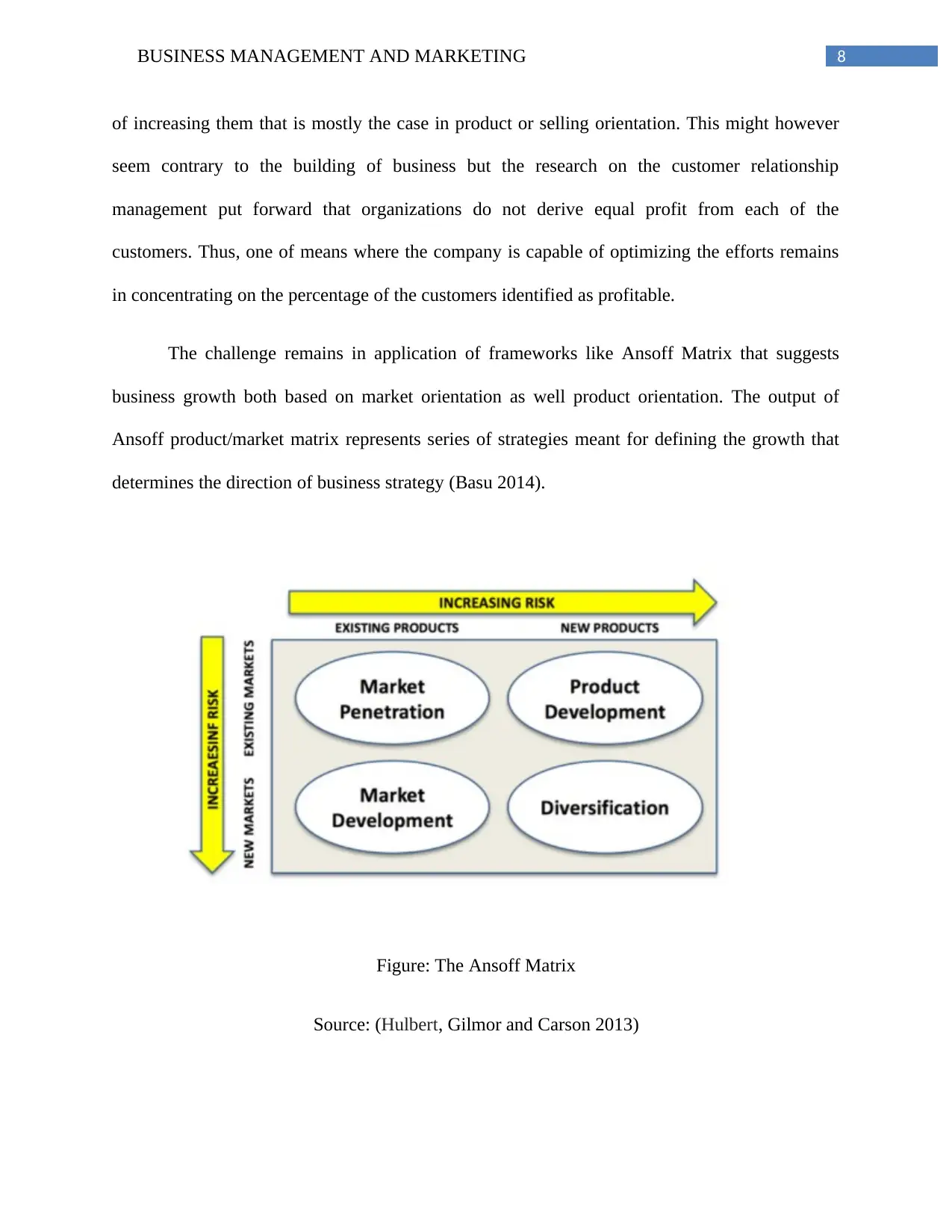
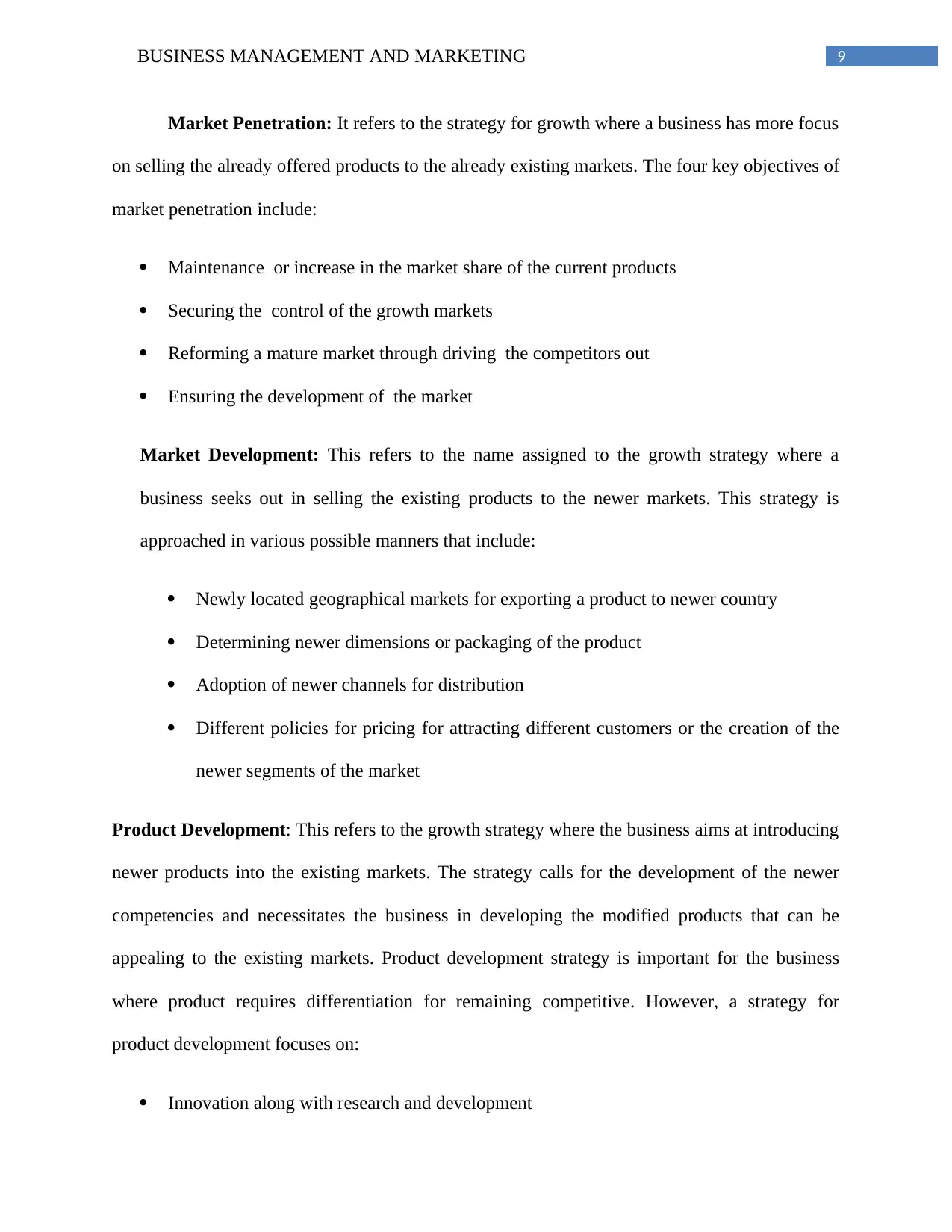
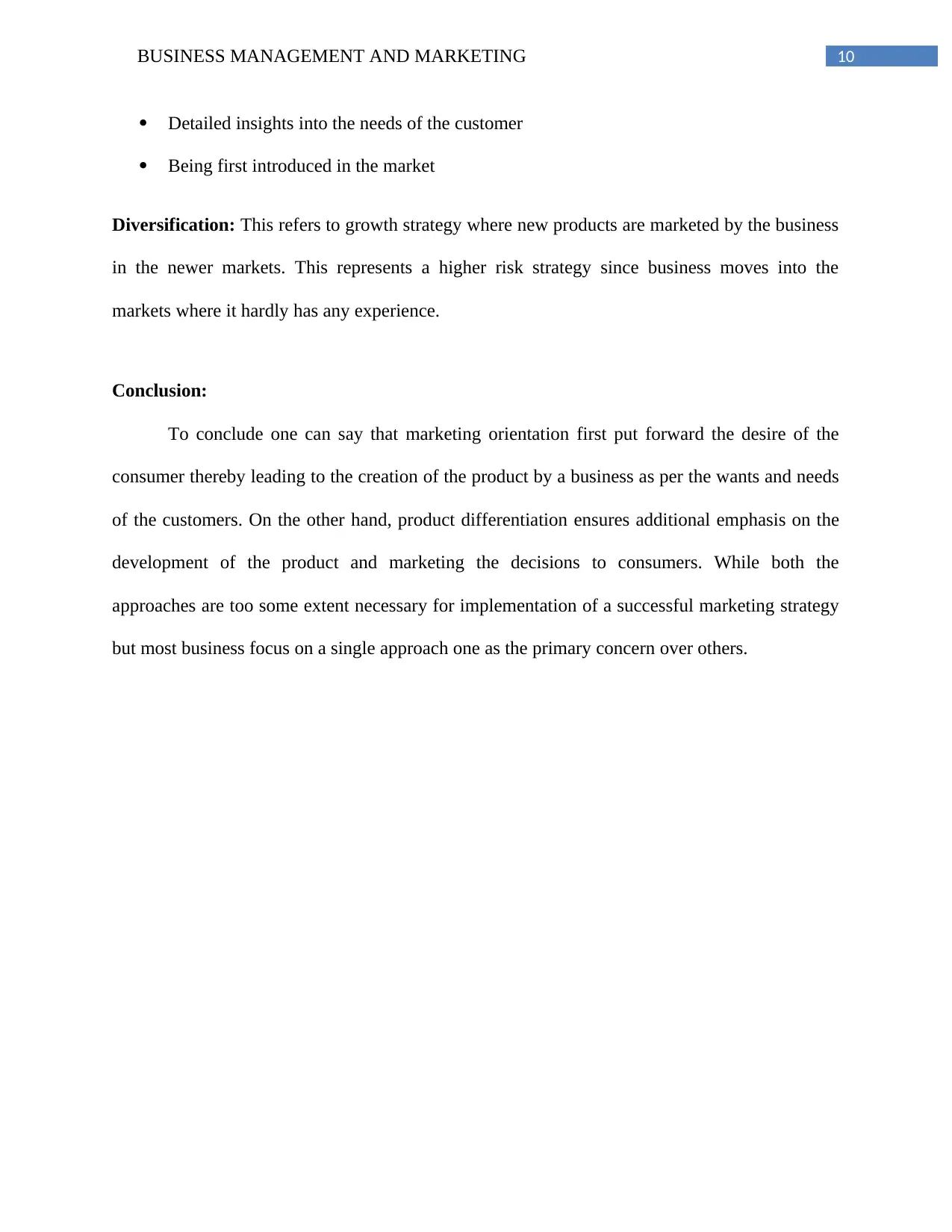
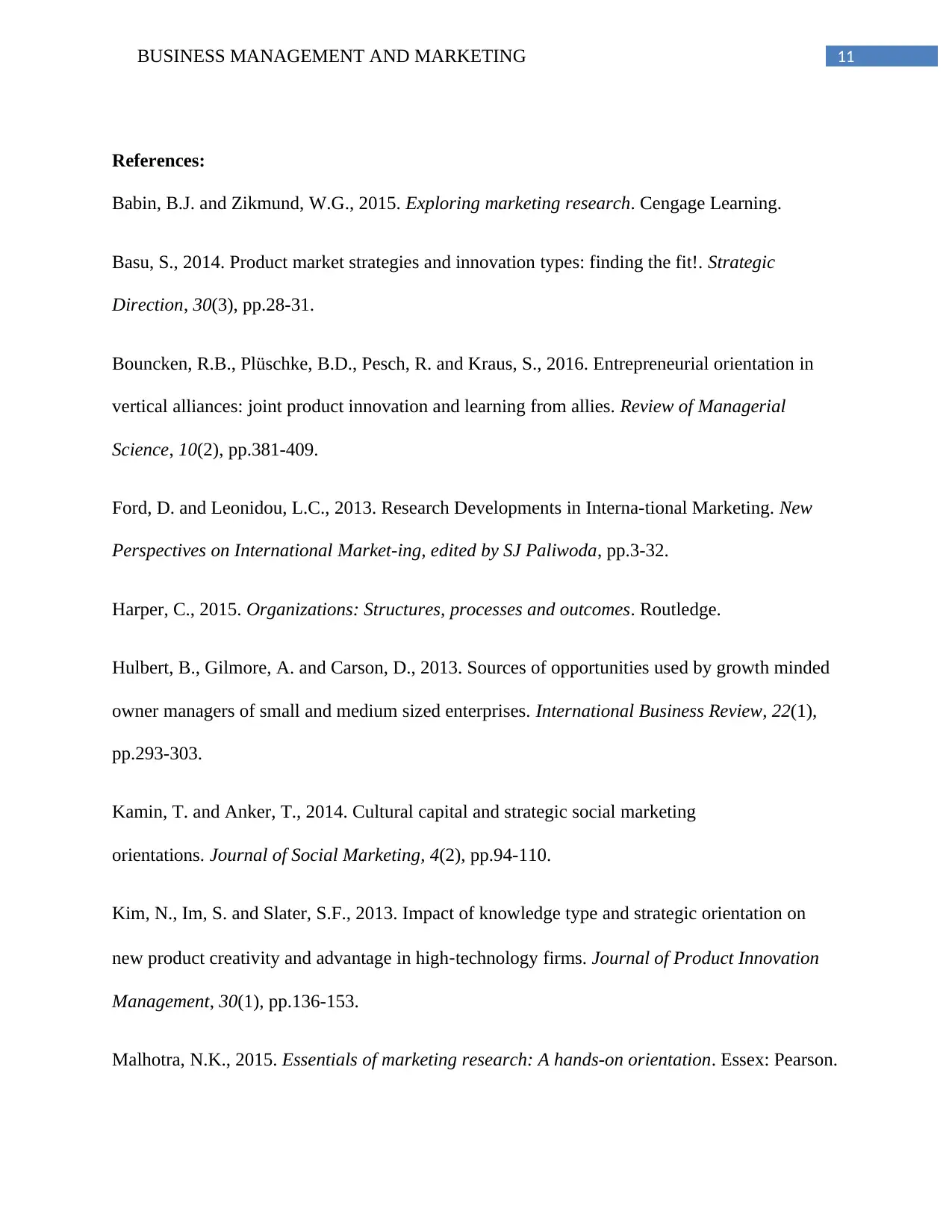
The challenge remains in application of frameworks like Ansoff Matrix that suggests
business growth both based on market orientation as well product orientation. The output of
Ansoff product/market matrix represents series of strategies meant for defining the growth that
determines the direction of business strategy (Basu 2014).
Figure: The Ansoff Matrix
Source: (Hulbert, Gilmor and Carson 2013)
of increasing them that is mostly the case in product or selling orientation. This might however
seem contrary to the building of business but the research on the customer relationship
management put forward that organizations do not derive equal profit from each of the
customers. Thus, one of means where the company is capable of optimizing the efforts remains
in concentrating on the percentage of the customers identified as profitable.
The challenge remains in application of frameworks like Ansoff Matrix that suggests
business growth both based on market orientation as well product orientation. The output of
Ansoff product/market matrix represents series of strategies meant for defining the growth that
determines the direction of business strategy (Basu 2014).
Figure: The Ansoff Matrix
Source: (Hulbert, Gilmor and Carson 2013)
⊘ This is a preview!⊘
Do you want full access?
Subscribe today to unlock all pages.
Trusted by 1+ million students worldwide
9BUSINESS MANAGEMENT AND MARKETING
Market Penetration: It refers to the strategy for growth where a business has more focus
on selling the already offered products to the already existing markets. The four key objectives of
market penetration include:
Maintenance or increase in the market share of the current products
Securing the control of the growth markets
Reforming a mature market through driving the competitors out
Ensuring the development of the market
Market Development: This refers to the name assigned to the growth strategy where a
business seeks out in selling the existing products to the newer markets. This strategy is
approached in various possible manners that include:
Newly located geographical markets for exporting a product to newer country
Determining newer dimensions or packaging of the product
Adoption of newer channels for distribution
Different policies for pricing for attracting different customers or the creation of the
newer segments of the market
Product Development: This refers to the growth strategy where the business aims at introducing
newer products into the existing markets. The strategy calls for the development of the newer
competencies and necessitates the business in developing the modified products that can be
appealing to the existing markets. Product development strategy is important for the business
where product requires differentiation for remaining competitive. However, a strategy for
product development focuses on:
Innovation along with research and development
Market Penetration: It refers to the strategy for growth where a business has more focus
on selling the already offered products to the already existing markets. The four key objectives of
market penetration include:
Maintenance or increase in the market share of the current products
Securing the control of the growth markets
Reforming a mature market through driving the competitors out
Ensuring the development of the market
Market Development: This refers to the name assigned to the growth strategy where a
business seeks out in selling the existing products to the newer markets. This strategy is
approached in various possible manners that include:
Newly located geographical markets for exporting a product to newer country
Determining newer dimensions or packaging of the product
Adoption of newer channels for distribution
Different policies for pricing for attracting different customers or the creation of the
newer segments of the market
Product Development: This refers to the growth strategy where the business aims at introducing
newer products into the existing markets. The strategy calls for the development of the newer
competencies and necessitates the business in developing the modified products that can be
appealing to the existing markets. Product development strategy is important for the business
where product requires differentiation for remaining competitive. However, a strategy for
product development focuses on:
Innovation along with research and development
Paraphrase This Document
Need a fresh take? Get an instant paraphrase of this document with our AI Paraphraser
10BUSINESS MANAGEMENT AND MARKETING
Detailed insights into the needs of the customer
Being first introduced in the market
Diversification: This refers to growth strategy where new products are marketed by the business
in the newer markets. This represents a higher risk strategy since business moves into the
markets where it hardly has any experience.
Conclusion:
To conclude one can say that marketing orientation first put forward the desire of the
consumer thereby leading to the creation of the product by a business as per the wants and needs
of the customers. On the other hand, product differentiation ensures additional emphasis on the
development of the product and marketing the decisions to consumers. While both the
approaches are too some extent necessary for implementation of a successful marketing strategy
but most business focus on a single approach one as the primary concern over others.
Detailed insights into the needs of the customer
Being first introduced in the market
Diversification: This refers to growth strategy where new products are marketed by the business
in the newer markets. This represents a higher risk strategy since business moves into the
markets where it hardly has any experience.
Conclusion:
To conclude one can say that marketing orientation first put forward the desire of the
consumer thereby leading to the creation of the product by a business as per the wants and needs
of the customers. On the other hand, product differentiation ensures additional emphasis on the
development of the product and marketing the decisions to consumers. While both the
approaches are too some extent necessary for implementation of a successful marketing strategy
but most business focus on a single approach one as the primary concern over others.
11BUSINESS MANAGEMENT AND MARKETING
References:
Babin, B.J. and Zikmund, W.G., 2015. Exploring marketing research. Cengage Learning.
Basu, S., 2014. Product market strategies and innovation types: finding the fit!. Strategic
Direction, 30(3), pp.28-31.
Bouncken, R.B., Plüschke, B.D., Pesch, R. and Kraus, S., 2016. Entrepreneurial orientation in
vertical alliances: joint product innovation and learning from allies. Review of Managerial
Science, 10(2), pp.381-409.
Ford, D. and Leonidou, L.C., 2013. Research Developments in Interna-tional Marketing. New
Perspectives on International Market-ing, edited by SJ Paliwoda, pp.3-32.
Harper, C., 2015. Organizations: Structures, processes and outcomes. Routledge.
Hulbert, B., Gilmore, A. and Carson, D., 2013. Sources of opportunities used by growth minded
owner managers of small and medium sized enterprises. International Business Review, 22(1),
pp.293-303.
Kamin, T. and Anker, T., 2014. Cultural capital and strategic social marketing
orientations. Journal of Social Marketing, 4(2), pp.94-110.
Kim, N., Im, S. and Slater, S.F., 2013. Impact of knowledge type and strategic orientation on
new product creativity and advantage in high‐technology firms. Journal of Product Innovation
Management, 30(1), pp.136-153.
Malhotra, N.K., 2015. Essentials of marketing research: A hands-on orientation. Essex: Pearson.
References:
Babin, B.J. and Zikmund, W.G., 2015. Exploring marketing research. Cengage Learning.
Basu, S., 2014. Product market strategies and innovation types: finding the fit!. Strategic
Direction, 30(3), pp.28-31.
Bouncken, R.B., Plüschke, B.D., Pesch, R. and Kraus, S., 2016. Entrepreneurial orientation in
vertical alliances: joint product innovation and learning from allies. Review of Managerial
Science, 10(2), pp.381-409.
Ford, D. and Leonidou, L.C., 2013. Research Developments in Interna-tional Marketing. New
Perspectives on International Market-ing, edited by SJ Paliwoda, pp.3-32.
Harper, C., 2015. Organizations: Structures, processes and outcomes. Routledge.
Hulbert, B., Gilmore, A. and Carson, D., 2013. Sources of opportunities used by growth minded
owner managers of small and medium sized enterprises. International Business Review, 22(1),
pp.293-303.
Kamin, T. and Anker, T., 2014. Cultural capital and strategic social marketing
orientations. Journal of Social Marketing, 4(2), pp.94-110.
Kim, N., Im, S. and Slater, S.F., 2013. Impact of knowledge type and strategic orientation on
new product creativity and advantage in high‐technology firms. Journal of Product Innovation
Management, 30(1), pp.136-153.
Malhotra, N.K., 2015. Essentials of marketing research: A hands-on orientation. Essex: Pearson.
⊘ This is a preview!⊘
Do you want full access?
Subscribe today to unlock all pages.
Trusted by 1+ million students worldwide

1 out of 13


Related Documents


Your All-in-One AI-Powered Toolkit for Academic Success.
+13062052269
info@desklib.com
Available 24*7 on WhatsApp / Email
![[object Object]](/_next/static/media/star-bottom.7253800d.svg)
Unlock your academic potential
Copyright © 2020–2026 A2Z Services. All Rights Reserved. Developed and managed by ZUCOL.