The Impact of Social Components in Outsourcing: A Business Report

Verified

Added on  2020/05/03

|5
|964
|394
Report
AI Summary
This report delves into the social components of outsourcing, emphasizing corporate social responsibility (CSR) aspects such as environmental protection, employee health and safety, and compliance with legal requirements. It highlights the importance of considering social aspects due to government regulations, environmental concerns, and community health. The report uses the TELUS International case study to evaluate these components. It discusses the benefits of integrating social components, including reduced penalties, improved community living standards, and enhanced profitability through customer loyalty. It also acknowledges the risks, such as increased costs and potential limitations in supplier availability. The report references several academic sources to support its findings, providing a comprehensive analysis of social considerations in outsourcing.
Document Page
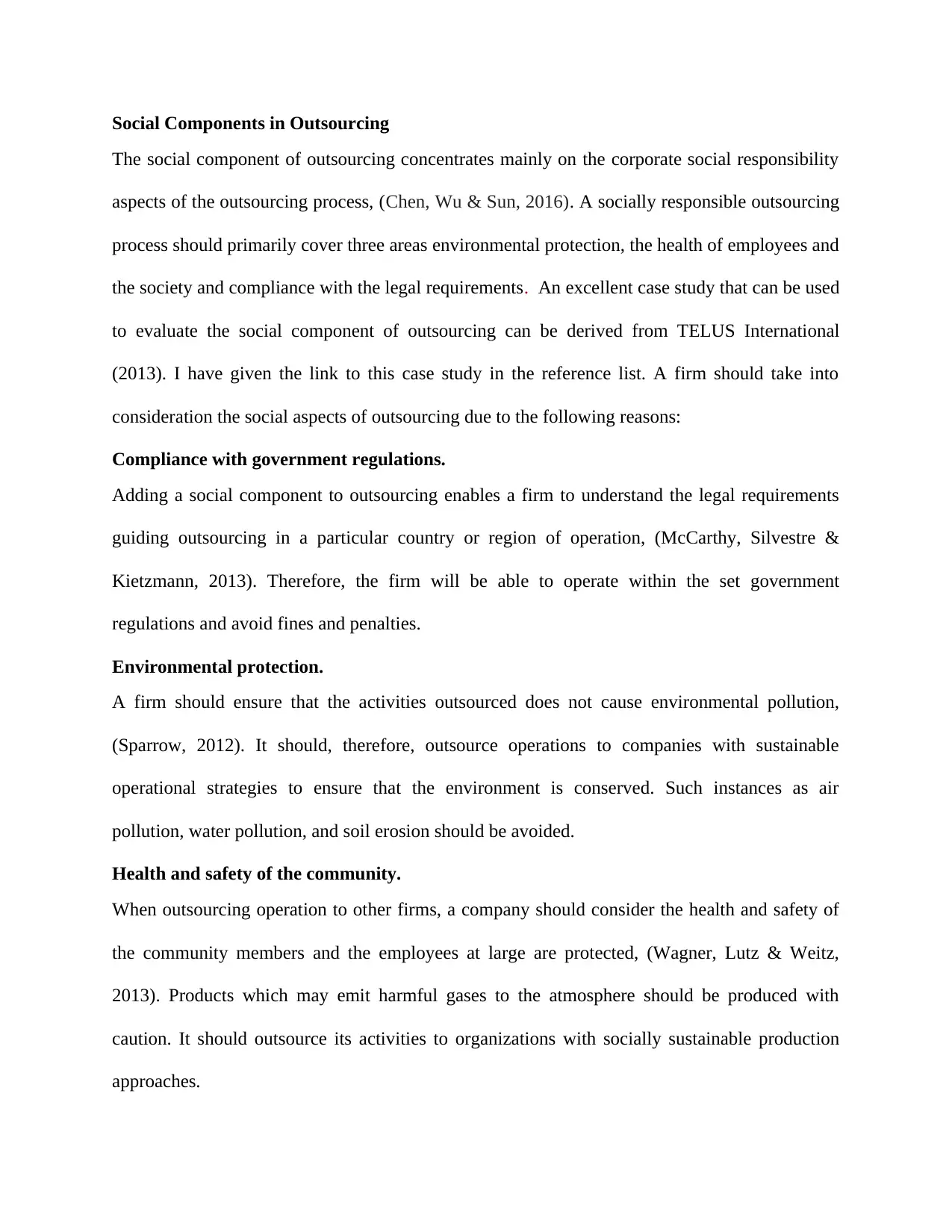
Social Components in Outsourcing
The social component of outsourcing concentrates mainly on the corporate social responsibility
aspects of the outsourcing process, (Chen, Wu & Sun, 2016). A socially responsible outsourcing
process should primarily cover three areas environmental protection, the health of employees and
the society and compliance with the legal requirements. An excellent case study that can be used
to evaluate the social component of outsourcing can be derived from TELUS International
(2013). I have given the link to this case study in the reference list. A firm should take into
consideration the social aspects of outsourcing due to the following reasons:
Compliance with government regulations.
Adding a social component to outsourcing enables a firm to understand the legal requirements
guiding outsourcing in a particular country or region of operation, (McCarthy, Silvestre &
Kietzmann, 2013). Therefore, the firm will be able to operate within the set government
regulations and avoid fines and penalties.
Environmental protection.
A firm should ensure that the activities outsourced does not cause environmental pollution,
(Sparrow, 2012). It should, therefore, outsource operations to companies with sustainable
operational strategies to ensure that the environment is conserved. Such instances as air
pollution, water pollution, and soil erosion should be avoided.
Health and safety of the community.
When outsourcing operation to other firms, a company should consider the health and safety of
the community members and the employees at large are protected, (Wagner, Lutz & Weitz,
2013). Products which may emit harmful gases to the atmosphere should be produced with
caution. It should outsource its activities to organizations with socially sustainable production
approaches.
tabler-icon-diamond-filled.svg

Paraphrase This Document

Need a fresh take? Get an instant paraphrase of this document with our AI Paraphraser
Document Page
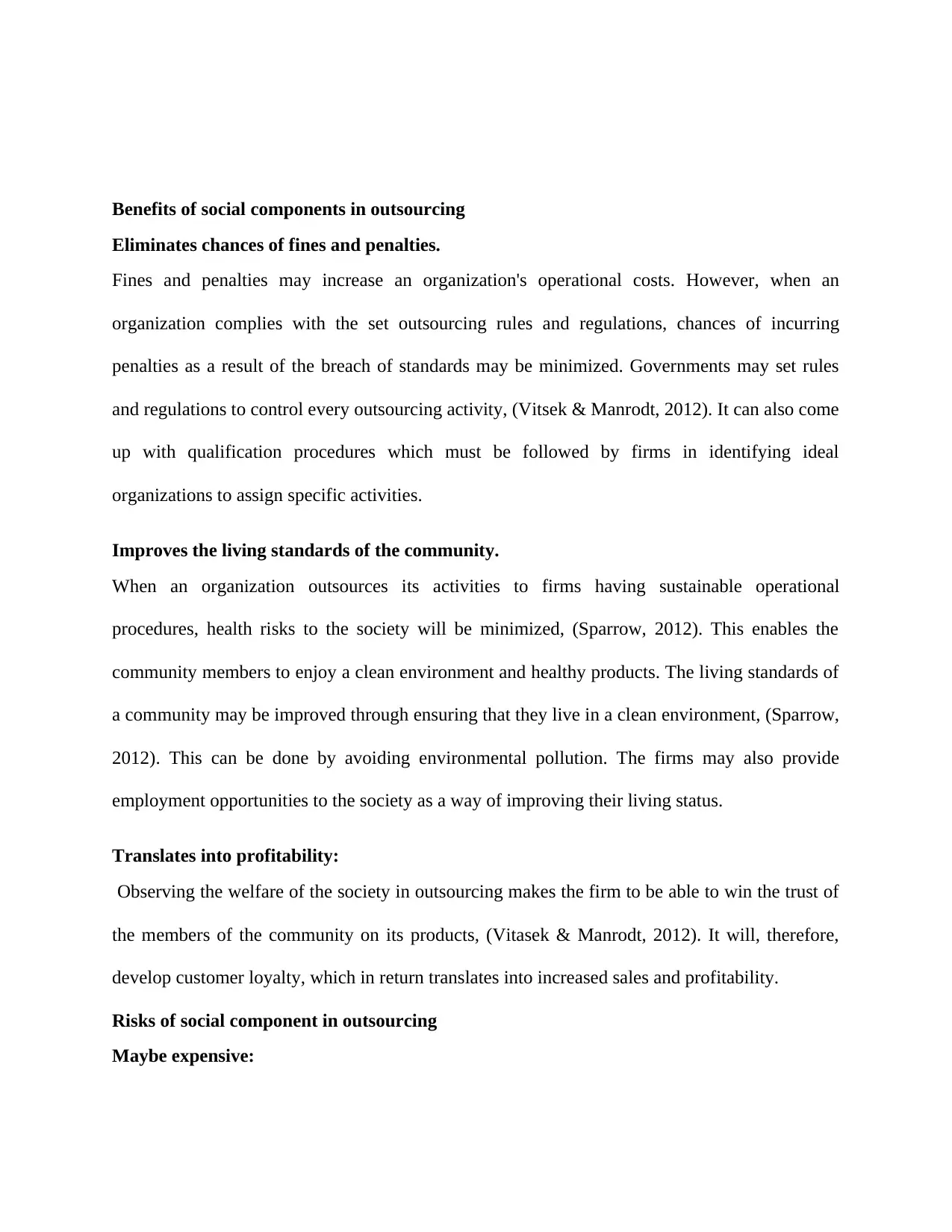
Benefits of social components in outsourcing
Eliminates chances of fines and penalties.
Fines and penalties may increase an organization's operational costs. However, when an
organization complies with the set outsourcing rules and regulations, chances of incurring
penalties as a result of the breach of standards may be minimized. Governments may set rules
and regulations to control every outsourcing activity, (Vitsek & Manrodt, 2012). It can also come
up with qualification procedures which must be followed by firms in identifying ideal
organizations to assign specific activities.
Improves the living standards of the community.
When an organization outsources its activities to firms having sustainable operational
procedures, health risks to the society will be minimized, (Sparrow, 2012). This enables the
community members to enjoy a clean environment and healthy products. The living standards of
a community may be improved through ensuring that they live in a clean environment, (Sparrow,
2012). This can be done by avoiding environmental pollution. The firms may also provide
employment opportunities to the society as a way of improving their living status.
Translates into profitability:
Observing the welfare of the society in outsourcing makes the firm to be able to win the trust of
the members of the community on its products, (Vitasek & Manrodt, 2012). It will, therefore,
develop customer loyalty, which in return translates into increased sales and profitability.
Risks of social component in outsourcing
Maybe expensive:
Document Page
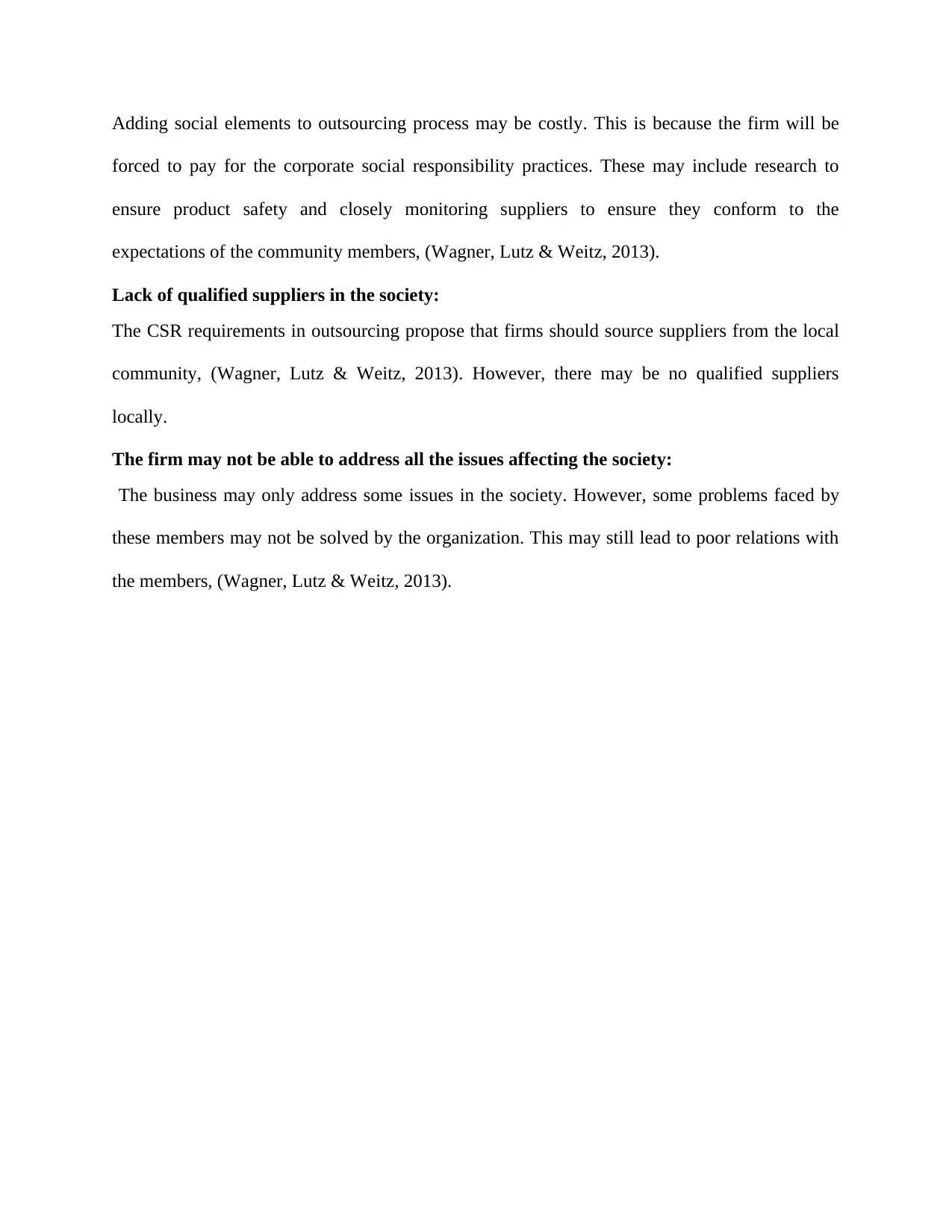
Adding social elements to outsourcing process may be costly. This is because the firm will be
forced to pay for the corporate social responsibility practices. These may include research to
ensure product safety and closely monitoring suppliers to ensure they conform to the
expectations of the community members, (Wagner, Lutz & Weitz, 2013).
Lack of qualified suppliers in the society:
The CSR requirements in outsourcing propose that firms should source suppliers from the local
community, (Wagner, Lutz & Weitz, 2013). However, there may be no qualified suppliers
locally.
The firm may not be able to address all the issues affecting the society:
The business may only address some issues in the society. However, some problems faced by
these members may not be solved by the organization. This may still lead to poor relations with
the members, (Wagner, Lutz & Weitz, 2013).
Document Page
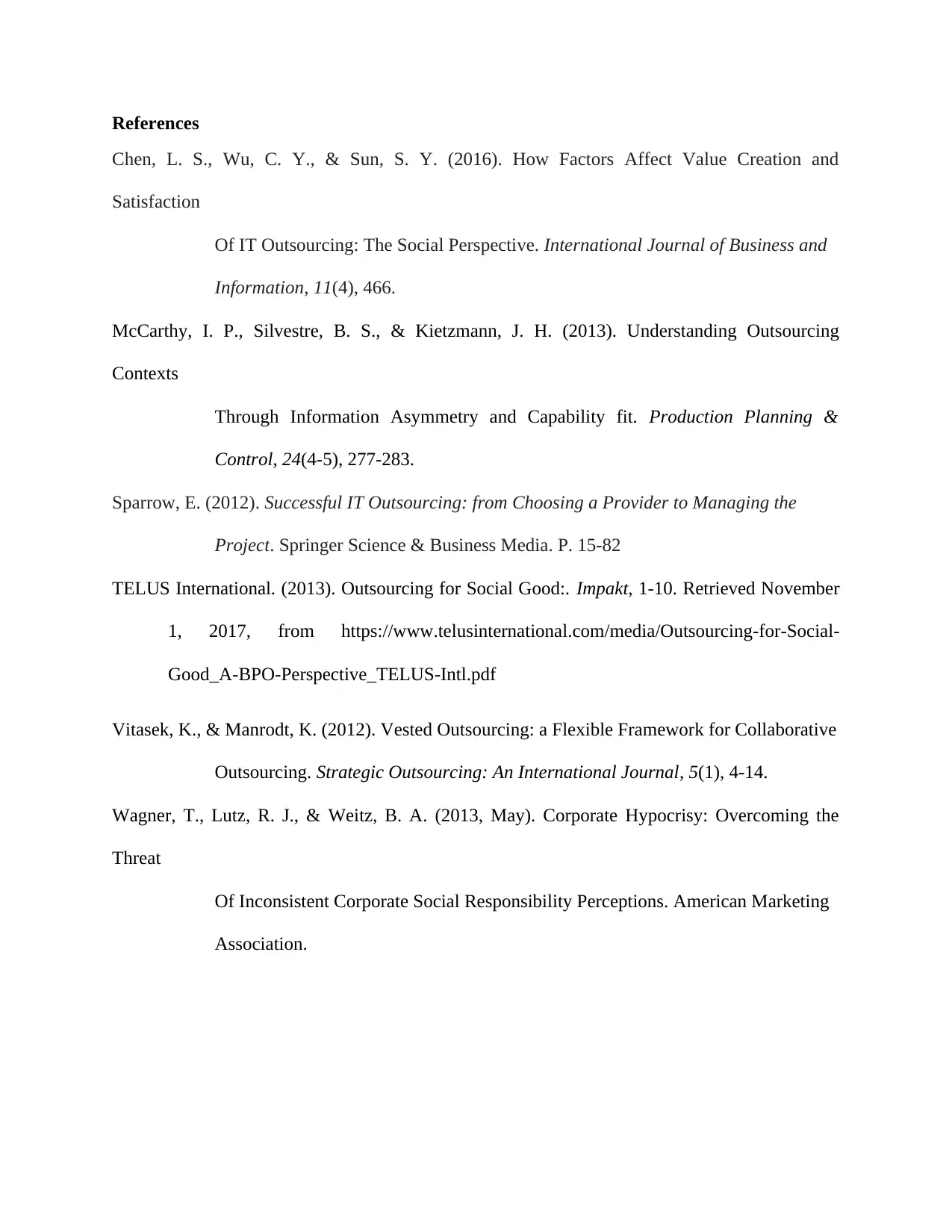
References
Chen, L. S., Wu, C. Y., & Sun, S. Y. (2016). How Factors Affect Value Creation and
Satisfaction
Of IT Outsourcing: The Social Perspective. International Journal of Business and
Information, 11(4), 466.
McCarthy, I. P., Silvestre, B. S., & Kietzmann, J. H. (2013). Understanding Outsourcing
Contexts
Through Information Asymmetry and Capability fit. Production Planning &
Control, 24(4-5), 277-283.
Sparrow, E. (2012). Successful IT Outsourcing: from Choosing a Provider to Managing the
Project. Springer Science & Business Media. P. 15-82
TELUS International. (2013). Outsourcing for Social Good:. Impakt, 1-10. Retrieved November
1, 2017, from https://www.telusinternational.com/media/Outsourcing-for-Social-
Good_A-BPO-Perspective_TELUS-Intl.pdf
Vitasek, K., & Manrodt, K. (2012). Vested Outsourcing: a Flexible Framework for Collaborative
Outsourcing. Strategic Outsourcing: An International Journal, 5(1), 4-14.
Wagner, T., Lutz, R. J., & Weitz, B. A. (2013, May). Corporate Hypocrisy: Overcoming the
Threat
Of Inconsistent Corporate Social Responsibility Perceptions. American Marketing
Association.
tabler-icon-diamond-filled.svg

Paraphrase This Document

Need a fresh take? Get an instant paraphrase of this document with our AI Paraphraser
Document Page
chevron_up_icon
1 out of 5
circle_padding
hide_on_mobile
zoom_out_icon
[object Object]