Developing and Implementing a Business Plan: A Performance Report

Verified

Added on  2022/11/17

|6
|838
|223
Report
AI Summary
This report, written from the perspective of an Operations Manager, focuses on the critical aspects of monitoring and implementing a business plan to ensure optimal performance. It explores various methods, including strategic execution, implementation schedules, and tracking goals. The report details different types of reporting methods, such as written, graphic, and oral reporting, and emphasizes the importance of consultation methods to understand stakeholder needs. Furthermore, it delves into resource allocation methods, highlighting the significance of identifying scopes, understanding resources, holistic thinking, and time tracking. The conclusion stresses the Operations Manager's role in operational development, project management, and inventory control. The report references relevant academic sources to support its findings.
Document Page
Running head: DEVELOP AND IMPLEMENT A BUSINESS PLAN
DEVELOP AND IMPLEMENT A BUSINESS PLAN
Name of the Student:
Name of the University:
Author Note:
tabler-icon-diamond-filled.svg

Paraphrase This Document

Need a fresh take? Get an instant paraphrase of this document with our AI Paraphraser
Document Page
1DEVELOP AND IMPLEMENT A BUSINESS PLAN
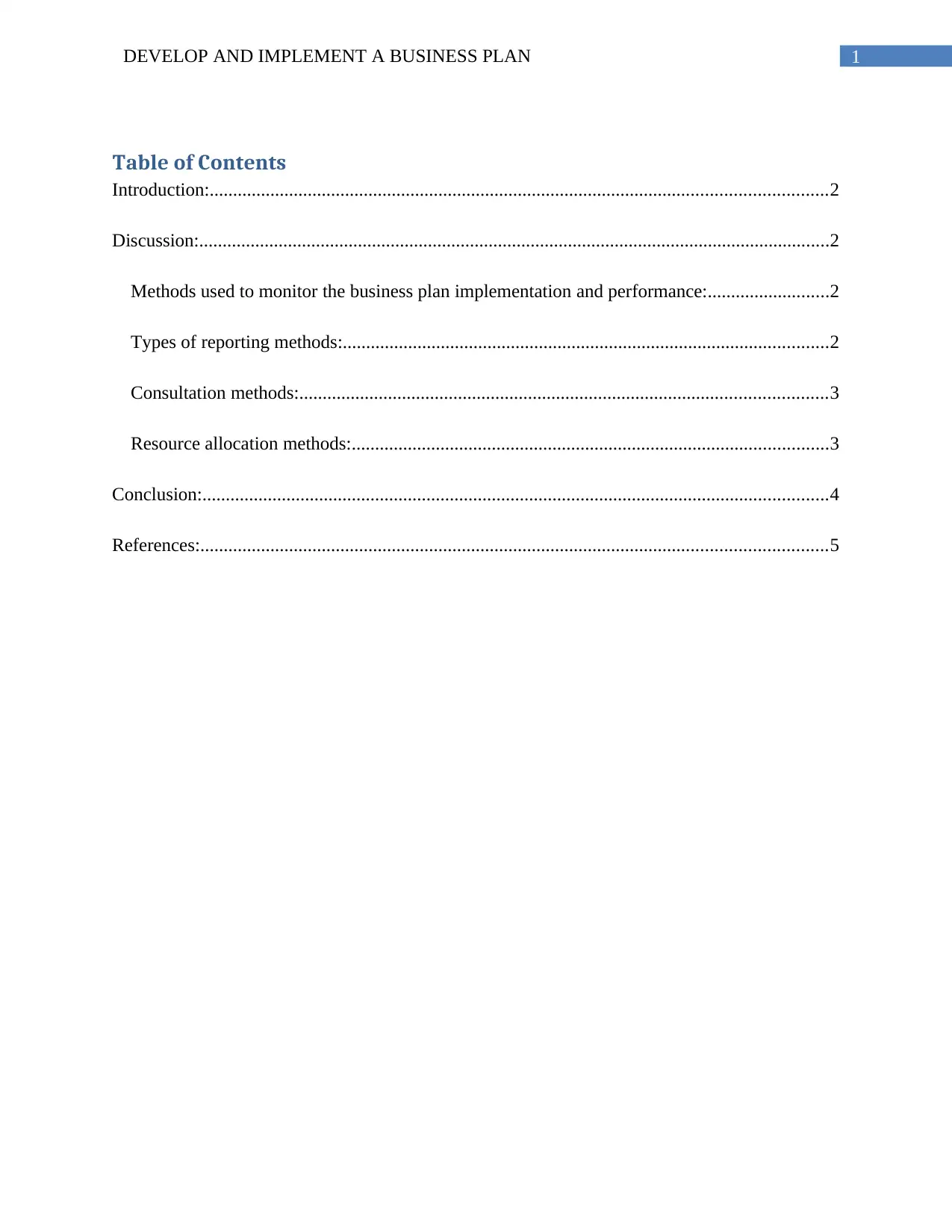
Table of Contents
Introduction:....................................................................................................................................2
Discussion:.......................................................................................................................................2
Methods used to monitor the business plan implementation and performance:..........................2
Types of reporting methods:........................................................................................................2
Consultation methods:.................................................................................................................3
Resource allocation methods:......................................................................................................3
Conclusion:......................................................................................................................................4
References:......................................................................................................................................5
Document Page
2DEVELOP AND IMPLEMENT A BUSINESS PLAN
Introduction:
This study focused on as an operational manager how I would monitor the
implementation of the business plan and performance. As an Operations Manager, I always
concerned about the organization’s performance to its best possible way. I always keep my eyes
on different departments of the organization, guide other employees to fulfil their targets and
achieve the goals.
Discussion:
Methods used to monitor the business plan implementation and performance:
Executing Strategy and Managing Performance: I noticed that executing my strategic plan is
essential because critical activities move through a strategic idea which helps the growth of the
organization (Tarhini et al., 2015).
Implementation Schedule: Implementation is the procedure that converts the strategic plan into
actions such as who, when, where and how (Tarhini et al., 2015).
Tracking Goals & Actions: I conduct strategy meeting in every month, which takes maximum 30
to 60 minutes because all the team members report on their progress and share how they achieve
their goal (Tarhini et al., 2015).
Types of reporting methods:
Written Reporting: As we know, written reporting is the most popular way to kept the reports
legally and used for referencing (Sekaran and Bougie 2016).
Document Page
3DEVELOP AND IMPLEMENT A BUSINESS PLAN
Graphic Reporting: The reports represent in diagrams, charts and pictures, which helps me for a
quick presentation about the information.
Oral Reporting: Oral reporting is helpful to me to decide in every group meetings and
conversation with each employee (Sekaran and Bougie 2016).
Consultation methods:
As we know that consultation procedure is an essential concept for organizational
management. Organizations exist to produce value for shareholders and consultation so that
organizational management understands the needs, requirements and expectations of
shareholders to develop the value. Also, discuss the plans so that the management of the
organization offers the value for the shareholders so that the shareholders could not say that the
organizations are never listening their needs to improving operational and strategic plans (Bushe
and Marshak 2014).
Resource allocation methods:
Know the scopes and identify resources: Before I share my plan or manage the plan, I fix the
opportunity of the assignment, which I am working. When the aim of the assignment is clear to
me, then it helps me to figure out the allocated resources so easily. So, it better to take more time
to figure out the full structure of the assignment before assigning any project (Lotfi et al., 2013).
Think holistically: When I estimate the assignment progresses, I first check what the plan of my
team is, is there anyone absent and are anyone who takes leave for a long period.
Track time: I always track my team’s production. It required because it helps to data collection
on the same document, where I check and schedule if needed (Lotfi et al., 2013).
tabler-icon-diamond-filled.svg

Paraphrase This Document

Need a fresh take? Get an instant paraphrase of this document with our AI Paraphraser
Document Page
4DEVELOP AND IMPLEMENT A BUSINESS PLAN
Maintain a routine: As a manager, I structure a plan, and then I execute and monitor.
Conclusion:
It concluded that the operations manager must concentrate on operational development,
product handling, implement, evaluate, enforce and assign the projects for the team member and
utilise the inventory management of the organization.
Document Page
5DEVELOP AND IMPLEMENT A BUSINESS PLAN
References:
Bushe, G. R., & Marshak, R. J. (2014). Dialogic organization development. The NTL handbook
of organization development and change, 193-211.
Lotfi, F. H., Hatami-Marbini, A., Agrell, P. J., Aghayi, N., & Gholami, K. (2013). Allocating
fixed resources and setting targets using a common-weights DEA approach. Computers
& Industrial Engineering, 64(2), 631-640.
Sekaran, U., & Bougie, R. (2016). Research methods for business: A skill building approach.
John Wiley & Sons.
Tarhini, A., Ammar, H., Tarhini, T., & Masa’deh, R. E. (2015). Analysis of the critical success
factors for enterprise resource planning implementation from stakeholders’ perspective:
A systematic review. International Business Research, 8(4), 25-40.
chevron_up_icon
1 out of 6
circle_padding
hide_on_mobile
zoom_out_icon
[object Object]