Business Policy & Strategy: Analysis of Key Business Decisions
VerifiedAdded on 2021/05/31
|8
|3268
|19
Case Study
AI Summary
This document presents a comprehensive case study analysis of a business policy and strategy scenario, focusing on a business owner named George and his decisions. The analysis explores the factors George should have considered before manufacturing a product, including market demand, costs, and his own experience. It also examines the risks and opportunities associated with licensing technology, such as royalty income and market entry, while also addressing potential downsides like loss of control. Furthermore, the case study delves into the reasons why middle and senior-level managers are often reluctant to adopt disruptive technologies, citing factors like customer focus, revenue concerns, and technological adoption challenges. The analysis highlights the importance of strategic decision-making, risk assessment, and understanding the impact of disruptive innovations in the business environment. The document concludes by emphasizing the potential for success when analyzing product features, market analysis, and making necessary adjustments.
Business Policy and Strategy: Some Important Decisions
1
Assignment Name: Business Policy & Strategy
Student Name:
Student ID Number:
Subject Title:
AQF Level:
Word count:
1
Assignment Name: Business Policy & Strategy
Student Name:
Student ID Number:
Subject Title:
AQF Level:
Word count:

Paraphrase This Document
Need a fresh take? Get an instant paraphrase of this document with our AI Paraphraser
Business Policy and Strategy: Some Important Decisions
2
Contents
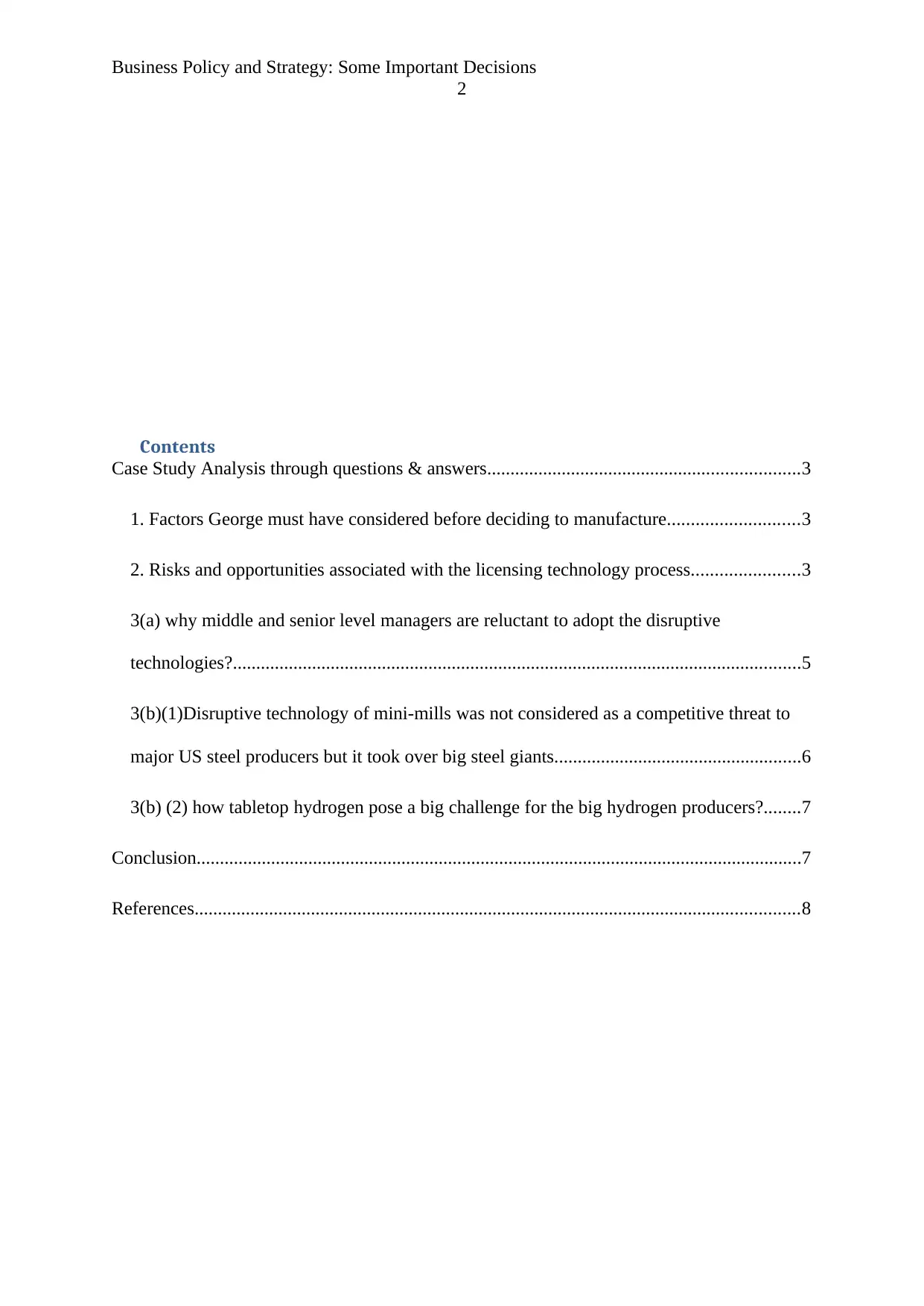
Case Study Analysis through questions & answers...................................................................3
1. Factors George must have considered before deciding to manufacture............................3
2. Risks and opportunities associated with the licensing technology process.......................3
3(a) why middle and senior level managers are reluctant to adopt the disruptive
technologies?..........................................................................................................................5
3(b)(1)Disruptive technology of mini-mills was not considered as a competitive threat to
major US steel producers but it took over big steel giants.....................................................6
3(b) (2) how tabletop hydrogen pose a big challenge for the big hydrogen producers?........7
Conclusion..................................................................................................................................7
References..................................................................................................................................8
2
Contents
Case Study Analysis through questions & answers...................................................................3
1. Factors George must have considered before deciding to manufacture............................3
2. Risks and opportunities associated with the licensing technology process.......................3
3(a) why middle and senior level managers are reluctant to adopt the disruptive
technologies?..........................................................................................................................5
3(b)(1)Disruptive technology of mini-mills was not considered as a competitive threat to
major US steel producers but it took over big steel giants.....................................................6
3(b) (2) how tabletop hydrogen pose a big challenge for the big hydrogen producers?........7
Conclusion..................................................................................................................................7
References..................................................................................................................................8
Business Policy and Strategy: Some Important Decisions
3
Case Study Analysis through questions & answers
1. Factors George must have considered before deciding to manufacture.
There are many factors which must have been on George’s checklist before deciding to start
manufacturing the product (Lindgren, 2017). The first factor which he should have
considered is the demand for the product or the supply gap that is there must be a large size
of the unsatisfied market in which the product manufacturer intends to launch the product.
Luckily, in this case, the demand was very high for the product. The cheap and safe source of
hydrogen was required by school, colleges, universities and government labs. The second
essential factor is the setup and running costs or the fixed and variable costs. Establishing a
manufacturing plant is a costly proposition. It involves licenses, equipment, customized
machines, and expert technical know-how. George did not ponder upon all these factors and
jumped to the conclusion of production. He should also have researched that if there are any
other manufacturers and how well are they performing in terms of production, operations,
and profits. Also, it is necessary to assess the process of the production to be adopted for the
product manufacturing and to understand the technical implications of the same. The choice
of product to be manufactured decides the cost of the machinery and labor. This further
decides the amount of capital required for starting the business. The third crucial factor which
George missed out was his own inexperience of running a business, lack of production
process knowledge and scarcity of required professional and technical qualifications
(GALEA, 2017). Being technically solid does not guarantee success in production. Had
George been a seasoned and well-experienced businessman he would have chalked out a
strategic development and expansion plan keeping in mind the stages at which funding would
be required. George must have analyzed before foraying into production the cost factor. This
was the major reason for the failure of his startup. It even leads him on the verge of
bankruptcy. He did not determine beforehand the amount he would invest out of his own
pocket. Assessing and ensuring the source of funds is the backbone of any production
operation. The fourth factor which did not get George’s enough attention was the seed capital
or the initial investment source. He risked all his life’s savings and invested in the business
which was not a sensible decision. Apart from these major investments, there are other costs
also involved in retail cost per individual unit, raw material cost, logistics, and marketing etc.
In manufacturing, everything cannot be made (Otten, Krenzler & Daduna, 2015). Some of the
less important things are to be outsourced. Proper knowledge of what is to be outsourced is
also necessary. It also helps in reducing the fixed cost and the quality remain the same.
Another factor is the production capacity and system. Had George kept it on a low scale i.e.
as a small scale production and understood the production process in and out maybe he could
have attracted more investors as the risk would have been small (Kachanova, 2016).
Conducting a market survey would also have provided him the first-hand information. He
would have come to know about the need for the product, expected the price per unit, market
competition, etc. Gathering of data regarding the investments required, profits generated,
break-even points attained could have helped him boost his project. Studying the government
policies with respect to the production is also required to see if any subsidy or grant is
provided in the field of choice. It can act as a boost in terms of capital investment and may
lower down the risk factor. Last is the feasibility of giving any idea a shape. Sometimes plans
look good on paper but are difficult to put into practice. Even after spending $450,000 and
nine months of his life he gained nothing. He ultimately got a buy-out offer and took the
same. Apart from this, the opportunity cost he paid is also high (Aksaray & Thompson,
2017).
3
Case Study Analysis through questions & answers
1. Factors George must have considered before deciding to manufacture.
There are many factors which must have been on George’s checklist before deciding to start
manufacturing the product (Lindgren, 2017). The first factor which he should have
considered is the demand for the product or the supply gap that is there must be a large size
of the unsatisfied market in which the product manufacturer intends to launch the product.
Luckily, in this case, the demand was very high for the product. The cheap and safe source of
hydrogen was required by school, colleges, universities and government labs. The second
essential factor is the setup and running costs or the fixed and variable costs. Establishing a
manufacturing plant is a costly proposition. It involves licenses, equipment, customized
machines, and expert technical know-how. George did not ponder upon all these factors and
jumped to the conclusion of production. He should also have researched that if there are any
other manufacturers and how well are they performing in terms of production, operations,
and profits. Also, it is necessary to assess the process of the production to be adopted for the
product manufacturing and to understand the technical implications of the same. The choice
of product to be manufactured decides the cost of the machinery and labor. This further
decides the amount of capital required for starting the business. The third crucial factor which
George missed out was his own inexperience of running a business, lack of production
process knowledge and scarcity of required professional and technical qualifications
(GALEA, 2017). Being technically solid does not guarantee success in production. Had
George been a seasoned and well-experienced businessman he would have chalked out a
strategic development and expansion plan keeping in mind the stages at which funding would
be required. George must have analyzed before foraying into production the cost factor. This
was the major reason for the failure of his startup. It even leads him on the verge of
bankruptcy. He did not determine beforehand the amount he would invest out of his own
pocket. Assessing and ensuring the source of funds is the backbone of any production
operation. The fourth factor which did not get George’s enough attention was the seed capital
or the initial investment source. He risked all his life’s savings and invested in the business
which was not a sensible decision. Apart from these major investments, there are other costs
also involved in retail cost per individual unit, raw material cost, logistics, and marketing etc.
In manufacturing, everything cannot be made (Otten, Krenzler & Daduna, 2015). Some of the
less important things are to be outsourced. Proper knowledge of what is to be outsourced is
also necessary. It also helps in reducing the fixed cost and the quality remain the same.
Another factor is the production capacity and system. Had George kept it on a low scale i.e.
as a small scale production and understood the production process in and out maybe he could
have attracted more investors as the risk would have been small (Kachanova, 2016).
Conducting a market survey would also have provided him the first-hand information. He
would have come to know about the need for the product, expected the price per unit, market
competition, etc. Gathering of data regarding the investments required, profits generated,
break-even points attained could have helped him boost his project. Studying the government
policies with respect to the production is also required to see if any subsidy or grant is
provided in the field of choice. It can act as a boost in terms of capital investment and may
lower down the risk factor. Last is the feasibility of giving any idea a shape. Sometimes plans
look good on paper but are difficult to put into practice. Even after spending $450,000 and
nine months of his life he gained nothing. He ultimately got a buy-out offer and took the
same. Apart from this, the opportunity cost he paid is also high (Aksaray & Thompson,
2017).
⊘ This is a preview!⊘
Do you want full access?
Subscribe today to unlock all pages.

Trusted by 1+ million students worldwide
Business Policy and Strategy: Some Important Decisions
4
2. Risks and opportunities associated with the licensing technology process.
As a consultant, they would have explained George about both, the opportunities as well as
the risks. The first opportunity is the royalty of the company. Royalty is a sum of the amount
paid by the licensee to the licensor for the use of technology/product licensed to him
(Symeonidou & Bruneel, 2017). It could be paid per product sold, or lump sum or as a
percentage of total sales. It is a continuous source of income for the owner. It is an additional
kind of income or profitability with very little investment. The second opportunity for the
licensor is that it is a jump card for making an entry into the foreign markets. It helps in
circumventing all the legal formalities and helps to enter the foreign markets. There are so
many trade barriers and tariffs accompanied by numerous taxes and legal bindings which
make it practically impossible for an individual to launch its product in the foreign market
(Wang, Tseng & Liang, 2016). The third opportunity is that it requires a very low amount of
capital requirements. It is a very cost-effective route of getting the product into the market.
The licensor does not have to spend on manufacturing, packaging, marketing, logistics and
hefty salary bills. The fourth advantage which the licensor enjoys is that he does not have to
worry about the market knowledge, industry or the existing trends as he enters the market
with an established organization. Lastly, if there are any discrepancies in the product they get
removed as the owner does not have the required infrastructure and resources which the
organization has. It creates a reverse flow of the information as it provides new insights to the
licensor about his own product. However, with opportunities, risks are also associated with
this. The first risk is the total loss of the technology (Chowdhury, Jeon & Ramalingam,
2017). At times the idea or the product licensed is in its crude or early stage. The
organizations act clever and make changes in the product and claim it to be its own
production. The second risk which is an aftereffect of the first risk. Once the owner loses the
ownership of the product, it is followed by the loss of intellectual property if the product is
not patented by the owner. The most common example of such infringement happens in case
of the software industry. Another risk associated with this is that the license period is usually
limited. Once the terms of the agreement are over, the licensee may turn out to be your
competitor. He has got all the required information the production of the product. He can
offer competitive prices for the same product. Sometimes it happens that the agreement is
entered into but the production does not start. In such a case there are no royalties to payouts
for an indefinite amount of period. Also, there is the very limited scope of participation for
the owner because when a company is investing in the product a huge amount it becomes its
discretion how to produce and at what price to sell. The licensor becomes overly dependent
on the licensee for every development and promotion of the product as he has given all the
rights to the company. In such a context he has a very limited say. But after the analysis, it
can be deduced that technology licensing has more advantages than disadvantages.
4
2. Risks and opportunities associated with the licensing technology process.
As a consultant, they would have explained George about both, the opportunities as well as
the risks. The first opportunity is the royalty of the company. Royalty is a sum of the amount
paid by the licensee to the licensor for the use of technology/product licensed to him
(Symeonidou & Bruneel, 2017). It could be paid per product sold, or lump sum or as a
percentage of total sales. It is a continuous source of income for the owner. It is an additional
kind of income or profitability with very little investment. The second opportunity for the
licensor is that it is a jump card for making an entry into the foreign markets. It helps in
circumventing all the legal formalities and helps to enter the foreign markets. There are so
many trade barriers and tariffs accompanied by numerous taxes and legal bindings which
make it practically impossible for an individual to launch its product in the foreign market
(Wang, Tseng & Liang, 2016). The third opportunity is that it requires a very low amount of
capital requirements. It is a very cost-effective route of getting the product into the market.
The licensor does not have to spend on manufacturing, packaging, marketing, logistics and
hefty salary bills. The fourth advantage which the licensor enjoys is that he does not have to
worry about the market knowledge, industry or the existing trends as he enters the market
with an established organization. Lastly, if there are any discrepancies in the product they get
removed as the owner does not have the required infrastructure and resources which the
organization has. It creates a reverse flow of the information as it provides new insights to the
licensor about his own product. However, with opportunities, risks are also associated with
this. The first risk is the total loss of the technology (Chowdhury, Jeon & Ramalingam,
2017). At times the idea or the product licensed is in its crude or early stage. The
organizations act clever and make changes in the product and claim it to be its own
production. The second risk which is an aftereffect of the first risk. Once the owner loses the
ownership of the product, it is followed by the loss of intellectual property if the product is
not patented by the owner. The most common example of such infringement happens in case
of the software industry. Another risk associated with this is that the license period is usually
limited. Once the terms of the agreement are over, the licensee may turn out to be your
competitor. He has got all the required information the production of the product. He can
offer competitive prices for the same product. Sometimes it happens that the agreement is
entered into but the production does not start. In such a case there are no royalties to payouts
for an indefinite amount of period. Also, there is the very limited scope of participation for
the owner because when a company is investing in the product a huge amount it becomes its
discretion how to produce and at what price to sell. The licensor becomes overly dependent
on the licensee for every development and promotion of the product as he has given all the
rights to the company. In such a context he has a very limited say. But after the analysis, it
can be deduced that technology licensing has more advantages than disadvantages.
Paraphrase This Document
Need a fresh take? Get an instant paraphrase of this document with our AI Paraphraser
Business Policy and Strategy: Some Important Decisions
5
3(a) why middle and senior level managers are reluctant to adopt the disruptive
technologies?
The book named The Innovator's Dilemma by Clayton Christensen explains that in spite of
doing everything right how successful and leading organizations lose their market shares and
leadership to the extent of failing in business. Using Clayton’s findings in the book the case
study will explain why the middle and senior level managers did not show interest in
George’s product. The first reason they produced was that their existing customers did not
see any value in the product. Clayton describes disruptive technologies as an innovation
leading to the creation of a product which creates a new market for itself, a valuable network
and improving itself over the period of time. Thus it replaces the product in the market and
disrupts the market too. The managers did not want to adopt the product because it was a
disruptive innovation. It has its own disadvantages and potential threats to the organization.
First of all, it competes with the existing product which they are selling. It is comparatively
cheaper, simpler and easy to operate as compared to other products in the market. They want
to continue with the sustainable technology because it focuses on the present customers. It is
more comfortable and easier to continue producing what they are currently producing rather
than setting up a new plant with all the fresh investments. Another disadvantage is that it
creates a new consumer class and market in the already existing market. It leads to the
division of the target segment and eventually overriding their customers. PCs replacing
mainframe computers, memory cards replacing floppy disks are the common examples of the
disruptive technologies. It also forces the organizations to change their focus from the
existing products and mainstream customers to the less profitable with small market size and
simpler products. It is not a favorable proposition for the big companies as it affects their
performance trajectories. Even if they agree to focus on this, the investors do not show any
interest in investing. The second reason they put forward was that the sales of the tabletops
will not produce enough revenue thus making it not worth the investments. However, it can
be seen that George’s product has full potential and traits of becoming a successful product. It
is also said that the organizations must not be fixed to the grounds. They must keep on
finding new opportunities. Their reluctance to invest in the product became an opportunity
for the Salvation Enterprises. They made $10 million in their annual profits after working for
more than a couple of years and discussions are going on for selling their product to the
chemical companies of 10 big countries. Salvation enterprises proved that analyzing the
product, features and market analysis combined with a push can make difference. Sometimes
even if the companies try adopting the disruptive technologies the technology is so rapidly
changing that at times it becomes practically impossible to implement the process of adoption
of disruptive technology. This overshooting of technology in the mainstream markets is a big
problem for the managers. Big companies rather than selling what they make should make
what sells. The success of aviation enterprises is in itself a proof of the same. At times
focusing on customers’ needs is also profitable. Another possible reason for the reluctance of
the senior level managers is that they are not authorized to do so. It means that in spite of the
fact they find it a good project, the management or the board of directors do not approve of
the same. As far as the middle management is concerned they are so comfortable with the
sustainable technologies that they do not want to venture into the new ideas or simply
speaking they do not want to come out of their comfort zones. They are bound by the
knowledge which the organization and management have gathered over the period of time. It
makes no sense to them to discard that knowledge. Same is the attitude of the sales team of
any organization. Likewise, they are also reluctant to adopt the products generat4d through
the adoption of the disruptive technologies.
5
3(a) why middle and senior level managers are reluctant to adopt the disruptive
technologies?
The book named The Innovator's Dilemma by Clayton Christensen explains that in spite of
doing everything right how successful and leading organizations lose their market shares and
leadership to the extent of failing in business. Using Clayton’s findings in the book the case
study will explain why the middle and senior level managers did not show interest in
George’s product. The first reason they produced was that their existing customers did not
see any value in the product. Clayton describes disruptive technologies as an innovation
leading to the creation of a product which creates a new market for itself, a valuable network
and improving itself over the period of time. Thus it replaces the product in the market and
disrupts the market too. The managers did not want to adopt the product because it was a
disruptive innovation. It has its own disadvantages and potential threats to the organization.
First of all, it competes with the existing product which they are selling. It is comparatively
cheaper, simpler and easy to operate as compared to other products in the market. They want
to continue with the sustainable technology because it focuses on the present customers. It is
more comfortable and easier to continue producing what they are currently producing rather
than setting up a new plant with all the fresh investments. Another disadvantage is that it
creates a new consumer class and market in the already existing market. It leads to the
division of the target segment and eventually overriding their customers. PCs replacing
mainframe computers, memory cards replacing floppy disks are the common examples of the
disruptive technologies. It also forces the organizations to change their focus from the
existing products and mainstream customers to the less profitable with small market size and
simpler products. It is not a favorable proposition for the big companies as it affects their
performance trajectories. Even if they agree to focus on this, the investors do not show any
interest in investing. The second reason they put forward was that the sales of the tabletops
will not produce enough revenue thus making it not worth the investments. However, it can
be seen that George’s product has full potential and traits of becoming a successful product. It
is also said that the organizations must not be fixed to the grounds. They must keep on
finding new opportunities. Their reluctance to invest in the product became an opportunity
for the Salvation Enterprises. They made $10 million in their annual profits after working for
more than a couple of years and discussions are going on for selling their product to the
chemical companies of 10 big countries. Salvation enterprises proved that analyzing the
product, features and market analysis combined with a push can make difference. Sometimes
even if the companies try adopting the disruptive technologies the technology is so rapidly
changing that at times it becomes practically impossible to implement the process of adoption
of disruptive technology. This overshooting of technology in the mainstream markets is a big
problem for the managers. Big companies rather than selling what they make should make
what sells. The success of aviation enterprises is in itself a proof of the same. At times
focusing on customers’ needs is also profitable. Another possible reason for the reluctance of
the senior level managers is that they are not authorized to do so. It means that in spite of the
fact they find it a good project, the management or the board of directors do not approve of
the same. As far as the middle management is concerned they are so comfortable with the
sustainable technologies that they do not want to venture into the new ideas or simply
speaking they do not want to come out of their comfort zones. They are bound by the
knowledge which the organization and management have gathered over the period of time. It
makes no sense to them to discard that knowledge. Same is the attitude of the sales team of
any organization. Likewise, they are also reluctant to adopt the products generat4d through
the adoption of the disruptive technologies.
Business Policy and Strategy: Some Important Decisions
6
3(b)(1)Disruptive technology of mini-mills was not considered as a competitive threat to
major US steel producers but it took over big steel giants.
The mini-mills worked at the microeconomic levels of productions and did not aim bigger in
the beginning. They understood the point that why some of the big producers have stagnated
in terms of profits and en-cashed the point which led the successful companies to lose their
growth and ultimately fail. The big iron ore steel producers used iron ore for steel production.
They used big furnaces, castings and rolling machines for finished products. It was a huge
investment for setting up a mill close to 10 billion dollars. Apart from the initial investments
the licenses, required technical manpower, and ongoing recurring expenses like salary bills,
trade tariffs, etc. On the other hand, the advantages minimills had over them were that they
were using recycled steel, junk cars, and industry scrap as their raw material. They can
produce with less labor and in small batch quantities. This gave them an added cost
advantage of 20% to 25%. The mini-mills became technologically viable in the 1960s and
their market was concrete reinforcement rebar market. Steel required for rebar is so easy that
anyone can make it without much of a problem. They were a great success as the product
required no specifications for burying it in cement. However, the quality produced was
uniformly bad and the only perfect market for this crummy product was rebar market which
procured it for concrete reinforcement market. Similarly, from rebar market to structural
steel, they grew like anything and today they control a major part of the steel market in
America ("Connotation and Selection of Disruptive Technologies that Lead Industrial
Change", 2017). They rose to their success by making their foundations strong. Big industries
collapsed because they did not pay attention to the less profitable piece of business.
6
3(b)(1)Disruptive technology of mini-mills was not considered as a competitive threat to
major US steel producers but it took over big steel giants.
The mini-mills worked at the microeconomic levels of productions and did not aim bigger in
the beginning. They understood the point that why some of the big producers have stagnated
in terms of profits and en-cashed the point which led the successful companies to lose their
growth and ultimately fail. The big iron ore steel producers used iron ore for steel production.
They used big furnaces, castings and rolling machines for finished products. It was a huge
investment for setting up a mill close to 10 billion dollars. Apart from the initial investments
the licenses, required technical manpower, and ongoing recurring expenses like salary bills,
trade tariffs, etc. On the other hand, the advantages minimills had over them were that they
were using recycled steel, junk cars, and industry scrap as their raw material. They can
produce with less labor and in small batch quantities. This gave them an added cost
advantage of 20% to 25%. The mini-mills became technologically viable in the 1960s and
their market was concrete reinforcement rebar market. Steel required for rebar is so easy that
anyone can make it without much of a problem. They were a great success as the product
required no specifications for burying it in cement. However, the quality produced was
uniformly bad and the only perfect market for this crummy product was rebar market which
procured it for concrete reinforcement market. Similarly, from rebar market to structural
steel, they grew like anything and today they control a major part of the steel market in
America ("Connotation and Selection of Disruptive Technologies that Lead Industrial
Change", 2017). They rose to their success by making their foundations strong. Big industries
collapsed because they did not pay attention to the less profitable piece of business.
⊘ This is a preview!⊘
Do you want full access?
Subscribe today to unlock all pages.
Trusted by 1+ million students worldwide

Business Policy and Strategy: Some Important Decisions
7
3(b) (2) how tabletop hydrogen poses a big challenge for the big hydrogen producers?
In the earlier question, it has been seen that how the hydrogen tabletops have succeeded and
performed well in local and international markets. Any product which is new to the market
Moreover, R & D companies of major chemical companies are planning to research on this.
If all of this goes according to the plan the Hydrogen tabletops can be a huge success like the
mini-mills and they will replace the existing products as these tabletops are cheap, simpler
and easy to operate and they will create a separate market and group of consuming for them.
These changes will ultimately lead to the clean sweep of the existing products in the market
which is expensive, difficult to use & operate. The hydrogen table top can help the company
to expand themselves in the markets. It will be more of a customer-oriented product and
when people get what they need that commodity sells at a great speed as compared to buying
what is available in the markets.
7
3(b) (2) how tabletop hydrogen poses a big challenge for the big hydrogen producers?
In the earlier question, it has been seen that how the hydrogen tabletops have succeeded and
performed well in local and international markets. Any product which is new to the market
Moreover, R & D companies of major chemical companies are planning to research on this.
If all of this goes according to the plan the Hydrogen tabletops can be a huge success like the
mini-mills and they will replace the existing products as these tabletops are cheap, simpler
and easy to operate and they will create a separate market and group of consuming for them.
These changes will ultimately lead to the clean sweep of the existing products in the market
which is expensive, difficult to use & operate. The hydrogen table top can help the company
to expand themselves in the markets. It will be more of a customer-oriented product and
when people get what they need that commodity sells at a great speed as compared to buying
what is available in the markets.
Paraphrase This Document
Need a fresh take? Get an instant paraphrase of this document with our AI Paraphraser
Business Policy and Strategy: Some Important Decisions
8
References
Aksaray, G., & Thompson, P. (2017). Density Dependence of Entrepreneurial Dynamics:
Competition, Opportunity Cost, or Minimum Efficient Scale?. Management Science.
http://dx.doi.org/10.1287/mnsc.2016.2710
Chowdhury, S., Jeon, J., & Ramalingam, A. (2017). Property rights and loss aversion in
contests. Economic Inquiry. http://dx.doi.org/10.1111/ecin.12505
Coccia, M. (2017). Disruptive Technologies and Competitive Advantage of Firms in
Dynamic Markets. SSRN Electronic Journal. http://dx.doi.org/10.2139/ssrn.2960190
Connotation and Selection of Disruptive Technologies that Lead Industrial Change.
(2017). Chinese Journal Of Engineering Science, 19(5), 9. http://dx.doi.org/10.15302/j-
sscae-2017.05.002
Debrulle, J., & Maes, J. (2015). Start-ups' Internationalization: The Impact of Business
Owners' Management Experience, Start-up Experience and Professional Network on
Export Intensity. European Management Review, 12(3), 171-187.
http://dx.doi.org/10.1111/emre.12050
GALEA, S. (2017). On the Production of Useful Knowledge. The Milbank Quarterly, 95(4),
722-725. http://dx.doi.org/10.1111/1468-0009.12296
Kachanova, L. (2016). A system approach to management of the technological process of
production and application of fertilizers. Vestnik Orelgau, 2(59), 103-112.
http://dx.doi.org/10.15217/issn1990-3618.2016.2.103
Lindgren, L. (2017). Integrated Design of Material, Manufacturing, Product, and
Performance. Procedia Manufacturing, 7, 53-58.
http://dx.doi.org/10.1016/j.promfg.2016.12.016
Otten, S., Krenzler, R., & Daduna, H. (2015). Models for integrated production-inventory
systems: steady state and cost analysis. International Journal Of Production
Research, 54(20), 6174-6191. http://dx.doi.org/10.1080/00207543.2015.1082669
Symeonidou, N., & Bruneel, J. (2017). Determinants, causal connections, and outcomes of
corporate technology licensing: a systematic review and research agenda. R&D
Management, 47(4), 620-636. http://dx.doi.org/10.1111/radm.12278
Wang, K., Tseng, C., & Liang, W. (2016). Patent Licensing in the Presence of Trade
Barriers. The Japanese Economic Review, 67(3), 329-347.
http://dx.doi.org/10.1111/jere.12098
Wang, L., & Mukherjee, A. (2014). Patent Protection, Innovation and Technology
Licensing. Australian Economic Papers, 53(3-4), 245-254.
http://dx.doi.org/10.1111/1467-8454.12030
8
References
Aksaray, G., & Thompson, P. (2017). Density Dependence of Entrepreneurial Dynamics:
Competition, Opportunity Cost, or Minimum Efficient Scale?. Management Science.
http://dx.doi.org/10.1287/mnsc.2016.2710
Chowdhury, S., Jeon, J., & Ramalingam, A. (2017). Property rights and loss aversion in
contests. Economic Inquiry. http://dx.doi.org/10.1111/ecin.12505
Coccia, M. (2017). Disruptive Technologies and Competitive Advantage of Firms in
Dynamic Markets. SSRN Electronic Journal. http://dx.doi.org/10.2139/ssrn.2960190
Connotation and Selection of Disruptive Technologies that Lead Industrial Change.
(2017). Chinese Journal Of Engineering Science, 19(5), 9. http://dx.doi.org/10.15302/j-
sscae-2017.05.002
Debrulle, J., & Maes, J. (2015). Start-ups' Internationalization: The Impact of Business
Owners' Management Experience, Start-up Experience and Professional Network on
Export Intensity. European Management Review, 12(3), 171-187.
http://dx.doi.org/10.1111/emre.12050
GALEA, S. (2017). On the Production of Useful Knowledge. The Milbank Quarterly, 95(4),
722-725. http://dx.doi.org/10.1111/1468-0009.12296
Kachanova, L. (2016). A system approach to management of the technological process of
production and application of fertilizers. Vestnik Orelgau, 2(59), 103-112.
http://dx.doi.org/10.15217/issn1990-3618.2016.2.103
Lindgren, L. (2017). Integrated Design of Material, Manufacturing, Product, and
Performance. Procedia Manufacturing, 7, 53-58.
http://dx.doi.org/10.1016/j.promfg.2016.12.016
Otten, S., Krenzler, R., & Daduna, H. (2015). Models for integrated production-inventory
systems: steady state and cost analysis. International Journal Of Production
Research, 54(20), 6174-6191. http://dx.doi.org/10.1080/00207543.2015.1082669
Symeonidou, N., & Bruneel, J. (2017). Determinants, causal connections, and outcomes of
corporate technology licensing: a systematic review and research agenda. R&D
Management, 47(4), 620-636. http://dx.doi.org/10.1111/radm.12278
Wang, K., Tseng, C., & Liang, W. (2016). Patent Licensing in the Presence of Trade
Barriers. The Japanese Economic Review, 67(3), 329-347.
http://dx.doi.org/10.1111/jere.12098
Wang, L., & Mukherjee, A. (2014). Patent Protection, Innovation and Technology
Licensing. Australian Economic Papers, 53(3-4), 245-254.
http://dx.doi.org/10.1111/1467-8454.12030

1 out of 8


Related Documents


Your All-in-One AI-Powered Toolkit for Academic Success.
+13062052269
info@desklib.com
Available 24*7 on WhatsApp / Email
![[object Object]](/_next/static/media/star-bottom.7253800d.svg)
Unlock your academic potential
Copyright © 2020–2026 A2Z Services. All Rights Reserved. Developed and managed by ZUCOL.