Business Process Management Report: Coffee Emporium Case Study
VerifiedAdded on 2020/12/14
|17
|2814
|43
Report
AI Summary
This report delves into the business process management (BPM) lifecycle of the Coffee Emporium, a coffee franchise. It begins by outlining the importance of recognizing and continuously developing business processes for achieving company objectives. The report then provides a detailed description of the Coffee Emporium, its history, and its characteristics. Key aspects such as optimization strategies, process evaluation methods using time, cost, and quality indicators, and the creation of business model strategies are analyzed. The report also covers automation, monitoring techniques, and statistical methods employed by the company. Furthermore, it examines customer case reception processes, process optimization, and proposes improvements to customer engagement. The report includes an organizational chart, strengths, weaknesses, opportunities, and threats analysis, as well as the use of ISO Tools Excellence Software for automation. The report concludes with monitoring actions based on data analysis, communication channels, and various assessment tools. This comprehensive analysis offers valuable insights into BPM practices.
Table of Content
TASK 1...................................................................................................................................2
Introduction.............................................................................................................................2
Description..............................................................................................................................3
Optimization............................................................................................................................3
Process evaluation method......................................................................................................6
Modeling...............................................................................................................................10
Business model strategies......................................................................................................11
Automation............................................................................................................................13
Monitoring.............................................................................................................................14
Statistical methods.................................................................................................................15
Customer case reception processes / Process optimization...................................................16
Here is an improvement to the customer engagement and response process:......................17
TASK 1...................................................................................................................................2
Introduction.............................................................................................................................2
Description..............................................................................................................................3
Optimization............................................................................................................................3
Process evaluation method......................................................................................................6
Modeling...............................................................................................................................10
Business model strategies......................................................................................................11
Automation............................................................................................................................13
Monitoring.............................................................................................................................14
Statistical methods.................................................................................................................15
Customer case reception processes / Process optimization...................................................16
Here is an improvement to the customer engagement and response process:......................17

Paraphrase This Document
Need a fresh take? Get an instant paraphrase of this document with our AI Paraphraser
TASK 1
Introduction
According to the life cycle of the coffee emporium that is the organization chosen to this
task, the object is to identify the business process management lifecycle.
The first step is to understand that in a company is important to recognise and be aware
about the business processes, and the continuous development cycles of each process
because these help the fulfilment of the objectives, and the success of the company. Today
companies seek to execute actions that help them efficiently in the formalization of
processes and their implementation. Therefore, the organization and improvement of
communication between work teams and clients is a key piece that must be given clearly
and precisely; and guarantee that the processes can be executed correctly. To exemplify the
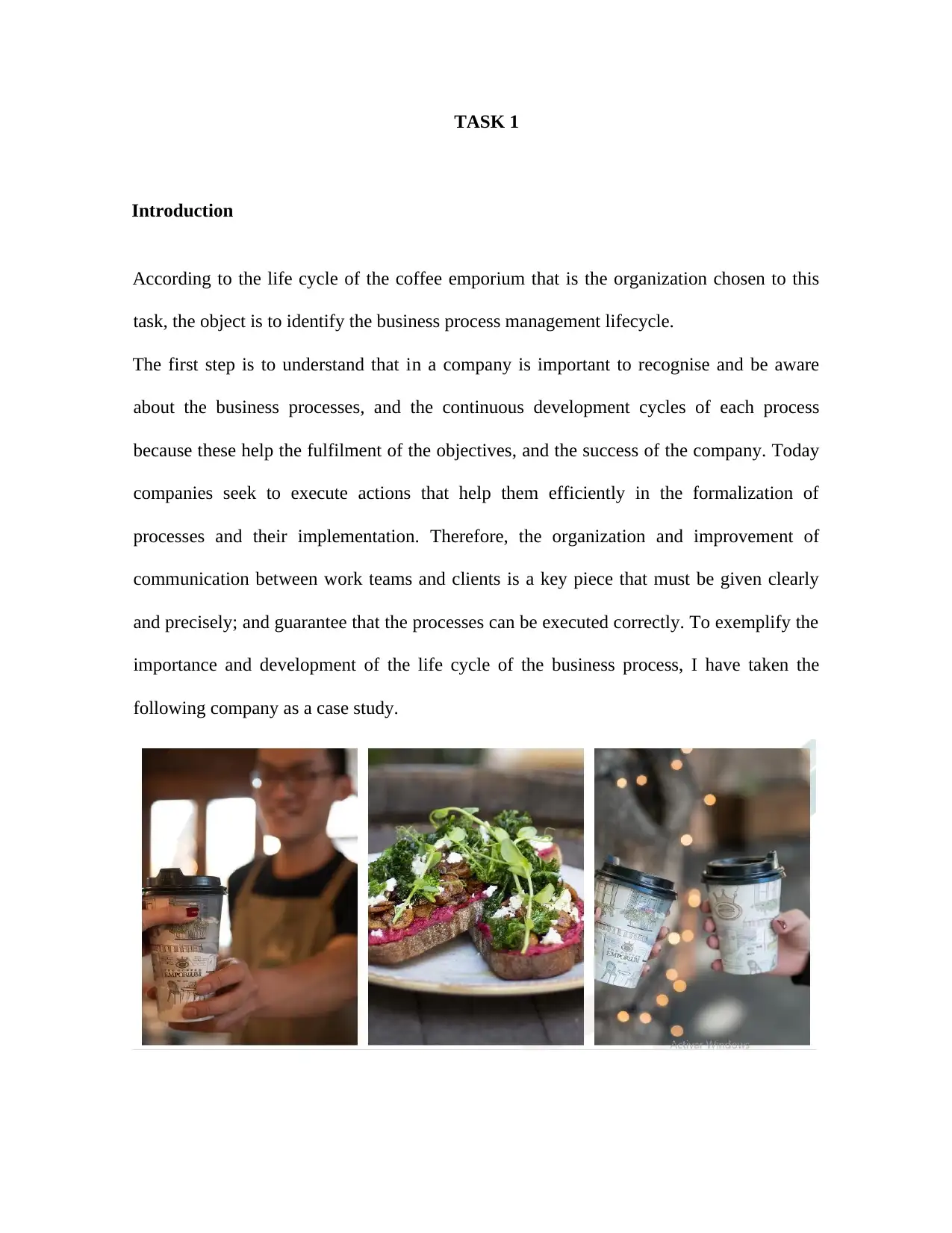
importance and development of the life cycle of the business process, I have taken the
following company as a case study.
Introduction
According to the life cycle of the coffee emporium that is the organization chosen to this
task, the object is to identify the business process management lifecycle.
The first step is to understand that in a company is important to recognise and be aware
about the business processes, and the continuous development cycles of each process
because these help the fulfilment of the objectives, and the success of the company. Today
companies seek to execute actions that help them efficiently in the formalization of
processes and their implementation. Therefore, the organization and improvement of
communication between work teams and clients is a key piece that must be given clearly
and precisely; and guarantee that the processes can be executed correctly. To exemplify the
importance and development of the life cycle of the business process, I have taken the
following company as a case study.
Description
The coffee emporium is a company, which was originally located in Bankstown, Sydney,
Australia. It was founded in 1991. The founder of the company is John Ayoub, a coffee
lover; the company prospered and in 2005 became a powerful association, recognized as a
coffee powerhouse and icon. Today the company is a large franchise, with more than 40
stores across Australia.
The life cycle of the company is characterized by the efficiency and quality standards of the
product, below I will describe the characteristics of each stage.
Optimization
The optimization of the company is based on the response to the market. The company pays
great attention to product extraction mechanisms, from the purchase of the raw material to
its transformation, using traditional and innovative methods that allow an agile response to
the consumer. The optimization of processes and resources establishes improvement
actions in the tasks necessary for the elaboration of the product.
The Emporium coffee has the challenge of achieving an adequate integration between the
processes, the people who execute these processes and the technology used to carry them
out.
The coffee emporium is a company, which was originally located in Bankstown, Sydney,
Australia. It was founded in 1991. The founder of the company is John Ayoub, a coffee
lover; the company prospered and in 2005 became a powerful association, recognized as a
coffee powerhouse and icon. Today the company is a large franchise, with more than 40
stores across Australia.
The life cycle of the company is characterized by the efficiency and quality standards of the
product, below I will describe the characteristics of each stage.
Optimization
The optimization of the company is based on the response to the market. The company pays
great attention to product extraction mechanisms, from the purchase of the raw material to
its transformation, using traditional and innovative methods that allow an agile response to
the consumer. The optimization of processes and resources establishes improvement
actions in the tasks necessary for the elaboration of the product.
The Emporium coffee has the challenge of achieving an adequate integration between the
processes, the people who execute these processes and the technology used to carry them
out.
⊘ This is a preview!⊘
Do you want full access?
Subscribe today to unlock all pages.

Trusted by 1+ million students worldwide
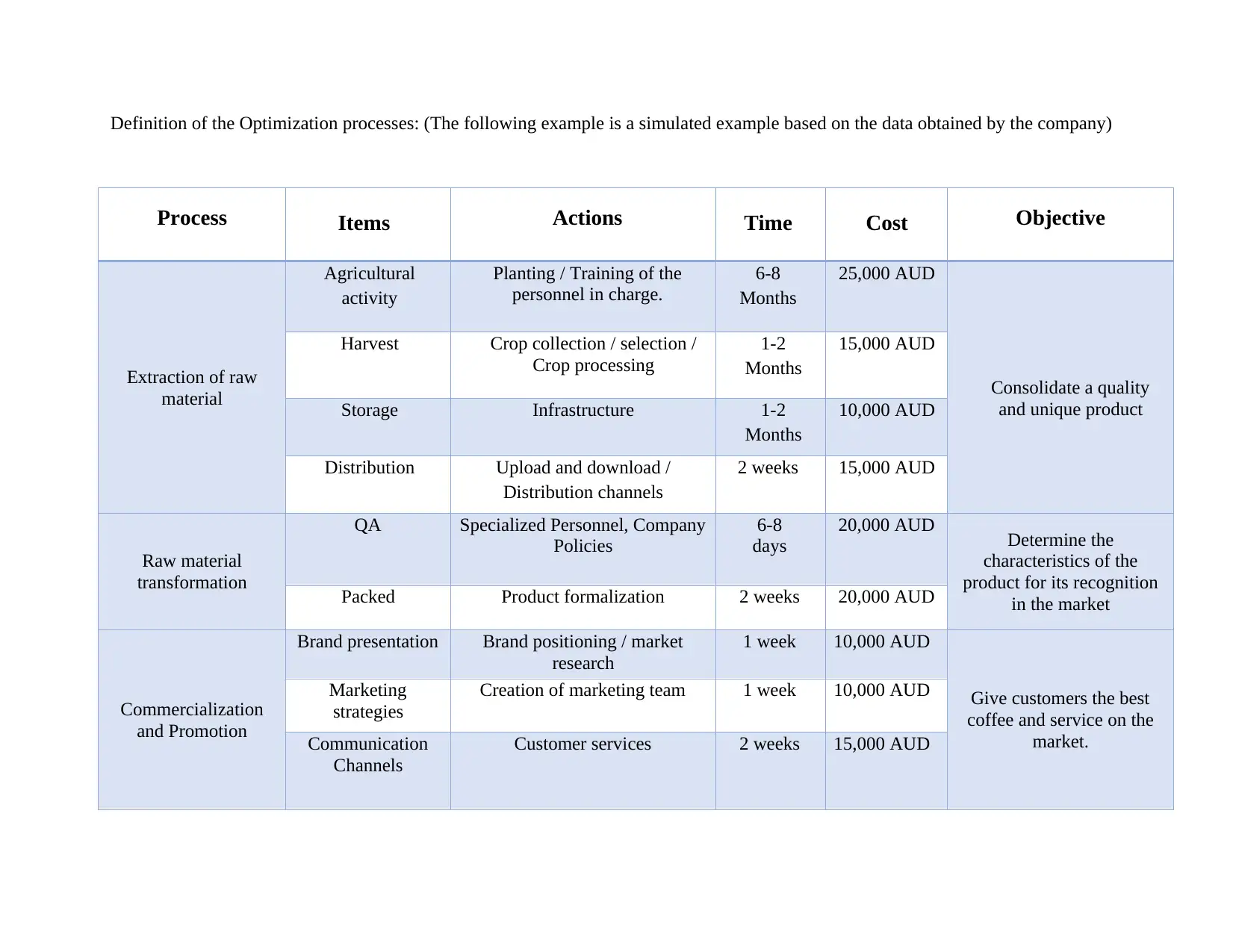
Definition of the Optimization processes: (The following example is a simulated example based on the data obtained by the company)
Process Items Actions Time Cost Objective
Extraction of raw
material
Agricultural
activity
Planting / Training of the
personnel in charge.
6-8
Months
25,000 AUD
Consolidate a quality
and unique product
Harvest Crop collection / selection /
Crop processing
1-2
Months
15,000 AUD
Storage Infrastructure 1-2
Months
10,000 AUD
Distribution Upload and download /
Distribution channels
2 weeks 15,000 AUD
Raw material
transformation
QA Specialized Personnel, Company
Policies
6-8
days
20,000 AUD Determine the
characteristics of the
product for its recognition
in the marketPacked Product formalization 2 weeks 20,000 AUD
Commercialization
and Promotion
Brand presentation Brand positioning / market
research
1 week 10,000 AUD
Give customers the best
coffee and service on the
market.
Marketing
strategies
Creation of marketing team 1 week 10,000 AUD
Communication
Channels
Customer services 2 weeks 15,000 AUD
Process Items Actions Time Cost Objective
Extraction of raw
material
Agricultural
activity
Planting / Training of the
personnel in charge.
6-8
Months
25,000 AUD
Consolidate a quality
and unique product
Harvest Crop collection / selection /
Crop processing
1-2
Months
15,000 AUD
Storage Infrastructure 1-2
Months
10,000 AUD
Distribution Upload and download /
Distribution channels
2 weeks 15,000 AUD
Raw material
transformation
QA Specialized Personnel, Company
Policies
6-8
days
20,000 AUD Determine the
characteristics of the
product for its recognition
in the marketPacked Product formalization 2 weeks 20,000 AUD
Commercialization
and Promotion
Brand presentation Brand positioning / market
research
1 week 10,000 AUD
Give customers the best
coffee and service on the
market.
Marketing
strategies
Creation of marketing team 1 week 10,000 AUD
Communication
Channels
Customer services 2 weeks 15,000 AUD
Paraphrase This Document
Need a fresh take? Get an instant paraphrase of this document with our AI Paraphraser
The main purpose of the company is to achieve an adequate integration between the
different areas of the company. And in this way, all the dependencies and components fit
together properly.
Process evaluation method
To get the measure the efficiency of the process, the fulfilment of three essential indicators
is taken into account: the first one is time, this indicator allow us to evaluate if the process
is presenting any delay or if it is possible to execute it in a shorter time. The second
indicator is the cost, for this indicator a market evaluation is carried out focused on the
monetary value that the process requires. This evaluation allows us to observe if the costs
of each process are static or dynamic, in this way we can make future projections of
different scenarios in the market. The last indicator is quality, which is derived from the
tangible and intangible qualities of the product, as a result of the execution of each process.
Each of the previous indicators has sub indicators, which help in the formalization and
efficiency of each process. The information is obtained through process monitoring forms,
internal and external surveys (Clients administrative staff), and observing the balance of the
company's accounting.
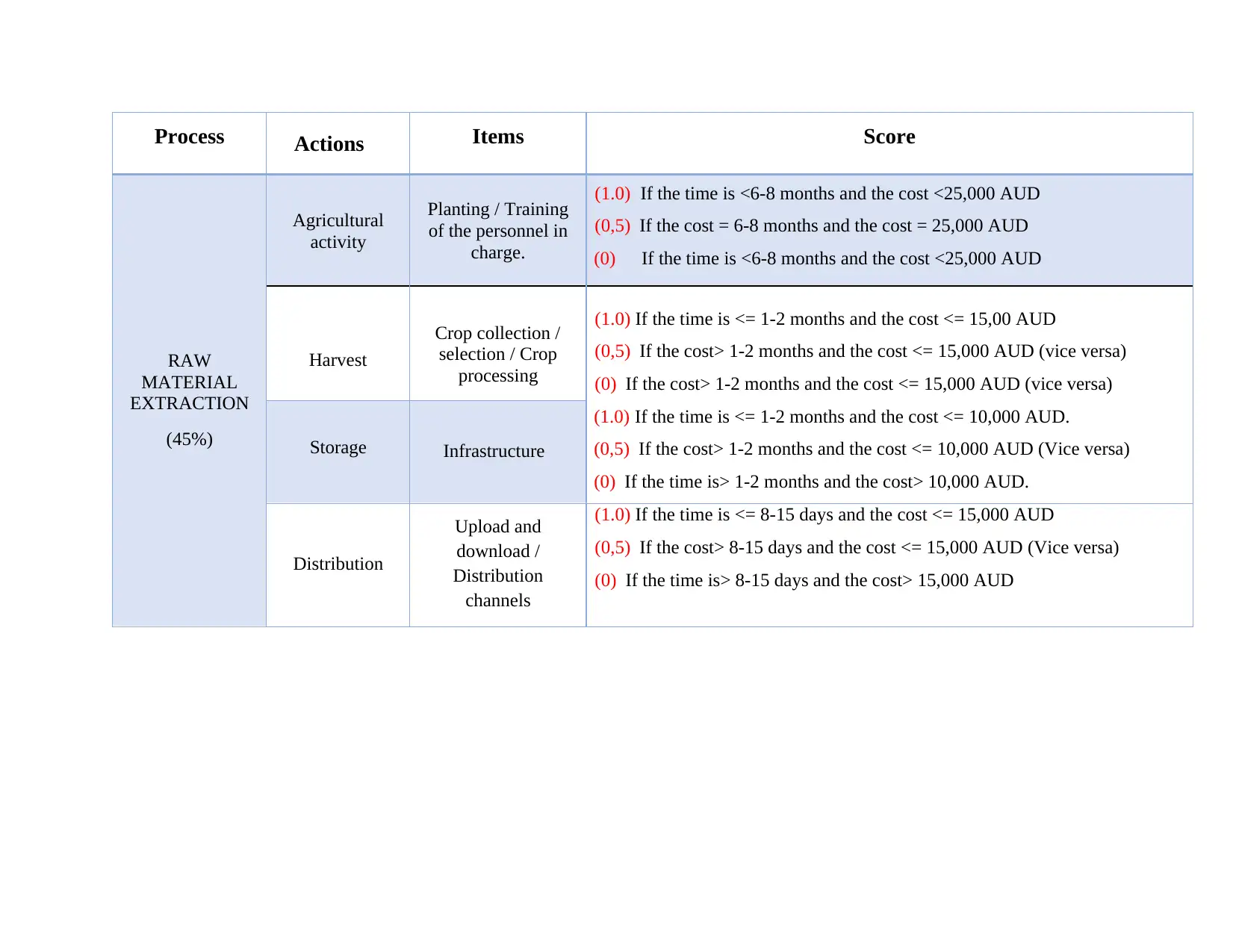
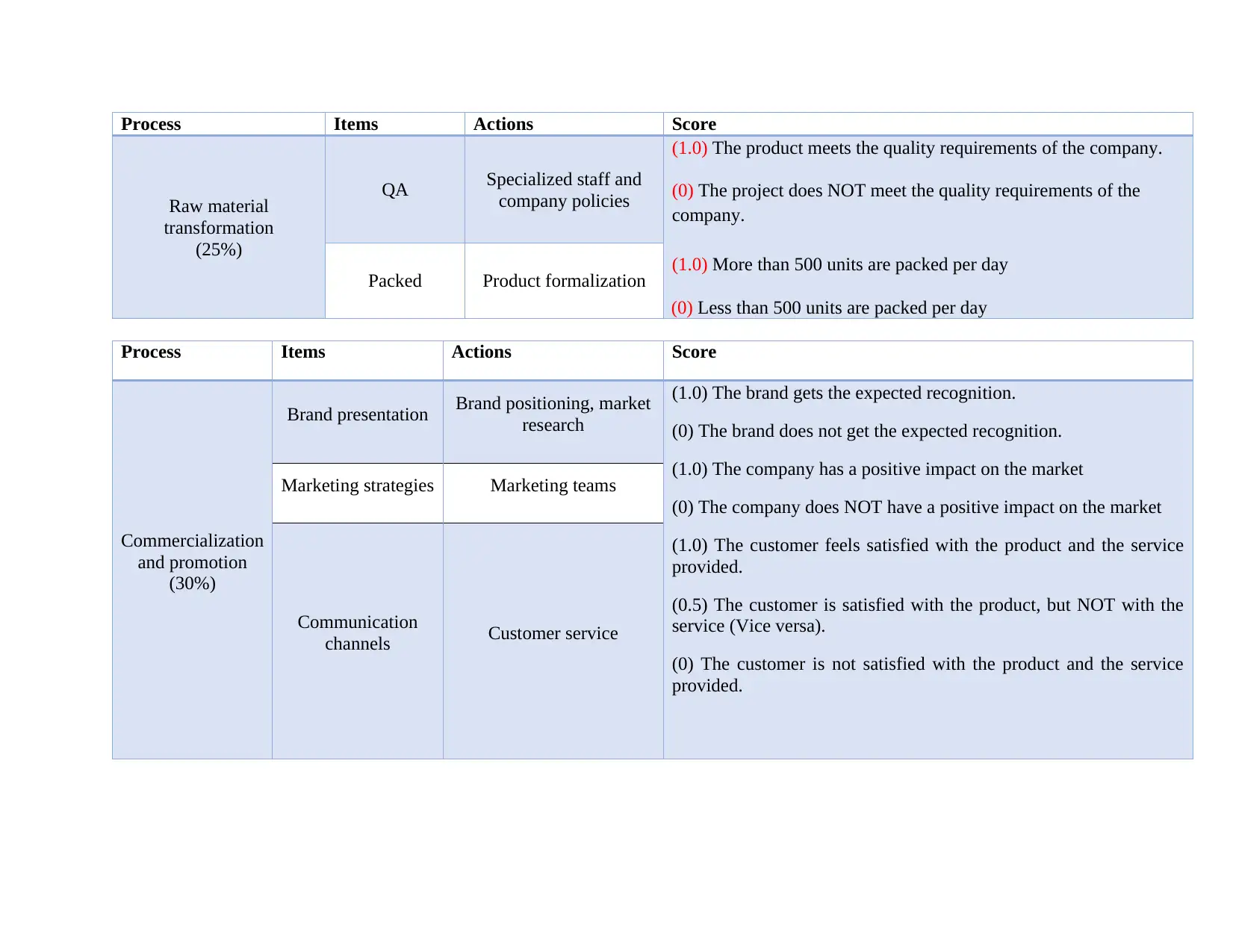
The evaluation scale for each process is shown on the chart below:
different areas of the company. And in this way, all the dependencies and components fit
together properly.
Process evaluation method
To get the measure the efficiency of the process, the fulfilment of three essential indicators
is taken into account: the first one is time, this indicator allow us to evaluate if the process
is presenting any delay or if it is possible to execute it in a shorter time. The second
indicator is the cost, for this indicator a market evaluation is carried out focused on the
monetary value that the process requires. This evaluation allows us to observe if the costs
of each process are static or dynamic, in this way we can make future projections of
different scenarios in the market. The last indicator is quality, which is derived from the
tangible and intangible qualities of the product, as a result of the execution of each process.
Each of the previous indicators has sub indicators, which help in the formalization and
efficiency of each process. The information is obtained through process monitoring forms,
internal and external surveys (Clients administrative staff), and observing the balance of the
company's accounting.
The evaluation scale for each process is shown on the chart below:
Process Actions Items Score
RAW
MATERIAL
EXTRACTION
(45%)
Agricultural
activity
Planting / Training
of the personnel in
charge.
(1.0) If the time is <6-8 months and the cost <25,000 AUD
(0,5) If the cost = 6-8 months and the cost = 25,000 AUD
(0) If the time is <6-8 months and the cost <25,000 AUD
Harvest
Crop collection /
selection / Crop
processing
(1.0) If the time is <= 1-2 months and the cost <= 15,00 AUD
(0,5) If the cost> 1-2 months and the cost <= 15,000 AUD (vice versa)
(0) If the cost> 1-2 months and the cost <= 15,000 AUD (vice versa)
(1.0) If the time is <= 1-2 months and the cost <= 10,000 AUD.
(0,5) If the cost> 1-2 months and the cost <= 10,000 AUD (Vice versa)
(0) If the time is> 1-2 months and the cost> 10,000 AUD.
Storage Infrastructure
Distribution
Upload and
download /
Distribution
channels
(1.0) If the time is <= 8-15 days and the cost <= 15,000 AUD
(0,5) If the cost> 8-15 days and the cost <= 15,000 AUD (Vice versa)
(0) If the time is> 8-15 days and the cost> 15,000 AUD
RAW
MATERIAL
EXTRACTION
(45%)
Agricultural
activity
Planting / Training
of the personnel in
charge.
(1.0) If the time is <6-8 months and the cost <25,000 AUD
(0,5) If the cost = 6-8 months and the cost = 25,000 AUD
(0) If the time is <6-8 months and the cost <25,000 AUD
Harvest
Crop collection /
selection / Crop
processing
(1.0) If the time is <= 1-2 months and the cost <= 15,00 AUD
(0,5) If the cost> 1-2 months and the cost <= 15,000 AUD (vice versa)
(0) If the cost> 1-2 months and the cost <= 15,000 AUD (vice versa)
(1.0) If the time is <= 1-2 months and the cost <= 10,000 AUD.
(0,5) If the cost> 1-2 months and the cost <= 10,000 AUD (Vice versa)
(0) If the time is> 1-2 months and the cost> 10,000 AUD.
Storage Infrastructure
Distribution
Upload and
download /
Distribution
channels
(1.0) If the time is <= 8-15 days and the cost <= 15,000 AUD
(0,5) If the cost> 8-15 days and the cost <= 15,000 AUD (Vice versa)
(0) If the time is> 8-15 days and the cost> 15,000 AUD
⊘ This is a preview!⊘
Do you want full access?
Subscribe today to unlock all pages.
Trusted by 1+ million students worldwide
Process Items Actions Score
Raw material
transformation
(25%)
QA Specialized staff and
company policies
(1.0) The product meets the quality requirements of the company.
(0) The project does NOT meet the quality requirements of the
company.
(1.0) More than 500 units are packed per day
(0) Less than 500 units are packed per day
Packed Product formalization
Process Items Actions Score
Commercialization
and promotion
(30%)
Brand presentation Brand positioning, market
research
(1.0) The brand gets the expected recognition.
(0) The brand does not get the expected recognition.
(1.0) The company has a positive impact on the market
(0) The company does NOT have a positive impact on the market
(1.0) The customer feels satisfied with the product and the service
provided.
(0.5) The customer is satisfied with the product, but NOT with the
service (Vice versa).
(0) The customer is not satisfied with the product and the service
provided.
Marketing strategies Marketing teams
Communication
channels Customer service
Raw material
transformation
(25%)
QA Specialized staff and
company policies
(1.0) The product meets the quality requirements of the company.
(0) The project does NOT meet the quality requirements of the
company.
(1.0) More than 500 units are packed per day
(0) Less than 500 units are packed per day
Packed Product formalization
Process Items Actions Score
Commercialization
and promotion
(30%)
Brand presentation Brand positioning, market
research
(1.0) The brand gets the expected recognition.
(0) The brand does not get the expected recognition.
(1.0) The company has a positive impact on the market
(0) The company does NOT have a positive impact on the market
(1.0) The customer feels satisfied with the product and the service
provided.
(0.5) The customer is satisfied with the product, but NOT with the
service (Vice versa).
(0) The customer is not satisfied with the product and the service
provided.
Marketing strategies Marketing teams
Communication
channels Customer service
Paraphrase This Document
Need a fresh take? Get an instant paraphrase of this document with our AI Paraphraser
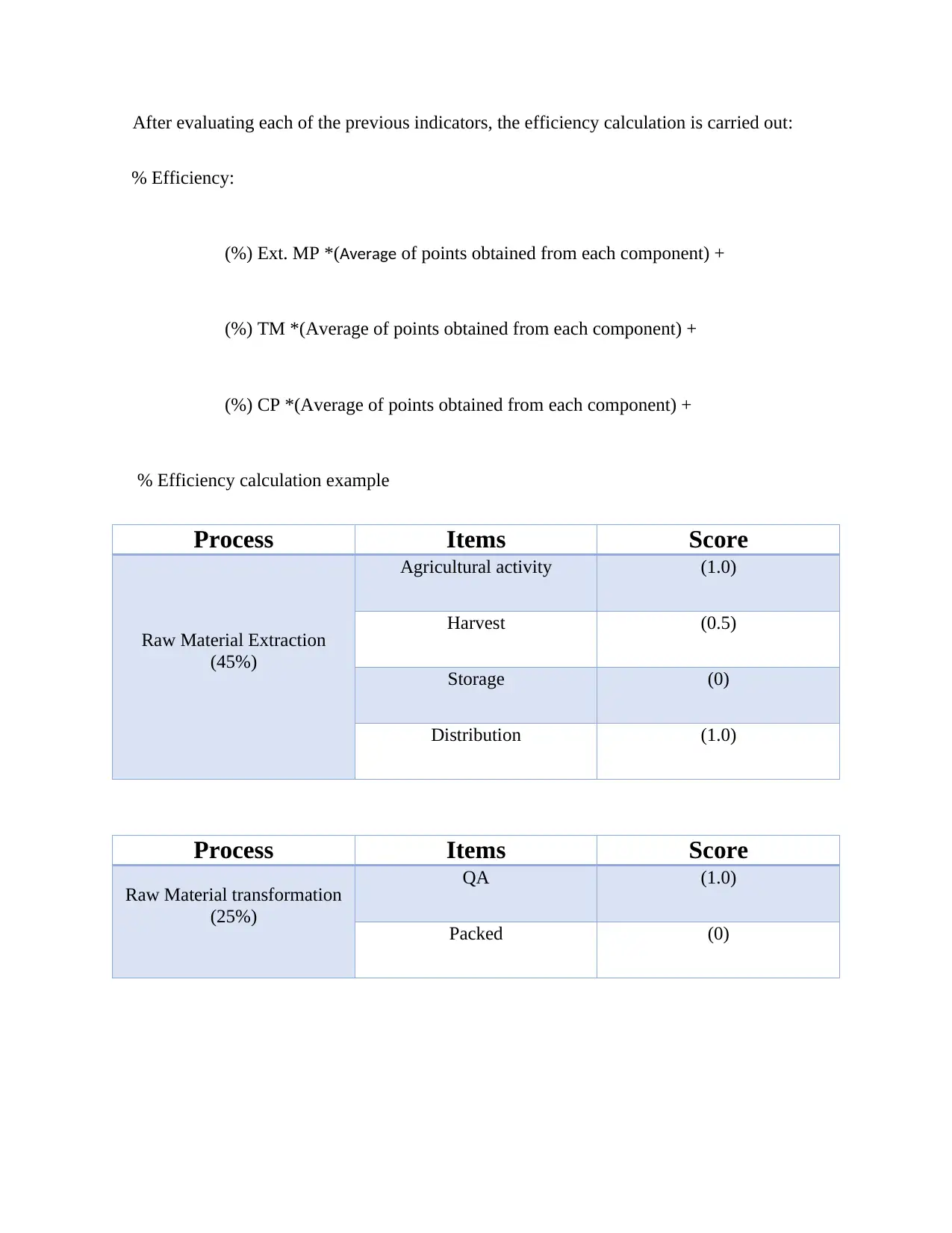
After evaluating each of the previous indicators, the efficiency calculation is carried out:
% Efficiency:
(%) Ext. MP *(Average of points obtained from each component) +
(%) TM *(Average of points obtained from each component) +
(%) CP *(Average of points obtained from each component) +
% Efficiency calculation example
Process Items Score
Raw Material Extraction
(45%)
Agricultural activity (1.0)
Harvest (0.5)
Storage (0)
Distribution (1.0)
Process Items Score
Raw Material transformation
(25%)
QA (1.0)
Packed (0)
% Efficiency:
(%) Ext. MP *(Average of points obtained from each component) +
(%) TM *(Average of points obtained from each component) +
(%) CP *(Average of points obtained from each component) +
% Efficiency calculation example
Process Items Score
Raw Material Extraction
(45%)
Agricultural activity (1.0)
Harvest (0.5)
Storage (0)
Distribution (1.0)
Process Items Score
Raw Material transformation
(25%)
QA (1.0)
Packed (0)
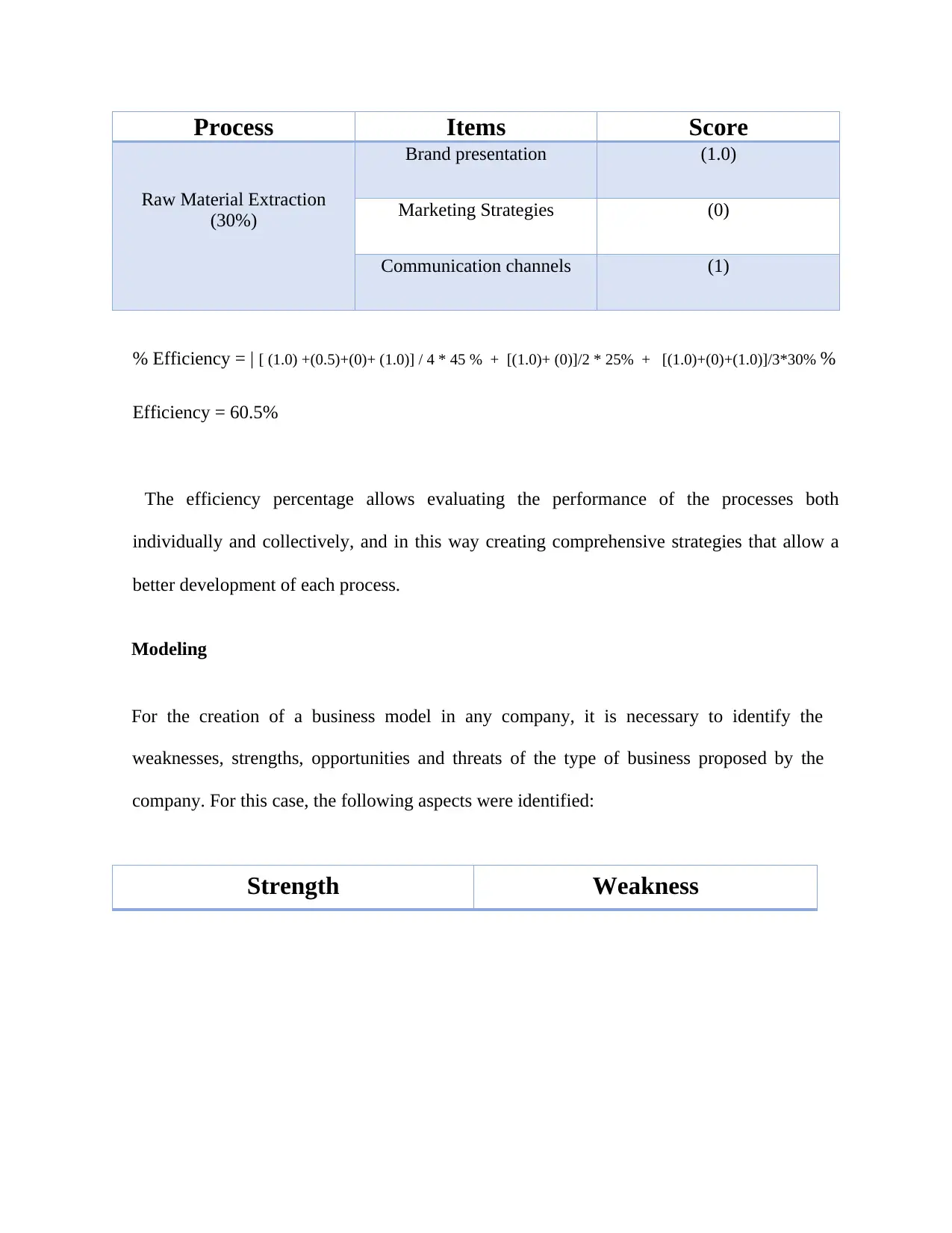
Process Items Score
Raw Material Extraction
(30%)
Brand presentation (1.0)
Marketing Strategies (0)
Communication channels (1)
% Efficiency = | [ (1.0) +(0.5)+(0)+ (1.0)] / 4 * 45 % + [(1.0)+ (0)]/2 * 25% + [(1.0)+(0)+(1.0)]/3*30% %
Efficiency = 60.5%
The efficiency percentage allows evaluating the performance of the processes both
individually and collectively, and in this way creating comprehensive strategies that allow a
better development of each process.
Modeling
For the creation of a business model in any company, it is necessary to identify the
weaknesses, strengths, opportunities and threats of the type of business proposed by the
company. For this case, the following aspects were identified:
Strength Weakness
Raw Material Extraction
(30%)
Brand presentation (1.0)
Marketing Strategies (0)
Communication channels (1)
% Efficiency = | [ (1.0) +(0.5)+(0)+ (1.0)] / 4 * 45 % + [(1.0)+ (0)]/2 * 25% + [(1.0)+(0)+(1.0)]/3*30% %
Efficiency = 60.5%
The efficiency percentage allows evaluating the performance of the processes both
individually and collectively, and in this way creating comprehensive strategies that allow a
better development of each process.
Modeling
For the creation of a business model in any company, it is necessary to identify the
weaknesses, strengths, opportunities and threats of the type of business proposed by the
company. For this case, the following aspects were identified:
Strength Weakness
⊘ This is a preview!⊘
Do you want full access?
Subscribe today to unlock all pages.
Trusted by 1+ million students worldwide
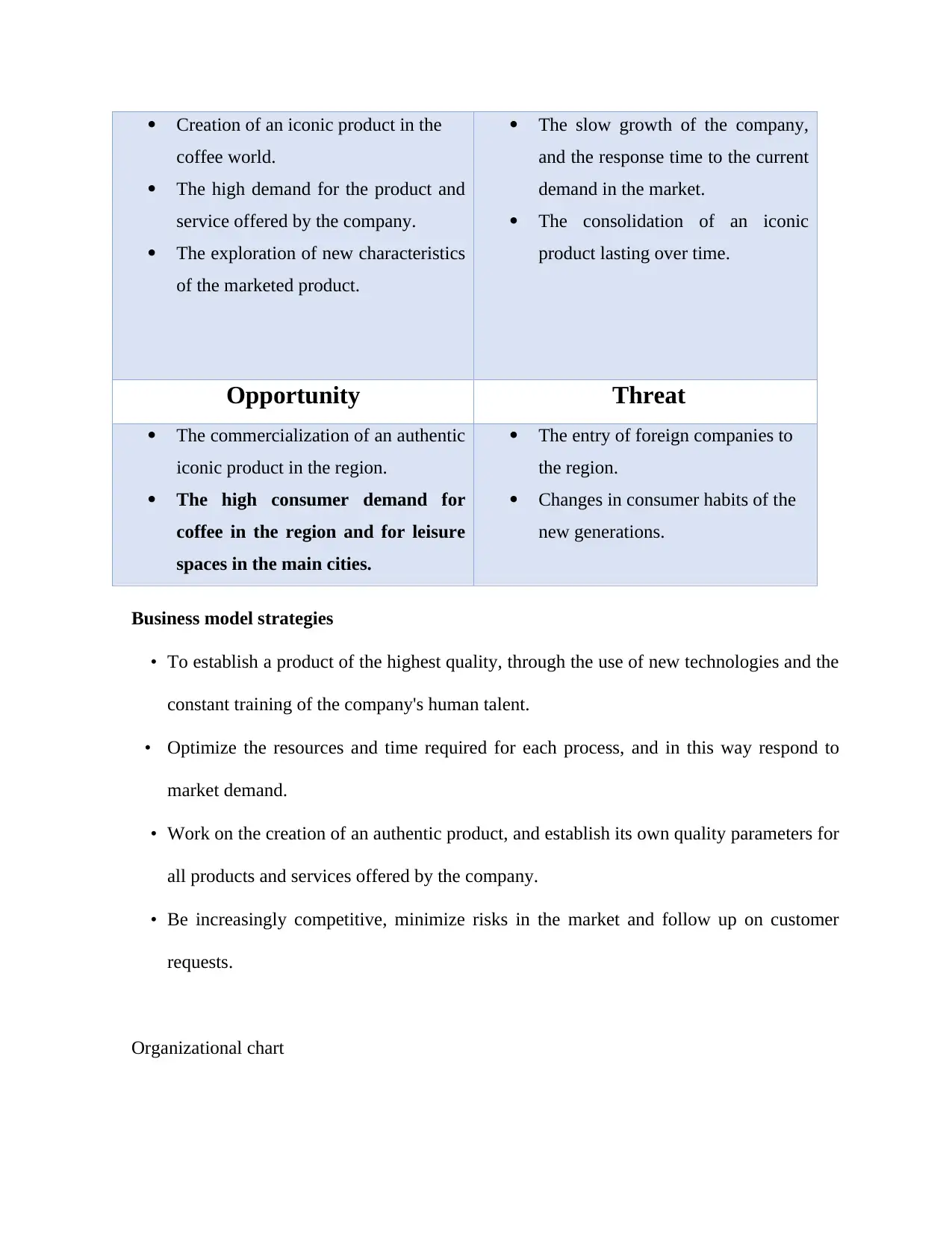
Creation of an iconic product in the
coffee world.
The high demand for the product and
service offered by the company.
The exploration of new characteristics
of the marketed product.
The slow growth of the company,
and the response time to the current
demand in the market.
The consolidation of an iconic
product lasting over time.
Opportunity Threat
The commercialization of an authentic
iconic product in the region.
The high consumer demand for
coffee in the region and for leisure
spaces in the main cities.
The entry of foreign companies to
the region.
Changes in consumer habits of the
new generations.
Business model strategies
• To establish a product of the highest quality, through the use of new technologies and the
constant training of the company's human talent.
• Optimize the resources and time required for each process, and in this way respond to
market demand.
• Work on the creation of an authentic product, and establish its own quality parameters for
all products and services offered by the company.
• Be increasingly competitive, minimize risks in the market and follow up on customer
requests.
Organizational chart
coffee world.
The high demand for the product and
service offered by the company.
The exploration of new characteristics
of the marketed product.
The slow growth of the company,
and the response time to the current
demand in the market.
The consolidation of an iconic
product lasting over time.
Opportunity Threat
The commercialization of an authentic
iconic product in the region.
The high consumer demand for
coffee in the region and for leisure
spaces in the main cities.
The entry of foreign companies to
the region.
Changes in consumer habits of the
new generations.
Business model strategies
• To establish a product of the highest quality, through the use of new technologies and the
constant training of the company's human talent.
• Optimize the resources and time required for each process, and in this way respond to
market demand.
• Work on the creation of an authentic product, and establish its own quality parameters for
all products and services offered by the company.
• Be increasingly competitive, minimize risks in the market and follow up on customer
requests.
Organizational chart
Paraphrase This Document
Need a fresh take? Get an instant paraphrase of this document with our AI Paraphraser
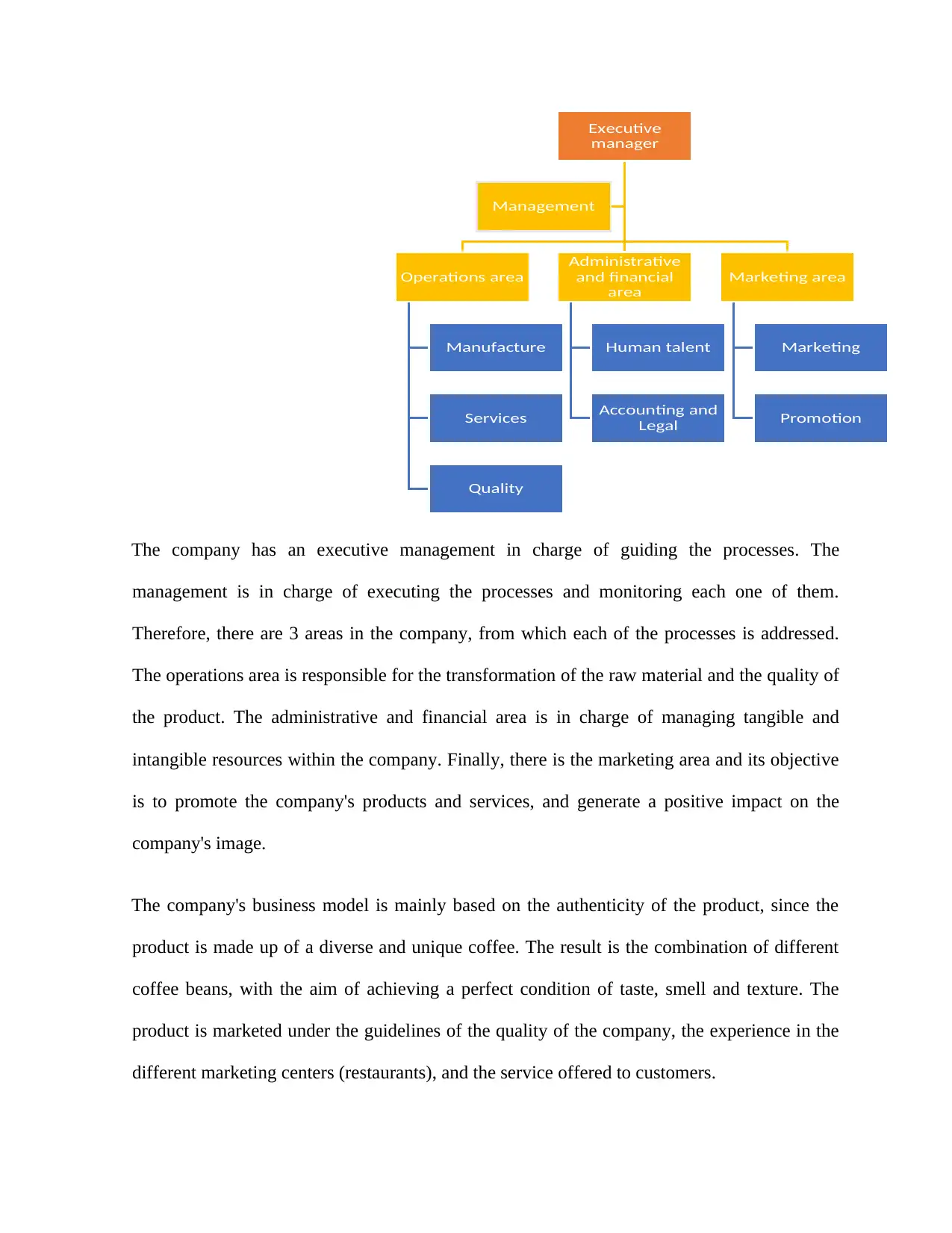
The company has an executive management in charge of guiding the processes. The
management is in charge of executing the processes and monitoring each one of them.
Therefore, there are 3 areas in the company, from which each of the processes is addressed.
The operations area is responsible for the transformation of the raw material and the quality of
the product. The administrative and financial area is in charge of managing tangible and
intangible resources within the company. Finally, there is the marketing area and its objective
is to promote the company's products and services, and generate a positive impact on the
company's image.
The company's business model is mainly based on the authenticity of the product, since the
product is made up of a diverse and unique coffee. The result is the combination of different
coffee beans, with the aim of achieving a perfect condition of taste, smell and texture. The
product is marketed under the guidelines of the quality of the company, the experience in the
different marketing centers (restaurants), and the service offered to customers.
Executive
manager
Operations area
Manufacture
Services
Quality
Administrative
and financial
area
Human talent
Accounting and
Legal
Marketing area
Marketing
Promotion
Management
management is in charge of executing the processes and monitoring each one of them.
Therefore, there are 3 areas in the company, from which each of the processes is addressed.
The operations area is responsible for the transformation of the raw material and the quality of
the product. The administrative and financial area is in charge of managing tangible and
intangible resources within the company. Finally, there is the marketing area and its objective
is to promote the company's products and services, and generate a positive impact on the
company's image.
The company's business model is mainly based on the authenticity of the product, since the
product is made up of a diverse and unique coffee. The result is the combination of different
coffee beans, with the aim of achieving a perfect condition of taste, smell and texture. The
product is marketed under the guidelines of the quality of the company, the experience in the
different marketing centers (restaurants), and the service offered to customers.
Executive
manager
Operations area
Manufacture
Services
Quality
Administrative
and financial
area
Human talent
Accounting and
Legal
Marketing area
Marketing
Promotion
Management
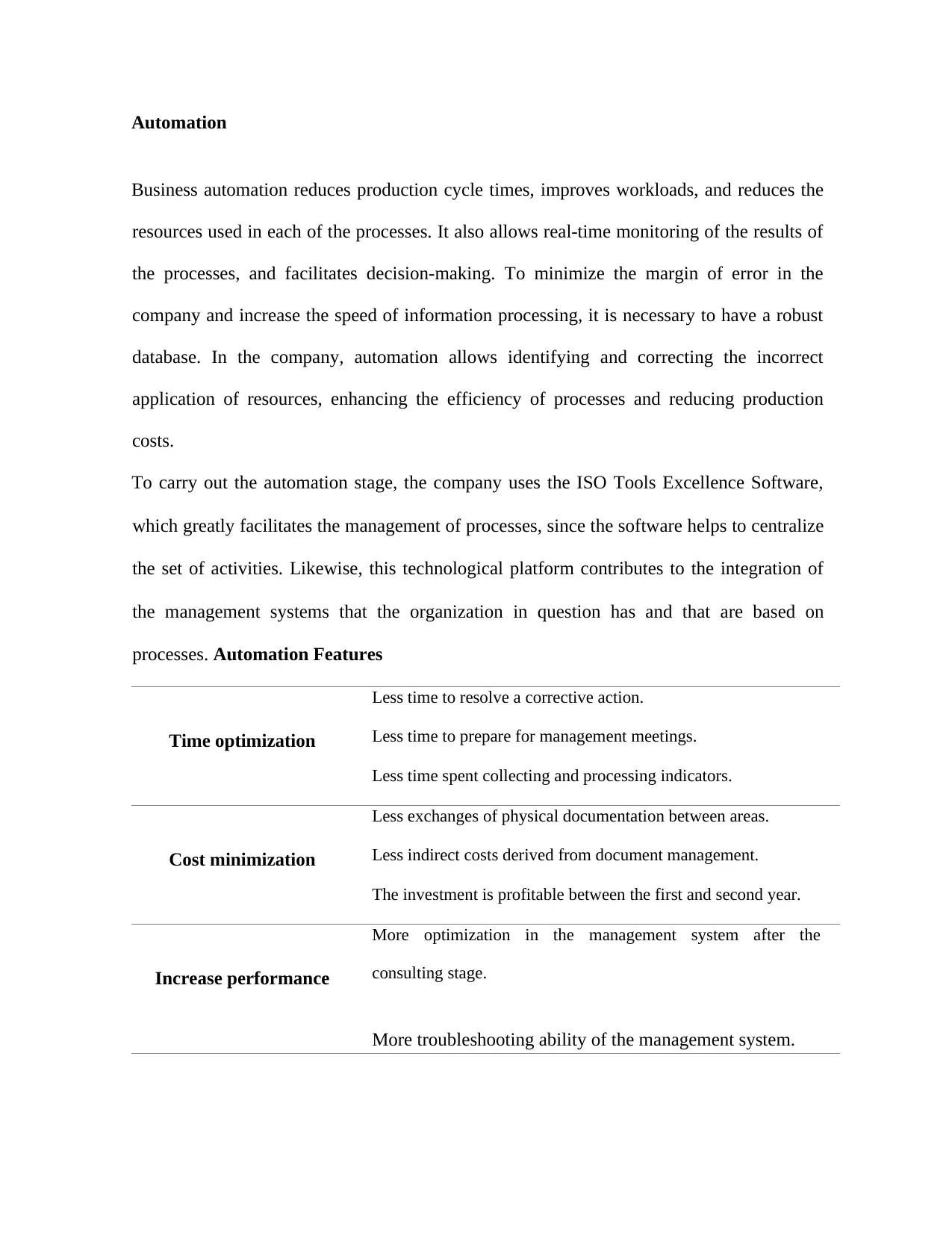
Automation
Business automation reduces production cycle times, improves workloads, and reduces the
resources used in each of the processes. It also allows real-time monitoring of the results of
the processes, and facilitates decision-making. To minimize the margin of error in the
company and increase the speed of information processing, it is necessary to have a robust
database. In the company, automation allows identifying and correcting the incorrect
application of resources, enhancing the efficiency of processes and reducing production
costs.
To carry out the automation stage, the company uses the ISO Tools Excellence Software,
which greatly facilitates the management of processes, since the software helps to centralize
the set of activities. Likewise, this technological platform contributes to the integration of
the management systems that the organization in question has and that are based on
processes. Automation Features
Time optimization
Less time to resolve a corrective action.
Less time to prepare for management meetings.
Less time spent collecting and processing indicators.
Cost minimization
Less exchanges of physical documentation between areas.
Less indirect costs derived from document management.
The investment is profitable between the first and second year.
Increase performance
More optimization in the management system after the
consulting stage.
More troubleshooting ability of the management system.
Business automation reduces production cycle times, improves workloads, and reduces the
resources used in each of the processes. It also allows real-time monitoring of the results of
the processes, and facilitates decision-making. To minimize the margin of error in the
company and increase the speed of information processing, it is necessary to have a robust
database. In the company, automation allows identifying and correcting the incorrect
application of resources, enhancing the efficiency of processes and reducing production
costs.
To carry out the automation stage, the company uses the ISO Tools Excellence Software,
which greatly facilitates the management of processes, since the software helps to centralize
the set of activities. Likewise, this technological platform contributes to the integration of
the management systems that the organization in question has and that are based on
processes. Automation Features
Time optimization
Less time to resolve a corrective action.
Less time to prepare for management meetings.
Less time spent collecting and processing indicators.
Cost minimization
Less exchanges of physical documentation between areas.
Less indirect costs derived from document management.
The investment is profitable between the first and second year.
Increase performance
More optimization in the management system after the
consulting stage.
More troubleshooting ability of the management system.
⊘ This is a preview!⊘
Do you want full access?
Subscribe today to unlock all pages.
Trusted by 1+ million students worldwide

1 out of 17


Related Documents


Your All-in-One AI-Powered Toolkit for Academic Success.
+13062052269
info@desklib.com
Available 24*7 on WhatsApp / Email
![[object Object]](/_next/static/media/star-bottom.7253800d.svg)
Unlock your academic potential
Copyright © 2020–2026 A2Z Services. All Rights Reserved. Developed and managed by ZUCOL.