Business Process Management Report: COBIT Framework and Metrics

Verified

Added on  2020/04/13

|5
|759
|41
Report
AI Summary
This report provides an overview of Business Process Management (BPM), focusing on key concepts and frameworks. It begins with an explanation of the Balanced Scorecard approach, detailing its use in aligning organizational goals, prioritizing projects, and monitoring progress. The report then discusses the importance of process performance measurement, including the use of KPIs and the distinction between internal and external measures. Matrix Management is explored as a structure that merges functional and process approaches, highlighting its elements and outcomes. The role of the Business Process Management Group is outlined, emphasizing its functions in process modification, enterprise-level management, and performance reporting. Finally, the report examines the COBIT framework, explaining its components and functions in managing IT governance, including setting IT goals and objectives, defining management processes, and providing matrices for process management. The report includes references to support the information provided.
Document Page
Running head: BUSINESS PROCESS MANAGEMENT
BUSINESS PROCESS MANAGEMENT
Name of the Student:
Name of the University:
Author Note:
tabler-icon-diamond-filled.svg

Paraphrase This Document

Need a fresh take? Get an instant paraphrase of this document with our AI Paraphraser
Document Page
1BUSINESS PROCESS MANAGEMENT
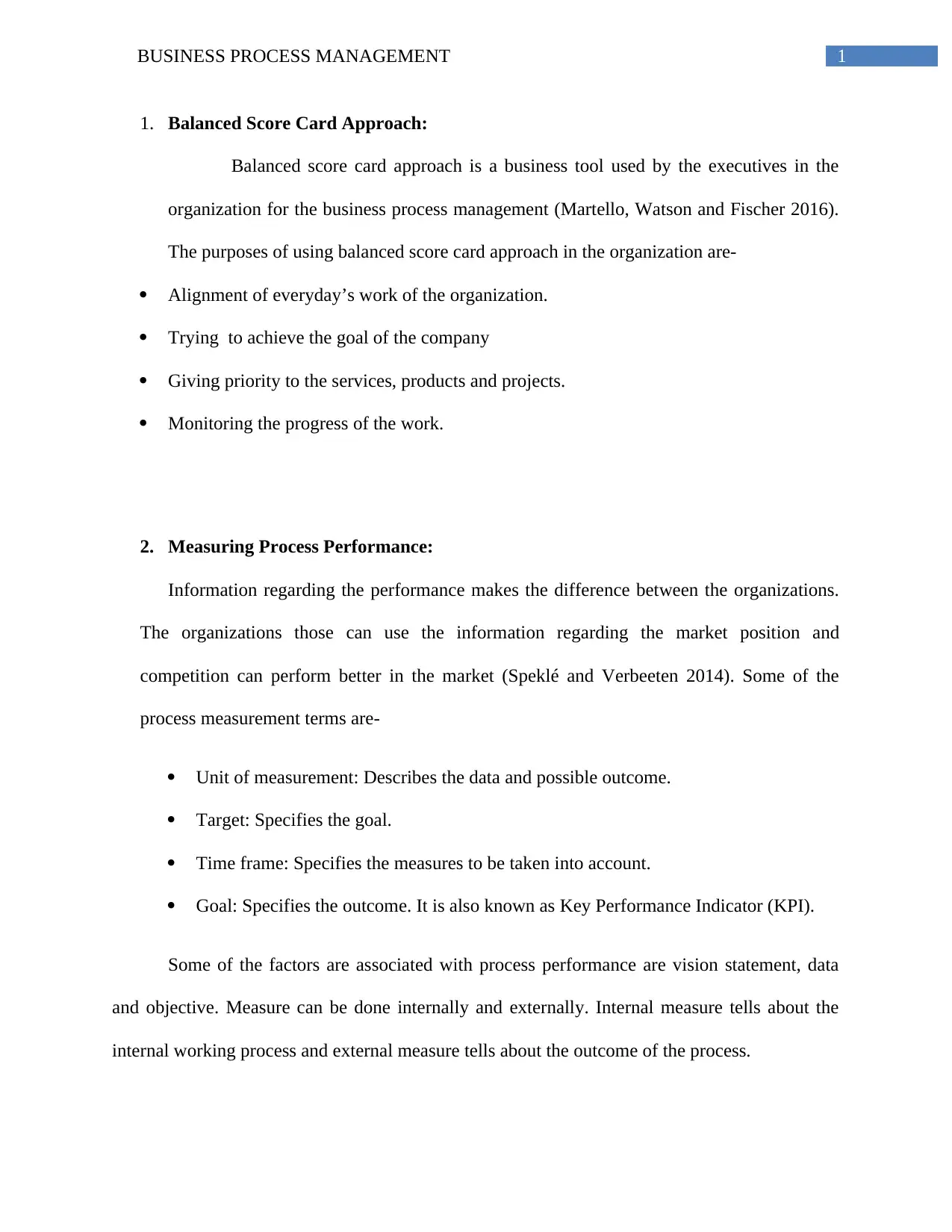
1. Balanced Score Card Approach:
Balanced score card approach is a business tool used by the executives in the
organization for the business process management (Martello, Watson and Fischer 2016).
The purposes of using balanced score card approach in the organization are-
Alignment of everyday’s work of the organization.
Trying to achieve the goal of the company
Giving priority to the services, products and projects.
Monitoring the progress of the work.
2. Measuring Process Performance:
Information regarding the performance makes the difference between the organizations.
The organizations those can use the information regarding the market position and
competition can perform better in the market (Speklé and Verbeeten 2014). Some of the
process measurement terms are-
Unit of measurement: Describes the data and possible outcome.
Target: Specifies the goal.
Time frame: Specifies the measures to be taken into account.
Goal: Specifies the outcome. It is also known as Key Performance Indicator (KPI).
Some of the factors are associated with process performance are vision statement, data
and objective. Measure can be done internally and externally. Internal measure tells about the
internal working process and external measure tells about the outcome of the process.
Document Page
2BUSINESS PROCESS MANAGEMENT
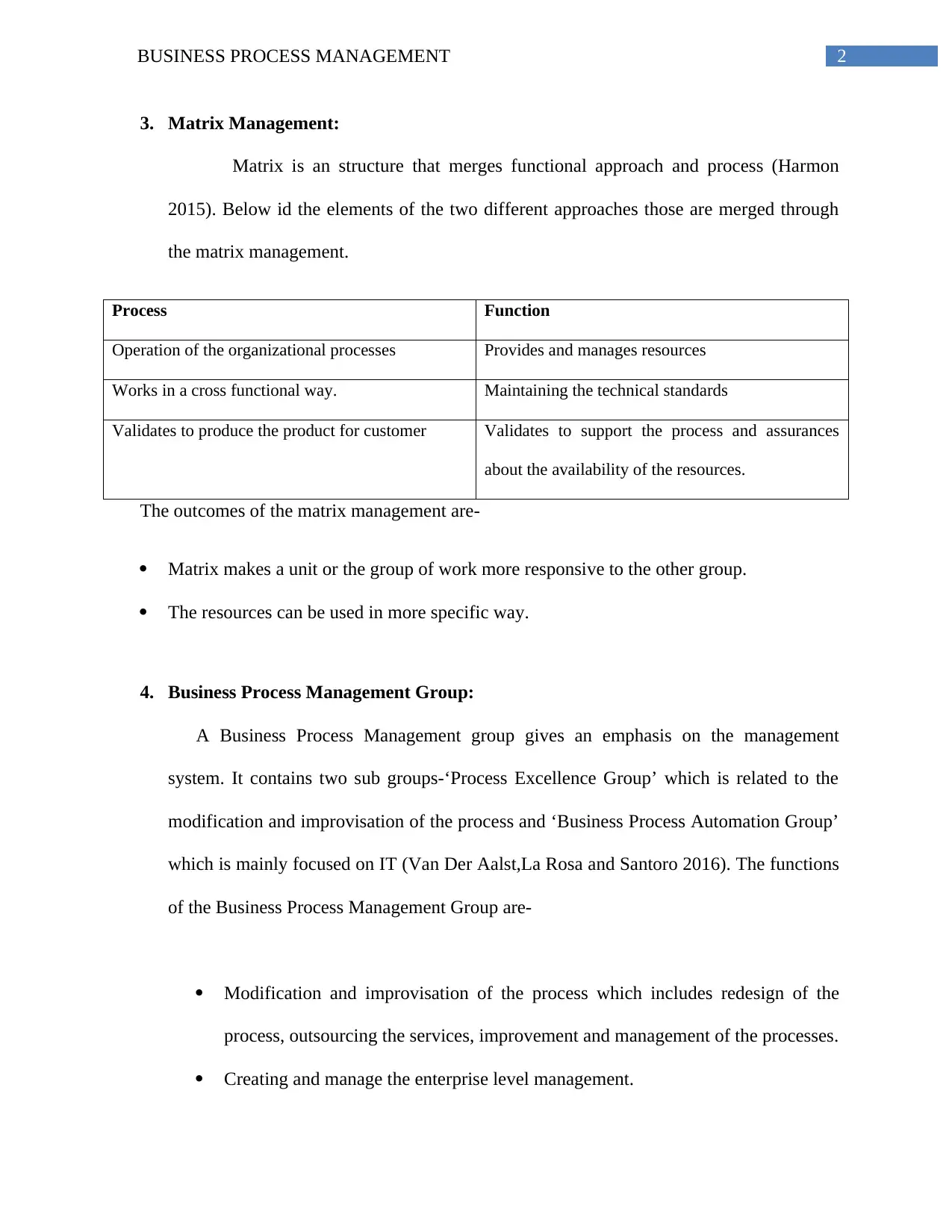
3. Matrix Management:
Matrix is an structure that merges functional approach and process (Harmon
2015). Below id the elements of the two different approaches those are merged through
the matrix management.
Process Function
Operation of the organizational processes Provides and manages resources
Works in a cross functional way. Maintaining the technical standards
Validates to produce the product for customer Validates to support the process and assurances
about the availability of the resources.
The outcomes of the matrix management are-
Matrix makes a unit or the group of work more responsive to the other group.
The resources can be used in more specific way.
4. Business Process Management Group:
A Business Process Management group gives an emphasis on the management
system. It contains two sub groups-‘Process Excellence Group’ which is related to the
modification and improvisation of the process and ‘Business Process Automation Group’
which is mainly focused on IT (Van Der Aalst,La Rosa and Santoro 2016). The functions
of the Business Process Management Group are-
Modification and improvisation of the process which includes redesign of the
process, outsourcing the services, improvement and management of the processes.
Creating and manage the enterprise level management.
Document Page
3BUSINESS PROCESS MANAGEMENT
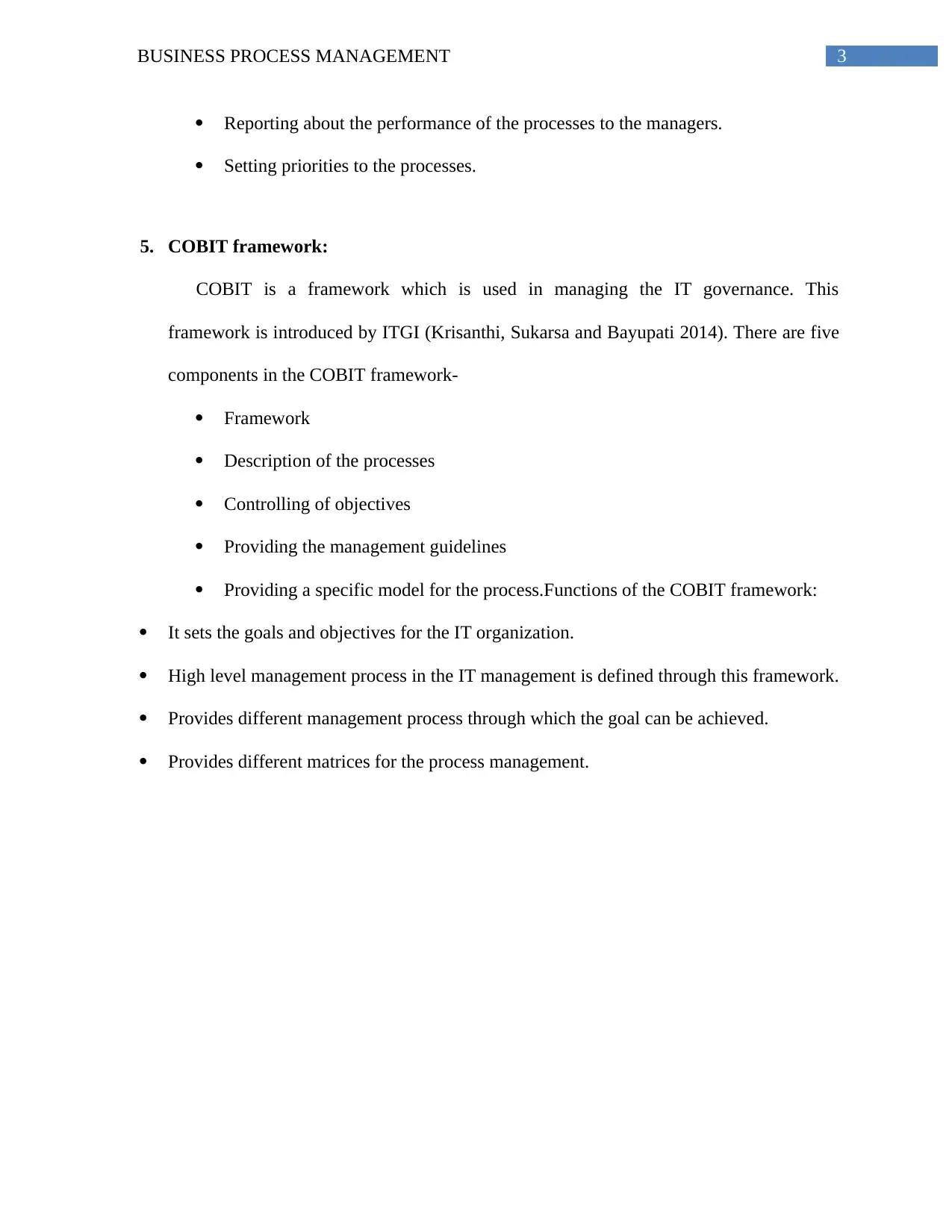
Reporting about the performance of the processes to the managers.
Setting priorities to the processes.
5. COBIT framework:
COBIT is a framework which is used in managing the IT governance. This
framework is introduced by ITGI (Krisanthi, Sukarsa and Bayupati 2014). There are five
components in the COBIT framework-
Framework
Description of the processes
Controlling of objectives
Providing the management guidelines
Providing a specific model for the process.Functions of the COBIT framework:
It sets the goals and objectives for the IT organization.
High level management process in the IT management is defined through this framework.
Provides different management process through which the goal can be achieved.
Provides different matrices for the process management.
tabler-icon-diamond-filled.svg

Paraphrase This Document

Need a fresh take? Get an instant paraphrase of this document with our AI Paraphraser
Document Page
4BUSINESS PROCESS MANAGEMENT
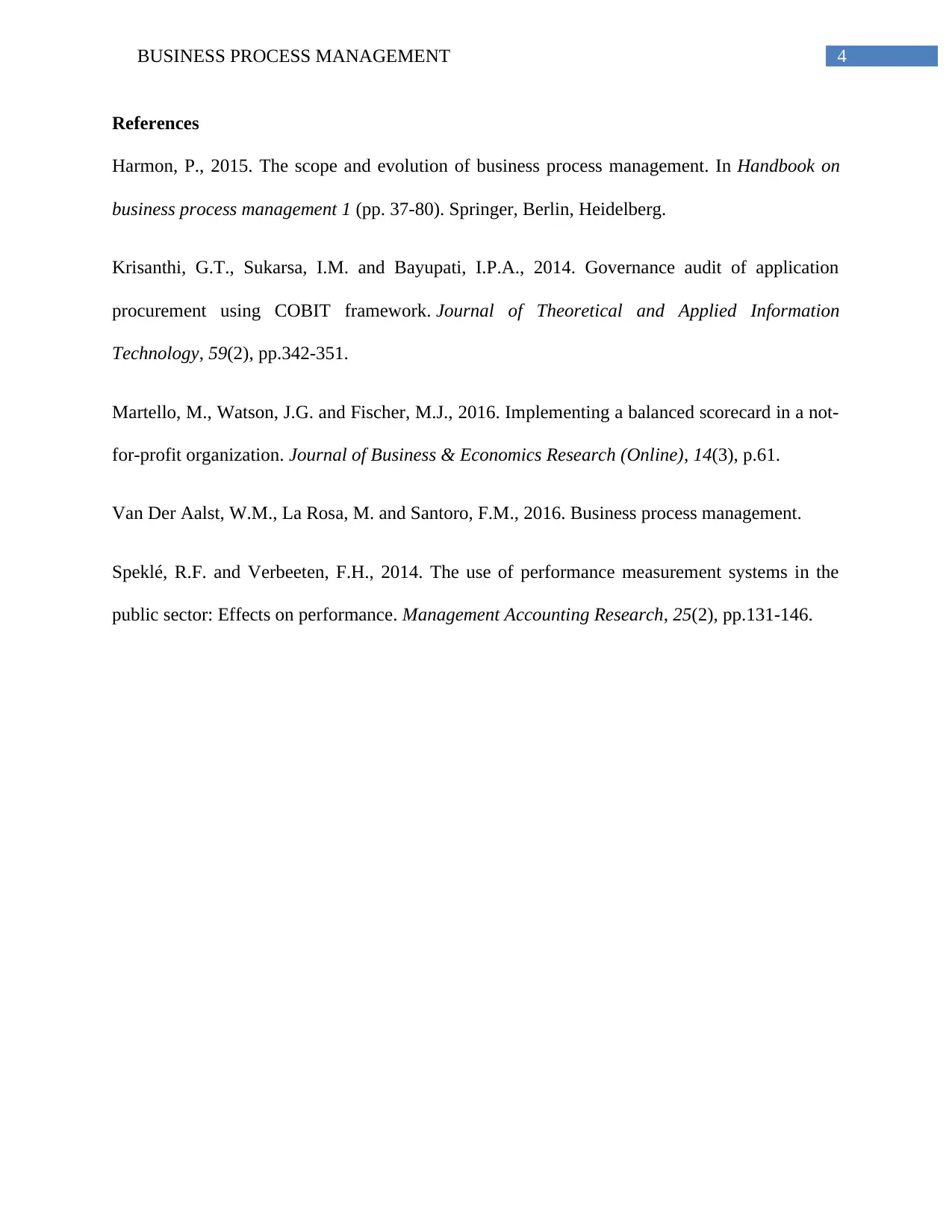
References
Harmon, P., 2015. The scope and evolution of business process management. In Handbook on
business process management 1 (pp. 37-80). Springer, Berlin, Heidelberg.
Krisanthi, G.T., Sukarsa, I.M. and Bayupati, I.P.A., 2014. Governance audit of application
procurement using COBIT framework. Journal of Theoretical and Applied Information
Technology, 59(2), pp.342-351.
Martello, M., Watson, J.G. and Fischer, M.J., 2016. Implementing a balanced scorecard in a not-
for-profit organization. Journal of Business & Economics Research (Online), 14(3), p.61.
Van Der Aalst, W.M., La Rosa, M. and Santoro, F.M., 2016. Business process management.
Speklé, R.F. and Verbeeten, F.H., 2014. The use of performance measurement systems in the
public sector: Effects on performance. Management Accounting Research, 25(2), pp.131-146.
chevron_up_icon
1 out of 5
circle_padding
hide_on_mobile
zoom_out_icon
[object Object]