PROJ6009: Business Process Management Analysis - Nestle Order Process

Verified

Added on  2022/10/04

|10
|1920
|221
Report
AI Summary
This report provides a business process analysis of Nestle's order management system. It begins with an introduction to Business Process Management (BPM) and its importance, highlighting the need for analysis and improvement within organizations. The study focuses on Nestle's current order-taking process, identifying inefficiencies related to manual order processing by receptionists, which leads to lost orders and customer dissatisfaction. The report presents an As-Is process model, illustrating the existing workflow, and proposes a To-Be process model incorporating AI chatbots to automate order taking, reduce errors, and improve customer service. A critical analysis of the mappings is included, discussing the advantages of AI implementation, such as error reduction and increased availability, while also considering potential disadvantages like data accuracy and the cost of implementation. The report concludes with a discussion of process analytical plan and recommendations for process and technology changes.
Document Page
Running head: BUSINESS PROCESS MANAGEMENT
BUSINESS PROCESS MANAGEMENT
Name of Student
Name of the University
Author Note
tabler-icon-diamond-filled.svg

Paraphrase This Document

Need a fresh take? Get an instant paraphrase of this document with our AI Paraphraser
Document Page
1BUSINESS PROCESS MANAGEMENT
Table of Contents
Part A: Business process analytical plan.............................................................................2
Introduction..........................................................................................................................2
Discussion............................................................................................................................2
As-Is process model.........................................................................................................5
To-Be process model.......................................................................................................6
Critical analysis of the mapping......................................................................................6
Conclusion...........................................................................................................................8
References............................................................................................................................9
Document Page
2BUSINESS PROCESS MANAGEMENT
Part A: Business process analytical plan
Introduction
On the other hand business process improvement refers to the activities carried out by the
organizational leaders in order to carry out process analysis such that the leaders will be able to
improve the accuracy of the process, improve the effectiveness and efficiency of the process and
various other reasons. The company selected for purpose of study is Nestle Company. The main
intention of the paper is discussing regarding the business process analysis and business process
improvement. The paper will discuss about as is mapping for the purpose of carrying out
business process analysis and the paper will also discuss about the to be mapping for the purpose
of improving the business process.
Discussion
Business process denotes to the set of inter-related deeds that is performed in an
organization in coordination with technical environment. It also comprises of various objects and
actors that helps in providing value to the customers. Business process management aims at
improving the overall performance of business by combination of various governance and
information technological methods. It is necessary to carry out business process analysis for all
types of organizations because they help in understanding the operations of business; it will help
in improving the stakeholder engagement (Rosemann & vom Brocke, 2015). Some of the major
business process models includes quote for ordering, procure to pay, order to cash, concern to
solution and various others. Some of the major capabilities of Business process management
includes leveraging for improving the efficiency, countering faster as well as managing change
properly. There are various components of business process management such as - modelling as
Document Page
3BUSINESS PROCESS MANAGEMENT
well as simulation, monitoring of business activity, rules as well as pre built framework,
collaboration between people, content centric processing, as well as process automation (vom
Brocke, Zelt & Schmiedel, 2016).
The business process management in Nestle comprises of its various operational
activities and strategies and therefore includes all other strategies such as- corporate strategy,
subsidiary strategy, global strategy of the company, capacity planning, lean and just in time
production activities of the company, and various others. The company is facing major issues in
management of the business procedures and particularly in process of receiving orders from
customers. With the growth in number of the customers of business, organisation cannot handle
all the customers who are calling in the company for placing their orders for various kinds of
products (Rahimi, Møller & Hvam, 2016). This issue has led to the significant loss of customers
for the company. Presently the company has employed an receptionist who takes the order from
the retailers and the customers who want to buy their products. There has been situations when
the human workforce in the company has been significantly inefficient and it has led to the
misplacement of orders (Vom Brocke & Mendling, 2018). For eliminating this particular issue,
the company has taken the decision of implementing the solution of artificial intelligence bots
who would take the orders of the clients and input in the pending order database. The main
advantage of the implementation of AI chatbots is that the misplacement of the orders would be
eliminated and the orders of all the customers would be accurately placed in the company.
The operation strategy of the company under study comprises of pushing the customers
into believing that the goods and services of the company are healthier than other others. The
operation strategy is focused on meeting the needs of the customers because it a customer centric
company (Uhl & Gollenia, 2016). The company is based on principles of trustworthiness,
tabler-icon-diamond-filled.svg

Paraphrase This Document

Need a fresh take? Get an instant paraphrase of this document with our AI Paraphraser
Document Page
4BUSINESS PROCESS MANAGEMENT
fairness and various other similar values. The company aims at obtaining competitive advantage
by using a road map and this road map can be divided into three main levels- the corporate
strategy the global strategy and the subsidiary strategy. The corporate strategy of company is
intended at reducing risk and improving efficiency through optimization of principles and rules.
The management system of the company works using the process of learning with corporate
culture and trust as a foundation (Müller et al., 2016). In order to simplify the business structure
the company adopted a program called GLOBE. The organization has a subsidiary strategy for
looking after the operations of its subsidiaries. The company has about 100 subsidiaries
operating worldwide. Nestle follows the global strategy of decentralised structure. The global
strategy of the company also comprises of its decision to acquire other organizations in the
emerging market. They have the strategy of acquiring all the local players such that identification
of its target markets can be done properly.
For gaining significant competitive advantage in this changing environment, organisation
try to utilise its own capabilities such as making use of just in time production and lean
production techniques such that they can survive in the long run and perform more effectively
and efficiently (Roeser & Kern, 2015). By adopting lean production techniques, organizations try
reducing their operational cost and reducing the over production of products and services. On the
other hand just in time techniques of production are used to look over the production of
inventory such that there is neither over production of inventory nor underproduction of
inventory. The strategy of differentiation in production and services can help organizations to
gain a competitive advantage.
Document Page
5BUSINESS PROCESS MANAGEMENT
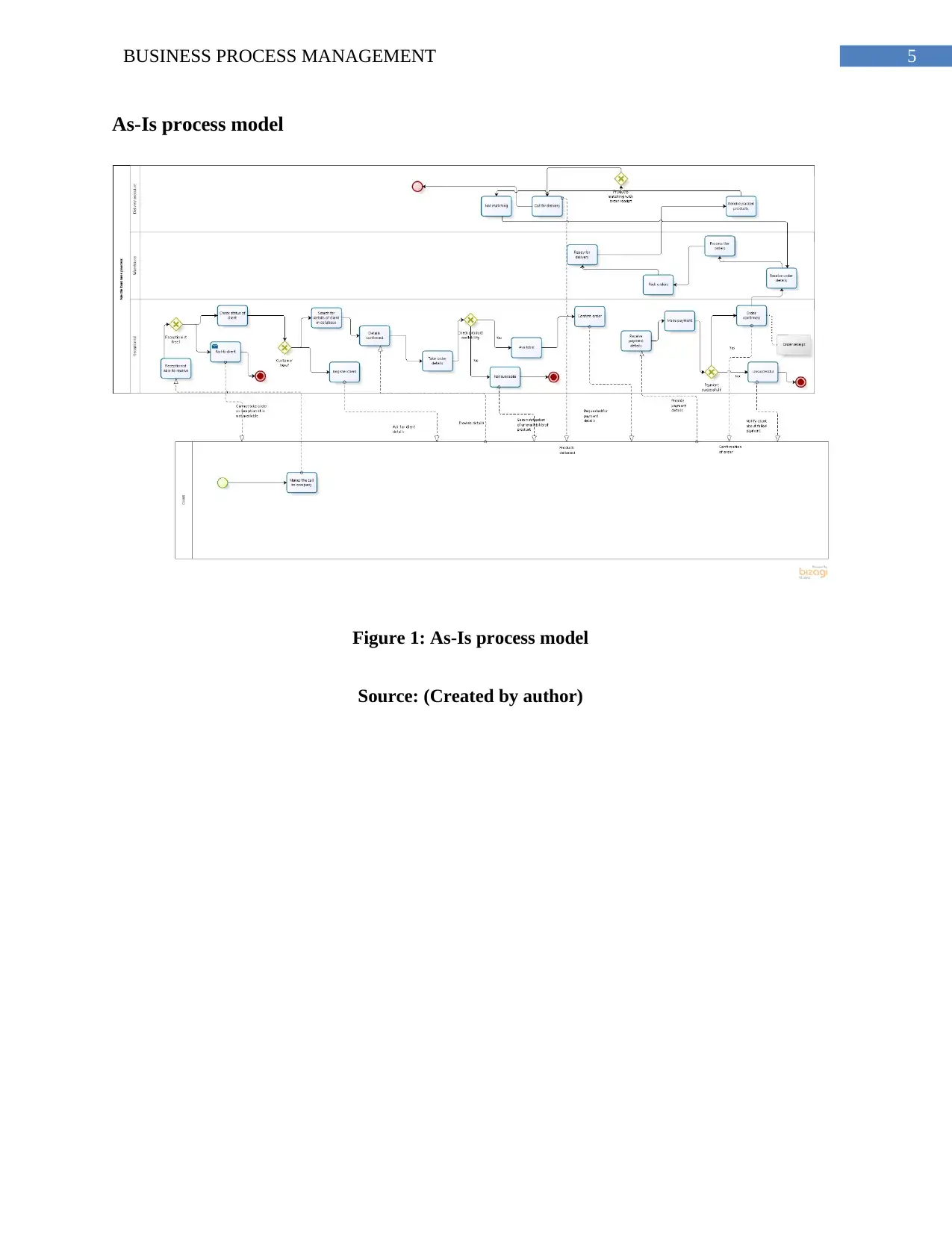
As-Is process model
Figure 1: As-Is process model
Source: (Created by author)
Document Page
6BUSINESS PROCESS MANAGEMENT
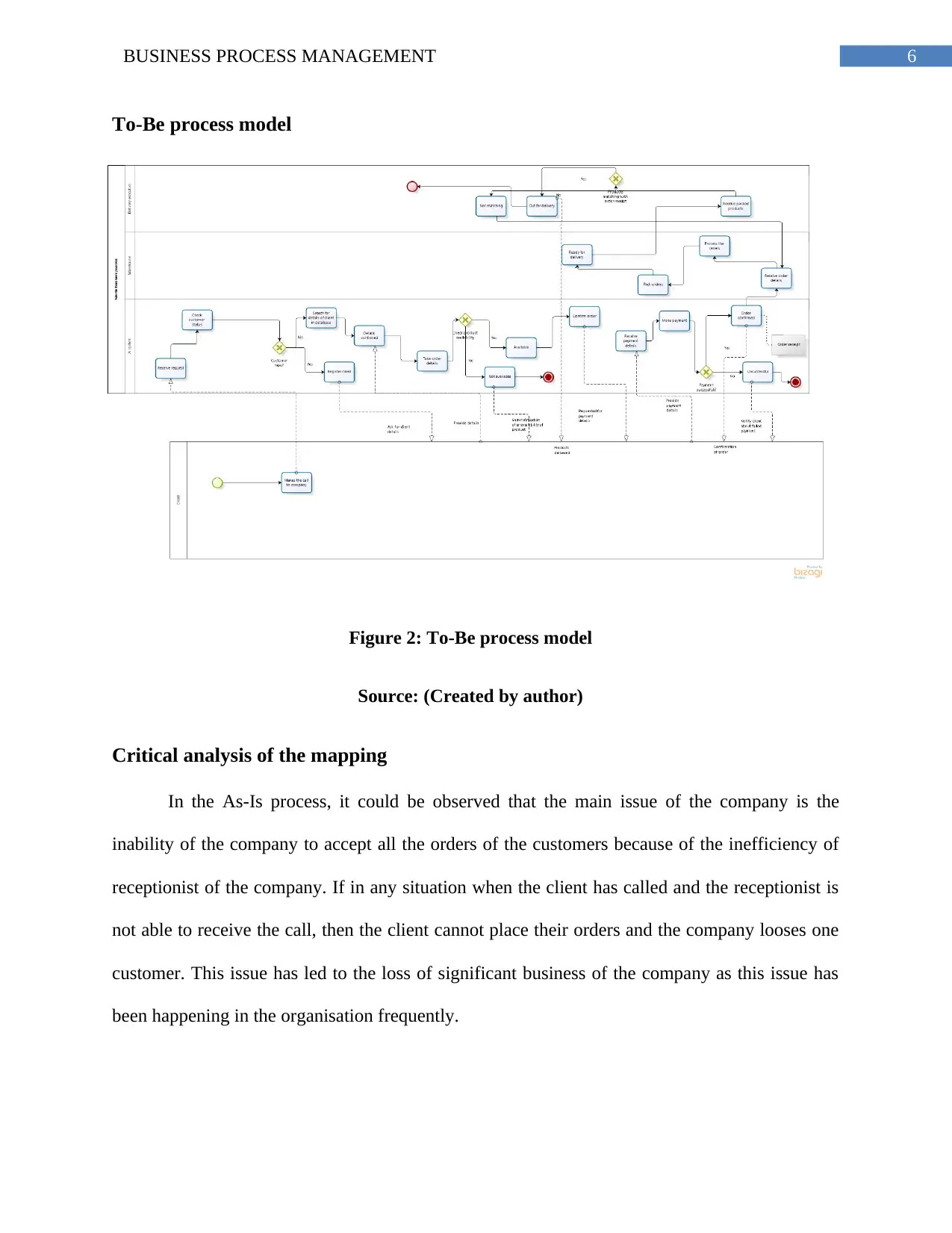
To-Be process model
Figure 2: To-Be process model
Source: (Created by author)
Critical analysis of the mapping
In the As-Is process, it could be observed that the main issue of the company is the
inability of the company to accept all the orders of the customers because of the inefficiency of
receptionist of the company. If in any situation when the client has called and the receptionist is
not able to receive the call, then the client cannot place their orders and the company looses one
customer. This issue has led to the loss of significant business of the company as this issue has
been happening in the organisation frequently.
tabler-icon-diamond-filled.svg

Paraphrase This Document

Need a fresh take? Get an instant paraphrase of this document with our AI Paraphraser
Document Page
7BUSINESS PROCESS MANAGEMENT
In the To-Be process, it could be observed that the company has been suggested to
implement the AI system that would increase the availability of the system for accepting the
orders of the clients. The AI systems would ensure that all the orders of any client is accurately
received and stored in the company database for providing the client with the products. The
availability of the system would be significantly increased and client satisfaction would also be
increased. The main advantages of implementing Artificial intelligence in the business are as
follows:
Reduction of error: The technology of artificial intelligence could help the company with
the reduction of error and then reach the significant accuracy with the higher degree of precision.
It is being applied within various studies like the exploration. The business of Nestle would be
significantly benefitted from the implementation of the AI in their business. The intelligent
robots are provided with all the required information and then they could be made to work as per
the requirement. As the AI systems have the ability of making the more informed decisions, the
system would provide the accurate decisions for the company. The AI systems would manage
the database of the orders that are made in the company and provide better insight to all the
orders. The customers could be accurately checked before they are registered in the company.
All the information of the customers would be accepted accurately and then stored in the
database.
Although AI system provides significant benefit to the business, there are some
disadvantages of the artificial intelligence systems that are required to be considered before
implementing this technology. Proper risk management could be used for mitigating the issues of
the artificial intelligence. Some of the disadvantages of artificial intelligence for the company
are:
Document Page
8BUSINESS PROCESS MANAGEMENT
If the data of the company is not accurate, the company could not make the most out
of the AI systems implemented in the company.
The shortage of skills as well as the unavailability of the technical staff who have the
proper knowledge as well as the training for deploying as well as the operating the AI
solutions could be considered as another disadvantage for the company.
The cost of the AI technology could be considered as another disadvantage of this
technology for the company. The AI solutions require significant installation capital
that could be challenging to the company because it would disrupt the financial
planning of the company.
Conclusion
Further a process analytical plan is also discussed in the paper. Through the business
process improvement report in the paper, the various audit process improvement method have
been understood, the “should-be” mapping is also done as against the “to-be” mapping. Further
from the paper the various recommendations for process and technology changes have also be
understood.
Document Page
9BUSINESS PROCESS MANAGEMENT
References
Müller, O., Schmiedel, T., Gorbacheva, E., & Vom Brocke, J. (2016). Towards a typology of
business process management professionals: identifying patterns of competences through
latent semantic analysis. Enterprise Information Systems, 10(1), 50-80.
Rahimi, F., Møller, C., & Hvam, L. (2016). Business process management and IT management:
The missing integration. International Journal of Information Management, 36(1), 142-
154.
Roeser, T., & Kern, E. M. (2015). Surveys in business process management–a literature
review. Business Process Management Journal, 21(3), 692-718.
Rosemann, M., & vom Brocke, J. (2015). The six core elements of business process
management. In Handbook on business process management 1 (pp. 105-122). Springer,
Berlin, Heidelberg.
Uhl, A., & Gollenia, L. A. (Eds.). (2016). A handbook of business transformation management
methodology. Routledge.
Vom Brocke, J., & Mendling, J. (2018). Business process management cases. Digital Innovation
and Business Transformation in Practice. Berlin et al.: Springer.
vom Brocke, J., Zelt, S., & Schmiedel, T. (2016). On the role of context in business process
management. International Journal of Information Management, 36(3), 486-495.
chevron_up_icon
1 out of 10
circle_padding
hide_on_mobile
zoom_out_icon
[object Object]