Analysis of Business Process Modeling, Simulation, and Design Textbook
VerifiedAdded on 2023/02/01
|48
|22285
|86
Homework Assignment
AI Summary
This document provides a detailed overview of the textbook 'Business Process Modeling, Simulation and Design, Third Edition' by Manuel Laguna and Johan Marklund. The analysis covers key concepts such as business process design, process management, and various improvement programs like Six Sigma and Business Process Reengineering. It explores frameworks for business process design projects, emphasizing tools like process flow analysis, workflow design principles, and queuing modeling. The document delves into managing process flows, including cycle time and capacity analysis, and introduces simulation techniques using ExtendSim. Furthermore, it discusses input and output data analysis, including goodness-of-fit tests and random number generators, and concludes with case studies for practical application. This resource is designed to help students understand and apply process modeling, simulation, and design principles in a business context.

Paraphrase This Document
Need a fresh take? Get an instant paraphrase of this document with our AI Paraphraser
Business Process Modeling,
Simulation and Design
Third Edition
Simulation and Design
Third Edition
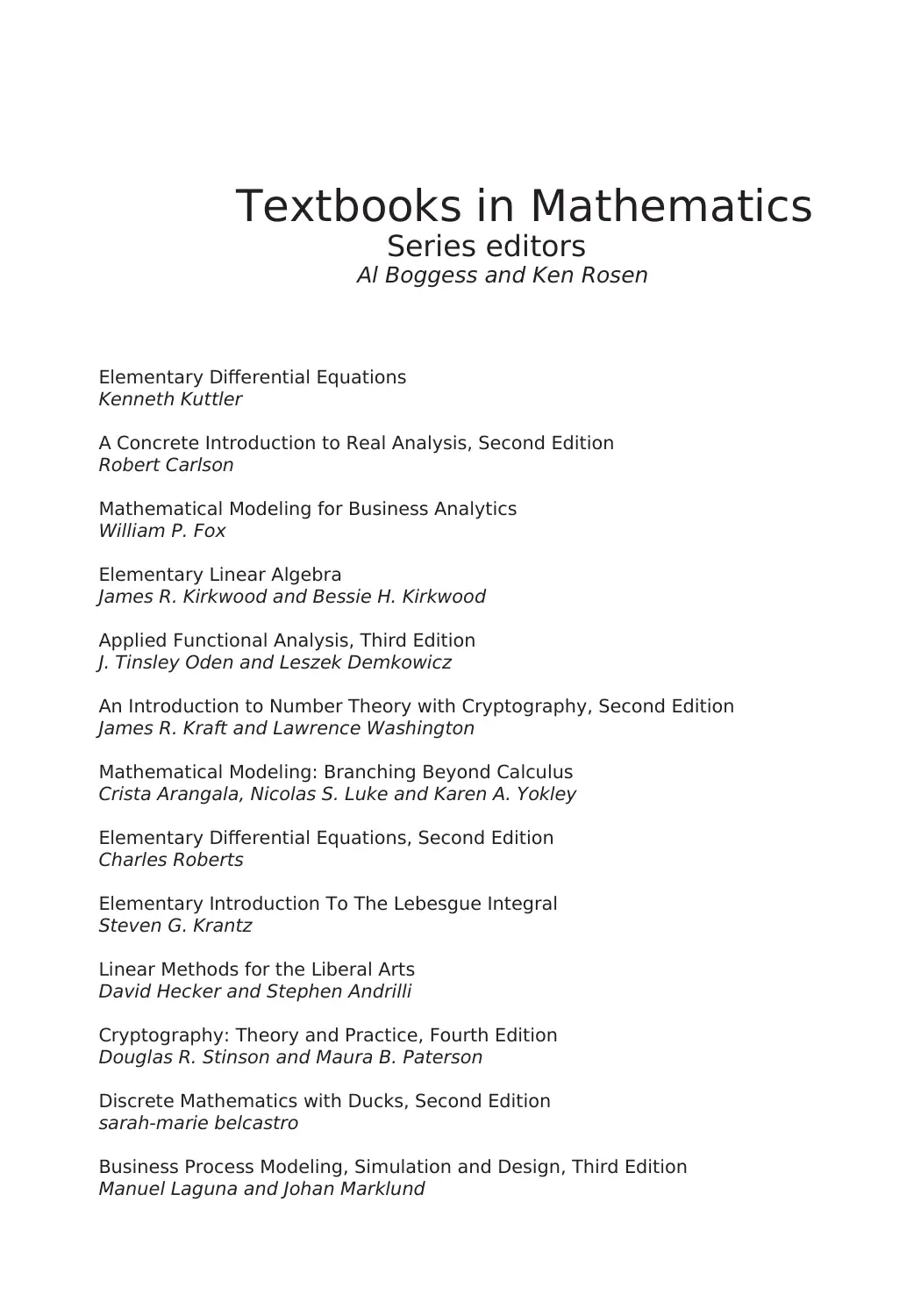
Textbooks in Mathematics
Series editors
Al Boggess and Ken Rosen
Elementary Differential Equations
Kenneth Kuttler
A Concrete Introduction to Real Analysis, Second Edition
Robert Carlson
Mathematical Modeling for Business Analytics
William P. Fox
Elementary Linear Algebra
James R. Kirkwood and Bessie H. Kirkwood
Applied Functional Analysis, Third Edition
J. Tinsley Oden and Leszek Demkowicz
An Introduction to Number Theory with Cryptography, Second Edition
James R. Kraft and Lawrence Washington
Mathematical Modeling: Branching Beyond Calculus
Crista Arangala, Nicolas S. Luke and Karen A. Yokley
Elementary Differential Equations, Second Edition
Charles Roberts
Elementary Introduction To The Lebesgue Integral
Steven G. Krantz
Linear Methods for the Liberal Arts
David Hecker and Stephen Andrilli
Cryptography: Theory and Practice, Fourth Edition
Douglas R. Stinson and Maura B. Paterson
Discrete Mathematics with Ducks, Second Edition
sarah-marie belcastro
Business Process Modeling, Simulation and Design, Third Edition
Manuel Laguna and Johan Marklund
Series editors
Al Boggess and Ken Rosen
Elementary Differential Equations
Kenneth Kuttler
A Concrete Introduction to Real Analysis, Second Edition
Robert Carlson
Mathematical Modeling for Business Analytics
William P. Fox
Elementary Linear Algebra
James R. Kirkwood and Bessie H. Kirkwood
Applied Functional Analysis, Third Edition
J. Tinsley Oden and Leszek Demkowicz
An Introduction to Number Theory with Cryptography, Second Edition
James R. Kraft and Lawrence Washington
Mathematical Modeling: Branching Beyond Calculus
Crista Arangala, Nicolas S. Luke and Karen A. Yokley
Elementary Differential Equations, Second Edition
Charles Roberts
Elementary Introduction To The Lebesgue Integral
Steven G. Krantz
Linear Methods for the Liberal Arts
David Hecker and Stephen Andrilli
Cryptography: Theory and Practice, Fourth Edition
Douglas R. Stinson and Maura B. Paterson
Discrete Mathematics with Ducks, Second Edition
sarah-marie belcastro
Business Process Modeling, Simulation and Design, Third Edition
Manuel Laguna and Johan Marklund
⊘ This is a preview!⊘
Do you want full access?
Subscribe today to unlock all pages.

Trusted by 1+ million students worldwide
Business Process Modeling,
Simulation and Design
Third Edition
By
Manuel Laguna
Johan Marklund
Simulation and Design
Third Edition
By
Manuel Laguna
Johan Marklund
Paraphrase This Document
Need a fresh take? Get an instant paraphrase of this document with our AI Paraphraser
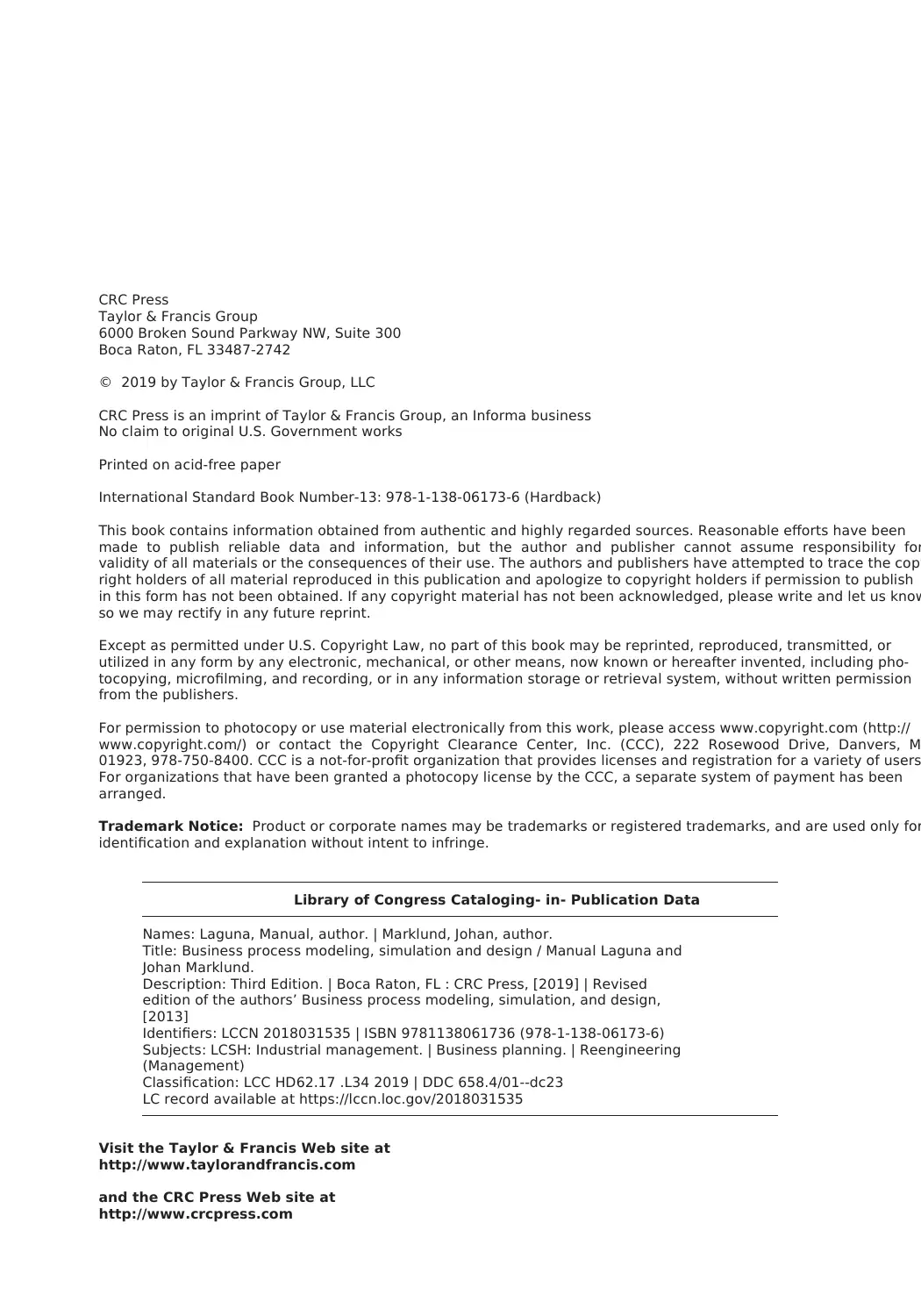
CRC Press
Taylor & Francis Group
6000 Broken Sound Parkway NW, Suite 300
Boca Raton, FL 33487-2742
© 2019 by Taylor & Francis Group, LLC
CRC Press is an imprint of Taylor & Francis Group, an Informa business
No claim to original U.S. Government works
Printed on acid-free paper
International Standard Book Number-13: 978-1-138-06173-6 (Hardback)
This book contains information obtained from authentic and highly regarded sources. Reasonable efforts have been
made to publish reliable data and information, but the author and publisher cannot assume responsibility for
validity of all materials or the consequences of their use. The authors and publishers have attempted to trace the copy
right holders of all material reproduced in this publication and apologize to copyright holders if permission to publish
in this form has not been obtained. If any copyright material has not been acknowledged, please write and let us know
so we may rectify in any future reprint.
Except as permitted under U.S. Copyright Law, no part of this book may be reprinted, reproduced, transmitted, or
utilized in any form by any electronic, mechanical, or other means, now known or hereafter invented, including pho-
tocopying, microfilming, and recording, or in any information storage or retrieval system, without written permission
from the publishers.
For permission to photocopy or use material electronically from this work, please access www.copyright.com (http://
www.copyright.com/) or contact the Copyright Clearance Center, Inc. (CCC), 222 Rosewood Drive, Danvers, M
01923, 978-750-8400. CCC is a not-for-profit organization that provides licenses and registration for a variety of users
For organizations that have been granted a photocopy license by the CCC, a separate system of payment has been
arranged.
Trademark Notice: Product or corporate names may be trademarks or registered trademarks, and are used only for
identification and explanation without intent to infringe.
Library of Congress Cataloging‑ in‑ Publication Data
Names: Laguna, Manual, author. | Marklund, Johan, author.
Title: Business process modeling, simulation and design / Manual Laguna and
Johan Marklund.
Description: Third Edition. | Boca Raton, FL : CRC Press, [2019] | Revised
edition of the authors’ Business process modeling, simulation, and design,
[2013]
Identifiers: LCCN 2018031535 | ISBN 9781138061736 (978-1-138-06173-6)
Subjects: LCSH: Industrial management. | Business planning. | Reengineering
(Management)
Classification: LCC HD62.17 .L34 2019 | DDC 658.4/01--dc23
LC record available at https://lccn.loc.gov/2018031535
Visit the Taylor & Francis Web site at
http://www.taylorandfrancis.com
and the CRC Press Web site at
http://www.crcpress.com
Taylor & Francis Group
6000 Broken Sound Parkway NW, Suite 300
Boca Raton, FL 33487-2742
© 2019 by Taylor & Francis Group, LLC
CRC Press is an imprint of Taylor & Francis Group, an Informa business
No claim to original U.S. Government works
Printed on acid-free paper
International Standard Book Number-13: 978-1-138-06173-6 (Hardback)
This book contains information obtained from authentic and highly regarded sources. Reasonable efforts have been
made to publish reliable data and information, but the author and publisher cannot assume responsibility for
validity of all materials or the consequences of their use. The authors and publishers have attempted to trace the copy
right holders of all material reproduced in this publication and apologize to copyright holders if permission to publish
in this form has not been obtained. If any copyright material has not been acknowledged, please write and let us know
so we may rectify in any future reprint.
Except as permitted under U.S. Copyright Law, no part of this book may be reprinted, reproduced, transmitted, or
utilized in any form by any electronic, mechanical, or other means, now known or hereafter invented, including pho-
tocopying, microfilming, and recording, or in any information storage or retrieval system, without written permission
from the publishers.
For permission to photocopy or use material electronically from this work, please access www.copyright.com (http://
www.copyright.com/) or contact the Copyright Clearance Center, Inc. (CCC), 222 Rosewood Drive, Danvers, M
01923, 978-750-8400. CCC is a not-for-profit organization that provides licenses and registration for a variety of users
For organizations that have been granted a photocopy license by the CCC, a separate system of payment has been
arranged.
Trademark Notice: Product or corporate names may be trademarks or registered trademarks, and are used only for
identification and explanation without intent to infringe.
Library of Congress Cataloging‑ in‑ Publication Data
Names: Laguna, Manual, author. | Marklund, Johan, author.
Title: Business process modeling, simulation and design / Manual Laguna and
Johan Marklund.
Description: Third Edition. | Boca Raton, FL : CRC Press, [2019] | Revised
edition of the authors’ Business process modeling, simulation, and design,
[2013]
Identifiers: LCCN 2018031535 | ISBN 9781138061736 (978-1-138-06173-6)
Subjects: LCSH: Industrial management. | Business planning. | Reengineering
(Management)
Classification: LCC HD62.17 .L34 2019 | DDC 658.4/01--dc23
LC record available at https://lccn.loc.gov/2018031535
Visit the Taylor & Francis Web site at
http://www.taylorandfrancis.com
and the CRC Press Web site at
http://www.crcpress.com
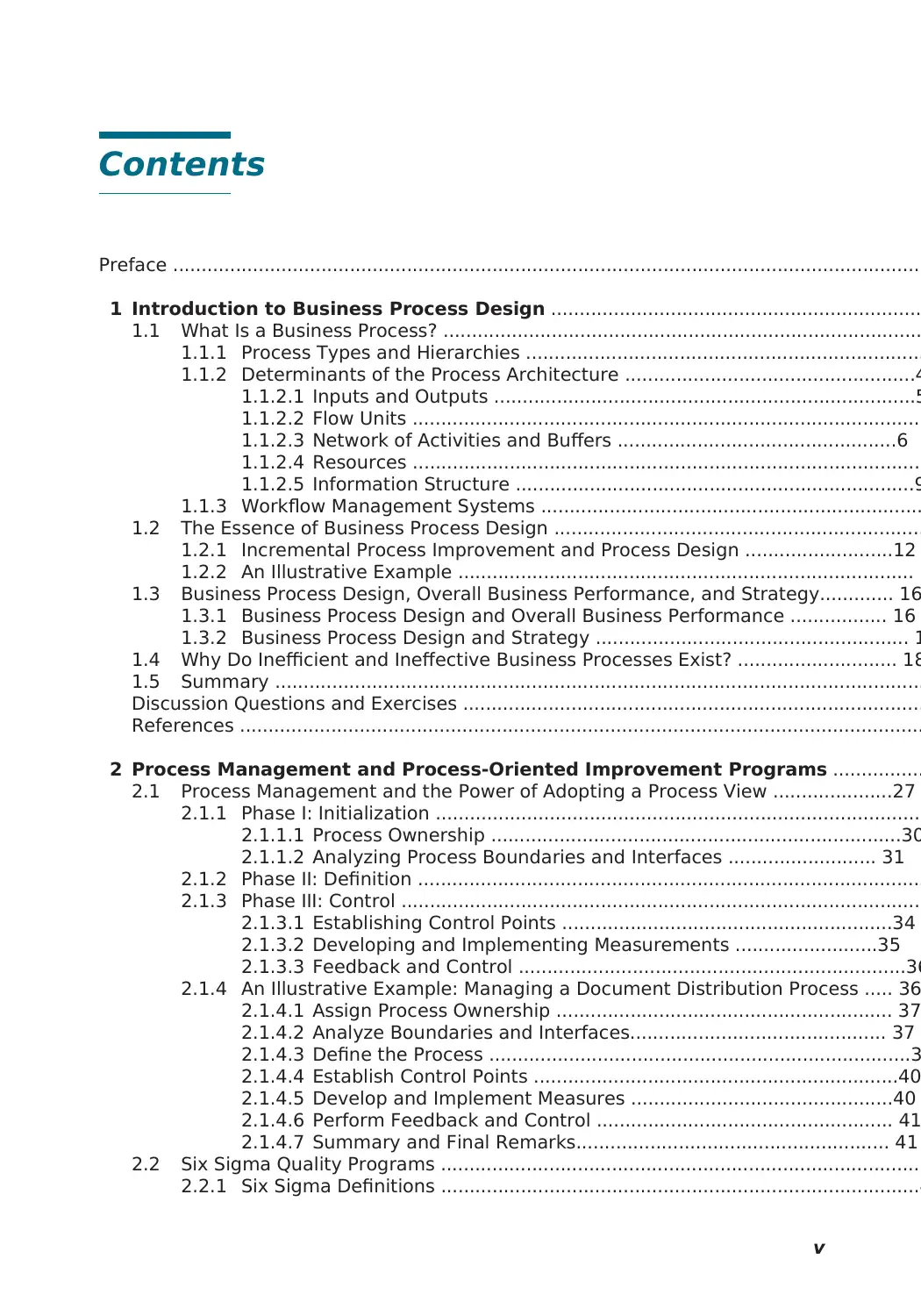
v
Contents
Preface ....................................................................................................................................
1 Introduction to Business Process Design .................................................................
1.1 What Is a Business Process? ....................................................................................
1.1.1 Process Types and Hierarchies ......................................................................
1.1.2 Determinants of the Process Architecture ...................................................4
1.1.2.1 Inputs and Outputs ..........................................................................5
1.1.2.2 Flow Units .........................................................................................5
1.1.2.3 Network of Activities and Buffers .................................................6
1.1.2.4 Resources ..........................................................................................
1.1.2.5 Information Structure ......................................................................9
1.1.3 Workflow Management Systems ...................................................................
1.2 The Essence of Business Process Design .................................................................
1.2.1 Incremental Process Improvement and Process Design ..........................12
1.2.2 An Illustrative Example ................................................................................ 1
1.3 Business Process Design, Overall Business Performance, and Strategy............. 16
1.3.1 Business Process Design and Overall Business Performance ................. 16
1.3.2 Business Process Design and Strategy ....................................................... 1
1.4 Why Do Inefficient and Ineffective Business Processes Exist? ............................ 18
1.5 Summary ..................................................................................................................
Discussion Questions and Exercises .................................................................................
References ........................................................................................................................
2 Process Management and Process‑Oriented Improvement Programs ................
2.1 Process Management and the Power of Adopting a Process View .....................27
2.1.1 Phase I: Initialization .....................................................................................2
2.1.1.1 Process Ownership ........................................................................30
2.1.1.2 Analyzing Process Boundaries and Interfaces .......................... 31
2.1.2 Phase II: Definition ........................................................................................3
2.1.3 Phase III: Control ...........................................................................................3
2.1.3.1 Establishing Control Points ..........................................................34
2.1.3.2 Developing and Implementing Measurements .........................35
2.1.3.3 Feedback and Control ....................................................................36
2.1.4 An Illustrative Example: Managing a Document Distribution Process ..... 36
2.1.4.1 Assign Process Ownership ........................................................... 37
2.1.4.2 Analyze Boundaries and Interfaces............................................. 37
2.1.4.3 Define the Process ..........................................................................3
2.1.4.4 Establish Control Points ................................................................40
2.1.4.5 Develop and Implement Measures ..............................................40
2.1.4.6 Perform Feedback and Control .................................................... 41
2.1.4.7 Summary and Final Remarks....................................................... 41
2.2 Six Sigma Quality Programs .....................................................................................
2.2.1 Six Sigma Definitions ....................................................................................4
Contents
Preface ....................................................................................................................................
1 Introduction to Business Process Design .................................................................
1.1 What Is a Business Process? ....................................................................................
1.1.1 Process Types and Hierarchies ......................................................................
1.1.2 Determinants of the Process Architecture ...................................................4
1.1.2.1 Inputs and Outputs ..........................................................................5
1.1.2.2 Flow Units .........................................................................................5
1.1.2.3 Network of Activities and Buffers .................................................6
1.1.2.4 Resources ..........................................................................................
1.1.2.5 Information Structure ......................................................................9
1.1.3 Workflow Management Systems ...................................................................
1.2 The Essence of Business Process Design .................................................................
1.2.1 Incremental Process Improvement and Process Design ..........................12
1.2.2 An Illustrative Example ................................................................................ 1
1.3 Business Process Design, Overall Business Performance, and Strategy............. 16
1.3.1 Business Process Design and Overall Business Performance ................. 16
1.3.2 Business Process Design and Strategy ....................................................... 1
1.4 Why Do Inefficient and Ineffective Business Processes Exist? ............................ 18
1.5 Summary ..................................................................................................................
Discussion Questions and Exercises .................................................................................
References ........................................................................................................................
2 Process Management and Process‑Oriented Improvement Programs ................
2.1 Process Management and the Power of Adopting a Process View .....................27
2.1.1 Phase I: Initialization .....................................................................................2
2.1.1.1 Process Ownership ........................................................................30
2.1.1.2 Analyzing Process Boundaries and Interfaces .......................... 31
2.1.2 Phase II: Definition ........................................................................................3
2.1.3 Phase III: Control ...........................................................................................3
2.1.3.1 Establishing Control Points ..........................................................34
2.1.3.2 Developing and Implementing Measurements .........................35
2.1.3.3 Feedback and Control ....................................................................36
2.1.4 An Illustrative Example: Managing a Document Distribution Process ..... 36
2.1.4.1 Assign Process Ownership ........................................................... 37
2.1.4.2 Analyze Boundaries and Interfaces............................................. 37
2.1.4.3 Define the Process ..........................................................................3
2.1.4.4 Establish Control Points ................................................................40
2.1.4.5 Develop and Implement Measures ..............................................40
2.1.4.6 Perform Feedback and Control .................................................... 41
2.1.4.7 Summary and Final Remarks....................................................... 41
2.2 Six Sigma Quality Programs .....................................................................................
2.2.1 Six Sigma Definitions ....................................................................................4
⊘ This is a preview!⊘
Do you want full access?
Subscribe today to unlock all pages.
Trusted by 1+ million students worldwide
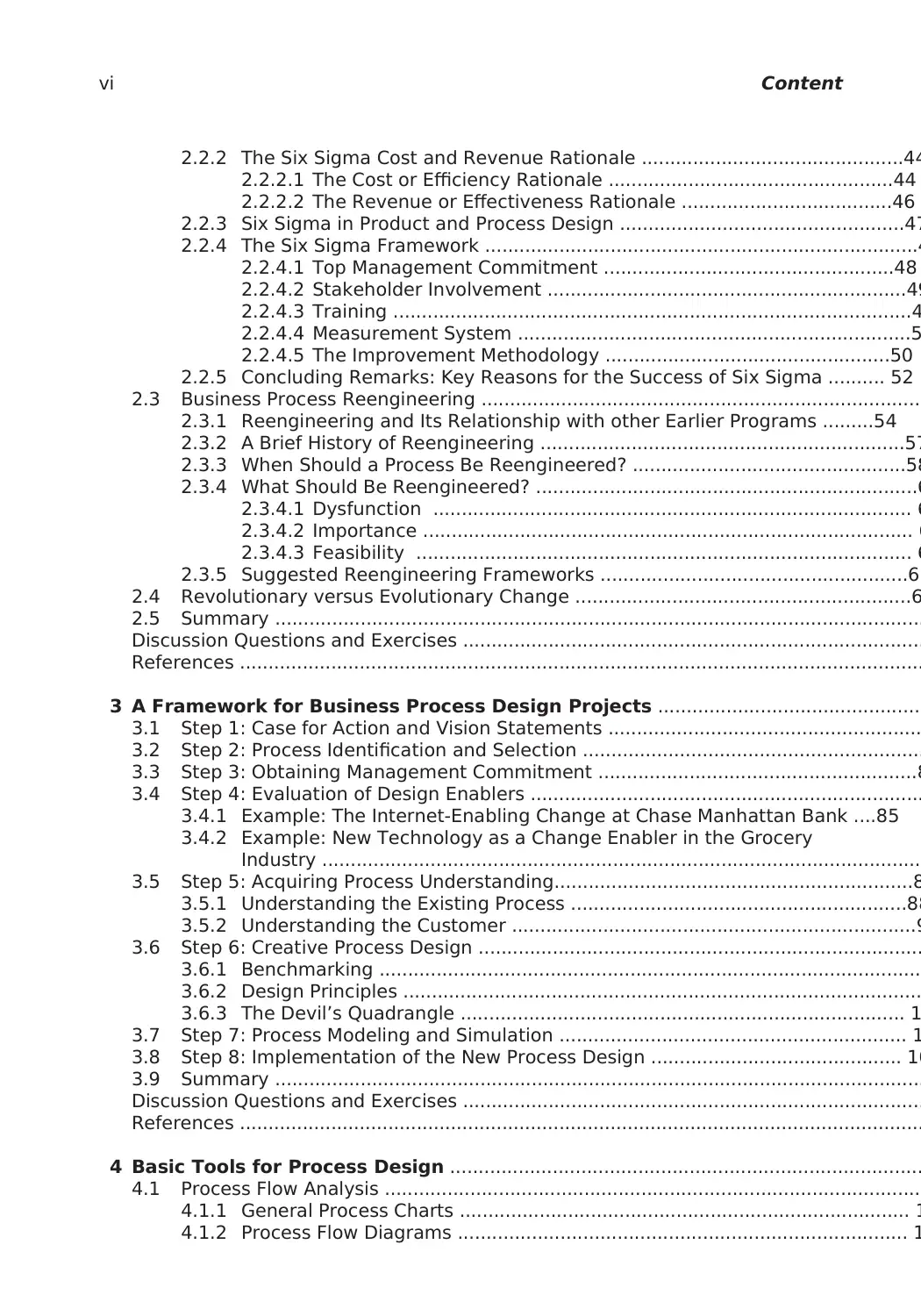
vi Content
2.2.2 The Six Sigma Cost and Revenue Rationale ..............................................44
2.2.2.1 The Cost or Efficiency Rationale ..................................................44
2.2.2.2 The Revenue or Effectiveness Rationale .....................................46
2.2.3 Six Sigma in Product and Process Design ..................................................47
2.2.4 The Six Sigma Framework ............................................................................4
2.2.4.1 Top Management Commitment ...................................................48
2.2.4.2 Stakeholder Involvement ...............................................................49
2.2.4.3 Training ...........................................................................................4
2.2.4.4 Measurement System .....................................................................5
2.2.4.5 The Improvement Methodology ..................................................50
2.2.5 Concluding Remarks: Key Reasons for the Success of Six Sigma .......... 52
2.3 Business Process Reengineering ..............................................................................
2.3.1 Reengineering and Its Relationship with other Earlier Programs .........54
2.3.2 A Brief History of Reengineering ................................................................57
2.3.3 When Should a Process Be Reengineered? ................................................58
2.3.4 What Should Be Reengineered? ...................................................................6
2.3.4.1 Dysfunction .................................................................................... 6
2.3.4.2 Importance ...................................................................................... 6
2.3.4.3 Feasibility ....................................................................................... 6
2.3.5 Suggested Reengineering Frameworks ......................................................63
2.4 Revolutionary versus Evolutionary Change ...........................................................6
2.5 Summary ..................................................................................................................
Discussion Questions and Exercises .................................................................................
References ........................................................................................................................
3 A Framework for Business Process Design Projects ...............................................
3.1 Step 1: Case for Action and Vision Statements .......................................................
3.2 Step 2: Process Identification and Selection ............................................................
3.3 Step 3: Obtaining Management Commitment ........................................................8
3.4 Step 4: Evaluation of Design Enablers .....................................................................
3.4.1 Example: The Internet-Enabling Change at Chase Manhattan Bank ....85
3.4.2 Example: New Technology as a Change Enabler in the Grocery
Industry ..........................................................................................................
3.5 Step 5: Acquiring Process Understanding...............................................................8
3.5.1 Understanding the Existing Process ...........................................................88
3.5.2 Understanding the Customer .......................................................................9
3.6 Step 6: Creative Process Design ..............................................................................
3.6.1 Benchmarking ................................................................................................
3.6.2 Design Principles ...........................................................................................
3.6.3 The Devil’s Quadrangle .............................................................................. 1
3.7 Step 7: Process Modeling and Simulation ............................................................. 1
3.8 Step 8: Implementation of the New Process Design ............................................ 10
3.9 Summary ..................................................................................................................
Discussion Questions and Exercises .................................................................................
References ........................................................................................................................
4 Basic Tools for Process Design ...................................................................................
4.1 Process Flow Analysis ..............................................................................................
4.1.1 General Process Charts ............................................................................... 1
4.1.2 Process Flow Diagrams ............................................................................... 1
2.2.2 The Six Sigma Cost and Revenue Rationale ..............................................44
2.2.2.1 The Cost or Efficiency Rationale ..................................................44
2.2.2.2 The Revenue or Effectiveness Rationale .....................................46
2.2.3 Six Sigma in Product and Process Design ..................................................47
2.2.4 The Six Sigma Framework ............................................................................4
2.2.4.1 Top Management Commitment ...................................................48
2.2.4.2 Stakeholder Involvement ...............................................................49
2.2.4.3 Training ...........................................................................................4
2.2.4.4 Measurement System .....................................................................5
2.2.4.5 The Improvement Methodology ..................................................50
2.2.5 Concluding Remarks: Key Reasons for the Success of Six Sigma .......... 52
2.3 Business Process Reengineering ..............................................................................
2.3.1 Reengineering and Its Relationship with other Earlier Programs .........54
2.3.2 A Brief History of Reengineering ................................................................57
2.3.3 When Should a Process Be Reengineered? ................................................58
2.3.4 What Should Be Reengineered? ...................................................................6
2.3.4.1 Dysfunction .................................................................................... 6
2.3.4.2 Importance ...................................................................................... 6
2.3.4.3 Feasibility ....................................................................................... 6
2.3.5 Suggested Reengineering Frameworks ......................................................63
2.4 Revolutionary versus Evolutionary Change ...........................................................6
2.5 Summary ..................................................................................................................
Discussion Questions and Exercises .................................................................................
References ........................................................................................................................
3 A Framework for Business Process Design Projects ...............................................
3.1 Step 1: Case for Action and Vision Statements .......................................................
3.2 Step 2: Process Identification and Selection ............................................................
3.3 Step 3: Obtaining Management Commitment ........................................................8
3.4 Step 4: Evaluation of Design Enablers .....................................................................
3.4.1 Example: The Internet-Enabling Change at Chase Manhattan Bank ....85
3.4.2 Example: New Technology as a Change Enabler in the Grocery
Industry ..........................................................................................................
3.5 Step 5: Acquiring Process Understanding...............................................................8
3.5.1 Understanding the Existing Process ...........................................................88
3.5.2 Understanding the Customer .......................................................................9
3.6 Step 6: Creative Process Design ..............................................................................
3.6.1 Benchmarking ................................................................................................
3.6.2 Design Principles ...........................................................................................
3.6.3 The Devil’s Quadrangle .............................................................................. 1
3.7 Step 7: Process Modeling and Simulation ............................................................. 1
3.8 Step 8: Implementation of the New Process Design ............................................ 10
3.9 Summary ..................................................................................................................
Discussion Questions and Exercises .................................................................................
References ........................................................................................................................
4 Basic Tools for Process Design ...................................................................................
4.1 Process Flow Analysis ..............................................................................................
4.1.1 General Process Charts ............................................................................... 1
4.1.2 Process Flow Diagrams ............................................................................... 1
Paraphrase This Document
Need a fresh take? Get an instant paraphrase of this document with our AI Paraphraser
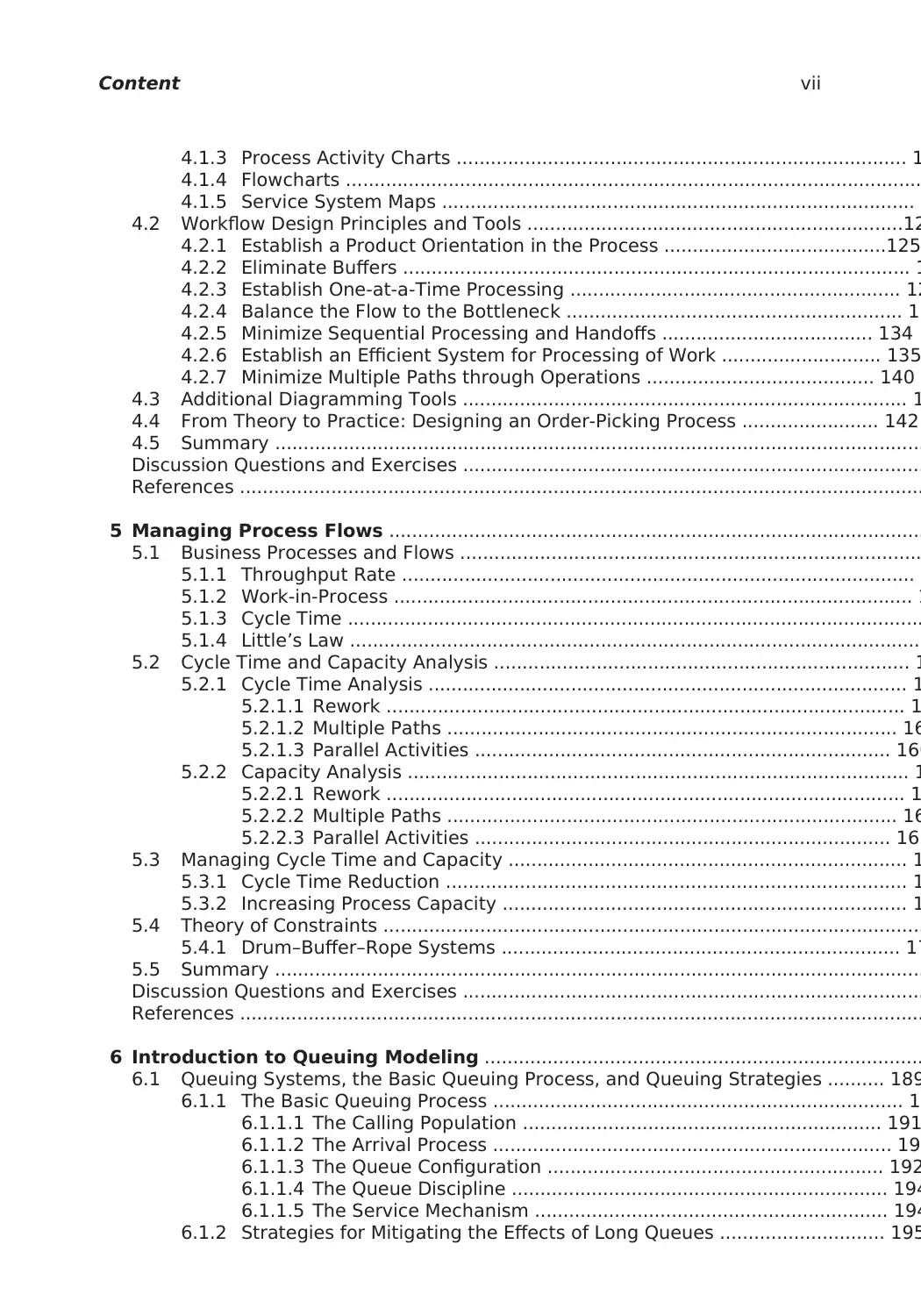
viiContent
4.1.3 Process Activity Charts ............................................................................... 1
4.1.4 Flowcharts .....................................................................................................
4.1.5 Service System Maps ................................................................................... 1
4.2 Workflow Design Principles and Tools ..................................................................12
4.2.1 Establish a Product Orientation in the Process .......................................125
4.2.2 Eliminate Buffers ......................................................................................... 1
4.2.3 Establish One-at-a-Time Processing .......................................................... 12
4.2.4 Balance the Flow to the Bottleneck ........................................................... 13
4.2.5 Minimize Sequential Processing and Handoffs ..................................... 134
4.2.6 Establish an Efficient System for Processing of Work ............................ 135
4.2.7 Minimize Multiple Paths through Operations ........................................ 140
4.3 Additional Diagramming Tools .............................................................................. 1
4.4 From Theory to Practice: Designing an Order-Picking Process ........................ 142
4.5 Summary ..................................................................................................................
Discussion Questions and Exercises .................................................................................
References ........................................................................................................................
5 Managing Process Flows ..............................................................................................
5.1 Business Processes and Flows .................................................................................
5.1.1 Throughput Rate .......................................................................................... 1
5.1.2 Work-in-Process ........................................................................................... 1
5.1.3 Cycle Time .....................................................................................................
5.1.4 Little’s Law ....................................................................................................
5.2 Cycle Time and Capacity Analysis ......................................................................... 1
5.2.1 Cycle Time Analysis .................................................................................... 1
5.2.1.1 Rework ........................................................................................... 1
5.2.1.2 Multiple Paths ............................................................................... 16
5.2.1.3 Parallel Activities ......................................................................... 160
5.2.2 Capacity Analysis ........................................................................................ 1
5.2.2.1 Rework ........................................................................................... 1
5.2.2.2 Multiple Paths ............................................................................... 16
5.2.2.3 Parallel Activities ......................................................................... 165
5.3 Managing Cycle Time and Capacity ...................................................................... 1
5.3.1 Cycle Time Reduction ................................................................................. 1
5.3.2 Increasing Process Capacity ....................................................................... 1
5.4 Theory of Constraints ...............................................................................................
5.4.1 Drum–Buffer–Rope Systems ...................................................................... 17
5.5 Summary ..................................................................................................................
Discussion Questions and Exercises .................................................................................
References ........................................................................................................................
6 Introduction to Queuing Modeling .............................................................................
6.1 Queuing Systems, the Basic Queuing Process, and Queuing Strategies .......... 189
6.1.1 The Basic Queuing Process ........................................................................ 19
6.1.1.1 The Calling Population ............................................................... 191
6.1.1.2 The Arrival Process ...................................................................... 192
6.1.1.3 The Queue Configuration ........................................................... 192
6.1.1.4 The Queue Discipline .................................................................. 194
6.1.1.5 The Service Mechanism .............................................................. 194
6.1.2 Strategies for Mitigating the Effects of Long Queues ............................. 195
4.1.3 Process Activity Charts ............................................................................... 1
4.1.4 Flowcharts .....................................................................................................
4.1.5 Service System Maps ................................................................................... 1
4.2 Workflow Design Principles and Tools ..................................................................12
4.2.1 Establish a Product Orientation in the Process .......................................125
4.2.2 Eliminate Buffers ......................................................................................... 1
4.2.3 Establish One-at-a-Time Processing .......................................................... 12
4.2.4 Balance the Flow to the Bottleneck ........................................................... 13
4.2.5 Minimize Sequential Processing and Handoffs ..................................... 134
4.2.6 Establish an Efficient System for Processing of Work ............................ 135
4.2.7 Minimize Multiple Paths through Operations ........................................ 140
4.3 Additional Diagramming Tools .............................................................................. 1
4.4 From Theory to Practice: Designing an Order-Picking Process ........................ 142
4.5 Summary ..................................................................................................................
Discussion Questions and Exercises .................................................................................
References ........................................................................................................................
5 Managing Process Flows ..............................................................................................
5.1 Business Processes and Flows .................................................................................
5.1.1 Throughput Rate .......................................................................................... 1
5.1.2 Work-in-Process ........................................................................................... 1
5.1.3 Cycle Time .....................................................................................................
5.1.4 Little’s Law ....................................................................................................
5.2 Cycle Time and Capacity Analysis ......................................................................... 1
5.2.1 Cycle Time Analysis .................................................................................... 1
5.2.1.1 Rework ........................................................................................... 1
5.2.1.2 Multiple Paths ............................................................................... 16
5.2.1.3 Parallel Activities ......................................................................... 160
5.2.2 Capacity Analysis ........................................................................................ 1
5.2.2.1 Rework ........................................................................................... 1
5.2.2.2 Multiple Paths ............................................................................... 16
5.2.2.3 Parallel Activities ......................................................................... 165
5.3 Managing Cycle Time and Capacity ...................................................................... 1
5.3.1 Cycle Time Reduction ................................................................................. 1
5.3.2 Increasing Process Capacity ....................................................................... 1
5.4 Theory of Constraints ...............................................................................................
5.4.1 Drum–Buffer–Rope Systems ...................................................................... 17
5.5 Summary ..................................................................................................................
Discussion Questions and Exercises .................................................................................
References ........................................................................................................................
6 Introduction to Queuing Modeling .............................................................................
6.1 Queuing Systems, the Basic Queuing Process, and Queuing Strategies .......... 189
6.1.1 The Basic Queuing Process ........................................................................ 19
6.1.1.1 The Calling Population ............................................................... 191
6.1.1.2 The Arrival Process ...................................................................... 192
6.1.1.3 The Queue Configuration ........................................................... 192
6.1.1.4 The Queue Discipline .................................................................. 194
6.1.1.5 The Service Mechanism .............................................................. 194
6.1.2 Strategies for Mitigating the Effects of Long Queues ............................. 195
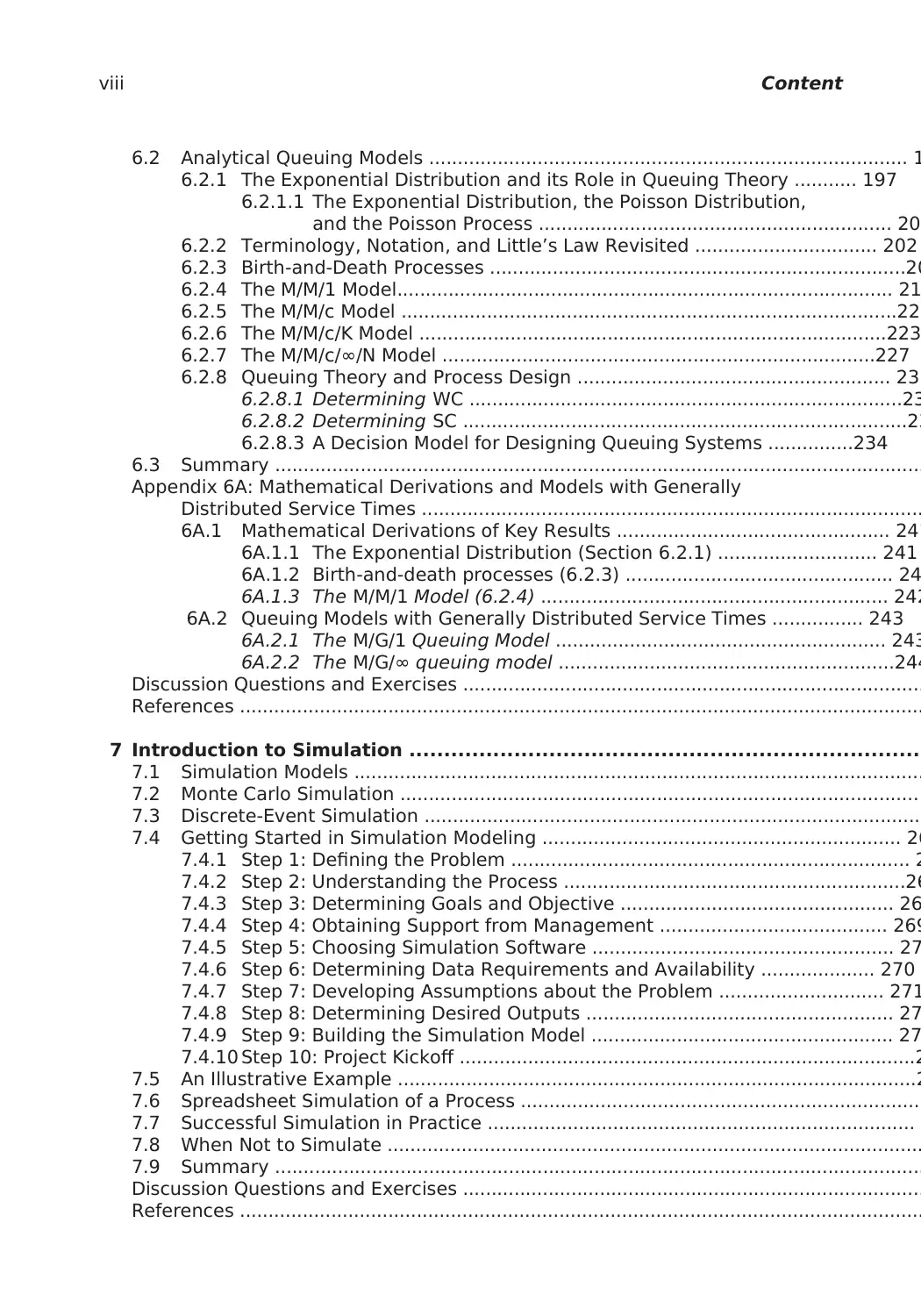
viii Content
6.2 Analytical Queuing Models .................................................................................... 1
6.2.1 The Exponential Distribution and its Role in Queuing Theory ........... 197
6.2.1.1 The Exponential Distribution, the Poisson Distribution,
and the Poisson Process .............................................................. 201
6.2.2 Terminology, Notation, and Little’s Law Revisited ................................ 202
6.2.3 Birth-and-Death Processes .........................................................................20
6.2.4 The M/M/1 Model....................................................................................... 21
6.2.5 The M/M/c Model .......................................................................................220
6.2.6 The M/M/c/K Model ..................................................................................223
6.2.7 The M/M/c/∞/N Model ............................................................................227
6.2.8 Queuing Theory and Process Design ....................................................... 231
6.2.8.1 Determining WC ............................................................................23
6.2.8.2 Determining SC ..............................................................................23
6.2.8.3 A Decision Model for Designing Queuing Systems ...............234
6.3 Summary ..................................................................................................................
Appendix 6A: Mathematical Derivations and Models with Generally
Distributed Service Times ........................................................................................
6A.1 Mathematical Derivations of Key Results ................................................ 241
6A.1.1 The Exponential Distribution (Section 6.2.1) ............................ 241
6A.1.2 Birth-and-death processes (6.2.3) ............................................... 24
6A.1.3 The M/M/1 Model (6.2.4) ............................................................. 242
6A.2 Queuing Models with Generally Distributed Service Times ................ 243
6A.2.1 The M/G/1 Queuing Model .......................................................... 243
6A.2.2 The M/G/∞ queuing model ...........................................................244
Discussion Questions and Exercises .................................................................................
References ........................................................................................................................
7 Introduction to Simulation ..........................................................................
7.1 Simulation Models ....................................................................................................
7.2 Monte Carlo Simulation ...........................................................................................
7.3 Discrete-Event Simulation .......................................................................................2
7.4 Getting Started in Simulation Modeling ............................................................... 26
7.4.1 Step 1: Defining the Problem ...................................................................... 2
7.4.2 Step 2: Understanding the Process ............................................................26
7.4.3 Step 3: Determining Goals and Objective ................................................ 26
7.4.4 Step 4: Obtaining Support from Management ........................................ 269
7.4.5 Step 5: Choosing Simulation Software ..................................................... 27
7.4.6 Step 6: Determining Data Requirements and Availability .................... 270
7.4.7 Step 7: Developing Assumptions about the Problem ............................. 271
7.4.8 Step 8: Determining Desired Outputs ...................................................... 27
7.4.9 Step 9: Building the Simulation Model ..................................................... 27
7.4.10 Step 10: Project Kickoff ................................................................................2
7.5 An Illustrative Example ...........................................................................................2
7.6 Spreadsheet Simulation of a Process ......................................................................
7.7 Successful Simulation in Practice ........................................................................... 2
7.8 When Not to Simulate ..............................................................................................
7.9 Summary ..................................................................................................................
Discussion Questions and Exercises .................................................................................
References ........................................................................................................................
6.2 Analytical Queuing Models .................................................................................... 1
6.2.1 The Exponential Distribution and its Role in Queuing Theory ........... 197
6.2.1.1 The Exponential Distribution, the Poisson Distribution,
and the Poisson Process .............................................................. 201
6.2.2 Terminology, Notation, and Little’s Law Revisited ................................ 202
6.2.3 Birth-and-Death Processes .........................................................................20
6.2.4 The M/M/1 Model....................................................................................... 21
6.2.5 The M/M/c Model .......................................................................................220
6.2.6 The M/M/c/K Model ..................................................................................223
6.2.7 The M/M/c/∞/N Model ............................................................................227
6.2.8 Queuing Theory and Process Design ....................................................... 231
6.2.8.1 Determining WC ............................................................................23
6.2.8.2 Determining SC ..............................................................................23
6.2.8.3 A Decision Model for Designing Queuing Systems ...............234
6.3 Summary ..................................................................................................................
Appendix 6A: Mathematical Derivations and Models with Generally
Distributed Service Times ........................................................................................
6A.1 Mathematical Derivations of Key Results ................................................ 241
6A.1.1 The Exponential Distribution (Section 6.2.1) ............................ 241
6A.1.2 Birth-and-death processes (6.2.3) ............................................... 24
6A.1.3 The M/M/1 Model (6.2.4) ............................................................. 242
6A.2 Queuing Models with Generally Distributed Service Times ................ 243
6A.2.1 The M/G/1 Queuing Model .......................................................... 243
6A.2.2 The M/G/∞ queuing model ...........................................................244
Discussion Questions and Exercises .................................................................................
References ........................................................................................................................
7 Introduction to Simulation ..........................................................................
7.1 Simulation Models ....................................................................................................
7.2 Monte Carlo Simulation ...........................................................................................
7.3 Discrete-Event Simulation .......................................................................................2
7.4 Getting Started in Simulation Modeling ............................................................... 26
7.4.1 Step 1: Defining the Problem ...................................................................... 2
7.4.2 Step 2: Understanding the Process ............................................................26
7.4.3 Step 3: Determining Goals and Objective ................................................ 26
7.4.4 Step 4: Obtaining Support from Management ........................................ 269
7.4.5 Step 5: Choosing Simulation Software ..................................................... 27
7.4.6 Step 6: Determining Data Requirements and Availability .................... 270
7.4.7 Step 7: Developing Assumptions about the Problem ............................. 271
7.4.8 Step 8: Determining Desired Outputs ...................................................... 27
7.4.9 Step 9: Building the Simulation Model ..................................................... 27
7.4.10 Step 10: Project Kickoff ................................................................................2
7.5 An Illustrative Example ...........................................................................................2
7.6 Spreadsheet Simulation of a Process ......................................................................
7.7 Successful Simulation in Practice ........................................................................... 2
7.8 When Not to Simulate ..............................................................................................
7.9 Summary ..................................................................................................................
Discussion Questions and Exercises .................................................................................
References ........................................................................................................................
⊘ This is a preview!⊘
Do you want full access?
Subscribe today to unlock all pages.
Trusted by 1+ million students worldwide
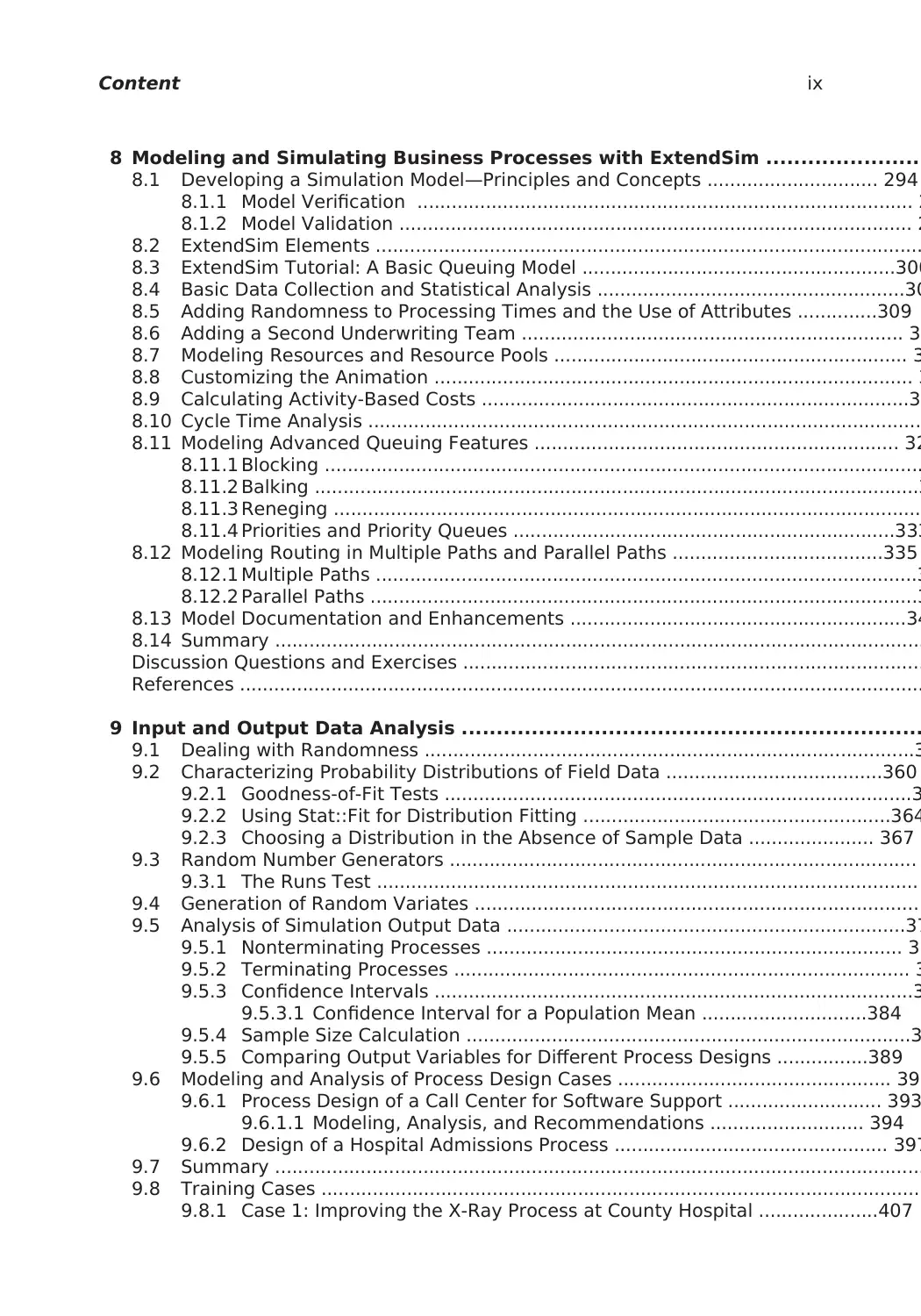
ixContent
8 Modeling and Simulating Business Processes with ExtendSim .......................
8.1 Developing a Simulation Model—Principles and Concepts .............................. 294
8.1.1 Model Verification ....................................................................................... 2
8.1.2 Model Validation .......................................................................................... 2
8.2 ExtendSim Elements ................................................................................................
8.3 ExtendSim Tutorial: A Basic Queuing Model .......................................................300
8.4 Basic Data Collection and Statistical Analysis ......................................................30
8.5 Adding Randomness to Processing Times and the Use of Attributes ..............309
8.6 Adding a Second Underwriting Team ................................................................... 31
8.7 Modeling Resources and Resource Pools .............................................................. 3
8.8 Customizing the Animation .................................................................................... 3
8.9 Calculating Activity-Based Costs ...........................................................................32
8.10 Cycle Time Analysis .................................................................................................
8.11 Modeling Advanced Queuing Features ................................................................ 32
8.11.1 Blocking .........................................................................................................
8.11.2 Balking ..........................................................................................................3
8.11.3 Reneging .......................................................................................................
8.11.4 Priorities and Priority Queues ...................................................................333
8.12 Modeling Routing in Multiple Paths and Parallel Paths .....................................335
8.12.1 Multiple Paths ...............................................................................................3
8.12.2 Parallel Paths ................................................................................................3
8.13 Model Documentation and Enhancements ...........................................................34
8.14 Summary ..................................................................................................................
Discussion Questions and Exercises .................................................................................
References ........................................................................................................................
9 Input and Output Data Analysis ..................................................................
9.1 Dealing with Randomness ......................................................................................3
9.2 Characterizing Probability Distributions of Field Data ......................................360
9.2.1 Goodness-of-Fit Tests ..................................................................................3
9.2.2 Using Stat::Fit for Distribution Fitting ......................................................364
9.2.3 Choosing a Distribution in the Absence of Sample Data ...................... 367
9.3 Random Number Generators ..................................................................................
9.3.1 The Runs Test ...............................................................................................
9.4 Generation of Random Variates ..............................................................................
9.5 Analysis of Simulation Output Data ......................................................................37
9.5.1 Nonterminating Processes ......................................................................... 37
9.5.2 Terminating Processes ................................................................................ 3
9.5.3 Confidence Intervals ....................................................................................3
9.5.3.1 Confidence Interval for a Population Mean .............................384
9.5.4 Sample Size Calculation ..............................................................................3
9.5.5 Comparing Output Variables for Different Process Designs ................389
9.6 Modeling and Analysis of Process Design Cases ................................................ 392
9.6.1 Process Design of a Call Center for Software Support ........................... 393
9.6.1.1 Modeling, Analysis, and Recommendations ........................... 394
9.6.2 Design of a Hospital Admissions Process ................................................ 397
9.7 Summary ..................................................................................................................
9.8 Training Cases ..........................................................................................................
9.8.1 Case 1: Improving the X-Ray Process at County Hospital .....................407
8 Modeling and Simulating Business Processes with ExtendSim .......................
8.1 Developing a Simulation Model—Principles and Concepts .............................. 294
8.1.1 Model Verification ....................................................................................... 2
8.1.2 Model Validation .......................................................................................... 2
8.2 ExtendSim Elements ................................................................................................
8.3 ExtendSim Tutorial: A Basic Queuing Model .......................................................300
8.4 Basic Data Collection and Statistical Analysis ......................................................30
8.5 Adding Randomness to Processing Times and the Use of Attributes ..............309
8.6 Adding a Second Underwriting Team ................................................................... 31
8.7 Modeling Resources and Resource Pools .............................................................. 3
8.8 Customizing the Animation .................................................................................... 3
8.9 Calculating Activity-Based Costs ...........................................................................32
8.10 Cycle Time Analysis .................................................................................................
8.11 Modeling Advanced Queuing Features ................................................................ 32
8.11.1 Blocking .........................................................................................................
8.11.2 Balking ..........................................................................................................3
8.11.3 Reneging .......................................................................................................
8.11.4 Priorities and Priority Queues ...................................................................333
8.12 Modeling Routing in Multiple Paths and Parallel Paths .....................................335
8.12.1 Multiple Paths ...............................................................................................3
8.12.2 Parallel Paths ................................................................................................3
8.13 Model Documentation and Enhancements ...........................................................34
8.14 Summary ..................................................................................................................
Discussion Questions and Exercises .................................................................................
References ........................................................................................................................
9 Input and Output Data Analysis ..................................................................
9.1 Dealing with Randomness ......................................................................................3
9.2 Characterizing Probability Distributions of Field Data ......................................360
9.2.1 Goodness-of-Fit Tests ..................................................................................3
9.2.2 Using Stat::Fit for Distribution Fitting ......................................................364
9.2.3 Choosing a Distribution in the Absence of Sample Data ...................... 367
9.3 Random Number Generators ..................................................................................
9.3.1 The Runs Test ...............................................................................................
9.4 Generation of Random Variates ..............................................................................
9.5 Analysis of Simulation Output Data ......................................................................37
9.5.1 Nonterminating Processes ......................................................................... 37
9.5.2 Terminating Processes ................................................................................ 3
9.5.3 Confidence Intervals ....................................................................................3
9.5.3.1 Confidence Interval for a Population Mean .............................384
9.5.4 Sample Size Calculation ..............................................................................3
9.5.5 Comparing Output Variables for Different Process Designs ................389
9.6 Modeling and Analysis of Process Design Cases ................................................ 392
9.6.1 Process Design of a Call Center for Software Support ........................... 393
9.6.1.1 Modeling, Analysis, and Recommendations ........................... 394
9.6.2 Design of a Hospital Admissions Process ................................................ 397
9.7 Summary ..................................................................................................................
9.8 Training Cases ..........................................................................................................
9.8.1 Case 1: Improving the X-Ray Process at County Hospital .....................407
Paraphrase This Document
Need a fresh take? Get an instant paraphrase of this document with our AI Paraphraser
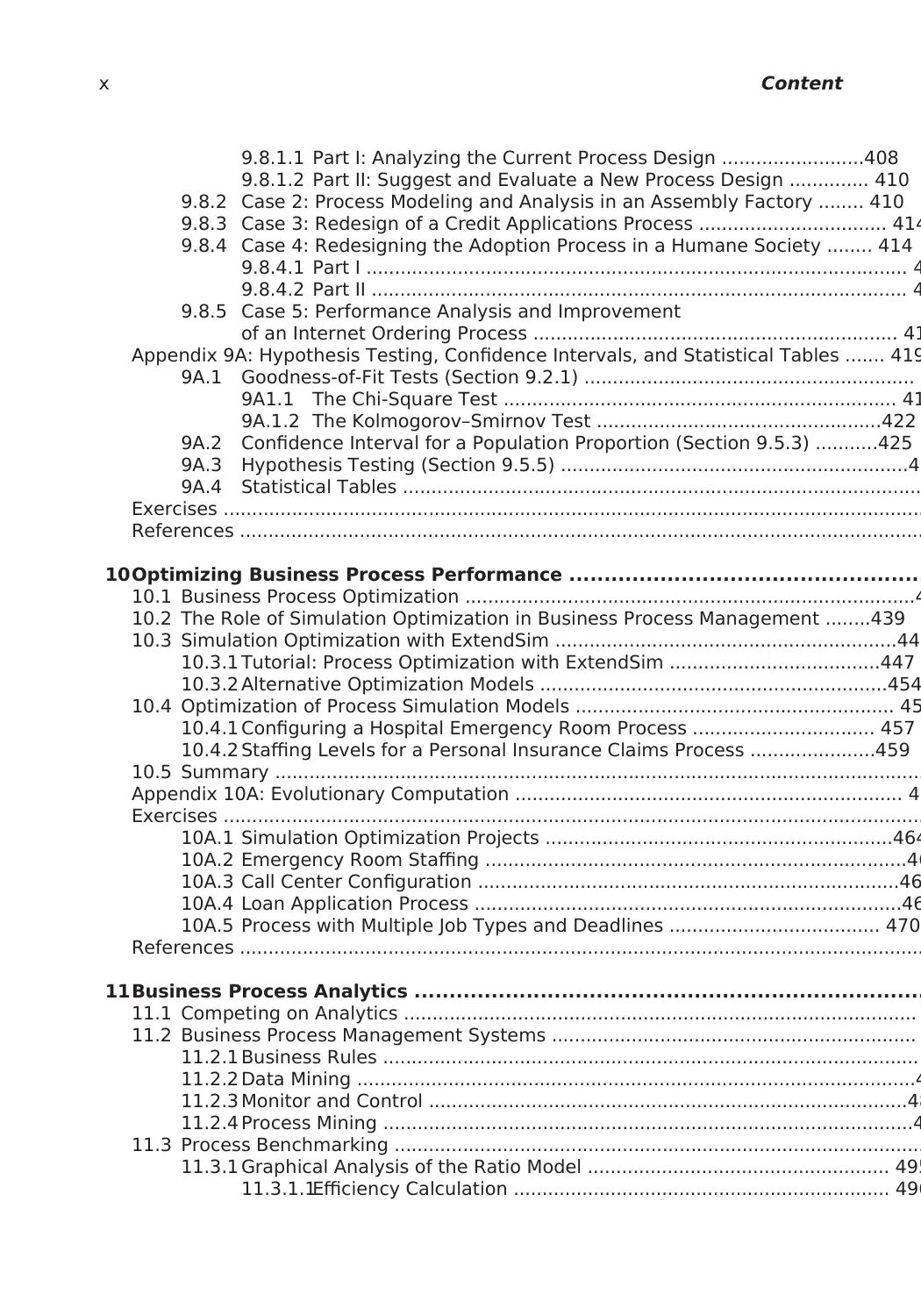
x Content
9.8.1.1 Part I: Analyzing the Current Process Design .........................408
9.8.1.2 Part II: Suggest and Evaluate a New Process Design .............. 410
9.8.2 Case 2: Process Modeling and Analysis in an Assembly Factory ........ 410
9.8.3 Case 3: Redesign of a Credit Applications Process ................................. 414
9.8.4 Case 4: Redesigning the Adoption Process in a Humane Society ........ 414
9.8.4.1 Part I ............................................................................................... 4
9.8.4.2 Part II .............................................................................................. 4
9.8.5 Case 5: Performance Analysis and Improvement
of an Internet Ordering Process ................................................................ 41
Appendix 9A: Hypothesis Testing, Confidence Intervals, and Statistical Tables ....... 419
9A.1 Goodness-of-Fit Tests (Section 9.2.1) .......................................................... 4
9A1.1 The Chi-Square Test ..................................................................... 41
9A.1.2 The Kolmogorov–Smirnov Test ..................................................422
9A.2 Confidence Interval for a Population Proportion (Section 9.5.3) ...........425
9A.3 Hypothesis Testing (Section 9.5.5) .............................................................42
9A.4 Statistical Tables ...........................................................................................
Exercises ...........................................................................................................................
References ........................................................................................................................
10 Optimizing Business Process Performance ...................................................
10.1 Business Process Optimization ...............................................................................4
10.2 The Role of Simulation Optimization in Business Process Management ........439
10.3 Simulation Optimization with ExtendSim ............................................................444
10.3.1 Tutorial: Process Optimization with ExtendSim .....................................447
10.3.2 Alternative Optimization Models .............................................................454
10.4 Optimization of Process Simulation Models ........................................................ 45
10.4.1 Configuring a Hospital Emergency Room Process ................................ 457
10.4.2 Staffing Levels for a Personal Insurance Claims Process ......................459
10.5 Summary ..................................................................................................................
Appendix 10A: Evolutionary Computation .................................................................... 46
Exercises ...........................................................................................................................
10A.1 Simulation Optimization Projects .............................................................464
10A.2 Emergency Room Staffing ..........................................................................46
10A.3 Call Center Configuration ..........................................................................46
10A.4 Loan Application Process ...........................................................................46
10A.5 Process with Multiple Job Types and Deadlines ..................................... 470
References ........................................................................................................................
11 Business Process Analytics .........................................................................
11.1 Competing on Analytics ..........................................................................................
11.2 Business Process Management Systems ................................................................
11.2.1 Business Rules ..............................................................................................
11.2.2 Data Mining ..................................................................................................4
11.2.3 Monitor and Control ....................................................................................48
11.2.4 Process Mining .............................................................................................4
11.3 Process Benchmarking .............................................................................................
11.3.1 Graphical Analysis of the Ratio Model ..................................................... 495
11.3.1.1Efficiency Calculation .................................................................. 496
9.8.1.1 Part I: Analyzing the Current Process Design .........................408
9.8.1.2 Part II: Suggest and Evaluate a New Process Design .............. 410
9.8.2 Case 2: Process Modeling and Analysis in an Assembly Factory ........ 410
9.8.3 Case 3: Redesign of a Credit Applications Process ................................. 414
9.8.4 Case 4: Redesigning the Adoption Process in a Humane Society ........ 414
9.8.4.1 Part I ............................................................................................... 4
9.8.4.2 Part II .............................................................................................. 4
9.8.5 Case 5: Performance Analysis and Improvement
of an Internet Ordering Process ................................................................ 41
Appendix 9A: Hypothesis Testing, Confidence Intervals, and Statistical Tables ....... 419
9A.1 Goodness-of-Fit Tests (Section 9.2.1) .......................................................... 4
9A1.1 The Chi-Square Test ..................................................................... 41
9A.1.2 The Kolmogorov–Smirnov Test ..................................................422
9A.2 Confidence Interval for a Population Proportion (Section 9.5.3) ...........425
9A.3 Hypothesis Testing (Section 9.5.5) .............................................................42
9A.4 Statistical Tables ...........................................................................................
Exercises ...........................................................................................................................
References ........................................................................................................................
10 Optimizing Business Process Performance ...................................................
10.1 Business Process Optimization ...............................................................................4
10.2 The Role of Simulation Optimization in Business Process Management ........439
10.3 Simulation Optimization with ExtendSim ............................................................444
10.3.1 Tutorial: Process Optimization with ExtendSim .....................................447
10.3.2 Alternative Optimization Models .............................................................454
10.4 Optimization of Process Simulation Models ........................................................ 45
10.4.1 Configuring a Hospital Emergency Room Process ................................ 457
10.4.2 Staffing Levels for a Personal Insurance Claims Process ......................459
10.5 Summary ..................................................................................................................
Appendix 10A: Evolutionary Computation .................................................................... 46
Exercises ...........................................................................................................................
10A.1 Simulation Optimization Projects .............................................................464
10A.2 Emergency Room Staffing ..........................................................................46
10A.3 Call Center Configuration ..........................................................................46
10A.4 Loan Application Process ...........................................................................46
10A.5 Process with Multiple Job Types and Deadlines ..................................... 470
References ........................................................................................................................
11 Business Process Analytics .........................................................................
11.1 Competing on Analytics ..........................................................................................
11.2 Business Process Management Systems ................................................................
11.2.1 Business Rules ..............................................................................................
11.2.2 Data Mining ..................................................................................................4
11.2.3 Monitor and Control ....................................................................................48
11.2.4 Process Mining .............................................................................................4
11.3 Process Benchmarking .............................................................................................
11.3.1 Graphical Analysis of the Ratio Model ..................................................... 495
11.3.1.1Efficiency Calculation .................................................................. 496
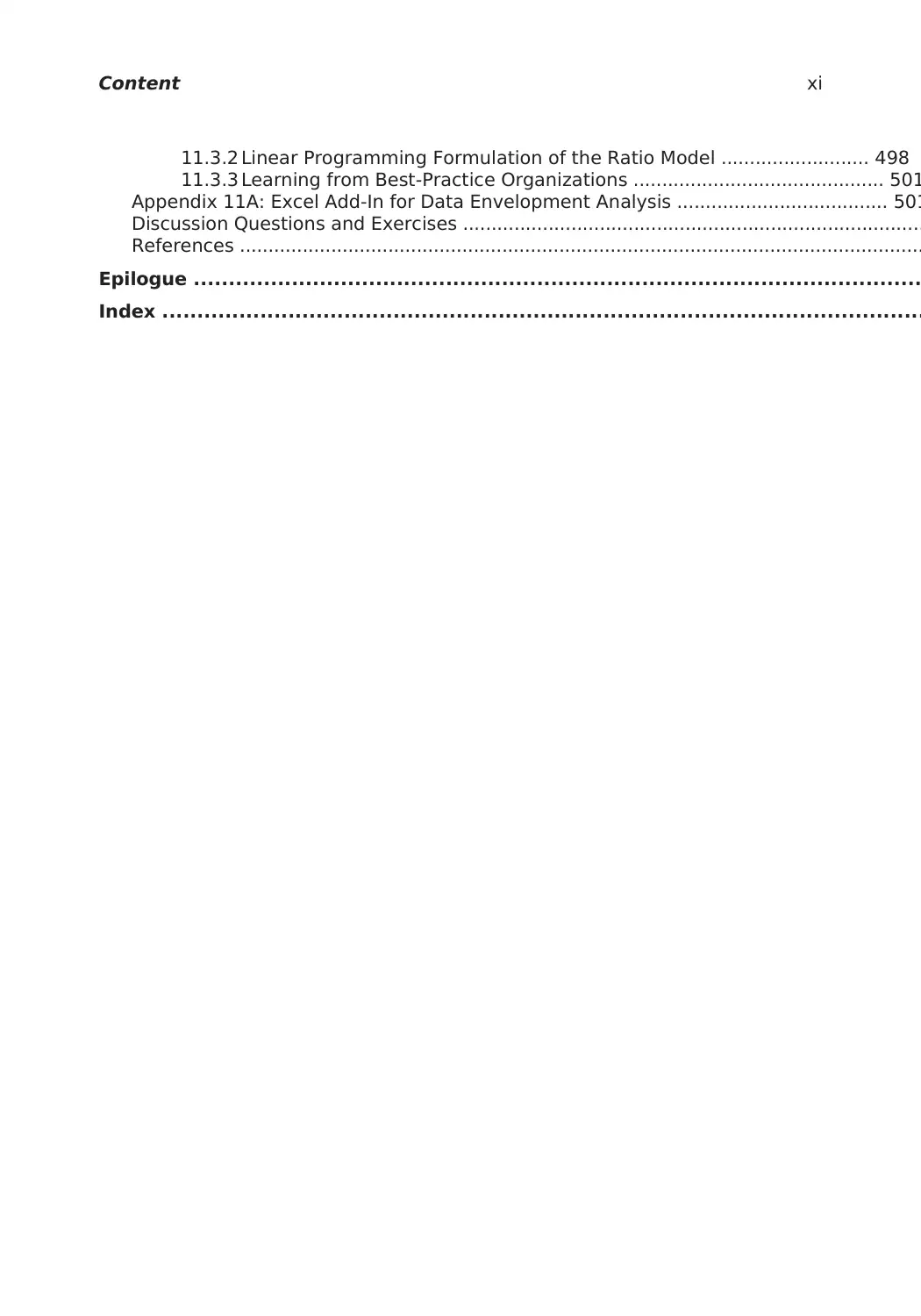
xiContent
11.3.2 Linear Programming Formulation of the Ratio Model .......................... 498
11.3.3 Learning from Best-Practice Organizations ............................................ 501
Appendix 11A: Excel Add-In for Data Envelopment Analysis ..................................... 501
Discussion Questions and Exercises .................................................................................
References ........................................................................................................................
Epilogue ........................................................................................................
Index .............................................................................................................
11.3.2 Linear Programming Formulation of the Ratio Model .......................... 498
11.3.3 Learning from Best-Practice Organizations ............................................ 501
Appendix 11A: Excel Add-In for Data Envelopment Analysis ..................................... 501
Discussion Questions and Exercises .................................................................................
References ........................................................................................................................
Epilogue ........................................................................................................
Index .............................................................................................................
⊘ This is a preview!⊘
Do you want full access?
Subscribe today to unlock all pages.
Trusted by 1+ million students worldwide

1 out of 48


Your All-in-One AI-Powered Toolkit for Academic Success.
+13062052269
info@desklib.com
Available 24*7 on WhatsApp / Email
![[object Object]](/_next/static/media/star-bottom.7253800d.svg)
Unlock your academic potential
Copyright © 2020–2026 A2Z Services. All Rights Reserved. Developed and managed by ZUCOL.