MITS5507 Assignment 3: Business Process Modelling for ShutterCorp
VerifiedAdded on 2023/03/30
|12
|1674
|148
Project
AI Summary
This report analyzes and proposes improvements for ShutterCorp, a photography company, focusing on business process modeling. It begins with an 'As-Is' process model, followed by a waste analysis and an issue register identifying current problems. The report describes proposed changes, primarily involving a website to optimize booking and payment. A 'To-Be' process model is recommended, outlining the modified processes. A detailed cost analysis assesses the financial implications of implementing the changes. The report concludes with a summary of the findings and recommendations for improving efficiency within ShutterCorp. The assignment uses BPMN diagrams and business process management concepts to redesign the booking-to-cash process, addressing identified issues and suggesting automation strategies. This includes website integration for bookings and payments, and improved customer communication.
Running head: BUSINESS PROCESS MODELLING
BUSINESS PROCESS MODELLING
Name of student
Name of university
Author’s note:
BUSINESS PROCESS MODELLING
Name of student
Name of university
Author’s note:
Paraphrase This Document
Need a fresh take? Get an instant paraphrase of this document with our AI Paraphraser

1
BUSINESS PROCESS MODELLING
Executive summary
This report intends to discuss the process improvements for the ShutterCorp photography
company for allowing them to manage their business more efficiently. The present business
model has been provided in this report along with a detailed waste analysis. The issue register
has been briefly discussed in the report. The description of the major changes within the
processes has been stated in this report. A To-Be process model is recommended with the
required changes in the business processes. A detailed cost analysis has been provided in the
report that provides the details of the cost involved in implementing the modified processes.
Lastly this report concludes with the appropriate conclusion.
BUSINESS PROCESS MODELLING
Executive summary
This report intends to discuss the process improvements for the ShutterCorp photography
company for allowing them to manage their business more efficiently. The present business
model has been provided in this report along with a detailed waste analysis. The issue register
has been briefly discussed in the report. The description of the major changes within the
processes has been stated in this report. A To-Be process model is recommended with the
required changes in the business processes. A detailed cost analysis has been provided in the
report that provides the details of the cost involved in implementing the modified processes.
Lastly this report concludes with the appropriate conclusion.

2
BUSINESS PROCESS MODELLING
Table of Contents
As-Is process model.......................................................................................................3
Waste analysis................................................................................................................3
Issue register...................................................................................................................4
Description of changes...................................................................................................5
To-Be process model......................................................................................................7
Cost analysis...................................................................................................................7
BUSINESS PROCESS MODELLING
Table of Contents
As-Is process model.......................................................................................................3
Waste analysis................................................................................................................3
Issue register...................................................................................................................4
Description of changes...................................................................................................5
To-Be process model......................................................................................................7
Cost analysis...................................................................................................................7
⊘ This is a preview!⊘
Do you want full access?
Subscribe today to unlock all pages.

Trusted by 1+ million students worldwide

3
BUSINESS PROCESS MODELLING
As-Is process model
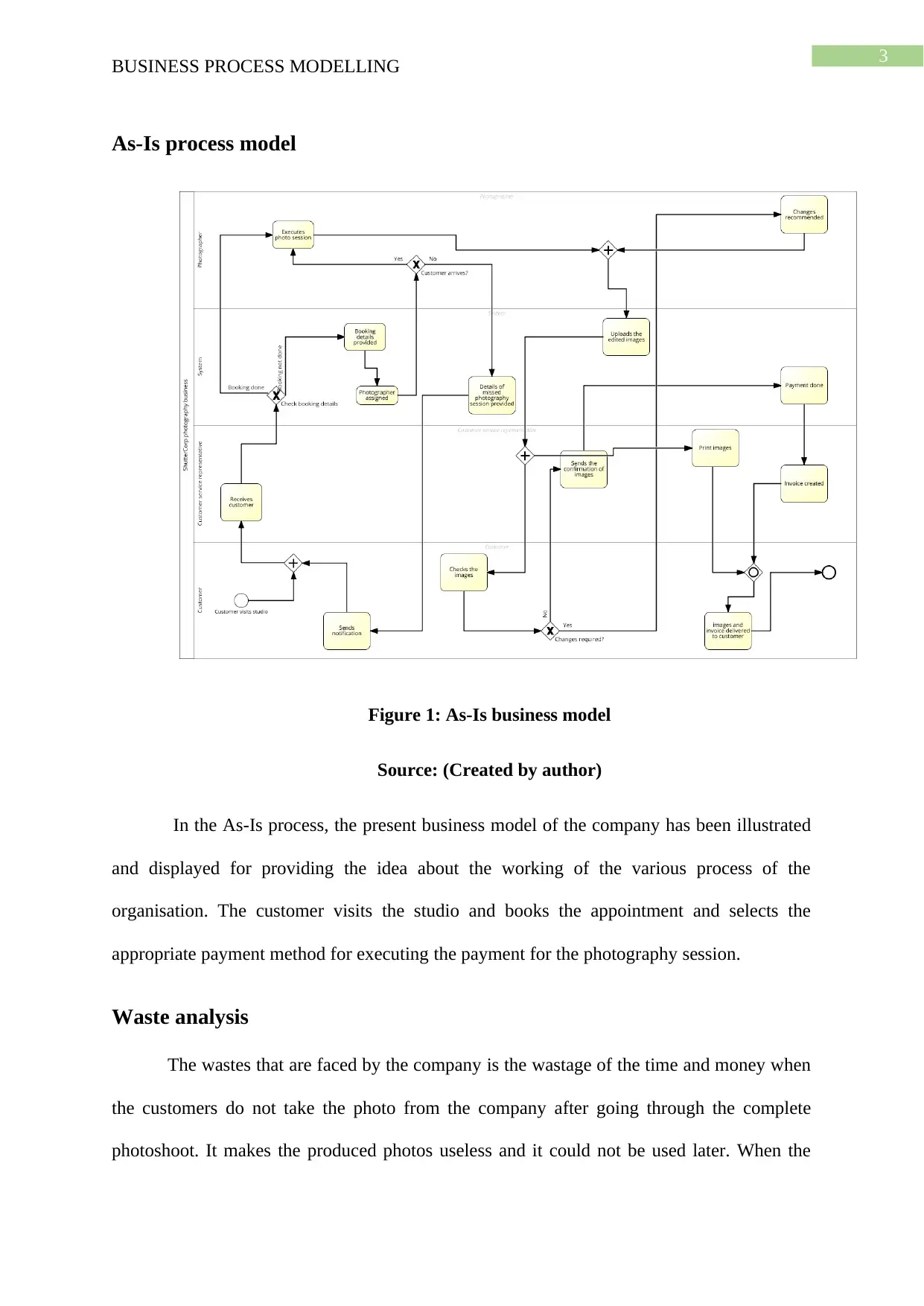
Figure 1: As-Is business model
Source: (Created by author)
In the As-Is process, the present business model of the company has been illustrated
and displayed for providing the idea about the working of the various process of the
organisation. The customer visits the studio and books the appointment and selects the
appropriate payment method for executing the payment for the photography session.
Waste analysis
The wastes that are faced by the company is the wastage of the time and money when
the customers do not take the photo from the company after going through the complete
photoshoot. It makes the produced photos useless and it could not be used later. When the
BUSINESS PROCESS MODELLING
As-Is process model
Figure 1: As-Is business model
Source: (Created by author)
In the As-Is process, the present business model of the company has been illustrated
and displayed for providing the idea about the working of the various process of the
organisation. The customer visits the studio and books the appointment and selects the
appropriate payment method for executing the payment for the photography session.
Waste analysis
The wastes that are faced by the company is the wastage of the time and money when
the customers do not take the photo from the company after going through the complete
photoshoot. It makes the produced photos useless and it could not be used later. When the
Paraphrase This Document
Need a fresh take? Get an instant paraphrase of this document with our AI Paraphraser

4
BUSINESS PROCESS MODELLING
photos has been uploaded in the file server but due to technical reasons, the uploaded file is
corrupted, that could mean the loss of money as they have to perform the photoshoot again
and even provide compensation to the customer for investing their time one more time.
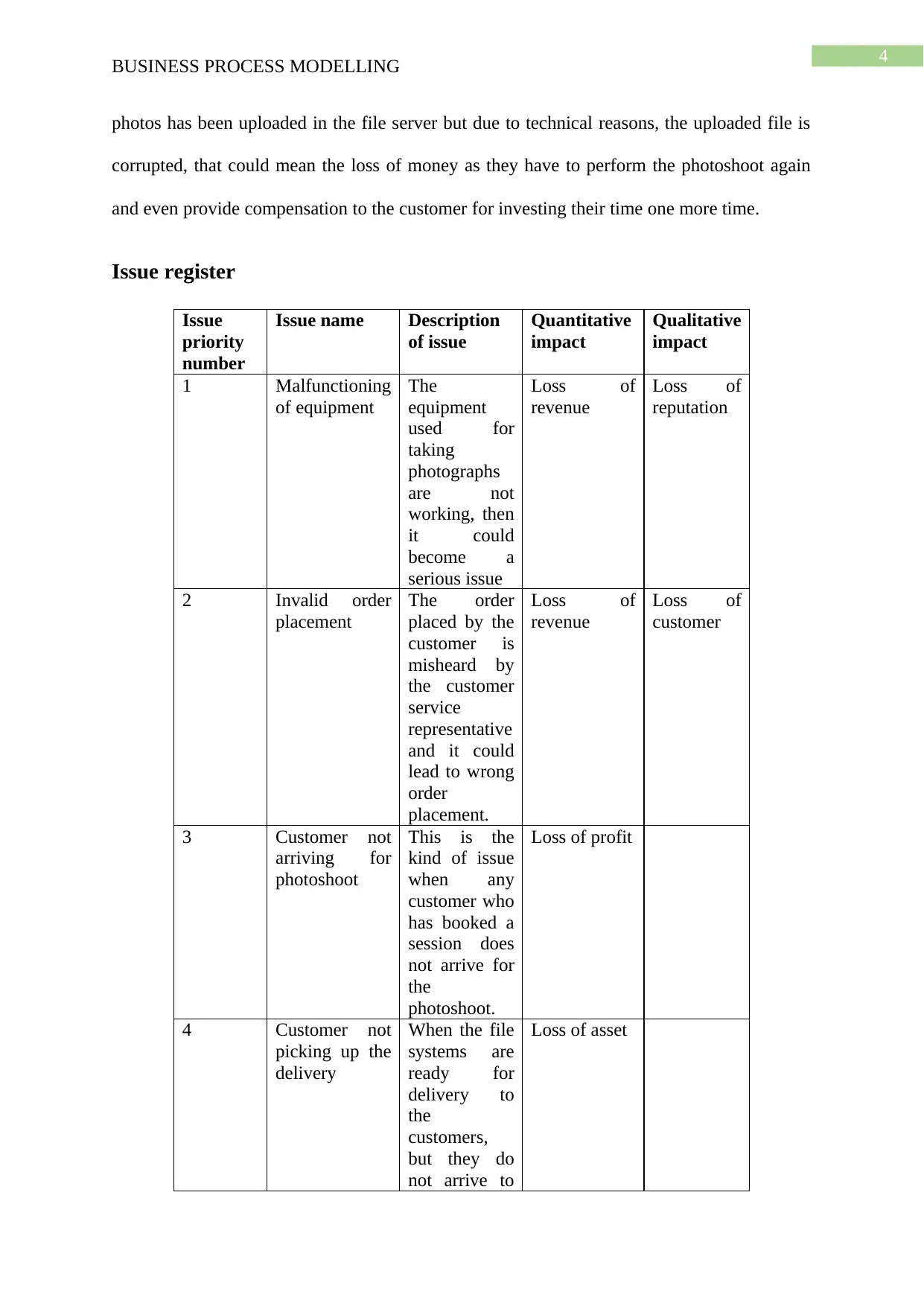
Issue register
Issue
priority
number
Issue name Description
of issue
Quantitative
impact
Qualitative
impact
1 Malfunctioning
of equipment
The
equipment
used for
taking
photographs
are not
working, then
it could
become a
serious issue
Loss of
revenue
Loss of
reputation
2 Invalid order
placement
The order
placed by the
customer is
misheard by
the customer
service
representative
and it could
lead to wrong
order
placement.
Loss of
revenue
Loss of
customer
3 Customer not
arriving for
photoshoot
This is the
kind of issue
when any
customer who
has booked a
session does
not arrive for
the
photoshoot.
Loss of profit
4 Customer not
picking up the
delivery
When the file
systems are
ready for
delivery to
the
customers,
but they do
not arrive to
Loss of asset
BUSINESS PROCESS MODELLING
photos has been uploaded in the file server but due to technical reasons, the uploaded file is
corrupted, that could mean the loss of money as they have to perform the photoshoot again
and even provide compensation to the customer for investing their time one more time.
Issue register
Issue
priority
number
Issue name Description
of issue
Quantitative
impact
Qualitative
impact
1 Malfunctioning
of equipment
The
equipment
used for
taking
photographs
are not
working, then
it could
become a
serious issue
Loss of
revenue
Loss of
reputation
2 Invalid order
placement
The order
placed by the
customer is
misheard by
the customer
service
representative
and it could
lead to wrong
order
placement.
Loss of
revenue
Loss of
customer
3 Customer not
arriving for
photoshoot
This is the
kind of issue
when any
customer who
has booked a
session does
not arrive for
the
photoshoot.
Loss of profit
4 Customer not
picking up the
delivery
When the file
systems are
ready for
delivery to
the
customers,
but they do
not arrive to
Loss of asset

5
BUSINESS PROCESS MODELLING
collect the
photos.
5 Damage in file
server
The files
uploaded in
the server of
the company
gets corrupted
and the
customer
could not
download the
files.
Loss of asset
and revenue
Loss of
reputation
6 Payment
related issues
The invoice
that has been
sent to the
customers has
some
discrepancy
due to which
payment
could not be
completed.
Loss of asset. Loss of
reputation.
Description of changes
The changes that are implemented within the organisation is the implementation of
website that could help in optimising the booking and payment process. With the introduction
of the website, there is no requirement of customer representative for accepting the bookings
of customers. The customers could register in the website and create their account that would
be used for ordering the photoshoot and the details of the photoshoot would be provided to
the respective accounts. When the customers login into the website using the username and
password, they could view the various options of selecting the kind of services that they
desire. The choice of session, the selection of appropriate photography style, or hire any
photographer for commercial purposes. After the selection of the activity that is desired by
the customers, they could also select the duration for which the photography is likely to
occur. When all the details are provided in this section, the customer is taken to the
confirmation page and the payment page.
BUSINESS PROCESS MODELLING
collect the
photos.
5 Damage in file
server
The files
uploaded in
the server of
the company
gets corrupted
and the
customer
could not
download the
files.
Loss of asset
and revenue
Loss of
reputation
6 Payment
related issues
The invoice
that has been
sent to the
customers has
some
discrepancy
due to which
payment
could not be
completed.
Loss of asset. Loss of
reputation.
Description of changes
The changes that are implemented within the organisation is the implementation of
website that could help in optimising the booking and payment process. With the introduction
of the website, there is no requirement of customer representative for accepting the bookings
of customers. The customers could register in the website and create their account that would
be used for ordering the photoshoot and the details of the photoshoot would be provided to
the respective accounts. When the customers login into the website using the username and
password, they could view the various options of selecting the kind of services that they
desire. The choice of session, the selection of appropriate photography style, or hire any
photographer for commercial purposes. After the selection of the activity that is desired by
the customers, they could also select the duration for which the photography is likely to
occur. When all the details are provided in this section, the customer is taken to the
confirmation page and the payment page.
⊘ This is a preview!⊘
Do you want full access?
Subscribe today to unlock all pages.

Trusted by 1+ million students worldwide

6
BUSINESS PROCESS MODELLING
The customer could select the most preferred payment methods from the selection of
several payment techniques. Complete payment could be done upfront by the customers, the
50% advance payment could be done for the session or the option of payment after delivery
could be selected by the customer. When the payment method has been confirmed and in the
situation when online payment method has been selected, then the payment process with the
bank is executed and if the payment method is selected as cash on delivery, then the invoice
for all the kinds of payment method is done and stored in the server. The assigned
photographer or the allocated photographer receives the notification of booking from the
system of the company. The customer who have booked a photography session with the
company receives the notification about the upcoming session few hours earlier for allowing
to make the required preparations. When the photography session is done, then the
photographer uploads the edited images into the account of the particular customer and then
the customer receives the notification on their mobile phones regarding the recent
developments. The customer could then login into the account and view the uploaded files
and recommend any changes, if required. If there are no changes required, and the payment
has been done for the photography session, then the customers could download the digital
copy on their system, if needed. The customers would not be able to download the photos if
the payment is not complete. If the customers sends the acknowledge regarding the status of
the photos to the photographer, and if no changes are required in the photos, then these
photos are printed by the photographer and sent to the delivery address that has been
provided by the customer. If any changes are required, then the photographer makes the
required changes and then sends it to the specific customers. In both the situations, the
notification about the developments in the photographs are provided in the customer account.
This particular improvement in the processes of the photography company helps them
to provide the seamless facility to the customers of the company and fulfil the requirements
BUSINESS PROCESS MODELLING
The customer could select the most preferred payment methods from the selection of
several payment techniques. Complete payment could be done upfront by the customers, the
50% advance payment could be done for the session or the option of payment after delivery
could be selected by the customer. When the payment method has been confirmed and in the
situation when online payment method has been selected, then the payment process with the
bank is executed and if the payment method is selected as cash on delivery, then the invoice
for all the kinds of payment method is done and stored in the server. The assigned
photographer or the allocated photographer receives the notification of booking from the
system of the company. The customer who have booked a photography session with the
company receives the notification about the upcoming session few hours earlier for allowing
to make the required preparations. When the photography session is done, then the
photographer uploads the edited images into the account of the particular customer and then
the customer receives the notification on their mobile phones regarding the recent
developments. The customer could then login into the account and view the uploaded files
and recommend any changes, if required. If there are no changes required, and the payment
has been done for the photography session, then the customers could download the digital
copy on their system, if needed. The customers would not be able to download the photos if
the payment is not complete. If the customers sends the acknowledge regarding the status of
the photos to the photographer, and if no changes are required in the photos, then these
photos are printed by the photographer and sent to the delivery address that has been
provided by the customer. If any changes are required, then the photographer makes the
required changes and then sends it to the specific customers. In both the situations, the
notification about the developments in the photographs are provided in the customer account.
This particular improvement in the processes of the photography company helps them
to provide the seamless facility to the customers of the company and fulfil the requirements
Paraphrase This Document
Need a fresh take? Get an instant paraphrase of this document with our AI Paraphraser

7
BUSINESS PROCESS MODELLING
of the customers with improved methods and processes. The mistakes that could be made by
the customer service representative would not impact severely on this form of transaction and
the issues faced by the company regarding the payment methods would be eliminated
completely.
To-Be process model
Figure 2: To-Be process
Source: (Created by author)
Cost analysis
The cost associated in the As-Is process is significantly high as the loss that the
company might have to face is significantly high. But the probability of the loss is
significantly low in the To-Be process. The cost of implementation of the website could be
EUR 100 and the cost of transportation could be almost EUR 100.
BUSINESS PROCESS MODELLING
of the customers with improved methods and processes. The mistakes that could be made by
the customer service representative would not impact severely on this form of transaction and
the issues faced by the company regarding the payment methods would be eliminated
completely.
To-Be process model
Figure 2: To-Be process
Source: (Created by author)
Cost analysis
The cost associated in the As-Is process is significantly high as the loss that the
company might have to face is significantly high. But the probability of the loss is
significantly low in the To-Be process. The cost of implementation of the website could be
EUR 100 and the cost of transportation could be almost EUR 100.

8
BUSINESS PROCESS MODELLING
⊘ This is a preview!⊘
Do you want full access?
Subscribe today to unlock all pages.

Trusted by 1+ million students worldwide

9
BUSINESS PROCESS MODELLING
Bibliography
Alotaibi, Y., 2016. Business process modelling challenges and solutions: a literature
review. Journal of Intelligent Manufacturing, 27(4), pp.701-723.
Alpers, S., Becker, C., Oberweis, A. and Schuster, T., 2015, September. Microservice based
tool support for business process modelling. In 2015 IEEE 19th International Enterprise
Distributed Object Computing Workshop (pp. 71-78). IEEE.
Becker, J., Pfeiffer, D., Räckers, M., Falk, T. and Czerwonka, M., 2015. Semantic business
process modelling and analysis. In Handbook on Business Process Management 1 (pp. 187-
217). Springer, Berlin, Heidelberg.
Buh, B., Kovačič, A. and Indihar Štemberger, M., 2015. Critical success factors for different
stages of business process management adoption–a case study. Economic Research-
Ekonomska Istraživanja, 28(1), pp.243-257.
de Oca, I.M.M., Snoeck, M., Reijers, H.A. and Rodríguez-Morffi, A., 2015. A systematic
literature review of studies on business process modeling quality. Information and Software
Technology, 58, pp.187-205.
Di Francescomarino, C., Rospocher, M., Ghidini, C. and Valerio, A., 2014, September. The
role of semantic annotations in business process modelling. In 2014 IEEE 18th International
Enterprise Distributed Object Computing Conference (pp. 181-189). IEEE.
Dijkman, R., Vanderfeesten, I. and Reijers, H.A., 2016. Business process architectures:
overview, comparison and framework. Enterprise Information Systems, 10(2), pp.129-158.
Elgammal, A., Turetken, O., van den Heuvel, W.J. and Papazoglou, M., 2016. Formalizing
and appling compliance patterns for business process compliance. Software & Systems
Modeling, 15(1), pp.119-146.
BUSINESS PROCESS MODELLING
Bibliography
Alotaibi, Y., 2016. Business process modelling challenges and solutions: a literature
review. Journal of Intelligent Manufacturing, 27(4), pp.701-723.
Alpers, S., Becker, C., Oberweis, A. and Schuster, T., 2015, September. Microservice based
tool support for business process modelling. In 2015 IEEE 19th International Enterprise
Distributed Object Computing Workshop (pp. 71-78). IEEE.
Becker, J., Pfeiffer, D., Räckers, M., Falk, T. and Czerwonka, M., 2015. Semantic business
process modelling and analysis. In Handbook on Business Process Management 1 (pp. 187-
217). Springer, Berlin, Heidelberg.
Buh, B., Kovačič, A. and Indihar Štemberger, M., 2015. Critical success factors for different
stages of business process management adoption–a case study. Economic Research-
Ekonomska Istraživanja, 28(1), pp.243-257.
de Oca, I.M.M., Snoeck, M., Reijers, H.A. and Rodríguez-Morffi, A., 2015. A systematic
literature review of studies on business process modeling quality. Information and Software
Technology, 58, pp.187-205.
Di Francescomarino, C., Rospocher, M., Ghidini, C. and Valerio, A., 2014, September. The
role of semantic annotations in business process modelling. In 2014 IEEE 18th International
Enterprise Distributed Object Computing Conference (pp. 181-189). IEEE.
Dijkman, R., Vanderfeesten, I. and Reijers, H.A., 2016. Business process architectures:
overview, comparison and framework. Enterprise Information Systems, 10(2), pp.129-158.
Elgammal, A., Turetken, O., van den Heuvel, W.J. and Papazoglou, M., 2016. Formalizing
and appling compliance patterns for business process compliance. Software & Systems
Modeling, 15(1), pp.119-146.
Paraphrase This Document
Need a fresh take? Get an instant paraphrase of this document with our AI Paraphraser

10
BUSINESS PROCESS MODELLING
Fellmann, M. and Zasada, A., 2014. State-of-the-art of business process compliance
approaches.
Geissdoerfer, M., Bocken, N.M. and Hultink, E.J., 2016. Design thinking to enhance the
sustainable business modelling process–A workshop based on a value mapping
process. Journal of Cleaner Production, 135, pp.1218-1232.
Goedertier, S., Vanthienen, J. and Caron, F., 2015. Declarative business process modelling:
principles and modelling languages. Enterprise Information Systems, 9(2), pp.161-185.
Greasley, A., 2017. Simulation modelling for business. Routledge.
Hinkelmann, K., Gerber, A., Karagiannis, D., Thoenssen, B., Van der Merwe, A. and
Woitsch, R., 2016. A new paradigm for the continuous alignment of business and IT:
Combining enterprise architecture modelling and enterprise ontology. Computers in
Industry, 79, pp.77-86.
Kocbek, M., Jost, G., Hericko, M. and Polancic, G., 2015. Business process model and
notation: The current state of affairs. Comput. Sci. Inf. Syst., 12(2), pp.509-539.
Kohlborn, T., Mueller, O., Poeppelbuss, J. and Roeglinger, M., 2014. Interview with Michael
Rosemann on ambidextrous business process management. Business Process Management
Journal, 20(4), pp.634-638.
Looy, A.V., Backer, M.D. and Poels, G., 2014. A conceptual framework and classification of
capability areas for business process maturity. Enterprise Information Systems, 8(2), pp.188-
224.
Rospocher, M., Ghidini, C. and Serafini, L., 2014, September. An ontology for the Business
Process Modelling Notation. In FOIS (pp. 133-146).
BUSINESS PROCESS MODELLING
Fellmann, M. and Zasada, A., 2014. State-of-the-art of business process compliance
approaches.
Geissdoerfer, M., Bocken, N.M. and Hultink, E.J., 2016. Design thinking to enhance the
sustainable business modelling process–A workshop based on a value mapping
process. Journal of Cleaner Production, 135, pp.1218-1232.
Goedertier, S., Vanthienen, J. and Caron, F., 2015. Declarative business process modelling:
principles and modelling languages. Enterprise Information Systems, 9(2), pp.161-185.
Greasley, A., 2017. Simulation modelling for business. Routledge.
Hinkelmann, K., Gerber, A., Karagiannis, D., Thoenssen, B., Van der Merwe, A. and
Woitsch, R., 2016. A new paradigm for the continuous alignment of business and IT:
Combining enterprise architecture modelling and enterprise ontology. Computers in
Industry, 79, pp.77-86.
Kocbek, M., Jost, G., Hericko, M. and Polancic, G., 2015. Business process model and
notation: The current state of affairs. Comput. Sci. Inf. Syst., 12(2), pp.509-539.
Kohlborn, T., Mueller, O., Poeppelbuss, J. and Roeglinger, M., 2014. Interview with Michael
Rosemann on ambidextrous business process management. Business Process Management
Journal, 20(4), pp.634-638.
Looy, A.V., Backer, M.D. and Poels, G., 2014. A conceptual framework and classification of
capability areas for business process maturity. Enterprise Information Systems, 8(2), pp.188-
224.
Rospocher, M., Ghidini, C. and Serafini, L., 2014, September. An ontology for the Business
Process Modelling Notation. In FOIS (pp. 133-146).

11
BUSINESS PROCESS MODELLING
Sikdar, A. and Payyazhi, J., 2014. A process model of managing organizational change
during business process redesign. Business Process Management Journal, 20(6), pp.971-998.
vom Brocke, J., Zelt, S. and Schmiedel, T., 2016. On the role of context in business process
management. International Journal of Information Management, 36(3), pp.486-495.
Wang, W., Indulska, M. and Sadiq, S., 2014. Integrated modelling of business process
models and business rules: a research agenda. ACIS.
BUSINESS PROCESS MODELLING
Sikdar, A. and Payyazhi, J., 2014. A process model of managing organizational change
during business process redesign. Business Process Management Journal, 20(6), pp.971-998.
vom Brocke, J., Zelt, S. and Schmiedel, T., 2016. On the role of context in business process
management. International Journal of Information Management, 36(3), pp.486-495.
Wang, W., Indulska, M. and Sadiq, S., 2014. Integrated modelling of business process
models and business rules: a research agenda. ACIS.
⊘ This is a preview!⊘
Do you want full access?
Subscribe today to unlock all pages.

Trusted by 1+ million students worldwide
1 out of 12
Related Documents
Your All-in-One AI-Powered Toolkit for Academic Success.
+13062052269
info@desklib.com
Available 24*7 on WhatsApp / Email
Unlock your academic potential
Copyright © 2020–2025 A2Z Services. All Rights Reserved. Developed and managed by ZUCOL.