Business Process Reengineering and Improvement of ALM Process Report
VerifiedAdded on 2023/06/03
|28
|5549
|428
Report
AI Summary
This report focuses on the reengineering and improvement of a case company's management processes, specifically the ALM (Absenteeism, Leave, and Management) process, utilizing business process re-engineering and process design methodologies. The study, based on literature review and semi-structured interviews with company personnel, aims to enhance constancy, accountability, and efficiency. The report details the development of a WTR (Working Time Reporting) system to support the ALM process, along with the application of performance/importance matrices and business process modeling. It includes an analysis of system requirements, process improvement phases, and visualizations, ultimately providing a framework for regular business process improvements. The research addresses current problems faced by the ALM process, proposes improvements, and identifies the need for a supporting software system.
Running head: Emerging Technologies and Innovation 1
University
(Name)
Emerging Technologies and Innovations
(Professor’s Name)
(Date)
University
(Name)
Emerging Technologies and Innovations
(Professor’s Name)
(Date)

Paraphrase This Document
Need a fresh take? Get an instant paraphrase of this document with our AI Paraphraser
2
1.0 Executive Summary
The purpose of the thesis is to improve, re-engineer and develop a case company’s
management processes though business process re-engineering and process advancement and
design methodologies.
The data of the report theoretical analysis was unruffled from pertinent literature for this
topic. The main aim of the analysis was to re-engineer the management processes and
improve business processes. The pragmatic study was based on the ALM process. The
important part of collecting data was interviewing the personnel that are involved in the
management processes.
The consequences of the thesis outlines reasons behind the development of ALM process
case company, reengineering and improvement for the case company to realise constancy,
accountability and efficiency in the organization. Results of the designing process was to
utilize in creating the organization’s WTR system as a tool and also a product to enhance
ALM processes. Furthermore the results outlines how improvement can be done regularly on
the business.
1.0 Executive Summary
The purpose of the thesis is to improve, re-engineer and develop a case company’s
management processes though business process re-engineering and process advancement and
design methodologies.
The data of the report theoretical analysis was unruffled from pertinent literature for this
topic. The main aim of the analysis was to re-engineer the management processes and
improve business processes. The pragmatic study was based on the ALM process. The
important part of collecting data was interviewing the personnel that are involved in the
management processes.
The consequences of the thesis outlines reasons behind the development of ALM process
case company, reengineering and improvement for the case company to realise constancy,
accountability and efficiency in the organization. Results of the designing process was to
utilize in creating the organization’s WTR system as a tool and also a product to enhance
ALM processes. Furthermore the results outlines how improvement can be done regularly on
the business.
3
Table of Contents
2.0 Introduction to research domain..................................................................................................4
2.1 Research question......................................................................................................................4
3.0 Literature Review..........................................................................................................................4
4.0 Methodology...................................................................................................................................6
4.1 semi-structural interviews............................................................................................................6
4 Discussion/Analysis...................................................................................................................6
4.3 Analysis for the system requirements..........................................................................................6
5.0 Re-engineering and Business Process Design..............................................................................8
5.1 Business process Re-engineering.................................................................................................8
5.2 modelling of business process.....................................................................................................8
5.3 performance/important matrix.....................................................................................................9
6.0 Findings........................................................................................................................................11
6.1 Description of improving business process............................................................................11
6.3 Process improvements visualization.......................................................................................13
6.2 Re-engineering and of the ALM process................................................................................14
6.2 Re-engineering of ALM process and Business process improvement..................................19
6.21 Identification of critical process............................................................................................20
6.22 Testing of redesigned ALM process......................................................................................22
6.23 performance/importance matrix...........................................................................................23
6.24 Establishment of the Redesigned ALM process..................................................................23
7.0 conclusion.....................................................................................................................................24
8.0 References.....................................................................................................................................25
Table of Contents
2.0 Introduction to research domain..................................................................................................4
2.1 Research question......................................................................................................................4
3.0 Literature Review..........................................................................................................................4
4.0 Methodology...................................................................................................................................6
4.1 semi-structural interviews............................................................................................................6
4 Discussion/Analysis...................................................................................................................6
4.3 Analysis for the system requirements..........................................................................................6
5.0 Re-engineering and Business Process Design..............................................................................8
5.1 Business process Re-engineering.................................................................................................8
5.2 modelling of business process.....................................................................................................8
5.3 performance/important matrix.....................................................................................................9
6.0 Findings........................................................................................................................................11
6.1 Description of improving business process............................................................................11
6.3 Process improvements visualization.......................................................................................13
6.2 Re-engineering and of the ALM process................................................................................14
6.2 Re-engineering of ALM process and Business process improvement..................................19
6.21 Identification of critical process............................................................................................20
6.22 Testing of redesigned ALM process......................................................................................22
6.23 performance/importance matrix...........................................................................................23
6.24 Establishment of the Redesigned ALM process..................................................................23
7.0 conclusion.....................................................................................................................................24
8.0 References.....................................................................................................................................25
⊘ This is a preview!⊘
Do you want full access?
Subscribe today to unlock all pages.

Trusted by 1+ million students worldwide
4
2.0 Introduction to research domain
Due to the fact that there is no regulated and standardise business process and organizational
processes, many challenges has been reported concerning the administrational tasks. The
primary objective of implementing this thesis was to improve the existing organizational
processes and also to improve and develop the process through theories applications (Lin,
Chen, & Ye, 2018).
2.1 Research question
1. What are the current problems that are faced by the ALM process?
2. How can ALM process be improve and developed in the company?
3. Which are the needs of a system or a software that may support redesign of ALM
process?
3.0 Literature Review
In4mo is an information technology company located in Finland, the main offices are located
in Espoo, Finland and Stockholm, Sweden. It was founded in the year 2007 and has
experience a significant growth because of having a good and close relationship with its
customers, it has a constant optimum level of services and a great contract concentration to
comprehensive simplicity of products and innovation. The company branch located in
Sweden has about 40 employees and the organization official language is English.
In4mo emphasise on the necessities of NIC Company and they have partnered with
construction and drying companies. In4mo mainly provides Mobile Multimedia Reporting
solutions and many other products. Insurance holders are the greatest beneficiary of the
company.
2.0 Introduction to research domain
Due to the fact that there is no regulated and standardise business process and organizational
processes, many challenges has been reported concerning the administrational tasks. The
primary objective of implementing this thesis was to improve the existing organizational
processes and also to improve and develop the process through theories applications (Lin,
Chen, & Ye, 2018).
2.1 Research question
1. What are the current problems that are faced by the ALM process?
2. How can ALM process be improve and developed in the company?
3. Which are the needs of a system or a software that may support redesign of ALM
process?
3.0 Literature Review
In4mo is an information technology company located in Finland, the main offices are located
in Espoo, Finland and Stockholm, Sweden. It was founded in the year 2007 and has
experience a significant growth because of having a good and close relationship with its
customers, it has a constant optimum level of services and a great contract concentration to
comprehensive simplicity of products and innovation. The company branch located in
Sweden has about 40 employees and the organization official language is English.
In4mo emphasise on the necessities of NIC Company and they have partnered with
construction and drying companies. In4mo mainly provides Mobile Multimedia Reporting
solutions and many other products. Insurance holders are the greatest beneficiary of the
company.
Paraphrase This Document
Need a fresh take? Get an instant paraphrase of this document with our AI Paraphraser
5
The company contain a working organization structure which consist of Board of Directors
with 5 executive members, the chief executive officer and the managers who are the heads of
various departments. The company focuses on a good working environment and it emphasis
very much on team work.
I4mo emphasis on security in its designation step because the company is ISO 27001:2005
certified. The company has worn various competition and it has been referred as one of the
fast growing company in Finland.
3.0 Needs for development in ALM process
The business process for the administration of ALM is to be created in the thesis for the
company to approve, monitor and report on the days they are out of work, these are usually
the vacation days, overtime working hours and other kind of leave that are granted by the
laws of Finland and the agreements of the company.
Two personnel working for the company was interviewed and out of this interview the
development needs of the company were defined. The following are some of the
requirements.
3.1Software needs
3.11 Better overview of the structure for the executive the management team and the
employees.
3.2 Need to make the managers and the employees accountable for their actions.
The company contain a working organization structure which consist of Board of Directors
with 5 executive members, the chief executive officer and the managers who are the heads of
various departments. The company focuses on a good working environment and it emphasis
very much on team work.
I4mo emphasis on security in its designation step because the company is ISO 27001:2005
certified. The company has worn various competition and it has been referred as one of the
fast growing company in Finland.
3.0 Needs for development in ALM process
The business process for the administration of ALM is to be created in the thesis for the
company to approve, monitor and report on the days they are out of work, these are usually
the vacation days, overtime working hours and other kind of leave that are granted by the
laws of Finland and the agreements of the company.
Two personnel working for the company was interviewed and out of this interview the
development needs of the company were defined. The following are some of the
requirements.
3.1Software needs
3.11 Better overview of the structure for the executive the management team and the
employees.
3.2 Need to make the managers and the employees accountable for their actions.
6
4.0 Methodology
4.1 semi-structural interviews
In the thesis I found this kind of interview to be suitable because there was need to list down
the questions, but questions itself is required to be open-ended because of the need to look for
the current information about ALM process and also comprehending the needs for customers.
The interviews was limited by this technique to only two primary persons to be interviewed
(Chang, 2016).
4 Discussion/Analysis.
Data collected in the interview throughout the writing of the thesis is going to be analysed
by discussing method of analysis that referred to be the communal texts. The method of
data collection was suitable because of the re-engineering and the developments of the
ALM Process which is based mainly to management wishes and also wishes of the
customers.
4.3 Analysis for the system requirements
This type of is mostly used in software developments and Information Technology in order to
comprehend the targets and the needs solution design. The system requirements is a way of
meeting the needs of the esteemed customers and are also crucial in defining the system
attributes for its development (Yours, 2014).
The development of the system should must start by defining the needs of customers, this is
achieved by discussing with the customers about their needs.
The analysis requirements in the thesis was done by analysing data that was collected at the
discussion that was performed in the meeting and interviews which took place in the process
of preparing the thesis. Analysis of the system requirements ware required to enable the
company to utilize the gathered information to improve the ALM WTR systems.
4.0 Methodology
4.1 semi-structural interviews
In the thesis I found this kind of interview to be suitable because there was need to list down
the questions, but questions itself is required to be open-ended because of the need to look for
the current information about ALM process and also comprehending the needs for customers.
The interviews was limited by this technique to only two primary persons to be interviewed
(Chang, 2016).
4 Discussion/Analysis.
Data collected in the interview throughout the writing of the thesis is going to be analysed
by discussing method of analysis that referred to be the communal texts. The method of
data collection was suitable because of the re-engineering and the developments of the
ALM Process which is based mainly to management wishes and also wishes of the
customers.
4.3 Analysis for the system requirements
This type of is mostly used in software developments and Information Technology in order to
comprehend the targets and the needs solution design. The system requirements is a way of
meeting the needs of the esteemed customers and are also crucial in defining the system
attributes for its development (Yours, 2014).
The development of the system should must start by defining the needs of customers, this is
achieved by discussing with the customers about their needs.
The analysis requirements in the thesis was done by analysing data that was collected at the
discussion that was performed in the meeting and interviews which took place in the process
of preparing the thesis. Analysis of the system requirements ware required to enable the
company to utilize the gathered information to improve the ALM WTR systems.
⊘ This is a preview!⊘
Do you want full access?
Subscribe today to unlock all pages.
Trusted by 1+ million students worldwide

7
Paraphrase This Document
Need a fresh take? Get an instant paraphrase of this document with our AI Paraphraser
8
5.0 Re-engineering and Business Process Design
5.1 Business process Re-engineering
It is define as “the fundamental rethinking and radical redesign of business processes to
achieve dramatic improvements in critical, contemporary measures of performance, such as
cost, quality, service and speed” (Tonnossen, 2014).
5.2 modelling of business process
The biggest section of BPD is modelling which contain the evaluation tools. When
developing a business process, it is important to know owners goals. The owner should
outline a certain number of goals that the new system should meet. Various stakeholders
should be consulted to give out the goals of the organization (Luka, 2018).
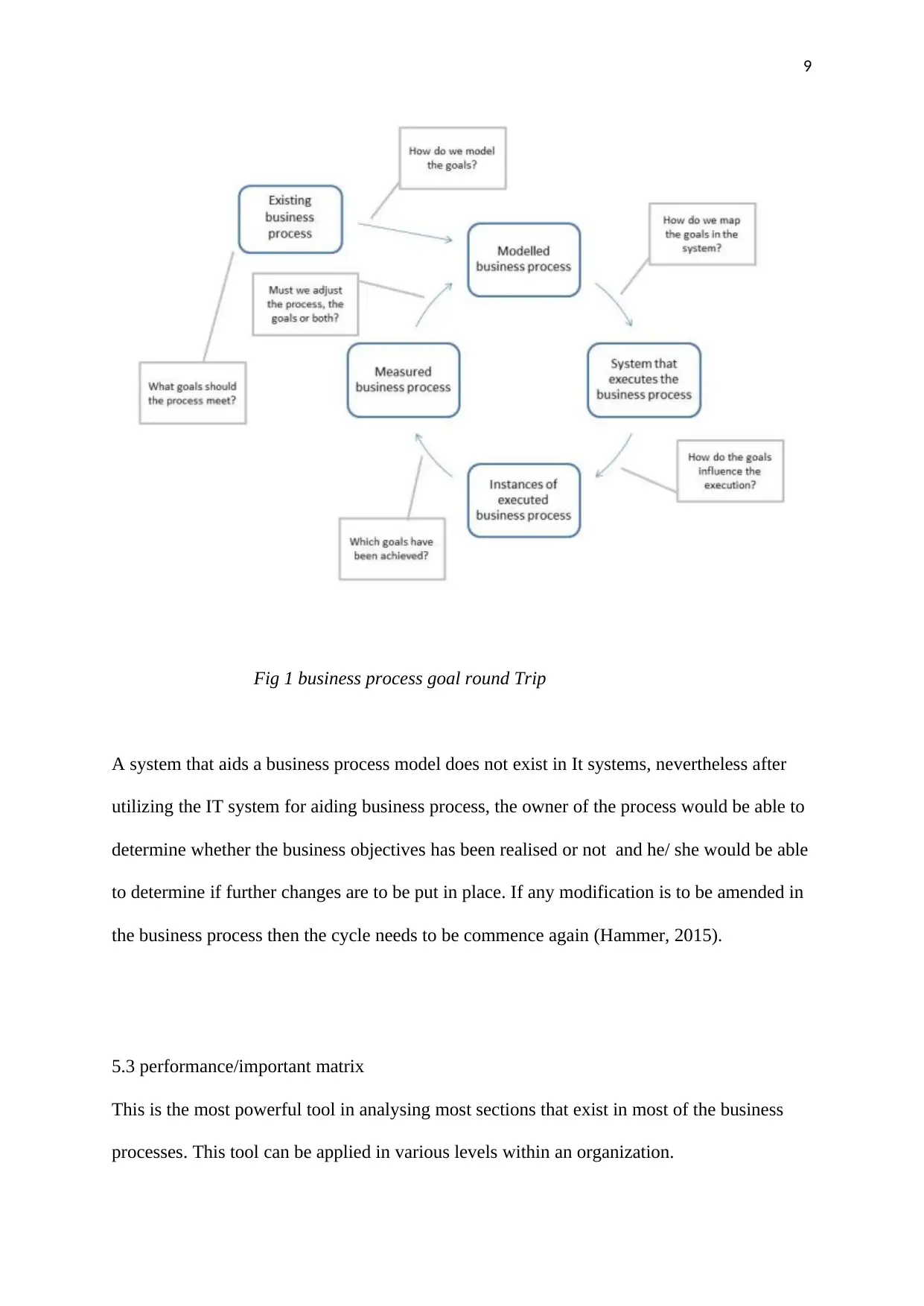
After building a BPM an Information Technology System or a software is set up to aid the
BPM and its implementation.
The following table illustrate steps of Business Process Modelling that assist an organization
to realise the objective.
5.0 Re-engineering and Business Process Design
5.1 Business process Re-engineering
It is define as “the fundamental rethinking and radical redesign of business processes to
achieve dramatic improvements in critical, contemporary measures of performance, such as
cost, quality, service and speed” (Tonnossen, 2014).
5.2 modelling of business process
The biggest section of BPD is modelling which contain the evaluation tools. When
developing a business process, it is important to know owners goals. The owner should
outline a certain number of goals that the new system should meet. Various stakeholders
should be consulted to give out the goals of the organization (Luka, 2018).
After building a BPM an Information Technology System or a software is set up to aid the
BPM and its implementation.
The following table illustrate steps of Business Process Modelling that assist an organization
to realise the objective.
9
Fig 1 business process goal round Trip
A system that aids a business process model does not exist in It systems, nevertheless after
utilizing the IT system for aiding business process, the owner of the process would be able to
determine whether the business objectives has been realised or not and he/ she would be able
to determine if further changes are to be put in place. If any modification is to be amended in
the business process then the cycle needs to be commence again (Hammer, 2015).
5.3 performance/important matrix
This is the most powerful tool in analysing most sections that exist in most of the business
processes. This tool can be applied in various levels within an organization.
Fig 1 business process goal round Trip
A system that aids a business process model does not exist in It systems, nevertheless after
utilizing the IT system for aiding business process, the owner of the process would be able to
determine whether the business objectives has been realised or not and he/ she would be able
to determine if further changes are to be put in place. If any modification is to be amended in
the business process then the cycle needs to be commence again (Hammer, 2015).
5.3 performance/important matrix
This is the most powerful tool in analysing most sections that exist in most of the business
processes. This tool can be applied in various levels within an organization.
⊘ This is a preview!⊘
Do you want full access?
Subscribe today to unlock all pages.
Trusted by 1+ million students worldwide
10
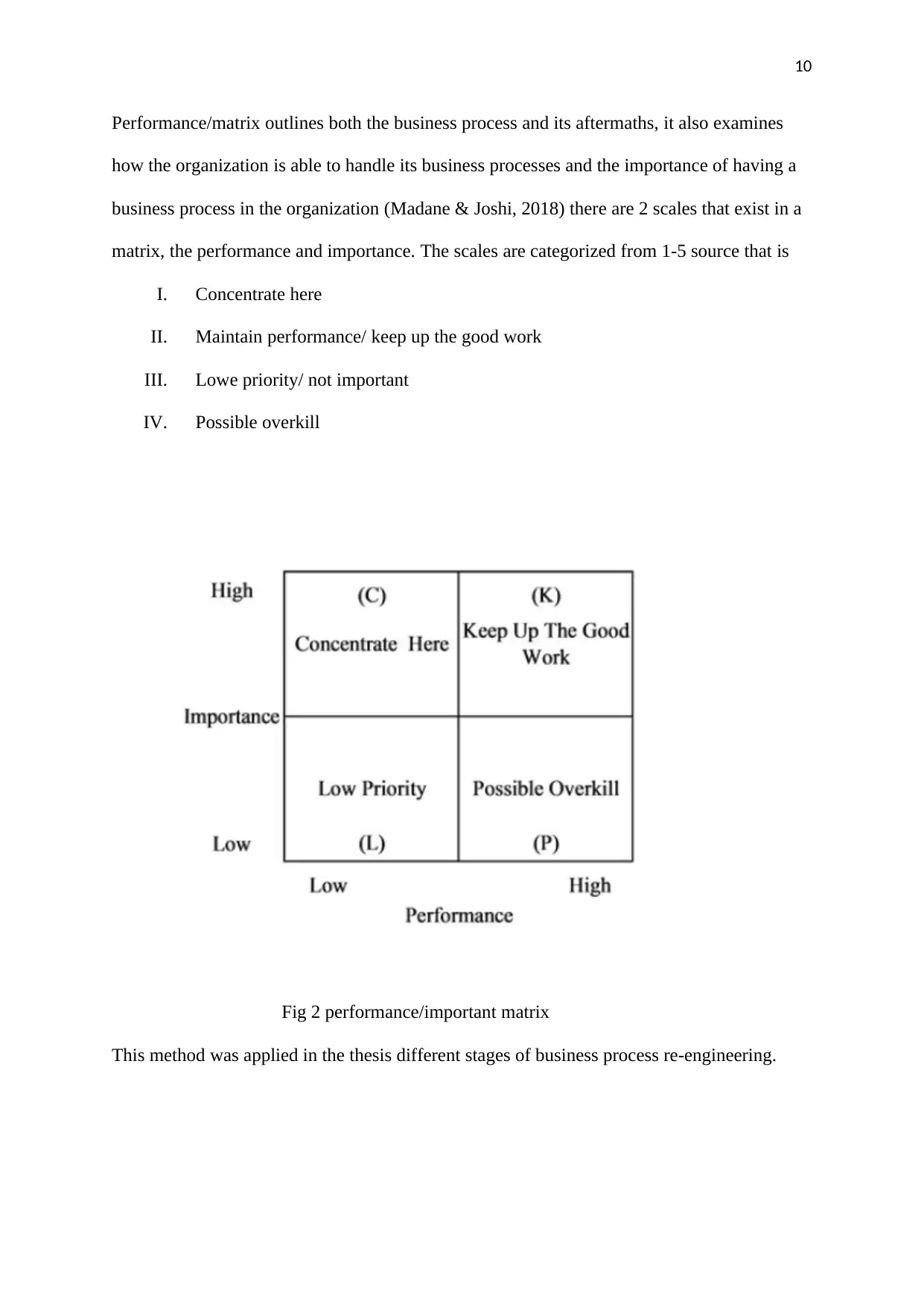
Performance/matrix outlines both the business process and its aftermaths, it also examines
how the organization is able to handle its business processes and the importance of having a
business process in the organization (Madane & Joshi, 2018) there are 2 scales that exist in a
matrix, the performance and importance. The scales are categorized from 1-5 source that is
I. Concentrate here
II. Maintain performance/ keep up the good work
III. Lowe priority/ not important
IV. Possible overkill
Fig 2 performance/important matrix
This method was applied in the thesis different stages of business process re-engineering.
Performance/matrix outlines both the business process and its aftermaths, it also examines
how the organization is able to handle its business processes and the importance of having a
business process in the organization (Madane & Joshi, 2018) there are 2 scales that exist in a
matrix, the performance and importance. The scales are categorized from 1-5 source that is
I. Concentrate here
II. Maintain performance/ keep up the good work
III. Lowe priority/ not important
IV. Possible overkill
Fig 2 performance/important matrix
This method was applied in the thesis different stages of business process re-engineering.
Paraphrase This Document
Need a fresh take? Get an instant paraphrase of this document with our AI Paraphraser
11
6.0 Findings
6.1 Description of improving business process
Business process improvement description this a systematic methodology of realigning the
critical processes of the organization to achieve excellent improvements (Bhaskar, 2018).
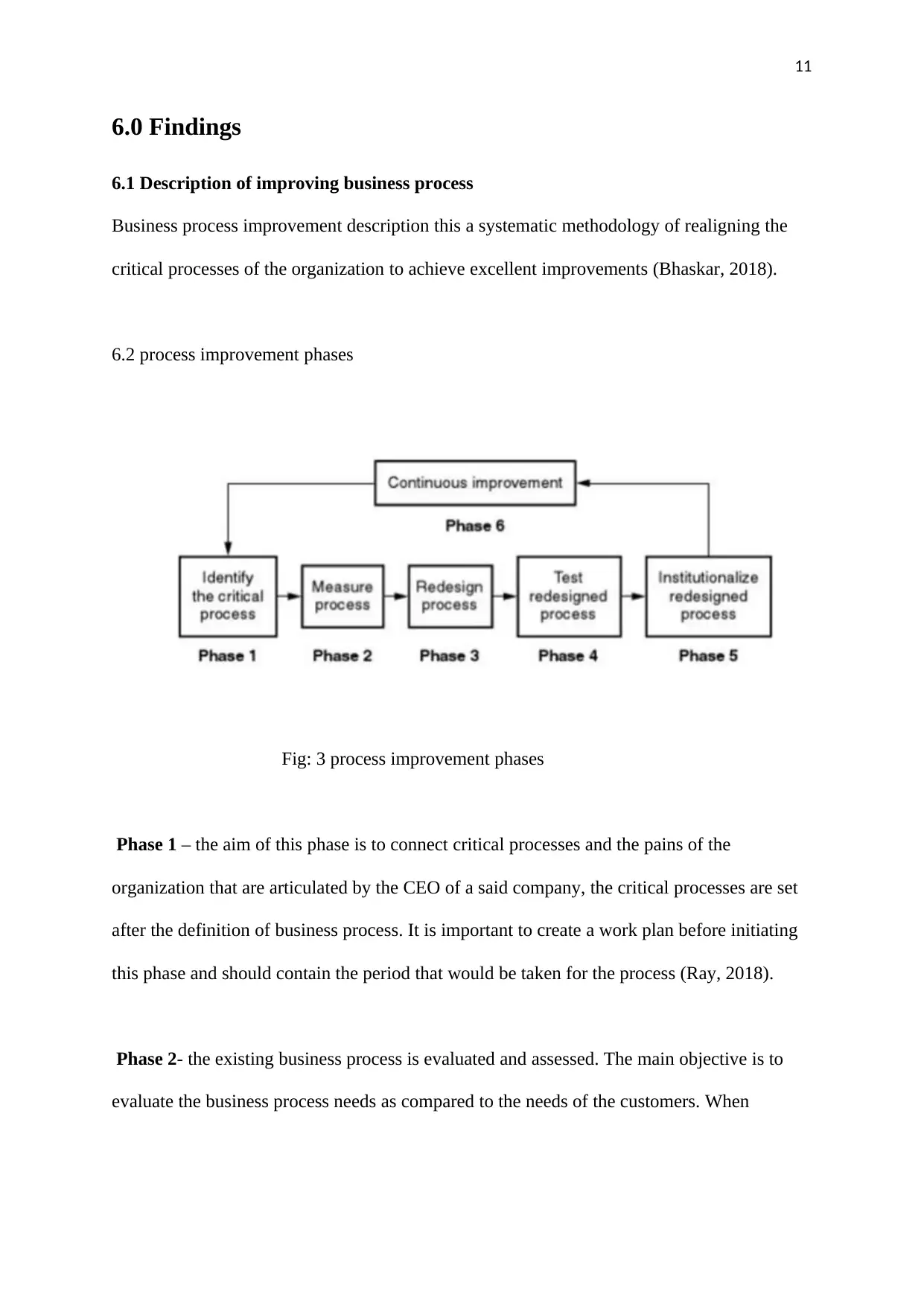
6.2 process improvement phases
Fig: 3 process improvement phases
Phase 1 – the aim of this phase is to connect critical processes and the pains of the
organization that are articulated by the CEO of a said company, the critical processes are set
after the definition of business process. It is important to create a work plan before initiating
this phase and should contain the period that would be taken for the process (Ray, 2018).
Phase 2- the existing business process is evaluated and assessed. The main objective is to
evaluate the business process needs as compared to the needs of the customers. When
6.0 Findings
6.1 Description of improving business process
Business process improvement description this a systematic methodology of realigning the
critical processes of the organization to achieve excellent improvements (Bhaskar, 2018).
6.2 process improvement phases
Fig: 3 process improvement phases
Phase 1 – the aim of this phase is to connect critical processes and the pains of the
organization that are articulated by the CEO of a said company, the critical processes are set
after the definition of business process. It is important to create a work plan before initiating
this phase and should contain the period that would be taken for the process (Ray, 2018).
Phase 2- the existing business process is evaluated and assessed. The main objective is to
evaluate the business process needs as compared to the needs of the customers. When
12
initiating this phase data of the existing process is gathered. Business process may be
restricted by certain policies in this phase (Gil & Velazco, 2017).
Phase 3- this phase consist of 3 parts, the analysis part, the deal state part and the to-be state.
The main goal of the phase is to analyse data that was collected from interviews among the
customers who are within. The idea here is to analyse data and establish the goal of the
process to yield the intended purpose. Processes are re-engineered to achieve the
requirements of the business processes (King, 2018). A work plan testing for the business
process is created during this phase prior to forwarding the proposal to the management
(Sarker & lee, 2015).
The first three phases this business improvements covers around 90 percent of the total work
load (Iranov, 2018).
Phase 4- After redesigning of the process, the redesign procedure are tested. Testing can be
done by using various tools such as Pareto charts and Fishbone diagram. Testing success is
measured in terms of capability yield and throughput and the effectiveness of the equipment.
The satisfaction of customers is also measured to determine whether the business voice is
achieved (Alrabiah & Drew, 2018).
Basing on the test results some modification should be made to the process redesigned, the
final step of this phase is to introduce the plan for the redesign process (Serban, 2015).
Phase 5- this is to make sure that the redesign process is achieving success. Five lessons plan
should be documented in this phase. This phase is the implementation of process that took
place in the phase three. (Jeston, 2014) This phase may also involve data collection to ensure
that the customer requirements are realized. To implement the redesign process it needs an
organization to have proper planning. There is also a need to train employees in order to
initiating this phase data of the existing process is gathered. Business process may be
restricted by certain policies in this phase (Gil & Velazco, 2017).
Phase 3- this phase consist of 3 parts, the analysis part, the deal state part and the to-be state.
The main goal of the phase is to analyse data that was collected from interviews among the
customers who are within. The idea here is to analyse data and establish the goal of the
process to yield the intended purpose. Processes are re-engineered to achieve the
requirements of the business processes (King, 2018). A work plan testing for the business
process is created during this phase prior to forwarding the proposal to the management
(Sarker & lee, 2015).
The first three phases this business improvements covers around 90 percent of the total work
load (Iranov, 2018).
Phase 4- After redesigning of the process, the redesign procedure are tested. Testing can be
done by using various tools such as Pareto charts and Fishbone diagram. Testing success is
measured in terms of capability yield and throughput and the effectiveness of the equipment.
The satisfaction of customers is also measured to determine whether the business voice is
achieved (Alrabiah & Drew, 2018).
Basing on the test results some modification should be made to the process redesigned, the
final step of this phase is to introduce the plan for the redesign process (Serban, 2015).
Phase 5- this is to make sure that the redesign process is achieving success. Five lessons plan
should be documented in this phase. This phase is the implementation of process that took
place in the phase three. (Jeston, 2014) This phase may also involve data collection to ensure
that the customer requirements are realized. To implement the redesign process it needs an
organization to have proper planning. There is also a need to train employees in order to
⊘ This is a preview!⊘
Do you want full access?
Subscribe today to unlock all pages.
Trusted by 1+ million students worldwide

1 out of 28


Related Documents


Your All-in-One AI-Powered Toolkit for Academic Success.
+13062052269
info@desklib.com
Available 24*7 on WhatsApp / Email
![[object Object]](/_next/static/media/star-bottom.7253800d.svg)
Unlock your academic potential
Copyright © 2020–2026 A2Z Services. All Rights Reserved. Developed and managed by ZUCOL.