INF80028 Business Process Management: SGC Case Study Analysis Report
VerifiedAdded on 2022/11/23
|7
|1819
|76
Report
AI Summary
This report presents a comprehensive analysis of the Swinburne Guru Consulting (SGC) case study, focusing on the challenges faced by the company in its business processes. The report examines the inefficiencies in scheduling, the complexities of managing corporate clients, and the limitations in handling group sessions. It provides a detailed breakdown of the current processes, highlighting issues such as time wastage, high costs, and customer dissatisfaction. The analysis includes a business process analysis diagram and explores the need for restructuring to improve efficiency and customer satisfaction, particularly for repeat corporate clients and group coaching sessions. The report also references academic sources to support its findings and recommendations, emphasizing the importance of adapting to a dynamic business environment and implementing business process improvements to achieve organizational goals. The report suggests that the flat organizational structure at SGC may hinder the implementation of changes.

BUSINESS MANAGEMENT: SWINBURNE GURU CONSULTING
(SGC) CASE STUDY
(SGC) CASE STUDY
Paraphrase This Document
Need a fresh take? Get an instant paraphrase of this document with our AI Paraphraser

Table of Contents
Introduction......................................................................................................................................................3
Business Background.......................................................................................................................................3
Business Process Analysis................................................................................................................................4
4. Scheduling...............................................................................................................................................4
6. Corporate Clients.....................................................................................................................................5
9. Group sessions.........................................................................................................................................5
References.....................................................................................................................................................................7
Introduction......................................................................................................................................................3
Business Background.......................................................................................................................................3
Business Process Analysis................................................................................................................................4
4. Scheduling...............................................................................................................................................4
6. Corporate Clients.....................................................................................................................................5
9. Group sessions.........................................................................................................................................5
References.....................................................................................................................................................................7

Introduction
SGC is a consulting company based in Hawthorne with plans to spread to the rest of Melbourne
given the growth in business and demand for coaching services. Founded by Emily, the firm has
four permanent employees and hires consultants depending on demand and the need for their
services. Increasing business has resulted in challenges with operational efficiency and high
operating costs, as well as customer dissatisfaction with SGC operations and processes, mainly
arising due to the present business operational processes. Cognizant of this, and knowing it will
adversely affect operations and expansion objectives, Emily is seeking solutions on how to improve
scheduling, better manage corporate clients that are often repeat customers, and how to improve
debt management. This paper provides solutions to improve these processes.
Business Background
SGC is a small but rapidly growing consulting business that specializes in coaching, services it
offers by partnering or hiring specialist coaches for clients. The business processes at SGC are
largely ineffective and too manual, with several repetitive tasks; corporate customers that have used
the services of SGC, for example, have to go through the same repetitive process again when
seeking coaching services for their staff. The company operates on a skeletal staff of the founder, a
receptionist, a part time bookkeeper, a scheduling officer, and a customer relationship staff. Clients
have to book for appointments by going thorough the receptionist, who makes an assignment and
then hands over the subsequent scheduling task to Ahmed, the coaching specialist. Ahmed must
search through the database of coaches and match them with the client requirements and once this is
done, the task is passed on to Madeleine, in charge of customer relations to do the scheduling. She
must liaise with the coaches who have various other commitments; she must also contact the client
and confirm the assignment, the costs, and scheduled coaching time.
The clients sometimes decide not to go ahead with the assignment and so the coaching is canceled
and if the coach Ahmed recommended is unavailable, Madeleine tasks Ahmed to find an alternative
coach. If the required coaching skills by the client are not available, Ahmed advertises for another
coach, with the clients’ permission, and interviews them and if none is found within a fortnight, the
client is informed and the assignment is canceled. Just before the coaching session, the verifier has
to contact the coach and client and remind them of the assignment, a role tasked to Madeleine, but if
too busy, passes this on to Linda or Ahmed. This process is long, tedious, unwieldy, costly, and
above all, results in customer dissatisfaction; the founder, Emily, is seeking a solution and a
consultant has raised a number of issues, including time wastage, long processes, high costs, poor
debt management, repetitive tasks, among others. The business world is dynamic and yet for many
SGC is a consulting company based in Hawthorne with plans to spread to the rest of Melbourne
given the growth in business and demand for coaching services. Founded by Emily, the firm has
four permanent employees and hires consultants depending on demand and the need for their
services. Increasing business has resulted in challenges with operational efficiency and high
operating costs, as well as customer dissatisfaction with SGC operations and processes, mainly
arising due to the present business operational processes. Cognizant of this, and knowing it will
adversely affect operations and expansion objectives, Emily is seeking solutions on how to improve
scheduling, better manage corporate clients that are often repeat customers, and how to improve
debt management. This paper provides solutions to improve these processes.
Business Background
SGC is a small but rapidly growing consulting business that specializes in coaching, services it
offers by partnering or hiring specialist coaches for clients. The business processes at SGC are
largely ineffective and too manual, with several repetitive tasks; corporate customers that have used
the services of SGC, for example, have to go through the same repetitive process again when
seeking coaching services for their staff. The company operates on a skeletal staff of the founder, a
receptionist, a part time bookkeeper, a scheduling officer, and a customer relationship staff. Clients
have to book for appointments by going thorough the receptionist, who makes an assignment and
then hands over the subsequent scheduling task to Ahmed, the coaching specialist. Ahmed must
search through the database of coaches and match them with the client requirements and once this is
done, the task is passed on to Madeleine, in charge of customer relations to do the scheduling. She
must liaise with the coaches who have various other commitments; she must also contact the client
and confirm the assignment, the costs, and scheduled coaching time.
The clients sometimes decide not to go ahead with the assignment and so the coaching is canceled
and if the coach Ahmed recommended is unavailable, Madeleine tasks Ahmed to find an alternative
coach. If the required coaching skills by the client are not available, Ahmed advertises for another
coach, with the clients’ permission, and interviews them and if none is found within a fortnight, the
client is informed and the assignment is canceled. Just before the coaching session, the verifier has
to contact the coach and client and remind them of the assignment, a role tasked to Madeleine, but if
too busy, passes this on to Linda or Ahmed. This process is long, tedious, unwieldy, costly, and
above all, results in customer dissatisfaction; the founder, Emily, is seeking a solution and a
consultant has raised a number of issues, including time wastage, long processes, high costs, poor
debt management, repetitive tasks, among others. The business world is dynamic and yet for many
⊘ This is a preview!⊘
Do you want full access?
Subscribe today to unlock all pages.

Trusted by 1+ million students worldwide

organizations, business related processes are increasingly failing to deliver the desired outcomes.
Organizations such as SGC, must, therefore, constantly adapt to dynamic elements in the business
environment and improve its business processes to better meet client and organization goals
(Ramakrishnan, 2019).
Business Process Analysis
4. Scheduling
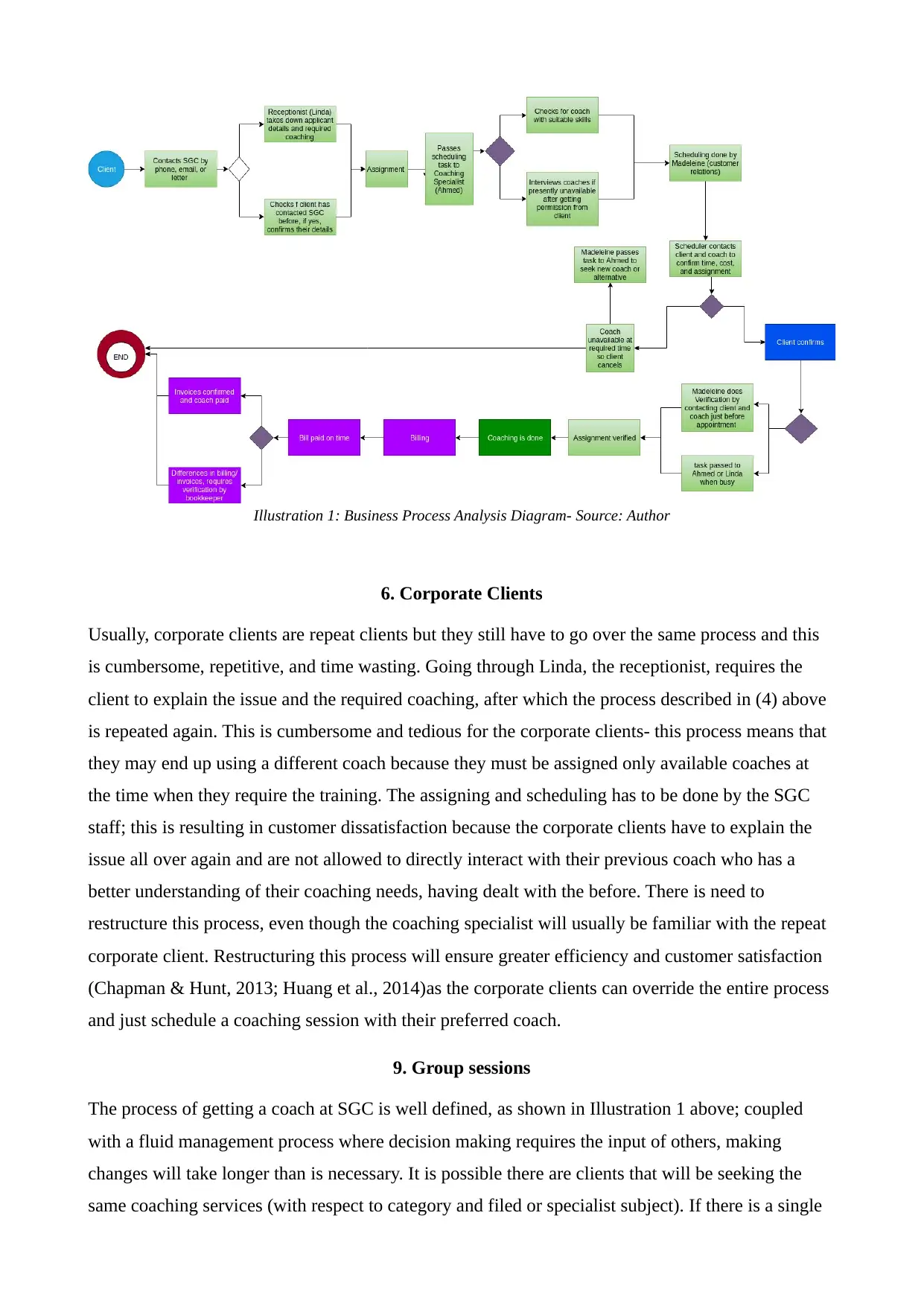
The scheduling process at SGC is complex and unwieldy; it starts with a client contacting the
receptionist (Linda) by phone, email, or letter to request for a personal coach: Linda then records
the client personal details as well as the client requirements to create an assignment. Linda must
check the clients’ history and if the client has called before, their details are recorded but must still
be confirmed. The assignment is handed over to Ahmed, the coaching specialist who finds a
suitable coach or interviews one with the clients’ permission. Once a coach is located, scheduling
must be done and Madeleine does this by contacting the client to confirm time, assignment, and
costs. The client may pull out of the assignment, resulting in cancellation and if the recommended
coach is unavailable at the scheduled time, Madeleine passes the assignment back to Ahmed to find
another coach. Madeleine does verification by contacting both client and coach to confirm the
scheduled appointment but when busy, passes the task to either Linda or Ahmed. If there is no
confirmation by client, the assignment is canceled while if the coach does not confirm, the clients’
permission is sought to seek another coach, reschedule or cancel the coaching, after discussing with
the client. Such complex processes waste time, money, resources, and lead to client dissatisfaction
(Cassidy, 2009; Koski et al., 2016; Vafeas, Hughes & Hilton, 2016). The business process analysis
is shown in Illustration 1 below;
Organizations such as SGC, must, therefore, constantly adapt to dynamic elements in the business
environment and improve its business processes to better meet client and organization goals
(Ramakrishnan, 2019).
Business Process Analysis
4. Scheduling
The scheduling process at SGC is complex and unwieldy; it starts with a client contacting the
receptionist (Linda) by phone, email, or letter to request for a personal coach: Linda then records
the client personal details as well as the client requirements to create an assignment. Linda must
check the clients’ history and if the client has called before, their details are recorded but must still
be confirmed. The assignment is handed over to Ahmed, the coaching specialist who finds a
suitable coach or interviews one with the clients’ permission. Once a coach is located, scheduling
must be done and Madeleine does this by contacting the client to confirm time, assignment, and
costs. The client may pull out of the assignment, resulting in cancellation and if the recommended
coach is unavailable at the scheduled time, Madeleine passes the assignment back to Ahmed to find
another coach. Madeleine does verification by contacting both client and coach to confirm the
scheduled appointment but when busy, passes the task to either Linda or Ahmed. If there is no
confirmation by client, the assignment is canceled while if the coach does not confirm, the clients’
permission is sought to seek another coach, reschedule or cancel the coaching, after discussing with
the client. Such complex processes waste time, money, resources, and lead to client dissatisfaction
(Cassidy, 2009; Koski et al., 2016; Vafeas, Hughes & Hilton, 2016). The business process analysis
is shown in Illustration 1 below;
Paraphrase This Document
Need a fresh take? Get an instant paraphrase of this document with our AI Paraphraser

6. Corporate Clients
Usually, corporate clients are repeat clients but they still have to go over the same process and this
is cumbersome, repetitive, and time wasting. Going through Linda, the receptionist, requires the
client to explain the issue and the required coaching, after which the process described in (4) above
is repeated again. This is cumbersome and tedious for the corporate clients- this process means that
they may end up using a different coach because they must be assigned only available coaches at
the time when they require the training. The assigning and scheduling has to be done by the SGC
staff; this is resulting in customer dissatisfaction because the corporate clients have to explain the
issue all over again and are not allowed to directly interact with their previous coach who has a
better understanding of their coaching needs, having dealt with the before. There is need to
restructure this process, even though the coaching specialist will usually be familiar with the repeat
corporate client. Restructuring this process will ensure greater efficiency and customer satisfaction
(Chapman & Hunt, 2013; Huang et al., 2014)as the corporate clients can override the entire process
and just schedule a coaching session with their preferred coach.
9. Group sessions
The process of getting a coach at SGC is well defined, as shown in Illustration 1 above; coupled
with a fluid management process where decision making requires the input of others, making
changes will take longer than is necessary. It is possible there are clients that will be seeking the
same coaching services (with respect to category and filed or specialist subject). If there is a single
Illustration 1: Business Process Analysis Diagram- Source: Author
Usually, corporate clients are repeat clients but they still have to go over the same process and this
is cumbersome, repetitive, and time wasting. Going through Linda, the receptionist, requires the
client to explain the issue and the required coaching, after which the process described in (4) above
is repeated again. This is cumbersome and tedious for the corporate clients- this process means that
they may end up using a different coach because they must be assigned only available coaches at
the time when they require the training. The assigning and scheduling has to be done by the SGC
staff; this is resulting in customer dissatisfaction because the corporate clients have to explain the
issue all over again and are not allowed to directly interact with their previous coach who has a
better understanding of their coaching needs, having dealt with the before. There is need to
restructure this process, even though the coaching specialist will usually be familiar with the repeat
corporate client. Restructuring this process will ensure greater efficiency and customer satisfaction
(Chapman & Hunt, 2013; Huang et al., 2014)as the corporate clients can override the entire process
and just schedule a coaching session with their preferred coach.
9. Group sessions
The process of getting a coach at SGC is well defined, as shown in Illustration 1 above; coupled
with a fluid management process where decision making requires the input of others, making
changes will take longer than is necessary. It is possible there are clients that will be seeking the
same coaching services (with respect to category and filed or specialist subject). If there is a single
Illustration 1: Business Process Analysis Diagram- Source: Author

coach with different time schedules for each client, it means there is resource wastage and some
clients have to wait longer to receive coaching services. For corporate organizations, coaching may
be needed for a group of workers that would require the same coaching. With some coaches having
agreed to conduct group sessions, this aspect of assigning and scheduling needs to be restructured
and re-engineered. While it is possible this will be agreed to, the fluid organizational structure and
culture at SGC means even decision making on how to restructure this process is never going to be
easy. Such a structure is flat and very fluid and lack a hierarchical management structure with
management being tasks instead of a group of persons (Mazal, 2014; Morgan, 2015). There is high
accountability and transparency (Shah, 2015); everyone is involved in making decisions but
everyone not being involved in decision making (Rogers, 2016). At SGC, everyone’s opinion is
somehow needed before decisions are made, meaning decision making can take a long time.
Restructuring the process to enable group sessions will require organizational change management
before processes can be changed and technology incorporated to achieve the desired changes and
outcomes.
clients have to wait longer to receive coaching services. For corporate organizations, coaching may
be needed for a group of workers that would require the same coaching. With some coaches having
agreed to conduct group sessions, this aspect of assigning and scheduling needs to be restructured
and re-engineered. While it is possible this will be agreed to, the fluid organizational structure and
culture at SGC means even decision making on how to restructure this process is never going to be
easy. Such a structure is flat and very fluid and lack a hierarchical management structure with
management being tasks instead of a group of persons (Mazal, 2014; Morgan, 2015). There is high
accountability and transparency (Shah, 2015); everyone is involved in making decisions but
everyone not being involved in decision making (Rogers, 2016). At SGC, everyone’s opinion is
somehow needed before decisions are made, meaning decision making can take a long time.
Restructuring the process to enable group sessions will require organizational change management
before processes can be changed and technology incorporated to achieve the desired changes and
outcomes.
⊘ This is a preview!⊘
Do you want full access?
Subscribe today to unlock all pages.

Trusted by 1+ million students worldwide

References
Cassidy, A. (2009). A practical guide to information systems strategic planning. 2nd ed. Boca
Raton, Fla.: Auerbach Publications.
Chapman, R. and Hunt, M. (2013). Open government. 1st ed. London: Routledge, p.Chapter 4.
Huang, S., Lee, C., Chiu, A. and Yen, D. (2014). How business process reengineering affects
information technology investment and employee performance under different performance
measurement. Information Systems Frontiers, 17(5), pp.1133-1144.
Koski, A., Kuusinen, K., Suonsyrja, S. and Mikkonen, T. (2016). Implementing Continuous
Customer Care: First-Hand Experiences from an Industrial Setting. 2016 42th Euromicro
Conference on Software Engineering and Advanced Applications (SEAA), 1.
Mazal, J. (2014). Flat and Fluid: How Companies Without Hierarchy Manage Themselves. [online]
Medium. Available at: https://medium.com/@jorgemazal/flat-and-fluid-how-companies-without-
hierarchy-manage-themselves-2da856304b27 [Accessed 8 Sep. 2019].
Morgan, J. (2015). The 5 Types Of Organizational Structures: Part 3, Flat Organizations. [online]
Forbes.com. Available at: https://www.forbes.com/sites/jacobmorgan/2015/07/13/the-5-types-of-
organizational-structures-part-3-flat-organizations/#2cc075e26caa [Accessed 8 Sep. 2019].
Ramakrishnan, S. (2019). Business Process Management implemention pitfalls. [online] Boombirds
- Industry agnostic workflow management. Available at: https://www.boombirds.com/blog/pitfalls-
to-avoid-while-implementing-business-process-management-bpm/ [Accessed 8 Sep. 2019].
Rogers, D. (2016). The Big Four British Banks. 3rd ed. London: Palgrave Macmillan Limited,
pp.60-61.
Shah, R. (2015). 5 Leadership Attitudes From Flat Organizations. [online] Forbes.com. Available
at: https://www.forbes.com/sites/rawnshah/2015/11/05/5-leadership-attitudes-from-flat-
organizations/#4c835c234fa6 [Accessed 9 Sep. 2019].
Vafeas, M., Hughes, T. and Hilton, T. (2016). Antecedents to value diminution. Marketing Theory,
16(4), pp.469-491.
Cassidy, A. (2009). A practical guide to information systems strategic planning. 2nd ed. Boca
Raton, Fla.: Auerbach Publications.
Chapman, R. and Hunt, M. (2013). Open government. 1st ed. London: Routledge, p.Chapter 4.
Huang, S., Lee, C., Chiu, A. and Yen, D. (2014). How business process reengineering affects
information technology investment and employee performance under different performance
measurement. Information Systems Frontiers, 17(5), pp.1133-1144.
Koski, A., Kuusinen, K., Suonsyrja, S. and Mikkonen, T. (2016). Implementing Continuous
Customer Care: First-Hand Experiences from an Industrial Setting. 2016 42th Euromicro
Conference on Software Engineering and Advanced Applications (SEAA), 1.
Mazal, J. (2014). Flat and Fluid: How Companies Without Hierarchy Manage Themselves. [online]
Medium. Available at: https://medium.com/@jorgemazal/flat-and-fluid-how-companies-without-
hierarchy-manage-themselves-2da856304b27 [Accessed 8 Sep. 2019].
Morgan, J. (2015). The 5 Types Of Organizational Structures: Part 3, Flat Organizations. [online]
Forbes.com. Available at: https://www.forbes.com/sites/jacobmorgan/2015/07/13/the-5-types-of-
organizational-structures-part-3-flat-organizations/#2cc075e26caa [Accessed 8 Sep. 2019].
Ramakrishnan, S. (2019). Business Process Management implemention pitfalls. [online] Boombirds
- Industry agnostic workflow management. Available at: https://www.boombirds.com/blog/pitfalls-
to-avoid-while-implementing-business-process-management-bpm/ [Accessed 8 Sep. 2019].
Rogers, D. (2016). The Big Four British Banks. 3rd ed. London: Palgrave Macmillan Limited,
pp.60-61.
Shah, R. (2015). 5 Leadership Attitudes From Flat Organizations. [online] Forbes.com. Available
at: https://www.forbes.com/sites/rawnshah/2015/11/05/5-leadership-attitudes-from-flat-
organizations/#4c835c234fa6 [Accessed 9 Sep. 2019].
Vafeas, M., Hughes, T. and Hilton, T. (2016). Antecedents to value diminution. Marketing Theory,
16(4), pp.469-491.
1 out of 7
Related Documents
Your All-in-One AI-Powered Toolkit for Academic Success.
+13062052269
info@desklib.com
Available 24*7 on WhatsApp / Email
Unlock your academic potential
Copyright © 2020–2025 A2Z Services. All Rights Reserved. Developed and managed by ZUCOL.