BlueCorp Plc Project: Digital Technology Impact on Sales Department
VerifiedAdded on 2021/04/24
|22
|4107
|44
Project
AI Summary
This project report focuses on the impact of digital technology on business activities, specifically within the sales department of BlueCorp Plc. It addresses the problem of excessive time spent on compiling sales reports, leading to missed revenue targets. The project outlines a strategy for monitoring and controlling the project's progress, including risk management and change control. The implementation plan details the use of technological management, including competitiveness assessment, technological audits, and environmental surveillance. The project's objectives include reducing costs, improving performance, and saving time. The scope statement defines included and excluded aspects, along with deliverables and success criteria. The report also includes a work breakdown structure (WBS) to organize tasks. Overall, the project aims to implement new technology to streamline sales processes and enhance efficiency.

1
Business Project
Name:
Course
Professor’s name
University name
City, State
Date of submission
Business Project
Name:
Course
Professor’s name
University name
City, State
Date of submission

Paraphrase This Document
Need a fresh take? Get an instant paraphrase of this document with our AI Paraphraser
2
1.0 Project definition
The impact of digital technology on business activity.How digital technology has transformed
business activities in the sales department.
Problem statement
Managers In the sales department are spending a lot of time at the end of each week compiling
the necessary sales reports for the management. This reduces the number of hours required to
mentor the sales staff, lead generation in business and closing of a business. Ignoring this
productivity issue results in missed revenue targets and decreased sales for the business, and
considering that this has been a common occurrence in BlueCorp Plc, it is important to reduce
the time spent in compiling reports to not more than 15% of the sales managers time in a week.
By adopting relevant technology, Blue Corp Plc can reduce duplicative processes and wasted
efforts(Landman, 2008)..
Project strategy
The strategy that we are going to use in reviewing the progress of the Project to comply with
what is defined in the Project Management plan and achieve the satisfaction of the interested
parties. In this case we shall
1.0 Project definition
The impact of digital technology on business activity.How digital technology has transformed
business activities in the sales department.
Problem statement
Managers In the sales department are spending a lot of time at the end of each week compiling
the necessary sales reports for the management. This reduces the number of hours required to
mentor the sales staff, lead generation in business and closing of a business. Ignoring this
productivity issue results in missed revenue targets and decreased sales for the business, and
considering that this has been a common occurrence in BlueCorp Plc, it is important to reduce
the time spent in compiling reports to not more than 15% of the sales managers time in a week.
By adopting relevant technology, Blue Corp Plc can reduce duplicative processes and wasted
efforts(Landman, 2008)..
Project strategy
The strategy that we are going to use in reviewing the progress of the Project to comply with
what is defined in the Project Management plan and achieve the satisfaction of the interested
parties. In this case we shall
3
Monitoring and Control of the Project: it allows to know in what state the Project is, to identify
problems and to be able to take preventive or corrective measures, which may entail the
modification of the initial Plan. It also helps us identify new risks for the Project and analyze,
review and monitor the risks we already identified. We make sure that all the risks that can affect
our Project are identified and the appropriate response plans to those risks are implemented.
To verify the effectiveness and efficiency of the Project Execution: the monitoring and control of
the Project helps the sales Managers of Bllue Corp Plc to verify the efficiency and effectiveness
of the execution of a Project. Through this monitoring and control we identify their weaknesses
and find new risks that we had not previously identified, which allows us to implement
corrective measures.
Project Monitoring and Control is based on: management activities that allow the Project
Director to monitor and analyze if the Project advances according to what we had planned in the
three baselines of the Project, scope, time and costs.
Evaluate the performance of the Project: what we do is evaluate the actual performance of the
Project to determine the need for preventive or corrective action and, where appropriate,
recommend those changes that are considered relevant to redirect the Project to what was
planned and agreed with the stakeholders.
The Monitoring and Control of the Project is concerned with comparing: the actual performance
of the Project with respect to the plan for the direction of the Project, that is, the relationship
between how the Project is actually being executed and being able to compare it with what we
Monitoring and Control of the Project: it allows to know in what state the Project is, to identify
problems and to be able to take preventive or corrective measures, which may entail the
modification of the initial Plan. It also helps us identify new risks for the Project and analyze,
review and monitor the risks we already identified. We make sure that all the risks that can affect
our Project are identified and the appropriate response plans to those risks are implemented.
To verify the effectiveness and efficiency of the Project Execution: the monitoring and control of
the Project helps the sales Managers of Bllue Corp Plc to verify the efficiency and effectiveness
of the execution of a Project. Through this monitoring and control we identify their weaknesses
and find new risks that we had not previously identified, which allows us to implement
corrective measures.
Project Monitoring and Control is based on: management activities that allow the Project
Director to monitor and analyze if the Project advances according to what we had planned in the
three baselines of the Project, scope, time and costs.
Evaluate the performance of the Project: what we do is evaluate the actual performance of the
Project to determine the need for preventive or corrective action and, where appropriate,
recommend those changes that are considered relevant to redirect the Project to what was
planned and agreed with the stakeholders.
The Monitoring and Control of the Project is concerned with comparing: the actual performance
of the Project with respect to the plan for the direction of the Project, that is, the relationship
between how the Project is actually being executed and being able to compare it with what we
⊘ This is a preview!⊘
Do you want full access?
Subscribe today to unlock all pages.

Trusted by 1+ million students worldwide
4
had planned.
Documentation: maintain, during the execution of the Project, a base of accurate and timely
information relative to the Project product and its related documentation. This is very valuable
within the general communication system of the Project.
Information element: monitoring and control provides the information needed to support the
status report, the progress measurement of the Project
to and forecasts of the Project. It is a key tool for the correct Directorate. Change Control: the
monitoring and control serves us to monitor the implementation of the changes approved for the
Project. Project Status Report: it is a fixed photograph of the exact status of a Project in a
moment determined. It serves to inform all interested parties of the real state of a Project, which
will allow us to compare the reality of the Project with its initial planning(Sokowski, n.d.).. Its
content is not fixed but at least it must reflect if the project is being developed as planned, if the
dates of the milestones and deliverables are met, where appropriate, identification of new risks,
evolution of known risks and their impact , if they have occurred.
These reports are usually carried out periodically and following a detailed plan in the planning of
the Project.nature-human-execution-projectActions of the Project Monitoring and Control
ProcessThe Monitoring and Control of the Project measures the performance of the Project in
accordance with the planned measures in project management plans.
Check the baselines: determine variations of the baseline of the Project. Recommend changes:
recommend changes in the Project and obtain approval of changes in the integrated control of
had planned.
Documentation: maintain, during the execution of the Project, a base of accurate and timely
information relative to the Project product and its related documentation. This is very valuable
within the general communication system of the Project.
Information element: monitoring and control provides the information needed to support the
status report, the progress measurement of the Project
to and forecasts of the Project. It is a key tool for the correct Directorate. Change Control: the
monitoring and control serves us to monitor the implementation of the changes approved for the
Project. Project Status Report: it is a fixed photograph of the exact status of a Project in a
moment determined. It serves to inform all interested parties of the real state of a Project, which
will allow us to compare the reality of the Project with its initial planning(Sokowski, n.d.).. Its
content is not fixed but at least it must reflect if the project is being developed as planned, if the
dates of the milestones and deliverables are met, where appropriate, identification of new risks,
evolution of known risks and their impact , if they have occurred.
These reports are usually carried out periodically and following a detailed plan in the planning of
the Project.nature-human-execution-projectActions of the Project Monitoring and Control
ProcessThe Monitoring and Control of the Project measures the performance of the Project in
accordance with the planned measures in project management plans.
Check the baselines: determine variations of the baseline of the Project. Recommend changes:
recommend changes in the Project and obtain approval of changes in the integrated control of
Paraphrase This Document
Need a fresh take? Get an instant paraphrase of this document with our AI Paraphraser
5
changes in the Project. Updating plans: the plan for Project management, the project scope
statement and other deliverables are kept up-to-date by means of a rigorous and continuous
management of the changes, either rejecting or approving them, in order to ensure that only
approved changes are incorporated into a project. Revised baseline.Control the scope: control the
scope of the project, schedule and cost at the level of the Project baseline. Review the
acquisitions: perform the audit of the Project's acquisitions. Control the Project: refine the
control limits and hold meetings regarding the control of the Project. Acceptance of the
deliverables: obtain formal acceptance of the project. the deliverables generated by the Project by
the Project.
Stakeholders: obtain information from interested parties the Project to determine if the Project
controls need to be updated inform about Project performance to those interested in the Project
make sure that they have the continuous consent from the interested parties before the plan for
the direction of the Project. Risks: evaluate the Effectiveness of the response of the project team
to the risks These are raised through a risk audit be aware of the appearance of new risks re-
analyze the existing risks use variation reports to help correct small problems that we have
identified in the Project's work before they become more serious reevaluate the business case of
the Project in case a serious problem arises(Hess, 2006).
. Milestones: use the milestones of the Project as a control function of the Project.
Quality: use quality control tools such as inspection, pareto diagram , cause-effect diagrams, etc.
Changes: control changes in the Project make sure that only the approved changes are
implemented work with the Project's change control committee observe where the changes we
have had to apply to the Project come from and try to eliminate its causes realize the integrated
changes in the Project. Updating plans: the plan for Project management, the project scope
statement and other deliverables are kept up-to-date by means of a rigorous and continuous
management of the changes, either rejecting or approving them, in order to ensure that only
approved changes are incorporated into a project. Revised baseline.Control the scope: control the
scope of the project, schedule and cost at the level of the Project baseline. Review the
acquisitions: perform the audit of the Project's acquisitions. Control the Project: refine the
control limits and hold meetings regarding the control of the Project. Acceptance of the
deliverables: obtain formal acceptance of the project. the deliverables generated by the Project by
the Project.
Stakeholders: obtain information from interested parties the Project to determine if the Project
controls need to be updated inform about Project performance to those interested in the Project
make sure that they have the continuous consent from the interested parties before the plan for
the direction of the Project. Risks: evaluate the Effectiveness of the response of the project team
to the risks These are raised through a risk audit be aware of the appearance of new risks re-
analyze the existing risks use variation reports to help correct small problems that we have
identified in the Project's work before they become more serious reevaluate the business case of
the Project in case a serious problem arises(Hess, 2006).
. Milestones: use the milestones of the Project as a control function of the Project.
Quality: use quality control tools such as inspection, pareto diagram , cause-effect diagrams, etc.
Changes: control changes in the Project make sure that only the approved changes are
implemented work with the Project's change control committee observe where the changes we
have had to apply to the Project come from and try to eliminate its causes realize the integrated
6
control of changes of the Project. Client: to evaluate the client's satisfaction of the Project or
complete the Project in accordance with the Act of constitution of the Project and the plan for the
direction of the Project. Acquisitions: administer the acquisitions of the Project.Equipment:
Project objectives
The following are the objectives that we have in mind when implementing the new technology
into the company.
Cost
The new software will reduce the overall cost by more than 60%. After the
implementation of technology , fewer staff will be used to carry out the work .
Technology makes work easier and we estimate that after the new technology is rolled
out, the total cost will be significantly lower that it is currently. It reduces the labour cost.
Performance
Technology improves performance and the new software will improve the overall
performance in terms of accuracy and number of reports that will be produced. The sales
team can now create reports at any given time and present them to the management. It
also improves the overall quality of the work produced and also it aims at improving
decision making(Heerkens, 2015)..
Time
Another objective of this project is to reduce the time taken to carry out specific functions
for the management. Introducing technology saves time in many aspects including the
time required to analyze and prepare reports.
control of changes of the Project. Client: to evaluate the client's satisfaction of the Project or
complete the Project in accordance with the Act of constitution of the Project and the plan for the
direction of the Project. Acquisitions: administer the acquisitions of the Project.Equipment:
Project objectives
The following are the objectives that we have in mind when implementing the new technology
into the company.
Cost
The new software will reduce the overall cost by more than 60%. After the
implementation of technology , fewer staff will be used to carry out the work .
Technology makes work easier and we estimate that after the new technology is rolled
out, the total cost will be significantly lower that it is currently. It reduces the labour cost.
Performance
Technology improves performance and the new software will improve the overall
performance in terms of accuracy and number of reports that will be produced. The sales
team can now create reports at any given time and present them to the management. It
also improves the overall quality of the work produced and also it aims at improving
decision making(Heerkens, 2015)..
Time
Another objective of this project is to reduce the time taken to carry out specific functions
for the management. Introducing technology saves time in many aspects including the
time required to analyze and prepare reports.
⊘ This is a preview!⊘
Do you want full access?
Subscribe today to unlock all pages.
Trusted by 1+ million students worldwide
7
Project Scope statement
Scope
description
Included scope
o Set up a system ready to handle all the sales queries
o Training the sales staff on how to use the system
o An administrative system which can be configured by the sales team
Excluded scope
o Support for other teams in other departments
o Ability to route complex sales enquiries ,for example partnerships.
Project
deliverables
o A training manual for all staff in the sales department
o A configuration system
Acceptance
criteria
The system will be accepted when it meets all the deliverables
Constraints The sales team are not dedicated to this project and must fit this around their
day to day jobs
Success Criteria
The project will be deemed successful if it meets all deliverables and is successful in its
objectives.
Project Scope statement
Scope
description
Included scope
o Set up a system ready to handle all the sales queries
o Training the sales staff on how to use the system
o An administrative system which can be configured by the sales team
Excluded scope
o Support for other teams in other departments
o Ability to route complex sales enquiries ,for example partnerships.
Project
deliverables
o A training manual for all staff in the sales department
o A configuration system
Acceptance
criteria
The system will be accepted when it meets all the deliverables
Constraints The sales team are not dedicated to this project and must fit this around their
day to day jobs
Success Criteria
The project will be deemed successful if it meets all deliverables and is successful in its
objectives.
Paraphrase This Document
Need a fresh take? Get an instant paraphrase of this document with our AI Paraphraser
8
Project assumptions
A sales team and a full project team will be available during the whole process.
2.0 Implementation plan
Introduction to implementation plan
Technological Management is a set of steps or activities based on tools that allow achieving an
objective or completing a process, integrating various instruments, knowledge, procedures and
methods applicable in different branches (Hess, 2006).
Currently in the professional field, we interact with a competitive globalized world and with a
market that changes by diverse factors, where each member must survive implementing
strategies that allow him to determine his competitive advantage and this is where the
technological management is the protagonist, because it allows The organizations create a
sustainable and solid competitive advantage, additionally adding value to the strategic plan of the
company.
The technological management seeks that the organization link its strategic plans with the efforts
of technological development, allowing through its execution, identify its technologies, keys,
basic and those in phases of obsolescence. Also the degree of mastery over them, for which
contributes to increase its productivity, investments, and improve the quality of processes, feed
Project assumptions
A sales team and a full project team will be available during the whole process.
2.0 Implementation plan
Introduction to implementation plan
Technological Management is a set of steps or activities based on tools that allow achieving an
objective or completing a process, integrating various instruments, knowledge, procedures and
methods applicable in different branches (Hess, 2006).
Currently in the professional field, we interact with a competitive globalized world and with a
market that changes by diverse factors, where each member must survive implementing
strategies that allow him to determine his competitive advantage and this is where the
technological management is the protagonist, because it allows The organizations create a
sustainable and solid competitive advantage, additionally adding value to the strategic plan of the
company.
The technological management seeks that the organization link its strategic plans with the efforts
of technological development, allowing through its execution, identify its technologies, keys,
basic and those in phases of obsolescence. Also the degree of mastery over them, for which
contributes to increase its productivity, investments, and improve the quality of processes, feed
9
the supply of products and services and obtain greater differentiation from other competitors (A
guide to the project management body of knowledge, 2017).
The effective development of technology management is based on a solid conceptualization,
review and documentation of a set of ideas that support the sequences of activities necessary to
obtain results, for which it is necessary to address and understand the following terms (Portny,
n.d.):
Competitiveness assessment: This function is the initial stage for the company to face
development strategies and consists of analyzing the ability to mobilize its own resources,
including technological resources, oriented towards the main needs that exist in current markets,
considering to the main competitors. The approach of technological strategies must be based on
the results of the analyzes that determine their critical or key technologies, and the level of
control over them (Landman, 2008).
Technological audit: it is based on the verification of the technologies, and knowledge dominated
by the organization through the main activities that it develops, conceptualizing the products or
services offered to the market, with the purpose of visualizing the design of a map of the
technologies that uses the company and that later will establish their ability to master them.
According to this, it is of great significance to classify the technologies into three hard core,
peripheral and basic technology groups.
the supply of products and services and obtain greater differentiation from other competitors (A
guide to the project management body of knowledge, 2017).
The effective development of technology management is based on a solid conceptualization,
review and documentation of a set of ideas that support the sequences of activities necessary to
obtain results, for which it is necessary to address and understand the following terms (Portny,
n.d.):
Competitiveness assessment: This function is the initial stage for the company to face
development strategies and consists of analyzing the ability to mobilize its own resources,
including technological resources, oriented towards the main needs that exist in current markets,
considering to the main competitors. The approach of technological strategies must be based on
the results of the analyzes that determine their critical or key technologies, and the level of
control over them (Landman, 2008).
Technological audit: it is based on the verification of the technologies, and knowledge dominated
by the organization through the main activities that it develops, conceptualizing the products or
services offered to the market, with the purpose of visualizing the design of a map of the
technologies that uses the company and that later will establish their ability to master them.
According to this, it is of great significance to classify the technologies into three hard core,
peripheral and basic technology groups.
⊘ This is a preview!⊘
Do you want full access?
Subscribe today to unlock all pages.
Trusted by 1+ million students worldwide
10
Increase or enrichment of our own technological heritage: The main reflection that must be
carried out is that no company should work individually, in order to achieve its expansion in new
technological areas typical of its pillars activities (Baguley, 2008).
It is proposed a specialization management activities that allow to take advantage of the research
potential of the (universities, management centers and technology development, other companies
in the sector, etc.). This is a key factor in the progress of the Small and medium enterprises,
which have as their main challenge, finding new ways to adapt and use technology developed by
others, or complement existing ones (Sokowski, n.d.).
Surveillance of the environment: Technological surveillance becomes a fundamental activity for
the development of technological management, the intention of its application has two purposes,
on the one hand, to know the technological changes of the environment, the performance of the
main competitors and other characteristics that can support the identification of opportunities and
threats, thus helping the company to recognize its own competitiveness through evaluation, on
the other hand select those external contacts that are able to provide new key technologies for the
company with the intention of enriching its technological heritage (Cooke and Tate, 2011).
Increase or enrichment of our own technological heritage: The main reflection that must be
carried out is that no company should work individually, in order to achieve its expansion in new
technological areas typical of its pillars activities (Baguley, 2008).
It is proposed a specialization management activities that allow to take advantage of the research
potential of the (universities, management centers and technology development, other companies
in the sector, etc.). This is a key factor in the progress of the Small and medium enterprises,
which have as their main challenge, finding new ways to adapt and use technology developed by
others, or complement existing ones (Sokowski, n.d.).
Surveillance of the environment: Technological surveillance becomes a fundamental activity for
the development of technological management, the intention of its application has two purposes,
on the one hand, to know the technological changes of the environment, the performance of the
main competitors and other characteristics that can support the identification of opportunities and
threats, thus helping the company to recognize its own competitiveness through evaluation, on
the other hand select those external contacts that are able to provide new key technologies for the
company with the intention of enriching its technological heritage (Cooke and Tate, 2011).
Paraphrase This Document
Need a fresh take? Get an instant paraphrase of this document with our AI Paraphraser
11
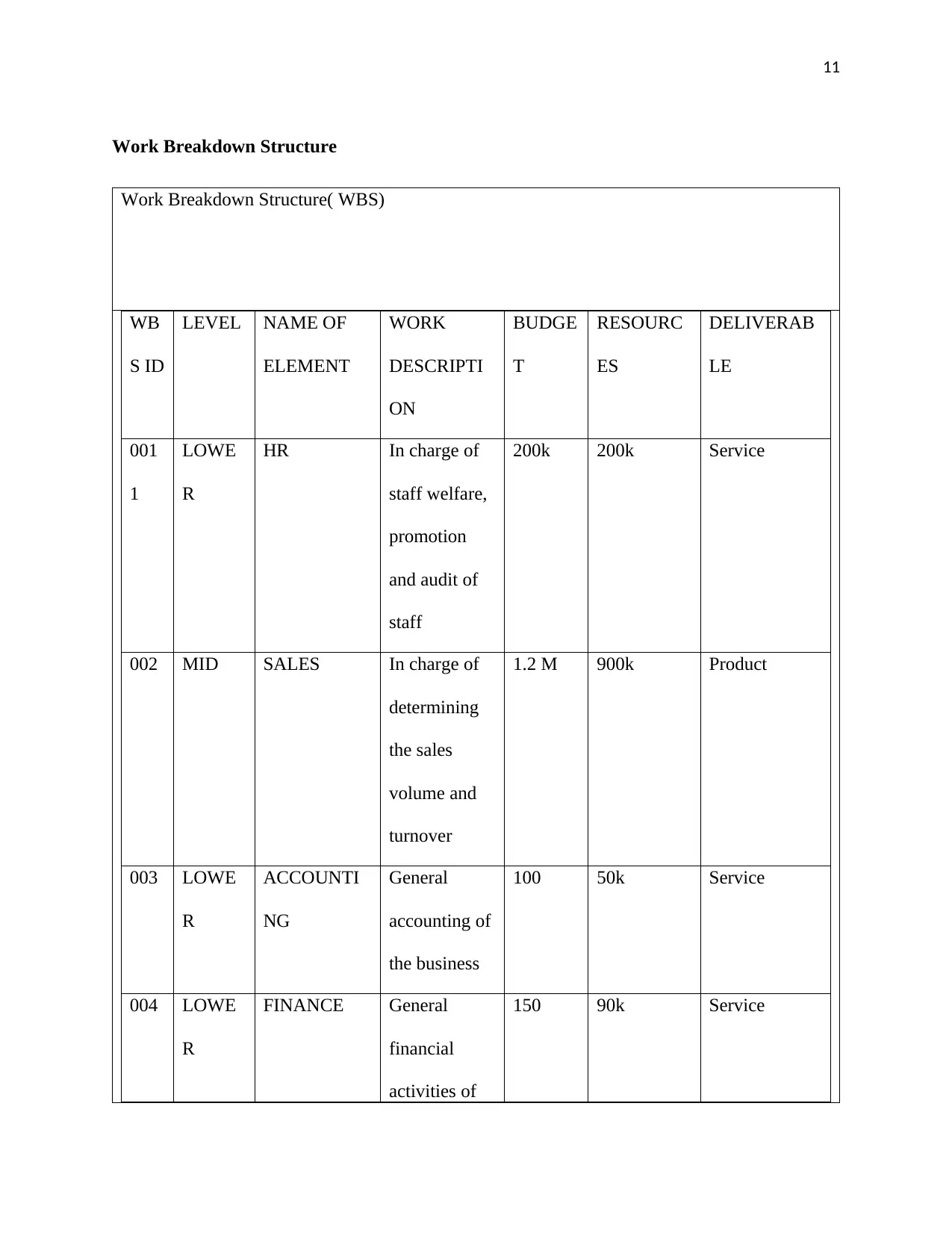
Work Breakdown Structure
Work Breakdown Structure( WBS)
WB
S ID
LEVEL NAME OF
ELEMENT
WORK
DESCRIPTI
ON
BUDGE
T
RESOURC
ES
DELIVERAB
LE
001
1
LOWE
R
HR In charge of
staff welfare,
promotion
and audit of
staff
200k 200k Service
002 MID SALES In charge of
determining
the sales
volume and
turnover
1.2 M 900k Product
003 LOWE
R
ACCOUNTI
NG
General
accounting of
the business
100 50k Service
004 LOWE
R
FINANCE General
financial
activities of
150 90k Service
Work Breakdown Structure
Work Breakdown Structure( WBS)
WB
S ID
LEVEL NAME OF
ELEMENT
WORK
DESCRIPTI
ON
BUDGE
T
RESOURC
ES
DELIVERAB
LE
001
1
LOWE
R
HR In charge of
staff welfare,
promotion
and audit of
staff
200k 200k Service
002 MID SALES In charge of
determining
the sales
volume and
turnover
1.2 M 900k Product
003 LOWE
R
ACCOUNTI
NG
General
accounting of
the business
100 50k Service
004 LOWE
R
FINANCE General
financial
activities of
150 90k Service
12
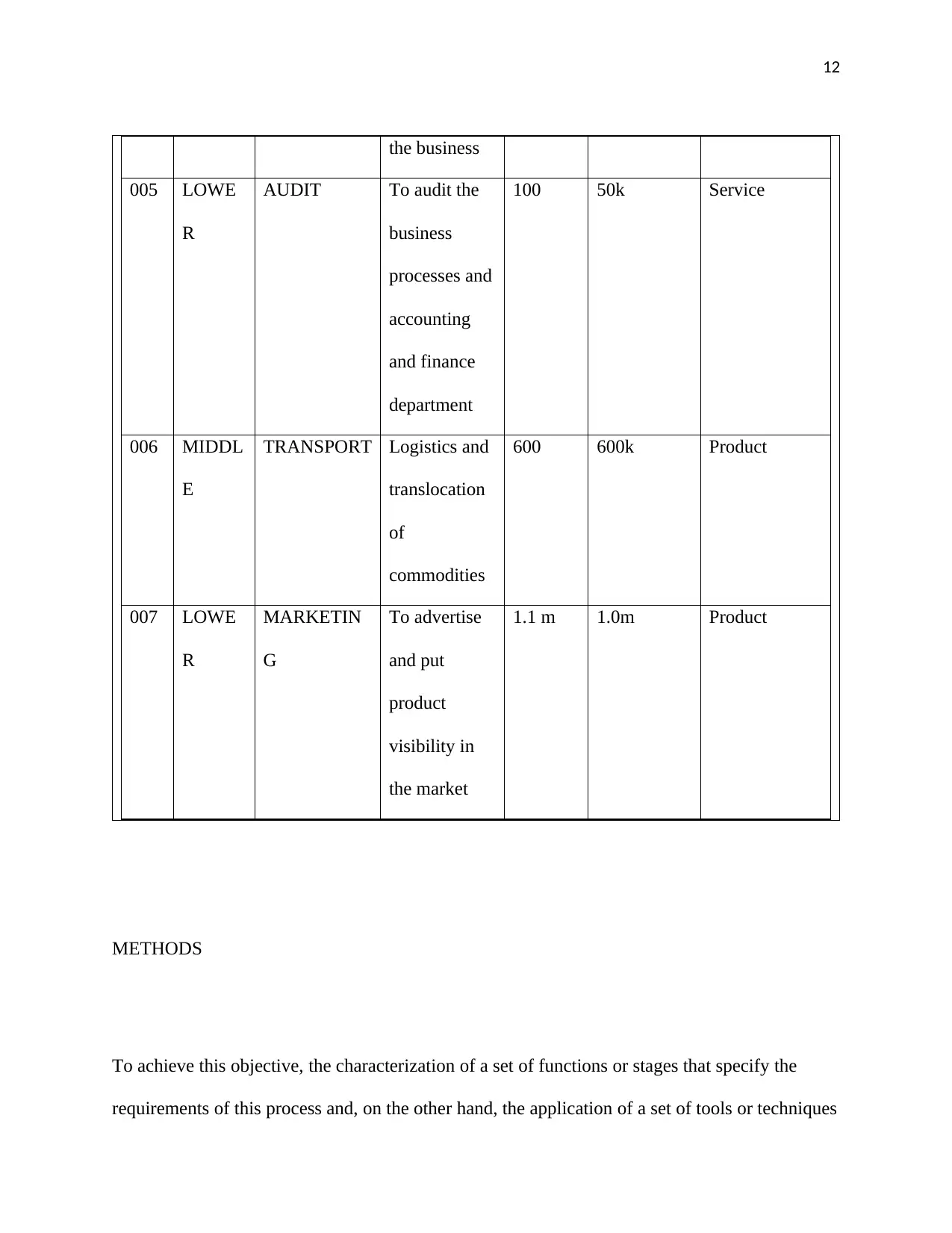
the business
005 LOWE
R
AUDIT To audit the
business
processes and
accounting
and finance
department
100 50k Service
006 MIDDL
E
TRANSPORT Logistics and
translocation
of
commodities
600 600k Product
007 LOWE
R
MARKETIN
G
To advertise
and put
product
visibility in
the market
1.1 m 1.0m Product
METHODS
To achieve this objective, the characterization of a set of functions or stages that specify the
requirements of this process and, on the other hand, the application of a set of tools or techniques
the business
005 LOWE
R
AUDIT To audit the
business
processes and
accounting
and finance
department
100 50k Service
006 MIDDL
E
TRANSPORT Logistics and
translocation
of
commodities
600 600k Product
007 LOWE
R
MARKETIN
G
To advertise
and put
product
visibility in
the market
1.1 m 1.0m Product
METHODS
To achieve this objective, the characterization of a set of functions or stages that specify the
requirements of this process and, on the other hand, the application of a set of tools or techniques
⊘ This is a preview!⊘
Do you want full access?
Subscribe today to unlock all pages.
Trusted by 1+ million students worldwide

1 out of 22


Related Documents


Your All-in-One AI-Powered Toolkit for Academic Success.
+13062052269
info@desklib.com
Available 24*7 on WhatsApp / Email
![[object Object]](/_next/static/media/star-bottom.7253800d.svg)
Unlock your academic potential
Copyright © 2020–2026 A2Z Services. All Rights Reserved. Developed and managed by ZUCOL.